Biodiversity Conservation
This incorporates the preservation, maintenance, sustainable use (conservation), recovery
and enhancement of the components of biological diversity, where:
Conservation - is the sustainable use of resources and encompasses protection as well as
exploitation and;
Preservation - is an aspect of conservation meaning to keep something without altering or
changing it.
Sustainable development
This refers to development that meets the needs of the current generation without
compromising the ability of future generations to meet their needs; it simply refers to intra
and intergenerational equity. A balance between the environment, development and society
results to sustainable development which ensures biodiversity conservation. This is only
possible in the presence of good enforced and implemented policies/ conventions,
environmental institutions and political stability among others.
Sustainable development
CONSERVATION STRATEGIES
Conservation efforts can be grouped into the following two categories:
 1. In-situ (on-site) conservation includes the protection of plants and animals within
their natural habitats or in protected areas. Protected areas are land or sea dedicated to
protect and maintain biodiversity.
 2. Ex-situ (off-site) conservation of plants and animals outside their natural habitats.
These include botanical gardens, zoo, gene banks, seek bank, tissue culture and
cryopreservation.
In-situ methods
Protection of habitat: The main strategy for conservation of species is the protection of
habitats in representative ecosystems.
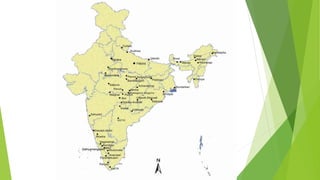
 Currently, India has 103 National Parks,
 573 hundred Wildlife Sanctuaries,
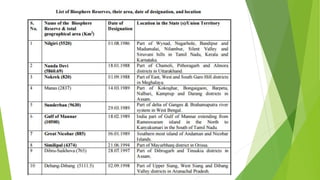
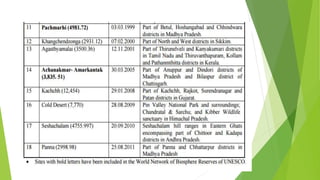
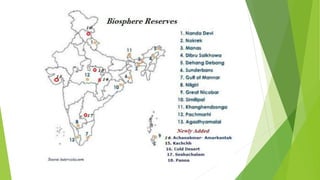
 18 Biosphere Reserves,
 47 Tiger Reserves and
 32 Elephant Reserves
covering an area of 15.67 million hectares or 5% of the geographical area of the country.
Twenty six wetlands,
thirty mangrove areas and
four coral reef areas nhave been identified for intensive conservation and management
purposes by the Ministry of Environment and Forests, Govt. of India.
Convention on biological diversity (CBD)
 Conservation of biological diversity and sustainable use of its components came into
the limelight in 1972 (United Nations Conference on Human Environment; Stockholm).
 In 1973, UNEP identified conservation of biodiversity as a priority area, hence there
was need to get the legal mandate for conservation of world resources. There were
negotiations for a legally binding instrument to address biological diversity and its loss
to enhance fairness and equity in sharing of the benefits of biodiversity; this led to the
opening of the Convention on Biological Diversity in 1992; Rio de Janeiro under the
United Nations Conference on Environment and Development (UNCED)/ Earth
Summit.
 The convention was inspired by the growing concern all over the world for sustainable
development.
The convention objectives were:
 • Conservation of the biological diversity;
 • Sustainable use of its components;
 • A fair and equitable sharing of its benefits.
This was the first global comprehensive agreement that addressed all the aspects of
biological diversity; genetic resources, species diversity and ecosystem diversity
Other international biodiversity conventions and conservation
organizations
• African Convention on Conservation of nature and natural resources.
• The Ramsar Convention on Wetlands of international importance.
• International Union for the Conservation of nature (World Conservation Union).
• Convention on International trade for endangered species (CITES).
• International Convention for the Protection on birds.
• International Board for Plant genetic resources .
• World Resources Institute.
• World Wide Fund for Nature. (WWF)
• Convention on Conservation of migratory species of wild animals.
• International Convention for the Regulation of whaling .
• UNESCO programme on Man and biosphere .
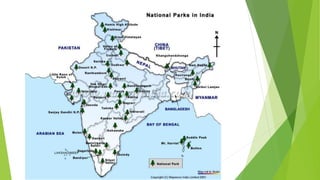
National Parks
 National parks in India are IUCN category II protected areas.
 India's first national park was established in 1936 as Hailey National Park, now known
as Jim Corbett National Park, Uttarakhand.
 By 1970, India only had five national parks.
 In 1972, India enacted the Wildlife Protection Act and Project Tiger to safeguard the
habitats of conservation reliant species.
 Further federal legislation strengthening protections for wildlife was introduced in the
1980s.
 As of July 2015, there were 103 national parks encompassing an area of 40,500 km2,
comprising 1.23% of India's total surface area.
Wildlife sanctuaries
Wildlife sanctuaries are established by IUCN category II protected
areas. India has 537 wildlife sanctuaries referred to as wildlife sanctuaries
category IV protected areas.
Among these, the 49 tiger reserves are governed by Project Tiger, and are of
special significance in the conservation of the tiger
Difference between the two
 National parks enjoy greater degree of protection than sanctuaries.
 Certain activities which are regulated in sanctuaries, such as grazing of livestock, are
prohibited in National Parks
 Wildlife sanctuary can be created for a particular species, whereas the national parks is
not primarily focused on a particular species.
 Central government may also declare a national parks under certain conditions
Many National Parks and Sanctuaries have been established to preserve wildlife in their
natural environment. Some of them are given below along with important species found
there.
• Kaziranga sanctuary (Assam) – One-horned rhinoceros
• Manas sanctuary (Assam) – Wild buffaloes
• Gir forest (Gujarat) – Lions, chital, sambar, wild bears
• Kelameru bird sanctuary (Andhra Pradesh) – Pelicans and marine birds
• Dachigam sanctuary (Jammu and Kashmir) – Kashmir stags, Himalayan tahr, wild goats,
sheep, antelopes.
• Bandipur sanctuary (Karnataka) – Indian bison, elephants, langurs
• Periyar sanctuary (Kerala) – Elephants, barking deer, sambhar
• Kanha National Park (Madhya Pradesh) – Tiger, leopards, wild dogs
 • Simipal National Park (Orissa) – Mangroves, marine turtles lay eggs
 • Bharatpur bird sanctuary (Rajasthan) – Ducks, herons
 • Corbett National Park (Uttaranchal) –Tigers, barking deer, sambar, wild bear, rhesus
monkey.
 • Jaladpara sanctuary (West Bengal) – Rhinoceros
Biosphere Reserves
 The idea of `Biosphere Reserves’ was initiated by UNESCO in 1973-74 under its Man
and Biosphere (MAB) Programme. The MAB, launched in 1970 by UNESCO.
 BRs are thus special environments for both people and the nature and are living
examples of how human beings and nature can co-exist while respecting each others’
needs.
Functions of Biosphere Reserves
Conservation
 • To ensure the conservation of landscapes, ecosystems, species and genetic
variations.
 • To encourage the traditional resource use systems;
 • To understand the patterns and processes of functioning of ecosystems;
 • To monitor the natural and human-caused changes on spatial and temporal
scales;
Development
• To promote, at the local level, economic development which is culturally, socially
and ecologically sustainable.
• To develop the strategies leading to improvement and management of natural
resources;
Logistics support
 • To provide support for research, monitoring, education and information exchange
related to local, national and global issues of conservation and development
 • Sharing of knowledge generated by research through site specific training and
education; and
 • Development of community spirit in the management of natural resources.
 International Co-ordinating Council of UNESCO, in November, 1971 introduced
the designation ‘Biosphere reserve’ for natural areas.
 The concept of Biosphere reserve was refined by a task force of UNESCO’s
MAB programme in 1974, and BR network was formally launched in 1976.
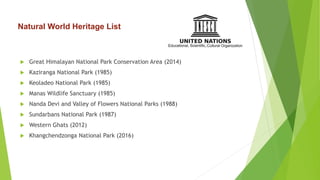
 Great Himalayan National Park Conservation Area (2014)
 Kaziranga National Park (1985)
 Keoladeo National Park (1985)
 Manas Wildlife Sanctuary (1985)
 Nanda Devi and Valley of Flowers National Parks (1988)
 Sundarbans National Park (1987)
 Western Ghats (2012)
 Khangchendzonga National Park (2016)
Natural World Heritage List
The Ministry of Environment and Forests provides some financial assistance to the
State/Union Territory Governments for protection and management of the Protected
Areas under the three main Centrally Sponsored Schemes viz.,
Integrated Development of Wildlife Habitats
Project Tiger
Project Elephant
A Biosphere Reserve consists of core, buffer and transition zones.
 (a) The core zone is fully protected and natural area of the Biosphere Reserve least disturbed by human
activities.
 This zone should be kept absolutely undisturbed.
 It is legally protected ecosystem in which entry is not allowed except with permission for some special
purpose.
 Destructive sampling for scientific investigations is prohibited.
 (b) The buffer zone
It surrounds the core zone and is managed to accommodate a greater variety of resource use
strategies, and research and educational activities.
Research and educational activities are to be encouraged.
c) the transition zone,
the outermost part of the Biosphere Reserve,
it is an area of active cooperation between the reserve management and the local people,
wherein activities like settlements, cropping, forestry , recreation and other economic that
are in harmony with the conservation goals.
CBD
 The Convention on Biological Diversity was opened for signature at the Earth Summit
in Rio de Janeiro on 5 June 1992 and entered into force on 29 December 1993.
 To date, there are 193 Parties
 Components of biodiversity are all the various forms of life on Earth including
ecosystems, animals, plants, fungi, microorganisms, and genetic diversity
 With its three objectives, the CBD is often seen as the key international instrument for
sustainable development
 Ecosystems, species and genetic resources should be used for the benefit of humans, but
in a way that does not lead to the decline of biodiversity
 India has established a National Biodiversity Authority in Chennai, 2003 under
biodiversity act 2002.
Ramsar Convention
The Ramsar Convention is an international treaty for the conservation and sustainable use
of wetlands. It is also known as the Convention on Wetlands. It is named after the city
of Ramsar in Iran, where the Convention was signed in 1971.
India became a contracting party to the Ramsar Convention in October 1981 and
designated Chilika Lake (Odisha) and Keoladeo National Park (Rajasthan) as its first two
Ramsar Sites.
Four additional sites were designated in 1990: Sambhar Lake (Rajasthan), Loktak Lake
(Manipur), Harike Lake (Punjab) and Wular Lake (Jammu & Kashmir).
Project Tiger
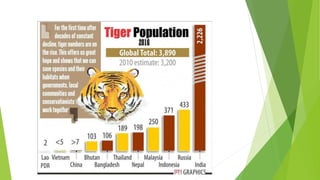
 A potential example of conservation of a highly endangered species is the Indian Tiger.
 It is estimated that india had about 40,000 tigers in 1900, and the number declined to a
mere about 1800 in 1972.
 Hence Project tiger centrally sponsored scheme was launched in 1973.
 Initially 9 tiger reserved were covered under the project, and has currently increased to
47, falling in 18 states.
 The National Tiger Conservation Authority (NTCA) is a statutory body of the Ministry,
with an overarching supervisory / coordination role, performing functions as provided
in the Wildlife (Protection) Act, 1972.
Project Elephant:
 Project Elephant: Project Elephant was launched in 1992 to ensure the long-
term survival of a viable population of elephants in their natural habitats in
north and north-eastern India and south India.
 It is being implemented in 12 States.
 In spite of this, our elephant herds are at threat as their habitat is shrinking
and their migration routes are disrupted by human activities.
Crocodile Conservation
 Crocodiles have been threatened as their skin is used for making leather articles.
 This led to the near extinction of crocodiles in the wild in the 1960s in India.
 A Crocodile Breeding and Conservation Program was initiated in 1975 to protect the
remaining population of crocodilians in their natural habitat and by creating breeding
centers.
 It is perhaps one of the most successful ex situ conservation breeding projects in the
country.
 Crocodiles have been extensively bred in over 30 captive breeding centers, zoos and
other sites where successful breeding takes place. Thousands of crocodiles of all three
species have been bred and restocked in 20 natural water bodies.
Biodiversity conservation

Biodiversity conservation

  • 1.
    Biodiversity Conservation This incorporatesthe preservation, maintenance, sustainable use (conservation), recovery and enhancement of the components of biological diversity, where: Conservation - is the sustainable use of resources and encompasses protection as well as exploitation and; Preservation - is an aspect of conservation meaning to keep something without altering or changing it. Sustainable development This refers to development that meets the needs of the current generation without compromising the ability of future generations to meet their needs; it simply refers to intra and intergenerational equity. A balance between the environment, development and society results to sustainable development which ensures biodiversity conservation. This is only possible in the presence of good enforced and implemented policies/ conventions, environmental institutions and political stability among others.
  • 2.
  • 3.
    CONSERVATION STRATEGIES Conservation effortscan be grouped into the following two categories:  1. In-situ (on-site) conservation includes the protection of plants and animals within their natural habitats or in protected areas. Protected areas are land or sea dedicated to protect and maintain biodiversity.  2. Ex-situ (off-site) conservation of plants and animals outside their natural habitats. These include botanical gardens, zoo, gene banks, seek bank, tissue culture and cryopreservation.
  • 4.
    In-situ methods Protection ofhabitat: The main strategy for conservation of species is the protection of habitats in representative ecosystems.  Currently, India has 103 National Parks,  573 hundred Wildlife Sanctuaries,  18 Biosphere Reserves,  47 Tiger Reserves and  32 Elephant Reserves covering an area of 15.67 million hectares or 5% of the geographical area of the country. Twenty six wetlands, thirty mangrove areas and four coral reef areas nhave been identified for intensive conservation and management purposes by the Ministry of Environment and Forests, Govt. of India.
  • 5.
    Convention on biologicaldiversity (CBD)  Conservation of biological diversity and sustainable use of its components came into the limelight in 1972 (United Nations Conference on Human Environment; Stockholm).  In 1973, UNEP identified conservation of biodiversity as a priority area, hence there was need to get the legal mandate for conservation of world resources. There were negotiations for a legally binding instrument to address biological diversity and its loss to enhance fairness and equity in sharing of the benefits of biodiversity; this led to the opening of the Convention on Biological Diversity in 1992; Rio de Janeiro under the United Nations Conference on Environment and Development (UNCED)/ Earth Summit.  The convention was inspired by the growing concern all over the world for sustainable development.
  • 6.
    The convention objectiveswere:  • Conservation of the biological diversity;  • Sustainable use of its components;  • A fair and equitable sharing of its benefits. This was the first global comprehensive agreement that addressed all the aspects of biological diversity; genetic resources, species diversity and ecosystem diversity
  • 7.
    Other international biodiversityconventions and conservation organizations • African Convention on Conservation of nature and natural resources. • The Ramsar Convention on Wetlands of international importance. • International Union for the Conservation of nature (World Conservation Union). • Convention on International trade for endangered species (CITES). • International Convention for the Protection on birds. • International Board for Plant genetic resources . • World Resources Institute. • World Wide Fund for Nature. (WWF) • Convention on Conservation of migratory species of wild animals. • International Convention for the Regulation of whaling . • UNESCO programme on Man and biosphere .

  • 8.
    National Parks  Nationalparks in India are IUCN category II protected areas.  India's first national park was established in 1936 as Hailey National Park, now known as Jim Corbett National Park, Uttarakhand.  By 1970, India only had five national parks.  In 1972, India enacted the Wildlife Protection Act and Project Tiger to safeguard the habitats of conservation reliant species.  Further federal legislation strengthening protections for wildlife was introduced in the 1980s.  As of July 2015, there were 103 national parks encompassing an area of 40,500 km2, comprising 1.23% of India's total surface area.
  • 10.
    Wildlife sanctuaries Wildlife sanctuariesare established by IUCN category II protected areas. India has 537 wildlife sanctuaries referred to as wildlife sanctuaries category IV protected areas. Among these, the 49 tiger reserves are governed by Project Tiger, and are of special significance in the conservation of the tiger
  • 11.
    Difference between thetwo  National parks enjoy greater degree of protection than sanctuaries.  Certain activities which are regulated in sanctuaries, such as grazing of livestock, are prohibited in National Parks  Wildlife sanctuary can be created for a particular species, whereas the national parks is not primarily focused on a particular species.  Central government may also declare a national parks under certain conditions
  • 12.
    Many National Parksand Sanctuaries have been established to preserve wildlife in their natural environment. Some of them are given below along with important species found there. • Kaziranga sanctuary (Assam) – One-horned rhinoceros • Manas sanctuary (Assam) – Wild buffaloes • Gir forest (Gujarat) – Lions, chital, sambar, wild bears • Kelameru bird sanctuary (Andhra Pradesh) – Pelicans and marine birds • Dachigam sanctuary (Jammu and Kashmir) – Kashmir stags, Himalayan tahr, wild goats, sheep, antelopes. • Bandipur sanctuary (Karnataka) – Indian bison, elephants, langurs • Periyar sanctuary (Kerala) – Elephants, barking deer, sambhar • Kanha National Park (Madhya Pradesh) – Tiger, leopards, wild dogs
  • 13.
     • SimipalNational Park (Orissa) – Mangroves, marine turtles lay eggs  • Bharatpur bird sanctuary (Rajasthan) – Ducks, herons  • Corbett National Park (Uttaranchal) –Tigers, barking deer, sambar, wild bear, rhesus monkey.  • Jaladpara sanctuary (West Bengal) – Rhinoceros
  • 14.
    Biosphere Reserves  Theidea of `Biosphere Reserves’ was initiated by UNESCO in 1973-74 under its Man and Biosphere (MAB) Programme. The MAB, launched in 1970 by UNESCO.  BRs are thus special environments for both people and the nature and are living examples of how human beings and nature can co-exist while respecting each others’ needs.
  • 16.
    Functions of BiosphereReserves Functions of Biosphere Reserves Conservation  • To ensure the conservation of landscapes, ecosystems, species and genetic variations.  • To encourage the traditional resource use systems;  • To understand the patterns and processes of functioning of ecosystems;  • To monitor the natural and human-caused changes on spatial and temporal scales; Development • To promote, at the local level, economic development which is culturally, socially and ecologically sustainable. • To develop the strategies leading to improvement and management of natural resources;
  • 17.
    Logistics support  •To provide support for research, monitoring, education and information exchange related to local, national and global issues of conservation and development  • Sharing of knowledge generated by research through site specific training and education; and  • Development of community spirit in the management of natural resources.
  • 18.
     International Co-ordinatingCouncil of UNESCO, in November, 1971 introduced the designation ‘Biosphere reserve’ for natural areas.  The concept of Biosphere reserve was refined by a task force of UNESCO’s MAB programme in 1974, and BR network was formally launched in 1976.
  • 22.
     Great HimalayanNational Park Conservation Area (2014)  Kaziranga National Park (1985)  Keoladeo National Park (1985)  Manas Wildlife Sanctuary (1985)  Nanda Devi and Valley of Flowers National Parks (1988)  Sundarbans National Park (1987)  Western Ghats (2012)  Khangchendzonga National Park (2016) Natural World Heritage List
  • 23.
    The Ministry ofEnvironment and Forests provides some financial assistance to the State/Union Territory Governments for protection and management of the Protected Areas under the three main Centrally Sponsored Schemes viz., Integrated Development of Wildlife Habitats Project Tiger Project Elephant
  • 24.
    A Biosphere Reserveconsists of core, buffer and transition zones.  (a) The core zone is fully protected and natural area of the Biosphere Reserve least disturbed by human activities.  This zone should be kept absolutely undisturbed.  It is legally protected ecosystem in which entry is not allowed except with permission for some special purpose.  Destructive sampling for scientific investigations is prohibited.
  • 25.
     (b) Thebuffer zone It surrounds the core zone and is managed to accommodate a greater variety of resource use strategies, and research and educational activities. Research and educational activities are to be encouraged. c) the transition zone, the outermost part of the Biosphere Reserve, it is an area of active cooperation between the reserve management and the local people, wherein activities like settlements, cropping, forestry , recreation and other economic that are in harmony with the conservation goals.
  • 26.
    CBD  The Conventionon Biological Diversity was opened for signature at the Earth Summit in Rio de Janeiro on 5 June 1992 and entered into force on 29 December 1993.  To date, there are 193 Parties  Components of biodiversity are all the various forms of life on Earth including ecosystems, animals, plants, fungi, microorganisms, and genetic diversity  With its three objectives, the CBD is often seen as the key international instrument for sustainable development  Ecosystems, species and genetic resources should be used for the benefit of humans, but in a way that does not lead to the decline of biodiversity  India has established a National Biodiversity Authority in Chennai, 2003 under biodiversity act 2002.
  • 27.
    Ramsar Convention The RamsarConvention is an international treaty for the conservation and sustainable use of wetlands. It is also known as the Convention on Wetlands. It is named after the city of Ramsar in Iran, where the Convention was signed in 1971. India became a contracting party to the Ramsar Convention in October 1981 and designated Chilika Lake (Odisha) and Keoladeo National Park (Rajasthan) as its first two Ramsar Sites. Four additional sites were designated in 1990: Sambhar Lake (Rajasthan), Loktak Lake (Manipur), Harike Lake (Punjab) and Wular Lake (Jammu & Kashmir).
  • 28.
    Project Tiger  Apotential example of conservation of a highly endangered species is the Indian Tiger.  It is estimated that india had about 40,000 tigers in 1900, and the number declined to a mere about 1800 in 1972.  Hence Project tiger centrally sponsored scheme was launched in 1973.  Initially 9 tiger reserved were covered under the project, and has currently increased to 47, falling in 18 states.  The National Tiger Conservation Authority (NTCA) is a statutory body of the Ministry, with an overarching supervisory / coordination role, performing functions as provided in the Wildlife (Protection) Act, 1972.
  • 31.
    Project Elephant:  ProjectElephant: Project Elephant was launched in 1992 to ensure the long- term survival of a viable population of elephants in their natural habitats in north and north-eastern India and south India.  It is being implemented in 12 States.  In spite of this, our elephant herds are at threat as their habitat is shrinking and their migration routes are disrupted by human activities.
  • 32.
    Crocodile Conservation  Crocodileshave been threatened as their skin is used for making leather articles.  This led to the near extinction of crocodiles in the wild in the 1960s in India.  A Crocodile Breeding and Conservation Program was initiated in 1975 to protect the remaining population of crocodilians in their natural habitat and by creating breeding centers.  It is perhaps one of the most successful ex situ conservation breeding projects in the country.  Crocodiles have been extensively bred in over 30 captive breeding centers, zoos and other sites where successful breeding takes place. Thousands of crocodiles of all three species have been bred and restocked in 20 natural water bodies.