PRESENTED BY
Jagan Kumar Ojha
M.Sc. Tutor
Dept. of Community Health
SNC, Bhubaneswar
Hotspots of Biodiversity
• Term “HOT SPOT”----Norman Myers (1988)
Those geographical regions:
 Rich in endemic, rare and threatened species
 Facing significant threats to habitat loss
 Due to direct and indirect interference of
human activities.
Hotspots of Biodiversity
• A biodiversity hotspot is a biogeographic region
that acts as a significant reservoir of biodiversity
and also threatened with destruction by human
habitation.
• Biodiversity hotspots are places on earth that
homes to thousands of irreplaceable species and are
facing multiple, urgent threats.
Hotspots of Biodiversity
To qualify as a biodiversity, a region must meet two
strict Criteria:
 It must contain at least 0.5% or 1,500 species of
plants as endemics,
 It has to have lost at least 70% of its primary
vegetation.
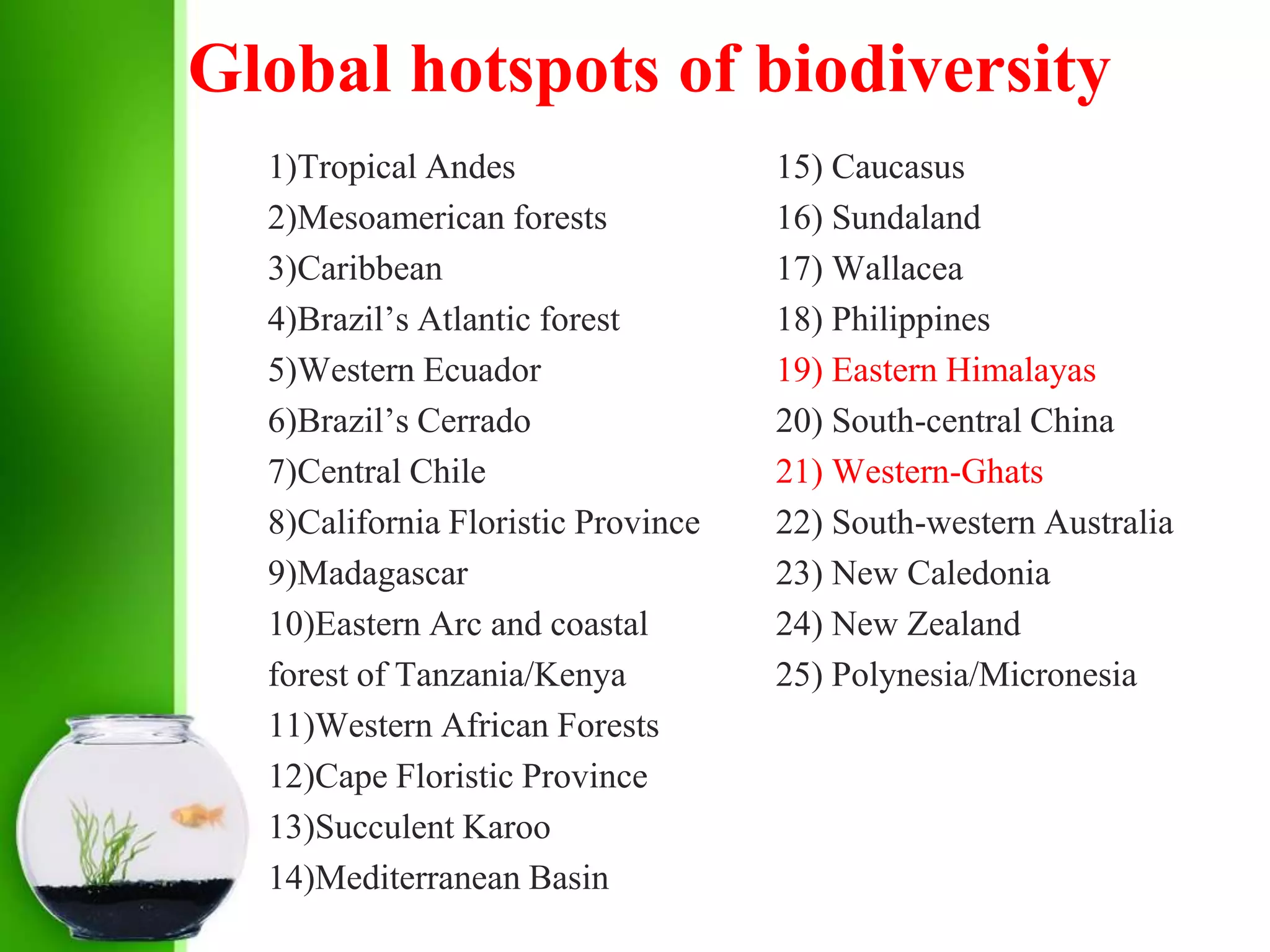
Global hotspots of biodiversity
1)Tropical Andes 15) Caucasus
2)Mesoamerican forests 16) Sundaland
3)Caribbean 17) Wallacea
4)Brazil’s Atlantic forest 18) Philippines
5)Western Ecuador 19) Eastern Himalayas
6)Brazil’s Cerrado 20) South-central China
7)Central Chile 21) Western-Ghats
8)California Floristic Province 22) South-western Australia
9)Madagascar 23) New Caledonia
10)Eastern Arc and coastal 24) New Zealand
forest of Tanzania/Kenya 25) Polynesia/Micronesia
11)Western African Forests
12)Cape Floristic Province
13)Succulent Karoo
14)Mediterranean Basin
Salient features of Indian Hotspots
A) Eastern Himalayas:
• The eastern himalayan region encompasses Bhutan, North
east India, and south, central and eastern Nepal
• The region is home to 163 globally threatened species
including Asia’s Three largest herbivores –the Asian
elephant, the greater one horned rhinoceros, and the wild
water buffalo, Carnivore-The tiger & Birds-Vultures,
Storks and hornbills
• Out of the world’s recorded flora, 30% are endemic to India
of which 35,000 are in the Himalayas.
Salient features of Indian Hotspots
B) Western Ghats
• It extends along a 17000 sq.km strip of forests in
Maharashtra, Karnataka, TN and Kerala and has 40%
of total endemic plants.
• The major centers of diversity are Agastyamalai Hills
and Amambalam reserve.
• It is reported that only 6.8% of original forests are
existing today while the rest has been deforested or
degraded.
Threats to Biodiversity
• The process of extinction has become
particularly fast in this recent years of human
civilization.
• One of the estimates puts the figure of extinction
as 27/day
• If the present trend continues we would lose 1/3rd
to 2/3rd of our current biodiversity by the middle
of 21st century
Loss of Habitat
• Destruction and loss of natural habitat is the single
largest cause of biodiversity loss.
• Billions of hectares of forests and grasslands have been
cleared over the last few years i.e converted into
agricultural lands, pastures, settlement areas or
development projects.
• Thousand of species have freezing due to loss of their
natural habitation.
• As a result of human intervention, marine biodiversity
is under serious threat due to large scale destruction of
the fragile breeding and feeding grounds.
Poaching
Poaching
• Illegal trade of wildlife products by killing prohibited
animals, is a threat to wildlife
• Despite international ban on trade in products from
endangered species, smuggling of wildlife items like
furs, skins, tusks, etc. is continuing.
• The worse issue is that for every live animal that gets
into market, about 50 additional animals are caught and
killed
Man-wildlife Conflicts
• When wild life causes immense damage and danger to
man , the conflict occurs.
• In retaliation, the villagers electrocute or kill the animals
which sometimes exceed poaching.
Causes of man-animal conflict
1) Diminishing of habitats and human violations
into the forest areas
1) The wild life corridors through which
animals used to migrate seasonally have been
used for human settlements and hence
animals attack the settlements
Causes of man-animal conflict
3) The stopping of cultivation of paddy, sugarcane
etc.. within the sanctuaries have led the animals
to stray out
4) The compensation paid by the government in lieu
of the damage caused to the crops is not
adequate and the suffering farmer gets
revengeful and kills the wild animals
5) Usually the ill, weak and injured animals have a
tendency to attack man.
Conservation of Biodiversity
Conservation of biodiversity
• The enormous value of biodiversity due to their
genetic, commercial medical, aesthetic importance
emphasize the need to conserve biodiversity.
• There are two approaches of biodiversity
conservation;
– In situ conservation
– Ex situ conservation
In Situ conservation
 This is achieved by protection of wild flora and fauna in
nature itself. E.g Biosphere reserves, National parks,
Sancturies, Reserve forests etc.
 The Biosphere reserves conserve some representative
ecosystems as a whole for long term in situ conservation.
Gulf of mannar, Nilgiri, Sunderbans, Nanda devi are few
biosphere reserves
 A National park is an area dedicated for the conservation of
wildlife along with its environment.
 Each park aims at conservation of some particular species of
wildlife along with others
Important National Parks in India
Name of the National Park Important Wildlife
Kaziranga One horned Rhino
Gir national park Indian Lion
Dachigam Hangul
Bandipur Elephant
Periyar Elephant, Tiger
Kanha Tiger
Corbett Tiger
Dudwa Tiger
Ranthambore Tiger
Sariska Tiger
Wild Life Sanctuaries
 These are protected areas where killing, hunting,
shooting or capturing of wildlife is prohibited except
under control of highest authority.
Name of Sanctuary Major wild life
Ghana Bird Sanctuary 300 species of birds
Hazaribagh Sanctuary Tiger, Leopard
Sultanpur Bird Sanctuary Migratory birds
Nal Sarovar Bird Sanctuary Water birds
Abohar wildlife Sanctuary Black buck
Mudumalai wildlife Sanctuary Tiger, elephant, Leopard
Vedanthangal Bird Sanctuary Water Birds
Jaldapara Wildlife Sanctuary Rhinoceros, elephant, Tiger
Wild Ass Sanctuary Wild ass, Wolf, nilgai, chinkara
Ex Situ Conservation
• Ex situ conservation involves conserving components
of biological diversity outside their natural habitat
• The maintenance and breeding of endangered plants and
animals under partially or wholly controlled conditions in
specific areas.
• The ex-situ conservation strategies include botanical
gardens, zoological gardens, conservation stands and
gene, pollen, seed, tissue culture and DNA banks.
Ex Situ Conservation
• In this the conservation in captivity under human care
• The objective is to conserve the total genetic variability
of different species for future improvement or
afforestation programmes.
Important gene bank/seed banks
1) National Bureau of Plant Genetic Resources (NBPGR)-
Located in New Delhi
Here agricultural and horticultural crops are cryopreserved
2) National Bureau of Animal Genetic Resources(NBAGR)-
Located in Haryana
Preserves semen of domesticated bovine animals
3) National Facility for Plant Tissue Culture Repository
(NFPTCR)-within NBPGR
Conservation of crop plants/trees by tissue culture
Project Tiger
• Project Tiger Scheme has been under implementation
since 1973 as a Centrally Sponsored Scheme of
Government of India
• The main objective of Project Tiger is to ensure a viable
population of tiger in India and to preserve for all time
• Main objectives under the scheme include wildlife
management, protection measures and site specific
ecosystem development to reduce the dependency of
local communities on tiger reserve resources.
Project Elephant
 Project Elephant (PE), a centrally sponsored scheme, was
launched in February 1992 to provide financial and
technical support to major elephant bearing States in the
country for protection of elephants, their habitats and
corridors
 The Project Elephant in India also aimed to decrease the
human-elephant battles and help in the welfare of
domesticated elephants in India.
THANK YOU

Biodiversity hotspot, threats & its conservation

  • 1.
    PRESENTED BY Jagan KumarOjha M.Sc. Tutor Dept. of Community Health SNC, Bhubaneswar
  • 3.
    Hotspots of Biodiversity •Term “HOT SPOT”----Norman Myers (1988) Those geographical regions:  Rich in endemic, rare and threatened species  Facing significant threats to habitat loss  Due to direct and indirect interference of human activities.
  • 4.
    Hotspots of Biodiversity •A biodiversity hotspot is a biogeographic region that acts as a significant reservoir of biodiversity and also threatened with destruction by human habitation. • Biodiversity hotspots are places on earth that homes to thousands of irreplaceable species and are facing multiple, urgent threats.
  • 5.
    Hotspots of Biodiversity Toqualify as a biodiversity, a region must meet two strict Criteria:  It must contain at least 0.5% or 1,500 species of plants as endemics,  It has to have lost at least 70% of its primary vegetation.
  • 6.
    Global hotspots ofbiodiversity 1)Tropical Andes 15) Caucasus 2)Mesoamerican forests 16) Sundaland 3)Caribbean 17) Wallacea 4)Brazil’s Atlantic forest 18) Philippines 5)Western Ecuador 19) Eastern Himalayas 6)Brazil’s Cerrado 20) South-central China 7)Central Chile 21) Western-Ghats 8)California Floristic Province 22) South-western Australia 9)Madagascar 23) New Caledonia 10)Eastern Arc and coastal 24) New Zealand forest of Tanzania/Kenya 25) Polynesia/Micronesia 11)Western African Forests 12)Cape Floristic Province 13)Succulent Karoo 14)Mediterranean Basin
  • 7.
    Salient features ofIndian Hotspots A) Eastern Himalayas: • The eastern himalayan region encompasses Bhutan, North east India, and south, central and eastern Nepal • The region is home to 163 globally threatened species including Asia’s Three largest herbivores –the Asian elephant, the greater one horned rhinoceros, and the wild water buffalo, Carnivore-The tiger & Birds-Vultures, Storks and hornbills • Out of the world’s recorded flora, 30% are endemic to India of which 35,000 are in the Himalayas.
  • 8.
    Salient features ofIndian Hotspots B) Western Ghats • It extends along a 17000 sq.km strip of forests in Maharashtra, Karnataka, TN and Kerala and has 40% of total endemic plants. • The major centers of diversity are Agastyamalai Hills and Amambalam reserve. • It is reported that only 6.8% of original forests are existing today while the rest has been deforested or degraded.
  • 10.
    Threats to Biodiversity •The process of extinction has become particularly fast in this recent years of human civilization. • One of the estimates puts the figure of extinction as 27/day • If the present trend continues we would lose 1/3rd to 2/3rd of our current biodiversity by the middle of 21st century
  • 11.
    Loss of Habitat •Destruction and loss of natural habitat is the single largest cause of biodiversity loss. • Billions of hectares of forests and grasslands have been cleared over the last few years i.e converted into agricultural lands, pastures, settlement areas or development projects. • Thousand of species have freezing due to loss of their natural habitation. • As a result of human intervention, marine biodiversity is under serious threat due to large scale destruction of the fragile breeding and feeding grounds.
  • 12.
  • 13.
    Poaching • Illegal tradeof wildlife products by killing prohibited animals, is a threat to wildlife • Despite international ban on trade in products from endangered species, smuggling of wildlife items like furs, skins, tusks, etc. is continuing. • The worse issue is that for every live animal that gets into market, about 50 additional animals are caught and killed
  • 14.
    Man-wildlife Conflicts • Whenwild life causes immense damage and danger to man , the conflict occurs. • In retaliation, the villagers electrocute or kill the animals which sometimes exceed poaching.
  • 15.
    Causes of man-animalconflict 1) Diminishing of habitats and human violations into the forest areas 1) The wild life corridors through which animals used to migrate seasonally have been used for human settlements and hence animals attack the settlements
  • 16.
    Causes of man-animalconflict 3) The stopping of cultivation of paddy, sugarcane etc.. within the sanctuaries have led the animals to stray out 4) The compensation paid by the government in lieu of the damage caused to the crops is not adequate and the suffering farmer gets revengeful and kills the wild animals 5) Usually the ill, weak and injured animals have a tendency to attack man.
  • 17.
  • 18.
    Conservation of biodiversity •The enormous value of biodiversity due to their genetic, commercial medical, aesthetic importance emphasize the need to conserve biodiversity. • There are two approaches of biodiversity conservation; – In situ conservation – Ex situ conservation
  • 19.
    In Situ conservation This is achieved by protection of wild flora and fauna in nature itself. E.g Biosphere reserves, National parks, Sancturies, Reserve forests etc.  The Biosphere reserves conserve some representative ecosystems as a whole for long term in situ conservation. Gulf of mannar, Nilgiri, Sunderbans, Nanda devi are few biosphere reserves  A National park is an area dedicated for the conservation of wildlife along with its environment.  Each park aims at conservation of some particular species of wildlife along with others
  • 20.
    Important National Parksin India Name of the National Park Important Wildlife Kaziranga One horned Rhino Gir national park Indian Lion Dachigam Hangul Bandipur Elephant Periyar Elephant, Tiger Kanha Tiger Corbett Tiger Dudwa Tiger Ranthambore Tiger Sariska Tiger
  • 21.
    Wild Life Sanctuaries These are protected areas where killing, hunting, shooting or capturing of wildlife is prohibited except under control of highest authority. Name of Sanctuary Major wild life Ghana Bird Sanctuary 300 species of birds Hazaribagh Sanctuary Tiger, Leopard Sultanpur Bird Sanctuary Migratory birds Nal Sarovar Bird Sanctuary Water birds Abohar wildlife Sanctuary Black buck Mudumalai wildlife Sanctuary Tiger, elephant, Leopard Vedanthangal Bird Sanctuary Water Birds Jaldapara Wildlife Sanctuary Rhinoceros, elephant, Tiger Wild Ass Sanctuary Wild ass, Wolf, nilgai, chinkara
  • 22.
    Ex Situ Conservation •Ex situ conservation involves conserving components of biological diversity outside their natural habitat • The maintenance and breeding of endangered plants and animals under partially or wholly controlled conditions in specific areas. • The ex-situ conservation strategies include botanical gardens, zoological gardens, conservation stands and gene, pollen, seed, tissue culture and DNA banks.
  • 23.
    Ex Situ Conservation •In this the conservation in captivity under human care • The objective is to conserve the total genetic variability of different species for future improvement or afforestation programmes.
  • 24.
    Important gene bank/seedbanks 1) National Bureau of Plant Genetic Resources (NBPGR)- Located in New Delhi Here agricultural and horticultural crops are cryopreserved 2) National Bureau of Animal Genetic Resources(NBAGR)- Located in Haryana Preserves semen of domesticated bovine animals 3) National Facility for Plant Tissue Culture Repository (NFPTCR)-within NBPGR Conservation of crop plants/trees by tissue culture
  • 25.
    Project Tiger • ProjectTiger Scheme has been under implementation since 1973 as a Centrally Sponsored Scheme of Government of India • The main objective of Project Tiger is to ensure a viable population of tiger in India and to preserve for all time • Main objectives under the scheme include wildlife management, protection measures and site specific ecosystem development to reduce the dependency of local communities on tiger reserve resources.
  • 26.
    Project Elephant  ProjectElephant (PE), a centrally sponsored scheme, was launched in February 1992 to provide financial and technical support to major elephant bearing States in the country for protection of elephants, their habitats and corridors  The Project Elephant in India also aimed to decrease the human-elephant battles and help in the welfare of domesticated elephants in India.
  • 27.