INTERNATIONAL UNION FOR
CONSERVATION OF NATURE & natural
resources
Prepared by:
Bhavyasree R K
PhD Genetics and Plant Breeding
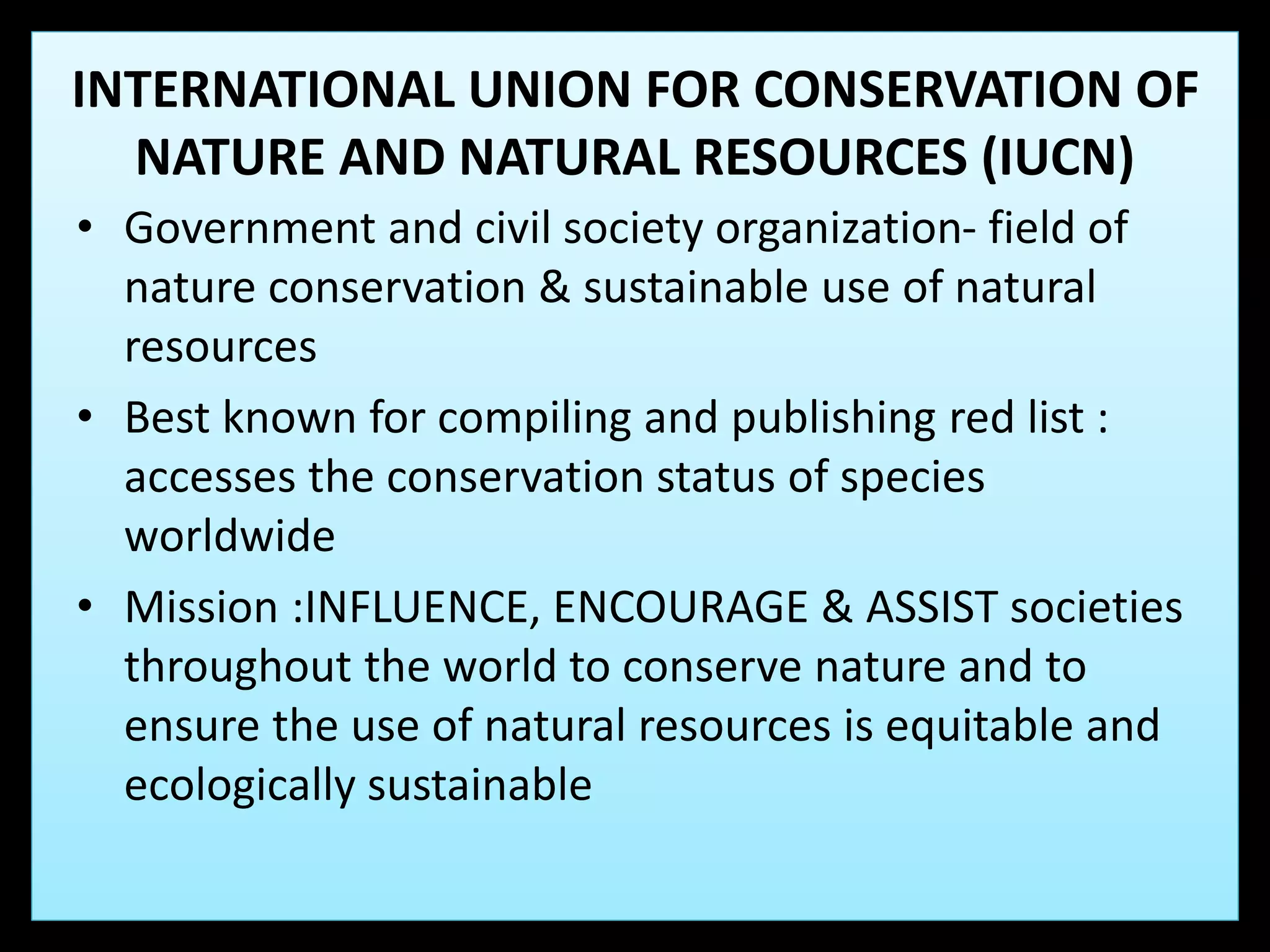
INTERNATIONAL UNION FOR CONSERVATION OF
NATURE AND NATURAL RESOURCES (IUCN)
• Government and civil society organization- field of
nature conservation & sustainable use of natural
resources
• Best known for compiling and publishing red list :
accesses the conservation status of species
worldwide
• Mission :INFLUENCE, ENCOURAGE & ASSIST societies
throughout the world to conserve nature and to
ensure the use of natural resources is equitable and
ecologically sustainable
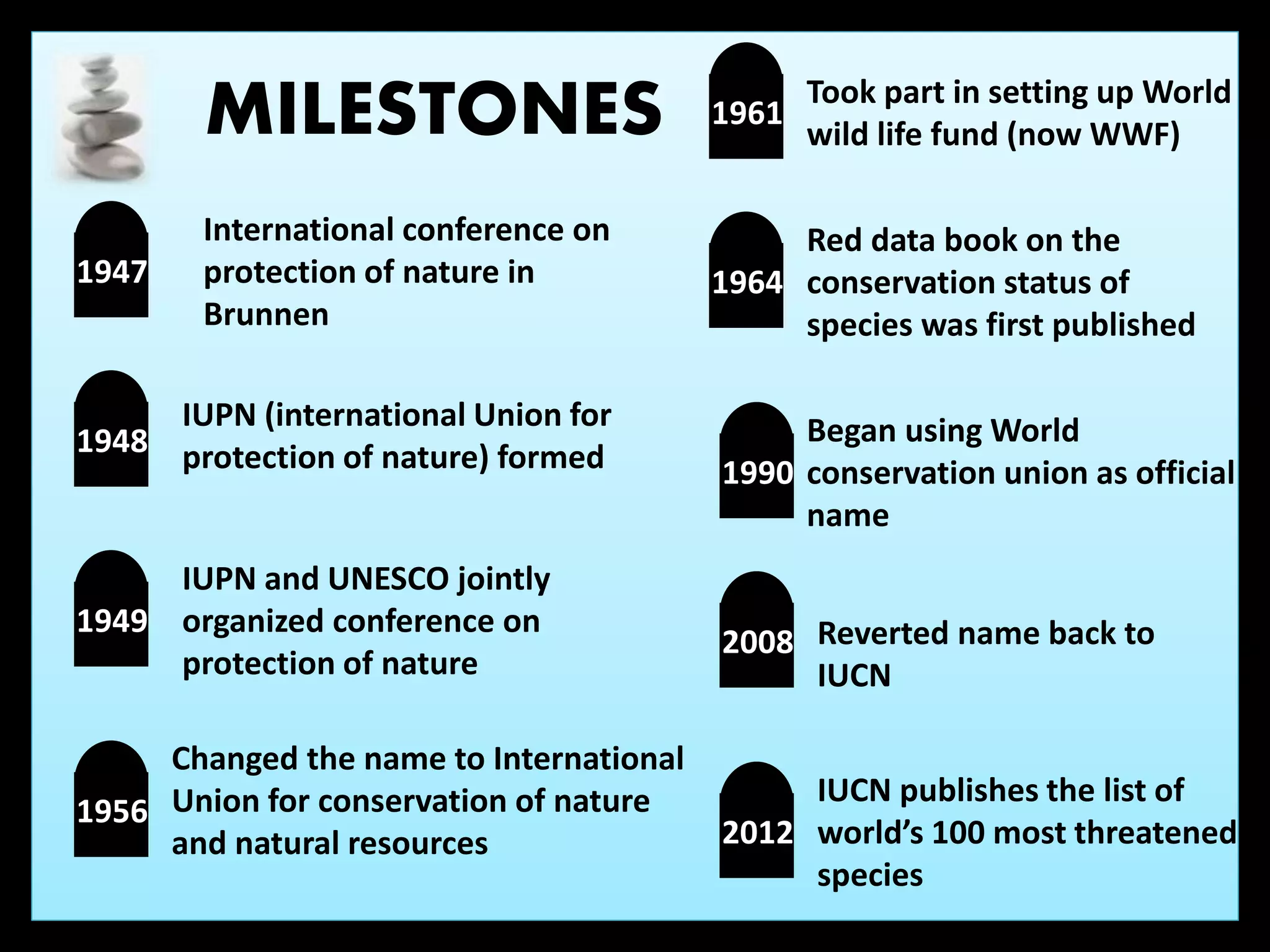
MILESTONES
1947
1948
1961
2012
1990
1964
1949
1956
2008
Took part in setting up World
wild life fund (now WWF)
IUPN (international Union for
protection of nature) formed
IUPN and UNESCO jointly
organized conference on
protection of nature
Changed the name to International
Union for conservation of nature
and natural resources
International conference on
protection of nature in
Brunnen
Red data book on the
conservation status of
species was first published
Began using World
conservation union as official
name
Reverted name back to
IUCN
IUCN publishes the list of
world’s 100 most threatened
species
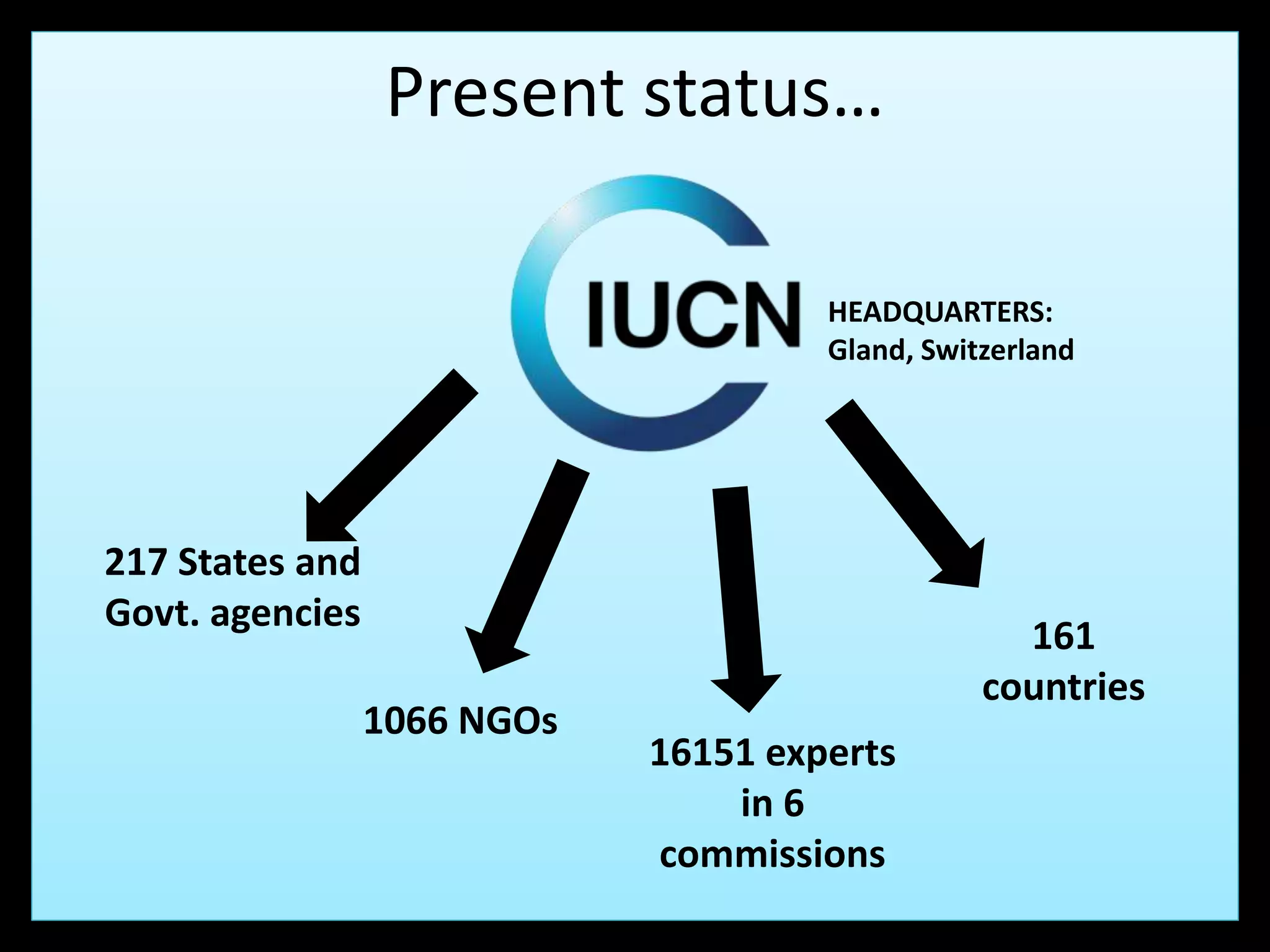
Present status…
217 States and
Govt. agencies
1066 NGOs
16151 experts
in 6
commissions
161
countries
HEADQUARTERS:
Gland, Switzerland
IUCN- Management & Governing body
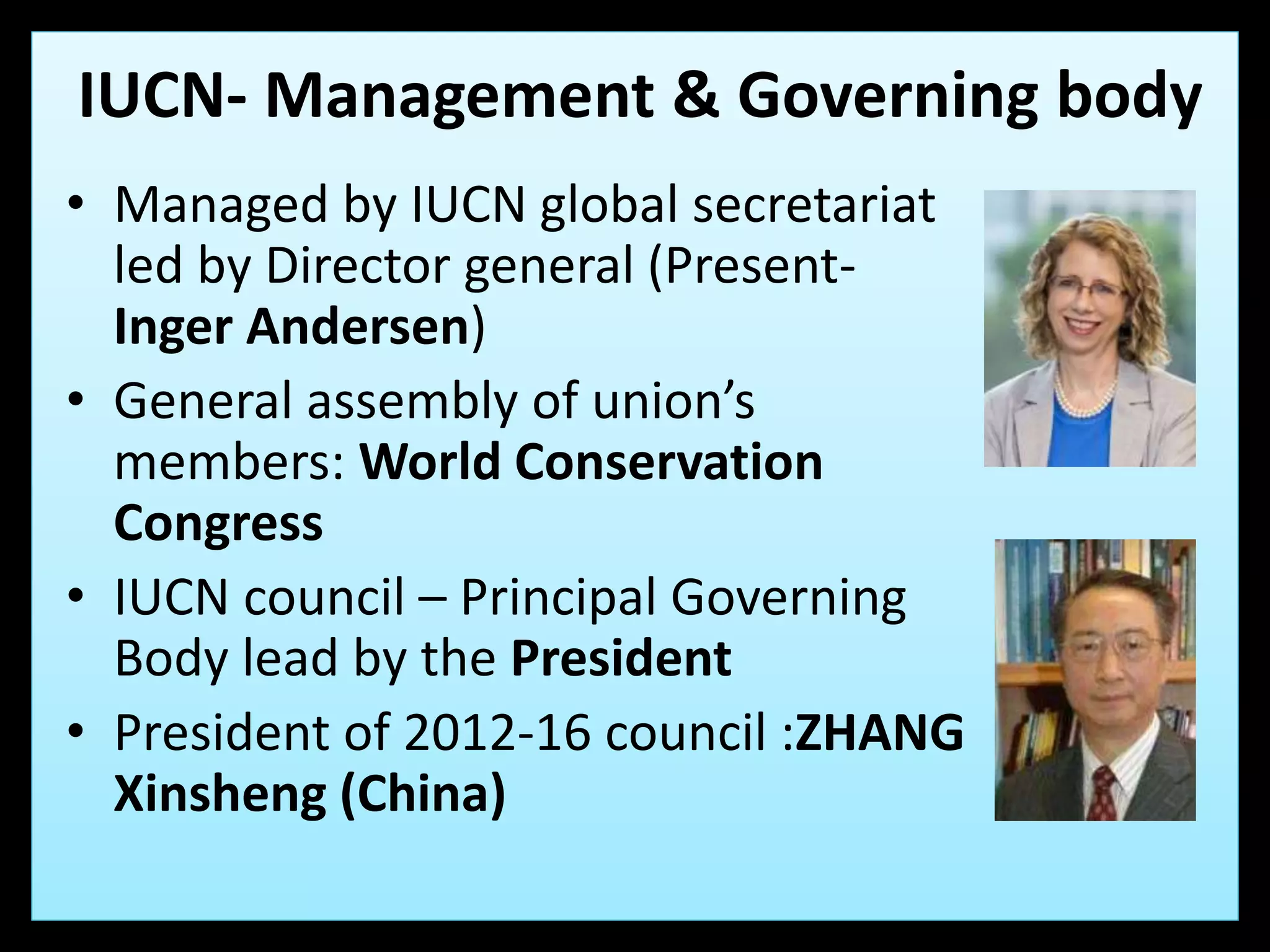
• Managed by IUCN global secretariat
led by Director general (Present-
Inger Andersen)
• General assembly of union’s
members: World Conservation
Congress
• IUCN council – Principal Governing
Body lead by the President
• President of 2012-16 council :ZHANG
Xinsheng (China)
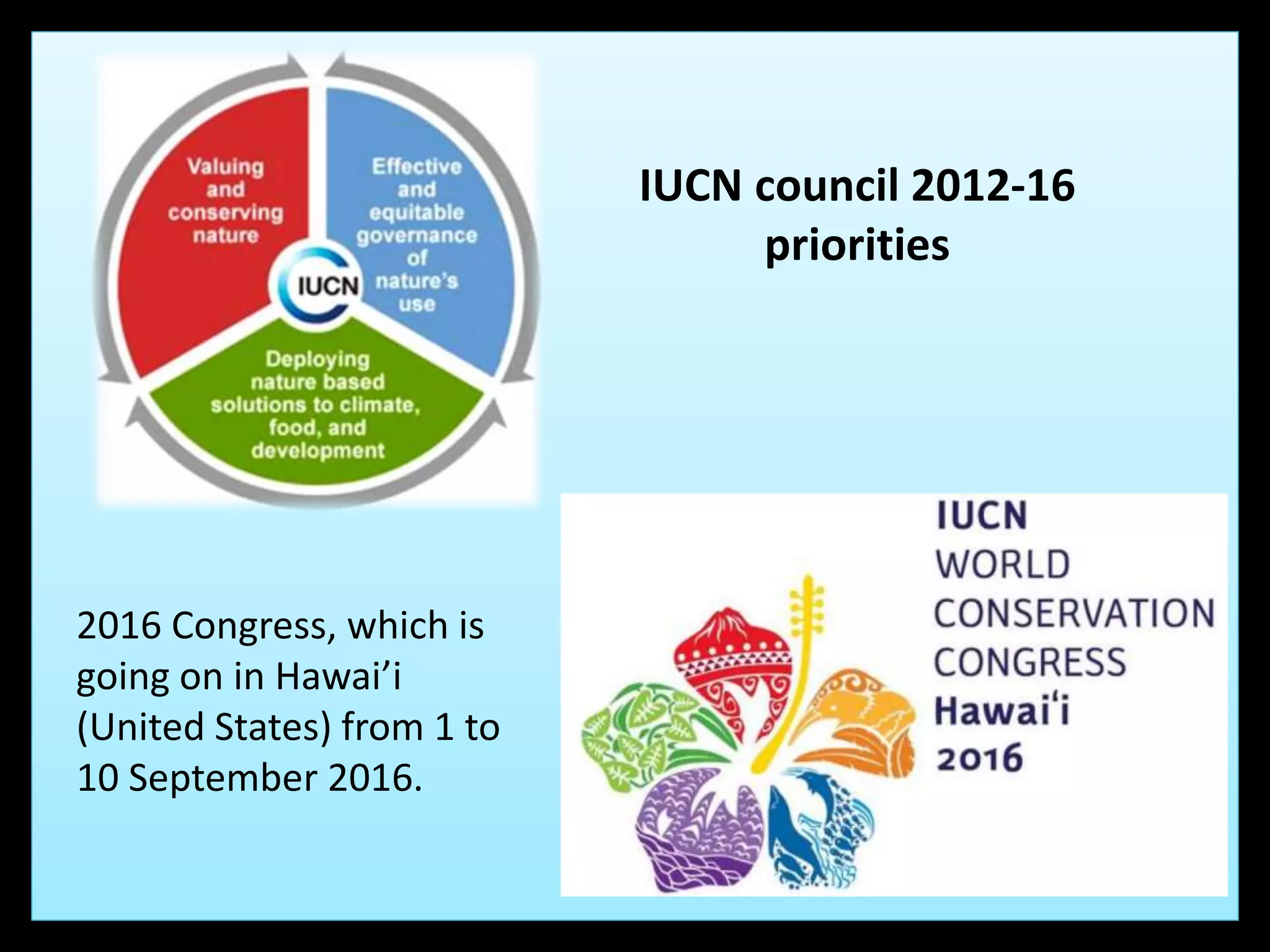
IUCN council 2012-16
priorities
2016 Congress, which is
going on in Hawai’i
(United States) from 1 to
10 September 2016.
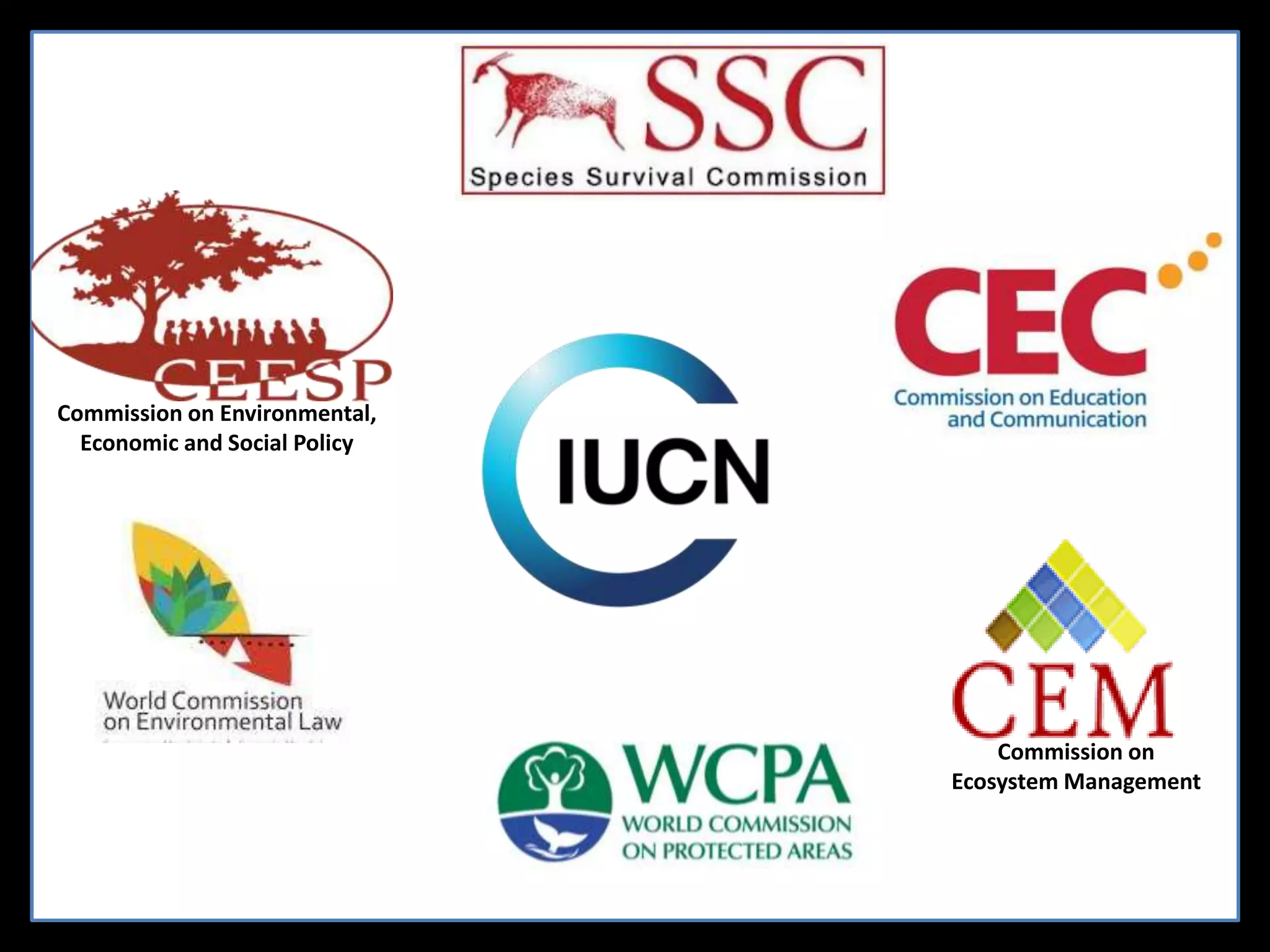
Commission on Environmental,
Economic and Social Policy
Commission on
Ecosystem Management
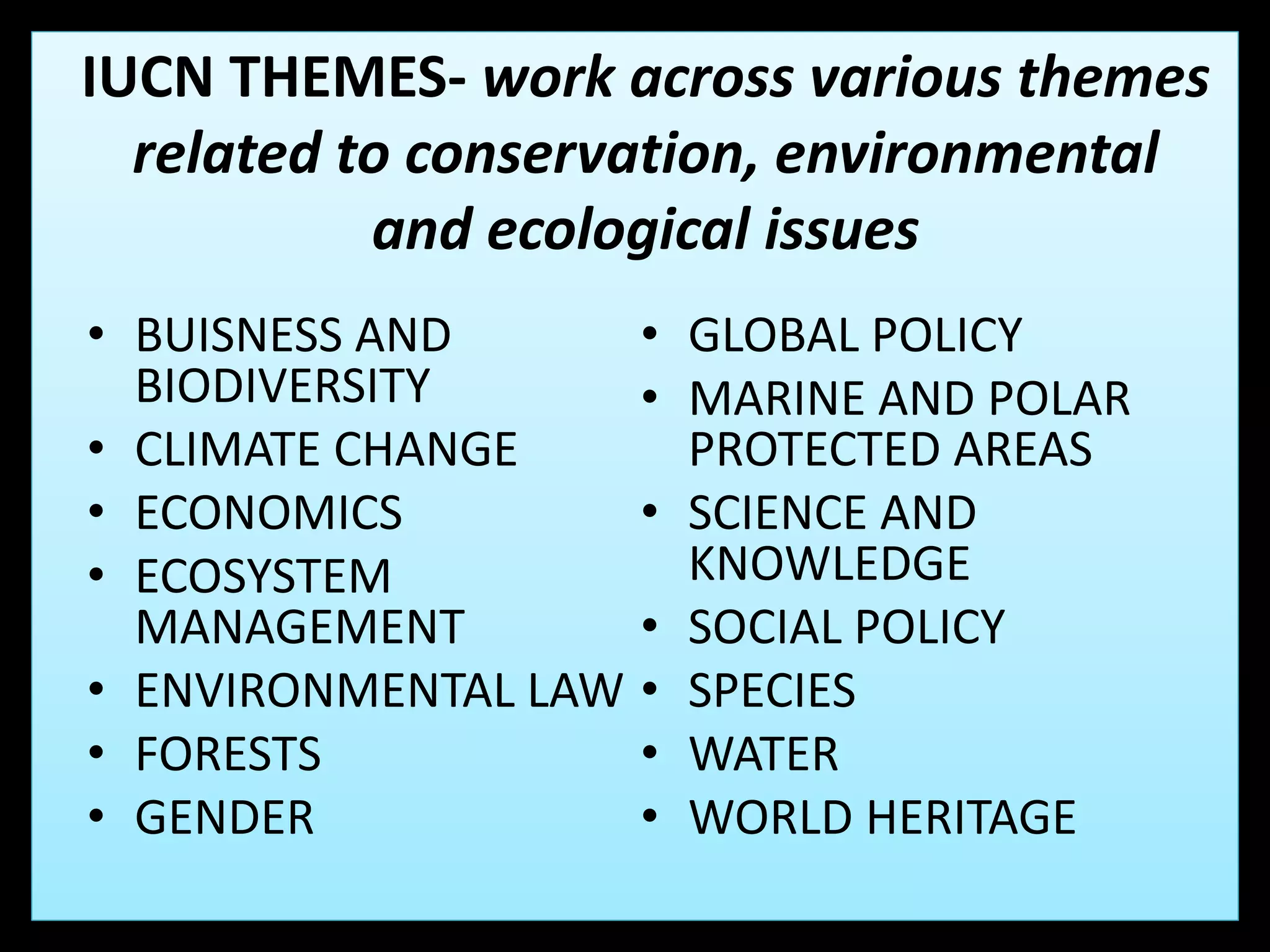
IUCN THEMES- work across various themes
related to conservation, environmental
and ecological issues
• BUISNESS AND
BIODIVERSITY
• CLIMATE CHANGE
• ECONOMICS
• ECOSYSTEM
MANAGEMENT
• ENVIRONMENTAL LAW
• FORESTS
• GENDER
• GLOBAL POLICY
• MARINE AND POLAR
PROTECTED AREAS
• SCIENCE AND
KNOWLEDGE
• SOCIAL POLICY
• SPECIES
• WATER
• WORLD HERITAGE
Regions of Action
• Asia
• Central And West Africa
• Eastern And Southern
Africa
• Eastern Europe And
Central Asia
• Europe
• Mediterranean
• Mexico, Central
America And The
Caribbean
• Oceania
• South America
• Washington D.C. Office
• West Asia
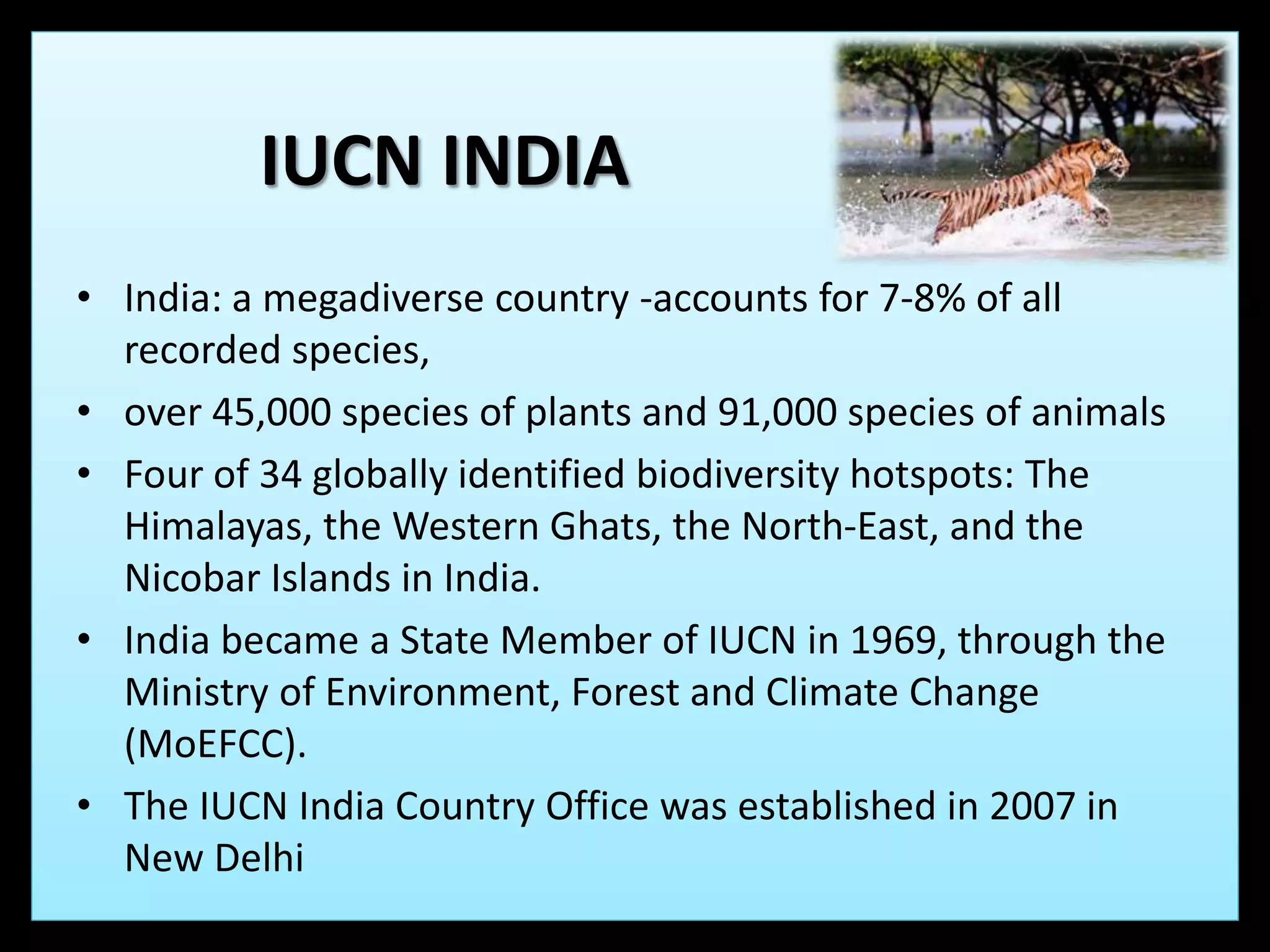
IUCN INDIA
• India: a megadiverse country -accounts for 7-8% of all
recorded species,
• over 45,000 species of plants and 91,000 species of animals
• Four of 34 globally identified biodiversity hotspots: The
Himalayas, the Western Ghats, the North-East, and the
Nicobar Islands in India.
• India became a State Member of IUCN in 1969, through the
Ministry of Environment, Forest and Climate Change
(MoEFCC).
• The IUCN India Country Office was established in 2007 in
New Delhi
IUCN RED LIST
• First published in 1964
• IUCN Global species programme working with
IUCN Species Survival Commission (SSC)
• Access the conservation status of species,
subspecies, varieties and even selected sub
populations on global scale
• Highlight the taxa threatened with extinction
and thereby promote their conservation
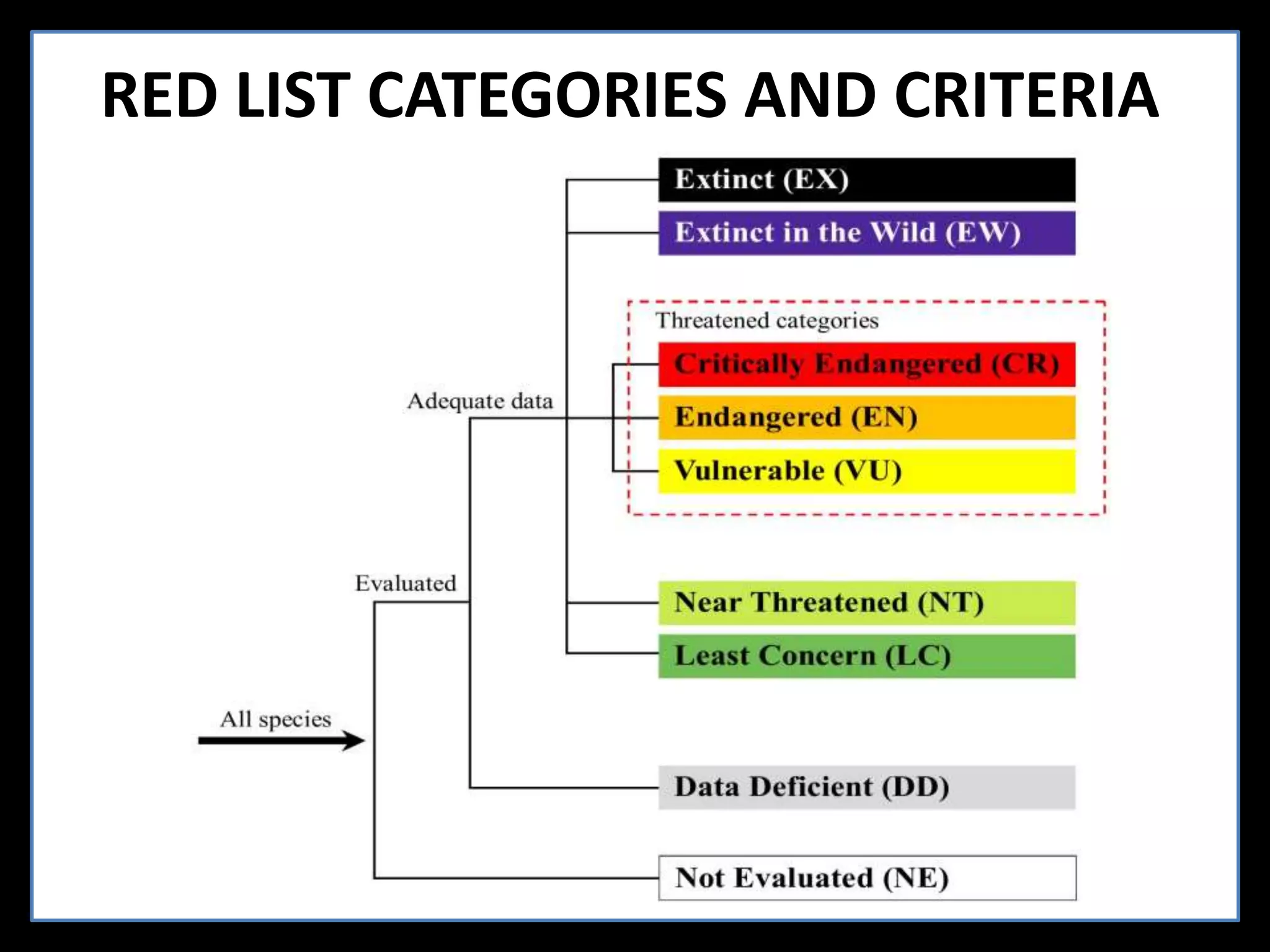
RED LIST CATEGORIES AND CRITERIA
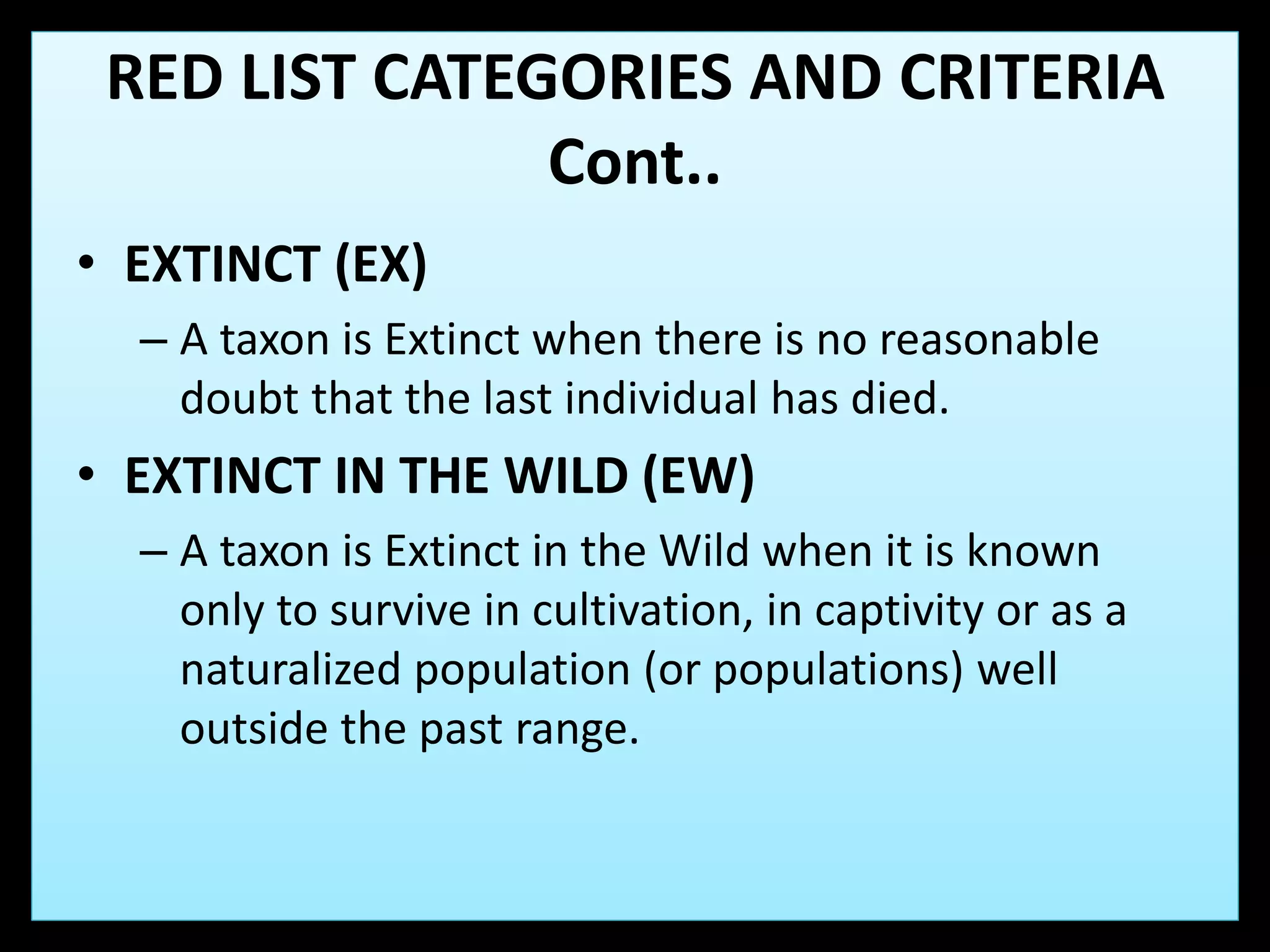
• EXTINCT (EX)
– A taxon is Extinct when there is no reasonable
doubt that the last individual has died.
• EXTINCT IN THE WILD (EW)
– A taxon is Extinct in the Wild when it is known
only to survive in cultivation, in captivity or as a
naturalized population (or populations) well
outside the past range.
RED LIST CATEGORIES AND CRITERIA
Cont..
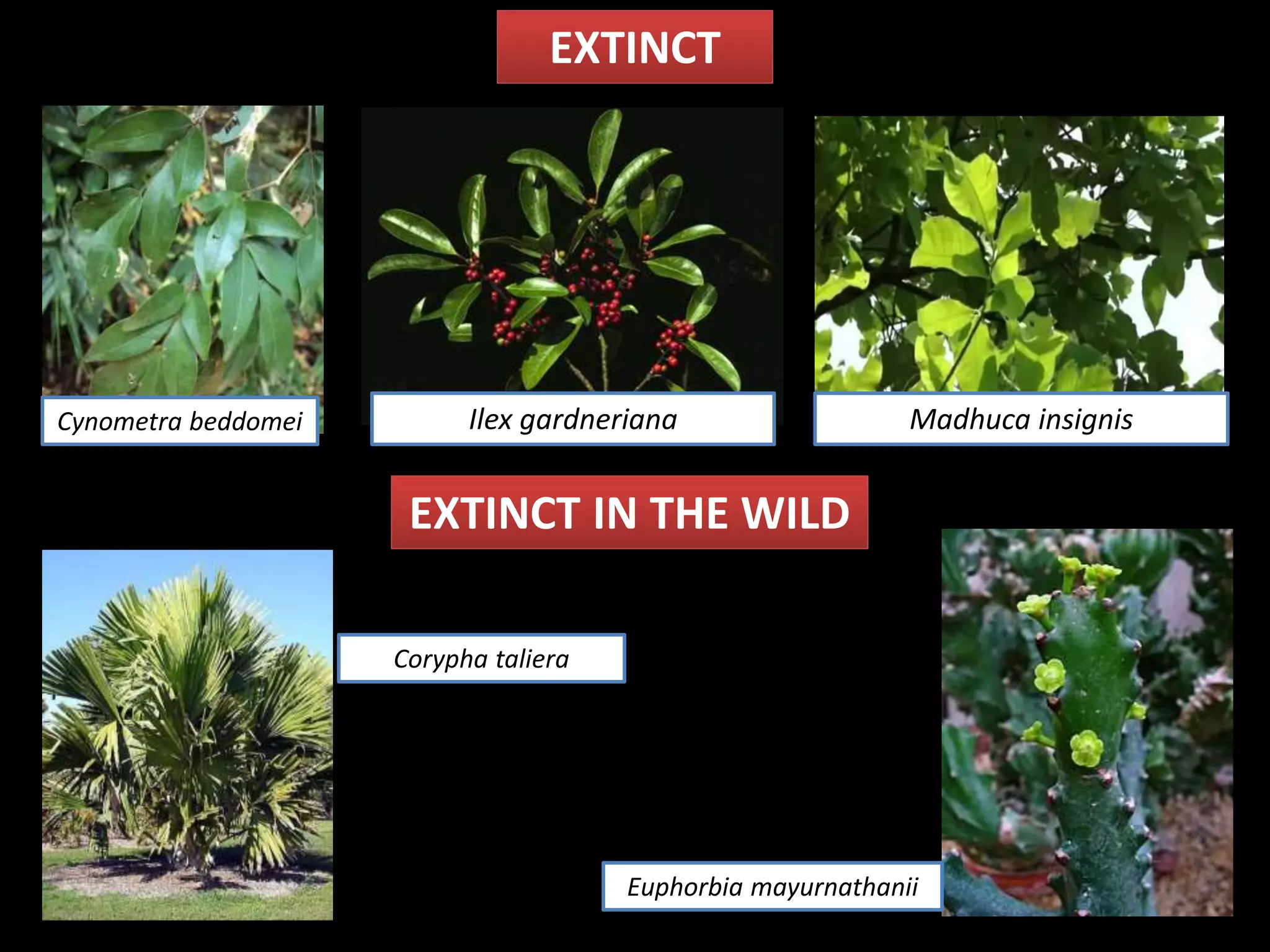
Cynometra beddomei Ilex gardneriana Madhuca insignis
EXTINCT
EXTINCT IN THE WILD
Corypha taliera
Euphorbia mayurnathanii
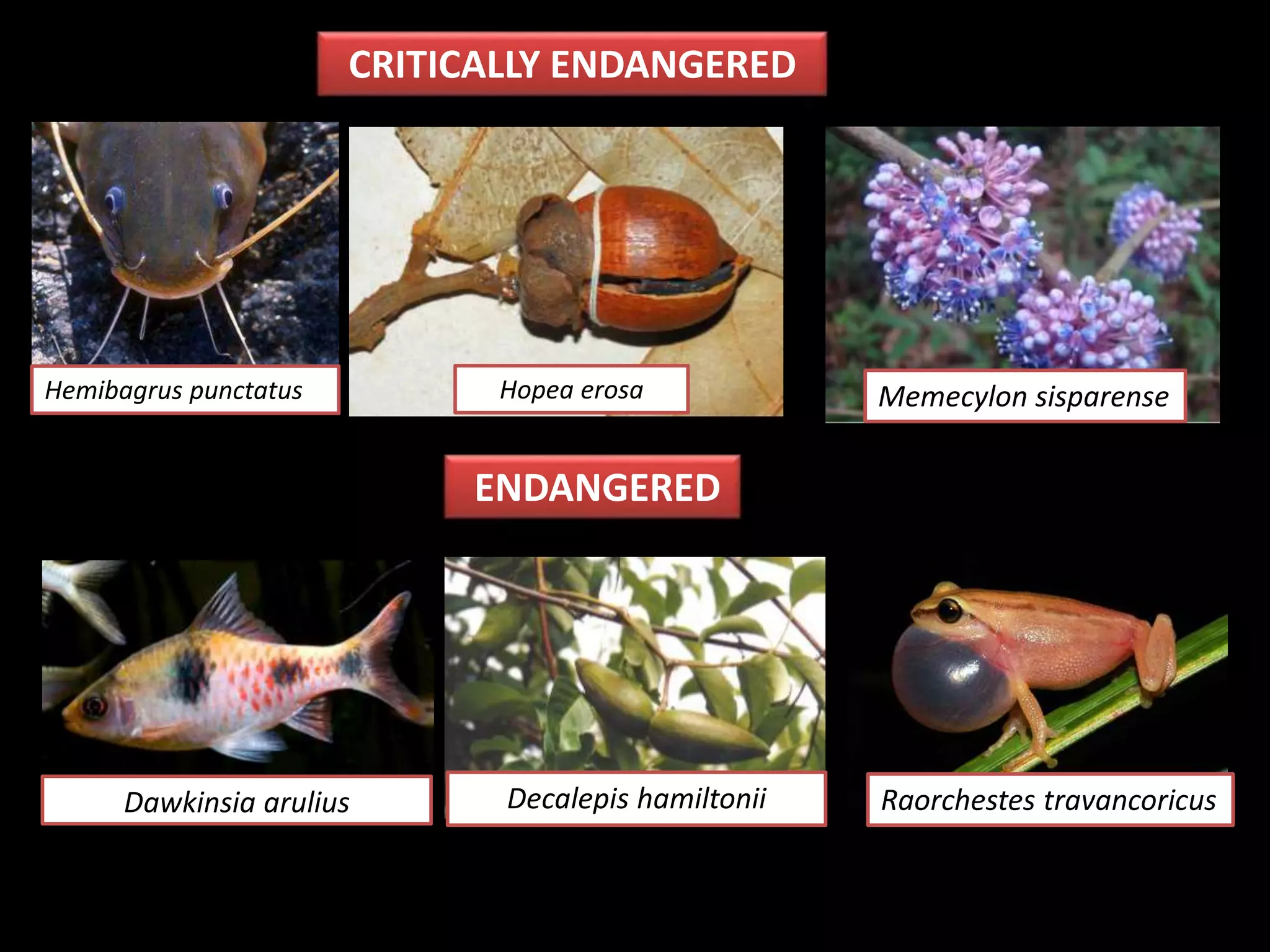
ENDANGERED
CRITICALLY ENDANGERED
Hemibagrus punctatus Hopea erosa Memecylon sisparense
Dawkinsia arulius Decalepis hamiltonii Raorchestes travancoricus
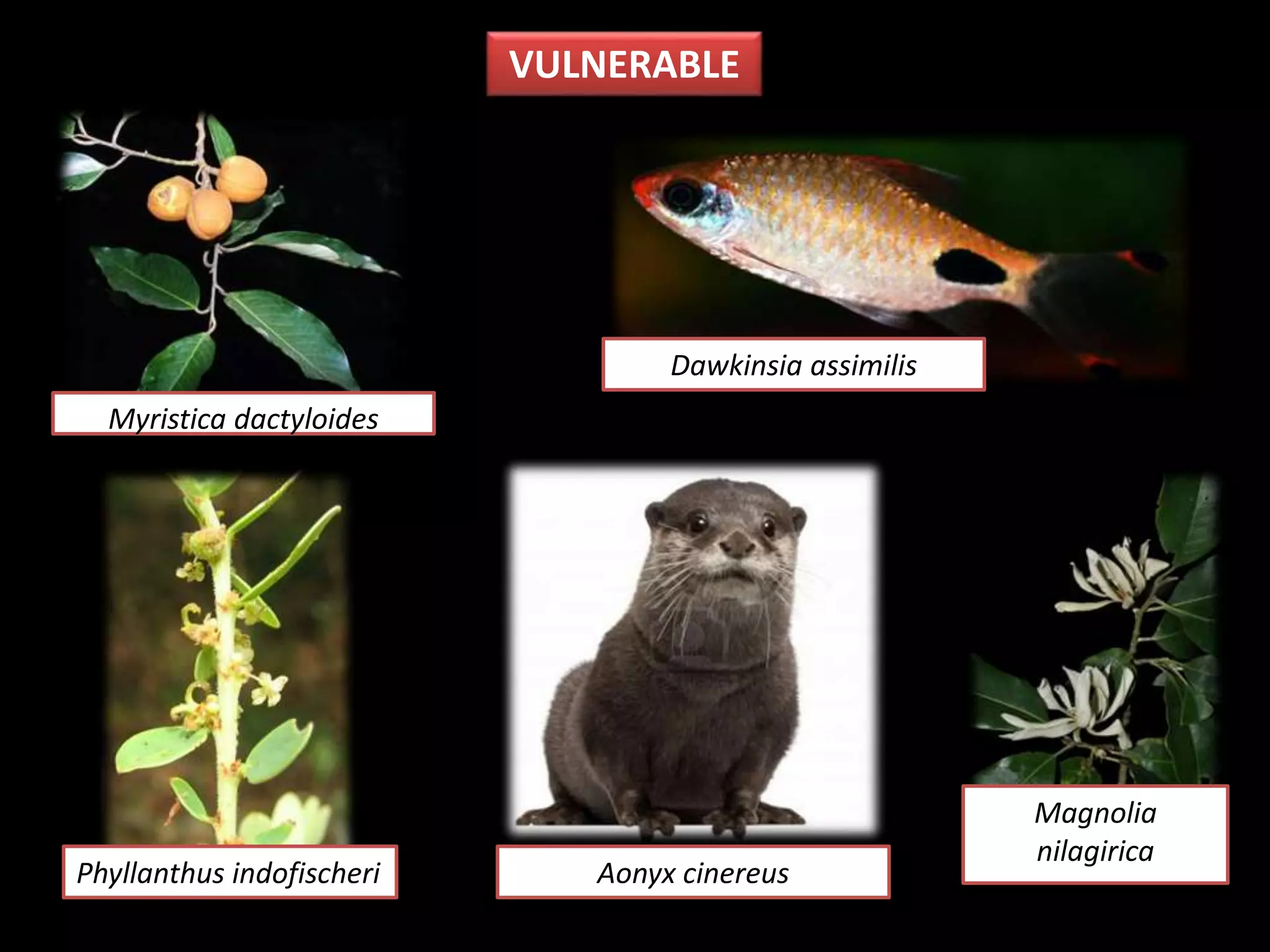
VULNERABLE
Aonyx cinereus
Magnolia
nilagirica
Dawkinsia assimilis
Myristica dactyloides
Phyllanthus indofischeri
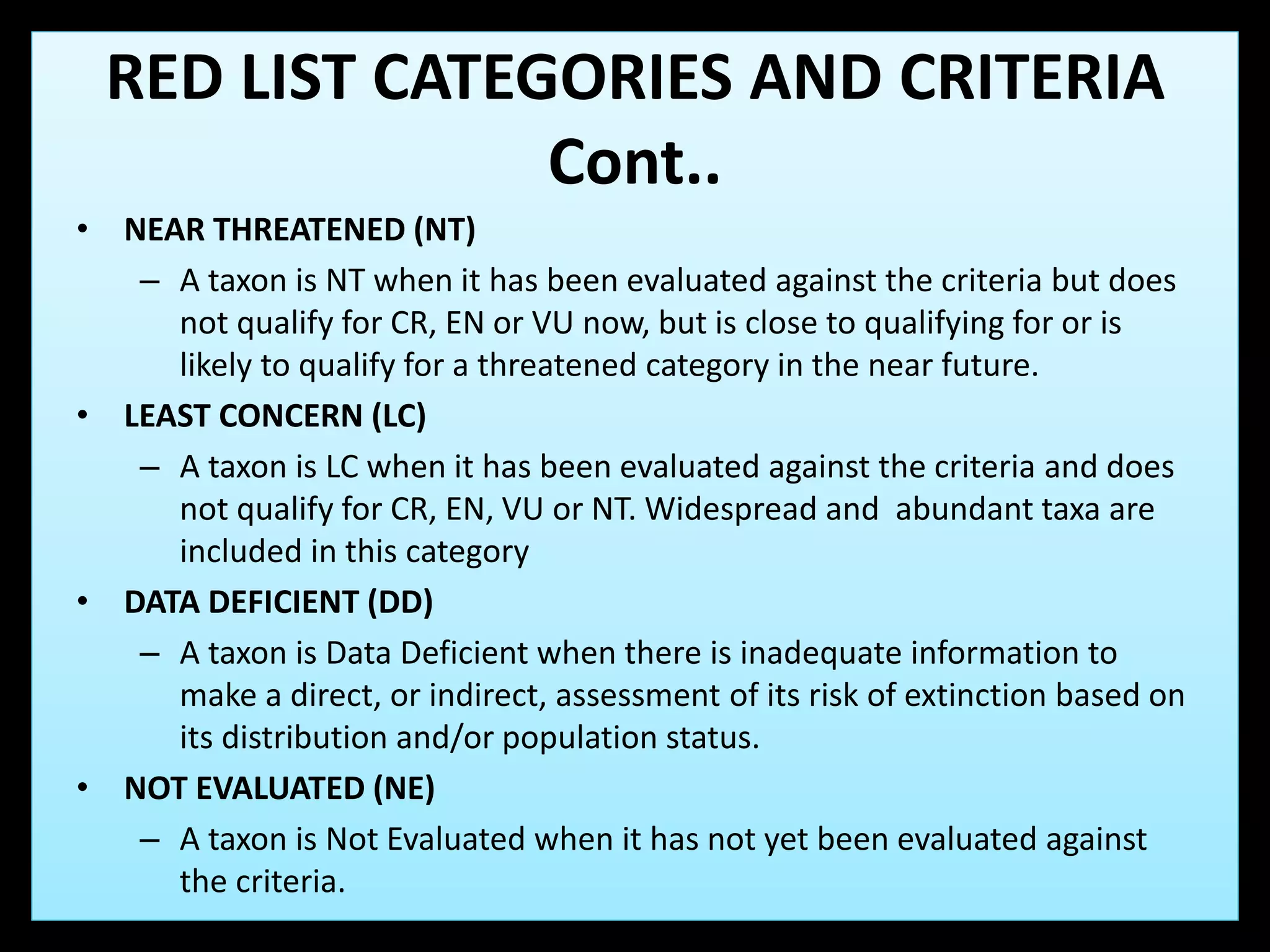
• NEAR THREATENED (NT)
– A taxon is NT when it has been evaluated against the criteria but does
not qualify for CR, EN or VU now, but is close to qualifying for or is
likely to qualify for a threatened category in the near future.
• LEAST CONCERN (LC)
– A taxon is LC when it has been evaluated against the criteria and does
not qualify for CR, EN, VU or NT. Widespread and abundant taxa are
included in this category
• DATA DEFICIENT (DD)
– A taxon is Data Deficient when there is inadequate information to
make a direct, or indirect, assessment of its risk of extinction based on
its distribution and/or population status.
• NOT EVALUATED (NE)
– A taxon is Not Evaluated when it has not yet been evaluated against
the criteria.
RED LIST CATEGORIES AND CRITERIA
Cont..
IUCN

IUCN

  • 1.
    INTERNATIONAL UNION FOR CONSERVATIONOF NATURE & natural resources Prepared by: Bhavyasree R K PhD Genetics and Plant Breeding
  • 2.
    INTERNATIONAL UNION FORCONSERVATION OF NATURE AND NATURAL RESOURCES (IUCN) • Government and civil society organization- field of nature conservation & sustainable use of natural resources • Best known for compiling and publishing red list : accesses the conservation status of species worldwide • Mission :INFLUENCE, ENCOURAGE & ASSIST societies throughout the world to conserve nature and to ensure the use of natural resources is equitable and ecologically sustainable
  • 3.
    MILESTONES 1947 1948 1961 2012 1990 1964 1949 1956 2008 Took part insetting up World wild life fund (now WWF) IUPN (international Union for protection of nature) formed IUPN and UNESCO jointly organized conference on protection of nature Changed the name to International Union for conservation of nature and natural resources International conference on protection of nature in Brunnen Red data book on the conservation status of species was first published Began using World conservation union as official name Reverted name back to IUCN IUCN publishes the list of world’s 100 most threatened species
  • 4.
    Present status… 217 Statesand Govt. agencies 1066 NGOs 16151 experts in 6 commissions 161 countries HEADQUARTERS: Gland, Switzerland
  • 5.
    IUCN- Management &Governing body • Managed by IUCN global secretariat led by Director general (Present- Inger Andersen) • General assembly of union’s members: World Conservation Congress • IUCN council – Principal Governing Body lead by the President • President of 2012-16 council :ZHANG Xinsheng (China)
  • 6.
    IUCN council 2012-16 priorities 2016Congress, which is going on in Hawai’i (United States) from 1 to 10 September 2016.
  • 7.
    Commission on Environmental, Economicand Social Policy Commission on Ecosystem Management
  • 8.
    IUCN THEMES- workacross various themes related to conservation, environmental and ecological issues • BUISNESS AND BIODIVERSITY • CLIMATE CHANGE • ECONOMICS • ECOSYSTEM MANAGEMENT • ENVIRONMENTAL LAW • FORESTS • GENDER • GLOBAL POLICY • MARINE AND POLAR PROTECTED AREAS • SCIENCE AND KNOWLEDGE • SOCIAL POLICY • SPECIES • WATER • WORLD HERITAGE
  • 9.
    Regions of Action •Asia • Central And West Africa • Eastern And Southern Africa • Eastern Europe And Central Asia • Europe • Mediterranean • Mexico, Central America And The Caribbean • Oceania • South America • Washington D.C. Office • West Asia
  • 10.
    IUCN INDIA • India:a megadiverse country -accounts for 7-8% of all recorded species, • over 45,000 species of plants and 91,000 species of animals • Four of 34 globally identified biodiversity hotspots: The Himalayas, the Western Ghats, the North-East, and the Nicobar Islands in India. • India became a State Member of IUCN in 1969, through the Ministry of Environment, Forest and Climate Change (MoEFCC). • The IUCN India Country Office was established in 2007 in New Delhi
  • 11.
    IUCN RED LIST •First published in 1964 • IUCN Global species programme working with IUCN Species Survival Commission (SSC) • Access the conservation status of species, subspecies, varieties and even selected sub populations on global scale • Highlight the taxa threatened with extinction and thereby promote their conservation
  • 12.
    RED LIST CATEGORIESAND CRITERIA
  • 13.
    • EXTINCT (EX) –A taxon is Extinct when there is no reasonable doubt that the last individual has died. • EXTINCT IN THE WILD (EW) – A taxon is Extinct in the Wild when it is known only to survive in cultivation, in captivity or as a naturalized population (or populations) well outside the past range. RED LIST CATEGORIES AND CRITERIA Cont..
  • 14.
    Cynometra beddomei Ilexgardneriana Madhuca insignis EXTINCT EXTINCT IN THE WILD Corypha taliera Euphorbia mayurnathanii
  • 17.
    ENDANGERED CRITICALLY ENDANGERED Hemibagrus punctatusHopea erosa Memecylon sisparense Dawkinsia arulius Decalepis hamiltonii Raorchestes travancoricus
  • 18.
  • 19.
    • NEAR THREATENED(NT) – A taxon is NT when it has been evaluated against the criteria but does not qualify for CR, EN or VU now, but is close to qualifying for or is likely to qualify for a threatened category in the near future. • LEAST CONCERN (LC) – A taxon is LC when it has been evaluated against the criteria and does not qualify for CR, EN, VU or NT. Widespread and abundant taxa are included in this category • DATA DEFICIENT (DD) – A taxon is Data Deficient when there is inadequate information to make a direct, or indirect, assessment of its risk of extinction based on its distribution and/or population status. • NOT EVALUATED (NE) – A taxon is Not Evaluated when it has not yet been evaluated against the criteria. RED LIST CATEGORIES AND CRITERIA Cont..