BIODIVERSITY WITH SPECIAL REFERENCE
TO INDIA-STATUS MONITORING AND
DOCUMENTATION,MAJOR DRIVERS OF
BIODIVERSITY CHANGE
 Biodiversity is the variety of life on Earth.It refers to
the totality of genes, species and ecosystems of a
region
 There are 3 components/hierarchical levels of
biodiversity
1)Genetic diversity: it refers to the total number of
characteristics of a species,a subspecies, or a group
of species.
 The variation of the genes could be in alleles, in the
entire genes or in the chromosomal structures.
 This diversity enables a population in adapting to its
envioronment and respond to natural selection.
 speciation is based on genetic diversity
2) Species diversity: it is the variety of species within a
region
 It has two components namely,Species Richness, the
number of species in a community and Species Evenness,
the relative abundance of species
3) Community diversity: this diversity has the following three
perspectives:
• Alpha diversty (within-community diversity):diversity of
organisms sharing the same community/habitat
• Beta diversity (between-community diversity):rate of
replacement of species along environmental gradients
such as altitudinal gradient,moisture gradient etc
• Gamma diversity:diversity of habitats over the total
landscape or geographical area
3)ecosystem diversity includes
climate,microclimate,soils,topography,num
ber of trophic levels,niches,energy
flow,food web,biogeochemical cycling,biotic
interactions and time etc.
 India is one of the 12 mega-biodiversity countries of the
world.
 It is estimated that 70%of the world’s total flowering plants
occur in India
 Indian gets 10th place in the world and 4th in Asia among
these 12 mega-diverse countries
 India has 10 biogeographic zones. They are Trans-Himalaya,
Himalaya, Desert, Semi-arid, Western ghats, Deccan
peninsula, Gangetic plain, Coasts, North-East, Islands
 It is among top 10-15 nations of the world for its great
diversity of plant life, especially flowering plants
 India is a source of traditional crop varieties ranking first
amongest the 12 regions of diversty of crop plants and
seventh in the contribution of agricultural species
 India is the origin of 166 species of crop plants and
320 species of wild relatives of cultivated crops
 India’s marine biodiversty is als rich, supporting the
most productive ecosystems such as mangroves,
coral reefs and estuaries
 In India, among plant kingdom angiosperms tops the
list(17,500 species) while gymnosperms are the least,
comprising only of 64 species
 In India, among animal kingdom, arthropoda tops the
list(68,389) while Protochordata are the list with only
119 species
 The endemics are concentarted mainly in western
ghats, NE Himalayas, NW Himalayas and Andaman &
Nicobar islands. About 33% of the flowering plants
present are endemic
 About 53%fresh water fishes are endemic
 About 60%of amphibians are endemic mostly in
western ghats
 About 36%reptiles are endemic
 About 10%mammals are endemic
 Indian flora is known to
harbour more endemic
species than any other
region of the world,
except Australia
 In india there are
following three mega
endemic centres
1. Eastern Himalayas:
1808 endemic plants
from approx.6000
species
2. Western Ghats: 1500
endemic plants from
4000 species
3. Western Himalayas:
1195 endemic plants
from 5000 species
 IUCN maintains RDB.It gives a complete list of lower
risk,threatened risk and extinct categories of flora and
fauna.The IUCN Red list system was initiated in 1963
 The first volume of Red Data Books on Indian animals was
published by ZSI in 199
 Red list has following uses:
• Developing awareness about the importance of threatened
biodiversity
• Identification and documentation of endangered species
• Providing a global index of the decline of biodiversity
• Guiding conservation action
• Provides information to international; agreements such as
CBD,CITES
 LOWER RISK CATEGORIES
 Least Concern(LC), lower risk.Does not qualify for a more
risk category. Widespread and abundant taxa are included
in this category
 Near Threatened(NT),is close to qualifying for or is likely
to qualify for a threatened category in the near future
 THREATENED RISK CATEGORIES
• Vulnerable(VU),considered to be facing a high risk of
extinction in the wild
• Endangered(EN),considered to be facing a very high risk of
extinction in the wild
• Critically Endangered(CR),facing an extremely high risk of
extinction in the wild
 EXTINCT
CATEGORIES
 Extinct in the
Wild(EW),known to
survive in
cultivation, in
captivity or as a
naturalized
population well
outside the past
range
 Extinct(EX),there is
no reasonable
doubt that the last
individual has died
 Monitoring biodiversity,estimates diversity at the
same location at more than one time period for
drawing inference about change
 At the genetic level,genetic diversity of individual
organisms within a population is important
 At the species level,abundance,density,and biomass
of each population may be of interest
 At the ecosystem level,richness,evenness,and
diversity of species,gulids, and communities are
important
 At the landscape level, attributes that could be
monitored include the identity,distribution,and
propotions of each type of habitat,and the
distribution of species within those habitats
 It is best to assess and interpret biodiversity across all these
levels of organization by using various approaches at several
spatial and temporal scales
 Monitoring is an effective tool to measure the progress and
effectiveness of conservation measures, and to detect biological
trends in response to natural and human induced disturbances
in the environment
 Monitoring biological diversity at national, regional and global
levels requires systematic and ecological infrastructure,
economic input and human resources
 Monitoring aims to make an inventory of species and habitats
present in an area as well as noting their natural relationships
 Different approaches can be followed monitoring
programme over a certain time span such as
 Focus on a number of key species groups such as
termites, fishes or butterflies
 Focus on the description of all species present in
a certain area
 Provide an inventory of selected species giving a
quick estimate of the biological richness of an
area
 Identify cause and effect relationships between
external developments and changes in the
biological community
 All those who will monitor,all individuals or groups that
will be involved in the monitoring activities,should be
identified and categorized in a primary, secondary and
tertiary category of monitors
PRIMARY MONITORS
 Individuals and groups that constitute the project
experts team and effectively design the indicators
 They include scientists,experts,project managers and all
individuals employed by the project whether from local
communities or not
SECONDARY MONITORS
 Individuals and groups that are not essential for the
implementation of the activities but are important to ensure
that all project indicators are properly monitored
 These include partner organizations, government, focal point
and departments, volunteer groups
TERTIARY MONITORS
 individuals and groups that may not be involved in
project but are essential to ensure long term
sustainability of proposed monitoring activities of
established indicators
 These include municipalities, as well as the private
sector, volunteer groups from local communities
 Drivers are natural or human-induced factors that
directly or indirectly cause a change in biodiversity
 Direct drivers that explicitly influence ecosystem
processes include land use change, climate change
invasive species, over exploitation and pollution
 Indirect drivers such as changes in human
population incomes or life style operate more
diffusely by altering one or more direct drivers
 Drivers affecting biodiversity range from local to global and
from immediate to long term
 Changes in biodiversity are driven by combinations of drivers
that work overtime, on different scales, and that tend to
amplify each other
 For example, population and income growth combined with
technological advances, can lead to climate change
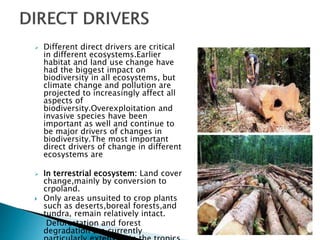
 Different direct drivers are critical
in different ecosystems.Earlier
habitat and land use change have
had the biggest impact on
biodiversity in all ecosystems, but
climate change and pollution are
projected to increasingly affect all
aspects of
biodiversity.Overexploitation and
invasive species have been
important as well and continue to
be major drivers of changes in
biodiversity.The most important
direct drivers of change in different
ecosystems are
 In terrestrial ecosystem: Land cover
change,mainly by conversion to
crpoland.
 Only areas unsuited to crop plants
such as deserts,boreal forests,and
tundra, remain relatively intact.
 Deforestation and forest
degradation are currently
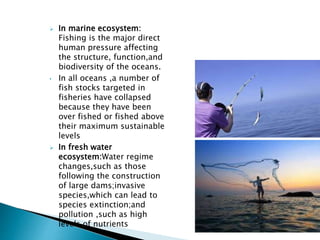
 In marine ecosystem:
Fishing is the major direct
human pressure affecting
the structure, function,and
biodiversity of the oceans.
• In all oceans ,a number of
fish stocks targeted in
fisheries have collapsed
because they have been
over fished or fished above
their maximum sustainable
levels
 In fresh water
ecosystem:Water regime
changes,such as those
following the construction
of large dams;invasive
species,which can lead to
species extinction;and
pollution ,such as high
levels of nutrients
Specific direct drivers
1. HABITAT DESTRUCTION/LOSS
 it is the primary reason for loss
of biodiversity and results from
the increase of human
population and human
activities
 it occurs in mostly on islands
 Habitat is lost by cutting down
trees,filling
wetlands,ploughing
grasslands,burning
forests,cattle
ranching,plantation,dam
construction
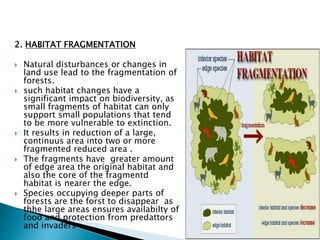
2. HABITAT FRAGMENTATION
 Natural disturbances or changes in
land use lead to the fragmentation of
forests.
 such habitat changes have a
significant impact on biodiversity, as
small fragments of habitat can only
support small populations that tend
to be more vulnerable to extinction.
 It results in reduction of a large,
continuus area into two or more
fragmented reduced area .
 The fragments have greater amount
of edge area the original habitat and
also the core of the fragmentd
habitat is nearer the edge.
 Species occupying deeper parts of
forests are the forst to disappear as
thhe large areas ensures availabilty of
food and protection from predattors
and invaders
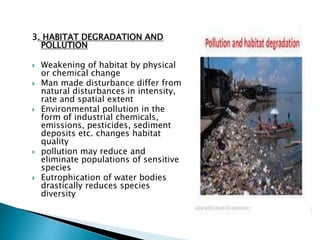
3. HABITAT DEGRADATION AND
POLLUTION
 Weakening of habitat by physical
or chemical change
 Man made disturbance differ from
natural disturbances in intensity,
rate and spatial extent
 Environmental pollution in the
form of industrial chemicals,
emissions, pesticides, sediment
deposits etc. changes habitat
quality
 pollution may reduce and
eliminate populations of sensitive
species
 Eutrophication of water bodies
drastically reduces species
diversity
4.INVASIVE ALIEN SPECIES/EXOTIC
SPECIES
 They rank second as a major cause
of biodiversity loss
 Exotic/Alien species are the new
species entering a geographical
range
 Chief factors responsible for their
introduction are:European
colonization,horticulture and
agriculiture and accidental
transport
 They may be natural chance
immigrants, escaped ornamentals
or escaped domestic animals
 They may cause of disappearance
of native species through changed
biotic interactions as they have no
natural predators
4.OVEREXPLOITATION
 It remains a serious threat to many
species, such as marine fish and
invertebrates, trees, and animals
hunted for meat
 Over exploitation results in either
complete extinction of the species or
reduction in the population size
beyond critical density
 Most industrial fisheries are either
fully or over exploited, while
destructive fishing technique harm
estuaries and wet lands
 The overexploitation of bush meat is
in a similar situation, where
sustainable levels of exploitation are
poorly understood, and the catches
difficult ti manage effectively
5. GLOBAL CLIMATE CHANGE
 Global warming, depletion of
ozone layer and acid rain are
responsible for the loss of
biodiversity across the globe
 They have affected species
distributions, population sizes
and the timing of reproduction
or migration events,as well as
the frequency of pest and
disease outbreaks
 Projected changes in climate
by 2050 could lead to the
extinction of many species
living in certain limited
geographical regions
 By the end of the century,
climate change and its impacts
may become the main direct
driver of overall biodiversity
loss
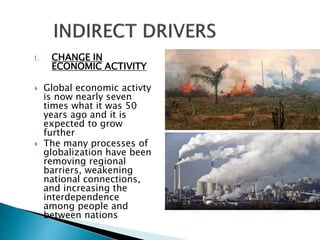
1. CHANGE IN
ECONOMIC ACTIVITY
 Global economic activty
is now nearly seven
times what it was 50
years ago and it is
expected to grow
further
 The many processes of
globalization have been
removing regional
barriers, weakening
national connections,
and increasing the
interdependence
among people and
between nations
2. POPULATION CHANGE
 World population has
doubled in the past
forty years, reaching 6
billion in 2000
 The fact that more and
more people live in
cities increases the
demand for food and
energy and thereby
pressure on
ecosystems
3. SOCIO-POLITICAL FACTORS
The trend toward democratic institutions
over the past 50 years has enabled new
forms of managemenbt of environmental
resources
4. CULTURAL AND RELIGIOUS FACTORS
Culture conditions individuals perceptions’ of
the world, and their priority setting, for
instance in terms of conservation
5. SCIENCE AND TECHONOLOGY
 The development and diffusion of scientific
knowledge and technologies can on the one
hand allow for increased efficiency in
resource use and on the other hand provide
the means to increase exploitation of natural
resources
 In-situ approaches include methods and tools
that protect species,genetic varieties and habitats
in the wild.
• It is a favourable approach amongst ecologists
and conservationsts to protect habitats and
ecosystems
 Ex situ approaches include methods that remove
plants,animals and microbial species and genetic
varieties from their envirnment.
• These are popular amongst agriculturalists and
species-oriented biololgists, and helps the
maintenance of samples of species
 Restoration and rehabilitation approaches include methods that draw upon in-situ
and ex-situ tools to re-establish species,genetic
varieties,communities,populations,habitats and ecological processes
 Ecological restoration usually invoves the reconstruction of natural and semi-
natural ecosystems on degraded lands
 This includes the reintroduction of most native species,while eclogical
rehabilitation invlves the repair of ecosystem processes
 Major land-use approaches include tools and stratgies in
forestry,fisheries,agriculture,wildlife management and tourism
 These incorporate protection,sustainable use and equity criteria and guidelines on
management objectives and practices
 Since these land-use approaches dominate most landscapes and the near shore
coastal zone,they are approaches where often the greatest reward for investments
in biodiversity management will be found
Biodiversity  india status

Biodiversity india status

  • 1.
    BIODIVERSITY WITH SPECIALREFERENCE TO INDIA-STATUS MONITORING AND DOCUMENTATION,MAJOR DRIVERS OF BIODIVERSITY CHANGE
  • 2.
     Biodiversity isthe variety of life on Earth.It refers to the totality of genes, species and ecosystems of a region  There are 3 components/hierarchical levels of biodiversity 1)Genetic diversity: it refers to the total number of characteristics of a species,a subspecies, or a group of species.  The variation of the genes could be in alleles, in the entire genes or in the chromosomal structures.  This diversity enables a population in adapting to its envioronment and respond to natural selection.  speciation is based on genetic diversity
  • 3.
    2) Species diversity:it is the variety of species within a region  It has two components namely,Species Richness, the number of species in a community and Species Evenness, the relative abundance of species 3) Community diversity: this diversity has the following three perspectives: • Alpha diversty (within-community diversity):diversity of organisms sharing the same community/habitat • Beta diversity (between-community diversity):rate of replacement of species along environmental gradients such as altitudinal gradient,moisture gradient etc • Gamma diversity:diversity of habitats over the total landscape or geographical area
  • 4.
    3)ecosystem diversity includes climate,microclimate,soils,topography,num berof trophic levels,niches,energy flow,food web,biogeochemical cycling,biotic interactions and time etc.
  • 5.
     India isone of the 12 mega-biodiversity countries of the world.  It is estimated that 70%of the world’s total flowering plants occur in India  Indian gets 10th place in the world and 4th in Asia among these 12 mega-diverse countries  India has 10 biogeographic zones. They are Trans-Himalaya, Himalaya, Desert, Semi-arid, Western ghats, Deccan peninsula, Gangetic plain, Coasts, North-East, Islands  It is among top 10-15 nations of the world for its great diversity of plant life, especially flowering plants  India is a source of traditional crop varieties ranking first amongest the 12 regions of diversty of crop plants and seventh in the contribution of agricultural species
  • 6.
     India isthe origin of 166 species of crop plants and 320 species of wild relatives of cultivated crops  India’s marine biodiversty is als rich, supporting the most productive ecosystems such as mangroves, coral reefs and estuaries  In India, among plant kingdom angiosperms tops the list(17,500 species) while gymnosperms are the least, comprising only of 64 species  In India, among animal kingdom, arthropoda tops the list(68,389) while Protochordata are the list with only 119 species
  • 7.
     The endemicsare concentarted mainly in western ghats, NE Himalayas, NW Himalayas and Andaman & Nicobar islands. About 33% of the flowering plants present are endemic  About 53%fresh water fishes are endemic  About 60%of amphibians are endemic mostly in western ghats  About 36%reptiles are endemic  About 10%mammals are endemic
  • 8.
     Indian florais known to harbour more endemic species than any other region of the world, except Australia  In india there are following three mega endemic centres 1. Eastern Himalayas: 1808 endemic plants from approx.6000 species 2. Western Ghats: 1500 endemic plants from 4000 species 3. Western Himalayas: 1195 endemic plants from 5000 species
  • 9.
     IUCN maintainsRDB.It gives a complete list of lower risk,threatened risk and extinct categories of flora and fauna.The IUCN Red list system was initiated in 1963  The first volume of Red Data Books on Indian animals was published by ZSI in 199  Red list has following uses: • Developing awareness about the importance of threatened biodiversity • Identification and documentation of endangered species • Providing a global index of the decline of biodiversity • Guiding conservation action • Provides information to international; agreements such as CBD,CITES
  • 10.
     LOWER RISKCATEGORIES  Least Concern(LC), lower risk.Does not qualify for a more risk category. Widespread and abundant taxa are included in this category  Near Threatened(NT),is close to qualifying for or is likely to qualify for a threatened category in the near future  THREATENED RISK CATEGORIES • Vulnerable(VU),considered to be facing a high risk of extinction in the wild • Endangered(EN),considered to be facing a very high risk of extinction in the wild • Critically Endangered(CR),facing an extremely high risk of extinction in the wild
  • 11.
     EXTINCT CATEGORIES  Extinctin the Wild(EW),known to survive in cultivation, in captivity or as a naturalized population well outside the past range  Extinct(EX),there is no reasonable doubt that the last individual has died
  • 12.
     Monitoring biodiversity,estimatesdiversity at the same location at more than one time period for drawing inference about change  At the genetic level,genetic diversity of individual organisms within a population is important  At the species level,abundance,density,and biomass of each population may be of interest  At the ecosystem level,richness,evenness,and diversity of species,gulids, and communities are important  At the landscape level, attributes that could be monitored include the identity,distribution,and propotions of each type of habitat,and the distribution of species within those habitats
  • 13.
     It isbest to assess and interpret biodiversity across all these levels of organization by using various approaches at several spatial and temporal scales  Monitoring is an effective tool to measure the progress and effectiveness of conservation measures, and to detect biological trends in response to natural and human induced disturbances in the environment  Monitoring biological diversity at national, regional and global levels requires systematic and ecological infrastructure, economic input and human resources  Monitoring aims to make an inventory of species and habitats present in an area as well as noting their natural relationships
  • 14.
     Different approachescan be followed monitoring programme over a certain time span such as  Focus on a number of key species groups such as termites, fishes or butterflies  Focus on the description of all species present in a certain area  Provide an inventory of selected species giving a quick estimate of the biological richness of an area  Identify cause and effect relationships between external developments and changes in the biological community
  • 15.
     All thosewho will monitor,all individuals or groups that will be involved in the monitoring activities,should be identified and categorized in a primary, secondary and tertiary category of monitors PRIMARY MONITORS  Individuals and groups that constitute the project experts team and effectively design the indicators  They include scientists,experts,project managers and all individuals employed by the project whether from local communities or not
  • 16.
    SECONDARY MONITORS  Individualsand groups that are not essential for the implementation of the activities but are important to ensure that all project indicators are properly monitored  These include partner organizations, government, focal point and departments, volunteer groups
  • 17.
    TERTIARY MONITORS  individualsand groups that may not be involved in project but are essential to ensure long term sustainability of proposed monitoring activities of established indicators  These include municipalities, as well as the private sector, volunteer groups from local communities
  • 18.
     Drivers arenatural or human-induced factors that directly or indirectly cause a change in biodiversity  Direct drivers that explicitly influence ecosystem processes include land use change, climate change invasive species, over exploitation and pollution  Indirect drivers such as changes in human population incomes or life style operate more diffusely by altering one or more direct drivers
  • 19.
     Drivers affectingbiodiversity range from local to global and from immediate to long term  Changes in biodiversity are driven by combinations of drivers that work overtime, on different scales, and that tend to amplify each other  For example, population and income growth combined with technological advances, can lead to climate change
  • 21.
     Different directdrivers are critical in different ecosystems.Earlier habitat and land use change have had the biggest impact on biodiversity in all ecosystems, but climate change and pollution are projected to increasingly affect all aspects of biodiversity.Overexploitation and invasive species have been important as well and continue to be major drivers of changes in biodiversity.The most important direct drivers of change in different ecosystems are  In terrestrial ecosystem: Land cover change,mainly by conversion to crpoland.  Only areas unsuited to crop plants such as deserts,boreal forests,and tundra, remain relatively intact.  Deforestation and forest degradation are currently
  • 22.
     In marineecosystem: Fishing is the major direct human pressure affecting the structure, function,and biodiversity of the oceans. • In all oceans ,a number of fish stocks targeted in fisheries have collapsed because they have been over fished or fished above their maximum sustainable levels  In fresh water ecosystem:Water regime changes,such as those following the construction of large dams;invasive species,which can lead to species extinction;and pollution ,such as high levels of nutrients
  • 23.
    Specific direct drivers 1.HABITAT DESTRUCTION/LOSS  it is the primary reason for loss of biodiversity and results from the increase of human population and human activities  it occurs in mostly on islands  Habitat is lost by cutting down trees,filling wetlands,ploughing grasslands,burning forests,cattle ranching,plantation,dam construction
  • 24.
    2. HABITAT FRAGMENTATION Natural disturbances or changes in land use lead to the fragmentation of forests.  such habitat changes have a significant impact on biodiversity, as small fragments of habitat can only support small populations that tend to be more vulnerable to extinction.  It results in reduction of a large, continuus area into two or more fragmented reduced area .  The fragments have greater amount of edge area the original habitat and also the core of the fragmentd habitat is nearer the edge.  Species occupying deeper parts of forests are the forst to disappear as thhe large areas ensures availabilty of food and protection from predattors and invaders
  • 25.
    3. HABITAT DEGRADATIONAND POLLUTION  Weakening of habitat by physical or chemical change  Man made disturbance differ from natural disturbances in intensity, rate and spatial extent  Environmental pollution in the form of industrial chemicals, emissions, pesticides, sediment deposits etc. changes habitat quality  pollution may reduce and eliminate populations of sensitive species  Eutrophication of water bodies drastically reduces species diversity
  • 26.
    4.INVASIVE ALIEN SPECIES/EXOTIC SPECIES They rank second as a major cause of biodiversity loss  Exotic/Alien species are the new species entering a geographical range  Chief factors responsible for their introduction are:European colonization,horticulture and agriculiture and accidental transport  They may be natural chance immigrants, escaped ornamentals or escaped domestic animals  They may cause of disappearance of native species through changed biotic interactions as they have no natural predators
  • 27.
    4.OVEREXPLOITATION  It remainsa serious threat to many species, such as marine fish and invertebrates, trees, and animals hunted for meat  Over exploitation results in either complete extinction of the species or reduction in the population size beyond critical density  Most industrial fisheries are either fully or over exploited, while destructive fishing technique harm estuaries and wet lands  The overexploitation of bush meat is in a similar situation, where sustainable levels of exploitation are poorly understood, and the catches difficult ti manage effectively
  • 28.
    5. GLOBAL CLIMATECHANGE  Global warming, depletion of ozone layer and acid rain are responsible for the loss of biodiversity across the globe  They have affected species distributions, population sizes and the timing of reproduction or migration events,as well as the frequency of pest and disease outbreaks  Projected changes in climate by 2050 could lead to the extinction of many species living in certain limited geographical regions  By the end of the century, climate change and its impacts may become the main direct driver of overall biodiversity loss
  • 29.
    1. CHANGE IN ECONOMICACTIVITY  Global economic activty is now nearly seven times what it was 50 years ago and it is expected to grow further  The many processes of globalization have been removing regional barriers, weakening national connections, and increasing the interdependence among people and between nations
  • 30.
    2. POPULATION CHANGE World population has doubled in the past forty years, reaching 6 billion in 2000  The fact that more and more people live in cities increases the demand for food and energy and thereby pressure on ecosystems
  • 31.
    3. SOCIO-POLITICAL FACTORS Thetrend toward democratic institutions over the past 50 years has enabled new forms of managemenbt of environmental resources 4. CULTURAL AND RELIGIOUS FACTORS Culture conditions individuals perceptions’ of the world, and their priority setting, for instance in terms of conservation
  • 32.
    5. SCIENCE ANDTECHONOLOGY  The development and diffusion of scientific knowledge and technologies can on the one hand allow for increased efficiency in resource use and on the other hand provide the means to increase exploitation of natural resources
  • 33.
     In-situ approachesinclude methods and tools that protect species,genetic varieties and habitats in the wild. • It is a favourable approach amongst ecologists and conservationsts to protect habitats and ecosystems  Ex situ approaches include methods that remove plants,animals and microbial species and genetic varieties from their envirnment. • These are popular amongst agriculturalists and species-oriented biololgists, and helps the maintenance of samples of species
  • 34.
     Restoration andrehabilitation approaches include methods that draw upon in-situ and ex-situ tools to re-establish species,genetic varieties,communities,populations,habitats and ecological processes  Ecological restoration usually invoves the reconstruction of natural and semi- natural ecosystems on degraded lands  This includes the reintroduction of most native species,while eclogical rehabilitation invlves the repair of ecosystem processes  Major land-use approaches include tools and stratgies in forestry,fisheries,agriculture,wildlife management and tourism  These incorporate protection,sustainable use and equity criteria and guidelines on management objectives and practices  Since these land-use approaches dominate most landscapes and the near shore coastal zone,they are approaches where often the greatest reward for investments in biodiversity management will be found