Prokaryote Gene Expression
Section 1
Overview of RNA Function
Overview : Section 1
 “Central Dogma” of molecular biology
 mRNA Structure and organisation
 Prokaryotic mRNA
 Eukaryotic cytoplasmic mRNA
 Eukaryotic organelle mRNA
 tRNA: structure and overview of function
 Overview of translation
 Biosynthetic cycle of mRNA
 Polycistronic and monocistronic mRNAs
 Prokaryotic and eukaryotic mRNAs
“Central Dogma” of molecular
biology
 “dogma” - a strongly held viewpoint or idea
 Genetic information is stored in DNA, but is
expressed as proteins, through the
intermediate step of mRNA
 The processes of Replication, Transcription
and Translation regulate this storage and
expression of information
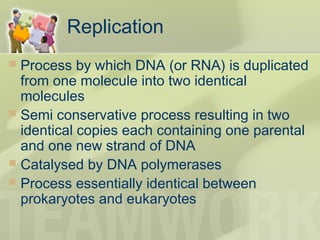
Replication
 Process by which DNA (or RNA) is duplicated
from one molecule into two identical
molecules
 Semi conservative process resulting in two
identical copies each containing one parental
and one new strand of DNA
 Catalysed by DNA polymerases
 Process essentially identical between
prokaryotes and eukaryotes
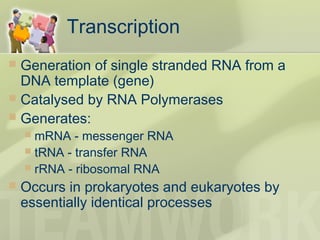
Transcription
 Generation of single stranded RNA from a
DNA template (gene)
 Catalysed by RNA Polymerases
 Generates:
 mRNA - messenger RNA
 tRNA - transfer RNA
 rRNA - ribosomal RNA
 Occurs in prokaryotes and eukaryotes by
essentially identical processes
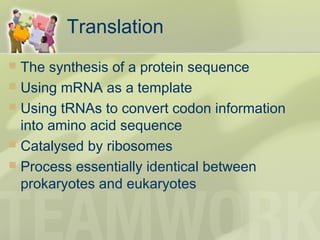
Translation
 The synthesis of a protein sequence
 Using mRNA as a template
 Using tRNAs to convert codon information
into amino acid sequence
 Catalysed by ribosomes
 Process essentially identical between
prokaryotes and eukaryotes
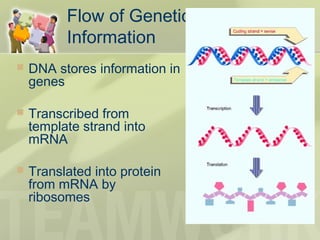
Flow of Genetic
Information
 DNA stores information in
genes
 Transcribed from
template strand into
mRNA
 Translated into protein
from mRNA by
ribosomes
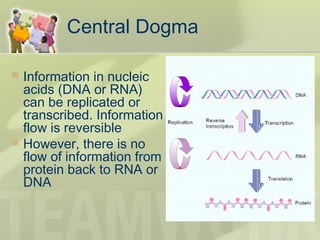
Central Dogma
 Information in nucleic
acids (DNA or RNA)
can be replicated or
transcribed. Information
flow is reversible
 However, there is no
flow of information from
protein back to RNA or
DNA
Genotype and Phenotype
 A Genotype is the specific allele at a locus (gene).
Variation in alleles is the cause of variation in
individuals
 mRNA is the mechanism by which information
encoded in genes is converted to proteins
 The activities of proteins are responsible for the
phenotype attributable to a gene
 The regulation of the level of expression of mRNA is
therefore the basis for regulating the expression of
the phenotype of a gene
 Regulation is primarily at the level of varying the rate
of transcription of genes
mRNA Structure
 mRNAs are single stranded RNA molecules
 They are copied from the TEMPLATE strand
of the gene, to give the SENSE strand in RNA
 They are transcribed from the 5’ to the 3’ end
 They are translated from the 5’ to the 3’ end
 Generally mRNAs are linear (although some
prokaryotic RNA viruses are circular and act
as mRNAs)
mRNA information coding
 They can code for one or many proteins
(translation of products) in prokaryotes
(polycistronic)
 They encode only one protein (each) in
eukaryotes (monocistronic)
 Polyproteins are observed in eukaryotic
viruses, but these are a single translation
product, cleaved into separate proteins after
translation
RNA synthesis
 Catalysed by RNA Polymerase
 Cycle requires initiation, elongation and
termination
 Initiation is at the Promoter sequence
 Regulation of gene expression is at the
initiation stage
 Transcription factors binding to the promoter
regulate the rate of initiation of RNA
Polymerase
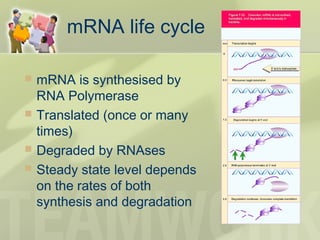
mRNA life cycle
 mRNA is synthesised by
RNA Polymerase
 Translated (once or many
times)
 Degraded by RNAses
 Steady state level depends
on the rates of both
synthesis and degradation
Prokaryote mRNA structure
 Linear RNA structure
 5’ and 3’ ends are unmodified
 Ribosomes bind at ribosome binding site,
internally within mRNA (do not require a free
5’ end)
 Can contain many open reading frames
(ORFs)
 Translated from 5’ end to 3’ end
 Transcribed and translated together
Eukaryote cytoplasmic mRNA
structure
 Linear RNA structure
 5’ and 3’ ends are modified
 5’ GpppG cap
 3’ poly A tail
 Transcribed, spliced, capped, poly
Adenylated in the nucleus, exported to
the cytoplasm
Eukaryote mRNA
translation
 Translated from 5’ end to 3’ end in cytoplasm
 Ribosomes bind at 5’ cap, and do require a
free 5’ end
 Can contain only one translated open reading
frames (ORF). Only first open reading frame
is translated
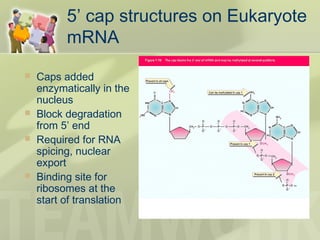
5’ cap structures on Eukaryote
mRNA
 Caps added
enzymatically in the
nucleus
 Block degradation
from 5’ end
 Required for RNA
spicing, nuclear
export
 Binding site for
ribosomes at the
start of translation
Poly A tails on eukaryote
mRNA
 Added to the 3’ end by poly A polymerase
 Added in the nucleus
 Approximately 200 A residues added in a template
independent fashion
 Required for splicing and nuclear export
 Bind poly A binding protein in the cytoplasm
 Prevent degradation of mRNA
 Loss of poly A binding protein results in sudden degradation
of mRNA in cytoplasm
 Regulates biological half-life of mRNA in vivo
mRNA Splicing
 Eukaryote genes made up of Exons and
Introns
 mRNA transcripts contain both exons and
introns when first synthesised
 Intron sequences removed from mRNA by
Splicing in the nucleus
 Occurs in eukaryotes, but not in prokaryotes
 Alternative splicing can generate diversity of
mRNA structures from a single gene
Eukaryote organelle mRNA
structure
 Single stranded
 Polycistronic (many ORFs)
 Unmodified 5’ and 3’ ends
 Transcribed and translated together
 Show similarity to prokaryote genes and
transcripts
Transfer RNA
 Small RNAs 75 - 85 bases in length
 Highly conserved secondary and tertiary
structures
 Each class of tRNA charged with a single
amino acid
 Each tRNA has a specific trinucleotide anti-
codon for mRNA recognition
 Conservation of structure and function in
prokaryotes and eukaryotes
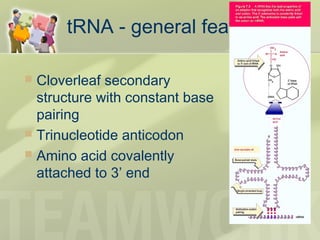
tRNA - general features
 Cloverleaf secondary
structure with constant base
pairing
 Trinucleotide anticodon
 Amino acid covalently
attached to 3’ end
tRNA: constant bases
and base pairing
 Constant structures of tRNAs due to
conserved bases at certain positions
 These form conserved base paired structures
which drive the formation of a stable fold
 First four double helical structures are formed
 Then the arms of the tRNA fold over to fold
the 3D structure
 The formation of triple base pairings stabilise
the overall 3D structure
tRNA conserved structures
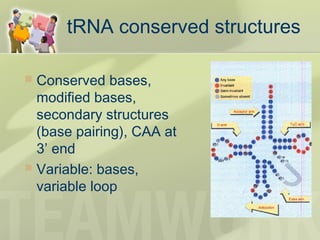
 Conserved bases,
modified bases,
secondary structures
(base pairing), CAA at
3’ end
 Variable: bases,
variable loop
tRNA secondary structure
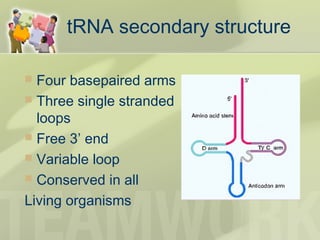
 Four basepaired arms
 Three single stranded
loops
 Free 3’ end
 Variable loop
 Conserved in all
Living organisms
tRNA 2D and 3D views
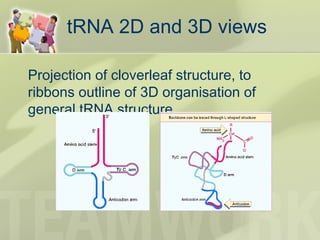
Projection of cloverleaf structure, to
ribbons outline of 3D organisation of
general tRNA structure
tRNA 3D ribbon - spacefill
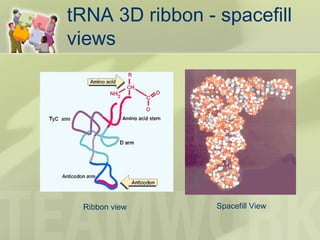
views
Ribbon view Spacefill View
tRNAs have common 3D
structure
 All tRNAs have a common 3D fold
 Bind to three sites on ribosomes, which fit this
common 3D structure
 Function to bind codons on mRNA bound to
ribosome and bring amino acyl groups to the
catalytic site on the ribosome
 Ribosomes to not differentiate tRNA structure
or amino acylation.
Aminoacylation of tRNAs
 tRNAs have amino acids added to them by enzymes
 These enzymes are the aminoacyl tRNA synthetases
 They add the specific amino acid to the correct tRNA in an
ATP dependent charging reaction
 Each enzyme recognises a specific amino acid and its
cognate tRNA, but does not only use the anti-codon for the
specificity of this reaction
 There are 20 amino acids, 24-60 tRNAs and generally
approximately than 20 aa-tRNA synthetases
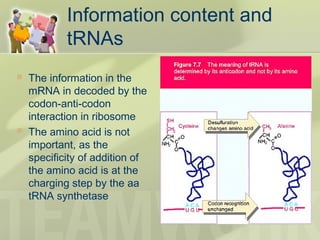
Information content and
tRNAs
 The information in the
mRNA in decoded by the
codon-anti-codon
interaction in ribosome
 The amino acid is not
important, as the
specificity of addition of
the amino acid is at the
charging step by the aa
tRNA synthetase
Ribosomes
 Highly conserved structures
 Found in all living organisms
 Made of RNA and ribosomal proteins
 Have two subunits, which bind together to
protein synthesis
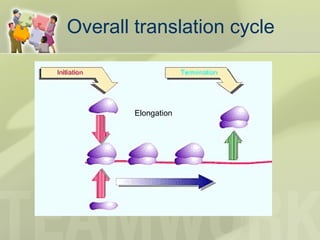
 Cycle of protein synthesis consists of
Initiation, Elongation and Termination
Ribosome structure
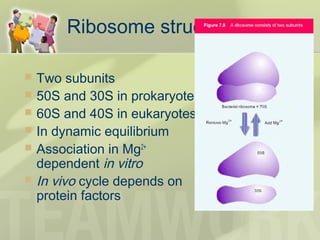
 Two subunits
 50S and 30S in prokaryotes
 60S and 40S in eukaryotes
 In dynamic equilibrium
 Association in Mg2+
dependent in vitro
 In vivo cycle depends on
protein factors
3D structure of ribosomes
 Most complex macromolecular complex yet
characterised
 Atomic resolution structure provides much
information about mechanisms of binding
substrates, and mechanisms of catalysis
 Is helping to clarify mechanisms of action of
antibiotics, which will lead to improved drug
designs in future
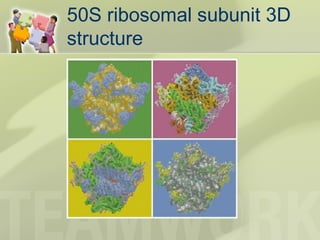
50S ribosomal subunit 3D
structure
Overview of Translation
 Biosynthesis of polypeptide (protein)
 Requires information content from mRNA
 Catalysed by ribosomes
 Requires amino acyl-tRNAs, mRNA, various
protein factors, ATP and GTP
 Rate of translation of mRNA determined by
rate of initiation of translation of mRNA
 Translation is not generally used as a
regulatory point in control of gene expression
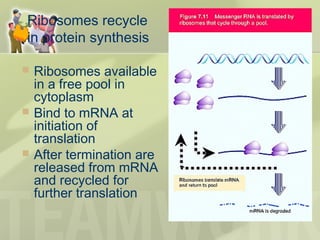
Ribosomes recycle
in protein synthesis
 Ribosomes available
in a free pool in
cytoplasm
 Bind to mRNA at
initiation of
translation
 After termination are
released from mRNA
and recycled for
further translation
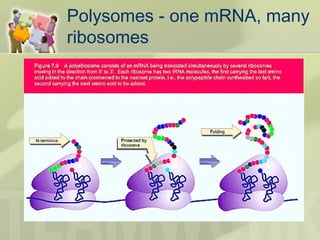
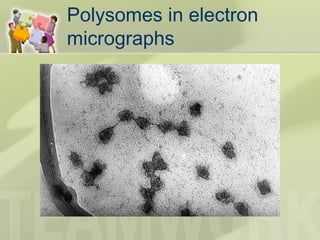
Polysomes - one mRNA, many
ribosomes
Polysomes in electron
micrographs
Transcription and
translation
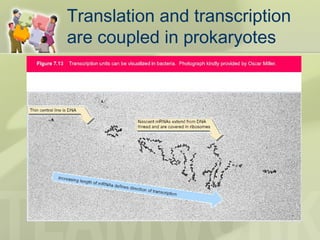
 RNA and protein synthesis are coupled processes in
prokaryotes
 As soon as the 5’ end of the mRNA is biosynthesised it is
available for translation
 Ribosomes bind, and start protein synthesis
 Degradation of the mRNA starts from the 5’ end through exo-
RNAase action
 The 5’ end can be degraded before the 3’ end is synthesised
 Coupling of these processes is important for regulation of
gene expression
Overall translation cycle
Elongation
Translation and transcription
are coupled in prokaryotes
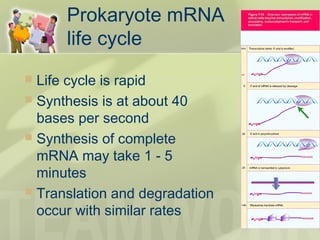
Prokaryote mRNA
life cycle
 Life cycle is rapid
 Synthesis is at about 40
bases per second
 Synthesis of complete
mRNA may take 1 - 5
minutes
 Translation and degradation
occur with similar rates
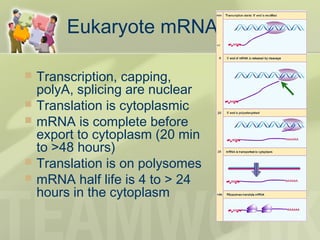
Eukaryote mRNA lifecycle
 Transcription, capping,
polyA, splicing are nuclear
 Translation is cytoplasmic
 mRNA is complete before
export to cytoplasm (20 min
to >48 hours)
 Translation is on polysomes
 mRNA half life is 4 to > 24
hours in the cytoplasm

Prokaryotic vs eukaryotic 3

  • 1.
    Prokaryote Gene Expression Section1 Overview of RNA Function
  • 2.
    Overview : Section1  “Central Dogma” of molecular biology  mRNA Structure and organisation  Prokaryotic mRNA  Eukaryotic cytoplasmic mRNA  Eukaryotic organelle mRNA  tRNA: structure and overview of function  Overview of translation  Biosynthetic cycle of mRNA  Polycistronic and monocistronic mRNAs  Prokaryotic and eukaryotic mRNAs
  • 3.
    “Central Dogma” ofmolecular biology  “dogma” - a strongly held viewpoint or idea  Genetic information is stored in DNA, but is expressed as proteins, through the intermediate step of mRNA  The processes of Replication, Transcription and Translation regulate this storage and expression of information
  • 4.
    Replication  Process bywhich DNA (or RNA) is duplicated from one molecule into two identical molecules  Semi conservative process resulting in two identical copies each containing one parental and one new strand of DNA  Catalysed by DNA polymerases  Process essentially identical between prokaryotes and eukaryotes
  • 5.
    Transcription  Generation ofsingle stranded RNA from a DNA template (gene)  Catalysed by RNA Polymerases  Generates:  mRNA - messenger RNA  tRNA - transfer RNA  rRNA - ribosomal RNA  Occurs in prokaryotes and eukaryotes by essentially identical processes
  • 6.
    Translation  The synthesisof a protein sequence  Using mRNA as a template  Using tRNAs to convert codon information into amino acid sequence  Catalysed by ribosomes  Process essentially identical between prokaryotes and eukaryotes
  • 7.
    Flow of Genetic Information DNA stores information in genes  Transcribed from template strand into mRNA  Translated into protein from mRNA by ribosomes
  • 8.
    Central Dogma  Informationin nucleic acids (DNA or RNA) can be replicated or transcribed. Information flow is reversible  However, there is no flow of information from protein back to RNA or DNA
  • 9.
    Genotype and Phenotype A Genotype is the specific allele at a locus (gene). Variation in alleles is the cause of variation in individuals  mRNA is the mechanism by which information encoded in genes is converted to proteins  The activities of proteins are responsible for the phenotype attributable to a gene  The regulation of the level of expression of mRNA is therefore the basis for regulating the expression of the phenotype of a gene  Regulation is primarily at the level of varying the rate of transcription of genes
  • 10.
    mRNA Structure  mRNAsare single stranded RNA molecules  They are copied from the TEMPLATE strand of the gene, to give the SENSE strand in RNA  They are transcribed from the 5’ to the 3’ end  They are translated from the 5’ to the 3’ end  Generally mRNAs are linear (although some prokaryotic RNA viruses are circular and act as mRNAs)
  • 11.
    mRNA information coding They can code for one or many proteins (translation of products) in prokaryotes (polycistronic)  They encode only one protein (each) in eukaryotes (monocistronic)  Polyproteins are observed in eukaryotic viruses, but these are a single translation product, cleaved into separate proteins after translation
  • 12.
    RNA synthesis  Catalysedby RNA Polymerase  Cycle requires initiation, elongation and termination  Initiation is at the Promoter sequence  Regulation of gene expression is at the initiation stage  Transcription factors binding to the promoter regulate the rate of initiation of RNA Polymerase
  • 13.
    mRNA life cycle mRNA is synthesised by RNA Polymerase  Translated (once or many times)  Degraded by RNAses  Steady state level depends on the rates of both synthesis and degradation
  • 14.
    Prokaryote mRNA structure Linear RNA structure  5’ and 3’ ends are unmodified  Ribosomes bind at ribosome binding site, internally within mRNA (do not require a free 5’ end)  Can contain many open reading frames (ORFs)  Translated from 5’ end to 3’ end  Transcribed and translated together
  • 15.
    Eukaryote cytoplasmic mRNA structure Linear RNA structure  5’ and 3’ ends are modified  5’ GpppG cap  3’ poly A tail  Transcribed, spliced, capped, poly Adenylated in the nucleus, exported to the cytoplasm
  • 16.
    Eukaryote mRNA translation  Translatedfrom 5’ end to 3’ end in cytoplasm  Ribosomes bind at 5’ cap, and do require a free 5’ end  Can contain only one translated open reading frames (ORF). Only first open reading frame is translated
  • 17.
    5’ cap structureson Eukaryote mRNA  Caps added enzymatically in the nucleus  Block degradation from 5’ end  Required for RNA spicing, nuclear export  Binding site for ribosomes at the start of translation
  • 18.
    Poly A tailson eukaryote mRNA  Added to the 3’ end by poly A polymerase  Added in the nucleus  Approximately 200 A residues added in a template independent fashion  Required for splicing and nuclear export  Bind poly A binding protein in the cytoplasm  Prevent degradation of mRNA  Loss of poly A binding protein results in sudden degradation of mRNA in cytoplasm  Regulates biological half-life of mRNA in vivo
  • 19.
    mRNA Splicing  Eukaryotegenes made up of Exons and Introns  mRNA transcripts contain both exons and introns when first synthesised  Intron sequences removed from mRNA by Splicing in the nucleus  Occurs in eukaryotes, but not in prokaryotes  Alternative splicing can generate diversity of mRNA structures from a single gene
  • 20.
    Eukaryote organelle mRNA structure Single stranded  Polycistronic (many ORFs)  Unmodified 5’ and 3’ ends  Transcribed and translated together  Show similarity to prokaryote genes and transcripts
  • 21.
    Transfer RNA  SmallRNAs 75 - 85 bases in length  Highly conserved secondary and tertiary structures  Each class of tRNA charged with a single amino acid  Each tRNA has a specific trinucleotide anti- codon for mRNA recognition  Conservation of structure and function in prokaryotes and eukaryotes
  • 22.
    tRNA - generalfeatures  Cloverleaf secondary structure with constant base pairing  Trinucleotide anticodon  Amino acid covalently attached to 3’ end
  • 23.
    tRNA: constant bases andbase pairing  Constant structures of tRNAs due to conserved bases at certain positions  These form conserved base paired structures which drive the formation of a stable fold  First four double helical structures are formed  Then the arms of the tRNA fold over to fold the 3D structure  The formation of triple base pairings stabilise the overall 3D structure
  • 24.
    tRNA conserved structures Conserved bases, modified bases, secondary structures (base pairing), CAA at 3’ end  Variable: bases, variable loop
  • 25.
    tRNA secondary structure Four basepaired arms  Three single stranded loops  Free 3’ end  Variable loop  Conserved in all Living organisms
  • 26.
    tRNA 2D and3D views Projection of cloverleaf structure, to ribbons outline of 3D organisation of general tRNA structure
  • 27.
    tRNA 3D ribbon- spacefill views Ribbon view Spacefill View
  • 28.
    tRNAs have common3D structure  All tRNAs have a common 3D fold  Bind to three sites on ribosomes, which fit this common 3D structure  Function to bind codons on mRNA bound to ribosome and bring amino acyl groups to the catalytic site on the ribosome  Ribosomes to not differentiate tRNA structure or amino acylation.
  • 29.
    Aminoacylation of tRNAs tRNAs have amino acids added to them by enzymes  These enzymes are the aminoacyl tRNA synthetases  They add the specific amino acid to the correct tRNA in an ATP dependent charging reaction  Each enzyme recognises a specific amino acid and its cognate tRNA, but does not only use the anti-codon for the specificity of this reaction  There are 20 amino acids, 24-60 tRNAs and generally approximately than 20 aa-tRNA synthetases
  • 30.
    Information content and tRNAs The information in the mRNA in decoded by the codon-anti-codon interaction in ribosome  The amino acid is not important, as the specificity of addition of the amino acid is at the charging step by the aa tRNA synthetase
  • 31.
    Ribosomes  Highly conservedstructures  Found in all living organisms  Made of RNA and ribosomal proteins  Have two subunits, which bind together to protein synthesis  Cycle of protein synthesis consists of Initiation, Elongation and Termination
  • 32.
    Ribosome structure  Twosubunits  50S and 30S in prokaryotes  60S and 40S in eukaryotes  In dynamic equilibrium  Association in Mg2+ dependent in vitro  In vivo cycle depends on protein factors
  • 33.
    3D structure ofribosomes  Most complex macromolecular complex yet characterised  Atomic resolution structure provides much information about mechanisms of binding substrates, and mechanisms of catalysis  Is helping to clarify mechanisms of action of antibiotics, which will lead to improved drug designs in future
  • 34.
  • 35.
    Overview of Translation Biosynthesis of polypeptide (protein)  Requires information content from mRNA  Catalysed by ribosomes  Requires amino acyl-tRNAs, mRNA, various protein factors, ATP and GTP  Rate of translation of mRNA determined by rate of initiation of translation of mRNA  Translation is not generally used as a regulatory point in control of gene expression
  • 36.
    Ribosomes recycle in proteinsynthesis  Ribosomes available in a free pool in cytoplasm  Bind to mRNA at initiation of translation  After termination are released from mRNA and recycled for further translation
  • 37.
    Polysomes - onemRNA, many ribosomes
  • 38.
  • 39.
    Transcription and translation  RNAand protein synthesis are coupled processes in prokaryotes  As soon as the 5’ end of the mRNA is biosynthesised it is available for translation  Ribosomes bind, and start protein synthesis  Degradation of the mRNA starts from the 5’ end through exo- RNAase action  The 5’ end can be degraded before the 3’ end is synthesised  Coupling of these processes is important for regulation of gene expression
  • 40.
  • 41.
    Translation and transcription arecoupled in prokaryotes
  • 42.
    Prokaryote mRNA life cycle Life cycle is rapid  Synthesis is at about 40 bases per second  Synthesis of complete mRNA may take 1 - 5 minutes  Translation and degradation occur with similar rates
  • 43.
    Eukaryote mRNA lifecycle Transcription, capping, polyA, splicing are nuclear  Translation is cytoplasmic  mRNA is complete before export to cytoplasm (20 min to >48 hours)  Translation is on polysomes  mRNA half life is 4 to > 24 hours in the cytoplasm