selfexplanatory.2022
Hello
HI
नमस्ते
ْ‫م‬ُ‫ك‬ْ‫ي‬‫ا‬‫ل‬‫ا‬‫ع‬ ُ‫م‬ ‫ا‬
‫َل‬ َّ
‫الس‬
ِ َّ
‫ٱَّلل‬ ُ‫اة‬‫م‬ْ‫ح‬‫ا‬‫ر‬‫ا‬‫و‬
ُ‫ه‬ُ‫ت‬‫كا‬‫ا‬‫ر‬‫ا‬‫ب‬‫ا‬‫و‬
Saba Parvin Haque
M.Sc. Life Sciences
(Specialization in Neurobiology)
from “Sophia College”
(Autonomous), Mumbai.
Protein Structure
classification/domain
prediction:
SCOP and CATH
BIOINFORMATICS
Classification
Of
Structural
Protein
https://images.app.goo.gl/1CxkhmPcXQNrCqep7
SCOP was created in 1994 in the
Centre for Protein Engineering
(CPE) and the Laboratory of
Molecular Biology (LMB).
SCop
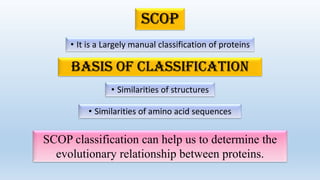
• It is a Largely manual classification of proteins
• Similarities of structures
• Similarities of amino acid sequences
Basis of classification
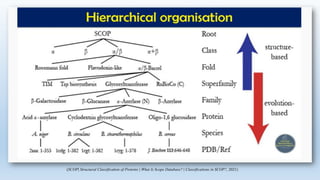
SCOP classification can help us to determine the
evolutionary relationship between proteins.
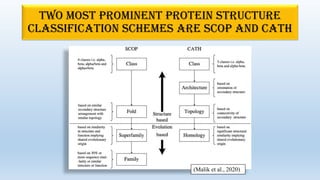
Two Most Prominent Protein Structure
Classification Schemes Are SCOP And CATH
(Malik et al., 2020)
(Lin et al., 2013)
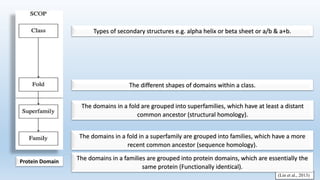
Types of secondary structures e.g. alpha helix or beta sheet or a/b & a+b.
The different shapes of domains within a class.
The domains in a fold are grouped into superfamilies, which have at least a distant
common ancestor (structural homology).
The domains in a fold in a superfamily are grouped into families, which have a more
recent common ancestor (sequence homology).
The domains in a families are grouped into protein domains, which are essentially the
same protein (Functionally identical).
Protein Domain
(SCOP| Structural Classification of Proteins | What Is Scope Database? | Classifications in SCOP?, 2021)
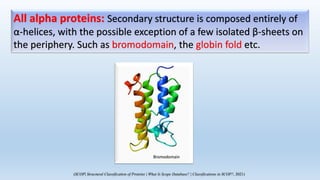
All alpha proteins: Secondary structure is composed entirely of
α-helices, with the possible exception of a few isolated β-sheets on
the periphery. Such as bromodomain, the globin fold etc.
(SCOP| Structural Classification of Proteins | What Is Scope Database? | Classifications in SCOP?, 2021)
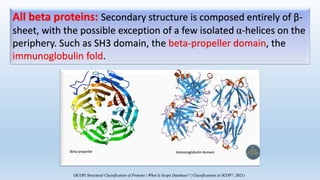
All beta proteins: Secondary structure is composed entirely of β-
sheet, with the possible exception of a few isolated α-helices on the
periphery. Such as SH3 domain, the beta-propeller domain, the
immunoglobulin fold.
(SCOP| Structural Classification of Proteins | What Is Scope Database? | Classifications in SCOP?, 2021)
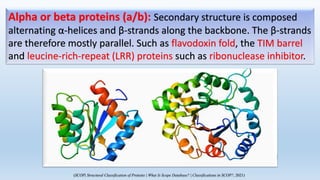
Alpha or beta proteins (a/b): Secondary structure is composed
alternating α-helices and β-strands along the backbone. The β-strands
are therefore mostly parallel. Such as flavodoxin fold, the TIM barrel
and leucine-rich-repeat (LRR) proteins such as ribonuclease inhibitor.
(SCOP| Structural Classification of Proteins | What Is Scope Database? | Classifications in SCOP?, 2021)
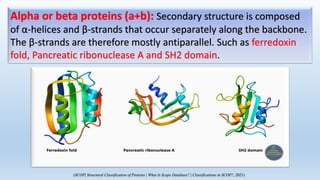
Alpha or beta proteins (a+b): Secondary structure is composed
of α-helices and β-strands that occur separately along the backbone.
The β-strands are therefore mostly antiparallel. Such as ferredoxin
fold, Pancreatic ribonuclease A and SH2 domain.
(SCOP| Structural Classification of Proteins | What Is Scope Database? | Classifications in SCOP?, 2021)
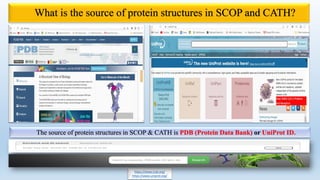
The source of protein structures in SCOP & CATH is PDB (Protein Data Bank) or UniProt ID.
What is the source of protein structures in SCOP and CATH?
https://www.rcsb.org/
https://www.uniprot.org/
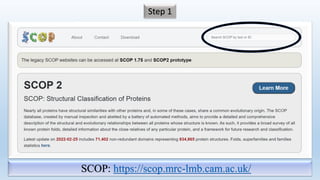
SCOP: https://scop.mrc-lmb.cam.ac.uk/
Step 1
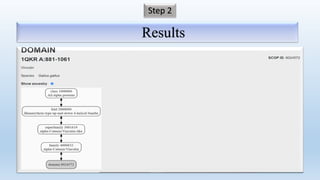
Results
Step 2
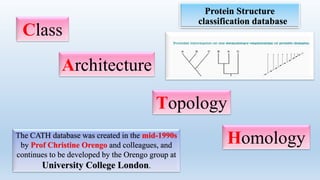
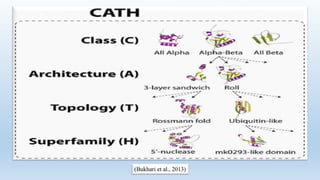
Architecture
Topology
Class
Homology
Protein Structure
classification database
The CATH database was created in the mid-1990s
by Prof Christine Orengo and colleagues, and
continues to be developed by the Orengo group at
University College London.
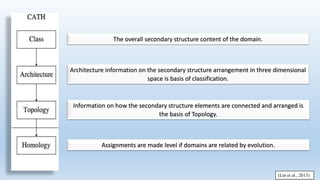
(Lin et al., 2013)
The overall secondary structure content of the domain.
Architecture information on the secondary structure arrangement in three dimensional
space is basis of classification.
Information on how the secondary structure elements are connected and arranged is
the basis of Topology.
Assignments are made level if domains are related by evolution.
(Bukhari et al., 2013)
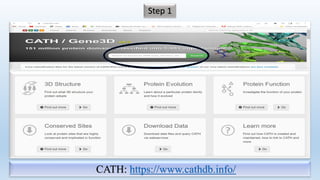
Step 1
CATH: https://www.cathdb.info/
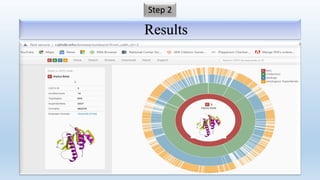
Results
Step 2
• Aryal, S. (2021, February 4). Protein Databases- Types and Importance. Microbe Notes.
https://microbenotes.com/protein-databases-types-and-importance/
• Malik, A. J., Poole, A. M., & Allison, J. R. (2020). Structural Phylogenetics with Confidence. Molecular
Biology and Evolution, 37(9), 2711–2726. https://doi.org/10.1093/molbev/msaa100
• Lin, C., Zou, Y., Qin, J., Liu, X., Jiang, Y., Ke, C., & Zou, Q. (2013). Hierarchical Classification of Protein
Folds Using a Novel Ensemble Classifier. PLoS ONE, 8(2), e56499.
https://doi.org/10.1371/journal.pone.0056499
• SCOP| Structural Classification of Proteins | What is scope database? | classifications in SCOP? (2021,
September 3). YouTube. https://www.youtube.com/watch?v=_yo1mRf8opA
• Sillitoe, Ian & Dawson, Natalie & Thornton, Janet & Orengo, Christine. (2015). The History of the CATH
Structural Classification of Protein Domains. Biochimie. 80. 10.1016/j.biochi.2015.08.004.
• Bukhari, Syed Abbas & Anolles, Gustavo. (2013). Origin and Evolution of Protein Fold Designs Inferred
from Phylogenomic Analysis of CATH Domain Structures in Proteomes. PLoS Computational Biology.
10.1371/journal.pcbi.1003009.
• Topics in Bioinformatics. (n.d.). . http://www.cs.cmu.edu/%7Eblmt/Seminar/SeminarMaterials/CATH.html
REFERENCES
Thank You

Protein structure classification/domain prediction: SCOP and CATH (Bioinformatics)..pdf

  • 1.
    selfexplanatory.2022 Hello HI नमस्ते ْ‫م‬ُ‫ك‬ْ‫ي‬‫ا‬‫ل‬‫ا‬‫ع‬ ُ‫م‬ ‫ا‬ ‫َل‬َّ ‫الس‬ ِ َّ ‫ٱَّلل‬ ُ‫اة‬‫م‬ْ‫ح‬‫ا‬‫ر‬‫ا‬‫و‬ ُ‫ه‬ُ‫ت‬‫كا‬‫ا‬‫ر‬‫ا‬‫ب‬‫ا‬‫و‬ Saba Parvin Haque M.Sc. Life Sciences (Specialization in Neurobiology) from “Sophia College” (Autonomous), Mumbai.
  • 2.
  • 4.
    Classification Of Structural Protein https://images.app.goo.gl/1CxkhmPcXQNrCqep7 SCOP was createdin 1994 in the Centre for Protein Engineering (CPE) and the Laboratory of Molecular Biology (LMB).
  • 5.
    SCop • It isa Largely manual classification of proteins • Similarities of structures • Similarities of amino acid sequences Basis of classification SCOP classification can help us to determine the evolutionary relationship between proteins.
  • 6.
    Two Most ProminentProtein Structure Classification Schemes Are SCOP And CATH (Malik et al., 2020)
  • 7.
    (Lin et al.,2013) Types of secondary structures e.g. alpha helix or beta sheet or a/b & a+b. The different shapes of domains within a class. The domains in a fold are grouped into superfamilies, which have at least a distant common ancestor (structural homology). The domains in a fold in a superfamily are grouped into families, which have a more recent common ancestor (sequence homology). The domains in a families are grouped into protein domains, which are essentially the same protein (Functionally identical). Protein Domain
  • 8.
    (SCOP| Structural Classificationof Proteins | What Is Scope Database? | Classifications in SCOP?, 2021)
  • 9.
    All alpha proteins:Secondary structure is composed entirely of α-helices, with the possible exception of a few isolated β-sheets on the periphery. Such as bromodomain, the globin fold etc. (SCOP| Structural Classification of Proteins | What Is Scope Database? | Classifications in SCOP?, 2021)
  • 10.
    All beta proteins:Secondary structure is composed entirely of β- sheet, with the possible exception of a few isolated α-helices on the periphery. Such as SH3 domain, the beta-propeller domain, the immunoglobulin fold. (SCOP| Structural Classification of Proteins | What Is Scope Database? | Classifications in SCOP?, 2021)
  • 11.
    Alpha or betaproteins (a/b): Secondary structure is composed alternating α-helices and β-strands along the backbone. The β-strands are therefore mostly parallel. Such as flavodoxin fold, the TIM barrel and leucine-rich-repeat (LRR) proteins such as ribonuclease inhibitor. (SCOP| Structural Classification of Proteins | What Is Scope Database? | Classifications in SCOP?, 2021)
  • 12.
    Alpha or betaproteins (a+b): Secondary structure is composed of α-helices and β-strands that occur separately along the backbone. The β-strands are therefore mostly antiparallel. Such as ferredoxin fold, Pancreatic ribonuclease A and SH2 domain. (SCOP| Structural Classification of Proteins | What Is Scope Database? | Classifications in SCOP?, 2021)
  • 13.
    The source ofprotein structures in SCOP & CATH is PDB (Protein Data Bank) or UniProt ID. What is the source of protein structures in SCOP and CATH? https://www.rcsb.org/ https://www.uniprot.org/
  • 14.
  • 15.
  • 17.
    Architecture Topology Class Homology Protein Structure classification database TheCATH database was created in the mid-1990s by Prof Christine Orengo and colleagues, and continues to be developed by the Orengo group at University College London.
  • 18.
    (Lin et al.,2013) The overall secondary structure content of the domain. Architecture information on the secondary structure arrangement in three dimensional space is basis of classification. Information on how the secondary structure elements are connected and arranged is the basis of Topology. Assignments are made level if domains are related by evolution.
  • 19.
  • 20.
  • 21.
  • 22.
    • Aryal, S.(2021, February 4). Protein Databases- Types and Importance. Microbe Notes. https://microbenotes.com/protein-databases-types-and-importance/ • Malik, A. J., Poole, A. M., & Allison, J. R. (2020). Structural Phylogenetics with Confidence. Molecular Biology and Evolution, 37(9), 2711–2726. https://doi.org/10.1093/molbev/msaa100 • Lin, C., Zou, Y., Qin, J., Liu, X., Jiang, Y., Ke, C., & Zou, Q. (2013). Hierarchical Classification of Protein Folds Using a Novel Ensemble Classifier. PLoS ONE, 8(2), e56499. https://doi.org/10.1371/journal.pone.0056499 • SCOP| Structural Classification of Proteins | What is scope database? | classifications in SCOP? (2021, September 3). YouTube. https://www.youtube.com/watch?v=_yo1mRf8opA • Sillitoe, Ian & Dawson, Natalie & Thornton, Janet & Orengo, Christine. (2015). The History of the CATH Structural Classification of Protein Domains. Biochimie. 80. 10.1016/j.biochi.2015.08.004. • Bukhari, Syed Abbas & Anolles, Gustavo. (2013). Origin and Evolution of Protein Fold Designs Inferred from Phylogenomic Analysis of CATH Domain Structures in Proteomes. PLoS Computational Biology. 10.1371/journal.pcbi.1003009. • Topics in Bioinformatics. (n.d.). . http://www.cs.cmu.edu/%7Eblmt/Seminar/SeminarMaterials/CATH.html REFERENCES
  • 23.