


Stem-Cell-Based Gene
Therapy for HIV
Infection VIPIN MOHAN
2011-09-112
College of Agriculture
Vellayani, TVM
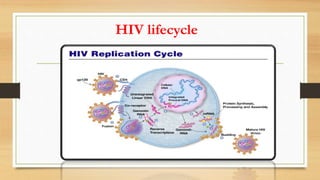
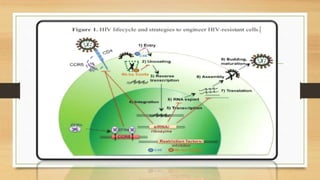
HIV lifecycle
Engineering HIV Resistant Cells
• The first targets are cellular genes necessary for viral replication.
• Second strategy directly targets HIV gene expression itself.
• Lastly, one that introduces genes that interfere with HIV replication, such as
host restriction factors and fusion inhibitors.
Targeting Expression of Cellular Genes that Are
Essential for Viral Replication
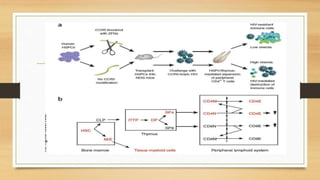
• CCR5 gene
• Berlin patient- bone marrow transplantation
• Maraviroc – inhibitor of CCR5 / HIV interaction.
• Genetherapy modifies peripheral blood T cells or HSCS can be used to
mimic the CCR5 Δ32 / Δ32 condition
• Block expression by distrupt it’s genome sequence by zinc finger proteins.
Targeting HIV Gene Expression
• HIV genes are essential for viral replication.
• Tat and Rev are regulatory proteins of HIV.
• Tat- Hammerehead ribozymes.
• Rev-dominant mutans or trans dominant.
• Targeting cellular factors such as CCR5 by RNAi are more effective than
targeting gene expression.
Introduction of Genes that Interfere with HIV
Replication
• Alternative strategy of HSC modification for HIV genes.
• Exogeneous factors inhibit key steps of HIV infection.
• Gp41-derived protein and C46 – structurally similar to inhibitor enfuvirtide.
• TRIM5-alpha, APOBEC (3F, 3G & letherin)-prevent HIV infection.
Combination Therapy to Prevent Viral Escape
• Virus have high genetic variability.
• Lentivirus are used as vector.
• Eg: In AIDS related lymphoma both retroviral vector and CD3+
hematopoetic stem cells are used.
• This modification persist atleast 24 months.
Engineering anti-HIV Immunity
• Immunity plays important role in controlling HIV infection.
• HIV doesn’t posses immunogenicity.
• Host doesn’t have ability to adequate response against HIV.
• Therapeutic vaccines are developed for HIV specific CD4 & CD8 T cell response.
• Molecularly cloned TCR or CAR receptors.
• Modified HSCS with SL9 TCR in humanized mice were able to suppress viral
replication.
stem cell based gen therapy

stem cell based gen therapy

  • 1.
    Stem-Cell-Based Gene Therapy forHIV Infection VIPIN MOHAN 2011-09-112 College of Agriculture Vellayani, TVM
  • 2.
  • 5.
    Engineering HIV ResistantCells • The first targets are cellular genes necessary for viral replication. • Second strategy directly targets HIV gene expression itself. • Lastly, one that introduces genes that interfere with HIV replication, such as host restriction factors and fusion inhibitors.
  • 7.
    Targeting Expression ofCellular Genes that Are Essential for Viral Replication • CCR5 gene • Berlin patient- bone marrow transplantation • Maraviroc – inhibitor of CCR5 / HIV interaction. • Genetherapy modifies peripheral blood T cells or HSCS can be used to mimic the CCR5 Δ32 / Δ32 condition • Block expression by distrupt it’s genome sequence by zinc finger proteins.
  • 8.
    Targeting HIV GeneExpression • HIV genes are essential for viral replication. • Tat and Rev are regulatory proteins of HIV. • Tat- Hammerehead ribozymes. • Rev-dominant mutans or trans dominant. • Targeting cellular factors such as CCR5 by RNAi are more effective than targeting gene expression.
  • 9.
    Introduction of Genesthat Interfere with HIV Replication • Alternative strategy of HSC modification for HIV genes. • Exogeneous factors inhibit key steps of HIV infection. • Gp41-derived protein and C46 – structurally similar to inhibitor enfuvirtide. • TRIM5-alpha, APOBEC (3F, 3G & letherin)-prevent HIV infection.
  • 10.
    Combination Therapy toPrevent Viral Escape • Virus have high genetic variability. • Lentivirus are used as vector. • Eg: In AIDS related lymphoma both retroviral vector and CD3+ hematopoetic stem cells are used. • This modification persist atleast 24 months.
  • 11.
    Engineering anti-HIV Immunity •Immunity plays important role in controlling HIV infection. • HIV doesn’t posses immunogenicity. • Host doesn’t have ability to adequate response against HIV. • Therapeutic vaccines are developed for HIV specific CD4 & CD8 T cell response. • Molecularly cloned TCR or CAR receptors. • Modified HSCS with SL9 TCR in humanized mice were able to suppress viral replication.