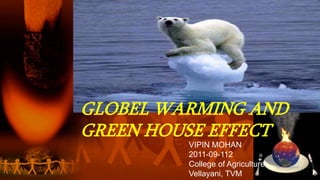
GLOBEL WARMING AND
GREEN HOUSE EFFECT
VIPIN MOHAN
2011-09-112
College of Agriculture
Vellayani, TVM
GLOBAL WARMING!
• Human activity is adding more
gases to the naturally occurring
layer of greenhouse gases. This
thickens it so it cannot let as much
heat return to space and so the
temperature of the earth gradually
increases……
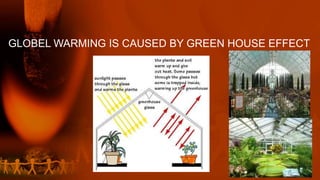
GLOBEL WARMING IS CAUSED BY GREEN HOUSE EFFECT
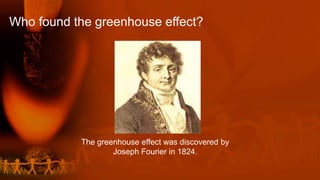
Who found the greenhouse effect?
The greenhouse effect was discovered by
Joseph Fourier in 1824.
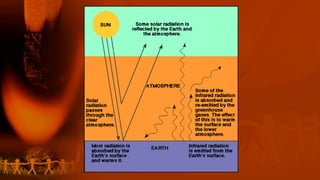
Our earth is surrounded by a layer of
gases called greenhouse gases.
There job is to keep the planet at a nice
warm temperature.
The main gases that make us this layer
are carbon dioxide, methane, CFC and
nitrous oxide.
This layer of gas acts like the roof of a
greenhouse and that is why it is called the
“Greenhouse effect”.
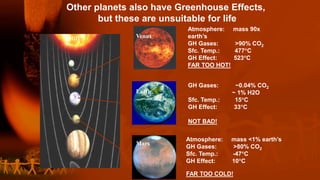
Mars
Atmosphere: mass <1% earth’s
GH Gases: >80% CO2
Sfc. Temp.: -47C
GH Effect: 10C
FAR TOO COLD!
Other planets also have Greenhouse Effects,
but these are unsuitable for life
Earth
GH Gases: ~0.04% CO2
~ 1% H2O
Sfc. Temp.: 15C
GH Effect: 33C
NOT BAD!
Venus
Atmosphere: mass 90x
earth’s
GH Gases: >90% CO2
Sfc. Temp.: 477C
GH Effect: 523C
FAR TOO HOT!
Sun
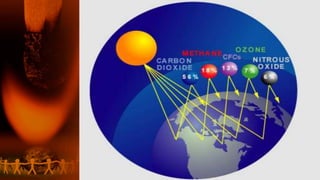
Greenhouse gases
 Greenhouse gases are the gases present in the
atmosphere which reduce the loss of heat into space
and therefore contribute to global temperatures.
Greenhouse gases are essential to maintaining the
temperature of the earth.
The term greenhouse gas is applied to, in order of
relative abundance: water vapour, carbon dioxide,
methane, nitrous oxide, ozone and CFCs.
•
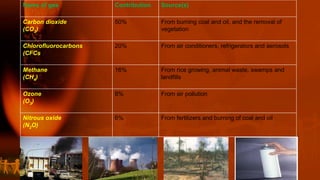
Name of gas Contribution Source(s)
Carbon dioxide
(CO2)
50% From burning coal and oil, and the removal of
vegetation
Chlorofluorocarbons
(CFCs)
20% From air conditioners, refrigerators and aerosols
Methane
(CH4)
16% From rice growing, animal waste, swamps and
landfills
Ozone
(O3)
8% From air pollution
Nitrous oxide
(N2O)
6% From fertilizers and burning of coal and oil
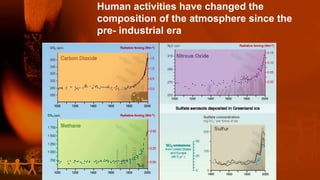
Human activities have changed the
composition of the atmosphere since the
pre- industrial era
Characteristics of GHG
• Atmospheric life time.
• Global warming potential.
• Atmospheric concentration.
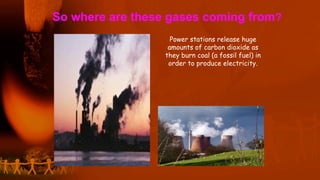
So where are these gases coming from?
Power stations release huge
amounts of carbon dioxide as
they burn coal (a fossil fuel) in
order to produce electricity.
Greenhouse Gas Emissions
Power Plants
40% of carbon dioxide emissions stem from the burning of fossil fuels for the purpose of
electricity generation
Cars
20% of carbon dioxide emissions comes from the burning of gasoline in internal-
combustion engines of cars and light trucks with poor gas mileage contribute the most to
global warming
Trucks
Another 13% of carbon dioxide emissions come from
trucks used mostly for commercial purposes
Airplanes
Aviation causes 3.5 percent of global warming,
and the figure could rise to 15 percent by 2050
Carbon Dioxide from Buildings
Buildings structure account for about 12% of
carbon dioxide emissions
CAUSES OF GREEN HOUSEEFFECT
• Deforestation.
• Emissionsofgases like nitrous oxide, carbon-dioxide,
methane, ozone and water vapor.
• Burningof fossilfuels, gasoline,oil
• Burning of woodandcoal
• CFC’s
• PopulationGrowth
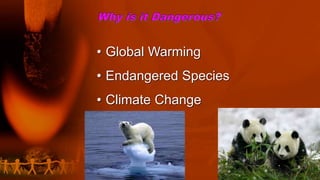
• Global Warming
• Endangered Species
• Climate Change
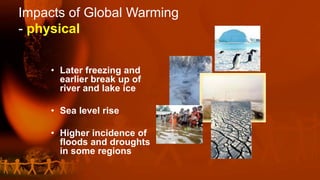
Impacts of Global Warming
- physical
• Later freezing and
earlier break up of
river and lake ice
• Sea level rise
• Higher incidence of
floods and droughts
in some regions
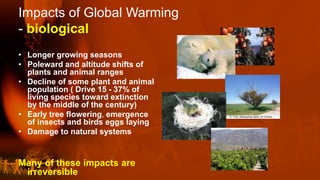
Impacts of Global Warming
- biological
• Longer growing seasons
• Poleward and altitude shifts of
plants and animal ranges
• Decline of some plant and animal
population ( Drive 15 - 37% of
living species toward extinction
by the middle of the century)
• Early tree flowering, emergence
of insects and birds eggs laying
• Damage to natural systems
Many of these impacts are
irreversible
Impacts of Global Warming
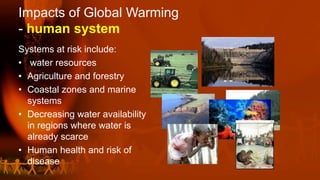
- human system
Systems at risk include:
• water resources
• Agriculture and forestry
• Coastal zones and marine
systems
• Decreasing water availability
in regions where water is
already scarce
• Human health and risk of
disease
polar bears and globel warming
• Natural habitat loss
• Reproduction related problem
• Swimming conditions become
problematic
• Inability to catch prey
There are also some positive effects of
global warming
• Decrease in death and disease
• Healthier, faster growing forests due to excess
CO2
• reduce cold-related deaths and help crop growth.
• Warmer temperatures (UK Mediterranean
climate!!)
• Plants and shrubs will be able to grow further
north and in present desert conditions
• Heavier rainfall in certain locations will give higher
agricultural production (Rice in India, Wheat in
Africa).
How can Global Warming be reduced?
• Reduce the use of fossil fuels. A major impact
would be to find alternatives to coal, oil and gas
power stations.
• Afforest areas, trees use up the CO2, reduce
deforestation.
• Reduce the reliance on the car (promote shared
public transport).
• Try to use energy efficiently (turn off lights and
not use as much!).
• Reduce, Reuse, Recycle.
• Careful long term planning to reduce the impact of
global warming.
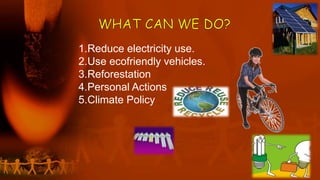
1.Reduce electricity use.
2.Use ecofriendly vehicles.
3.Reforestation
4.Personal Actions
5.Climate Policy
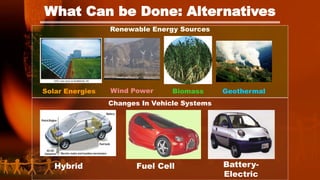
What Can be Done: Alternatives
Renewable Energy Sources
Solar Energies Wind Power Biomass Geothermal
Changes In Vehicle Systems
Hybrid Fuel Cell Battery-
Electric
Kyoto Protocol
• 1997, Kyoto, Japan  developed countries
agreed to specific targets for cutting their
emissions of greenhouse gases
• Industrialized countries committed to an
overall reduction of emissions of greenhouse
gases to 5.2% below 1990 levels for the period
2008 - 2012
• Objective is the stabilization of greenhouse gas
concentrations in the atmosphere at a level that
would prevent dangerous anthropogenic
interference with the climate system
So what will you do
?
Thank
you

globel warming and green house effect

  • 1.
    GLOBEL WARMING AND GREENHOUSE EFFECT VIPIN MOHAN 2011-09-112 College of Agriculture Vellayani, TVM
  • 2.
    GLOBAL WARMING! • Humanactivity is adding more gases to the naturally occurring layer of greenhouse gases. This thickens it so it cannot let as much heat return to space and so the temperature of the earth gradually increases……
  • 3.
    GLOBEL WARMING ISCAUSED BY GREEN HOUSE EFFECT
  • 4.
    Who found thegreenhouse effect? The greenhouse effect was discovered by Joseph Fourier in 1824.
  • 5.
    Our earth issurrounded by a layer of gases called greenhouse gases. There job is to keep the planet at a nice warm temperature. The main gases that make us this layer are carbon dioxide, methane, CFC and nitrous oxide. This layer of gas acts like the roof of a greenhouse and that is why it is called the “Greenhouse effect”.
  • 6.
    Mars Atmosphere: mass <1%earth’s GH Gases: >80% CO2 Sfc. Temp.: -47C GH Effect: 10C FAR TOO COLD! Other planets also have Greenhouse Effects, but these are unsuitable for life Earth GH Gases: ~0.04% CO2 ~ 1% H2O Sfc. Temp.: 15C GH Effect: 33C NOT BAD! Venus Atmosphere: mass 90x earth’s GH Gases: >90% CO2 Sfc. Temp.: 477C GH Effect: 523C FAR TOO HOT! Sun
  • 8.
    Greenhouse gases  Greenhousegases are the gases present in the atmosphere which reduce the loss of heat into space and therefore contribute to global temperatures. Greenhouse gases are essential to maintaining the temperature of the earth. The term greenhouse gas is applied to, in order of relative abundance: water vapour, carbon dioxide, methane, nitrous oxide, ozone and CFCs. •
  • 9.
    Name of gasContribution Source(s) Carbon dioxide (CO2) 50% From burning coal and oil, and the removal of vegetation Chlorofluorocarbons (CFCs) 20% From air conditioners, refrigerators and aerosols Methane (CH4) 16% From rice growing, animal waste, swamps and landfills Ozone (O3) 8% From air pollution Nitrous oxide (N2O) 6% From fertilizers and burning of coal and oil
  • 11.
    Human activities havechanged the composition of the atmosphere since the pre- industrial era
  • 12.
    Characteristics of GHG •Atmospheric life time. • Global warming potential. • Atmospheric concentration.
  • 13.
    So where arethese gases coming from? Power stations release huge amounts of carbon dioxide as they burn coal (a fossil fuel) in order to produce electricity.
  • 14.
    Greenhouse Gas Emissions PowerPlants 40% of carbon dioxide emissions stem from the burning of fossil fuels for the purpose of electricity generation Cars 20% of carbon dioxide emissions comes from the burning of gasoline in internal- combustion engines of cars and light trucks with poor gas mileage contribute the most to global warming Trucks Another 13% of carbon dioxide emissions come from trucks used mostly for commercial purposes Airplanes Aviation causes 3.5 percent of global warming, and the figure could rise to 15 percent by 2050 Carbon Dioxide from Buildings Buildings structure account for about 12% of carbon dioxide emissions
  • 15.
    CAUSES OF GREENHOUSEEFFECT • Deforestation. • Emissionsofgases like nitrous oxide, carbon-dioxide, methane, ozone and water vapor. • Burningof fossilfuels, gasoline,oil • Burning of woodandcoal • CFC’s • PopulationGrowth
  • 16.
    • Global Warming •Endangered Species • Climate Change
  • 17.
    Impacts of GlobalWarming - physical • Later freezing and earlier break up of river and lake ice • Sea level rise • Higher incidence of floods and droughts in some regions
  • 18.
    Impacts of GlobalWarming - biological • Longer growing seasons • Poleward and altitude shifts of plants and animal ranges • Decline of some plant and animal population ( Drive 15 - 37% of living species toward extinction by the middle of the century) • Early tree flowering, emergence of insects and birds eggs laying • Damage to natural systems Many of these impacts are irreversible
  • 19.
    Impacts of GlobalWarming - human system Systems at risk include: • water resources • Agriculture and forestry • Coastal zones and marine systems • Decreasing water availability in regions where water is already scarce • Human health and risk of disease
  • 20.
    polar bears andglobel warming • Natural habitat loss • Reproduction related problem • Swimming conditions become problematic • Inability to catch prey
  • 21.
    There are alsosome positive effects of global warming • Decrease in death and disease • Healthier, faster growing forests due to excess CO2 • reduce cold-related deaths and help crop growth. • Warmer temperatures (UK Mediterranean climate!!) • Plants and shrubs will be able to grow further north and in present desert conditions • Heavier rainfall in certain locations will give higher agricultural production (Rice in India, Wheat in Africa).
  • 22.
    How can GlobalWarming be reduced? • Reduce the use of fossil fuels. A major impact would be to find alternatives to coal, oil and gas power stations. • Afforest areas, trees use up the CO2, reduce deforestation. • Reduce the reliance on the car (promote shared public transport). • Try to use energy efficiently (turn off lights and not use as much!). • Reduce, Reuse, Recycle. • Careful long term planning to reduce the impact of global warming.
  • 23.
    1.Reduce electricity use. 2.Useecofriendly vehicles. 3.Reforestation 4.Personal Actions 5.Climate Policy
  • 24.
    What Can beDone: Alternatives Renewable Energy Sources Solar Energies Wind Power Biomass Geothermal Changes In Vehicle Systems Hybrid Fuel Cell Battery- Electric
  • 25.
    Kyoto Protocol • 1997,Kyoto, Japan  developed countries agreed to specific targets for cutting their emissions of greenhouse gases • Industrialized countries committed to an overall reduction of emissions of greenhouse gases to 5.2% below 1990 levels for the period 2008 - 2012 • Objective is the stabilization of greenhouse gas concentrations in the atmosphere at a level that would prevent dangerous anthropogenic interference with the climate system
  • 26.
    So what willyou do ?
  • 28.