Presentation
on
Biofortification
Submitted by
Sourabh kumar
M.Sc.(G&PB).
Deptt. Of Genetics & Plant Breeding
Ch. Charan Singh University, Meerut
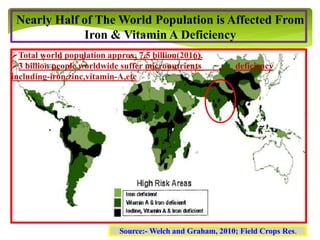
Total world population approx. 7.5 billion(2016).
3 billion people worldwide suffer micronutrients deficiency
including-iron,zinc,vitamin-A,etc
Nearly Half of The World Population is Affected From
Iron & Vitamin A Deficiency
Source:- Welch and Graham, 2010; Field Crops Res.
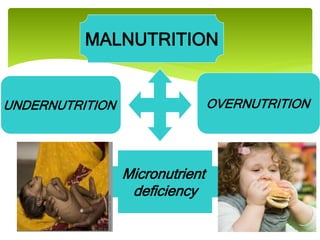
Malnutrition
 Derived from malus (bad) and nutrire (to nourish)
 Includes both
 Under nutrition (deficiency of one or more essential nutrients)
 Over nutrition (an excess of a nutrient or nutrients)
MALNUTRITION
UNDERNUTRITION OVERNUTRITION
Micronutrient
deficiency
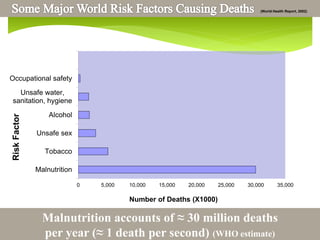
0 5,000 10,000 15,000 20,000 25,000 30,000 35,000
Malnutrition
Tobacco
Unsafe sex
Alcohol
Unsafe water,
sanitation, hygiene
Occupational safety
Number of Deaths (X1000)
RiskFactor
(World Health Report, 2002)
Malnutrition accounts of ≈ 30 million deaths
per year (≈ 1 death per second) (WHO estimate)
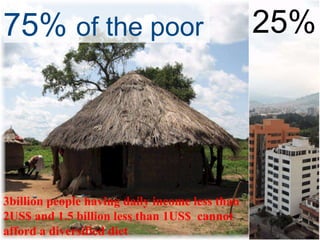
75% of the poor 25%
3billion people having daily income less than
2US$ and 1.5 billion less than 1US$ cannot
afford a diversified diet
 Macronutrients (carbohydrates, lipids, proteins &
water) - needed for energy, cell multiplication &
repair
 Micronutrients are trace elements, vitamins &
nutrients - essential for metabolic processes
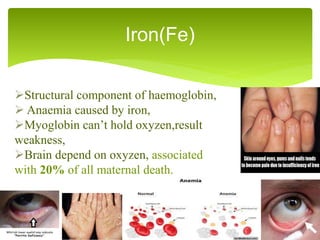
Iron(Fe)
Structural component of haemoglobin,
 Anaemia caused by iron,
Myoglobin can’t hold oxyzen,result
weakness,
Brain depend on oxyzen, associated
with 20% of all maternal death.
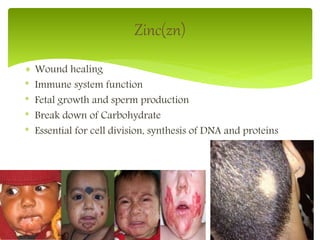
Zinc(zn)
 Wound healing
* Immune system function
* Fetal growth and sperm production
* Break down of Carbohydrate
* Essential for cell division, synthesis of DNA and proteins
10
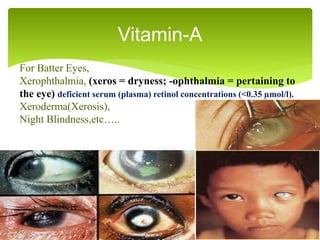
Vitamin-A
For Batter Eyes,
Xerophthalmia, (xeros = dryness; -ophthalmia = pertaining to
the eye) deficient serum (plasma) retinol concentrations (<0.35 µmol/l).
Xeroderma(Xerosis),
Night Blindness,etc…..
 Eyes- signs of vitamin A deficiency
 Ear – discharge from the ear, (serosanguneous or
purulent)
 Neck-Goitre,
 Mouth- angular stomatits,Oral hygiene,
 Skin – colour, whether dry and lusterless,
 Chest- shape, costochondral junction, Harrison's
sulcus
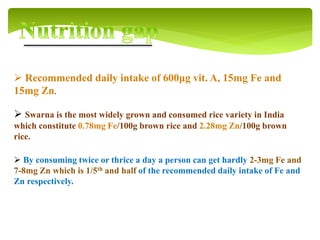
 Recommended daily intake of 600μg vit. A, 15mg Fe and
15mg Zn.
 Swarna is the most widely grown and consumed rice variety in India
which constitute 0.78mg Fe/100g brown rice and 2.28mg Zn/100g brown
rice.
 By consuming twice or thrice a day a person can get hardly 2-3mg Fe and
7-8mg Zn which is 1/5th and half of the recommended daily intake of Fe and
Zn respectively.
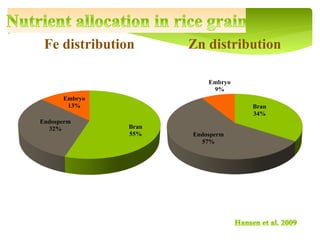
Bran
34%
Endosperm
57%
Embryo
9%
Zn distribution
Bran
55%
Endosperm
32%
Embryo
13%
Fe distribution
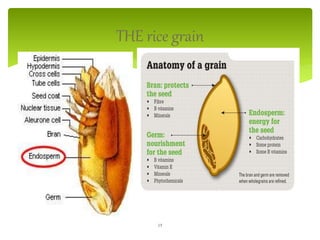
THE rice grain
15
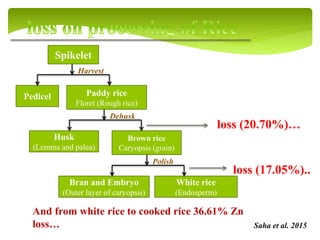
Spikelet
Pedicel Paddy rice
Floret (Rough rice)
Husk
(Lemma and palea)
Brown rice
Caryopsis (grain)
Bran and Embryo
(Outer layer of caryopsis)
White rice
(Endosperm)
Harvest
Dehusk
Polish
loss (20.70%)…
loss (17.05%)..
And from white rice to cooked rice 36.61% Zn
loss… Saha et al. 2015
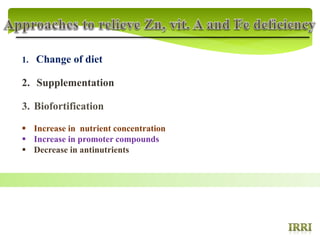
1. Change of diet
2. Supplementation
3. Biofortification
 Increase in nutrient concentration
 Increase in promoter compounds
 Decrease in antinutrients
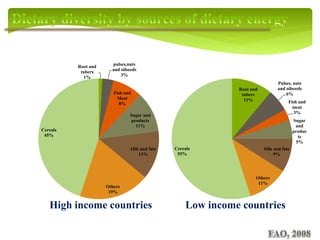
Root and
tubers
1%
pulses,nuts
and oilseeds
3%
Fish and
Meat
8%
Sugar and
products
11%
Oils and fats
13%
Others
19%
Cereals
45%
High income countries
Root and
tubers
11%
Pulses, nuts
and oilseeds
6%
Fish and
meat
3%
Sugar
and
produc
ts
5%
Oils and fats
9%
Others
11%
Cereals
55%
Low income countries
Bio-fortification:
Greek word “bios” means “life” and Latin word “fortificare” means
“make strong”.
Bio-fortification:
Biofortification is a method of breeding crops to increase their
nutritional value
Bio-fortification refers to increasing genetically the bio-available
mineral content of food crops (Brinch-Pederson et al., 2007).
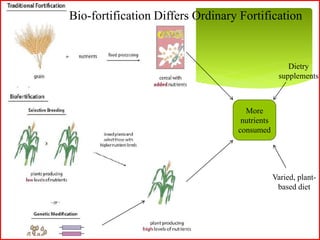
Bio-fortification differs from ordinary fortification because it
focuses on making plant foods more nutritious as the plants
are growing, rather than having nutrients added to the foods
when they are being processed.
What is Bio-Fortification
Bio-fortification Differs Ordinary Fortification
More
nutrients
consumed
Dietry
supplements
Varied, plant-
based diet
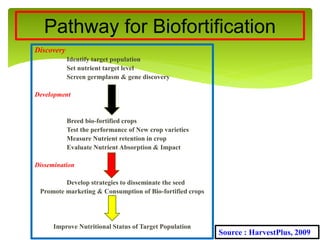
Discovery
Identify target population
Set nutrient target level
Screen germplasm & gene discovery
Development
Breed bio-fortified crops
Test the performance of New crop varieties
Measure Nutrient retention in crop
Evaluate Nutrient Absorption & Impact
Dissemination
Develop strategies to disseminate the seed
Promote marketing & Consumption of Bio-fortified crops
Improve Nutritional Status of Target Population
Pathway for Biofortification
Source : HarvestPlus, 2009
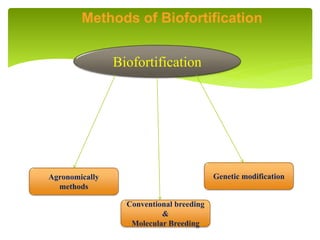
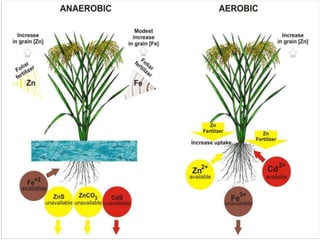
Methods of Biofortification
Biofortification
Agronomically
methods
Conventional breeding
&
Molecular Breeding
Genetic modification
Conventional Breeding
&
Molecular Breeding
(Marker Assisted Breeding)
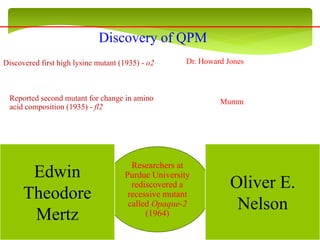
Researchers at
Purdue University
rediscovered a
recessive mutant
called Opaque-2
(1964)
Edwin
Theodore
Mertz
Oliver E.
Nelson
Discovered first high lysine mutant (1935) - o2 Dr. Howard Jones
MummReported second mutant for change in amino
acid composition (1935) - fl2
Discovery of QPM
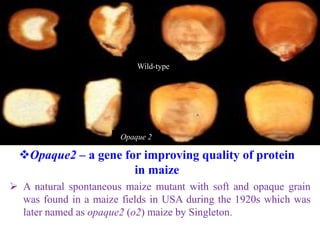
Wild-type
Opaque 2
Opaque2 – a gene for improving quality of protein
in maize
 A natural spontaneous maize mutant with soft and opaque grain
was found in a maize fields in USA during the 1920s which was
later named as opaque2 (o2) maize by Singleton.
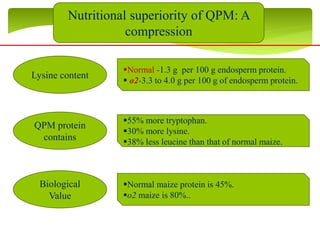
Nutritional superiority of QPM: A
compression
Lysine content
QPM protein
contains
Biological
Value
Normal -1.3 g per 100 g endosperm protein.
 o2-3.3 to 4.0 g per 100 g of endosperm protein.
55% more tryptophan.
30% more lysine.
38% less leucine than that of normal maize.
Normal maize protein is 45%.
o2 maize is 80%..
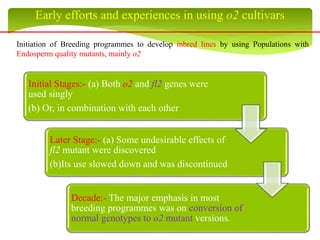
Early efforts and experiences in using o2 cultivars
Initiation of Breeding programmes to develop inbred lines by using Populations with
Endosperm quality mutants, mainly o2
Initial Stages:- (a) Both o2 and fl2 genes were
used singly
(b) Or, in combination with each other
Later Stage:- (a) Some undesirable effects of
fl2 mutant were discovered
(b)Its use slowed down and was discontinued
Decade:- The major emphasis in most
breeding programmes was on conversion of
normal genotypes to o2 mutant versions.
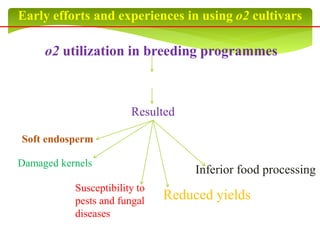
o2 utilization in breeding programmes
Resulted
Soft endosperm
Damaged kernels
Susceptibility to
pests and fungal
diseases
Inferior food processing
Reduced yields
Early efforts and experiences in using o2 cultivars
pleiotropic effects of this gene
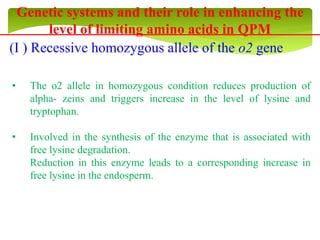
Genetic systems and their role in enhancing the
level of limiting amino acids in QPM
(I ) Recessive homozygous allele of the o2 gene
• The o2 allele in homozygous condition reduces production of
alpha- zeins and triggers increase in the level of lysine and
tryptophan.
• Involved in the synthesis of the enzyme that is associated with
free lysine degradation.
Reduction in this enzyme leads to a corresponding increase in
free lysine in the endosperm.
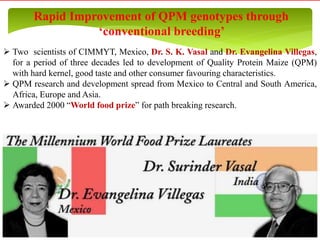
 Two scientists of CIMMYT, Mexico, Dr. S. K. Vasal and Dr. Evangelina Villegas,
for a period of three decades led to development of Quality Protein Maize (QPM)
with hard kernel, good taste and other consumer favouring characteristics.
 QPM research and development spread from Mexico to Central and South America,
Africa, Europe and Asia.
 Awarded 2000 “World food prize” for path breaking research.
Rapid Improvement of QPM genotypes through
‘conventional breeding’
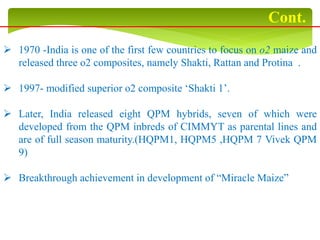
 1970 -India is one of the first few countries to focus on o2 maize and
released three o2 composites, namely Shakti, Rattan and Protina .
 1997- modified superior o2 composite ‘Shakti 1’.
 Later, India released eight QPM hybrids, seven of which were
developed from the QPM inbreds of CIMMYT as parental lines and
are of full season maturity.(HQPM1, HQPM5 ,HQPM 7 Vivek QPM
9)
 Breakthrough achievement in development of “Miracle Maize”
Cont.
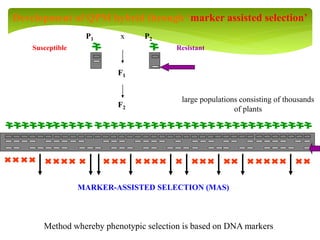
F2
P2
F1
P1 x
large populations consisting of thousands
of plants
ResistantSusceptible
MARKER-ASSISTED SELECTION (MAS)
Method whereby phenotypic selection is based on DNA markers
Development of QPM hybrid through ‘marker assisted selection’
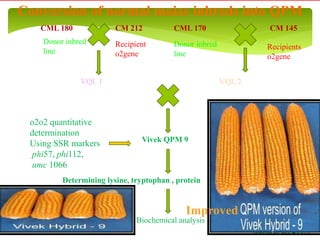
CML 180
VQL 1
CML 170CM 212
VQL 2
CM 145
Recipient
o2gene
Recipients
o2gene
Donor inbred
line
Donor inbred
line
Vivek QPM 9
(92.0%) (94.44%)
o2o2 quantitative
determination
Using SSR markers
phi57, phi112,
umc 1066
Determining lysine, tryptophan , protein
Biochemical analysis
Conversion of normal maize inbreds into QPM
Gupta et al. 2009.
Improved
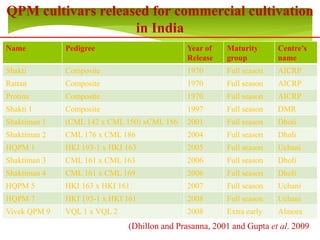
Name Pedigree Year of
Release
Maturity
group
Centre’s
name
Shakti Composite 1970 Full season AICRP
Rattan Composite 1970 Full season AICRP
Protina Composite 1970 Full season AICRP
Shakti 1 Composite 1997 Full season DMR
Shaktiman 1 (CML 142 x CML 150) xCML 186 2001 Full season Dholi
Shaktiman 2 CML 176 x CML 186 2004 Full season Dholi
HQPM 1 HKI 193-1 x HKI 163 2005 Full season Uchani
Shaktiman 3 CML 161 x CML 163 2006 Full season Dholi
Shaktiman 4 CML 161 x CML 169 2006 Full season Dholi
HQPM 5 HKI 163 x HKI 161 2007 Full season Uchani
HQPM 7 HKI 193-1 x HKI 161 2008 Full season Uchani
Vivek QPM 9 VQL 1 x VQL 2 2008 Extra early Almora
QPM cultivars released for commercial cultivation
in India
(Dhillon and Prasanna, 2001 and Gupta et al. 2009
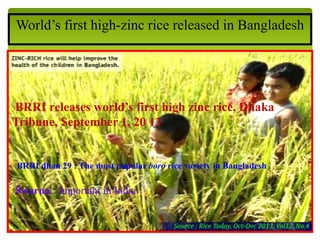
World’s first high-zinc rice released in Bangladesh
BRRI releases world’s first high zinc rice, Dhaka
Tribune, September 1, 20 13
Swarna : Important in India .
BRRI dhan 29 : The most popular boro rice variety in Bangladesh
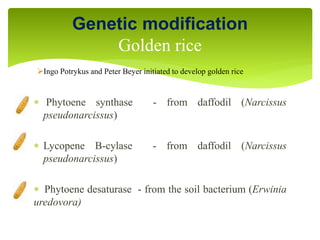
Genetic modification
Golden rice
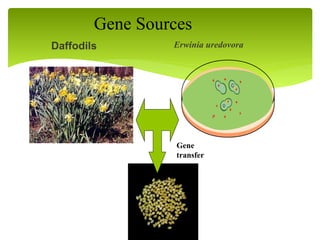
 Phytoene synthase - from daffodil (Narcissus
pseudonarcissus)
 Lycopene B-cylase - from daffodil (Narcissus
pseudonarcissus)
 Phytoene desaturase - from the soil bacterium (Erwinia
uredovora)
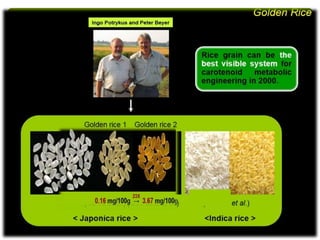
Ingo Potrykus and Peter Beyer initiated to develop golden rice
Daffodils
Gene
transfer
Golden Rice
Erwinia uredovora
Gene Sources
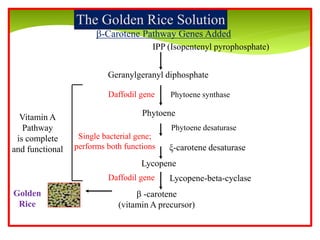
The Golden Rice Solution
IPP (Isopentenyl pyrophosphate)
Geranylgeranyl diphosphate
Phytoene
Lycopene
 -carotene
(vitamin A precursor)
Phytoene synthase
Phytoene desaturase
Lycopene-beta-cyclase
ξ-carotene desaturase
Daffodil gene
Single bacterial gene;
performs both functions
Daffodil gene
-Carotene Pathway Genes Added
Vitamin A
Pathway
is complete
and functional
Golden
Rice
41
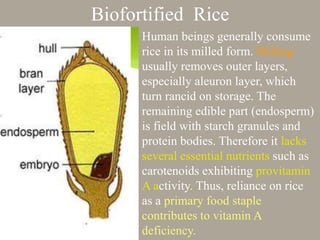
Biofortified Rice
Human beings generally consume
rice in its milled form. Milling
usually removes outer layers,
especially aleuron layer, which
turn rancid on storage. The
remaining edible part (endosperm)
is field with starch granules and
protein bodies. Therefore it lacks
several essential nutrients such as
carotenoids exhibiting provitamin
A activity. Thus, reliance on rice
as a primary food staple
contributes to vitamin A
deficiency.
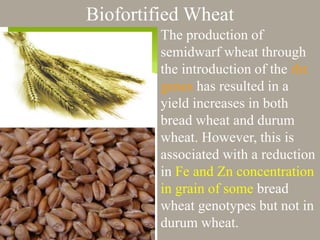
The production of
semidwarf wheat through
the introduction of the rht
genes has resulted in a
yield increases in both
bread wheat and durum
wheat. However, this is
associated with a reduction
in Fe and Zn concentration
in grain of some bread
wheat genotypes but not in
durum wheat.
Biofortified Wheat
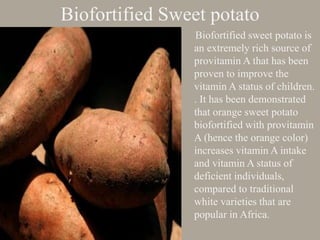
Biofortified sweet potato is
an extremely rich source of
provitamin A that has been
proven to improve the
vitamin A status of children.
. It has been demonstrated
that orange sweet potato
biofortified with provitamin
A (hence the orange color)
increases vitamin A intake
and vitamin A status of
deficient individuals,
compared to traditional
white varieties that are
popular in Africa.
Biofortified Sweet potato
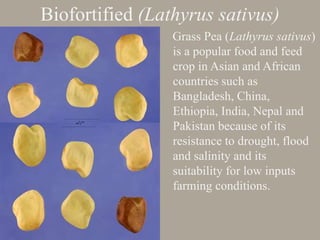
Biofortified (Lathyrus sativus)
Grass Pea (Lathyrus sativus)
is a popular food and feed
crop in Asian and African
countries such as
Bangladesh, China,
Ethiopia, India, Nepal and
Pakistan because of its
resistance to drought, flood
and salinity and its
suitability for low inputs
farming conditions.
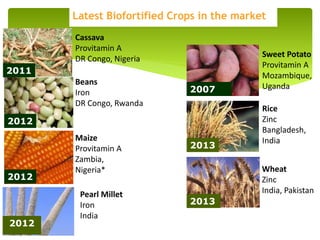
Latest Biofortified Crops in the market
2007
2011
Cassava
Provitamin A
DR Congo, Nigeria
2012
Beans
Iron
DR Congo, Rwanda
2012
Maize
Provitamin A
Zambia,
Nigeria*
Sweet Potato
Provitamin A
Mozambique,
Uganda
2013
Rice
Zinc
Bangladesh,
India
2013
Wheat
Zinc
India, Pakistan
2012
Pearl Millet
Iron
India
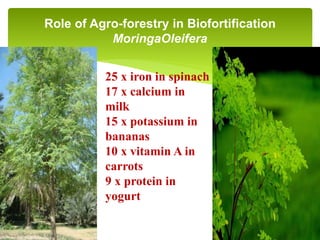
Role of Agro-forestry in Biofortification
MoringaOleifera
25 x iron in spinach
17 x calcium in
milk
15 x potassium in
bananas
10 x vitamin A in
carrots
9 x protein in
yogurt
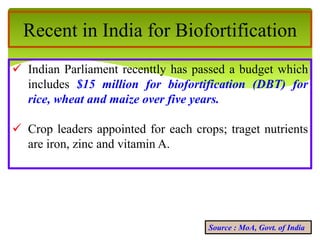
Recent in India for Biofortification
 Indian Parliament recenttly has passed a budget which
includes $15 million for biofortification (DBT) for
rice, wheat and maize over five years.
 Crop leaders appointed for each crops; traget nutrients
are iron, zinc and vitamin A.
Source : MoA, Govt. of India
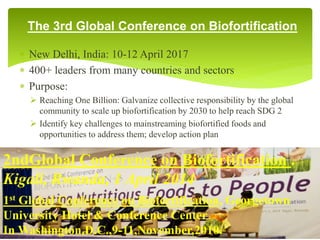
The 3rd Global Conference on Biofortification
 New Delhi, India: 10-12 April 2017
 400+ leaders from many countries and sectors
 Purpose:
 Reaching One Billion: Galvanize collective responsibility by the global
community to scale up biofortification by 2030 to help reach SDG 2
 Identify key challenges to mainstreaming biofortified foods and
opportunities to address them; develop action plan
50
2ndGlobal Conference on Biofortification .
Kigali, Rwanda, 1 April 2014
1st Global Conference on Biofortification, Georgetown
University Hotel & Conference Center
In Washington,D.C.,9-11,November,2010.
THANK YOU

Biofortification ppt.

  • 1.
    Presentation on Biofortification Submitted by Sourabh kumar M.Sc.(G&PB). Deptt.Of Genetics & Plant Breeding Ch. Charan Singh University, Meerut
  • 2.
    Total world populationapprox. 7.5 billion(2016). 3 billion people worldwide suffer micronutrients deficiency including-iron,zinc,vitamin-A,etc Nearly Half of The World Population is Affected From Iron & Vitamin A Deficiency Source:- Welch and Graham, 2010; Field Crops Res.
  • 3.
    Malnutrition  Derived frommalus (bad) and nutrire (to nourish)  Includes both  Under nutrition (deficiency of one or more essential nutrients)  Over nutrition (an excess of a nutrient or nutrients)
  • 4.
  • 5.
    0 5,000 10,00015,000 20,000 25,000 30,000 35,000 Malnutrition Tobacco Unsafe sex Alcohol Unsafe water, sanitation, hygiene Occupational safety Number of Deaths (X1000) RiskFactor (World Health Report, 2002) Malnutrition accounts of ≈ 30 million deaths per year (≈ 1 death per second) (WHO estimate)
  • 7.
    75% of thepoor 25% 3billion people having daily income less than 2US$ and 1.5 billion less than 1US$ cannot afford a diversified diet
  • 8.
     Macronutrients (carbohydrates,lipids, proteins & water) - needed for energy, cell multiplication & repair  Micronutrients are trace elements, vitamins & nutrients - essential for metabolic processes
  • 9.
    Iron(Fe) Structural component ofhaemoglobin,  Anaemia caused by iron, Myoglobin can’t hold oxyzen,result weakness, Brain depend on oxyzen, associated with 20% of all maternal death.
  • 10.
    Zinc(zn)  Wound healing *Immune system function * Fetal growth and sperm production * Break down of Carbohydrate * Essential for cell division, synthesis of DNA and proteins 10
  • 11.
    Vitamin-A For Batter Eyes, Xerophthalmia,(xeros = dryness; -ophthalmia = pertaining to the eye) deficient serum (plasma) retinol concentrations (<0.35 µmol/l). Xeroderma(Xerosis), Night Blindness,etc…..
  • 12.
     Eyes- signsof vitamin A deficiency  Ear – discharge from the ear, (serosanguneous or purulent)  Neck-Goitre,  Mouth- angular stomatits,Oral hygiene,  Skin – colour, whether dry and lusterless,  Chest- shape, costochondral junction, Harrison's sulcus
  • 13.
     Recommended dailyintake of 600μg vit. A, 15mg Fe and 15mg Zn.  Swarna is the most widely grown and consumed rice variety in India which constitute 0.78mg Fe/100g brown rice and 2.28mg Zn/100g brown rice.  By consuming twice or thrice a day a person can get hardly 2-3mg Fe and 7-8mg Zn which is 1/5th and half of the recommended daily intake of Fe and Zn respectively.
  • 14.
  • 15.
  • 16.
    Spikelet Pedicel Paddy rice Floret(Rough rice) Husk (Lemma and palea) Brown rice Caryopsis (grain) Bran and Embryo (Outer layer of caryopsis) White rice (Endosperm) Harvest Dehusk Polish loss (20.70%)… loss (17.05%).. And from white rice to cooked rice 36.61% Zn loss… Saha et al. 2015
  • 17.
    1. Change ofdiet 2. Supplementation 3. Biofortification  Increase in nutrient concentration  Increase in promoter compounds  Decrease in antinutrients
  • 18.
    Root and tubers 1% pulses,nuts and oilseeds 3% Fishand Meat 8% Sugar and products 11% Oils and fats 13% Others 19% Cereals 45% High income countries Root and tubers 11% Pulses, nuts and oilseeds 6% Fish and meat 3% Sugar and produc ts 5% Oils and fats 9% Others 11% Cereals 55% Low income countries
  • 19.
    Bio-fortification: Greek word “bios”means “life” and Latin word “fortificare” means “make strong”. Bio-fortification: Biofortification is a method of breeding crops to increase their nutritional value Bio-fortification refers to increasing genetically the bio-available mineral content of food crops (Brinch-Pederson et al., 2007). Bio-fortification differs from ordinary fortification because it focuses on making plant foods more nutritious as the plants are growing, rather than having nutrients added to the foods when they are being processed. What is Bio-Fortification
  • 20.
    Bio-fortification Differs OrdinaryFortification More nutrients consumed Dietry supplements Varied, plant- based diet
  • 21.
    Discovery Identify target population Setnutrient target level Screen germplasm & gene discovery Development Breed bio-fortified crops Test the performance of New crop varieties Measure Nutrient retention in crop Evaluate Nutrient Absorption & Impact Dissemination Develop strategies to disseminate the seed Promote marketing & Consumption of Bio-fortified crops Improve Nutritional Status of Target Population Pathway for Biofortification Source : HarvestPlus, 2009
  • 22.
  • 25.
  • 26.
    Researchers at Purdue University rediscovereda recessive mutant called Opaque-2 (1964) Edwin Theodore Mertz Oliver E. Nelson Discovered first high lysine mutant (1935) - o2 Dr. Howard Jones MummReported second mutant for change in amino acid composition (1935) - fl2 Discovery of QPM
  • 27.
    Wild-type Opaque 2 Opaque2 –a gene for improving quality of protein in maize  A natural spontaneous maize mutant with soft and opaque grain was found in a maize fields in USA during the 1920s which was later named as opaque2 (o2) maize by Singleton.
  • 28.
    Nutritional superiority ofQPM: A compression Lysine content QPM protein contains Biological Value Normal -1.3 g per 100 g endosperm protein.  o2-3.3 to 4.0 g per 100 g of endosperm protein. 55% more tryptophan. 30% more lysine. 38% less leucine than that of normal maize. Normal maize protein is 45%. o2 maize is 80%..
  • 29.
    Early efforts andexperiences in using o2 cultivars Initiation of Breeding programmes to develop inbred lines by using Populations with Endosperm quality mutants, mainly o2 Initial Stages:- (a) Both o2 and fl2 genes were used singly (b) Or, in combination with each other Later Stage:- (a) Some undesirable effects of fl2 mutant were discovered (b)Its use slowed down and was discontinued Decade:- The major emphasis in most breeding programmes was on conversion of normal genotypes to o2 mutant versions.
  • 30.
    o2 utilization inbreeding programmes Resulted Soft endosperm Damaged kernels Susceptibility to pests and fungal diseases Inferior food processing Reduced yields Early efforts and experiences in using o2 cultivars pleiotropic effects of this gene
  • 31.
    Genetic systems andtheir role in enhancing the level of limiting amino acids in QPM (I ) Recessive homozygous allele of the o2 gene • The o2 allele in homozygous condition reduces production of alpha- zeins and triggers increase in the level of lysine and tryptophan. • Involved in the synthesis of the enzyme that is associated with free lysine degradation. Reduction in this enzyme leads to a corresponding increase in free lysine in the endosperm.
  • 32.
     Two scientistsof CIMMYT, Mexico, Dr. S. K. Vasal and Dr. Evangelina Villegas, for a period of three decades led to development of Quality Protein Maize (QPM) with hard kernel, good taste and other consumer favouring characteristics.  QPM research and development spread from Mexico to Central and South America, Africa, Europe and Asia.  Awarded 2000 “World food prize” for path breaking research. Rapid Improvement of QPM genotypes through ‘conventional breeding’
  • 33.
     1970 -Indiais one of the first few countries to focus on o2 maize and released three o2 composites, namely Shakti, Rattan and Protina .  1997- modified superior o2 composite ‘Shakti 1’.  Later, India released eight QPM hybrids, seven of which were developed from the QPM inbreds of CIMMYT as parental lines and are of full season maturity.(HQPM1, HQPM5 ,HQPM 7 Vivek QPM 9)  Breakthrough achievement in development of “Miracle Maize” Cont.
  • 34.
    F2 P2 F1 P1 x large populationsconsisting of thousands of plants ResistantSusceptible MARKER-ASSISTED SELECTION (MAS) Method whereby phenotypic selection is based on DNA markers Development of QPM hybrid through ‘marker assisted selection’
  • 35.
    CML 180 VQL 1 CML170CM 212 VQL 2 CM 145 Recipient o2gene Recipients o2gene Donor inbred line Donor inbred line Vivek QPM 9 (92.0%) (94.44%) o2o2 quantitative determination Using SSR markers phi57, phi112, umc 1066 Determining lysine, tryptophan , protein Biochemical analysis Conversion of normal maize inbreds into QPM Gupta et al. 2009. Improved
  • 36.
    Name Pedigree Yearof Release Maturity group Centre’s name Shakti Composite 1970 Full season AICRP Rattan Composite 1970 Full season AICRP Protina Composite 1970 Full season AICRP Shakti 1 Composite 1997 Full season DMR Shaktiman 1 (CML 142 x CML 150) xCML 186 2001 Full season Dholi Shaktiman 2 CML 176 x CML 186 2004 Full season Dholi HQPM 1 HKI 193-1 x HKI 163 2005 Full season Uchani Shaktiman 3 CML 161 x CML 163 2006 Full season Dholi Shaktiman 4 CML 161 x CML 169 2006 Full season Dholi HQPM 5 HKI 163 x HKI 161 2007 Full season Uchani HQPM 7 HKI 193-1 x HKI 161 2008 Full season Uchani Vivek QPM 9 VQL 1 x VQL 2 2008 Extra early Almora QPM cultivars released for commercial cultivation in India (Dhillon and Prasanna, 2001 and Gupta et al. 2009
  • 37.
    World’s first high-zincrice released in Bangladesh BRRI releases world’s first high zinc rice, Dhaka Tribune, September 1, 20 13 Swarna : Important in India . BRRI dhan 29 : The most popular boro rice variety in Bangladesh
  • 38.
    Genetic modification Golden rice Phytoene synthase - from daffodil (Narcissus pseudonarcissus)  Lycopene B-cylase - from daffodil (Narcissus pseudonarcissus)  Phytoene desaturase - from the soil bacterium (Erwinia uredovora) Ingo Potrykus and Peter Beyer initiated to develop golden rice
  • 39.
  • 40.
    The Golden RiceSolution IPP (Isopentenyl pyrophosphate) Geranylgeranyl diphosphate Phytoene Lycopene  -carotene (vitamin A precursor) Phytoene synthase Phytoene desaturase Lycopene-beta-cyclase ξ-carotene desaturase Daffodil gene Single bacterial gene; performs both functions Daffodil gene -Carotene Pathway Genes Added Vitamin A Pathway is complete and functional Golden Rice
  • 41.
  • 42.
    Biofortified Rice Human beingsgenerally consume rice in its milled form. Milling usually removes outer layers, especially aleuron layer, which turn rancid on storage. The remaining edible part (endosperm) is field with starch granules and protein bodies. Therefore it lacks several essential nutrients such as carotenoids exhibiting provitamin A activity. Thus, reliance on rice as a primary food staple contributes to vitamin A deficiency.
  • 43.
    The production of semidwarfwheat through the introduction of the rht genes has resulted in a yield increases in both bread wheat and durum wheat. However, this is associated with a reduction in Fe and Zn concentration in grain of some bread wheat genotypes but not in durum wheat. Biofortified Wheat
  • 44.
    Biofortified sweet potatois an extremely rich source of provitamin A that has been proven to improve the vitamin A status of children. . It has been demonstrated that orange sweet potato biofortified with provitamin A (hence the orange color) increases vitamin A intake and vitamin A status of deficient individuals, compared to traditional white varieties that are popular in Africa. Biofortified Sweet potato
  • 45.
    Biofortified (Lathyrus sativus) GrassPea (Lathyrus sativus) is a popular food and feed crop in Asian and African countries such as Bangladesh, China, Ethiopia, India, Nepal and Pakistan because of its resistance to drought, flood and salinity and its suitability for low inputs farming conditions.
  • 46.
    Latest Biofortified Cropsin the market 2007 2011 Cassava Provitamin A DR Congo, Nigeria 2012 Beans Iron DR Congo, Rwanda 2012 Maize Provitamin A Zambia, Nigeria* Sweet Potato Provitamin A Mozambique, Uganda 2013 Rice Zinc Bangladesh, India 2013 Wheat Zinc India, Pakistan 2012 Pearl Millet Iron India
  • 47.
    Role of Agro-forestryin Biofortification MoringaOleifera 25 x iron in spinach 17 x calcium in milk 15 x potassium in bananas 10 x vitamin A in carrots 9 x protein in yogurt
  • 48.
    Recent in Indiafor Biofortification  Indian Parliament recenttly has passed a budget which includes $15 million for biofortification (DBT) for rice, wheat and maize over five years.  Crop leaders appointed for each crops; traget nutrients are iron, zinc and vitamin A. Source : MoA, Govt. of India
  • 49.
    The 3rd GlobalConference on Biofortification  New Delhi, India: 10-12 April 2017  400+ leaders from many countries and sectors  Purpose:  Reaching One Billion: Galvanize collective responsibility by the global community to scale up biofortification by 2030 to help reach SDG 2  Identify key challenges to mainstreaming biofortified foods and opportunities to address them; develop action plan 50 2ndGlobal Conference on Biofortification . Kigali, Rwanda, 1 April 2014 1st Global Conference on Biofortification, Georgetown University Hotel & Conference Center In Washington,D.C.,9-11,November,2010.
  • 50.