BIOTECHNOLOGY
“the exploitation of biological processes for industrial and
other purposes, especially the genetic manipulation of
microorganisms for the production of antibiotics,
hormones, etc.”
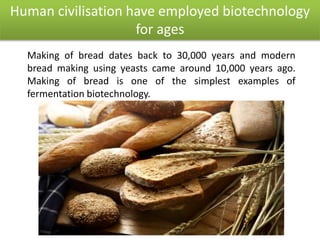
Making of bread dates back to 30,000 years and modern
bread making using yeasts came around 10,000 years ago.
Making of bread is one of the simplest examples of
fermentation biotechnology.
Human civilisation have employed biotechnology
for ages
Other examples of age old biotech products
Curd Wine
Ancient greeks making
wine.
6000BC was when
yeast (Saccharomyces
cerevisiae) was used
by Sumerians for beer.
Selection of crops and livestock is also
biotechnology
Biotechnology Timeline
Pre- 1800: Early applications and speculation
1800-1900: Significant advances in basic understanding
1900-1953: Genetics
1953- 1976: DNA research, science explodes
1977- present: modern biotechnology
Major contributions in mordernisation of
biotechnology
Gregor Mendel Robert Koch Edward Jenner
Louis Pasteur Frederick Sanger Craig Venter
First mordern biotech product: the dawn of
biotech, as we know it
1978: The cloning, expression and purification of recombinant
insulin by Genentech
Nature Medicine 16, 146–149 (2010)
Genetically Modified Organisms – the edge of
mordern biotechnology
Discovery of stem cells,
1981
Cloning
First GMO crop to be marketed
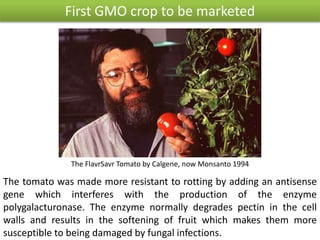
The FlavrSavr Tomato by Calgene, now Monsanto 1994
The tomato was made more resistant to rotting by adding an antisense
gene which interferes with the production of the enzyme
polygalacturonase. The enzyme normally degrades pectin in the cell
walls and results in the softening of fruit which makes them more
susceptible to being damaged by fungal infections.
Animals used for therapeutics
In 2006 that the European Medicines Evaluation Agency (EMEA) approved
antithrombin, the first recombinant protein derived from the milk of transgenic goats.
Out of 312 therapeutic products obtained using living organisms had been introduced
to the U.S. market by 2012, a total of 193 products were obtained using mammalian
cell cultures.
(Maksimenko et. al. Acta Naturae. 2013 Jan-Mar; 5(1): 33–46)
Opposition to GM crops
1. Doubt over origin of inserted foreign gene
2. Implication on safety. Eg., insect toxin gene coded (eg., in
Btcotton) can be tranfered horizontally causing harmful
pathogens and also can effect the fauna causing
environmental and health issues. Following the
introduction of Bt cotton in Northern China, non-target
pests such as Mirid Bugs (Heteroptera: Miridae) have been
becoming more abundant due to the reduction in
conventional pesticides being sprayed. Bt cotton accounts
for 93% of cotton grown in India. The state of Maharashtra
has banned the sale and distribution of Bt cotton in 2012,
in order to promote local Indian seeds, which demand less
water, fertilizers and pesticide input.
3. Implication on human health post consumption
Not all GM crops have “negative foreign” elements
The Golden Rice Story
• Vitamin A deficiency is a major health problem
• Causes blindness
• Influences severity of diarrhea, measles
• >100 million children suffer from the problem
• For many countries, the infrastructure doesn’t exist
to deliver vitamin pills
• Improved vitamin A content in widely consumed crops
an attractive alternative
-Carotene pathway in plants
IPP
Geranylgeranyl diphosphate
Phytoene
Lycopene
 -carotene
(vitamin A precursor)
Phytoene synthase
Phytoene desaturase
Lycopene-beta-cyclase
ξ-carotene desaturase
Problem:
Rice lacks
these enzymes
Normal
Vitamin A
“Deficient”
Rice
The Golden Rice Solution
IPP
Geranylgeranyl diphosphate
Phytoene
Lycopene
 -carotene
(vitamin A precursor)
Phytoene synthase
Phytoene desaturase
Lycopene-beta-cyclase
ξ-carotene desaturase
Daffodil gene
Single bacterial gene;
performs both functions
Daffodil gene
-Carotene Pathway Genes Added
Vitamin A
Pathway
is complete
and functional
Golden
Rice
The benefits of GMO in healthcare
Neutraceuticals:
The Indians, Egyptians, Chinese, and Sumerians are just a few civilizations
that have used food as medicine.
Nutraceutical, a portmanteau of the words “nutrition” and
“pharmaceutical”, was coined in 1989 by Stephen L. DeFelice, founder and
chairman of the Foundation of Innovation Medicine.The term is applied to
products that range from isolated nutrients, dietary supplements and
herbal products, specific diets and processed foods such as cereals, soups,
and beverages.
Golden rice is an example of mordern technology in neutraceuticals.
Pharming:
“the process of producing medically useful products from genetically
modified plants and animals.”
Antitrypsin from goat milk is a classic example of Pharming.
Biotechnology is not just recombinant DNA
technology
R&D
Healthcare & Biomedical
Agriculture, Livestock and GMO
Food processing
Fermentation technology
Drugs- pharmaceuticals
Bioinformatics – system biology, drug
designing
Synthetic biology
Environmental Biotechnology
Biotechnology supporting industries; service
industries
Biotech Boom – Did it
happen? Or will it not?
Debunking myths about biotech venture capital
1. Returns in Life Science venture investing lag other venture capital sectors.
in the 2000’s, venture investing in the Life Sciences has outperformed venture investing
in Tech. (Nature Biotechnology, July 2011)
Life Sciences Realized Returns (IRR) Dramatically Outperformed IT
Life Sciences Had A Lower Loss Rate and Higher Frequency of 5x+ Returns
Forbes, 22/5/2013
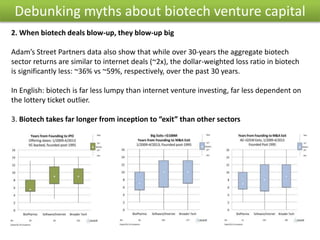
2. When biotech deals blow-up, they blow-up big
Adam’s Street Partners data also show that while over 30-years the aggregate biotech
sector returns are similar to internet deals (~2x), the dollar-weighted loss ratio in biotech
is significantly less: ~36% vs ~59%, respectively, over the past 30 years.
In English: biotech is far less lumpy than internet venture investing, far less dependent on
the lottery ticket outlier.
3. Biotech takes far longer from inception to “exit” than other sectors
Debunking myths about biotech venture capital
4. The overall biotech venture capital funding environment is drying up
Debunking myths about biotech venture capital
Biotech scope in India
• Today, Indian biotech sector comprises of more than 280
companies and 180 bio-suppliers. Indian biotech industry is
worth US$ 1.5 billion.
• Biotech Industry has 37.42% growth rate per annum
 Bioservices has reached US$ 160 million
 Bioagri sector has crossed US$ 130 million
 Biopharma has reached US$ 1billion
Bio Agri
6.95%
Bio Pharma
75.24 %
Bio Services
8.95%
Bio-IT
2.09 %
Composition of Indian biotech sector (2004-05)
Source:Biospectrum-ABLE Survey
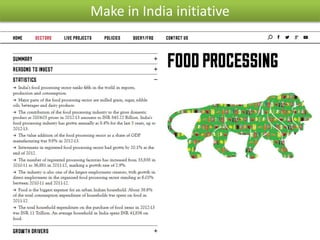
Make in India initiative
Indian Players
MNCs scripting success in India
Genome Valley, Hyderabad
• Committed to facilitating business driven research & development
• Spread across 200 acres and has over 30 R&D units functioning.
• Prominent Companies: GVK Bio, Aptuit Laurus, Nectar Therapeutics, Dupont India
Pvt Ltd, etc.
Centre for Cellular and Molecular Biology
Centre for DNA Fingerprinting and Diagnostics
International Crops Research Institute for the Semi-Arid Tropics
Indian Institute of Chemical Technology
National Institute of Nutrition, Hyderabad
Indian Immunologicals Limited
National Institute of Pharmaceutical Education and Research, Hyderabad
Centre for Computational Natural Sciences and Bioinformatics, IIIT Hyderabad
TCS Bioinformatics Innovation Lab, Hyderabad
Sir Ronald Ross Institute of Parasitology
Dr. Reddy's Institute of Life Sciences
Indo American Cancer Hospital and Research Institute
Indian Institute of Biotechnology
Directorate of Rice and Oil Seeds Research
Central Research Institute for Dry Land Agriculture
Central Forensic Science Laboratory, Hyderabad
Central Institute of Medicinal and Aromatic Plants
Central Food Technology Research Institute - Resource Center
L. V. Prasad Eye Institute
Apollo Cell and Molecular Biology Research Center
National Institute of Animal Biotechnology
National Academy of Agricultural Research Management
National Animal Resource Facility for Biomedical Research
American Oncology Institute
Asian Institute of Gastroenterology
Owaisi Center for Liver Research and diagnostics
Global Centers of Excellence in R & D
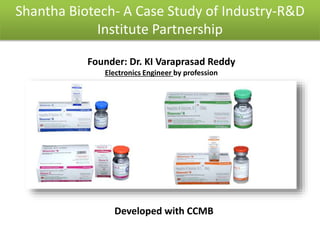
Shantha Biotech- A Case Study of Industry-R&D
Institute Partnership
Founder: Dr. KI Varaprasad Reddy
Electronics Engineer by profession
Developed with CCMB
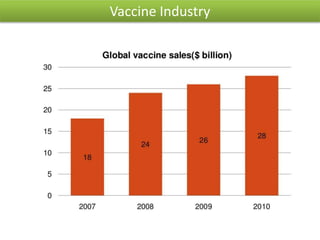
Vaccine Industry
Major Markets
Global vaccine leaders
The Indian Market
Vaccines currently under development by Indian
companies
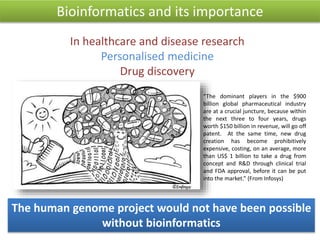
Bioinformatics and its importance
The human genome project would not have been possible
without bioinformatics
“The dominant players in the $900
billion global pharmaceutical industry
are at a crucial juncture, because within
the next three to four years, drugs
worth $150 billion in revenue, will go off
patent. At the same time, new drug
creation has become prohibitively
expensive, costing, on an average, more
than US$ 1 billion to take a drug from
concept and R&D through clinical trial
and FDA approval, before it can be put
into the market.” (From Infosys)
In healthcare and disease research
Personalised medicine
Drug discovery
Research Areas:
Computational Finance and Risk | Computational Life Sciences | e-Security | Business
Systems and Cybernetics
The research groups in Hyderabad work on:
Biomedical text-mining for enhanced healthcare
Human genome analysis
Computational structural biology
Drug development
e-Security: Advanced encryption methods, Enterprise digital rights management,
Digital watermarking and traitor tracing
Risk and Finance: Quantitative and computational methods for risk management in
financial and non financial applications with special emphasis on pricing, hedging,
Monte-Carlo simulations and stochastic optimization
Offering:
Bio-Suite™
Bio-Appliance platform
TCS PubMed eXplorer (TPX)
Genome Commons Navigator - A comprehensive tool for Genome Annotation and
Interpretation
Quantlator- A comprehensive tool for pricing and hedging of derivatives
Video Mudra – Digital watermarking tool for videos
eDRM – enterprise DRM for office documents
TCS Innovation Labs – Hyderabad
The Bioethical
Challenge
Is Biotechnology Morally Acceptable?
Two Kinds of Ethical Arguments Used to Evaluate
Concerns Over Biotechnology
• Intrinsic objections say the process of
biotechnology is objectionable in itself
• Extrinsic objections say the possible
consequences of some biotech applications
are objectionable, but others may be
acceptable
Ethical, Social and Legal Implications:
Agricultural Biotechnology
• Is it against “nature”? Risks vs benefits?
– Relative lack of religious objections.
– Transgenics intrinsically harmful to the environment?
Environmental biosafety concerns.
– Harmful to consumers? Health biosafety concerns.
• Gap between haves and have-nots increased.
– Intellectual property system in favour of already developed
countries (eg. gene patents).
– Production system in favour of the already efficient.
Ethical, Social and Legal Implications:
Cloning
• Is it ethical to use embryonic stem cells? In what
circumstances?
• Is it ethical to clone spare organs? From oneself? From
another individual?
• Is it ethical to clone human beings? Under what
circumstances?
• The legal status of a human clone?
Ethical, Social and Legal Implications:
Intellectual Property Rights
• Should genes be patentable?
• Who own the genes (biological materials)?
• Who has the right to use the genes?
• Special considerations for developing countries/poor
communities who cannot afford the treatment (eg. compare
with AIDS drugs).
• Role of government:
– Oversees development and capability strengthening in both
technical and social, ethical issues in biotechnology and life
sciences.
– Set up regulations and laws as necesssary, making sure of
having a healthy balance.
• Role of civil societies (NGOs)
– Help to make the public understand issues in various aspects,
not just lobby on single issues.
• Role of education/research institutes
– Acquire knowledge and understanding on issues interfacing
between technology and society.
– Help to generate healthy debates among various stakeholders
and the public.
Future Directions: Towards Good Governance in
Biotechnology
The Biotech Boom might not have happened, but it still is
steadily on rise and an attractive career option.
There has been a steady increase in number of jobs in
companies.
In academics, government has increased fellowships by more
than 50%
A Junior Research Fellow will get INR 25,000+HRA
A PostDoctoral Fellow will get INR 35,000+HRA
Biotech scope and prospects

Biotech scope and prospects

  • 1.
    BIOTECHNOLOGY “the exploitation ofbiological processes for industrial and other purposes, especially the genetic manipulation of microorganisms for the production of antibiotics, hormones, etc.”
  • 2.
    Making of breaddates back to 30,000 years and modern bread making using yeasts came around 10,000 years ago. Making of bread is one of the simplest examples of fermentation biotechnology. Human civilisation have employed biotechnology for ages
  • 3.
    Other examples ofage old biotech products Curd Wine Ancient greeks making wine. 6000BC was when yeast (Saccharomyces cerevisiae) was used by Sumerians for beer.
  • 4.
    Selection of cropsand livestock is also biotechnology
  • 5.
    Biotechnology Timeline Pre- 1800:Early applications and speculation 1800-1900: Significant advances in basic understanding 1900-1953: Genetics 1953- 1976: DNA research, science explodes 1977- present: modern biotechnology
  • 6.
    Major contributions inmordernisation of biotechnology Gregor Mendel Robert Koch Edward Jenner Louis Pasteur Frederick Sanger Craig Venter
  • 7.
    First mordern biotechproduct: the dawn of biotech, as we know it 1978: The cloning, expression and purification of recombinant insulin by Genentech Nature Medicine 16, 146–149 (2010)
  • 9.
    Genetically Modified Organisms– the edge of mordern biotechnology Discovery of stem cells, 1981 Cloning
  • 10.
    First GMO cropto be marketed The FlavrSavr Tomato by Calgene, now Monsanto 1994 The tomato was made more resistant to rotting by adding an antisense gene which interferes with the production of the enzyme polygalacturonase. The enzyme normally degrades pectin in the cell walls and results in the softening of fruit which makes them more susceptible to being damaged by fungal infections.
  • 11.
    Animals used fortherapeutics In 2006 that the European Medicines Evaluation Agency (EMEA) approved antithrombin, the first recombinant protein derived from the milk of transgenic goats. Out of 312 therapeutic products obtained using living organisms had been introduced to the U.S. market by 2012, a total of 193 products were obtained using mammalian cell cultures. (Maksimenko et. al. Acta Naturae. 2013 Jan-Mar; 5(1): 33–46)
  • 12.
    Opposition to GMcrops 1. Doubt over origin of inserted foreign gene 2. Implication on safety. Eg., insect toxin gene coded (eg., in Btcotton) can be tranfered horizontally causing harmful pathogens and also can effect the fauna causing environmental and health issues. Following the introduction of Bt cotton in Northern China, non-target pests such as Mirid Bugs (Heteroptera: Miridae) have been becoming more abundant due to the reduction in conventional pesticides being sprayed. Bt cotton accounts for 93% of cotton grown in India. The state of Maharashtra has banned the sale and distribution of Bt cotton in 2012, in order to promote local Indian seeds, which demand less water, fertilizers and pesticide input. 3. Implication on human health post consumption
  • 13.
    Not all GMcrops have “negative foreign” elements The Golden Rice Story • Vitamin A deficiency is a major health problem • Causes blindness • Influences severity of diarrhea, measles • >100 million children suffer from the problem • For many countries, the infrastructure doesn’t exist to deliver vitamin pills • Improved vitamin A content in widely consumed crops an attractive alternative
  • 14.
    -Carotene pathway inplants IPP Geranylgeranyl diphosphate Phytoene Lycopene  -carotene (vitamin A precursor) Phytoene synthase Phytoene desaturase Lycopene-beta-cyclase ξ-carotene desaturase Problem: Rice lacks these enzymes Normal Vitamin A “Deficient” Rice
  • 15.
    The Golden RiceSolution IPP Geranylgeranyl diphosphate Phytoene Lycopene  -carotene (vitamin A precursor) Phytoene synthase Phytoene desaturase Lycopene-beta-cyclase ξ-carotene desaturase Daffodil gene Single bacterial gene; performs both functions Daffodil gene -Carotene Pathway Genes Added Vitamin A Pathway is complete and functional Golden Rice
  • 16.
    The benefits ofGMO in healthcare Neutraceuticals: The Indians, Egyptians, Chinese, and Sumerians are just a few civilizations that have used food as medicine. Nutraceutical, a portmanteau of the words “nutrition” and “pharmaceutical”, was coined in 1989 by Stephen L. DeFelice, founder and chairman of the Foundation of Innovation Medicine.The term is applied to products that range from isolated nutrients, dietary supplements and herbal products, specific diets and processed foods such as cereals, soups, and beverages. Golden rice is an example of mordern technology in neutraceuticals. Pharming: “the process of producing medically useful products from genetically modified plants and animals.” Antitrypsin from goat milk is a classic example of Pharming.
  • 17.
    Biotechnology is notjust recombinant DNA technology R&D Healthcare & Biomedical Agriculture, Livestock and GMO Food processing Fermentation technology Drugs- pharmaceuticals Bioinformatics – system biology, drug designing Synthetic biology Environmental Biotechnology Biotechnology supporting industries; service industries
  • 18.
    Biotech Boom –Did it happen? Or will it not?
  • 19.
    Debunking myths aboutbiotech venture capital 1. Returns in Life Science venture investing lag other venture capital sectors. in the 2000’s, venture investing in the Life Sciences has outperformed venture investing in Tech. (Nature Biotechnology, July 2011) Life Sciences Realized Returns (IRR) Dramatically Outperformed IT Life Sciences Had A Lower Loss Rate and Higher Frequency of 5x+ Returns Forbes, 22/5/2013
  • 20.
    2. When biotechdeals blow-up, they blow-up big Adam’s Street Partners data also show that while over 30-years the aggregate biotech sector returns are similar to internet deals (~2x), the dollar-weighted loss ratio in biotech is significantly less: ~36% vs ~59%, respectively, over the past 30 years. In English: biotech is far less lumpy than internet venture investing, far less dependent on the lottery ticket outlier. 3. Biotech takes far longer from inception to “exit” than other sectors Debunking myths about biotech venture capital
  • 21.
    4. The overallbiotech venture capital funding environment is drying up Debunking myths about biotech venture capital
  • 22.
    Biotech scope inIndia • Today, Indian biotech sector comprises of more than 280 companies and 180 bio-suppliers. Indian biotech industry is worth US$ 1.5 billion. • Biotech Industry has 37.42% growth rate per annum  Bioservices has reached US$ 160 million  Bioagri sector has crossed US$ 130 million  Biopharma has reached US$ 1billion
  • 23.
    Bio Agri 6.95% Bio Pharma 75.24% Bio Services 8.95% Bio-IT 2.09 % Composition of Indian biotech sector (2004-05) Source:Biospectrum-ABLE Survey
  • 24.
    Make in Indiainitiative
  • 25.
  • 26.
  • 27.
    Genome Valley, Hyderabad •Committed to facilitating business driven research & development • Spread across 200 acres and has over 30 R&D units functioning. • Prominent Companies: GVK Bio, Aptuit Laurus, Nectar Therapeutics, Dupont India Pvt Ltd, etc.
  • 28.
    Centre for Cellularand Molecular Biology Centre for DNA Fingerprinting and Diagnostics International Crops Research Institute for the Semi-Arid Tropics Indian Institute of Chemical Technology National Institute of Nutrition, Hyderabad Indian Immunologicals Limited National Institute of Pharmaceutical Education and Research, Hyderabad Centre for Computational Natural Sciences and Bioinformatics, IIIT Hyderabad TCS Bioinformatics Innovation Lab, Hyderabad Sir Ronald Ross Institute of Parasitology Dr. Reddy's Institute of Life Sciences Indo American Cancer Hospital and Research Institute Indian Institute of Biotechnology Directorate of Rice and Oil Seeds Research Central Research Institute for Dry Land Agriculture Central Forensic Science Laboratory, Hyderabad Central Institute of Medicinal and Aromatic Plants Central Food Technology Research Institute - Resource Center L. V. Prasad Eye Institute Apollo Cell and Molecular Biology Research Center National Institute of Animal Biotechnology National Academy of Agricultural Research Management National Animal Resource Facility for Biomedical Research American Oncology Institute Asian Institute of Gastroenterology Owaisi Center for Liver Research and diagnostics Global Centers of Excellence in R & D
  • 29.
    Shantha Biotech- ACase Study of Industry-R&D Institute Partnership Founder: Dr. KI Varaprasad Reddy Electronics Engineer by profession Developed with CCMB
  • 30.
  • 31.
  • 32.
  • 33.
  • 35.
    Vaccines currently underdevelopment by Indian companies
  • 36.
    Bioinformatics and itsimportance The human genome project would not have been possible without bioinformatics “The dominant players in the $900 billion global pharmaceutical industry are at a crucial juncture, because within the next three to four years, drugs worth $150 billion in revenue, will go off patent. At the same time, new drug creation has become prohibitively expensive, costing, on an average, more than US$ 1 billion to take a drug from concept and R&D through clinical trial and FDA approval, before it can be put into the market.” (From Infosys) In healthcare and disease research Personalised medicine Drug discovery
  • 37.
    Research Areas: Computational Financeand Risk | Computational Life Sciences | e-Security | Business Systems and Cybernetics The research groups in Hyderabad work on: Biomedical text-mining for enhanced healthcare Human genome analysis Computational structural biology Drug development e-Security: Advanced encryption methods, Enterprise digital rights management, Digital watermarking and traitor tracing Risk and Finance: Quantitative and computational methods for risk management in financial and non financial applications with special emphasis on pricing, hedging, Monte-Carlo simulations and stochastic optimization Offering: Bio-Suite™ Bio-Appliance platform TCS PubMed eXplorer (TPX) Genome Commons Navigator - A comprehensive tool for Genome Annotation and Interpretation Quantlator- A comprehensive tool for pricing and hedging of derivatives Video Mudra – Digital watermarking tool for videos eDRM – enterprise DRM for office documents TCS Innovation Labs – Hyderabad
  • 38.
  • 39.
    Two Kinds ofEthical Arguments Used to Evaluate Concerns Over Biotechnology • Intrinsic objections say the process of biotechnology is objectionable in itself • Extrinsic objections say the possible consequences of some biotech applications are objectionable, but others may be acceptable
  • 40.
    Ethical, Social andLegal Implications: Agricultural Biotechnology • Is it against “nature”? Risks vs benefits? – Relative lack of religious objections. – Transgenics intrinsically harmful to the environment? Environmental biosafety concerns. – Harmful to consumers? Health biosafety concerns. • Gap between haves and have-nots increased. – Intellectual property system in favour of already developed countries (eg. gene patents). – Production system in favour of the already efficient.
  • 41.
    Ethical, Social andLegal Implications: Cloning • Is it ethical to use embryonic stem cells? In what circumstances? • Is it ethical to clone spare organs? From oneself? From another individual? • Is it ethical to clone human beings? Under what circumstances? • The legal status of a human clone?
  • 42.
    Ethical, Social andLegal Implications: Intellectual Property Rights • Should genes be patentable? • Who own the genes (biological materials)? • Who has the right to use the genes? • Special considerations for developing countries/poor communities who cannot afford the treatment (eg. compare with AIDS drugs).
  • 43.
    • Role ofgovernment: – Oversees development and capability strengthening in both technical and social, ethical issues in biotechnology and life sciences. – Set up regulations and laws as necesssary, making sure of having a healthy balance. • Role of civil societies (NGOs) – Help to make the public understand issues in various aspects, not just lobby on single issues. • Role of education/research institutes – Acquire knowledge and understanding on issues interfacing between technology and society. – Help to generate healthy debates among various stakeholders and the public. Future Directions: Towards Good Governance in Biotechnology
  • 44.
    The Biotech Boommight not have happened, but it still is steadily on rise and an attractive career option. There has been a steady increase in number of jobs in companies. In academics, government has increased fellowships by more than 50% A Junior Research Fellow will get INR 25,000+HRA A PostDoctoral Fellow will get INR 35,000+HRA