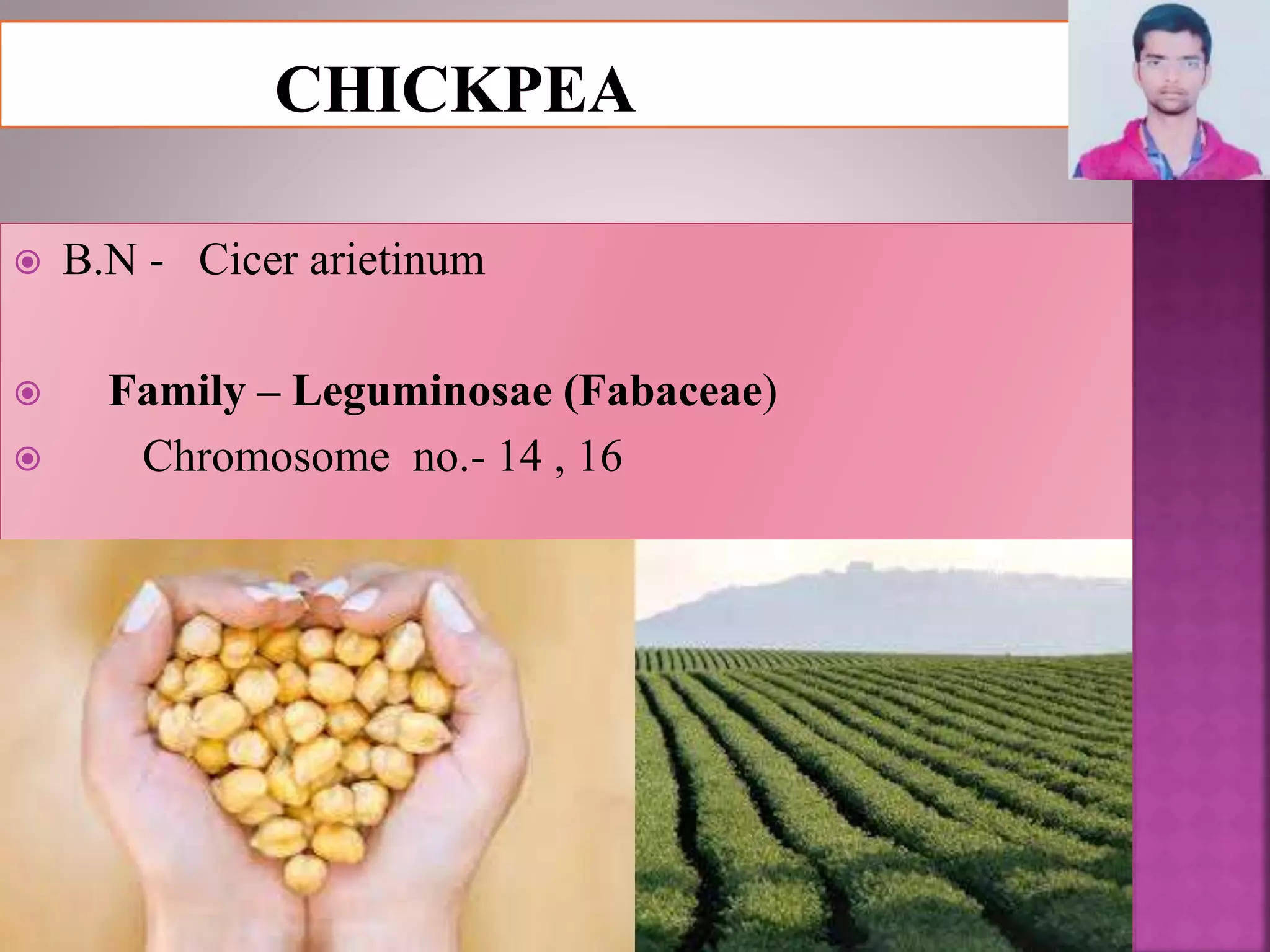

 B.N - Cicer arietinum
 Family – Leguminosae (Fabaceae)
 Chromosome no.- 14 , 16
 Gram is commonly known as chick pea, Bengal gram,
garbanzo bean, ceci bean, chana, .
 It is known as “King of Pulses”.
 Self pollinated crop.
 Long day & C3 plant.
 It is the most important pulse crop in India.
 India ranks 1st in the world in chick pea production.
 In India, Chick pea occupies about 38% of area under
pulses & contributes 50% of production.
 It is used for human consumption(as dal, vegetables,
snacks, sweets etc.) & for feeding to animals.
 The taste of the leaf of chick pea is sour due to the
presence of Maleic acid (90-96%); and Oxalic acid(4-
10%). Leaves are recommended for intestine disorder
patient.
 4-10 kg of these acids can be obtained from one ha crop.
 Germinated seeds can cure scurvy.
protein 17-23%
carbohydrate 61.5%
fat 4.5%
• It also contain Calcium of about 190 mg/100g;
• Iron 90.5 mg/100g.
• Phosphorus 280 mg/100g;
• Gram is rich source of calcium , iron and niacin.
 Gram has been known in this country for a long time. It is
said to be one of the oldest pulse known and cultivated
from ancient times both in Asia and Europe.
 The place of origin lies in south western asia, that is, in the
countries lying to the north-west of india such as
Afghanistan and persia)
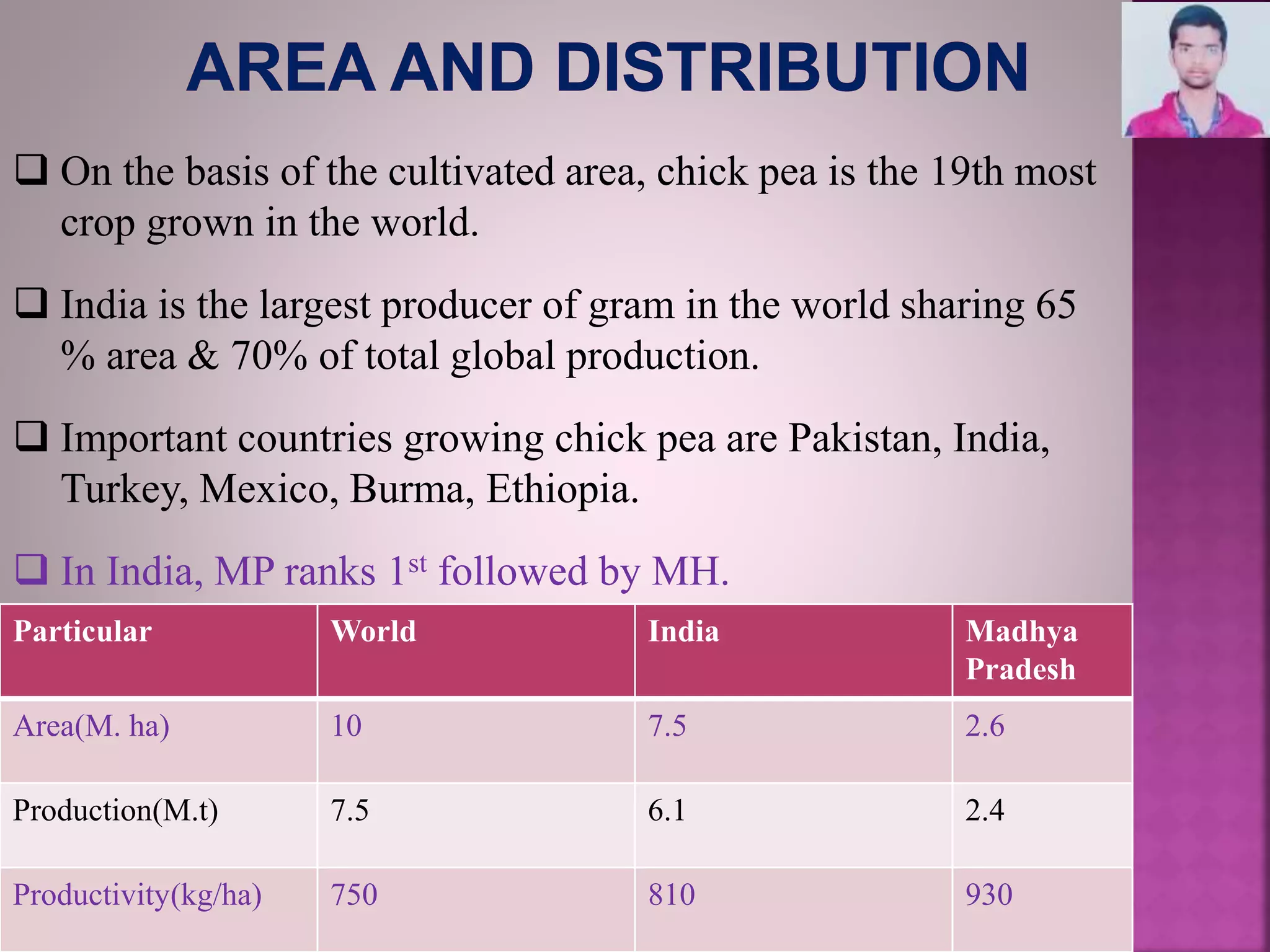
Particular World India Madhya
Pradesh
Area(M. ha) 10 7.5 2.6
Production(M.t) 7.5 6.1 2.4
Productivity(kg/ha) 750 810 930
 On the basis of the cultivated area, chick pea is the 19th most
crop grown in the world.
 India is the largest producer of gram in the world sharing 65
% area & 70% of total global production.
 Important countries growing chick pea are Pakistan, India,
Turkey, Mexico, Burma, Ethiopia.
 In India, MP ranks 1st followed by MH.
Area 14.56 million hectares
Production 15.72 million tonnes
Productivity 1080 Kg/hec.
Sources: http://www.researchgate.net
Country Area(Lakh ha) Production
(lakh tan)
Productivity
(Kg /ha)
India 105.61 112.29 1063
Australia 10.69 20.49 1875
Pakistan 9.71 3.3 340
Iraq 5.66 2.71 480
Russia 4.57 4.18 916
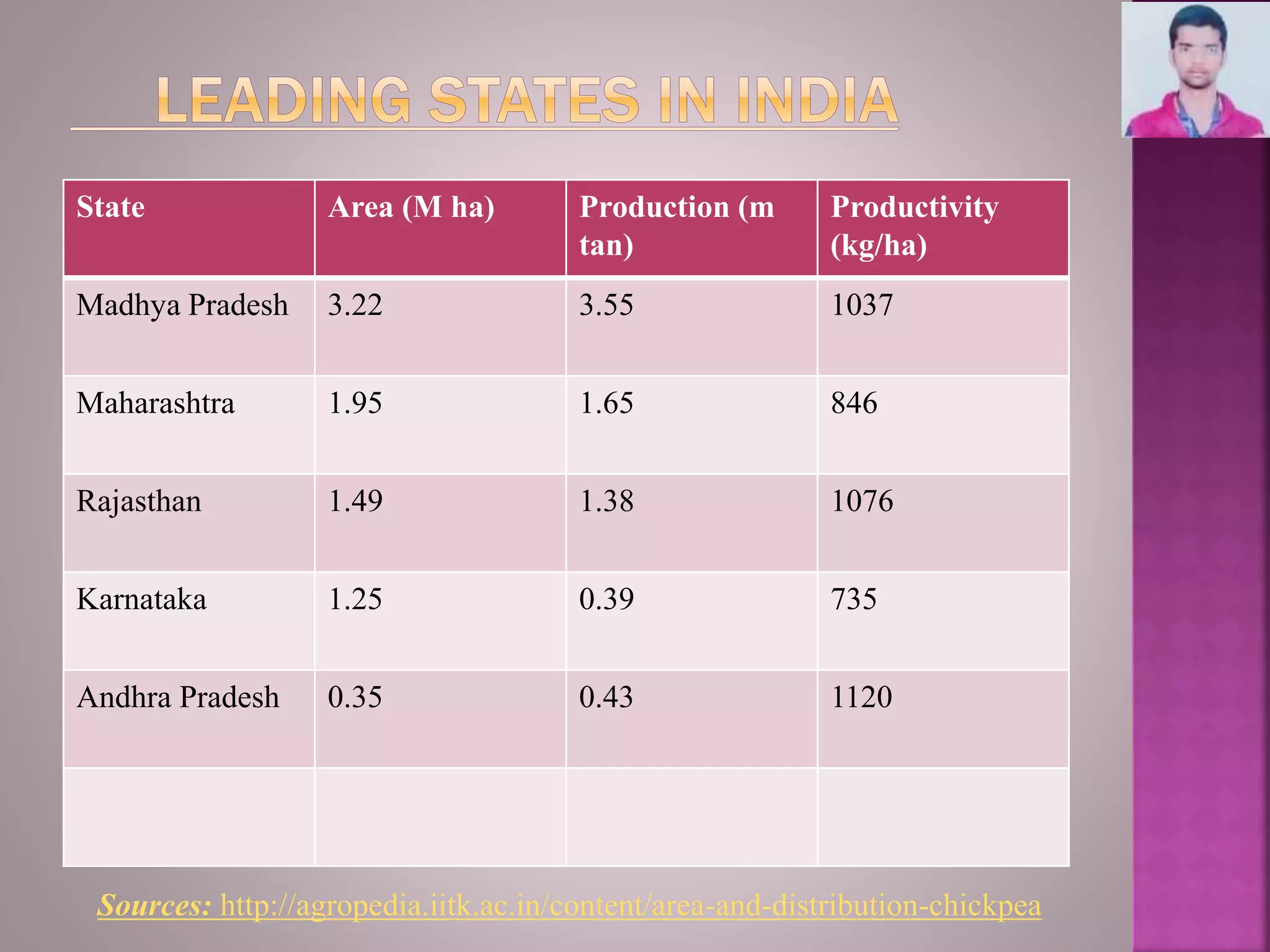
State Area (M ha) Production (m
tan)
Productivity
(kg/ha)
Madhya Pradesh 3.22 3.55 1037
Maharashtra 1.95 1.65 846
Rajasthan 1.49 1.38 1076
Karnataka 1.25 0.39 735
Andhra Pradesh 0.35 0.43 1120
Sources: http://agropedia.iitk.ac.in/content/area-and-distribution-chickpea
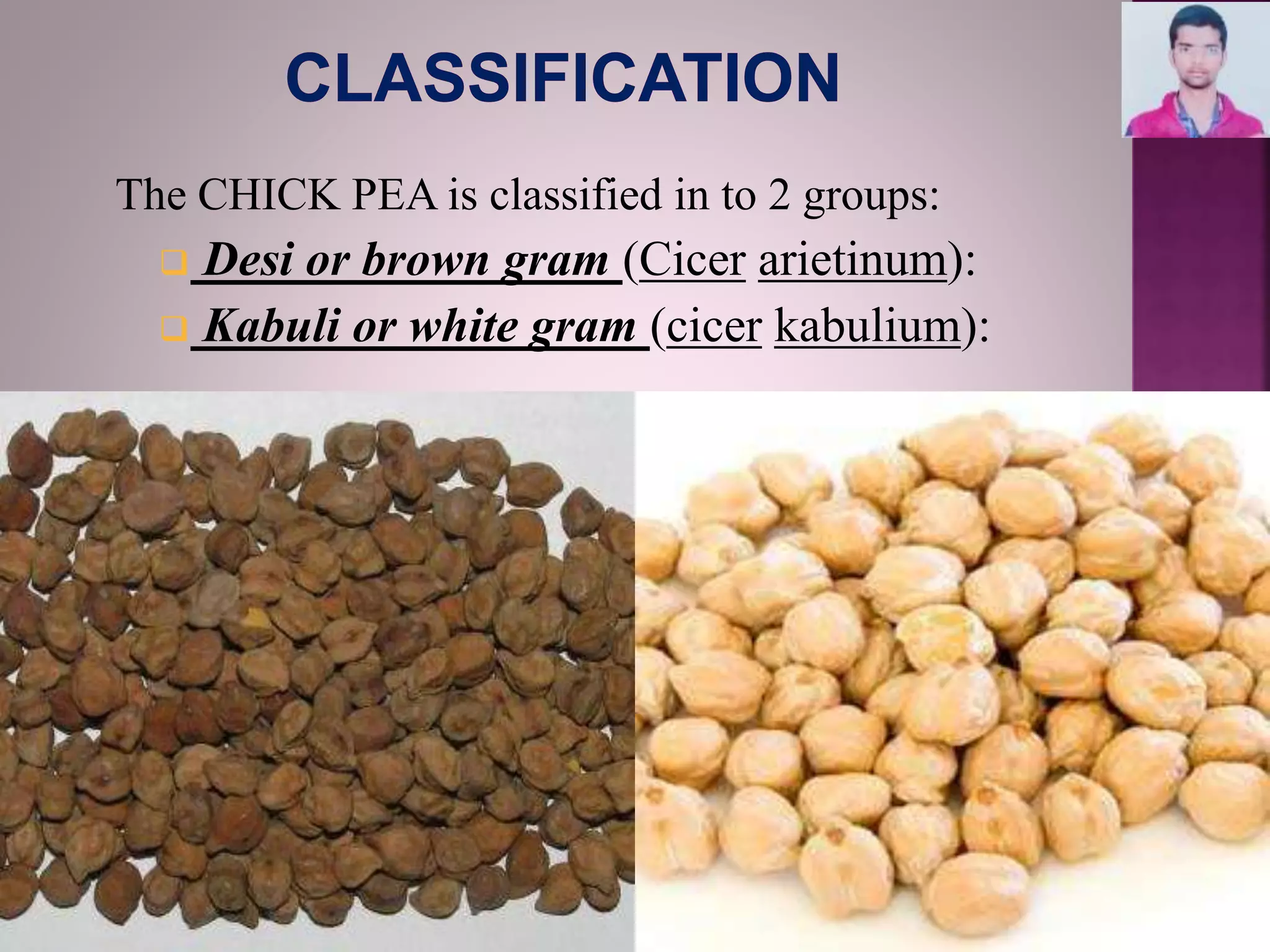
The CHICK PEA is classified in to 2 groups:
 Desi or brown gram (Cicer arietinum):
 Kabuli or white gram (cicer kabulium):
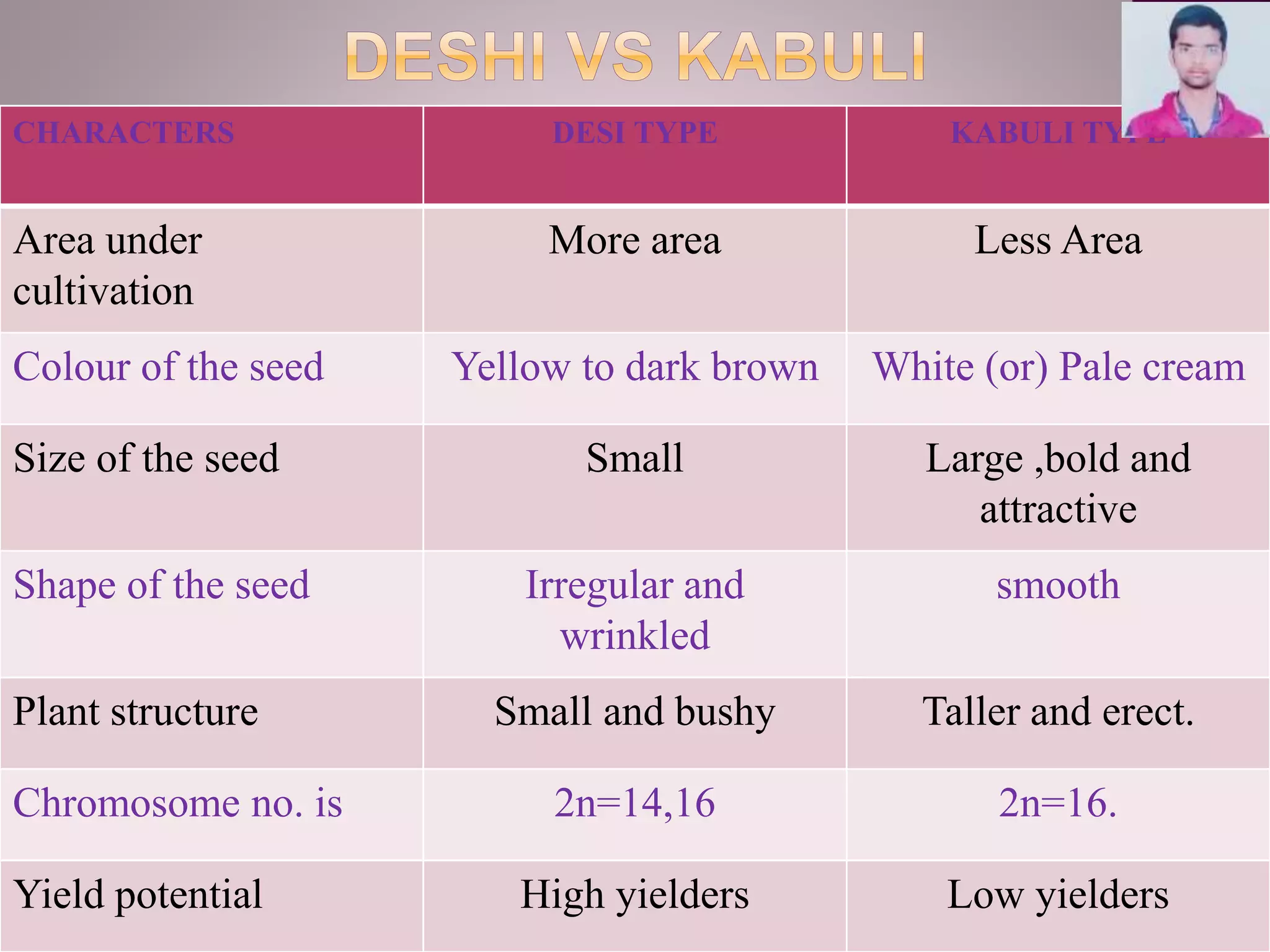
CHARACTERS DESI TYPE KABULI TYPE
Area under
cultivation
More area Less Area
Colour of the seed Yellow to dark brown White (or) Pale cream
Size of the seed Small Large ,bold and
attractive
Shape of the seed Irregular and
wrinkled
smooth
Plant structure Small and bushy Taller and erect.
Chromosome no. is 2n=14,16 2n=16.
Yield potential High yielders Low yielders
 Family: Fabaceae
 subfamily :Faboideae
 Small, much brunched herbaceous plant
 height 60cm.
 Root system: strong tap root
 Stem: the stem is branched produces not more then 1
secondary shoot.
 Leaves: the leaves are pinnately compound,& the colour
varies light green to dark with one terminal leaflet.
THE STUDY sapnacsauat@gmail.com
BY SHIV SINGH YADAV Mob - 8381912586
One central tap root along with numerous lateral branches
that spread out in all directions in the upper layer of soils.
Nodules are found on these roots. Rhizobium bacteria found
on these nodules.
THE STUDY sapnacsauat@gmail.com
BY SHIV SINGH YADAV Mob - 8381912586
Greyish in appearance. The stem is branched with
granular hairs on it. The main branch in gram usually
produces not more than one secondary shoot, in some
types the main branches may produce numerous laterals
branches.
THE STUDY sapnacsauat@gmail.com
BY SHIV SINGH YADAV Mob - 8381912586
 The leaves are pinnately compound, usually with one terminal
leaflet. Number and size of leaflets may vary in different types.
 9-15 pairs leaflets are found.
 Leaflets are small with serrated edges.
 Colour vary from light green to green or dark green.
 Central type posses leaflets with red margins.
THE STUDY sapnacsauat@gmail.com
BY SHIV SINGH YADAV Mob - 8381912586
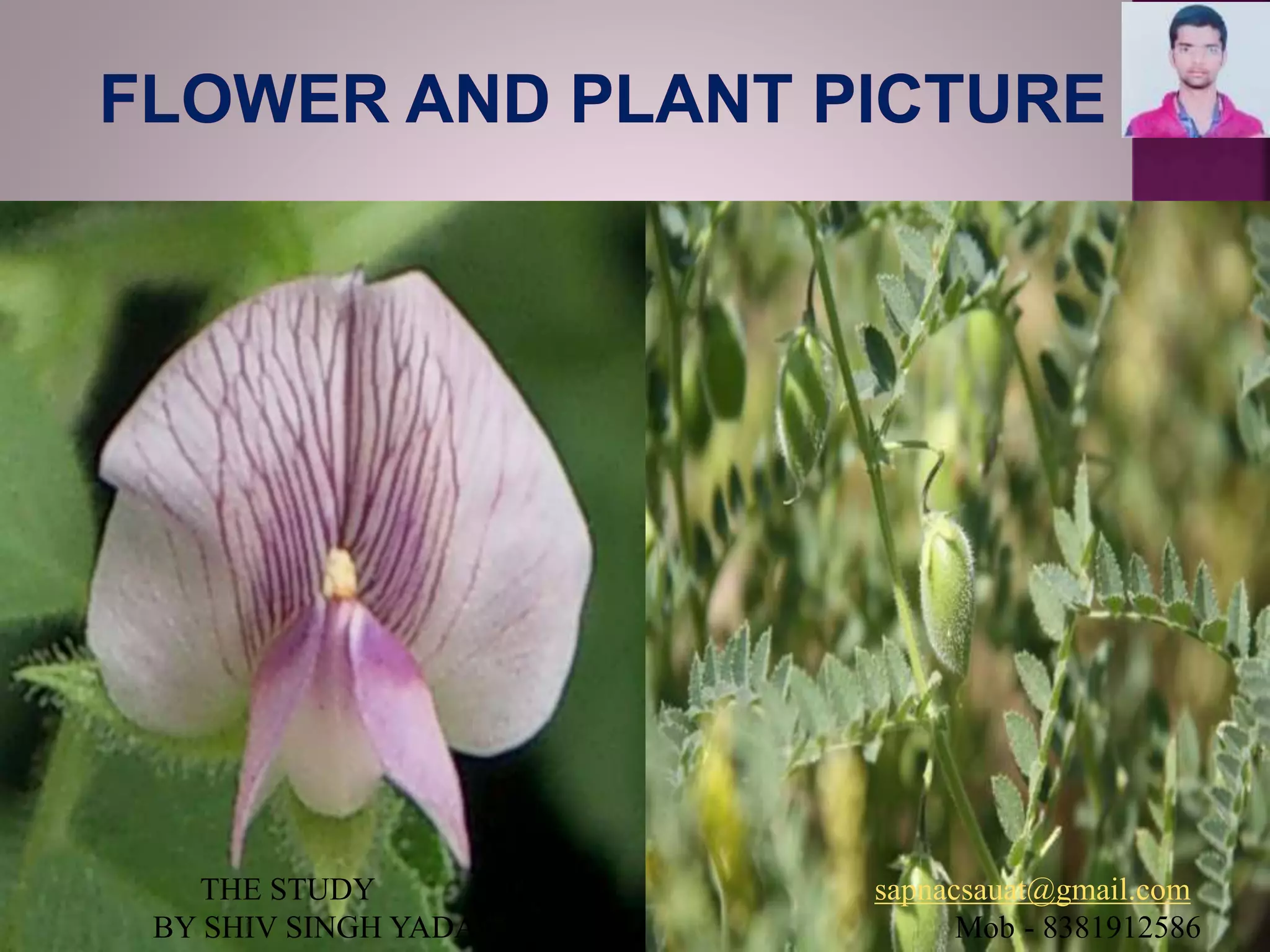
 Flowers: typical papilionaceous consisting five sepals, five
petal comprised of one standard, two wings and two keels,
ten stamens, nine fused to form one staminal column and
one free, and a carpel with the style borne laterally on the
ovary.
 Solitary flower present in axils of the leaves.
 white flowers with blue, violet or pink veins.
 Anthesis starts from 9:AM and 10 AM and may continue
up to 3 PM. Flowers remain open for two days, flowering
process being over early on the second day.
 Self pollination is the rule but cross pollination may occur
to the extent of about 5-10% due to agency of insects.
THE STUDY sapnacsauat@gmail.com
BY SHIV SINGH YADAV Mob - 8381912586
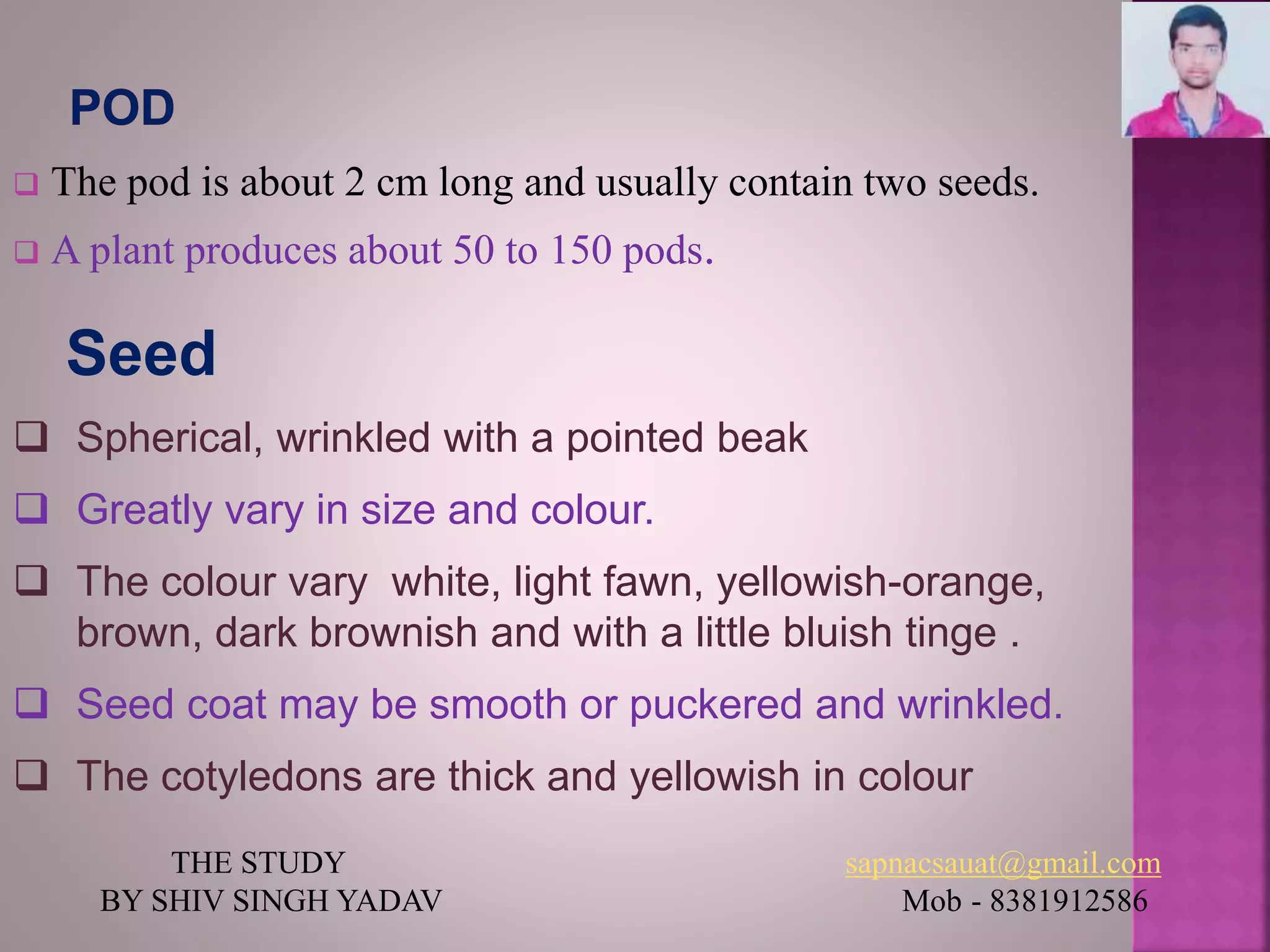
 The pod is about 2 cm long and usually contain two seeds.
 A plant produces about 50 to 150 pods.
Seed
 Spherical, wrinkled with a pointed beak
 Greatly vary in size and colour.
 The colour vary white, light fawn, yellowish-orange,
brown, dark brownish and with a little bluish tinge .
 Seed coat may be smooth or puckered and wrinkled.
 The cotyledons are thick and yellowish in colour
THE STUDY sapnacsauat@gmail.com
BY SHIV SINGH YADAV Mob - 8381912586
THE STUDY sapnacsauat@gmail.com
BY SHIV SINGH YADAV Mob - 8381912586
THE STUDY sapnacsauat@gmail.com
BY SHIV SINGH YADAV Mob - 8381912586
 Gram is winter season crop. Severe cold and frost are
injurious to it.
 Frost at the time flowering is injurious.
 Temparature:19-23º C.
 Generally grown as rainfed but gives good yield in
irrigated condition as well.
 Excessive rains soon after sowing or at flowering and
fruiting or hailstorms at ripening cause heavy loss.
 Best suited to the area having moderately rainfall of 60-
90 cm per annum.
 Elevation:1800MSL
THE STUDY sapnacsauat@gmail.com
BY SHIV SINGH YADAV Mob - 8381912586
 Grown on wide variety of soils.
 Generally grown on moderately heavy soils.
 Sandy loam to clay loam are best fit.
 Light alluvial soil is best with pH 6.0-7.5.
 Not suited >8.5.
THE STUDY sapnacsauat@gmail.com
BY SHIV SINGH YADAV Mob - 8381912586
Source Year of
Release
Area of adoption
Zone/State
Ave.
yield
(Q/ha)
Days to
maturit
y
Charecter
RAU,
Durgapur
a
1991 Rajasthan 20-23 135-150 to drought and frost, double
podded
CASUA
T
1992 NWPZ (Punjab,
Haryana, Delhi,
North Rajasthan
& West U.P.,
Bihar & West
Bengal).
20 135-140 Tolerant to root rot & wilt
stunt. Tolerant to pod borer.
Bold seeded.(late sown
ICRISAT 1992 SZ (A.P.,
Karnataka, Orissa
& Tamilnadu) CZ
(MP,Maharashtra,
Gujarat)
18-20 95-100 Resistant to Fusarium wilt
& dry root rot.
CSUAT 1992 Uttar Pradesh 21-23 145-150 Tolerant to wilt.
IARI 1993 NEPZ (East UP, 21-23 135-150 Moderately resistant to wilt,
eta
CV-2)
ICRISAT 1993 Maharashtra, A.P 12-13 80-90 Kabuli gram va
to wilt & Botryt
a -329 IARI 1993 NWPZ (Punjab,
Haryana, Delhi,
North Rajasthan &
West U.P)
21-23 145-155 Moderately resis
seeeded
ay (Phule
1-1-1)
MPKV 1994 CZ
(MP,Maharashtra,G
ujarat).
19-21 105-110 Resistant to wilt,
terminal moistur
gati (K-
6)
CSAUAT 1994 Uttar Pradesh. 17-21 140-145 Tolerant to wilt.
dan
NG663)
RAU,
Srigangana
gar
1995 NWPZ (Punjab,
Haryana, Delhi,
North Rajasthan &
West U.P).
22-25 150-155 Resistant to wilt
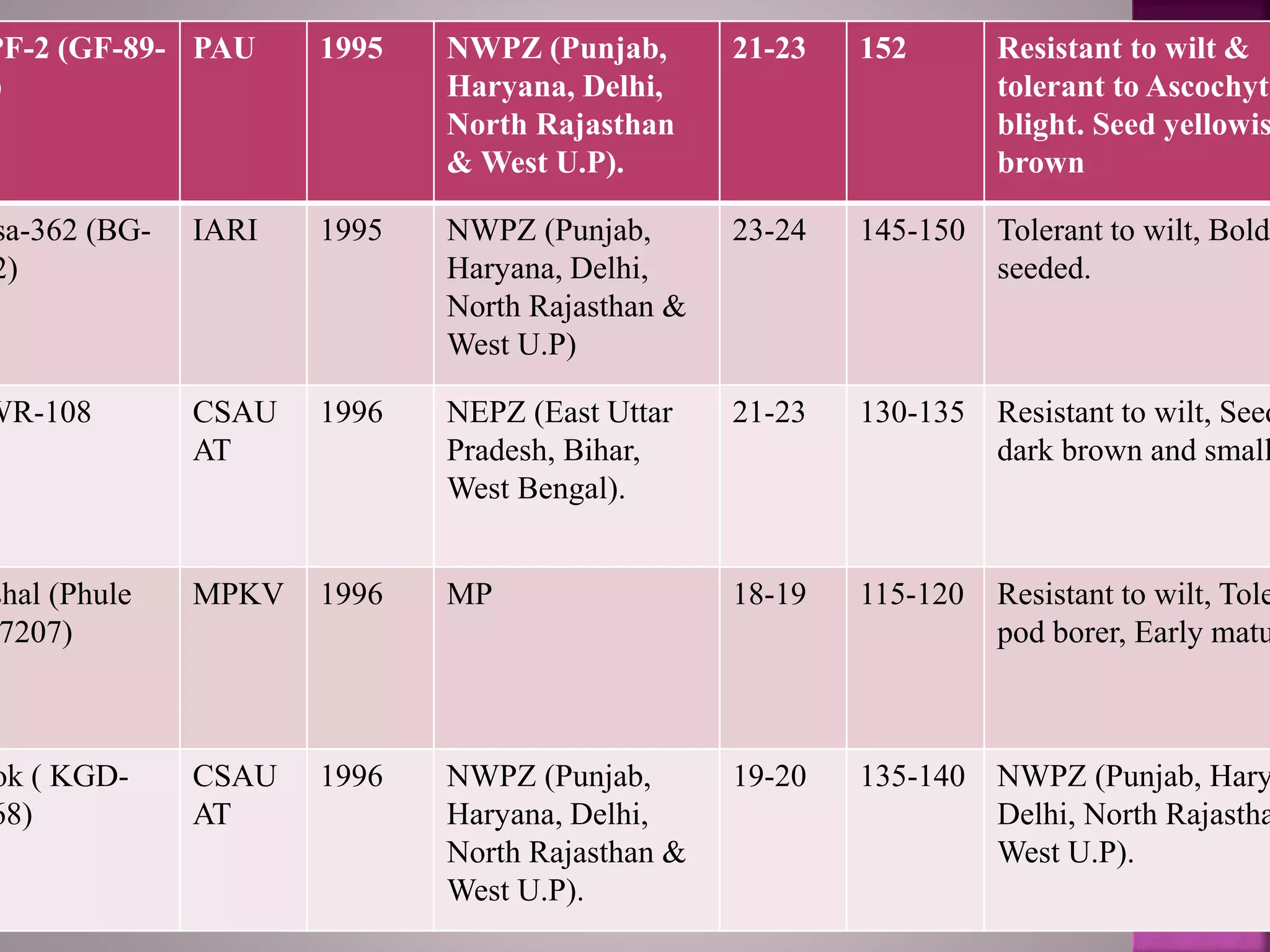
PF-2 (GF-89-
)
PAU 1995 NWPZ (Punjab,
Haryana, Delhi,
North Rajasthan
& West U.P).
21-23 152 Resistant to wilt &
tolerant to Ascochyta
blight. Seed yellowis
brown
sa-362 (BG-
2)
IARI 1995 NWPZ (Punjab,
Haryana, Delhi,
North Rajasthan &
West U.P)
23-24 145-150 Tolerant to wilt, Bold
seeded.
WR-108 CSAU
AT
1996 NEPZ (East Uttar
Pradesh, Bihar,
West Bengal).
21-23 130-135 Resistant to wilt, Seed
dark brown and small
shal (Phule
7207)
MPKV 1996 MP 18-19 115-120 Resistant to wilt, Tole
pod borer, Early matu
ok ( KGD-
68)
CSAU
AT
1996 NWPZ (Punjab,
Haryana, Delhi,
North Rajasthan &
West U.P).
19-20 135-140 NWPZ (Punjab, Hary
Delhi, North Rajastha
West U.P).
Recently released from IARI PDM-11, BG-2024
Popular variety from IARI Pusa-209
Desi variety CO-3, RS-10
Kabuli variety PUSA -1003, KAK2, HC-3
Early maturity and medium sized grain Chaff chaff, JG-62
Medium duration and high yielding RS-11, C-104
Late sown variety Radhey, Udai
Both early & late planting Mahamaya-2
heat tolerant variety: JG-14
Rainfed condition variety Vishal
Drought resistant variety NP-58 (Most suitable)
Resistant to blight Gourabh
Resistant to wilt Awarodhi, VISHAL
Resistant to pod borer PBG-3
RESISTANT TO DROUGHT & WILT JJ-11,G24
Mutant variety BGM48
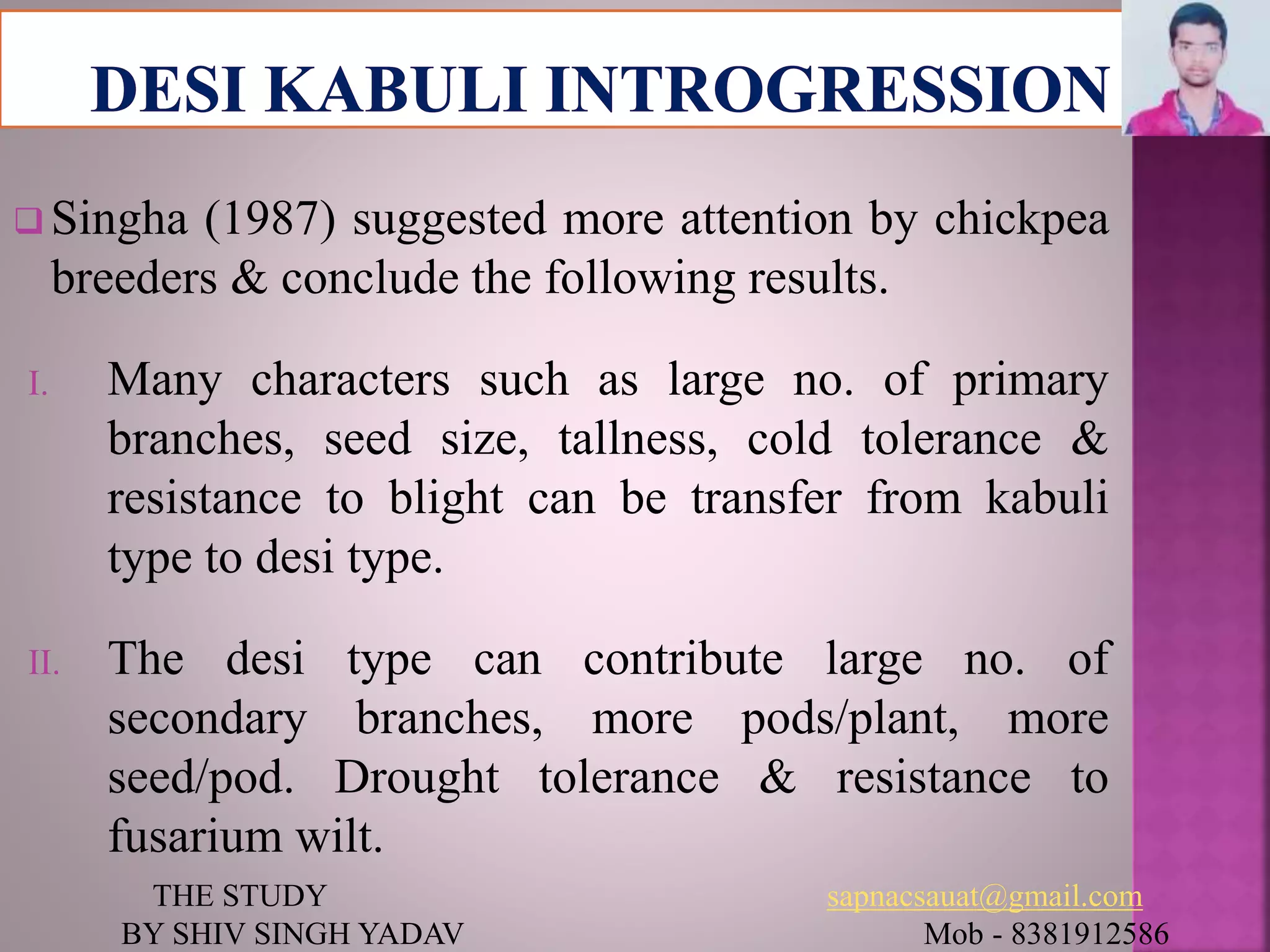
 Singha (1987) suggested more attention by chickpea
breeders & conclude the following results.
I. Many characters such as large no. of primary
branches, seed size, tallness, cold tolerance &
resistance to blight can be transfer from kabuli
type to desi type.
II. The desi type can contribute large no. of
secondary branches, more pods/plant, more
seed/pod. Drought tolerance & resistance to
fusarium wilt.
THE STUDY sapnacsauat@gmail.com
BY SHIV SINGH YADAV Mob - 8381912586
 Improvement of yield & other characters was more
easily exceed by having 1 backcross in the direction
where the improvement was needed.
 Resistance to fusarium wilt can be transfer from desi
type to kabuli type.
 E.g.. (kabuli x desi ) x kabuli for improvement towards
kabuli type
 (kabuli x desi)x desi for improvement towards desi
type.
THE STUDY sapnacsauat@gmail.com
BY SHIV SINGH YADAV Mob - 8381912586
 Chick pea in rotation with cereal crops helps in controlling soil
born disease. The most common cropping system are
CROPPING SYSTEMS:
 Rice – Chick pea
 Cotton – chickpea
INTERCROPPING:
 Chick pea + Mustard
 Chick pea + Linseed
 Chick pea + Sunflower
 Chick pea + Coriander (for South zone)
THE STUDY sapnacsauat@gmail.com
BY SHIV SINGH YADAV Mob - 8381912586
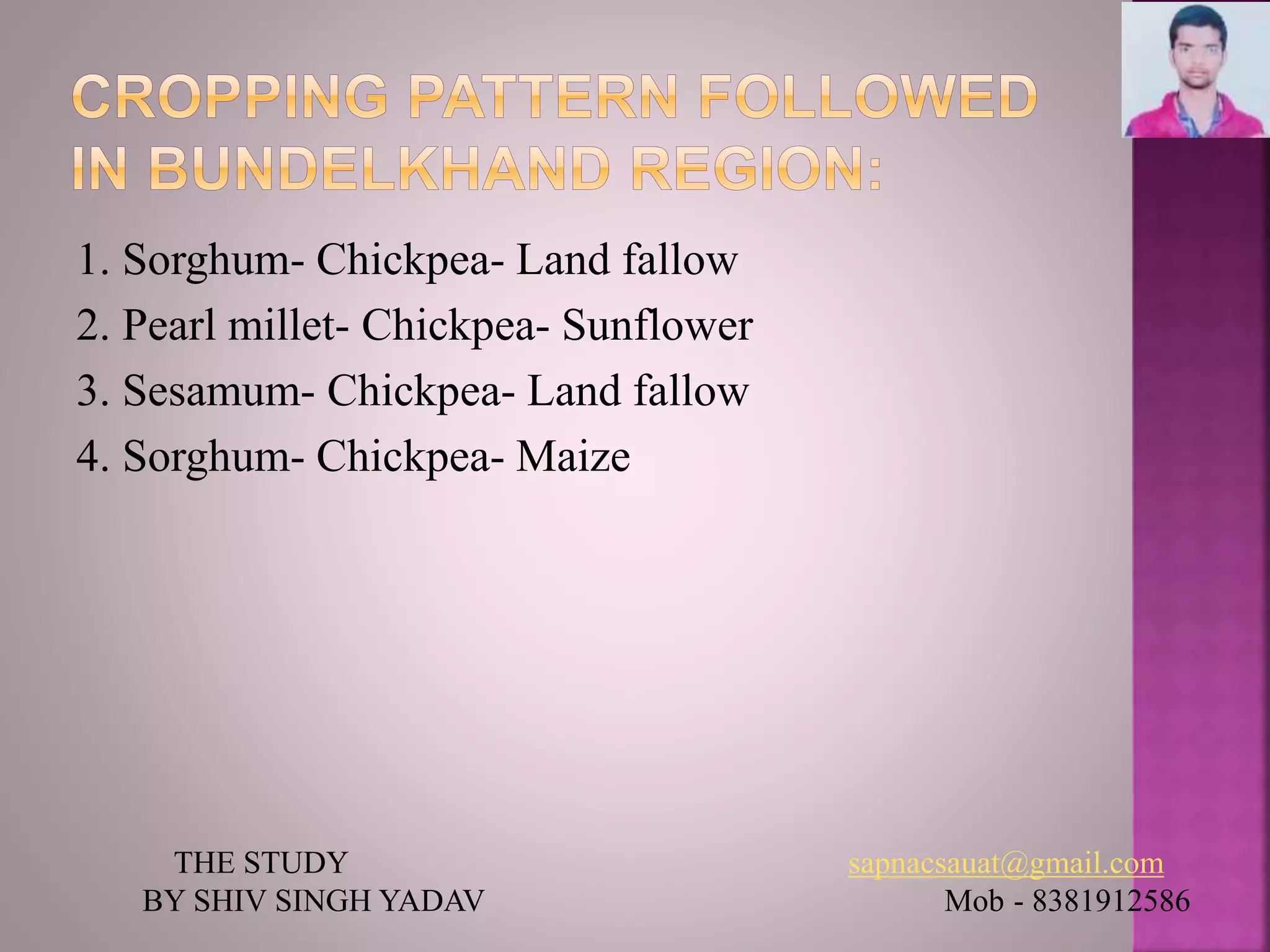
1. Sorghum- Chickpea- Land fallow
2. Pearl millet- Chickpea- Sunflower
3. Sesamum- Chickpea- Land fallow
4. Sorghum- Chickpea- Maize
THE STUDY sapnacsauat@gmail.com
BY SHIV SINGH YADAV Mob - 8381912586
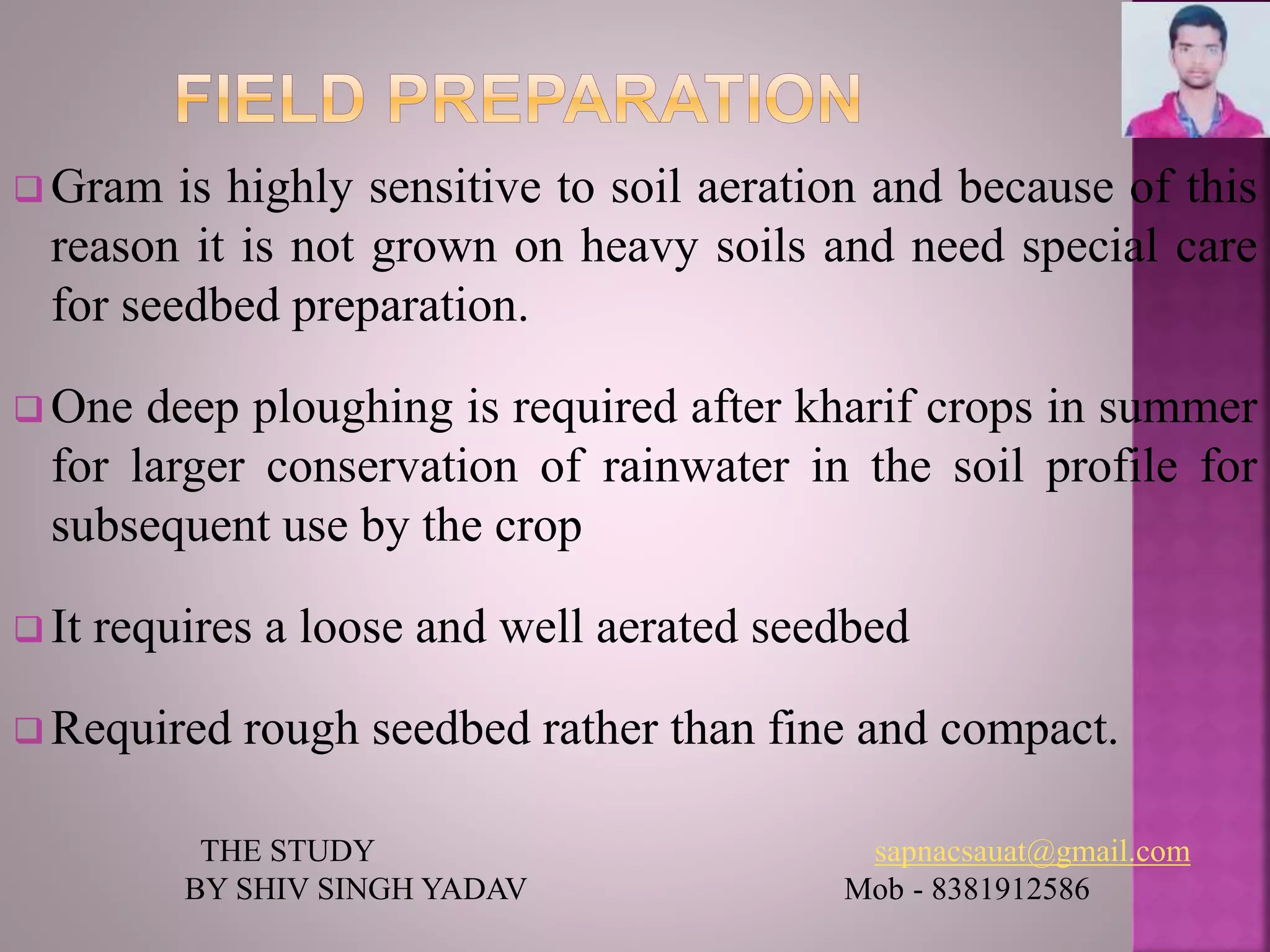
 Gram is highly sensitive to soil aeration and because of this
reason it is not grown on heavy soils and need special care
for seedbed preparation.
 One deep ploughing is required after kharif crops in summer
for larger conservation of rainwater in the soil profile for
subsequent use by the crop
 It requires a loose and well aerated seedbed
 Required rough seedbed rather than fine and compact.
THE STUDY sapnacsauat@gmail.com
BY SHIV SINGH YADAV Mob - 8381912586
 15 – 20th of October is the best time for chickpea sowing in northern India. Delay
will reduce the yield.
 In tarai, shallow water table and more winter rainfall area Ist FN of November is
most suitable.
 Early sowing of chick pea results in excessive vegetative growth & poor setting of
pods.
 Early sowing results more attack of wilt owing to high temperature at that time.
 The seed may be sown by seed drill; or local plough. Depth of sowing should be 6-8
cm, shallow sown crop is more liable to be damaged by wilt.
 Spacing : Desi type 30x10cm
Kabuli type 45x10cm.
 Seed rate : Early sown75-80 kg/ha.
Late sown: 80-100 kg/ha
 Seed should be sown after treatment with suitable fungicide.
Seed rate: Desi Type 65-70 kg/ha
Kabuli type 80-90 kg/ha
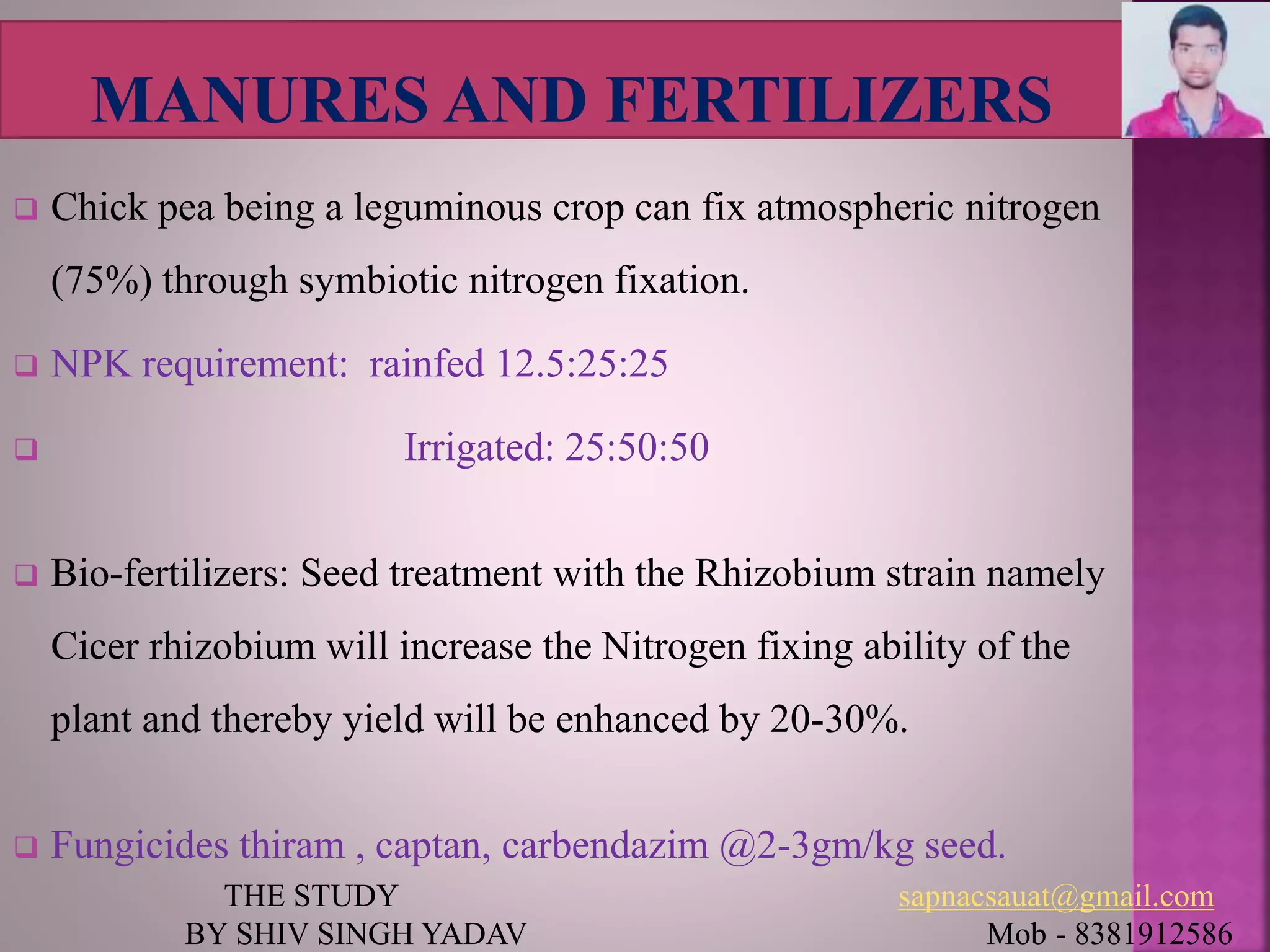
 Chick pea being a leguminous crop can fix atmospheric nitrogen
(75%) through symbiotic nitrogen fixation.
 NPK requirement: rainfed 12.5:25:25
 Irrigated: 25:50:50
 Bio-fertilizers: Seed treatment with the Rhizobium strain namely
Cicer rhizobium will increase the Nitrogen fixing ability of the
plant and thereby yield will be enhanced by 20-30%.
 Fungicides thiram , captan, carbendazim @2-3gm/kg seed.
THE STUDY sapnacsauat@gmail.com
BY SHIV SINGH YADAV Mob - 8381912586
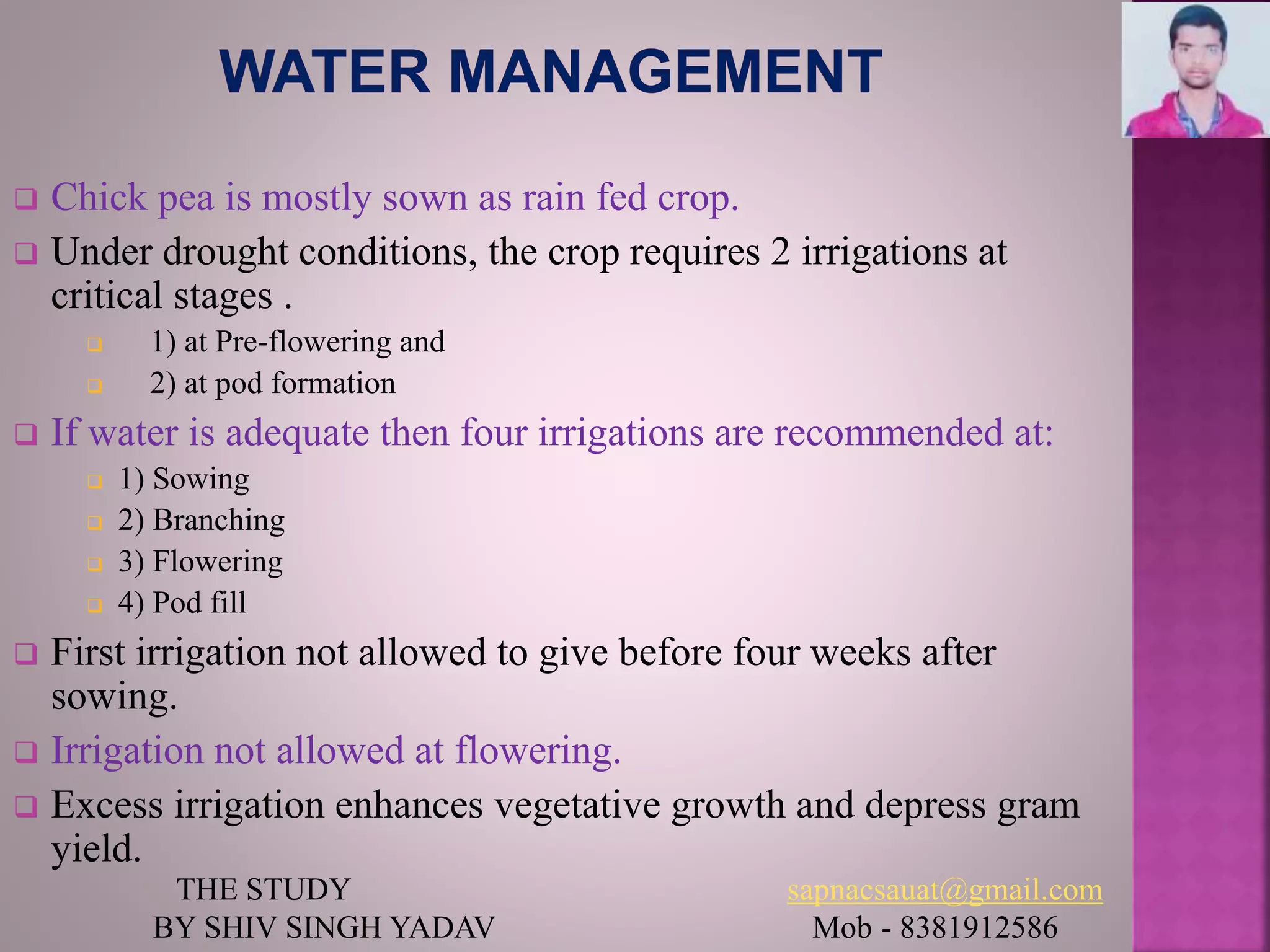
 Chick pea is mostly sown as rain fed crop.
 Under drought conditions, the crop requires 2 irrigations at
critical stages .
 1) at Pre-flowering and
 2) at pod formation
 If water is adequate then four irrigations are recommended at:
 1) Sowing
 2) Branching
 3) Flowering
 4) Pod fill
 First irrigation not allowed to give before four weeks after
sowing.
 Irrigation not allowed at flowering.
 Excess irrigation enhances vegetative growth and depress gram
yield.
THE STUDY sapnacsauat@gmail.com
BY SHIV SINGH YADAV Mob - 8381912586
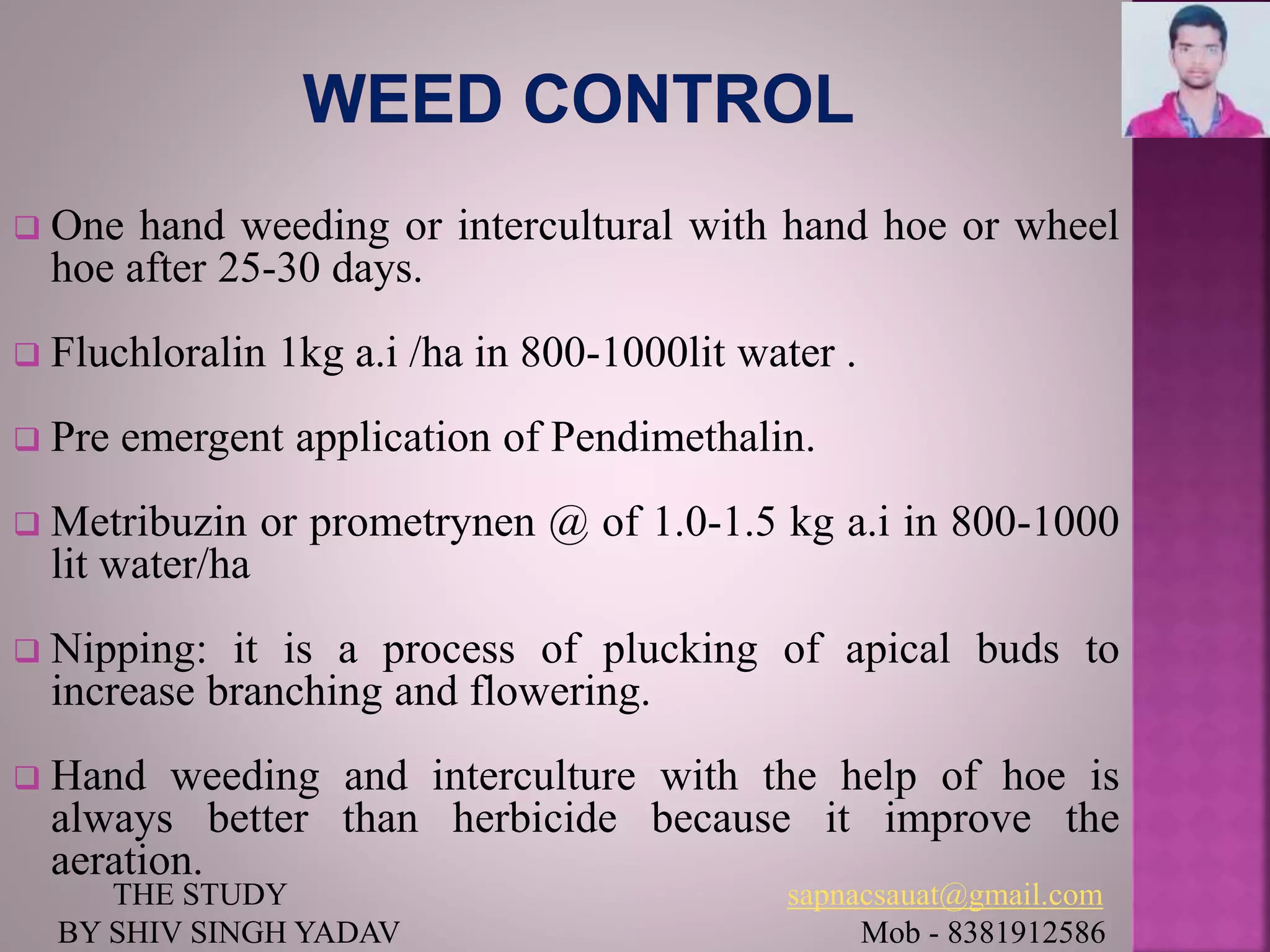
 One hand weeding or intercultural with hand hoe or wheel
hoe after 25-30 days.
 Fluchloralin 1kg a.i /ha in 800-1000lit water .
 Pre emergent application of Pendimethalin.
 Metribuzin or prometrynen @ of 1.0-1.5 kg a.i in 800-1000
lit water/ha
 Nipping: it is a process of plucking of apical buds to
increase branching and flowering.
 Hand weeding and interculture with the help of hoe is
always better than herbicide because it improve the
aeration.
THE STUDY sapnacsauat@gmail.com
BY SHIV SINGH YADAV Mob - 8381912586
Pendimethalin
Fluchloralin
Clodinafop
(control only
annual grasses)
Quizalofop
(control only
annual grasses)
1.0 kg a.i. / ha
0.75 kg a.i. / ha
0.06 kg a.i. / ha
0.05 kg a.i. / ha
Pre-emergence
Pre-plant
incorporation
Post emergence
Post emergence
THE STUDY sapnacsauat@gmail.com
BY SHIV SINGH YADAV Mob - 8381912586
THE STUDY sapnacsauat@gmail.com
BY SHIV SINGH YADAV Mob - 8381912586
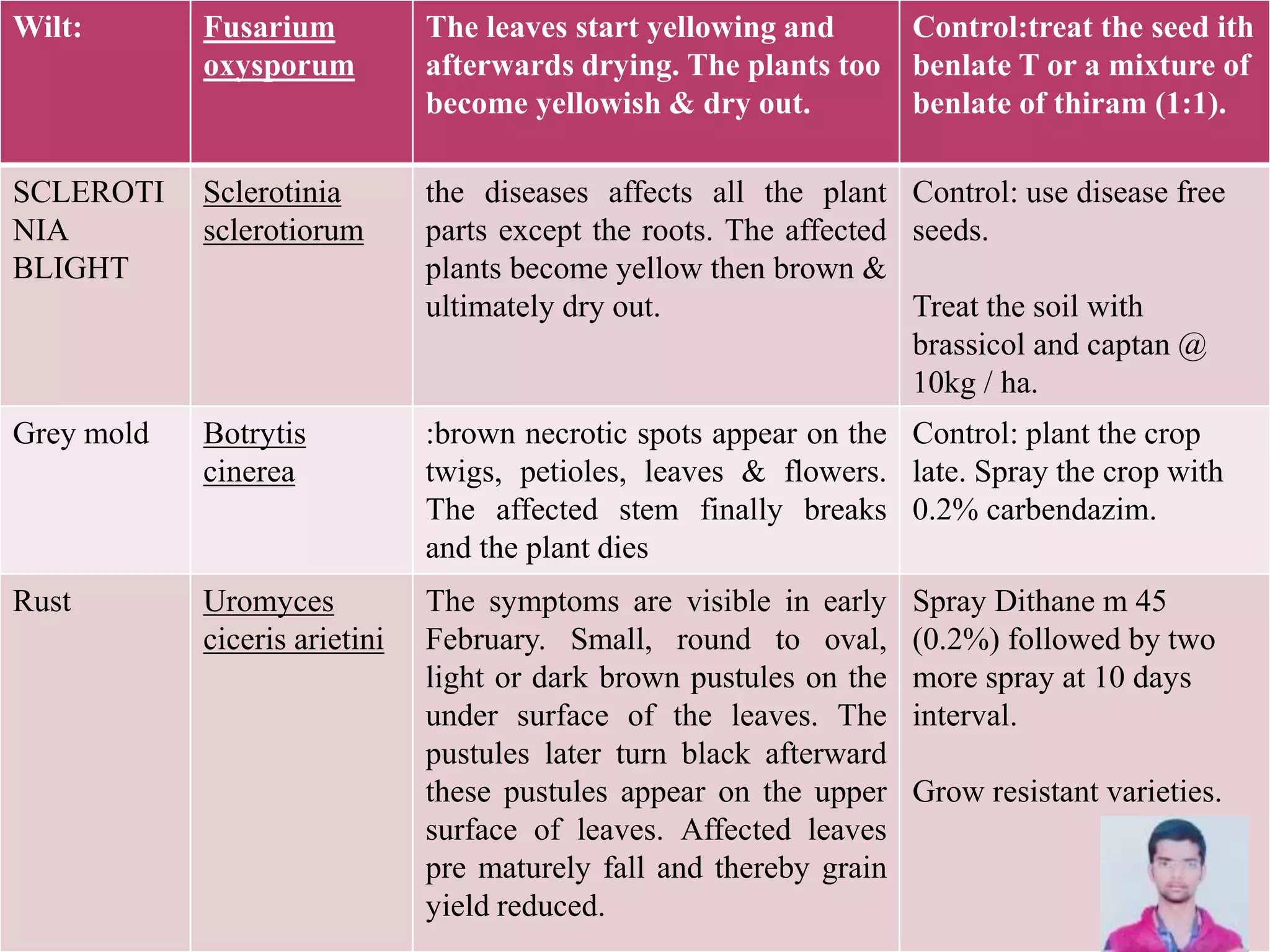
Wilt: Fusarium
oxysporum
The leaves start yellowing and
afterwards drying. The plants too
become yellowish & dry out.
Control:treat the seed ith
benlate T or a mixture of
benlate of thiram (1:1).
SCLEROTI
NIA
BLIGHT
Sclerotinia
sclerotiorum
the diseases affects all the plant
parts except the roots. The affected
plants become yellow then brown &
ultimately dry out.
Control: use disease free
seeds.
Treat the soil with
brassicol and captan @
10kg / ha.
Grey mold Botrytis
cinerea
:brown necrotic spots appear on the
twigs, petioles, leaves & flowers.
The affected stem finally breaks
and the plant dies
Control: plant the crop
late. Spray the crop with
0.2% carbendazim.
Rust Uromyces
ciceris arietini
The symptoms are visible in early
February. Small, round to oval,
light or dark brown pustules on the
under surface of the leaves. The
pustules later turn black afterward
these pustules appear on the upper
surface of leaves. Affected leaves
pre maturely fall and thereby grain
yield reduced.
Spray Dithane m 45
(0.2%) followed by two
more spray at 10 days
interval.
Grow resistant varieties.
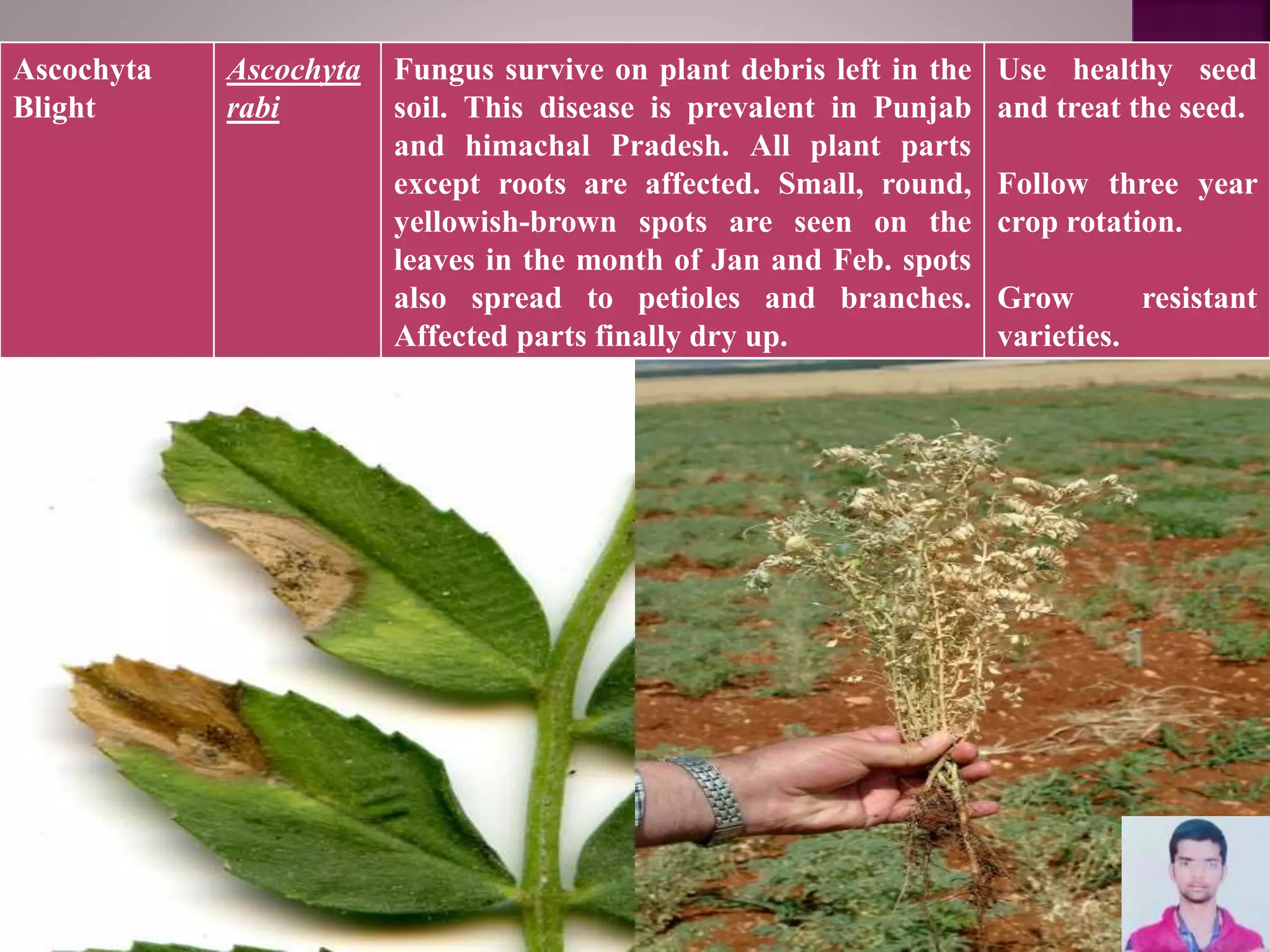
Ascochyta
Blight
Ascochyta
rabi
Fungus survive on plant debris left in the
soil. This disease is prevalent in Punjab
and himachal Pradesh. All plant parts
except roots are affected. Small, round,
yellowish-brown spots are seen on the
leaves in the month of Jan and Feb. spots
also spread to petioles and branches.
Affected parts finally dry up.
Use healthy seed
and treat the seed.
Follow three year
crop rotation.
Grow resistant
varieties.
CUTWORM Cutworm is a very serious pest in low
lying areas where fields are cloddy. The
caterpillar cut the plants at ground level.
The pest is sporadic in
nature and can be controlled
by the application of indene
6% granules @ 20-25kg/ha
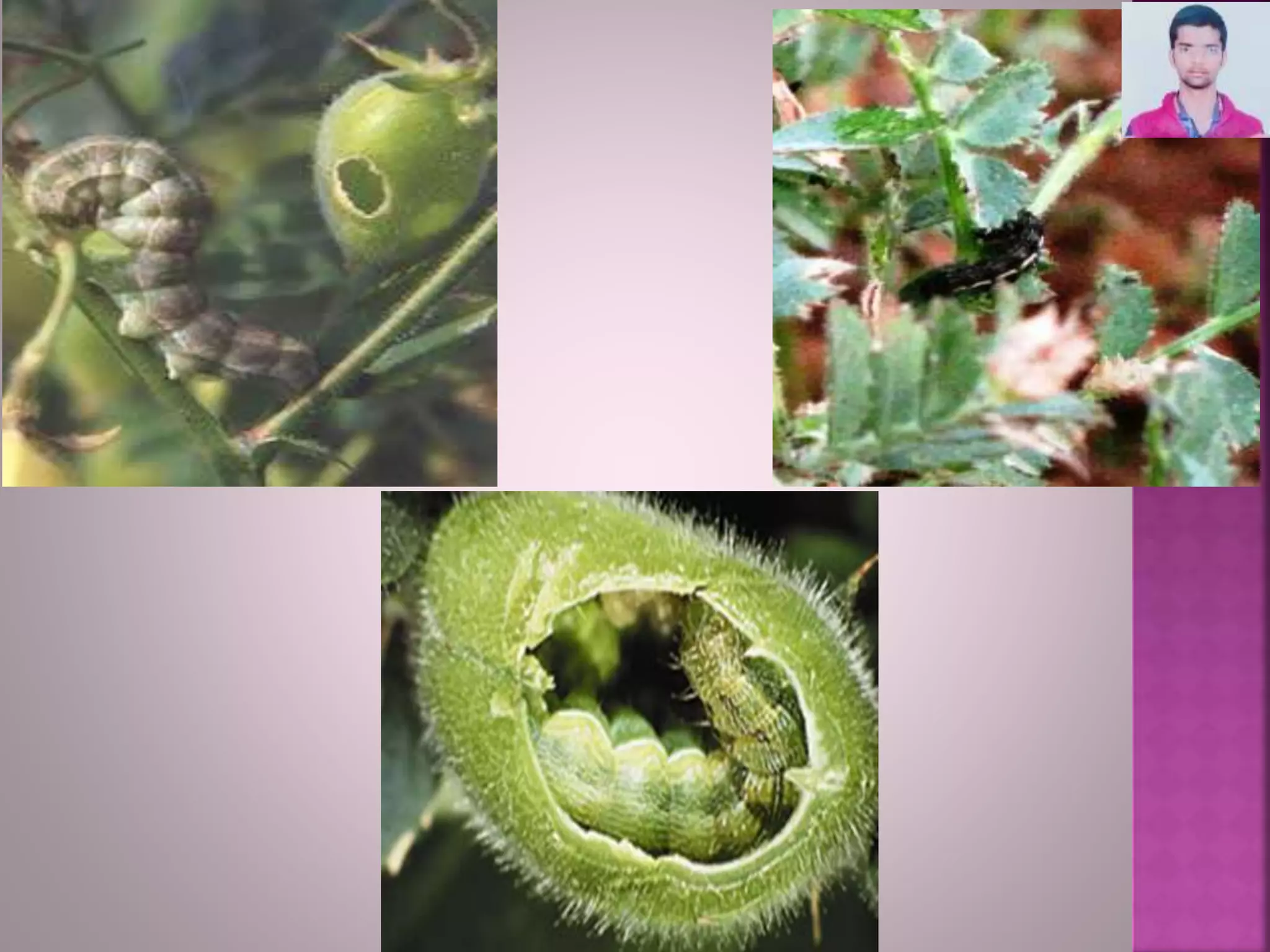
Gram pod borer This is the most serious pest of chickpea
causing damage upto 75% reduction in
yield. the caterpillar defoliates the tender
leaves and makes holes in the pods.
1.Spray monocrotopphos 36
EC at the time of pod
formation @ 1ml in 1 litre
water.
2.Spray other suitable
insecticide
THE STUDY sapnacsauat@gmail.com
BY SHIV SINGH YADAV Mob - 8381912586
 Crops become ready for harvest when leaves turn
reddish brown and start shedding
 Plants are either plucked out by hand or cut with sickle.
 The crop is allowed to dry in sun on threshing floor for
about 5-6 days ; thereafter threshing is done by beating
the plant with sickle or by trampling under the feet or
bullocks.
THE STUDY sapnacsauat@gmail.com
BY SHIV SINGH YADAV Mob - 8381912586
Rain fed condition: 12-15 Q/ha
Irrigated condition: 20-25 Q/ha
THE STUDY sapnacsauat@gmail.com
BY SHIV SINGH YADAV Mob - 8381912586
1. Plant density
2. Number of pods per plant
3. Pods weight per plant
4. Number of seeds per pod
5. Number of seeds per plant
6. 100 seed weight
7. Harvest index
8. Biological yield per hectare
9. Seed yield per hectare
THE STUDY sapnacsauat@gmail.com
BY SHIV SINGH YADAV Mob - 8381912586
 The leaves and pods of Bengal gram on the growing
crop are coated with thin film of Maleic acid (90-96%);
oxalic acid (4-9%).
 They are encrusted on leaves and pods and dissolved
on dew and settles on plants during winter season due
to this the plants give sour taste.
 These Acids are considered to have some medicinal
properties and they maybe collected and stored.
THE STUDY sapnacsauat@gmail.com
BY SHIV SINGH YADAV Mob - 8381912586
1.Modern Techniques of Raising field crops -
Chhidda Singh, Prem Singh, Rajbir Singh
2.Textbook of field crop production - Rajendra
Prasad
3.Textbook of field crops - Mukund Joshi
4.http://agropedia.iitk.ac.in/content/area-and-
distribution-chickpea
5.http://www.researchgate.net/
THE STUDY sapnacsauat@gmail.com
BY SHIV SINGH YADAV Mob - 8381912586
 PPT
 Submitted To – Dr. S.B singh
 Topic – Chickpea
 Prepared by – ( id – 1095 )
 Shiv Singh Yadav
 Emai: sapnacsauat@gmail.com
 Mob- 8381912586
THE STUDY sapnacsauat@gmail.com
BY SHIV SINGH YADAV Mob - 8381912586
3. chickpea ppt 1

3. chickpea ppt 1

  • 1.
     B.N -Cicer arietinum  Family – Leguminosae (Fabaceae)  Chromosome no.- 14 , 16
  • 2.
     Gram iscommonly known as chick pea, Bengal gram, garbanzo bean, ceci bean, chana, .  It is known as “King of Pulses”.  Self pollinated crop.  Long day & C3 plant.  It is the most important pulse crop in India.  India ranks 1st in the world in chick pea production.
  • 3.
     In India,Chick pea occupies about 38% of area under pulses & contributes 50% of production.  It is used for human consumption(as dal, vegetables, snacks, sweets etc.) & for feeding to animals.  The taste of the leaf of chick pea is sour due to the presence of Maleic acid (90-96%); and Oxalic acid(4- 10%). Leaves are recommended for intestine disorder patient.  4-10 kg of these acids can be obtained from one ha crop.  Germinated seeds can cure scurvy.
  • 4.
    protein 17-23% carbohydrate 61.5% fat4.5% • It also contain Calcium of about 190 mg/100g; • Iron 90.5 mg/100g. • Phosphorus 280 mg/100g; • Gram is rich source of calcium , iron and niacin.
  • 5.
     Gram hasbeen known in this country for a long time. It is said to be one of the oldest pulse known and cultivated from ancient times both in Asia and Europe.  The place of origin lies in south western asia, that is, in the countries lying to the north-west of india such as Afghanistan and persia)
  • 6.
    Particular World IndiaMadhya Pradesh Area(M. ha) 10 7.5 2.6 Production(M.t) 7.5 6.1 2.4 Productivity(kg/ha) 750 810 930  On the basis of the cultivated area, chick pea is the 19th most crop grown in the world.  India is the largest producer of gram in the world sharing 65 % area & 70% of total global production.  Important countries growing chick pea are Pakistan, India, Turkey, Mexico, Burma, Ethiopia.  In India, MP ranks 1st followed by MH.
  • 7.
    Area 14.56 millionhectares Production 15.72 million tonnes Productivity 1080 Kg/hec. Sources: http://www.researchgate.net
  • 8.
    Country Area(Lakh ha)Production (lakh tan) Productivity (Kg /ha) India 105.61 112.29 1063 Australia 10.69 20.49 1875 Pakistan 9.71 3.3 340 Iraq 5.66 2.71 480 Russia 4.57 4.18 916
  • 9.
    State Area (Mha) Production (m tan) Productivity (kg/ha) Madhya Pradesh 3.22 3.55 1037 Maharashtra 1.95 1.65 846 Rajasthan 1.49 1.38 1076 Karnataka 1.25 0.39 735 Andhra Pradesh 0.35 0.43 1120 Sources: http://agropedia.iitk.ac.in/content/area-and-distribution-chickpea
  • 10.
    The CHICK PEAis classified in to 2 groups:  Desi or brown gram (Cicer arietinum):  Kabuli or white gram (cicer kabulium):
  • 11.
    CHARACTERS DESI TYPEKABULI TYPE Area under cultivation More area Less Area Colour of the seed Yellow to dark brown White (or) Pale cream Size of the seed Small Large ,bold and attractive Shape of the seed Irregular and wrinkled smooth Plant structure Small and bushy Taller and erect. Chromosome no. is 2n=14,16 2n=16. Yield potential High yielders Low yielders
  • 12.
     Family: Fabaceae subfamily :Faboideae  Small, much brunched herbaceous plant  height 60cm.  Root system: strong tap root  Stem: the stem is branched produces not more then 1 secondary shoot.  Leaves: the leaves are pinnately compound,& the colour varies light green to dark with one terminal leaflet. THE STUDY sapnacsauat@gmail.com BY SHIV SINGH YADAV Mob - 8381912586
  • 13.
    One central taproot along with numerous lateral branches that spread out in all directions in the upper layer of soils. Nodules are found on these roots. Rhizobium bacteria found on these nodules. THE STUDY sapnacsauat@gmail.com BY SHIV SINGH YADAV Mob - 8381912586
  • 14.
    Greyish in appearance.The stem is branched with granular hairs on it. The main branch in gram usually produces not more than one secondary shoot, in some types the main branches may produce numerous laterals branches. THE STUDY sapnacsauat@gmail.com BY SHIV SINGH YADAV Mob - 8381912586
  • 15.
     The leavesare pinnately compound, usually with one terminal leaflet. Number and size of leaflets may vary in different types.  9-15 pairs leaflets are found.  Leaflets are small with serrated edges.  Colour vary from light green to green or dark green.  Central type posses leaflets with red margins. THE STUDY sapnacsauat@gmail.com BY SHIV SINGH YADAV Mob - 8381912586
  • 16.
     Flowers: typicalpapilionaceous consisting five sepals, five petal comprised of one standard, two wings and two keels, ten stamens, nine fused to form one staminal column and one free, and a carpel with the style borne laterally on the ovary.  Solitary flower present in axils of the leaves.  white flowers with blue, violet or pink veins.  Anthesis starts from 9:AM and 10 AM and may continue up to 3 PM. Flowers remain open for two days, flowering process being over early on the second day.  Self pollination is the rule but cross pollination may occur to the extent of about 5-10% due to agency of insects. THE STUDY sapnacsauat@gmail.com BY SHIV SINGH YADAV Mob - 8381912586
  • 17.
     The podis about 2 cm long and usually contain two seeds.  A plant produces about 50 to 150 pods. Seed  Spherical, wrinkled with a pointed beak  Greatly vary in size and colour.  The colour vary white, light fawn, yellowish-orange, brown, dark brownish and with a little bluish tinge .  Seed coat may be smooth or puckered and wrinkled.  The cotyledons are thick and yellowish in colour THE STUDY sapnacsauat@gmail.com BY SHIV SINGH YADAV Mob - 8381912586
  • 18.
    THE STUDY sapnacsauat@gmail.com BYSHIV SINGH YADAV Mob - 8381912586
  • 19.
    THE STUDY sapnacsauat@gmail.com BYSHIV SINGH YADAV Mob - 8381912586
  • 20.
     Gram iswinter season crop. Severe cold and frost are injurious to it.  Frost at the time flowering is injurious.  Temparature:19-23º C.  Generally grown as rainfed but gives good yield in irrigated condition as well.  Excessive rains soon after sowing or at flowering and fruiting or hailstorms at ripening cause heavy loss.  Best suited to the area having moderately rainfall of 60- 90 cm per annum.  Elevation:1800MSL THE STUDY sapnacsauat@gmail.com BY SHIV SINGH YADAV Mob - 8381912586
  • 21.
     Grown onwide variety of soils.  Generally grown on moderately heavy soils.  Sandy loam to clay loam are best fit.  Light alluvial soil is best with pH 6.0-7.5.  Not suited >8.5. THE STUDY sapnacsauat@gmail.com BY SHIV SINGH YADAV Mob - 8381912586
  • 22.
    Source Year of Release Areaof adoption Zone/State Ave. yield (Q/ha) Days to maturit y Charecter RAU, Durgapur a 1991 Rajasthan 20-23 135-150 to drought and frost, double podded CASUA T 1992 NWPZ (Punjab, Haryana, Delhi, North Rajasthan & West U.P., Bihar & West Bengal). 20 135-140 Tolerant to root rot & wilt stunt. Tolerant to pod borer. Bold seeded.(late sown ICRISAT 1992 SZ (A.P., Karnataka, Orissa & Tamilnadu) CZ (MP,Maharashtra, Gujarat) 18-20 95-100 Resistant to Fusarium wilt & dry root rot. CSUAT 1992 Uttar Pradesh 21-23 145-150 Tolerant to wilt. IARI 1993 NEPZ (East UP, 21-23 135-150 Moderately resistant to wilt,
  • 23.
    eta CV-2) ICRISAT 1993 Maharashtra,A.P 12-13 80-90 Kabuli gram va to wilt & Botryt a -329 IARI 1993 NWPZ (Punjab, Haryana, Delhi, North Rajasthan & West U.P) 21-23 145-155 Moderately resis seeeded ay (Phule 1-1-1) MPKV 1994 CZ (MP,Maharashtra,G ujarat). 19-21 105-110 Resistant to wilt, terminal moistur gati (K- 6) CSAUAT 1994 Uttar Pradesh. 17-21 140-145 Tolerant to wilt. dan NG663) RAU, Srigangana gar 1995 NWPZ (Punjab, Haryana, Delhi, North Rajasthan & West U.P). 22-25 150-155 Resistant to wilt
  • 24.
    PF-2 (GF-89- ) PAU 1995NWPZ (Punjab, Haryana, Delhi, North Rajasthan & West U.P). 21-23 152 Resistant to wilt & tolerant to Ascochyta blight. Seed yellowis brown sa-362 (BG- 2) IARI 1995 NWPZ (Punjab, Haryana, Delhi, North Rajasthan & West U.P) 23-24 145-150 Tolerant to wilt, Bold seeded. WR-108 CSAU AT 1996 NEPZ (East Uttar Pradesh, Bihar, West Bengal). 21-23 130-135 Resistant to wilt, Seed dark brown and small shal (Phule 7207) MPKV 1996 MP 18-19 115-120 Resistant to wilt, Tole pod borer, Early matu ok ( KGD- 68) CSAU AT 1996 NWPZ (Punjab, Haryana, Delhi, North Rajasthan & West U.P). 19-20 135-140 NWPZ (Punjab, Hary Delhi, North Rajastha West U.P).
  • 25.
    Recently released fromIARI PDM-11, BG-2024 Popular variety from IARI Pusa-209 Desi variety CO-3, RS-10 Kabuli variety PUSA -1003, KAK2, HC-3 Early maturity and medium sized grain Chaff chaff, JG-62 Medium duration and high yielding RS-11, C-104 Late sown variety Radhey, Udai Both early & late planting Mahamaya-2 heat tolerant variety: JG-14 Rainfed condition variety Vishal Drought resistant variety NP-58 (Most suitable) Resistant to blight Gourabh Resistant to wilt Awarodhi, VISHAL Resistant to pod borer PBG-3 RESISTANT TO DROUGHT & WILT JJ-11,G24 Mutant variety BGM48
  • 26.
     Singha (1987)suggested more attention by chickpea breeders & conclude the following results. I. Many characters such as large no. of primary branches, seed size, tallness, cold tolerance & resistance to blight can be transfer from kabuli type to desi type. II. The desi type can contribute large no. of secondary branches, more pods/plant, more seed/pod. Drought tolerance & resistance to fusarium wilt. THE STUDY sapnacsauat@gmail.com BY SHIV SINGH YADAV Mob - 8381912586
  • 27.
     Improvement ofyield & other characters was more easily exceed by having 1 backcross in the direction where the improvement was needed.  Resistance to fusarium wilt can be transfer from desi type to kabuli type.  E.g.. (kabuli x desi ) x kabuli for improvement towards kabuli type  (kabuli x desi)x desi for improvement towards desi type. THE STUDY sapnacsauat@gmail.com BY SHIV SINGH YADAV Mob - 8381912586
  • 28.
     Chick peain rotation with cereal crops helps in controlling soil born disease. The most common cropping system are CROPPING SYSTEMS:  Rice – Chick pea  Cotton – chickpea INTERCROPPING:  Chick pea + Mustard  Chick pea + Linseed  Chick pea + Sunflower  Chick pea + Coriander (for South zone) THE STUDY sapnacsauat@gmail.com BY SHIV SINGH YADAV Mob - 8381912586
  • 29.
    1. Sorghum- Chickpea-Land fallow 2. Pearl millet- Chickpea- Sunflower 3. Sesamum- Chickpea- Land fallow 4. Sorghum- Chickpea- Maize THE STUDY sapnacsauat@gmail.com BY SHIV SINGH YADAV Mob - 8381912586
  • 30.
     Gram ishighly sensitive to soil aeration and because of this reason it is not grown on heavy soils and need special care for seedbed preparation.  One deep ploughing is required after kharif crops in summer for larger conservation of rainwater in the soil profile for subsequent use by the crop  It requires a loose and well aerated seedbed  Required rough seedbed rather than fine and compact. THE STUDY sapnacsauat@gmail.com BY SHIV SINGH YADAV Mob - 8381912586
  • 31.
     15 –20th of October is the best time for chickpea sowing in northern India. Delay will reduce the yield.  In tarai, shallow water table and more winter rainfall area Ist FN of November is most suitable.  Early sowing of chick pea results in excessive vegetative growth & poor setting of pods.  Early sowing results more attack of wilt owing to high temperature at that time.  The seed may be sown by seed drill; or local plough. Depth of sowing should be 6-8 cm, shallow sown crop is more liable to be damaged by wilt.  Spacing : Desi type 30x10cm Kabuli type 45x10cm.  Seed rate : Early sown75-80 kg/ha. Late sown: 80-100 kg/ha  Seed should be sown after treatment with suitable fungicide. Seed rate: Desi Type 65-70 kg/ha Kabuli type 80-90 kg/ha
  • 32.
     Chick peabeing a leguminous crop can fix atmospheric nitrogen (75%) through symbiotic nitrogen fixation.  NPK requirement: rainfed 12.5:25:25  Irrigated: 25:50:50  Bio-fertilizers: Seed treatment with the Rhizobium strain namely Cicer rhizobium will increase the Nitrogen fixing ability of the plant and thereby yield will be enhanced by 20-30%.  Fungicides thiram , captan, carbendazim @2-3gm/kg seed. THE STUDY sapnacsauat@gmail.com BY SHIV SINGH YADAV Mob - 8381912586
  • 33.
     Chick peais mostly sown as rain fed crop.  Under drought conditions, the crop requires 2 irrigations at critical stages .  1) at Pre-flowering and  2) at pod formation  If water is adequate then four irrigations are recommended at:  1) Sowing  2) Branching  3) Flowering  4) Pod fill  First irrigation not allowed to give before four weeks after sowing.  Irrigation not allowed at flowering.  Excess irrigation enhances vegetative growth and depress gram yield. THE STUDY sapnacsauat@gmail.com BY SHIV SINGH YADAV Mob - 8381912586
  • 34.
     One handweeding or intercultural with hand hoe or wheel hoe after 25-30 days.  Fluchloralin 1kg a.i /ha in 800-1000lit water .  Pre emergent application of Pendimethalin.  Metribuzin or prometrynen @ of 1.0-1.5 kg a.i in 800-1000 lit water/ha  Nipping: it is a process of plucking of apical buds to increase branching and flowering.  Hand weeding and interculture with the help of hoe is always better than herbicide because it improve the aeration. THE STUDY sapnacsauat@gmail.com BY SHIV SINGH YADAV Mob - 8381912586
  • 35.
    Pendimethalin Fluchloralin Clodinafop (control only annual grasses) Quizalofop (controlonly annual grasses) 1.0 kg a.i. / ha 0.75 kg a.i. / ha 0.06 kg a.i. / ha 0.05 kg a.i. / ha Pre-emergence Pre-plant incorporation Post emergence Post emergence THE STUDY sapnacsauat@gmail.com BY SHIV SINGH YADAV Mob - 8381912586
  • 36.
    THE STUDY sapnacsauat@gmail.com BYSHIV SINGH YADAV Mob - 8381912586
  • 37.
    Wilt: Fusarium oxysporum The leavesstart yellowing and afterwards drying. The plants too become yellowish & dry out. Control:treat the seed ith benlate T or a mixture of benlate of thiram (1:1). SCLEROTI NIA BLIGHT Sclerotinia sclerotiorum the diseases affects all the plant parts except the roots. The affected plants become yellow then brown & ultimately dry out. Control: use disease free seeds. Treat the soil with brassicol and captan @ 10kg / ha. Grey mold Botrytis cinerea :brown necrotic spots appear on the twigs, petioles, leaves & flowers. The affected stem finally breaks and the plant dies Control: plant the crop late. Spray the crop with 0.2% carbendazim. Rust Uromyces ciceris arietini The symptoms are visible in early February. Small, round to oval, light or dark brown pustules on the under surface of the leaves. The pustules later turn black afterward these pustules appear on the upper surface of leaves. Affected leaves pre maturely fall and thereby grain yield reduced. Spray Dithane m 45 (0.2%) followed by two more spray at 10 days interval. Grow resistant varieties.
  • 38.
    Ascochyta Blight Ascochyta rabi Fungus survive onplant debris left in the soil. This disease is prevalent in Punjab and himachal Pradesh. All plant parts except roots are affected. Small, round, yellowish-brown spots are seen on the leaves in the month of Jan and Feb. spots also spread to petioles and branches. Affected parts finally dry up. Use healthy seed and treat the seed. Follow three year crop rotation. Grow resistant varieties.
  • 39.
    CUTWORM Cutworm isa very serious pest in low lying areas where fields are cloddy. The caterpillar cut the plants at ground level. The pest is sporadic in nature and can be controlled by the application of indene 6% granules @ 20-25kg/ha Gram pod borer This is the most serious pest of chickpea causing damage upto 75% reduction in yield. the caterpillar defoliates the tender leaves and makes holes in the pods. 1.Spray monocrotopphos 36 EC at the time of pod formation @ 1ml in 1 litre water. 2.Spray other suitable insecticide THE STUDY sapnacsauat@gmail.com BY SHIV SINGH YADAV Mob - 8381912586
  • 41.
     Crops becomeready for harvest when leaves turn reddish brown and start shedding  Plants are either plucked out by hand or cut with sickle.  The crop is allowed to dry in sun on threshing floor for about 5-6 days ; thereafter threshing is done by beating the plant with sickle or by trampling under the feet or bullocks. THE STUDY sapnacsauat@gmail.com BY SHIV SINGH YADAV Mob - 8381912586
  • 42.
    Rain fed condition:12-15 Q/ha Irrigated condition: 20-25 Q/ha THE STUDY sapnacsauat@gmail.com BY SHIV SINGH YADAV Mob - 8381912586
  • 43.
    1. Plant density 2.Number of pods per plant 3. Pods weight per plant 4. Number of seeds per pod 5. Number of seeds per plant 6. 100 seed weight 7. Harvest index 8. Biological yield per hectare 9. Seed yield per hectare THE STUDY sapnacsauat@gmail.com BY SHIV SINGH YADAV Mob - 8381912586
  • 44.
     The leavesand pods of Bengal gram on the growing crop are coated with thin film of Maleic acid (90-96%); oxalic acid (4-9%).  They are encrusted on leaves and pods and dissolved on dew and settles on plants during winter season due to this the plants give sour taste.  These Acids are considered to have some medicinal properties and they maybe collected and stored. THE STUDY sapnacsauat@gmail.com BY SHIV SINGH YADAV Mob - 8381912586
  • 45.
    1.Modern Techniques ofRaising field crops - Chhidda Singh, Prem Singh, Rajbir Singh 2.Textbook of field crop production - Rajendra Prasad 3.Textbook of field crops - Mukund Joshi 4.http://agropedia.iitk.ac.in/content/area-and- distribution-chickpea 5.http://www.researchgate.net/ THE STUDY sapnacsauat@gmail.com BY SHIV SINGH YADAV Mob - 8381912586
  • 46.
     PPT  SubmittedTo – Dr. S.B singh  Topic – Chickpea  Prepared by – ( id – 1095 )  Shiv Singh Yadav  Emai: sapnacsauat@gmail.com  Mob- 8381912586 THE STUDY sapnacsauat@gmail.com BY SHIV SINGH YADAV Mob - 8381912586