TOPIC: Seed Hardening, Principle and
Its Use In Dry Lands
Submitted To:
Dr. K.B.SUNEETHA DEVI,
PROFESSOR,
Dept. Of .AGRONOMY.
Submitted By:
A.Ravi kumar,
RAM/15-02.
SEED HARDENING
 Definition: The process of hydrating the
seed to initiate the pre-germinating
metabolism followed by dehydration which
fixes the biochemical events.
 purpose: to impart resistance against stress
conditions like drought and cold , to the
emerging seedling
Water treatment:
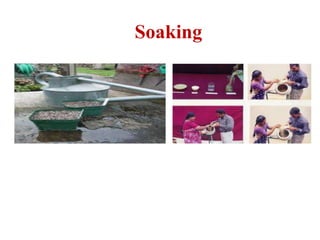
 Seeds are soaked in water and allowed to absorb
moisture up to 35 % of their weight and kept in
swollen condition for about 6 hrs. at 15 to 25oC.
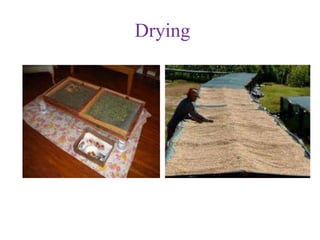
 Then seeds are spread out in a thin layer under
shade for 2 to 3 days to attain their original weight.
 The treatment can be repeated for 3-4 times, which
depends on type of crops and their varieties.
Methods of seed hardening:
Chemical treatment:
 The treatment of alternate wetting and drying
of seeds as in case of water treatment have to be
carried out with chemicals and varied
concentrations.
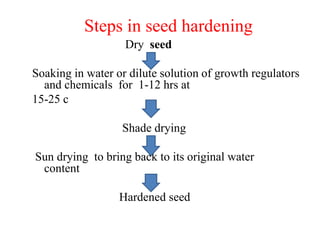
Steps in seed hardening
Dry seed
Soaking in water or dilute solution of growth regulators
and chemicals for 1-12 hrs at
15-25 c
Shade drying
Sun drying to bring back to its original water
content
Hardened seed
Soaking
Drying
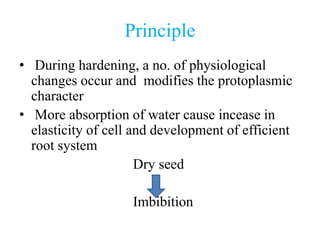
Principle
• During hardening, a no. of physiological
changes occur and modifies the protoplasmic
character
• More absorption of water cause incease in
elasticity of cell and development of efficient
root system
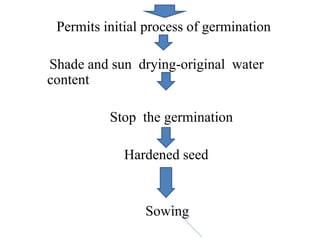
Dry seed
Imbibition
Permits initial process of germination
Shade and sun drying-original water
content
Stop the germination
Hardened seed
Sowing
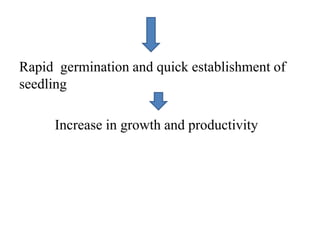
Rapid germination and quick establishment of
seedling
Increase in growth and productivity
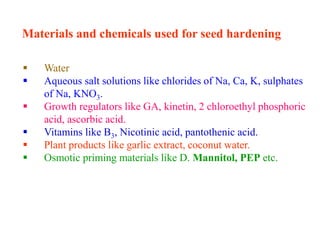
Materials and chemicals used for seed hardening
 Water
 Aqueous salt solutions like chlorides of Na, Ca, K, sulphates
of Na, KNO3.
 Growth regulators like GA, kinetin, 2 chloroethyl phosphoric
acid, ascorbic acid.
 Vitamins like B3, Nicotinic acid, pantothenic acid.
 Plant products like garlic extract, coconut water.
 Osmotic priming materials like D. Mannitol, PEP etc.
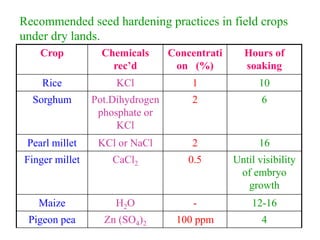
Recommended seed hardening practices in field crops
under dry lands.
Crop Chemicals
rec’d
Concentrati
on (%)
Hours of
soaking
Rice KCl 1 10
Sorghum Pot.Dihydrogen
phosphate or
KCl
2 6
Pearl millet KCl or NaCl 2 16
Finger millet CaCl2 0.5 Until visibility
of embryo
growth
Maize H2O - 12-16
Pigeon pea Zn (SO4)2 100 ppm 4
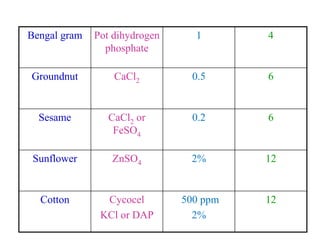
Bengal gram Pot dihydrogen
phosphate
1 4
Groundnut CaCl2 0.5 6
Sesame CaCl2 or
FeSO4
0.2 6
Sunflower ZnSO4 2% 12
Cotton Cycocel
KCl or DAP
500 ppm
2%
12
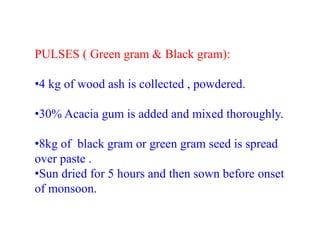
PULSES ( Green gram & Black gram):
•4 kg of wood ash is collected , powdered.
•30% Acacia gum is added and mixed thoroughly.
•8kg of black gram or green gram seed is spread
over paste .
•Sun dried for 5 hours and then sown before onset
of monsoon.
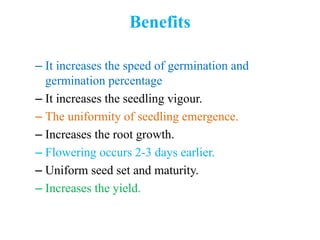
Benefits
– It increases the speed of germination and
germination percentage
– It increases the seedling vigour.
– The uniformity of seedling emergence.
– Increases the root growth.
– Flowering occurs 2-3 days earlier.
– Uniform seed set and maturity.
– Increases the yield.
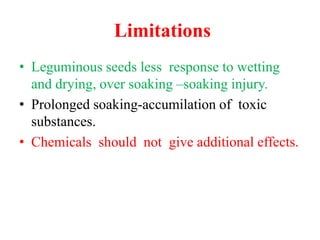
Limitations
• Leguminous seeds less response to wetting
and drying, over soaking –soaking injury.
• Prolonged soaking-accumilation of toxic
substances.
• Chemicals should not give additional effects.
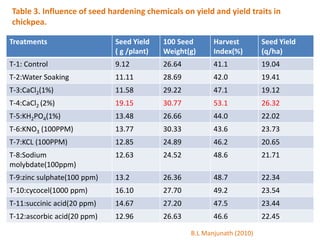
Table 3. Influence of seed hardening chemicals on yield and yield traits in
chickpea.
Treatments Seed Yield
( g /plant)
100 Seed
Weight(g)
Harvest
Index(%)
Seed Yield
(q/ha)
T-1: Control 9.12 26.64 41.1 19.04
T-2:Water Soaking 11.11 28.69 42.0 19.41
T-3:CaCl2(1%) 11.58 29.22 47.1 19.12
T-4:CaCl2 (2%) 19.15 30.77 53.1 26.32
T-5:KH2PO4(1%) 13.48 26.66 44.0 22.02
T-6:KNO3 (100PPM) 13.77 30.33 43.6 23.73
T-7:KCL (100PPM) 12.85 24.89 46.2 20.65
T-8:Sodium
molybdate(100ppm)
12.63 24.52 48.6 21.71
T-9:zinc sulphate(100 ppm) 13.2 26.36 48.7 22.34
T-10:cycocel(1000 ppm) 16.10 27.70 49.2 23.54
T-11:succinic acid(20 ppm) 14.67 27.20 47.5 23.44
T-12:ascorbic acid(20 ppm) 12.96 26.63 46.6 22.45
B.L Manjunath (2010)
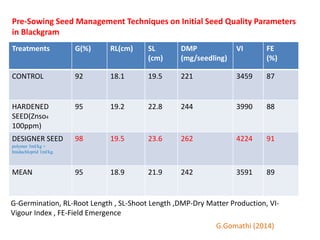
Treatments G(%) RL(cm) SL
(cm)
DMP
(mg/seedling)
VI FE
(%)
CONTROL 92 18.1 19.5 221 3459 87
HARDENED
SEED(Znso4
100ppm)
95 19.2 22.8 244 3990 88
DESIGNER SEED
polymer 3ml/kg +
Imidachloprid 1ml/kg.
98 19.5 23.6 262 4224 91
MEAN 95 18.9 21.9 242 3591 89
Pre-Sowing Seed Management Techniques on Initial Seed Quality Parameters
in Blackgram
G-Germination, RL-Root Length , SL-Shoot Length ,DMP-Dry Matter Production, VI-
Vigour Index , FE-Field Emergence
G.Gomathi (2014)
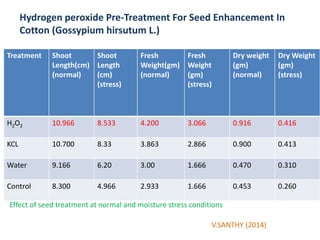
Hydrogen peroxide Pre-Treatment For Seed Enhancement In
Cotton (Gossypium hirsutum L.)
Treatment Shoot
Length(cm)
(normal)
Shoot
Length
(cm)
(stress)
Fresh
Weight(gm)
(normal)
Fresh
Weight
(gm)
(stress)
Dry weight
(gm)
(normal)
Dry Weight
(gm)
(stress)
H2O2 10.966 8.533 4.200 3.066 0.916 0.416
KCL 10.700 8.33 3.863 2.866 0.900 0.413
Water 9.166 6.20 3.00 1.666 0.470 0.310
Control 8.300 4.966 2.933 1.666 0.453 0.260
Effect of seed treatment at normal and moisture stress conditions
V.SANTHY (2014)
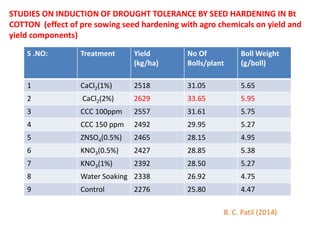
STUDIES ON INDUCTION OF DROUGHT TOLERANCE BY SEED HARDENING IN Bt
COTTON (effect of pre sowing seed hardening with agro chemicals on yield and
yield components)
S .NO: Treatment Yield
(kg/ha)
No Of
Bolls/plant
Boll Weight
(g/boll)
1 CaCl2(1%) 2518 31.05 5.65
2 CaCl2(2%) 2629 33.65 5.95
3 CCC 100ppm 2557 31.61 5.75
4 CCC 150 ppm 2492 29.95 5.27
5 ZNSO4(0.5%) 2465 28.15 4.95
6 KNO3(0.5%) 2427 28.85 5.38
7 KNO3(1%) 2392 28.50 5.27
8 Water Soaking 2338 26.92 4.75
9 Control 2276 25.80 4.47
B. C. Patil (2014)
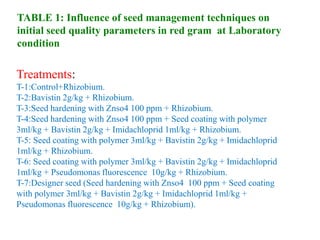
TABLE 1: Influence of seed management techniques on
initial seed quality parameters in red gram at Laboratory
condition
Treatments:
T-1:Control+Rhizobium.
T-2:Bavistin 2g/kg + Rhizobium.
T-3:Seed hardening with Znso4 100 ppm + Rhizobium.
T-4:Seed hardening with Znso4 100 ppm + Seed coating with polymer
3ml/kg + Bavistin 2g/kg + Imidachloprid 1ml/kg + Rhizobium.
T-5: Seed coating with polymer 3ml/kg + Bavistin 2g/kg + Imidachloprid
1ml/kg + Rhizobium.
T-6: Seed coating with polymer 3ml/kg + Bavistin 2g/kg + Imidachloprid
1ml/kg + Pseudomonas fluorescence 10g/kg + Rhizobium.
T-7:Designer seed (Seed hardening with Znso4 100 ppm + Seed coating
with polymer 3ml/kg + Bavistin 2g/kg + Imidachloprid 1ml/kg +
Pseudomonas fluorescence 10g/kg + Rhizobium).
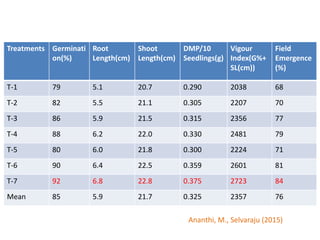
Treatments Germinati
on(%)
Root
Length(cm)
Shoot
Length(cm)
DMP/10
Seedlings(g)
Vigour
Index(G%+
SL(cm))
Field
Emergence
(%)
T-1 79 5.1 20.7 0.290 2038 68
T-2 82 5.5 21.1 0.305 2207 70
T-3 86 5.9 21.5 0.315 2356 77
T-4 88 6.2 22.0 0.330 2481 79
T-5 80 6.0 21.8 0.300 2224 71
T-6 90 6.4 22.5 0.359 2601 81
T-7 92 6.8 22.8 0.375 2723 84
Mean 85 5.9 21.7 0.325 2357 76
Ananthi, M., Selvaraju (2015)
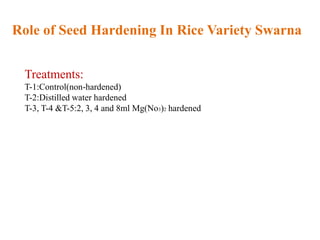
Role of Seed Hardening In Rice Variety Swarna
Treatments:
T-1:Control(non-hardened)
T-2:Distilled water hardened
T-3, T-4 &T-5:2, 3, 4 and 8ml Mg(No3)2 hardened
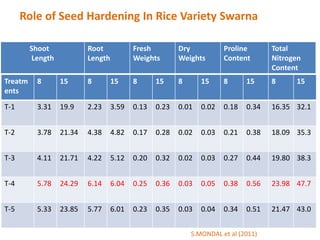
Treatm
ents
8 15 8 15 8 15 8 15 8 15 8 15
T-1 3.31 19.9 2.23 3.59 0.13 0.23 0.01 0.02 0.18 0.34 16.35 32.1
T-2 3.78 21.34 4.38 4.82 0.17 0.28 0.02 0.03 0.21 0.38 18.09 35.3
T-3 4.11 21.71 4.22 5.12 0.20 0.32 0.02 0.03 0.27 0.44 19.80 38.3
T-4 5.78 24.29 6.14 6.04 0.25 0.36 0.03 0.05 0.38 0.56 23.98 47.7
T-5 5.33 23.85 5.77 6.01 0.23 0.35 0.03 0.04 0.34 0.51 21.47 43.0
Shoot
Length
Root
Length
Fresh
Weights
Dry
Weights
Proline
Content
Total
Nitrogen
Content
Role of Seed Hardening In Rice Variety Swarna
S.MONDAL et al (2011)
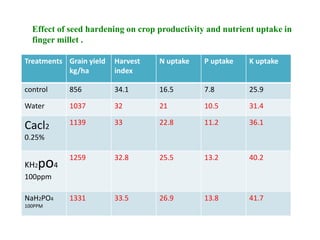
Treatments Grain yield
kg/ha
Harvest
index
N uptake P uptake K uptake
control 856 34.1 16.5 7.8 25.9
Water 1037 32 21 10.5 31.4
Cacl2
0.25%
1139 33 22.8 11.2 36.1
KH2po4
100ppm
1259 32.8 25.5 13.2 40.2
NaH2PO4
100PPM
1331 33.5 26.9 13.8 41.7
Effect of seed hardening on crop productivity and nutrient uptake in
finger millet .
Seed hardening

Seed hardening

  • 2.
    TOPIC: Seed Hardening,Principle and Its Use In Dry Lands Submitted To: Dr. K.B.SUNEETHA DEVI, PROFESSOR, Dept. Of .AGRONOMY. Submitted By: A.Ravi kumar, RAM/15-02.
  • 3.
    SEED HARDENING  Definition:The process of hydrating the seed to initiate the pre-germinating metabolism followed by dehydration which fixes the biochemical events.  purpose: to impart resistance against stress conditions like drought and cold , to the emerging seedling
  • 4.
    Water treatment:  Seedsare soaked in water and allowed to absorb moisture up to 35 % of their weight and kept in swollen condition for about 6 hrs. at 15 to 25oC.  Then seeds are spread out in a thin layer under shade for 2 to 3 days to attain their original weight.  The treatment can be repeated for 3-4 times, which depends on type of crops and their varieties. Methods of seed hardening:
  • 5.
    Chemical treatment:  Thetreatment of alternate wetting and drying of seeds as in case of water treatment have to be carried out with chemicals and varied concentrations.
  • 6.
    Steps in seedhardening Dry seed Soaking in water or dilute solution of growth regulators and chemicals for 1-12 hrs at 15-25 c Shade drying Sun drying to bring back to its original water content Hardened seed
  • 7.
  • 8.
  • 9.
    Principle • During hardening,a no. of physiological changes occur and modifies the protoplasmic character • More absorption of water cause incease in elasticity of cell and development of efficient root system Dry seed Imbibition
  • 10.
    Permits initial processof germination Shade and sun drying-original water content Stop the germination Hardened seed Sowing
  • 11.
    Rapid germination andquick establishment of seedling Increase in growth and productivity
  • 12.
    Materials and chemicalsused for seed hardening  Water  Aqueous salt solutions like chlorides of Na, Ca, K, sulphates of Na, KNO3.  Growth regulators like GA, kinetin, 2 chloroethyl phosphoric acid, ascorbic acid.  Vitamins like B3, Nicotinic acid, pantothenic acid.  Plant products like garlic extract, coconut water.  Osmotic priming materials like D. Mannitol, PEP etc.
  • 13.
    Recommended seed hardeningpractices in field crops under dry lands. Crop Chemicals rec’d Concentrati on (%) Hours of soaking Rice KCl 1 10 Sorghum Pot.Dihydrogen phosphate or KCl 2 6 Pearl millet KCl or NaCl 2 16 Finger millet CaCl2 0.5 Until visibility of embryo growth Maize H2O - 12-16 Pigeon pea Zn (SO4)2 100 ppm 4
  • 14.
    Bengal gram Potdihydrogen phosphate 1 4 Groundnut CaCl2 0.5 6 Sesame CaCl2 or FeSO4 0.2 6 Sunflower ZnSO4 2% 12 Cotton Cycocel KCl or DAP 500 ppm 2% 12
  • 15.
    PULSES ( Greengram & Black gram): •4 kg of wood ash is collected , powdered. •30% Acacia gum is added and mixed thoroughly. •8kg of black gram or green gram seed is spread over paste . •Sun dried for 5 hours and then sown before onset of monsoon.
  • 16.
    Benefits – It increasesthe speed of germination and germination percentage – It increases the seedling vigour. – The uniformity of seedling emergence. – Increases the root growth. – Flowering occurs 2-3 days earlier. – Uniform seed set and maturity. – Increases the yield.
  • 17.
    Limitations • Leguminous seedsless response to wetting and drying, over soaking –soaking injury. • Prolonged soaking-accumilation of toxic substances. • Chemicals should not give additional effects.
  • 18.
    Table 3. Influenceof seed hardening chemicals on yield and yield traits in chickpea. Treatments Seed Yield ( g /plant) 100 Seed Weight(g) Harvest Index(%) Seed Yield (q/ha) T-1: Control 9.12 26.64 41.1 19.04 T-2:Water Soaking 11.11 28.69 42.0 19.41 T-3:CaCl2(1%) 11.58 29.22 47.1 19.12 T-4:CaCl2 (2%) 19.15 30.77 53.1 26.32 T-5:KH2PO4(1%) 13.48 26.66 44.0 22.02 T-6:KNO3 (100PPM) 13.77 30.33 43.6 23.73 T-7:KCL (100PPM) 12.85 24.89 46.2 20.65 T-8:Sodium molybdate(100ppm) 12.63 24.52 48.6 21.71 T-9:zinc sulphate(100 ppm) 13.2 26.36 48.7 22.34 T-10:cycocel(1000 ppm) 16.10 27.70 49.2 23.54 T-11:succinic acid(20 ppm) 14.67 27.20 47.5 23.44 T-12:ascorbic acid(20 ppm) 12.96 26.63 46.6 22.45 B.L Manjunath (2010)
  • 19.
    Treatments G(%) RL(cm)SL (cm) DMP (mg/seedling) VI FE (%) CONTROL 92 18.1 19.5 221 3459 87 HARDENED SEED(Znso4 100ppm) 95 19.2 22.8 244 3990 88 DESIGNER SEED polymer 3ml/kg + Imidachloprid 1ml/kg. 98 19.5 23.6 262 4224 91 MEAN 95 18.9 21.9 242 3591 89 Pre-Sowing Seed Management Techniques on Initial Seed Quality Parameters in Blackgram G-Germination, RL-Root Length , SL-Shoot Length ,DMP-Dry Matter Production, VI- Vigour Index , FE-Field Emergence G.Gomathi (2014)
  • 20.
    Hydrogen peroxide Pre-TreatmentFor Seed Enhancement In Cotton (Gossypium hirsutum L.) Treatment Shoot Length(cm) (normal) Shoot Length (cm) (stress) Fresh Weight(gm) (normal) Fresh Weight (gm) (stress) Dry weight (gm) (normal) Dry Weight (gm) (stress) H2O2 10.966 8.533 4.200 3.066 0.916 0.416 KCL 10.700 8.33 3.863 2.866 0.900 0.413 Water 9.166 6.20 3.00 1.666 0.470 0.310 Control 8.300 4.966 2.933 1.666 0.453 0.260 Effect of seed treatment at normal and moisture stress conditions V.SANTHY (2014)
  • 21.
    STUDIES ON INDUCTIONOF DROUGHT TOLERANCE BY SEED HARDENING IN Bt COTTON (effect of pre sowing seed hardening with agro chemicals on yield and yield components) S .NO: Treatment Yield (kg/ha) No Of Bolls/plant Boll Weight (g/boll) 1 CaCl2(1%) 2518 31.05 5.65 2 CaCl2(2%) 2629 33.65 5.95 3 CCC 100ppm 2557 31.61 5.75 4 CCC 150 ppm 2492 29.95 5.27 5 ZNSO4(0.5%) 2465 28.15 4.95 6 KNO3(0.5%) 2427 28.85 5.38 7 KNO3(1%) 2392 28.50 5.27 8 Water Soaking 2338 26.92 4.75 9 Control 2276 25.80 4.47 B. C. Patil (2014)
  • 22.
    TABLE 1: Influenceof seed management techniques on initial seed quality parameters in red gram at Laboratory condition Treatments: T-1:Control+Rhizobium. T-2:Bavistin 2g/kg + Rhizobium. T-3:Seed hardening with Znso4 100 ppm + Rhizobium. T-4:Seed hardening with Znso4 100 ppm + Seed coating with polymer 3ml/kg + Bavistin 2g/kg + Imidachloprid 1ml/kg + Rhizobium. T-5: Seed coating with polymer 3ml/kg + Bavistin 2g/kg + Imidachloprid 1ml/kg + Rhizobium. T-6: Seed coating with polymer 3ml/kg + Bavistin 2g/kg + Imidachloprid 1ml/kg + Pseudomonas fluorescence 10g/kg + Rhizobium. T-7:Designer seed (Seed hardening with Znso4 100 ppm + Seed coating with polymer 3ml/kg + Bavistin 2g/kg + Imidachloprid 1ml/kg + Pseudomonas fluorescence 10g/kg + Rhizobium).
  • 23.
    Treatments Germinati on(%) Root Length(cm) Shoot Length(cm) DMP/10 Seedlings(g) Vigour Index(G%+ SL(cm)) Field Emergence (%) T-1 795.1 20.7 0.290 2038 68 T-2 82 5.5 21.1 0.305 2207 70 T-3 86 5.9 21.5 0.315 2356 77 T-4 88 6.2 22.0 0.330 2481 79 T-5 80 6.0 21.8 0.300 2224 71 T-6 90 6.4 22.5 0.359 2601 81 T-7 92 6.8 22.8 0.375 2723 84 Mean 85 5.9 21.7 0.325 2357 76 Ananthi, M., Selvaraju (2015)
  • 24.
    Role of SeedHardening In Rice Variety Swarna Treatments: T-1:Control(non-hardened) T-2:Distilled water hardened T-3, T-4 &T-5:2, 3, 4 and 8ml Mg(No3)2 hardened
  • 25.
    Treatm ents 8 15 815 8 15 8 15 8 15 8 15 T-1 3.31 19.9 2.23 3.59 0.13 0.23 0.01 0.02 0.18 0.34 16.35 32.1 T-2 3.78 21.34 4.38 4.82 0.17 0.28 0.02 0.03 0.21 0.38 18.09 35.3 T-3 4.11 21.71 4.22 5.12 0.20 0.32 0.02 0.03 0.27 0.44 19.80 38.3 T-4 5.78 24.29 6.14 6.04 0.25 0.36 0.03 0.05 0.38 0.56 23.98 47.7 T-5 5.33 23.85 5.77 6.01 0.23 0.35 0.03 0.04 0.34 0.51 21.47 43.0 Shoot Length Root Length Fresh Weights Dry Weights Proline Content Total Nitrogen Content Role of Seed Hardening In Rice Variety Swarna S.MONDAL et al (2011)
  • 26.
    Treatments Grain yield kg/ha Harvest index Nuptake P uptake K uptake control 856 34.1 16.5 7.8 25.9 Water 1037 32 21 10.5 31.4 Cacl2 0.25% 1139 33 22.8 11.2 36.1 KH2po4 100ppm 1259 32.8 25.5 13.2 40.2 NaH2PO4 100PPM 1331 33.5 26.9 13.8 41.7 Effect of seed hardening on crop productivity and nutrient uptake in finger millet .

Editor's Notes

  • #3 TOPIC: Seed Hardening, Principle and Its Use In Dry Lands
  • #19 B.L Manjunath (2010)
  • #20 G.Gomathi (2014)
  • #21 V.SANTHY (2014)
  • #22 B. C. Patil (2014)
  • #24 Ananthi, M., Selvaraju (2015)
  • #26 S.MONDAL et al (2011)