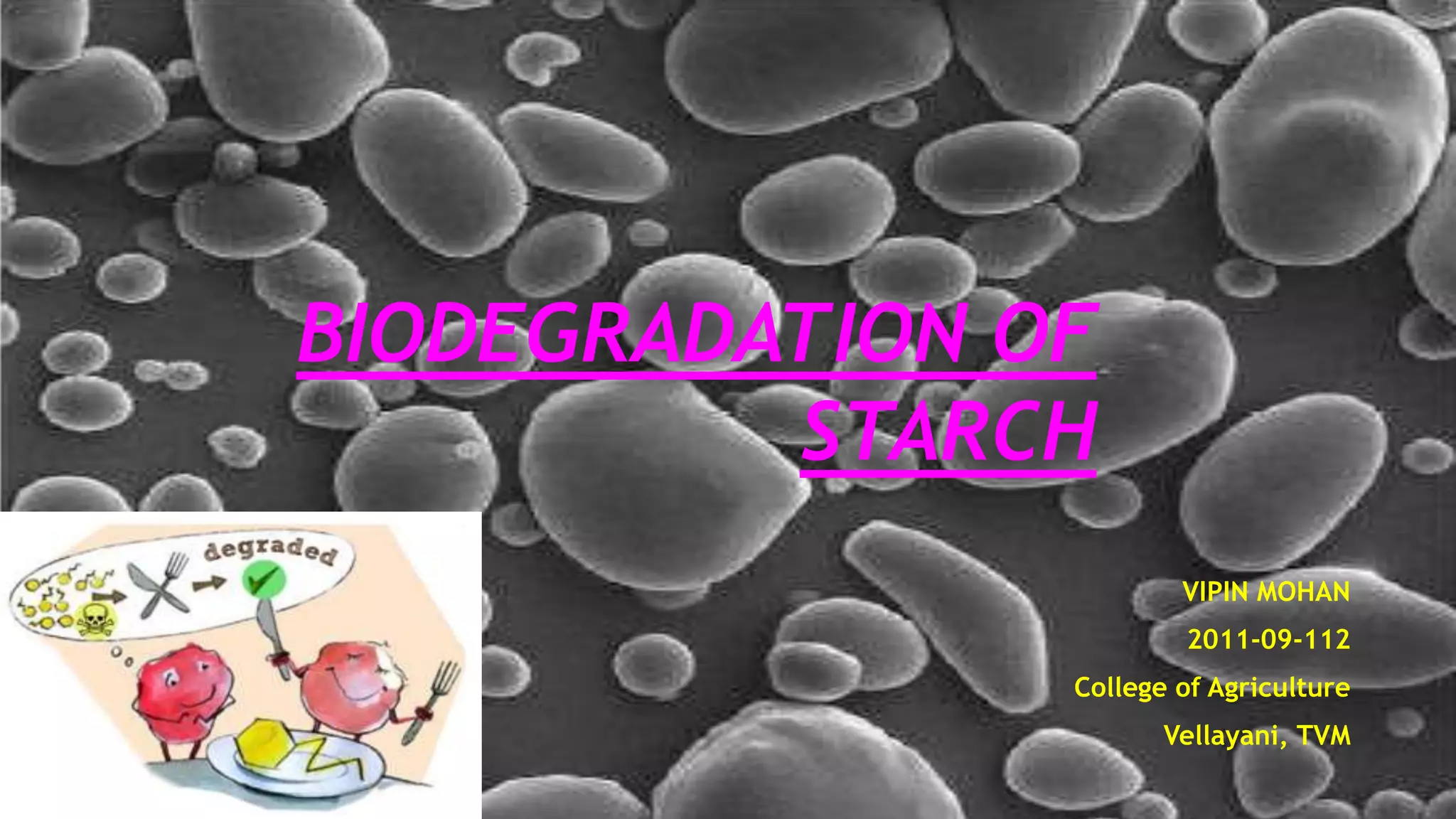
BIODEGRADATION OF
STARCH
VIPIN MOHAN
2011-09-112
College of Agriculture
Vellayani, TVM
Biodegradation is the chemical
dissolution of organic materials by
biological means (mainly by
microorganisms).It is nature’s way of
recycling waste or breaking down
organic matter into nutrients that can
be utilised by other organisms.
Organic materials can be degraded
Aerobically
 use oxygen
 Produce carbon dioxide & water
Anaerobically
 Absence of oxygen
 Use chemicals as electron acceptor like nitrate
sulphate & iorn
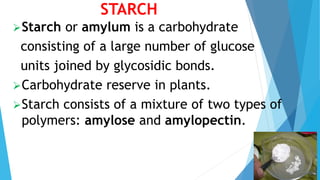
STARCH
Starch or amylum is a carbohydrate
consisting of a large number of glucose
units joined by glycosidic bonds.
Carbohydrate reserve in plants.
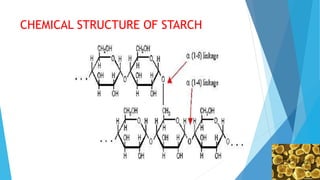
Starch consists of a mixture of two types of
polymers: amylose and amylopectin.
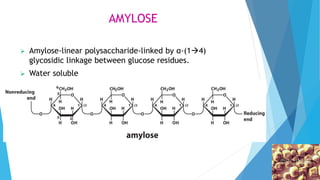
AMYLOSE
 Amylose-linear polysaccharide-linked by α-(14)
glycosidic linkage between glucose residues.
 Water soluble
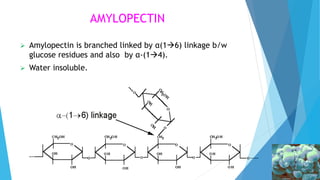
AMYLOPECTIN
 Amylopectin is branched linked by α(16) linkage b/w
glucose residues and also by α-(14).
 Water insoluble.
CHEMICAL STRUCTURE OF STARCH
TYPES OF STARCH
 Potato Starch
 Corn Starch
 Maize Starch
 Rice Starch
 Tapioca Starch
Wheat Starch
Soya bean Starch etc…
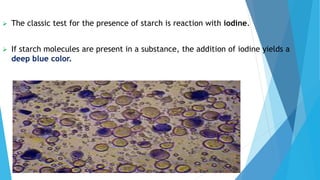
 The classic test for the presence of starch is reaction with iodine.
 If starch molecules are present in a substance, the addition of iodine yields a
deep blue color.
AMYLASE
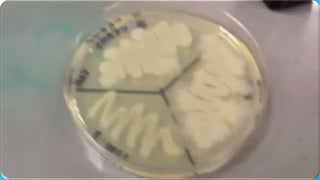
 Starch molecules are broken down by enzyme known as
amylase.
 Bacteria and fungi secrete amylases for extracellular
digestion. When they have broken down the insoluble
starch, the soluble end products such as (glucose or
maltose) are absorbed into their cells.
 Many microorganisms produce this enzyme, the most
commonly used in industrial production are
bacillus subtilis, bacillus licheniformis,
bacillus amyloliquifaciens and aspergillus niger.
BACTERIA FUNGI
Bacillus amyloliquefacicns Aspergillus
B. caldolyticus Candida
B. coagulans Cephalosporium
B. cereus Mucor
B. lichenformii Neurospora
B. subtilis Penicillium
B. stearothermophilus
Escherichia spp..
Lactobacillus spp..
Micrococcus spp.
Pseudomonas spp.
Proteus spp.
Serratia spp.
Bacteria and Fungi producing AMYLASE
Bacillus amyloliquefacicns Bacillus coagulans Aspergillus
Penicillium NeurosporaMucor
BIODEGRADATION BY MICROORGANISMS
 Microorganisms have high surface area to volume ratio,
this allows extensive interaction with the environment
and their high metabolic rate.
 Microbial enzymes are less choosy and generally exibit

broader substrate specificity.
 Eventhough individual microbial cell can only metabolise
a limited number of substrates they can be cultured
as a large biomass.
 Microorganisms can metabolize all naturally
occuring compounds and many xenobiotic
compounds.
 Relative ease of passage genetic material into
microorganism(recombinant microorganisms to increase
efficency) compared to cells of higher organisms.
 Allow for quick adaptation through the acquisition
of new metabolic capabilities
Microbial amylases usually contain three type
of amylases.
1.α-AMYLASE (ALPHA-AMYLASE)
 Produced by bacteria and fungi, Industrially it is obtained from Bacillus
amyloliquefaciens.
 Ca-metalloenzyme
 By acting at random location along the starch chain ,a-amylase breaks down long chain
carbohydrate ultimately yielding maltotriose and maltose or glucose and limit dextrin
from amylopectin.
 Because it can act anywhere on the substrate a-amylase tends to be faster than β -
amylases.
 It is called an endoglucanase because it normally attacks internal
α -1,4 bonds.
2.β-AMYLASE
 Found primarily in plants, but is infrequently made by bacteria.
 Removes maltose molecules from the non reducing ends of starch.
 β-amylase catalyzes the hydrolysis of the second α-1,4 glycosidic bond,
cleaving off two glucose units (maltose) at a time.
 So it removes molecules from the external end, it is called an exoglucanase.
works from the non reducing end.
 Fruit ripening starch converted to maltose by β -amylase which gives sweet
flavor.
 Found mainly in plants but is infrequenly made by bacteria.
3.γ-AMYLASE ( GLUCOAMYLASE OR AMYLOGLUCOSIDASE)
 γ-Amylase will cleave α(1-6) glycosidic linkages, as well as
the last α(1-4 )glycosidic linkages at the non reducing end
of amylose and amylopectin, yieldin glucose.
 Unlike the other forms of amylase, γ-amylase is most efficient in
acidic environments and has an optimum pH of 3.
 Inverting exo acting starch hydrolases releasing β-glucose from non
reducing end of starch.
 It is derived by submerged fermentation of specially selected
producer strains of Aspergillusniger.
 Selectively attacks the last bond on the reducing terminal.
PULLULANASE OR ISOAMYLASE
 A special kind of glucanase, an amylolytic enzyme that degrades
pullulan.
 Pullulan is a polysaccharide polymer consisting of maltotriose units.
 Three glucose in maltotriose connected by α(1-4) glycosidic bond
whereas consecutive maltotriose units are connected to each other by
α(1-6) glycosidic bonds.
 Pullulan is produced from starch by fungus Auerobasidiumpullulans.
TWO MAIN PROCESS IN DEGRADATION OF STARCH
 The initial step in random degradation is the splitting of large chains
into various smaller sized segments.
 This drastically reduces the viscosity of gelatinized starch solution,
resulting in Liquefaction - thinning of the solution.
 The final stages of degradation are mainly the formation of mono-,
di-, and tri-saccharides – called as Saccharification , due to the
formation of saccharides.
 Eg : Bacterial alpha-amylase - randomly attacks only the alpha-1,4
bonds- belongs to the liquefying category.
 The fungal alpha-amylase belongs to the saccharifying category.
FACTORS AFFECTNG BIODEGRADATION
 Light, Water and O2(if aerobic)
 Environmental factor(physical and chemical)
 Temperature (Thermophiles, Mesophils)
 Nutritional factor
METHODS OF MEASURING BIODEGRADATION
Respiratory test for aerobic microbes
 Solid waste sample + microorganism + soil in a container
and aerate the mixture . Over the course of time
Microorganisms digest the sample bit by bit and produce
CO2. Resulting amount of CO2 serves as an indicator of
degradation.
Applications of
STARCH
degradation
FOODINDUSTRY
High fructose corn syrup(HFCS)
Source Corn starch
Enzymes alpha-amylase, glucoamylase, glucose-isomerase
PRODUCTION IN HIGH FRUCTOSE CORN SYRUP
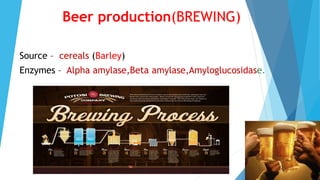
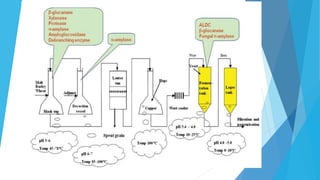
Beer production(BREWING)
Source – cereals (Barley)
Enzymes – Alpha amylase,Beta amylase,Amyloglucosidase.
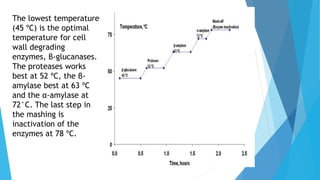
The lowest temperature
(45 ºC) is the optimal
temperature for cell
wall degrading
enzymes, β-glucanases.
The proteases works
best at 52 ºC, the β-
amylase best at 63 ºC
and the α-amylase at
72°C. The last step in
the mashing is
inactivation of the
enzymes at 78 ºC.
TEXTILEINDUSTRY
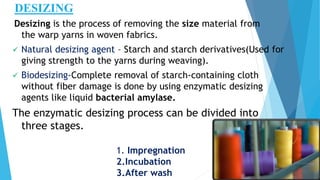
DESIZING
Desizing is the process of removing the size material from
the warp yarns in woven fabrics.
 Natural desizing agent – Starch and starch derivatives(Used for
giving strength to the yarns during weaving).
 Biodesizing-Complete removal of starch-containing cloth
without fiber damage is done by using enzymatic desizing
agents like liquid bacterial amylase.
The enzymatic desizing process can be divided into
three stages.
1. Impregnation
2.Incubation
3.After wash
 Impregnation
 Enzyme solution is absorbed by the fabric.
 During this stage gelatinization of the size
(starch) is to the highest possible extent.
 Incubation:
 The enzyme breaks down the size. Long
incubation time allows a low enzyme
concentration.
 After-wash:
 The breakdown products from the size are
removed from the fabric. This is best obtained by
a subsequent detergent wash (with NaOH) at the
highest possible temperature.
FUEL
PRODUCTION
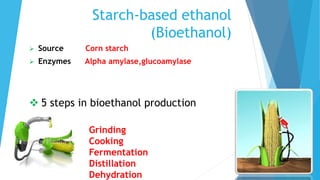
Starch-based ethanol
(Bioethanol)
 Source Corn starch
 Enzymes Alpha amylase,glucoamylase
 5 steps in bioethanol production
Grinding
Cooking
Fermentation
Distillation
Dehydration
Detergent industry
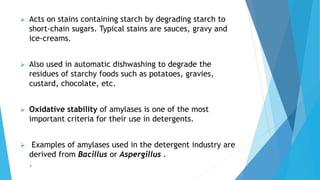
 Acts on stains containing starch by degrading starch to
short-chain sugars. Typical stains are sauces, gravy and
ice-creams.
 Also used in automatic dishwashing to degrade the
residues of starchy foods such as potatoes, gravies,
custard, chocolate, etc.
 Oxidative stability of amylases is one of the most
important criteria for their use in detergents.
 Examples of amylases used in the detergent industry are
derived from Bacillus or Aspergillus .
.
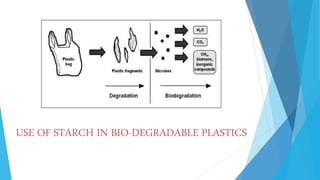
USE OF STARCH IN BIO-DEGRADABLE PLASTICS
Paper industry
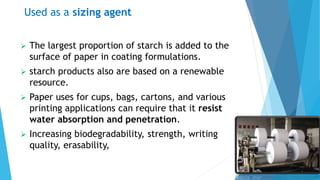
Used as a sizing agent
 The largest proportion of starch is added to the
surface of paper in coating formulations.
 starch products also are based on a renewable
resource.
 Paper uses for cups, bags, cartons, and various
printing applications can require that it resist
water absorption and penetration.
 Increasing biodegradability, strength, writing
quality, erasability,
MEDICAL AND
PHARMACUETICAL
INDUSTRY
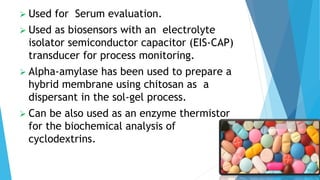
 Used for Serum evaluation.
 Used as biosensors with an electrolyte
isolator semiconductor capacitor (EIS-CAP)
transducer for process monitoring.
 Alpha-amylase has been used to prepare a
hybrid membrane using chitosan as a
dispersant in the sol-gel process.
 Can be also used as an enzyme thermistor
for the biochemical analysis of
cyclodextrins.
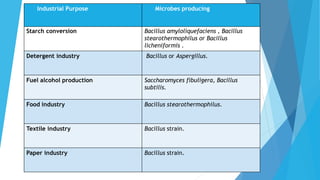
Starch conversion Bacillus amyloliquefaciens , Bacillus
stearothermophilus or Bacillus
licheniformis .
Detergent industry Bacillus or Aspergillus.
Fuel alcohol production Saccharomyces fibuligera, Bacillus
subtilis.
Food industry Bacillus stearothermophilus.
Textile industry Bacillus strain.
Paper industry Bacillus strain.
Industrial Purpose Microbes producing
STARCH BASED BIO-PRODUCTS !!!
BENEFITS
Cost effective
Reduce operating expenses
Environmentally safe
No adverse effects
Great public relations aspect(green
solution)
Biodegradation of starch

Biodegradation of starch

  • 1.
  • 2.
    Biodegradation is thechemical dissolution of organic materials by biological means (mainly by microorganisms).It is nature’s way of recycling waste or breaking down organic matter into nutrients that can be utilised by other organisms.
  • 3.
    Organic materials canbe degraded Aerobically  use oxygen  Produce carbon dioxide & water Anaerobically  Absence of oxygen  Use chemicals as electron acceptor like nitrate sulphate & iorn
  • 4.
    STARCH Starch or amylumis a carbohydrate consisting of a large number of glucose units joined by glycosidic bonds. Carbohydrate reserve in plants. Starch consists of a mixture of two types of polymers: amylose and amylopectin.
  • 5.
    AMYLOSE  Amylose-linear polysaccharide-linkedby α-(14) glycosidic linkage between glucose residues.  Water soluble
  • 6.
    AMYLOPECTIN  Amylopectin isbranched linked by α(16) linkage b/w glucose residues and also by α-(14).  Water insoluble.
  • 7.
  • 8.
    TYPES OF STARCH Potato Starch  Corn Starch  Maize Starch  Rice Starch  Tapioca Starch Wheat Starch Soya bean Starch etc…
  • 9.
     The classictest for the presence of starch is reaction with iodine.  If starch molecules are present in a substance, the addition of iodine yields a deep blue color.
  • 12.
    AMYLASE  Starch moleculesare broken down by enzyme known as amylase.  Bacteria and fungi secrete amylases for extracellular digestion. When they have broken down the insoluble starch, the soluble end products such as (glucose or maltose) are absorbed into their cells.  Many microorganisms produce this enzyme, the most commonly used in industrial production are bacillus subtilis, bacillus licheniformis, bacillus amyloliquifaciens and aspergillus niger.
  • 13.
    BACTERIA FUNGI Bacillus amyloliquefacicnsAspergillus B. caldolyticus Candida B. coagulans Cephalosporium B. cereus Mucor B. lichenformii Neurospora B. subtilis Penicillium B. stearothermophilus Escherichia spp.. Lactobacillus spp.. Micrococcus spp. Pseudomonas spp. Proteus spp. Serratia spp. Bacteria and Fungi producing AMYLASE
  • 14.
    Bacillus amyloliquefacicns Bacilluscoagulans Aspergillus Penicillium NeurosporaMucor
  • 15.
    BIODEGRADATION BY MICROORGANISMS Microorganisms have high surface area to volume ratio, this allows extensive interaction with the environment and their high metabolic rate.  Microbial enzymes are less choosy and generally exibit broader substrate specificity.  Eventhough individual microbial cell can only metabolise a limited number of substrates they can be cultured as a large biomass.
  • 16.
     Microorganisms canmetabolize all naturally occuring compounds and many xenobiotic compounds.  Relative ease of passage genetic material into microorganism(recombinant microorganisms to increase efficency) compared to cells of higher organisms.  Allow for quick adaptation through the acquisition of new metabolic capabilities
  • 17.
    Microbial amylases usuallycontain three type of amylases. 1.α-AMYLASE (ALPHA-AMYLASE)  Produced by bacteria and fungi, Industrially it is obtained from Bacillus amyloliquefaciens.  Ca-metalloenzyme  By acting at random location along the starch chain ,a-amylase breaks down long chain carbohydrate ultimately yielding maltotriose and maltose or glucose and limit dextrin from amylopectin.  Because it can act anywhere on the substrate a-amylase tends to be faster than β - amylases.  It is called an endoglucanase because it normally attacks internal α -1,4 bonds.
  • 18.
    2.β-AMYLASE  Found primarilyin plants, but is infrequently made by bacteria.  Removes maltose molecules from the non reducing ends of starch.  β-amylase catalyzes the hydrolysis of the second α-1,4 glycosidic bond, cleaving off two glucose units (maltose) at a time.  So it removes molecules from the external end, it is called an exoglucanase. works from the non reducing end.  Fruit ripening starch converted to maltose by β -amylase which gives sweet flavor.  Found mainly in plants but is infrequenly made by bacteria.
  • 19.
    3.γ-AMYLASE ( GLUCOAMYLASEOR AMYLOGLUCOSIDASE)  γ-Amylase will cleave α(1-6) glycosidic linkages, as well as the last α(1-4 )glycosidic linkages at the non reducing end of amylose and amylopectin, yieldin glucose.  Unlike the other forms of amylase, γ-amylase is most efficient in acidic environments and has an optimum pH of 3.  Inverting exo acting starch hydrolases releasing β-glucose from non reducing end of starch.  It is derived by submerged fermentation of specially selected producer strains of Aspergillusniger.  Selectively attacks the last bond on the reducing terminal.
  • 20.
    PULLULANASE OR ISOAMYLASE A special kind of glucanase, an amylolytic enzyme that degrades pullulan.  Pullulan is a polysaccharide polymer consisting of maltotriose units.  Three glucose in maltotriose connected by α(1-4) glycosidic bond whereas consecutive maltotriose units are connected to each other by α(1-6) glycosidic bonds.  Pullulan is produced from starch by fungus Auerobasidiumpullulans.
  • 21.
    TWO MAIN PROCESSIN DEGRADATION OF STARCH  The initial step in random degradation is the splitting of large chains into various smaller sized segments.  This drastically reduces the viscosity of gelatinized starch solution, resulting in Liquefaction - thinning of the solution.  The final stages of degradation are mainly the formation of mono-, di-, and tri-saccharides – called as Saccharification , due to the formation of saccharides.  Eg : Bacterial alpha-amylase - randomly attacks only the alpha-1,4 bonds- belongs to the liquefying category.  The fungal alpha-amylase belongs to the saccharifying category.
  • 22.
    FACTORS AFFECTNG BIODEGRADATION Light, Water and O2(if aerobic)  Environmental factor(physical and chemical)  Temperature (Thermophiles, Mesophils)  Nutritional factor
  • 23.
    METHODS OF MEASURINGBIODEGRADATION Respiratory test for aerobic microbes  Solid waste sample + microorganism + soil in a container and aerate the mixture . Over the course of time Microorganisms digest the sample bit by bit and produce CO2. Resulting amount of CO2 serves as an indicator of degradation.
  • 24.
  • 25.
  • 26.
    High fructose cornsyrup(HFCS) Source Corn starch Enzymes alpha-amylase, glucoamylase, glucose-isomerase
  • 27.
    PRODUCTION IN HIGHFRUCTOSE CORN SYRUP
  • 28.
    Beer production(BREWING) Source –cereals (Barley) Enzymes – Alpha amylase,Beta amylase,Amyloglucosidase.
  • 30.
    The lowest temperature (45ºC) is the optimal temperature for cell wall degrading enzymes, β-glucanases. The proteases works best at 52 ºC, the β- amylase best at 63 ºC and the α-amylase at 72°C. The last step in the mashing is inactivation of the enzymes at 78 ºC.
  • 31.
  • 32.
    DESIZING Desizing is theprocess of removing the size material from the warp yarns in woven fabrics.  Natural desizing agent – Starch and starch derivatives(Used for giving strength to the yarns during weaving).  Biodesizing-Complete removal of starch-containing cloth without fiber damage is done by using enzymatic desizing agents like liquid bacterial amylase. The enzymatic desizing process can be divided into three stages. 1. Impregnation 2.Incubation 3.After wash
  • 33.
     Impregnation  Enzymesolution is absorbed by the fabric.  During this stage gelatinization of the size (starch) is to the highest possible extent.  Incubation:  The enzyme breaks down the size. Long incubation time allows a low enzyme concentration.  After-wash:  The breakdown products from the size are removed from the fabric. This is best obtained by a subsequent detergent wash (with NaOH) at the highest possible temperature.
  • 34.
  • 35.
    Starch-based ethanol (Bioethanol)  SourceCorn starch  Enzymes Alpha amylase,glucoamylase  5 steps in bioethanol production Grinding Cooking Fermentation Distillation Dehydration
  • 36.
  • 37.
     Acts onstains containing starch by degrading starch to short-chain sugars. Typical stains are sauces, gravy and ice-creams.  Also used in automatic dishwashing to degrade the residues of starchy foods such as potatoes, gravies, custard, chocolate, etc.  Oxidative stability of amylases is one of the most important criteria for their use in detergents.  Examples of amylases used in the detergent industry are derived from Bacillus or Aspergillus . .
  • 38.
    USE OF STARCHIN BIO-DEGRADABLE PLASTICS
  • 39.
  • 40.
    Used as asizing agent  The largest proportion of starch is added to the surface of paper in coating formulations.  starch products also are based on a renewable resource.  Paper uses for cups, bags, cartons, and various printing applications can require that it resist water absorption and penetration.  Increasing biodegradability, strength, writing quality, erasability,
  • 41.
  • 42.
     Used forSerum evaluation.  Used as biosensors with an electrolyte isolator semiconductor capacitor (EIS-CAP) transducer for process monitoring.  Alpha-amylase has been used to prepare a hybrid membrane using chitosan as a dispersant in the sol-gel process.  Can be also used as an enzyme thermistor for the biochemical analysis of cyclodextrins.
  • 43.
    Starch conversion Bacillusamyloliquefaciens , Bacillus stearothermophilus or Bacillus licheniformis . Detergent industry Bacillus or Aspergillus. Fuel alcohol production Saccharomyces fibuligera, Bacillus subtilis. Food industry Bacillus stearothermophilus. Textile industry Bacillus strain. Paper industry Bacillus strain. Industrial Purpose Microbes producing
  • 44.
  • 45.
    BENEFITS Cost effective Reduce operatingexpenses Environmentally safe No adverse effects Great public relations aspect(green solution)