TRANSGENIC APPROACH TO
IMPROVE THE NUTRITIONAL
QUALITY OF RICE
SUBMITTED BY,
RANJANI.M.S.(2016610810)
SANDESH.G.M(2016610811 )
(Department of plant breeding and genetics)
TNAU, MADURAI
INTRODUCTION
– Rice is the most important food crop in the world. Almost half of the
world’s population depends on rice as their staple food especially in east
and southeast Asia.
– Rice provides a significant source of grains, and is amongst the most
important nutritional sources of protein for mankind world-wide.
– Similar to seed proteins of other cereals, seed proteins of rice are deficient
in some essential amino acids such as lysine, tryptophan, and especially
methionine , thus limiting the nutritive value of seed protein.
WHAT IS THE SOLUTION…?
– In case of many cereals, legumes, the protein content is being altered
through change in amino acid content like increase in lysine content, etc.
– Genetic engineering / transgenic technologies evolved as a solution
to improve rice grain quality and developing nutrient dense rice to save the
ever increasing population.
TRANSGENIC PLANTS…
– Plants that have been genetically engineered
– A breeding approach that uses recombinant DNA techniques to create plants with
new characteristics
– They are also called GMO’s.
GENERAL PROCEDURE FOR
DEVELOPING TRANSGENICS….
– Nucleic acid extraction
– Gene cloning
– Gene design and packaging
– Transformation
– Backcross breeding
THE GOLDEN RICE
– The search for a golden rice started off as a ROCKFELLER FOUNDATION
initiative in 1982.
– Golden rice was created by transforming rice with two beta-carotene
biosynthesis genes.
1.psy(phytoene synthase)from daffodil(Narcissus pseudonarcissus)
2.ctrl(carotene desaturase)from the soil bacterium (Erwinia uredovora).
PRINCIPLE BEHIND GOLDEN RICE
– Golden Rice technology is based on the simple principle that rice plants
possess the whole machinery to synthesise β-carotene, and while this
machinery is fully active in leaves, parts of it are turned off in the grain.
– By adding only two genes, a plant phytoene synthase (psy) and a bacterial
phytoene desaturase (crt I), the pathway is turned back on and β-carotene
consequently accumulates in the grain.
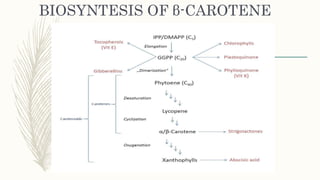
BIOSYNTESIS OF β-CAROTENE
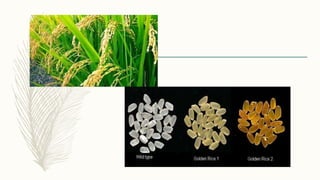
GOLDEN RICE 2
– It was produced by Syngenta in 2005.
– It is produced by combining phytoene synthase gene from maize with crt1
from the original golden rice.
– Golden rice 2 produced 23 times more carotenoids than golden rice.
why ?
Transgenic Approach
For the improvement of Nutrition the transgenic approach in Rice
played a role in increasing the following .
– Cysteine and methionine
– Lysine and Threonine
– Fe content
CYSTEINE
With the aim of increasing the cysteine level in rice (Oryza sativa L.)
and thus improving its nutritional quality, transgenic rice plants were
generated .
– Enzyme used: Escherichia coli serine acetyltransferase isoform
(EcSAT)
– It synthesis O-acetylserine, the precursor of cysteine.
– The contents of cysteine and glutathione increased 2.4-fold and 2-
fold, respectively.
– Free methionine increased in leaves up to 2.7-fold, in seeds up to 1.4-fold, and
bound to seed proteins up to 4.8-fold, respectively.
– As the transgenic rice plants over expressing EcSAT had significantly higher
levels of both soluble and protein-bound methionine, isoleucine, cysteine, and
glutathione in rice lead for improving the nutritional quality of Rice.
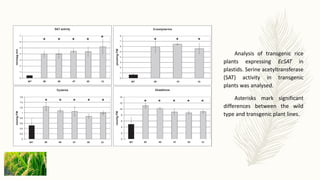
Analysis of transgenic rice
plants expressing EcSAT in
plastids. Serine acetyltransferase
(SAT) activity in transgenic
plants was analysed.
Asterisks mark significant
differences between the wild
type and transgenic plant lines.
Lysine and Threonine
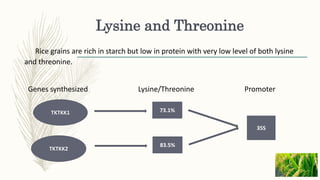
Rice grains are rich in starch but low in protein with very low level of both lysine
and threonine.
Genes synthesized Lysine/Threonine Promoter
TKTKK1
TKTKK2
73.1%
83.5%
35S
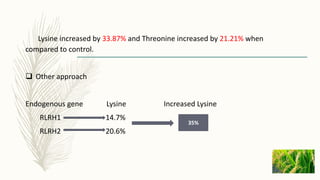
Lysine increased by 33.87% and Threonine increased by 21.21% when
compared to control.
 Other approach
Endogenous gene Lysine Increased Lysine
RLRH1 14.7%
RLRH2 20.6%
35%
IRON
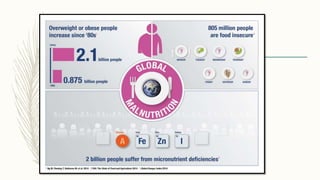
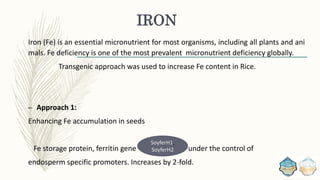
Iron (Fe) is an essential micronutrient for most organisms, including all plants and ani
mals. Fe deficiency is one of the most prevalent micronutrient deficiency globally.
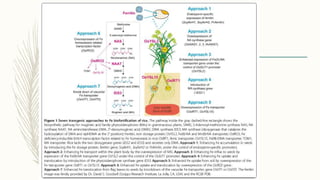
Transgenic approach was used to increase Fe content in Rice.
– Approach 1:
Enhancing Fe accumulation in seeds
Fe storage protein, ferritin gene under the control of
endosperm specific promoters. Increases by 2-fold.
SoyferH1,
SoyferH2
– Approach 2:
Enhancing Fe transport within the plant body by the over expression of NAS.
Increased by 3-fold.
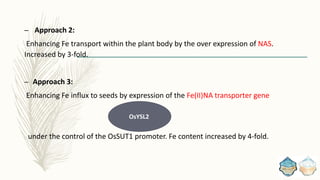
– Approach 3:
Enhancing Fe influx to seeds by expression of the Fe(II)NA transporter gene
under the control of the OsSUT1 promoter. Fe content increased by 4-fold.
OsYSL2
– Approach 4:
Enhancing Fe uptake and translocation by introduction of the phyto siderophore
synthase gene IDS3. Fe content increased by 1.4-fold.
– Approach 5:
Enhanced Fe uptake from soil by over expression of the Fe transporter gene OsIRT1
or OsYSL15. increased by 1.3-fold.
– Approach 6:
Enhanced Fe uptake and translocation by over expression of the OsIRO2 gene.
Increased by 3-fold.
– Approach 7:
Enhanced Fe translocation from flag leaves to seeds by knockdown of the
vacuolar Fe transporter gene OsVIT1 or OsVIT2. Fe content increased by 1.4-fold.
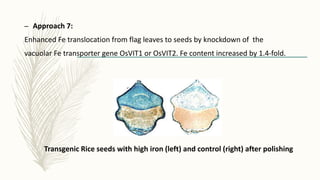
Transgenic Rice seeds with high iron (left) and control (right) after polishing
CONCLUSION
– The recent rice genome sequences developed by Monsanto,
Syngenta, and the Beijing Genomics Institute (BGI), along with
ongoing research in the International Rice Genome Sequencing
Project (IRGSP), have accelerated gene discovery and rice
improvement.
– As the Nutrition Quality is important for food , This Transgenic
approach made a significant role in improvement of nutritional
Quality in Rice.
THANK YOU…..,

Trangenic rice

  • 1.
    TRANSGENIC APPROACH TO IMPROVETHE NUTRITIONAL QUALITY OF RICE SUBMITTED BY, RANJANI.M.S.(2016610810) SANDESH.G.M(2016610811 ) (Department of plant breeding and genetics) TNAU, MADURAI
  • 2.
    INTRODUCTION – Rice isthe most important food crop in the world. Almost half of the world’s population depends on rice as their staple food especially in east and southeast Asia. – Rice provides a significant source of grains, and is amongst the most important nutritional sources of protein for mankind world-wide. – Similar to seed proteins of other cereals, seed proteins of rice are deficient in some essential amino acids such as lysine, tryptophan, and especially methionine , thus limiting the nutritive value of seed protein.
  • 3.
    WHAT IS THESOLUTION…? – In case of many cereals, legumes, the protein content is being altered through change in amino acid content like increase in lysine content, etc. – Genetic engineering / transgenic technologies evolved as a solution to improve rice grain quality and developing nutrient dense rice to save the ever increasing population.
  • 4.
    TRANSGENIC PLANTS… – Plantsthat have been genetically engineered – A breeding approach that uses recombinant DNA techniques to create plants with new characteristics – They are also called GMO’s.
  • 5.
    GENERAL PROCEDURE FOR DEVELOPINGTRANSGENICS…. – Nucleic acid extraction – Gene cloning – Gene design and packaging – Transformation – Backcross breeding
  • 6.
    THE GOLDEN RICE –The search for a golden rice started off as a ROCKFELLER FOUNDATION initiative in 1982. – Golden rice was created by transforming rice with two beta-carotene biosynthesis genes. 1.psy(phytoene synthase)from daffodil(Narcissus pseudonarcissus) 2.ctrl(carotene desaturase)from the soil bacterium (Erwinia uredovora).
  • 7.
    PRINCIPLE BEHIND GOLDENRICE – Golden Rice technology is based on the simple principle that rice plants possess the whole machinery to synthesise β-carotene, and while this machinery is fully active in leaves, parts of it are turned off in the grain. – By adding only two genes, a plant phytoene synthase (psy) and a bacterial phytoene desaturase (crt I), the pathway is turned back on and β-carotene consequently accumulates in the grain.
  • 8.
  • 9.
    GOLDEN RICE 2 –It was produced by Syngenta in 2005. – It is produced by combining phytoene synthase gene from maize with crt1 from the original golden rice. – Golden rice 2 produced 23 times more carotenoids than golden rice.
  • 11.
  • 13.
    Transgenic Approach For theimprovement of Nutrition the transgenic approach in Rice played a role in increasing the following . – Cysteine and methionine – Lysine and Threonine – Fe content
  • 14.
    CYSTEINE With the aimof increasing the cysteine level in rice (Oryza sativa L.) and thus improving its nutritional quality, transgenic rice plants were generated . – Enzyme used: Escherichia coli serine acetyltransferase isoform (EcSAT) – It synthesis O-acetylserine, the precursor of cysteine. – The contents of cysteine and glutathione increased 2.4-fold and 2- fold, respectively.
  • 15.
    – Free methionineincreased in leaves up to 2.7-fold, in seeds up to 1.4-fold, and bound to seed proteins up to 4.8-fold, respectively. – As the transgenic rice plants over expressing EcSAT had significantly higher levels of both soluble and protein-bound methionine, isoleucine, cysteine, and glutathione in rice lead for improving the nutritional quality of Rice.
  • 16.
    Analysis of transgenicrice plants expressing EcSAT in plastids. Serine acetyltransferase (SAT) activity in transgenic plants was analysed. Asterisks mark significant differences between the wild type and transgenic plant lines.
  • 17.
    Lysine and Threonine Ricegrains are rich in starch but low in protein with very low level of both lysine and threonine. Genes synthesized Lysine/Threonine Promoter TKTKK1 TKTKK2 73.1% 83.5% 35S
  • 18.
    Lysine increased by33.87% and Threonine increased by 21.21% when compared to control.  Other approach Endogenous gene Lysine Increased Lysine RLRH1 14.7% RLRH2 20.6% 35%
  • 19.
    IRON Iron (Fe) isan essential micronutrient for most organisms, including all plants and ani mals. Fe deficiency is one of the most prevalent micronutrient deficiency globally. Transgenic approach was used to increase Fe content in Rice. – Approach 1: Enhancing Fe accumulation in seeds Fe storage protein, ferritin gene under the control of endosperm specific promoters. Increases by 2-fold. SoyferH1, SoyferH2
  • 20.
    – Approach 2: EnhancingFe transport within the plant body by the over expression of NAS. Increased by 3-fold. – Approach 3: Enhancing Fe influx to seeds by expression of the Fe(II)NA transporter gene under the control of the OsSUT1 promoter. Fe content increased by 4-fold. OsYSL2
  • 21.
    – Approach 4: EnhancingFe uptake and translocation by introduction of the phyto siderophore synthase gene IDS3. Fe content increased by 1.4-fold. – Approach 5: Enhanced Fe uptake from soil by over expression of the Fe transporter gene OsIRT1 or OsYSL15. increased by 1.3-fold. – Approach 6: Enhanced Fe uptake and translocation by over expression of the OsIRO2 gene. Increased by 3-fold.
  • 22.
    – Approach 7: EnhancedFe translocation from flag leaves to seeds by knockdown of the vacuolar Fe transporter gene OsVIT1 or OsVIT2. Fe content increased by 1.4-fold. Transgenic Rice seeds with high iron (left) and control (right) after polishing
  • 24.
    CONCLUSION – The recentrice genome sequences developed by Monsanto, Syngenta, and the Beijing Genomics Institute (BGI), along with ongoing research in the International Rice Genome Sequencing Project (IRGSP), have accelerated gene discovery and rice improvement. – As the Nutrition Quality is important for food , This Transgenic approach made a significant role in improvement of nutritional Quality in Rice.
  • 25.