Dipali M.Kulkarni,
Yash Institute of Pharmacy,
Aurangabad
Concept of free energy,
endergonic and exergonic reaction, Relationship between free energy,
enthalpy and entropy;
Redox potential.
Energy rich compounds;
classification;
biological significances of
ATP and cyclic AMP
Contents
Bioenergetics
Is the partof biochemistry concerned with the energy
involved in making and breaking of chemical bonds in
the molecules
The role of energy is fundamental to such biological
processes
Life isdependent on energy transformations;living
organisms survive because of exchange of energy
within and without.
Itisthe quantitative studyof the energy transductions
that occurin living cellsand of the nature and
function of the chemical processesunderlying these
transductions
Biochemical thermodynamics
In a living organism,chemicalbondsare broken and made
as part of the exchange and transformation of energy.
Energyisavailable forwork (such as mechanical work)orfor
other processes (such as chemical synthesisand anabolic
processes in growth),
when weak bonds are broken and stronger bonds are
made. Theproduction of strongerbondsallows release of
usable energy.
The FirstLaw of Thermodynamics, also know as the law
of conservation of energy,
It states that energy can neither be created nor
destroyed. It may change from one form to another,
but the energy in a closed system remains constant.
Inany physical or chemical change, the total amount
of energy in the universe remains constant,although
the form of energy may change.
The Second Law of Thermodynamics states that when
energy is transferred, law of entropy, there will be less
energy available at the end of the transfer process
than at the beginning.
Due to entropy, which isthe measure of disorder in a
closed system, all of the available energy will not be
useful to the organism.
Entropy increases as energy istransferred.
In all natural processes, the entropy of the universe
increases.
The amount of energy that is available to do work is
described by the concept of free energy
Gibbs free energy (G) expresses the amount of energy
capable of doing work during a reaction at constant
temperature and pressure
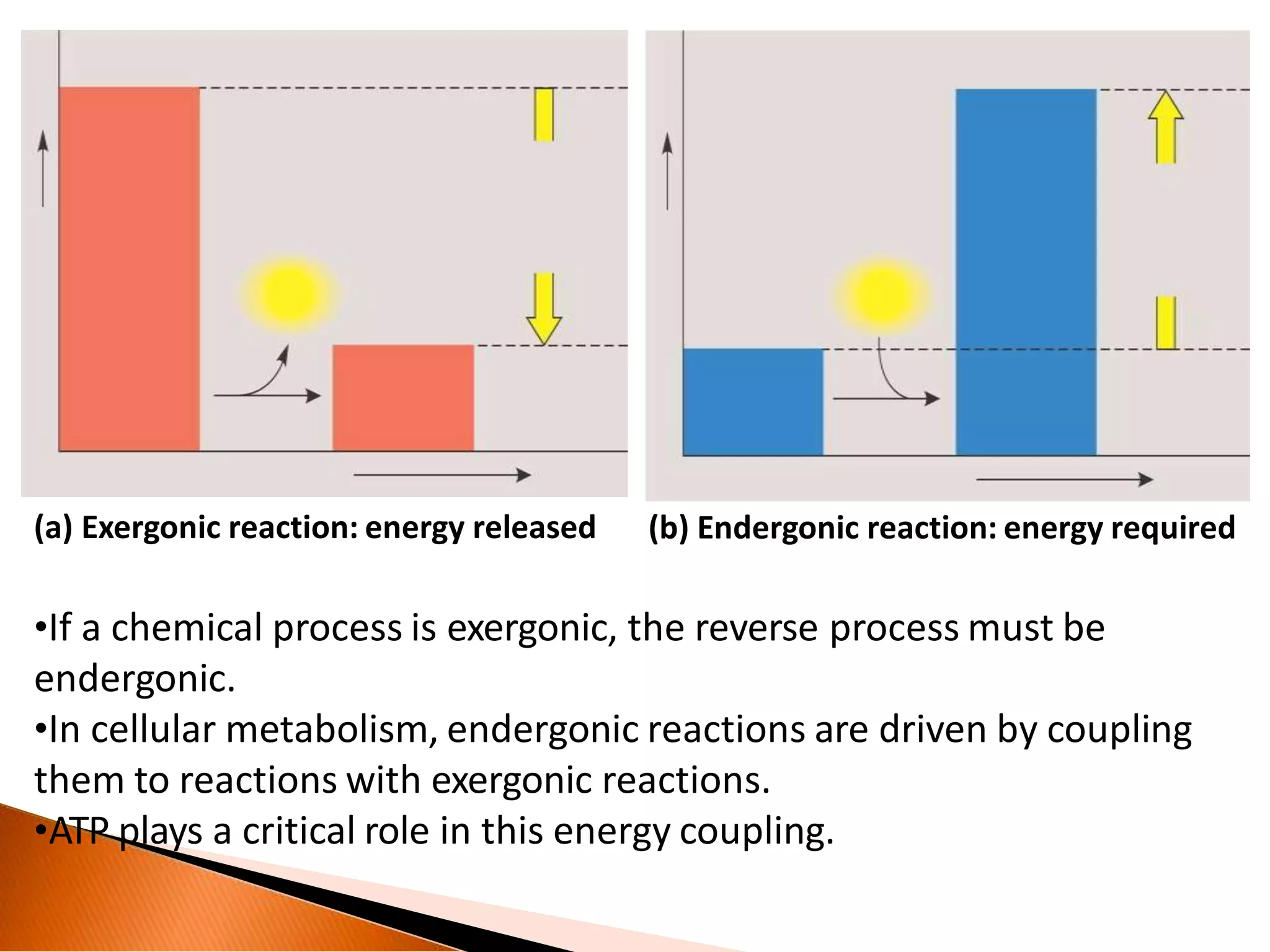
Exergonic reaction= A reaction that proceeds with a net
release of free energy and is spontaneous.
When a reaction proceeds with the release of free energy
(i.e., when the system changes so as to possess less free
energy),
Free-energy change, ΔG, has a negative sign and the
reaction is said to be exergonic.
•Endergonic reaction= An energy-requiring reaction that
proceeds with a net gain of free energy; a reaction that
absorbs free energy from its surroundings and non
spontaneous.
•In endergonic reactions, the system gains free energy and
ΔG is positive
Gibbs change in free energy (ΔG )is that portion of the total
energy change in a system available for doing work.
It is also known as the chemical potential .
ΔG= ΔH - TΔS.
Useful energy = change in Enthalpy – change in entropy
[∆G = Gibbs change in Free Energy; ∆H = Change in
Enthalpy; T = Temperature in K; ∆S = Change in Entropy]
Enthalpy, H, is the heat content of the reacting system.
It reflects the number and kinds of chemical bonds in the
reactants and products
The units of ΔG and ΔH are joules/mole or calories/mole
(recall that 1 cal equals 4.18 J);
Entropy, S, is a quantitative expression for the randomness or
disorder in a system.
units of entropy are joules/mole•degree Kelvin (J/mol•K)
The exergonic reaction is a type of
reaction in which free energy is released
Endergonic reactions are the type of
reaction in which free energy is absorbed.
Here Gibbs free energy is negative Here Gibbs free energy is positive
Exergonic reactions indicate that the
energy is
released in the system
Endergonic reactions indicate that the
energy is
absorbed by the system
All the exothermic reactions are
exergonic.
All endothermic reactions are
endothermic
Exergonic reactions do not require energy
to
begin
Endothermic reactions always require
energy to
begin
It is a downhill reaction It is an uphill reaction
Fatty Acid Catabolism, Glycolysis, cellular
respiration
DNA/RNA Synthesis, Protein synthesis,
Fatty acid
Synthesis
Exergonic reaction Endergonic reaction
(a) Exergonic reaction: energy released (b) Endergonic reaction: energy required
•If a chemical process is exergonic, the reverse process must be
endergonic.
•In cellular metabolism, endergonic reactions are driven by coupling
them to reactions with exergonic reactions.
•ATP plays a critical role in this energy coupling.
It is the affinity of a substance to accept electrons i.e. it
is the potential for a substance to become reduced.
Hydrogen has the lowest redox potential (-0.42 volt),
while oxygen has the highest redox potential (+0.82
volt).
The redox potentials of all other substances lie between
that of hydrogen and oxygen.
Electrons are transferred from substances with low
redox potential to substances with higher redox
potential.
This transfer of electrons is an energy yielding process
and the amount of energy liberated depends on the
redox potential difference between the electron donor
and acceptor.
Redox potential
The redox potential is a measure (in volts) of the
affinity of a substance for electrons — its
electronegativity — compared with hydrogen
Energy-rich compounds in cells comprise five
kinds of high-energy bonds:
phosphoanhydride, acyl phosphate,
enolphosphate, guanidine phosphate and
thioester bonds
The compounds are represented by adenosine
triphosphate (ATP).
substances capable of ATP formation in enzyme
reactions involving transfer of phosphate groups
Bonds in energy-rich compounds, which yields
high energy upon hydrolysis are called high-
energy bonds
ADENOSINE TRIPHOSPHATE (ATP)
✓ Adenosine-5'-triphosphate (ATP) is a
multifunctional nucleotide used in cells as a coenzyme.
✓ It is often called the "molecular unit of currency" of
intracellular energy transfer. ATP transports chemical energy
within cells for metabolism.
✓ It is produced by photophosphorylation and cellular
respiration and used by enzymes and structural proteins in
many cellular processes, including biosynthetic
reactions, motility, and cell division.
✓One molecule of ATP contains three phosphate groups and
it is produced by ATP synthase from inorganic
phosphate and adenosine diphosphate (ADP) or adenosine
monophosphate (AMP).
The structure of this molecule
consists of a purine base
(adenine) attached to the 1'
carbon atom of a pentose sugar
(ribose). Three phosphate groups
are attached at the 5' carbon
atom of the pentose sugar. It is
the addition and
removal of these phosphate
groups that inter-convert ATP,
ADP and AMP. When ATP is
used in DNA synthesis,
the ribose sugar is first converted
to deoxyribose by ribonucleotide
reductase
•ATP is an unstable molecule which hydrolyzes to ADP
and inorganic phosphate when it is in equilibrium with
water.
•The high energy of this molecule comes from the two
high-energy phosphate bonds.
•The bonds between phosphate molecules are called
phosphoanhydride bonds
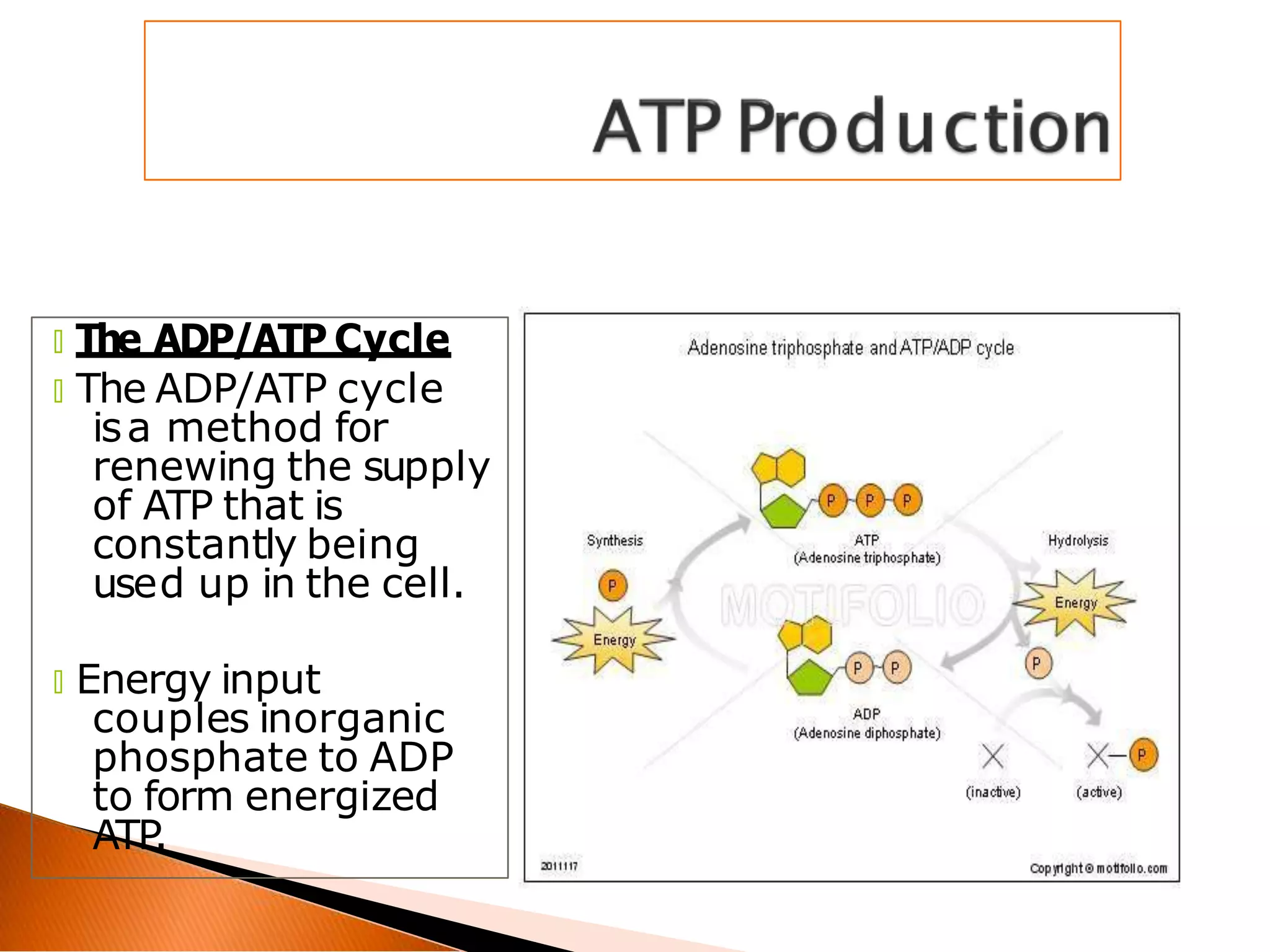
ATP is hydrolyzed to ADP in reaction
ATP+H2O→ADP+Pi+ free energy;
calculated ∆G for 1 mole of ATP is -57 kJ/mol.
The hydrolysis of ATP produces 7 kcal/mole
(note: Calories is the same as kcal).
ADP is combined with a phosphate to form ATP in the
reaction ADP+Pi+free energy→ATP+H2O.
CYCLIC ADENOSINE MONOPHOSPHATE
(cAMP, cyclic AMP or 3'-5'-cyclic adenosine
monophosphate)
✓ It is a second messenger important in many biological
processes. cAMP is derived from adenosine triphosphate
(ATP) and used for intracellular signal transduction in
many different organisms, conveying the cAMP-
dependent
pathway.
✓ cAMP is synthesised from ATP by adenylyl
cyclase located on the inner side of the plasma
membrane.
Adenylyl cyclase is activated by a range of
signaling molecules through the activation
of adenylyl cyclase stimulatory G
(Gs)-protein-coupled receptors and inhibited
by agonists of adenylyl cyclase inhibitory G
(Gi)-protein-coupled
receptors. Liver adenylyl cyclase responds
more strongly to glucagon, and muscle
adenylyl cyclase responds more
strongly to adrenaline.
✓ cAMP decomposition into AMP is catalyzed
by the enzyme phosphodiesterase.
Function:
cAMP is a second messenger, used for
intracellular signal transduction,
such as transferring the effects
of hormones like glucagon and adrenaline,
which cannot pass through the cell membrane. It
is involved in the activation of protein kinases and
regulates the effects of adrenaline and glucagon.
It also regulates the passage of
Ca2+ through ion channels. cAMP and its
associated kinases function in several biochemical
processes, including
the regulation of glycogen, sugar, and lipid
metabolism by activating protein kinase
🞇 The ADP/ATP Cycle
🞇 The ADP/ATP cycle
isa method for
renewing the supply
of ATP that is
constantly being
used up in the cell.
🞇 Energy input
couples inorganic
phosphate to ADP
to form energized
ATP
.
•References
•Lehninger-Principles of biochemisty (forth edition)
Authors-D.Nelson, M. Cox
•Biochemistry (fifth edition) Authors-J.berg, J.Tymoczko,
L.Styer
•Harper’s Illustrated Biochemistry(26th edition)
Authors-R.Murray, D.Granner, V.Rodwell
•Biochemistry(second edition) Authors-Garrett and Grisham
•Molecular biology of the cell Author-Bruce Albert
•Molecular cell biology(fifth edition) Authors-Lodish, Berk
• Bioenergetics, Lee, Thonylet E. Mabinta, Dianne Melad, Maria
Fe Power point presentation
• https://www.nicholls.edu/biol-
ds/biol155/Lectures/Biological%20Molecules.pdf

Bioenergetics

  • 1.
    Dipali M.Kulkarni, Yash Instituteof Pharmacy, Aurangabad
  • 2.
    Concept of freeenergy, endergonic and exergonic reaction, Relationship between free energy, enthalpy and entropy; Redox potential. Energy rich compounds; classification; biological significances of ATP and cyclic AMP Contents
  • 3.
    Bioenergetics Is the partofbiochemistry concerned with the energy involved in making and breaking of chemical bonds in the molecules The role of energy is fundamental to such biological processes Life isdependent on energy transformations;living organisms survive because of exchange of energy within and without. Itisthe quantitative studyof the energy transductions that occurin living cellsand of the nature and function of the chemical processesunderlying these transductions
  • 4.
    Biochemical thermodynamics In aliving organism,chemicalbondsare broken and made as part of the exchange and transformation of energy. Energyisavailable forwork (such as mechanical work)orfor other processes (such as chemical synthesisand anabolic processes in growth), when weak bonds are broken and stronger bonds are made. Theproduction of strongerbondsallows release of usable energy.
  • 5.
    The FirstLaw ofThermodynamics, also know as the law of conservation of energy, It states that energy can neither be created nor destroyed. It may change from one form to another, but the energy in a closed system remains constant. Inany physical or chemical change, the total amount of energy in the universe remains constant,although the form of energy may change.
  • 6.
    The Second Lawof Thermodynamics states that when energy is transferred, law of entropy, there will be less energy available at the end of the transfer process than at the beginning. Due to entropy, which isthe measure of disorder in a closed system, all of the available energy will not be useful to the organism. Entropy increases as energy istransferred. In all natural processes, the entropy of the universe increases.
  • 7.
    The amount ofenergy that is available to do work is described by the concept of free energy Gibbs free energy (G) expresses the amount of energy capable of doing work during a reaction at constant temperature and pressure Exergonic reaction= A reaction that proceeds with a net release of free energy and is spontaneous. When a reaction proceeds with the release of free energy (i.e., when the system changes so as to possess less free energy), Free-energy change, ΔG, has a negative sign and the reaction is said to be exergonic. •Endergonic reaction= An energy-requiring reaction that proceeds with a net gain of free energy; a reaction that absorbs free energy from its surroundings and non spontaneous. •In endergonic reactions, the system gains free energy and ΔG is positive
  • 8.
    Gibbs change infree energy (ΔG )is that portion of the total energy change in a system available for doing work. It is also known as the chemical potential . ΔG= ΔH - TΔS. Useful energy = change in Enthalpy – change in entropy [∆G = Gibbs change in Free Energy; ∆H = Change in Enthalpy; T = Temperature in K; ∆S = Change in Entropy] Enthalpy, H, is the heat content of the reacting system. It reflects the number and kinds of chemical bonds in the reactants and products The units of ΔG and ΔH are joules/mole or calories/mole (recall that 1 cal equals 4.18 J); Entropy, S, is a quantitative expression for the randomness or disorder in a system. units of entropy are joules/mole•degree Kelvin (J/mol•K)
  • 9.
    The exergonic reactionis a type of reaction in which free energy is released Endergonic reactions are the type of reaction in which free energy is absorbed. Here Gibbs free energy is negative Here Gibbs free energy is positive Exergonic reactions indicate that the energy is released in the system Endergonic reactions indicate that the energy is absorbed by the system All the exothermic reactions are exergonic. All endothermic reactions are endothermic Exergonic reactions do not require energy to begin Endothermic reactions always require energy to begin It is a downhill reaction It is an uphill reaction Fatty Acid Catabolism, Glycolysis, cellular respiration DNA/RNA Synthesis, Protein synthesis, Fatty acid Synthesis Exergonic reaction Endergonic reaction
  • 10.
    (a) Exergonic reaction:energy released (b) Endergonic reaction: energy required •If a chemical process is exergonic, the reverse process must be endergonic. •In cellular metabolism, endergonic reactions are driven by coupling them to reactions with exergonic reactions. •ATP plays a critical role in this energy coupling.
  • 11.
    It is theaffinity of a substance to accept electrons i.e. it is the potential for a substance to become reduced. Hydrogen has the lowest redox potential (-0.42 volt), while oxygen has the highest redox potential (+0.82 volt). The redox potentials of all other substances lie between that of hydrogen and oxygen. Electrons are transferred from substances with low redox potential to substances with higher redox potential. This transfer of electrons is an energy yielding process and the amount of energy liberated depends on the redox potential difference between the electron donor and acceptor. Redox potential
  • 12.
    The redox potentialis a measure (in volts) of the affinity of a substance for electrons — its electronegativity — compared with hydrogen
  • 13.
    Energy-rich compounds incells comprise five kinds of high-energy bonds: phosphoanhydride, acyl phosphate, enolphosphate, guanidine phosphate and thioester bonds The compounds are represented by adenosine triphosphate (ATP). substances capable of ATP formation in enzyme reactions involving transfer of phosphate groups Bonds in energy-rich compounds, which yields high energy upon hydrolysis are called high- energy bonds
  • 14.
    ADENOSINE TRIPHOSPHATE (ATP) ✓Adenosine-5'-triphosphate (ATP) is a multifunctional nucleotide used in cells as a coenzyme. ✓ It is often called the "molecular unit of currency" of intracellular energy transfer. ATP transports chemical energy within cells for metabolism. ✓ It is produced by photophosphorylation and cellular respiration and used by enzymes and structural proteins in many cellular processes, including biosynthetic reactions, motility, and cell division. ✓One molecule of ATP contains three phosphate groups and it is produced by ATP synthase from inorganic phosphate and adenosine diphosphate (ADP) or adenosine monophosphate (AMP).
  • 15.
    The structure ofthis molecule consists of a purine base (adenine) attached to the 1' carbon atom of a pentose sugar (ribose). Three phosphate groups are attached at the 5' carbon atom of the pentose sugar. It is the addition and removal of these phosphate groups that inter-convert ATP, ADP and AMP. When ATP is used in DNA synthesis, the ribose sugar is first converted to deoxyribose by ribonucleotide reductase
  • 16.
    •ATP is anunstable molecule which hydrolyzes to ADP and inorganic phosphate when it is in equilibrium with water. •The high energy of this molecule comes from the two high-energy phosphate bonds. •The bonds between phosphate molecules are called phosphoanhydride bonds ATP is hydrolyzed to ADP in reaction ATP+H2O→ADP+Pi+ free energy; calculated ∆G for 1 mole of ATP is -57 kJ/mol. The hydrolysis of ATP produces 7 kcal/mole (note: Calories is the same as kcal). ADP is combined with a phosphate to form ATP in the reaction ADP+Pi+free energy→ATP+H2O.
  • 17.
    CYCLIC ADENOSINE MONOPHOSPHATE (cAMP,cyclic AMP or 3'-5'-cyclic adenosine monophosphate) ✓ It is a second messenger important in many biological processes. cAMP is derived from adenosine triphosphate (ATP) and used for intracellular signal transduction in many different organisms, conveying the cAMP- dependent pathway. ✓ cAMP is synthesised from ATP by adenylyl cyclase located on the inner side of the plasma membrane.
  • 18.
    Adenylyl cyclase isactivated by a range of signaling molecules through the activation of adenylyl cyclase stimulatory G (Gs)-protein-coupled receptors and inhibited by agonists of adenylyl cyclase inhibitory G (Gi)-protein-coupled receptors. Liver adenylyl cyclase responds more strongly to glucagon, and muscle adenylyl cyclase responds more strongly to adrenaline. ✓ cAMP decomposition into AMP is catalyzed by the enzyme phosphodiesterase.
  • 19.
    Function: cAMP is asecond messenger, used for intracellular signal transduction, such as transferring the effects of hormones like glucagon and adrenaline, which cannot pass through the cell membrane. It is involved in the activation of protein kinases and regulates the effects of adrenaline and glucagon. It also regulates the passage of Ca2+ through ion channels. cAMP and its associated kinases function in several biochemical processes, including the regulation of glycogen, sugar, and lipid metabolism by activating protein kinase
  • 20.
    🞇 The ADP/ATPCycle 🞇 The ADP/ATP cycle isa method for renewing the supply of ATP that is constantly being used up in the cell. 🞇 Energy input couples inorganic phosphate to ADP to form energized ATP .
  • 21.
    •References •Lehninger-Principles of biochemisty(forth edition) Authors-D.Nelson, M. Cox •Biochemistry (fifth edition) Authors-J.berg, J.Tymoczko, L.Styer •Harper’s Illustrated Biochemistry(26th edition) Authors-R.Murray, D.Granner, V.Rodwell •Biochemistry(second edition) Authors-Garrett and Grisham •Molecular biology of the cell Author-Bruce Albert •Molecular cell biology(fifth edition) Authors-Lodish, Berk • Bioenergetics, Lee, Thonylet E. Mabinta, Dianne Melad, Maria Fe Power point presentation • https://www.nicholls.edu/biol- ds/biol155/Lectures/Biological%20Molecules.pdf