Bioenergetics:
How the body
converts food to
energy
K. Dunlap
Metabolism
• Metabolism: the sum of all chemical reactions
involved in maintaining the dynamic state of a
cell or organism.
– Pathway: a series of biochemical reactions.
– Catabolism: the biochemical pathways that are
involved in generating energy by breaking down
large nutrient molecules into smaller molecules
with the concurrent production of energy.
– Anabolism: the pathways by which biomolecules
are synthesized.
Metabolism
– Metabolism is the sum of catabolism and
anabolism.
oxidation and the
release of energy
Triglycerides Proteins
Fatty acids
and glycerol
Amino
Acids
Small
molecules
Anabolism
of proteins
beakdown
of larger
molecules
to smaller
ones
Some nutrients and
products of catabolism
Products of anabolism,
including proteins and
nucleic acids
Catabolism Excretion
energy and
reducing
agents
Monosac-
charides
Polysac-
charides
Excretion Anabolism
Catabolism Anabolism
A Mitochondrion
organelles in which the common catabolic pathway takes place in higher
organisms; the purpose of this catabolic pathway is to convert the energy
stored in food molecules into energy stored in molecules of ATP.
Common Catabolic Pathway
• The two parts to the common catabolic pathway:
– The citric acid cycle, also called the tricarboxylic acid
(TCA) or Krebs cycle.
– Electron transport chain and phosphorylation,
together called oxidative phosphorylation.
• Four principal compounds participating in the
common catabolic pathway are:
– AMP, ADP, and ATP
– NAD+/NADH
– FAD/FADH2
– coenzyme A; abbreviated CoA or CoA-SH
Adenosine Triphosphate
• ATP is the most important compound involved
in the transfer of phosphate groups.
– ATP contains two phosphoric anhydride bonds and
one phosphoric ester bond.
ATP
– Hydrolysis of the terminal phosphate (anhydride) of
ATP gives ADP, phosphate ion, and energy.
– Hydrolysis of a phosphoric anhydride liberates more
energy than hydrolysis of a phosphoric ester.
– We say that ATP and ADP contain two high-energy
phosphoric anhydride bonds.
– ATP is a universal carrier of phosphate groups.
– ATP is also a common currency for the storage and
transfer of energy.
NAD+/NADH2
• Nicotinamide adenine dinucleotide (NAD+) is a
biological oxidizing agent.
NAD+/NADH
– NAD+ is a two-electron oxidizing agent, and is reduced to
NADH.
– NADH is a two-electron reducing agent, and is oxidized to
NAD+.
–NADH is an electron and hydrogen ion
transporting molecule.
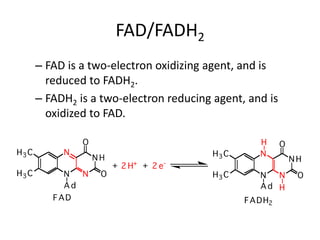
FAD/FADH2
• Flavin adenine dinucleotide (FAD) is also a
biological oxidizing agent.
FAD/FADH2
– FAD is a two-electron oxidizing agent, and is
reduced to FADH2.
– FADH2 is a two-electron reducing agent, and is
oxidized to FAD.
Coenzyme A
• Coenzyme A (CoA) is an acetyl-carrying group.
– Like NAD+ and FAD, coenzyme A contains a unit of
ADP
– CoA is often written CoA-SH to emphasize the fact
that it contains a sulfhydryl group.
– The vitamin part of coenzyme A is pantothenic
acid.
– The acetyl group of acetyl CoA is bound as a high-
energy thioester.
Coenzyme A
Citric Acid Cycle
– Overview: the two carbon acetyl group of acetyl CoA is fed into
the cycle and two CO2 are given off.
– There are four oxidation steps in the cycle.
Per turn:
•3 NADH
• 1 FADH2
• 1 GTP
• 2 CO2
************************************************************
 One high energy compound (GTP) is
produced for each cycle.
The TCA cycle provides reduced
electron carriers in the form of three
NADH and one FADH2 and ultimately
energy is provided for
oxidative phosphorylation.
************************************************************
*******************************************
The cycle also supplies some
precursors for several anabolic
processes.
All enzymes are in the mitochondrial
matrix or inner mitochondrial
membrane
***********************************************
Citric Acid Cycle
• Step 1: condensation of acetyl CoA with
oxaloacetate:
– The high-energy thioester of acetyl CoA is hydrolyzed.
– This hydrolysis provides the energy to drive Step 1.
– Citrate synthase, an allosteric enzyme, is inhibited by
NADH, ATP, and succinyl-CoA.
Citric Acid Cycle
• Step 2: dehydration and rehydration, catalyzed by
aconitase, gives isocitrate.
– Citrate and aconitate are achiral; neither has a
stereocenter.
– Isocitrate is chiral; it has 2 stereocenters and 4
stereoisomers are possible.
– Only one of the 4 possible stereoisomers is formed in the
cycle.
Citric Acid Cycle
• Step 3: oxidation of isocitrate followed by
decarboxylation gives a-ketoglutarate.
– Isocitrate dehydrogenase is an allosteric enzyme; it is
inhibited by ATP and NADH, and activated by ADP and
NAD+.
Citric Acid Cycle
• Step 4: oxidative decarboxylation of a-
ketoglutarate to succinyl-CoA.
– The two carbons of the acetyl group of acetyl CoA
are still present in succinyl CoA.
– This multienzyme complex is inhibited by ATP,
NADH, and succinyl CoA; it is activated by ADP and
NAD+.
Citric Acid Cycle
• Step 5: formation of succinate.
– The two CH2-COO- groups of succinate are now
equivalent.
– This is the first, and only, energy-yielding step of the
cycle; a molecule of GTP is produced.
Citric Acid Cycle
• Step 6: oxidation of succinate to fumarate.
• Step 7: hydration of fumarate to L-malate.
– Malate is chiral and can exist as a pair of enantiomers;
It is produced in the cycle as a single stereoisomer.
Citric Acid Cycle
• Step 8: oxidation of malate.
– Oxaloacetate now can react with acetyl CoA to start
another round of the cycle by repeating Step 1.
• The overall reaction of the cycle is:
24
Reactions and enzymes of the Citric Acid Cycle
TCA Cycle in Catabolism
• The catabolism of proteins, carbohydrates,
and fatty acids all feed into the citric acid cycle
at one or more points:
Pyruvate
a-Ketoglutarate
Succinyl-CoA
Fumarate
Oxaloacetate
Fatty AcidsProteins
Acetyl-CoA
Carbohydrates
Malate
intermediates
of the citric
acid cycle
Oxidative Phosphorylation
• Carried out by four closely related multisubunit
membrane-bound complexes and two electron
carriers, coenzyme Q and cytochrome c.
– In a series of oxidation-reduction reactions, electrons
from FADH2 and NADH are transferred from one
complex to the next until they reach O2.
– O2 is reduced to H2O.
– As a result of electron transport, protons are pumped
across the inner membrane to the intermembrane
space.
Oxidative Phosphorylation
Complex I
• The sequence starts with Complex I.
– This large complex contains some 40 subunits, among
them are a flavoprotein, several iron-sulfur (FeS) clusters,
and coenzyme Q (CoQ, ubiquinone).
– Complex I oxidizes NADH to NAD+.
– The oxidizing agent is CoQ, which is reduced to CoQH2.
– Some of the energy released in the oxidation of NAD+ is
used to move 2H+ from the matrix into the intermembrane
space.
Complex II
– Complex II oxidizes FADH2 to FAD.
– The oxidizing agent is CoQ, which is reduced to
CoQH2.
– The energy released in this reaction is not
sufficient to pump protons across the membrane.
Complex III
– Complex III delivers electrons from CoQH2 to
cytochrome c (Cyt c).
– This integral membrane complex contains 11 subunits,
including cytochrome b, cytochrome c1, and FeS
clusters.
– Complex III has two channels through which the two
H+ from each CoQH2 oxidized are pumped from the
matrix into the intermembrane space.
Complex IV
– Complex IV is also known as cytochrome oxidase.
– It contains 13 subunits, one of which is
cytochrome a3
– electrons flow from Cyt c (oxidized) in Complex III
to Cyt a3 in Complex IV.
– From Cyt a3 electrons are transferred to O2.
– During this redox reaction, H+ are pumped from
the matrix into the intermembrane space.
Coupling of Ox and Phos
• To explain how electron and H+ transport produce
the chemical energy of ATP, Peter Mitchell
proposed the chemiosmotic theory:
– The energy-releasing oxidations give rise to proton
pumping and a pH gradient is created across the inner
mitochondrial membrane.
– There is a higher concentration of H+ in the
intermembrane space than inside the mitochondria.
– This proton gradient provides the driving force to
propel protons back into the mitochondrion through
the enzyme complex called proton translocating
ATPase.
Coupling of Ox and Phos
– Protons flow back into the matrix through channels in
the F0 unit of ATP synthase.
– The flow of protons is accompanied by formation of
ATP in the F1 unit of ATP synthase.
• The functions of oxygen are:
– To oxidize NADH to NAD+ and FADH2 to FAD so that
these molecules can return to participate in the citric
acid cycle.
– Provide energy for the conversion of ADP to ATP.
ADP + Pi ATP + H2O
Coupling of Ox and Phos
• The overall reactions of oxidative
phosphorylation are:
• Oxidation of each NADH gives 3ATP.
• Oxidation of each FADH2 gives 2 ATP.
The Energy Yield
• A portion of the energy released during electron
transport is now built into ATP.
– For each two-carbon acetyl unit entering the citric acid
cycle, we get three NADH and one FADH2.
– For each NADH oxidized to NAD+, we get three ATP.
– For each FADH2 oxidized to FAD, we get two ATP.
– Thus, the yield of ATP per two-carbon acetyl group
oxidized to CO2 is:
Other Energy Forms
• The chemical energy of ATP is converted by the
body to several other forms of energy:
• Electrical energy
– The body maintains a K+ concentration gradient across
cell membranes; higher inside and lower outside.
– It also maintains a Na+ concentration gradient across
cell membranes; lower inside, higher outside.
– This pumping requires energy, which is supplied by
the hydrolysis of ATP to ADP.
– Thus, the chemical energy of ATP is transformed into
electrical energy, which operates in
neurotransmission.
Other Forms of Energy
• Mechanical energy
– ATP drives the alternating association and
dissociation of actin and myosin and,
consequently, the contraction and relaxation of
muscle tissue.
• Heat energy
– Hydrolysis of ATP to ADP yields 7.3 kcal/mol.
– Some of this energy is released as heat to
maintain body temperature.
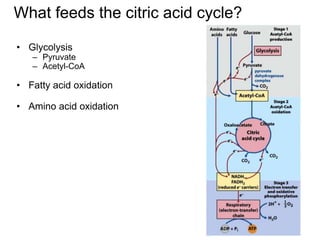
What feeds the citric acid cycle?
• Glycolysis
– Pyruvate
– Acetyl-CoA
• Fatty acid oxidation
• Amino acid oxidation
• Glycolysis is an ancient pathway that cleaves glucose (C6H12O6) into two
molecules of pyruvate (C3H3O3). Under aerobic conditions, the pyruvate is
completely oxidized by the citric acid cycle to generate CO2, whereas, under anaerobic
(lacking O2) conditions it is converted to lactate.
• The glycolytic pathway consists of ten enzymatic steps organized into two
stages. In Stage 1, two ATP are invested to “prime the pump,” and in Stage 2, four ATP
are produced to give a net ATP yield of two moles of ATP per mole of glucose.
• Glycolysis generates metabolic intermediates for a large number of other
pathways, including amino acid synthesis, pentose phosphate pathway, and
triacylglycerol synthesis.
Key Concepts in Glycolysis
-Glycolysis takes place
entirely in the cytosol
-pyruvate oxidation
occurs in the
mitochondrial matrix
-Oxygen is not required
for glycolysis in the
cytosol (anaerobic) but
it is necessary for
aerobic respiration in
the mitochondrial
matrix where the O2
serves as the terminal
electron acceptor.
Glycolysis
• Glycolysis: a series of 10 enzyme-catalyzed
reactions by which glucose is oxidized to two
molecules of pyruvate.
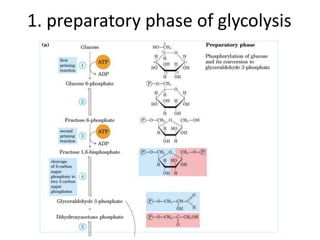
1. preparatory phase of glycolysis
2. payoff phase of glycolysis
step 1: phosphorylation of glucose
• Hexokinase – present in all cells (glucokinase in liver)
• Irreversible, rate-controlling reaction
• Activates glucose for subsequent reactions
• One ATP invested
Hexokinase binds glucose with the exclusion H2O from the enzyme
active site and brings the phosphoryl group of ATP into close proximity
with the C-6 carbon of glucose
step 2: conversion of G 6-P to F 6-P
• Phosphohexose Isomerase (aka: phosphoglucose isomerase)
– Isomerases enzymes convert between isomers
• Reversible reaction
• Direction depends on [substrate] and [product]
step 3: phosphorylation of F 6-P to F 1,6-bisP
• Phosphofructokinase-1 (aka: PFK-1)
• Second priming reaction in preparatory phase
• Irreversible
• Rate controlling enzyme in glycolysis because the activity of
PFK-1 is controlled by numerous allosteric effectors
(positive and negative).
step 4: cleavage of F 1,6-bisP
• Aldolase (aka: fructose 1,6-bisphosphate aldolase)
• Rapid product removal drives the reaction
• The splitting of fructose-1,6-BP into the triose phosphates
glyceraldehyde-3-P and dihydroxyacetone-P is the reaction
that puts the lysis in glycolysis (lysis means splitting).
step 5: interconversion of triose phosphates
• Triose phosphate isomerase
• Glyceraldehyde-3-P, rather than dihydroxyacetone-P, is
the substrate for reaction 6 in the glycolytic pathway,
making this isomerization necessary.
step 6: oxidation of glyceraldehyde 3-phosphate to 1,3-
bisphosphoglycerate
• Glyceraldehyde 3-phosphate dehydrogenase (a
dehydrogenation)
• First step in the payoff phase of glycolysis
• Note the presence of the NAD+ cofactor
-The NADH formed must be re-oxidized or glycolysis will stop
step 7: phosphoryl transfer from
1,3-bisphosphoglycerate to ADP
• Phosphoglycerate kinase
• First ATP formed
step 8: conversion of 3-phosphoglycerate
to 2-phosphoglycerate
• Phosphoglycerate mutase
• Mutases catalyze the transfer of functional groups from one position to
another
• The purpose of reaction 8 is to generate a compound, 2-phosphoglycerate,
that can be converted to phosphoenolpyruvate in the next reaction, in
preparation for a second phosphorylation to generate ATP.
step 9: dehydration of 2-phosphoglycerate to
phosphoenolpyruvate
• Enolase
• Reversible removal of water (a dehydration reaction).
step 10: transfer of the phosphoryl group from
phosphoenolpyruvate to ADP
• Pyruvate kinase
• Irreversible rate controlling reaction
• ATP formed
• Unlike phosphoenolpyruvate, pyruvate is a stable compound in
cells that is utilized by many other metabolic pathways.
overall balance sheet for glycolysis
Glucose + __ATP + __NAD+ + __ADP + 2Pi
__Pyruvate + __ADP + __NADH + 2H+ + __ATP + 2H2O
2 2 4
2 2 2 4
• Net gain of 2 ATP per glucose in glycolysis
• 4-6 more ATP can be gained from the transfer of NADH to the
mitochondria for oxidation there
Reactions of Pyruvate
• Pyruvate is most commonly metabolized in
one of three ways, depending on the type of
organism and the presence or absence of O2.
What happens to pyruvate?
Only 5% of total
energy is released
O2 is needed as the
final e- acceptor to
oxidize NADH
Produces the
necessary NAD+
Reactions of Pyruvate
• A key to understanding the biochemical logic
behind two of these reactions of pyruvate is to
recognize that glycolysis needs a continuing
supply of NAD+.
– If no oxygen is present to reoxidize NADH to NAD+,
then another way must be found to reoxidize it.
Pyruvate to Lactate
– In vertebrates under anaerobic conditions, the
most important pathway for the regeneration of
NAD+ is reduction of pyruvate to lactate. Pyruvate,
the oxidizing agent, is reduced to lactate.
– Lactate dehydrogenase (LDH
anaerobic fate: pyruvate to lactate
• Lactate dehydrogenase (LDH)
• Active skeletal muscle, erythrocytes
• Supplies NAD+ for glyceraldehyde 3-
phosphate dehydrogenase
• Lactate can be recycled in the liver (to
glucose via the Cori cycle)
• Some large animals remain
almost torpid until short
bursts of energy are
needed
• Extra oxygen is consumed
during the long recovery
period
Pyruvate to Lactate
– While reduction to lactate allows glycolysis to
continue, it increases the concentration of lactate
and also of H+ in muscle tissue
– When blood lactate reaches about 0.4 mg/100
mL, muscle tissue becomes almost completely
exhausted.
Pyruvate to Acetyl-CoA
– Under aerobic conditions, pyruvate undergoes
oxidative decarboxylation.
– The carboxylate group is converted to CO2.
– The remaining two carbons are converted to the
acetyl group of acetyl CoA.
Irreversible
-- irreversible means acetyl-CoA
cannot be converted backward
to pyruvate;
hence “fat cannot be converted to
carbohydrate”
Energy Yield of Glycolysis
1, 2, 3
5
6, 9
12
13
Reaction(s)
Activation (glucose
fructose 1,6-bisphosphate
Oxidative phosphorylation
(2 glyceraldehyde 3-phosphate
1,3-bisphosphoglycerate),
produces 2NAD+
+ H+
Phosphate transfer to ADP
from 1,3-bisphosphoglycerate
and phosphoenolpyruvate
Oxidative decarboxylation
2 (pyruvate acetyl CoA),
produces 2(NAD+
+ H+
)
Oxidation to two acetyl CoA
in the citric acid cycle etc.
ATP produced
-2
4
4
6
24
36TOTAL
Step

Bioenergetics

  • 1.
    Bioenergetics: How the body convertsfood to energy K. Dunlap
  • 2.
    Metabolism • Metabolism: thesum of all chemical reactions involved in maintaining the dynamic state of a cell or organism. – Pathway: a series of biochemical reactions. – Catabolism: the biochemical pathways that are involved in generating energy by breaking down large nutrient molecules into smaller molecules with the concurrent production of energy. – Anabolism: the pathways by which biomolecules are synthesized.
  • 3.
    Metabolism – Metabolism isthe sum of catabolism and anabolism. oxidation and the release of energy Triglycerides Proteins Fatty acids and glycerol Amino Acids Small molecules Anabolism of proteins beakdown of larger molecules to smaller ones Some nutrients and products of catabolism Products of anabolism, including proteins and nucleic acids Catabolism Excretion energy and reducing agents Monosac- charides Polysac- charides Excretion Anabolism Catabolism Anabolism
  • 4.
    A Mitochondrion organelles inwhich the common catabolic pathway takes place in higher organisms; the purpose of this catabolic pathway is to convert the energy stored in food molecules into energy stored in molecules of ATP.
  • 5.
    Common Catabolic Pathway •The two parts to the common catabolic pathway: – The citric acid cycle, also called the tricarboxylic acid (TCA) or Krebs cycle. – Electron transport chain and phosphorylation, together called oxidative phosphorylation. • Four principal compounds participating in the common catabolic pathway are: – AMP, ADP, and ATP – NAD+/NADH – FAD/FADH2 – coenzyme A; abbreviated CoA or CoA-SH
  • 6.
    Adenosine Triphosphate • ATPis the most important compound involved in the transfer of phosphate groups. – ATP contains two phosphoric anhydride bonds and one phosphoric ester bond.
  • 7.
    ATP – Hydrolysis ofthe terminal phosphate (anhydride) of ATP gives ADP, phosphate ion, and energy. – Hydrolysis of a phosphoric anhydride liberates more energy than hydrolysis of a phosphoric ester. – We say that ATP and ADP contain two high-energy phosphoric anhydride bonds. – ATP is a universal carrier of phosphate groups. – ATP is also a common currency for the storage and transfer of energy.
  • 8.
    NAD+/NADH2 • Nicotinamide adeninedinucleotide (NAD+) is a biological oxidizing agent.
  • 9.
    NAD+/NADH – NAD+ isa two-electron oxidizing agent, and is reduced to NADH. – NADH is a two-electron reducing agent, and is oxidized to NAD+. –NADH is an electron and hydrogen ion transporting molecule.
  • 10.
    FAD/FADH2 • Flavin adeninedinucleotide (FAD) is also a biological oxidizing agent.
  • 11.
    FAD/FADH2 – FAD isa two-electron oxidizing agent, and is reduced to FADH2. – FADH2 is a two-electron reducing agent, and is oxidized to FAD.
  • 12.
    Coenzyme A • CoenzymeA (CoA) is an acetyl-carrying group. – Like NAD+ and FAD, coenzyme A contains a unit of ADP – CoA is often written CoA-SH to emphasize the fact that it contains a sulfhydryl group. – The vitamin part of coenzyme A is pantothenic acid. – The acetyl group of acetyl CoA is bound as a high- energy thioester.
  • 13.
  • 14.
    Citric Acid Cycle –Overview: the two carbon acetyl group of acetyl CoA is fed into the cycle and two CO2 are given off. – There are four oxidation steps in the cycle. Per turn: •3 NADH • 1 FADH2 • 1 GTP • 2 CO2
  • 15.
    ************************************************************  One highenergy compound (GTP) is produced for each cycle. The TCA cycle provides reduced electron carriers in the form of three NADH and one FADH2 and ultimately energy is provided for oxidative phosphorylation. ************************************************************
  • 16.
    ******************************************* The cycle alsosupplies some precursors for several anabolic processes. All enzymes are in the mitochondrial matrix or inner mitochondrial membrane ***********************************************
  • 17.
    Citric Acid Cycle •Step 1: condensation of acetyl CoA with oxaloacetate: – The high-energy thioester of acetyl CoA is hydrolyzed. – This hydrolysis provides the energy to drive Step 1. – Citrate synthase, an allosteric enzyme, is inhibited by NADH, ATP, and succinyl-CoA.
  • 18.
    Citric Acid Cycle •Step 2: dehydration and rehydration, catalyzed by aconitase, gives isocitrate. – Citrate and aconitate are achiral; neither has a stereocenter. – Isocitrate is chiral; it has 2 stereocenters and 4 stereoisomers are possible. – Only one of the 4 possible stereoisomers is formed in the cycle.
  • 19.
    Citric Acid Cycle •Step 3: oxidation of isocitrate followed by decarboxylation gives a-ketoglutarate. – Isocitrate dehydrogenase is an allosteric enzyme; it is inhibited by ATP and NADH, and activated by ADP and NAD+.
  • 20.
    Citric Acid Cycle •Step 4: oxidative decarboxylation of a- ketoglutarate to succinyl-CoA. – The two carbons of the acetyl group of acetyl CoA are still present in succinyl CoA. – This multienzyme complex is inhibited by ATP, NADH, and succinyl CoA; it is activated by ADP and NAD+.
  • 21.
    Citric Acid Cycle •Step 5: formation of succinate. – The two CH2-COO- groups of succinate are now equivalent. – This is the first, and only, energy-yielding step of the cycle; a molecule of GTP is produced.
  • 22.
    Citric Acid Cycle •Step 6: oxidation of succinate to fumarate. • Step 7: hydration of fumarate to L-malate. – Malate is chiral and can exist as a pair of enantiomers; It is produced in the cycle as a single stereoisomer.
  • 23.
    Citric Acid Cycle •Step 8: oxidation of malate. – Oxaloacetate now can react with acetyl CoA to start another round of the cycle by repeating Step 1. • The overall reaction of the cycle is:
  • 24.
    24 Reactions and enzymesof the Citric Acid Cycle
  • 25.
    TCA Cycle inCatabolism • The catabolism of proteins, carbohydrates, and fatty acids all feed into the citric acid cycle at one or more points: Pyruvate a-Ketoglutarate Succinyl-CoA Fumarate Oxaloacetate Fatty AcidsProteins Acetyl-CoA Carbohydrates Malate intermediates of the citric acid cycle
  • 26.
    Oxidative Phosphorylation • Carriedout by four closely related multisubunit membrane-bound complexes and two electron carriers, coenzyme Q and cytochrome c. – In a series of oxidation-reduction reactions, electrons from FADH2 and NADH are transferred from one complex to the next until they reach O2. – O2 is reduced to H2O. – As a result of electron transport, protons are pumped across the inner membrane to the intermembrane space.
  • 27.
  • 28.
    Complex I • Thesequence starts with Complex I. – This large complex contains some 40 subunits, among them are a flavoprotein, several iron-sulfur (FeS) clusters, and coenzyme Q (CoQ, ubiquinone). – Complex I oxidizes NADH to NAD+. – The oxidizing agent is CoQ, which is reduced to CoQH2. – Some of the energy released in the oxidation of NAD+ is used to move 2H+ from the matrix into the intermembrane space.
  • 29.
    Complex II – ComplexII oxidizes FADH2 to FAD. – The oxidizing agent is CoQ, which is reduced to CoQH2. – The energy released in this reaction is not sufficient to pump protons across the membrane.
  • 30.
    Complex III – ComplexIII delivers electrons from CoQH2 to cytochrome c (Cyt c). – This integral membrane complex contains 11 subunits, including cytochrome b, cytochrome c1, and FeS clusters. – Complex III has two channels through which the two H+ from each CoQH2 oxidized are pumped from the matrix into the intermembrane space.
  • 31.
    Complex IV – ComplexIV is also known as cytochrome oxidase. – It contains 13 subunits, one of which is cytochrome a3 – electrons flow from Cyt c (oxidized) in Complex III to Cyt a3 in Complex IV. – From Cyt a3 electrons are transferred to O2. – During this redox reaction, H+ are pumped from the matrix into the intermembrane space.
  • 32.
    Coupling of Oxand Phos • To explain how electron and H+ transport produce the chemical energy of ATP, Peter Mitchell proposed the chemiosmotic theory: – The energy-releasing oxidations give rise to proton pumping and a pH gradient is created across the inner mitochondrial membrane. – There is a higher concentration of H+ in the intermembrane space than inside the mitochondria. – This proton gradient provides the driving force to propel protons back into the mitochondrion through the enzyme complex called proton translocating ATPase.
  • 33.
    Coupling of Oxand Phos – Protons flow back into the matrix through channels in the F0 unit of ATP synthase. – The flow of protons is accompanied by formation of ATP in the F1 unit of ATP synthase. • The functions of oxygen are: – To oxidize NADH to NAD+ and FADH2 to FAD so that these molecules can return to participate in the citric acid cycle. – Provide energy for the conversion of ADP to ATP. ADP + Pi ATP + H2O
  • 34.
    Coupling of Oxand Phos • The overall reactions of oxidative phosphorylation are: • Oxidation of each NADH gives 3ATP. • Oxidation of each FADH2 gives 2 ATP.
  • 35.
    The Energy Yield •A portion of the energy released during electron transport is now built into ATP. – For each two-carbon acetyl unit entering the citric acid cycle, we get three NADH and one FADH2. – For each NADH oxidized to NAD+, we get three ATP. – For each FADH2 oxidized to FAD, we get two ATP. – Thus, the yield of ATP per two-carbon acetyl group oxidized to CO2 is:
  • 36.
    Other Energy Forms •The chemical energy of ATP is converted by the body to several other forms of energy: • Electrical energy – The body maintains a K+ concentration gradient across cell membranes; higher inside and lower outside. – It also maintains a Na+ concentration gradient across cell membranes; lower inside, higher outside. – This pumping requires energy, which is supplied by the hydrolysis of ATP to ADP. – Thus, the chemical energy of ATP is transformed into electrical energy, which operates in neurotransmission.
  • 37.
    Other Forms ofEnergy • Mechanical energy – ATP drives the alternating association and dissociation of actin and myosin and, consequently, the contraction and relaxation of muscle tissue. • Heat energy – Hydrolysis of ATP to ADP yields 7.3 kcal/mol. – Some of this energy is released as heat to maintain body temperature.
  • 38.
    What feeds thecitric acid cycle? • Glycolysis – Pyruvate – Acetyl-CoA • Fatty acid oxidation • Amino acid oxidation
  • 39.
    • Glycolysis isan ancient pathway that cleaves glucose (C6H12O6) into two molecules of pyruvate (C3H3O3). Under aerobic conditions, the pyruvate is completely oxidized by the citric acid cycle to generate CO2, whereas, under anaerobic (lacking O2) conditions it is converted to lactate. • The glycolytic pathway consists of ten enzymatic steps organized into two stages. In Stage 1, two ATP are invested to “prime the pump,” and in Stage 2, four ATP are produced to give a net ATP yield of two moles of ATP per mole of glucose. • Glycolysis generates metabolic intermediates for a large number of other pathways, including amino acid synthesis, pentose phosphate pathway, and triacylglycerol synthesis. Key Concepts in Glycolysis
  • 40.
    -Glycolysis takes place entirelyin the cytosol -pyruvate oxidation occurs in the mitochondrial matrix -Oxygen is not required for glycolysis in the cytosol (anaerobic) but it is necessary for aerobic respiration in the mitochondrial matrix where the O2 serves as the terminal electron acceptor.
  • 41.
    Glycolysis • Glycolysis: aseries of 10 enzyme-catalyzed reactions by which glucose is oxidized to two molecules of pyruvate.
  • 42.
    1. preparatory phaseof glycolysis
  • 43.
    2. payoff phaseof glycolysis
  • 44.
    step 1: phosphorylationof glucose • Hexokinase – present in all cells (glucokinase in liver) • Irreversible, rate-controlling reaction • Activates glucose for subsequent reactions • One ATP invested
  • 45.
    Hexokinase binds glucosewith the exclusion H2O from the enzyme active site and brings the phosphoryl group of ATP into close proximity with the C-6 carbon of glucose
  • 46.
    step 2: conversionof G 6-P to F 6-P • Phosphohexose Isomerase (aka: phosphoglucose isomerase) – Isomerases enzymes convert between isomers • Reversible reaction • Direction depends on [substrate] and [product]
  • 47.
    step 3: phosphorylationof F 6-P to F 1,6-bisP • Phosphofructokinase-1 (aka: PFK-1) • Second priming reaction in preparatory phase • Irreversible • Rate controlling enzyme in glycolysis because the activity of PFK-1 is controlled by numerous allosteric effectors (positive and negative).
  • 48.
    step 4: cleavageof F 1,6-bisP • Aldolase (aka: fructose 1,6-bisphosphate aldolase) • Rapid product removal drives the reaction • The splitting of fructose-1,6-BP into the triose phosphates glyceraldehyde-3-P and dihydroxyacetone-P is the reaction that puts the lysis in glycolysis (lysis means splitting).
  • 49.
    step 5: interconversionof triose phosphates • Triose phosphate isomerase • Glyceraldehyde-3-P, rather than dihydroxyacetone-P, is the substrate for reaction 6 in the glycolytic pathway, making this isomerization necessary.
  • 50.
    step 6: oxidationof glyceraldehyde 3-phosphate to 1,3- bisphosphoglycerate • Glyceraldehyde 3-phosphate dehydrogenase (a dehydrogenation) • First step in the payoff phase of glycolysis • Note the presence of the NAD+ cofactor -The NADH formed must be re-oxidized or glycolysis will stop
  • 51.
    step 7: phosphoryltransfer from 1,3-bisphosphoglycerate to ADP • Phosphoglycerate kinase • First ATP formed
  • 52.
    step 8: conversionof 3-phosphoglycerate to 2-phosphoglycerate • Phosphoglycerate mutase • Mutases catalyze the transfer of functional groups from one position to another • The purpose of reaction 8 is to generate a compound, 2-phosphoglycerate, that can be converted to phosphoenolpyruvate in the next reaction, in preparation for a second phosphorylation to generate ATP.
  • 53.
    step 9: dehydrationof 2-phosphoglycerate to phosphoenolpyruvate • Enolase • Reversible removal of water (a dehydration reaction).
  • 54.
    step 10: transferof the phosphoryl group from phosphoenolpyruvate to ADP • Pyruvate kinase • Irreversible rate controlling reaction • ATP formed • Unlike phosphoenolpyruvate, pyruvate is a stable compound in cells that is utilized by many other metabolic pathways.
  • 55.
    overall balance sheetfor glycolysis Glucose + __ATP + __NAD+ + __ADP + 2Pi __Pyruvate + __ADP + __NADH + 2H+ + __ATP + 2H2O 2 2 4 2 2 2 4 • Net gain of 2 ATP per glucose in glycolysis • 4-6 more ATP can be gained from the transfer of NADH to the mitochondria for oxidation there
  • 56.
    Reactions of Pyruvate •Pyruvate is most commonly metabolized in one of three ways, depending on the type of organism and the presence or absence of O2.
  • 57.
    What happens topyruvate? Only 5% of total energy is released O2 is needed as the final e- acceptor to oxidize NADH Produces the necessary NAD+
  • 59.
    Reactions of Pyruvate •A key to understanding the biochemical logic behind two of these reactions of pyruvate is to recognize that glycolysis needs a continuing supply of NAD+. – If no oxygen is present to reoxidize NADH to NAD+, then another way must be found to reoxidize it.
  • 60.
    Pyruvate to Lactate –In vertebrates under anaerobic conditions, the most important pathway for the regeneration of NAD+ is reduction of pyruvate to lactate. Pyruvate, the oxidizing agent, is reduced to lactate. – Lactate dehydrogenase (LDH
  • 61.
    anaerobic fate: pyruvateto lactate • Lactate dehydrogenase (LDH) • Active skeletal muscle, erythrocytes • Supplies NAD+ for glyceraldehyde 3- phosphate dehydrogenase • Lactate can be recycled in the liver (to glucose via the Cori cycle) • Some large animals remain almost torpid until short bursts of energy are needed • Extra oxygen is consumed during the long recovery period
  • 62.
    Pyruvate to Lactate –While reduction to lactate allows glycolysis to continue, it increases the concentration of lactate and also of H+ in muscle tissue – When blood lactate reaches about 0.4 mg/100 mL, muscle tissue becomes almost completely exhausted.
  • 63.
    Pyruvate to Acetyl-CoA –Under aerobic conditions, pyruvate undergoes oxidative decarboxylation. – The carboxylate group is converted to CO2. – The remaining two carbons are converted to the acetyl group of acetyl CoA.
  • 64.
    Irreversible -- irreversible meansacetyl-CoA cannot be converted backward to pyruvate; hence “fat cannot be converted to carbohydrate”
  • 65.
    Energy Yield ofGlycolysis 1, 2, 3 5 6, 9 12 13 Reaction(s) Activation (glucose fructose 1,6-bisphosphate Oxidative phosphorylation (2 glyceraldehyde 3-phosphate 1,3-bisphosphoglycerate), produces 2NAD+ + H+ Phosphate transfer to ADP from 1,3-bisphosphoglycerate and phosphoenolpyruvate Oxidative decarboxylation 2 (pyruvate acetyl CoA), produces 2(NAD+ + H+ ) Oxidation to two acetyl CoA in the citric acid cycle etc. ATP produced -2 4 4 6 24 36TOTAL Step