Objectives
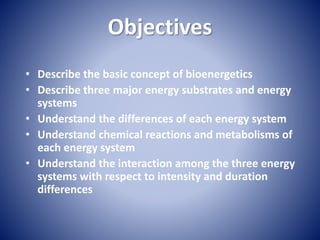
• Describe the basic concept of bioenergetics
• Describe three major energy substrates and energy
systems
• Understand the differences of each energy system
• Understand chemical reactions and metabolisms of
each energy system
• Understand the interaction among the three energy
systems with respect to intensity and duration
differences
• For any physical activity, energy must be
made and used by the body to accomplish
the task (work).
• The study of energy flow in living organisms
• How is that energy generated and ultimately
utilized?
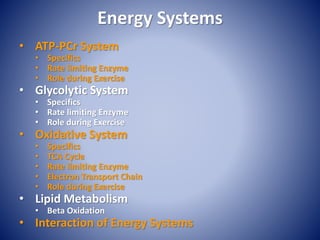
Energy Systems
• ATP-PCr System
• Specifics
• Rate limiting Enzyme
• Role during Exercise
• Glycolytic System
• Specifics
• Rate limiting Enzyme
• Role during Exercise
• Oxidative System
• Specifics
• TCA Cycle
• Rate limiting Enzyme
• Electron Transport Chain
• Role during Exercise
• Lipid Metabolism
• Beta Oxidation
• Interaction of Energy Systems
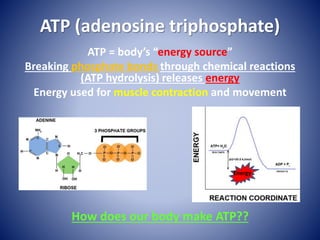
ATP (adenosine triphosphate)
ATP = body’s “energy source”
Breaking phosphate bonds through chemical reactions
(ATP hydrolysis) releases energy
Energy used for muscle contraction and movement
How does our body make ATP??
Energy
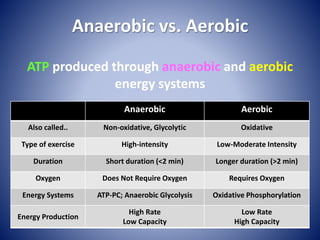
Anaerobic vs. Aerobic
ATP produced through anaerobic and aerobic
energy systems
Anaerobic Aerobic
Also called.. Non-oxidative, Glycolytic Oxidative
Type of exercise High-intensity Low-Moderate Intensity
Duration Short duration (<2 min) Longer duration (>2 min)
Oxygen Does Not Require Oxygen Requires Oxygen
Energy Systems ATP-PC; Anaerobic Glycolysis Oxidative Phosphorylation
Energy Production
High Rate
Low Capacity
Low Rate
High Capacity
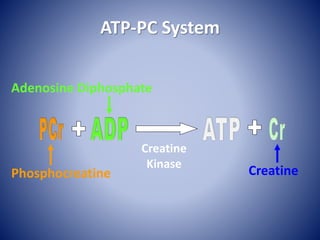
ATP-PC System
Creatine
Kinase
Phosphocreatine
Adenosine Diphosphate
Creatine
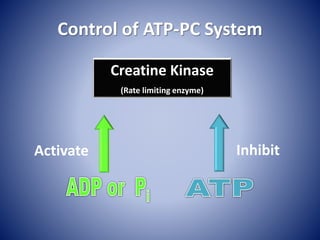
Control of ATP-PC System
Activate Inhibit
Creatine Kinase
(Rate limiting enzyme)
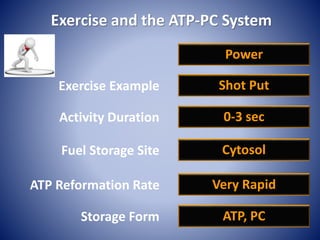
Exercise and the ATP-PC System
Power
Exercise Example Shot Put
Fuel Storage Site Cytosol
ATP Reformation Rate Very Rapid
Storage Form ATP, PC
Activity Duration 0-3 sec
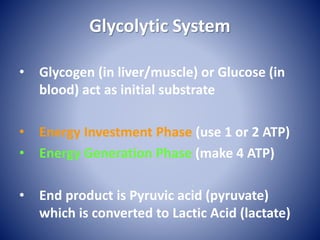
Glycolytic System
• Glycogen (in liver/muscle) or Glucose (in
blood) act as initial substrate
• Energy Investment Phase (use 1 or 2 ATP)
• Energy Generation Phase (make 4 ATP)
• End product is Pyruvic acid (pyruvate)
which is converted to Lactic Acid (lactate)
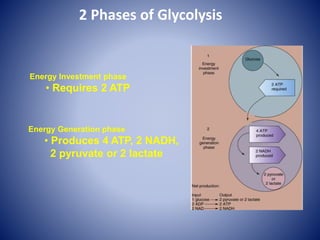
2 Phases of Glycolysis
Energy Investment phase
• Requires 2 ATP
Energy Generation phase
• Produces 4 ATP, 2 NADH,
2 pyruvate or 2 lactate
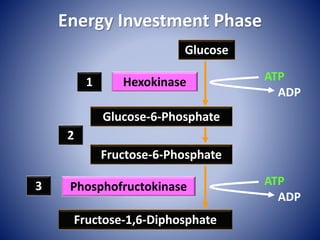
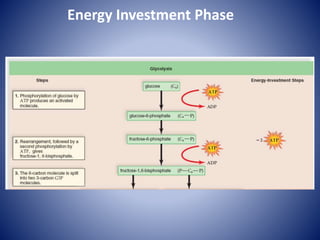
Energy Investment Phase
Glucose
ATP
ADP
Hexokinase
ATP
ADP
Phosphofructokinase
Glucose-6-Phosphate
1
Fructose-6-Phosphate
2
Fructose-1,6-Diphosphate
3
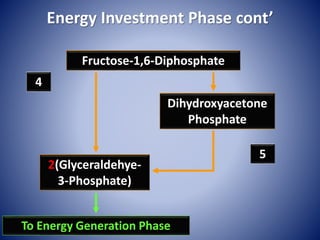
Energy Investment Phase cont’
Fructose-1,6-Diphosphate
2(Glyceraldehye-
3-Phosphate)
Dihydroxyacetone
Phosphate
4
5
To Energy Generation Phase
Energy Investment Phase
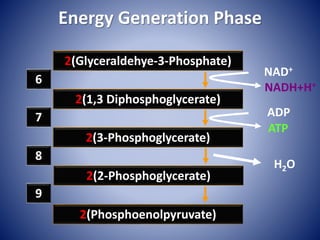
Energy Generation Phase
NAD+
NADH+H+
ADP
ATP
2(Glyceraldehye-3-Phosphate)
H2O
2(1,3 Diphosphoglycerate)
6
2(3-Phosphoglycerate)
7
2(2-Phosphoglycerate)
8
2(Phosphoenolpyruvate)
9
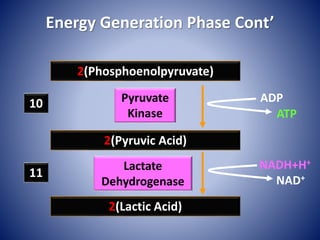
Energy Generation Phase Cont’
2(Phosphoenolpyruvate)
2(Lactic Acid)
11
2(Pyruvic Acid)
10
NADH+H+
NAD+
Lactate
Dehydrogenase
ADP
ATP
Pyruvate
Kinase
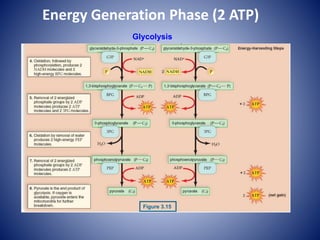
Energy Generation Phase (2 ATP)
Figure 3.15
Glycolysis
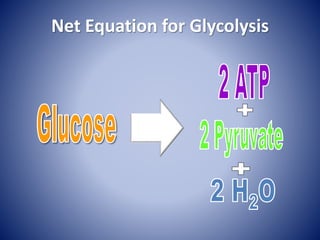
Net Equation for Glycolysis
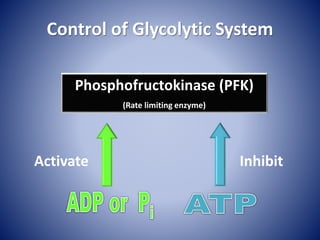
Control of Glycolytic System
Activate Inhibit
Phosphofructokinase (PFK)
(Rate limiting enzyme)
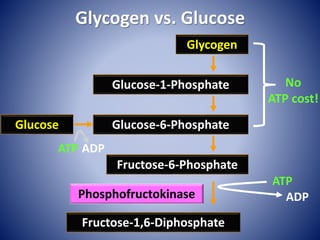
Glycogen vs. Glucose
Glycogen
ATP
ADPPhosphofructokinase
Glucose-1-Phosphate
Fructose-6-Phosphate
Fructose-1,6-Diphosphate
Glucose-6-Phosphate
No
ATP cost!
Glucose
ATP ADP
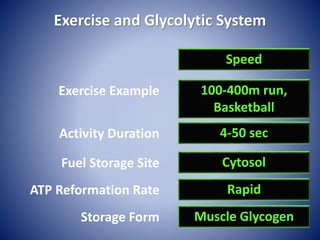
Exercise and Glycolytic System
Speed
Exercise Example 100-400m run,
Basketball
Fuel Storage Site Cytosol
ATP Reformation Rate Rapid
Storage Form Muscle Glycogen
Activity Duration 4-50 sec
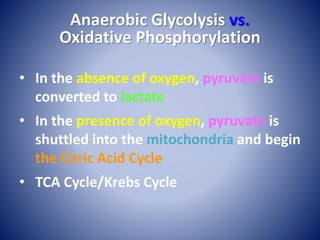
Anaerobic Glycolysis vs.
Oxidative Phosphorylation
• In the absence of oxygen, pyruvate is
converted to lactate
• In the presence of oxygen, pyruvate is
shuttled into the mitochondria and begin
the Citric Acid Cycle
• TCA Cycle/Krebs Cycle
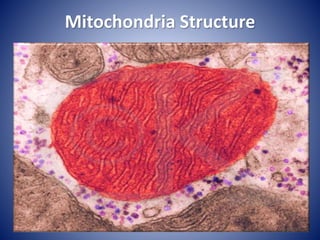
Mitochondria Structure
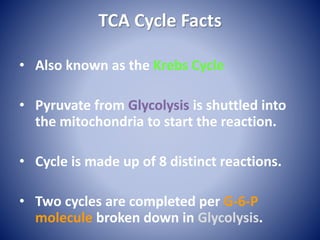
TCA Cycle Facts
• Also known as the Krebs Cycle
• Pyruvate from Glycolysis is shuttled into
the mitochondria to start the reaction.
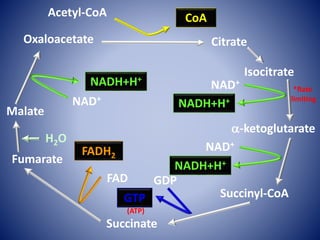
• Cycle is made up of 8 distinct reactions.
• Two cycles are completed per G-6-P
molecule broken down in Glycolysis.
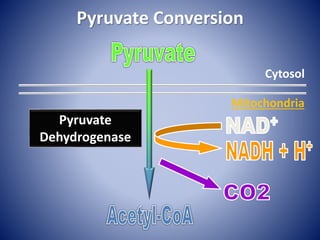
Pyruvate Conversion
Cytosol
Mitochondria
Pyruvate
Dehydrogenase
Isocitrate
-ketoglutarate
Succinyl-CoA
Succinate
Fumarate
Malate
Citrate
CoA
NAD+
NAD+
GDP
GTP
FADH2
FAD
NADH+H+
NAD+
Acetyl-CoA
Oxaloacetate
H2O
*Rate
limiting
NADH+H+
NADH+H+
(ATP)
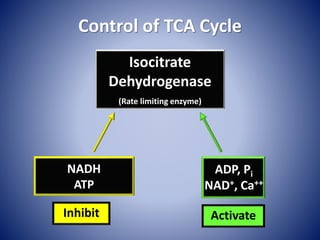
Control of TCA Cycle
Isocitrate
Dehydrogenase
(Rate limiting enzyme)
NADH
ATP
Inhibit
ADP, Pi
NAD+, Ca++
Activate
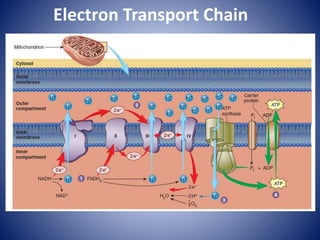
Electron Transport Chain (ETC) Basics
• Dictated by the Chemiosmotic Theory.
(movement of ions across a selectively permeable membrane, down their
electrochemical gradient)
• Physically Attached to Cristae of Mitochondria.
• Composed of Complex I-IV, CoQ, Cytochromes,
and F-complex (ATP Synthase).
• Multiple ETCs in each mitochondria.
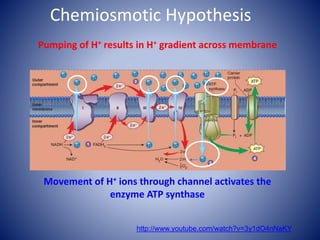
Chemiosmotic Theory
• Transfer of electrons (e-) along protein
complexes (enzymes and cytochromes) and
pumps protons (H+).
• Pumped protons create an energy gradient.
• Energy gradient is used to re-synthesize ATP
from ADP+Pi.
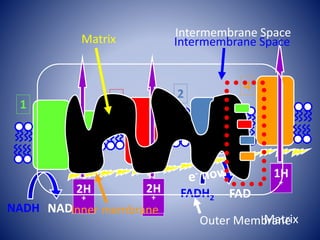
1 3 2
4
Intermembrane Space
Matrix
NADH NAD+
2H
+
2H
+
1H
+
FADH2 FAD2H
+
1H
+
Outer Membrane
Inner membrane
Matrix Intermembrane Space
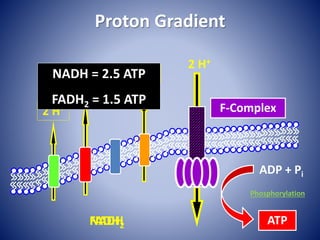
Proton Gradient
2 H+
1 H+
FADH2
2 H+
2 H+
1H+
NADH
NADH = 5 H+
FADH2 = 3 H+
2 H+
ADP + Pi
ATP
F-Complex
NADH = 2.5 ATP
FADH2 = 1.5 ATP
Phosphorylation
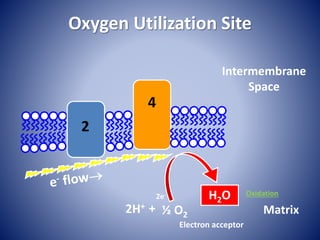
Oxygen Utilization Site
½ O2
H2O
Intermembrane
Space
Matrix
2
4
Electron acceptor
2H+ +
2e- Oxidation
Electron Transport Chain
Chemiosmotic Hypothesis
Pumping of H+ results in H+ gradient across membrane
Movement of H+ ions through channel activates the
enzyme ATP synthase
http://www.youtube.com/watch?v=3y1dO4nNaKY
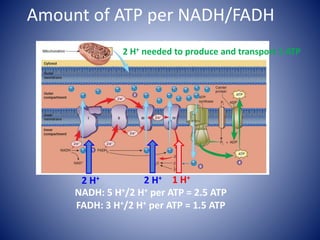
Amount of ATP per NADH/FADH
2 H+ 2 H+ 1 H+
2 H+ needed to produce and transport 1 ATP
NADH: 5 H+/2 H+ per ATP = 2.5 ATP
FADH: 3 H+/2 H+ per ATP = 1.5 ATP
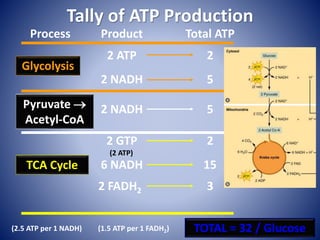
Tally of ATP Production
Process Product Total ATP
Pyruvate 
Acetyl-CoA
2 NADH
TCA Cycle
2 GTP
6 NADH
2 FADH2
2
5
Glycolysis
2 ATP
2 NADH
5
2
15
3
TOTAL = 32 / Glucose
(2 ATP)
(2.5 ATP per 1 NADH) (1.5 ATP per 1 FADH2)
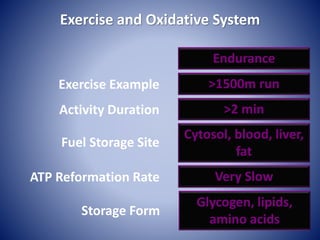
Exercise and Oxidative System
Endurance
Exercise Example >1500m run
Fuel Storage Site
Cytosol, blood, liver,
fat
ATP Reformation Rate Very Slow
Storage Form
Glycogen, lipids,
amino acids
Activity Duration >2 min
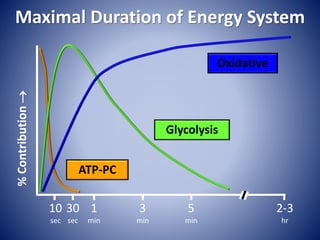
Maximal Duration of Energy System
30
sec
1
min
3
min
5
min
2-3
hr
%Contribution
ATP-PC
Glycolysis
Oxidative
10
sec
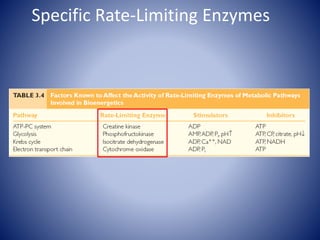
Specific Rate-Limiting Enzymes
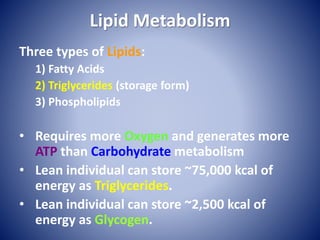
Lipid Metabolism
Three types of Lipids:
1) Fatty Acids
2) Triglycerides (storage form)
3) Phospholipids
• Requires more Oxygen and generates more
ATP than Carbohydrate metabolism
• Lean individual can store ~75,000 kcal of
energy as Triglycerides.
• Lean individual can store ~2,500 kcal of
energy as Glycogen.
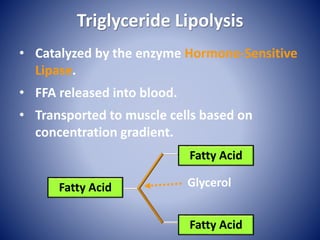
Triglyceride Lipolysis
• Catalyzed by the enzyme Hormone-Sensitive
Lipase.
• FFA released into blood.
• Transported to muscle cells based on
concentration gradient.
Fatty Acid
Fatty Acid
Fatty Acid Glycerol
Fatty Acids
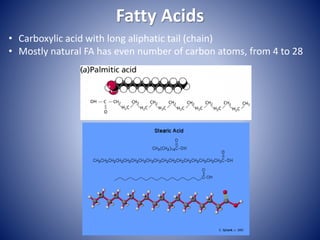
• Carboxylic acid with long aliphatic tail (chain)
• Mostly natural FA has even number of carbon atoms, from 4 to 28
Beta Oxidation of Fatty Acids
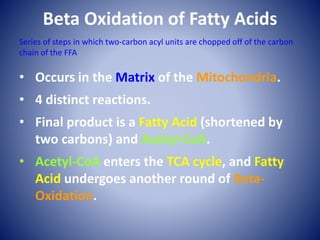
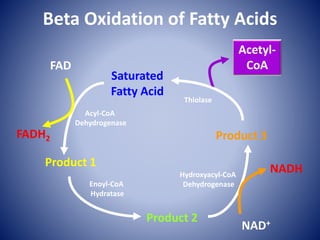
• Occurs in the Matrix of the Mitochondria.
• 4 distinct reactions.
• Final product is a Fatty Acid (shortened by
two carbons) and Acetyl-CoA.
• Acetyl-CoA enters the TCA cycle, and Fatty
Acid undergoes another round of Beta-
Oxidation.
Series of steps in which two-carbon acyl units are chopped off of the carbon
chain of the FFA
Acetyl-
CoA
Saturated
Fatty Acid
Product 3
Product 2
Product 1
FAD
FADH2
NAD+
NADH
Acyl-CoA
Dehydrogenase
Enoyl-CoA
Hydratase
Hydroxyacyl-CoA
Dehydrogenase
Thiolase
Beta Oxidation of Fatty Acids
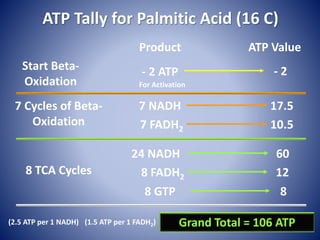
ATP Tally for Palmitic Acid (16 C)
Start Beta-
Oxidation
Product ATP Value
- 2 ATP - 2
7 Cycles of Beta-
Oxidation
7 NADH
7 FADH2
17.5
10.5
8 TCA Cycles
24 NADH
8 FADH2
8 GTP
60
12
8
Grand Total = 106 ATP
For Activation
(2.5 ATP per 1 NADH) (1.5 ATP per 1 FADH2)
Beta Oxidation during Exercise
Used to produce ATP:
1. At rest in exercise trained individuals.
2. When exercise intensity is low (< 40% max
effort)
3. When Glycogen is not abundant (end of long
duration exercise)
Its response is mediated by the “Crossover
Effect”
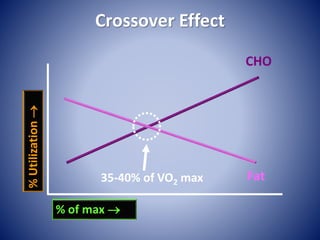
Crossover Effect
% of max 
%Utilization
CHO
Fat35-40% of VO2 max
Lecture 1   bioenergetics

Lecture 1 bioenergetics

  • 2.
    Objectives • Describe thebasic concept of bioenergetics • Describe three major energy substrates and energy systems • Understand the differences of each energy system • Understand chemical reactions and metabolisms of each energy system • Understand the interaction among the three energy systems with respect to intensity and duration differences
  • 3.
    • For anyphysical activity, energy must be made and used by the body to accomplish the task (work). • The study of energy flow in living organisms • How is that energy generated and ultimately utilized?
  • 4.
    Energy Systems • ATP-PCrSystem • Specifics • Rate limiting Enzyme • Role during Exercise • Glycolytic System • Specifics • Rate limiting Enzyme • Role during Exercise • Oxidative System • Specifics • TCA Cycle • Rate limiting Enzyme • Electron Transport Chain • Role during Exercise • Lipid Metabolism • Beta Oxidation • Interaction of Energy Systems
  • 5.
    ATP (adenosine triphosphate) ATP= body’s “energy source” Breaking phosphate bonds through chemical reactions (ATP hydrolysis) releases energy Energy used for muscle contraction and movement How does our body make ATP?? Energy
  • 6.
    Anaerobic vs. Aerobic ATPproduced through anaerobic and aerobic energy systems Anaerobic Aerobic Also called.. Non-oxidative, Glycolytic Oxidative Type of exercise High-intensity Low-Moderate Intensity Duration Short duration (<2 min) Longer duration (>2 min) Oxygen Does Not Require Oxygen Requires Oxygen Energy Systems ATP-PC; Anaerobic Glycolysis Oxidative Phosphorylation Energy Production High Rate Low Capacity Low Rate High Capacity
  • 7.
  • 8.
    Control of ATP-PCSystem Activate Inhibit Creatine Kinase (Rate limiting enzyme)
  • 9.
    Exercise and theATP-PC System Power Exercise Example Shot Put Fuel Storage Site Cytosol ATP Reformation Rate Very Rapid Storage Form ATP, PC Activity Duration 0-3 sec
  • 10.
    Glycolytic System • Glycogen(in liver/muscle) or Glucose (in blood) act as initial substrate • Energy Investment Phase (use 1 or 2 ATP) • Energy Generation Phase (make 4 ATP) • End product is Pyruvic acid (pyruvate) which is converted to Lactic Acid (lactate)
  • 11.
    2 Phases ofGlycolysis Energy Investment phase • Requires 2 ATP Energy Generation phase • Produces 4 ATP, 2 NADH, 2 pyruvate or 2 lactate
  • 12.
  • 13.
    Energy Investment Phasecont’ Fructose-1,6-Diphosphate 2(Glyceraldehye- 3-Phosphate) Dihydroxyacetone Phosphate 4 5 To Energy Generation Phase
  • 14.
  • 15.
    Energy Generation Phase NAD+ NADH+H+ ADP ATP 2(Glyceraldehye-3-Phosphate) H2O 2(1,3Diphosphoglycerate) 6 2(3-Phosphoglycerate) 7 2(2-Phosphoglycerate) 8 2(Phosphoenolpyruvate) 9
  • 16.
    Energy Generation PhaseCont’ 2(Phosphoenolpyruvate) 2(Lactic Acid) 11 2(Pyruvic Acid) 10 NADH+H+ NAD+ Lactate Dehydrogenase ADP ATP Pyruvate Kinase
  • 17.
    Energy Generation Phase(2 ATP) Figure 3.15 Glycolysis
  • 18.
    Net Equation forGlycolysis
  • 19.
    Control of GlycolyticSystem Activate Inhibit Phosphofructokinase (PFK) (Rate limiting enzyme)
  • 20.
  • 21.
    Exercise and GlycolyticSystem Speed Exercise Example 100-400m run, Basketball Fuel Storage Site Cytosol ATP Reformation Rate Rapid Storage Form Muscle Glycogen Activity Duration 4-50 sec
  • 22.
    Anaerobic Glycolysis vs. OxidativePhosphorylation • In the absence of oxygen, pyruvate is converted to lactate • In the presence of oxygen, pyruvate is shuttled into the mitochondria and begin the Citric Acid Cycle • TCA Cycle/Krebs Cycle
  • 23.
  • 24.
    TCA Cycle Facts •Also known as the Krebs Cycle • Pyruvate from Glycolysis is shuttled into the mitochondria to start the reaction. • Cycle is made up of 8 distinct reactions. • Two cycles are completed per G-6-P molecule broken down in Glycolysis.
  • 25.
  • 26.
  • 27.
    Control of TCACycle Isocitrate Dehydrogenase (Rate limiting enzyme) NADH ATP Inhibit ADP, Pi NAD+, Ca++ Activate
  • 29.
    Electron Transport Chain(ETC) Basics • Dictated by the Chemiosmotic Theory. (movement of ions across a selectively permeable membrane, down their electrochemical gradient) • Physically Attached to Cristae of Mitochondria. • Composed of Complex I-IV, CoQ, Cytochromes, and F-complex (ATP Synthase). • Multiple ETCs in each mitochondria.
  • 30.
    Chemiosmotic Theory • Transferof electrons (e-) along protein complexes (enzymes and cytochromes) and pumps protons (H+). • Pumped protons create an energy gradient. • Energy gradient is used to re-synthesize ATP from ADP+Pi.
  • 31.
    1 3 2 4 IntermembraneSpace Matrix NADH NAD+ 2H + 2H + 1H + FADH2 FAD2H + 1H + Outer Membrane Inner membrane Matrix Intermembrane Space
  • 32.
    Proton Gradient 2 H+ 1H+ FADH2 2 H+ 2 H+ 1H+ NADH NADH = 5 H+ FADH2 = 3 H+ 2 H+ ADP + Pi ATP F-Complex NADH = 2.5 ATP FADH2 = 1.5 ATP Phosphorylation
  • 33.
    Oxygen Utilization Site ½O2 H2O Intermembrane Space Matrix 2 4 Electron acceptor 2H+ + 2e- Oxidation
  • 34.
  • 35.
    Chemiosmotic Hypothesis Pumping ofH+ results in H+ gradient across membrane Movement of H+ ions through channel activates the enzyme ATP synthase http://www.youtube.com/watch?v=3y1dO4nNaKY
  • 36.
    Amount of ATPper NADH/FADH 2 H+ 2 H+ 1 H+ 2 H+ needed to produce and transport 1 ATP NADH: 5 H+/2 H+ per ATP = 2.5 ATP FADH: 3 H+/2 H+ per ATP = 1.5 ATP
  • 37.
    Tally of ATPProduction Process Product Total ATP Pyruvate  Acetyl-CoA 2 NADH TCA Cycle 2 GTP 6 NADH 2 FADH2 2 5 Glycolysis 2 ATP 2 NADH 5 2 15 3 TOTAL = 32 / Glucose (2 ATP) (2.5 ATP per 1 NADH) (1.5 ATP per 1 FADH2)
  • 38.
    Exercise and OxidativeSystem Endurance Exercise Example >1500m run Fuel Storage Site Cytosol, blood, liver, fat ATP Reformation Rate Very Slow Storage Form Glycogen, lipids, amino acids Activity Duration >2 min
  • 39.
    Maximal Duration ofEnergy System 30 sec 1 min 3 min 5 min 2-3 hr %Contribution ATP-PC Glycolysis Oxidative 10 sec
  • 40.
  • 41.
    Lipid Metabolism Three typesof Lipids: 1) Fatty Acids 2) Triglycerides (storage form) 3) Phospholipids • Requires more Oxygen and generates more ATP than Carbohydrate metabolism • Lean individual can store ~75,000 kcal of energy as Triglycerides. • Lean individual can store ~2,500 kcal of energy as Glycogen.
  • 42.
    Triglyceride Lipolysis • Catalyzedby the enzyme Hormone-Sensitive Lipase. • FFA released into blood. • Transported to muscle cells based on concentration gradient. Fatty Acid Fatty Acid Fatty Acid Glycerol
  • 43.
    Fatty Acids • Carboxylicacid with long aliphatic tail (chain) • Mostly natural FA has even number of carbon atoms, from 4 to 28
  • 44.
    Beta Oxidation ofFatty Acids • Occurs in the Matrix of the Mitochondria. • 4 distinct reactions. • Final product is a Fatty Acid (shortened by two carbons) and Acetyl-CoA. • Acetyl-CoA enters the TCA cycle, and Fatty Acid undergoes another round of Beta- Oxidation. Series of steps in which two-carbon acyl units are chopped off of the carbon chain of the FFA
  • 45.
    Acetyl- CoA Saturated Fatty Acid Product 3 Product2 Product 1 FAD FADH2 NAD+ NADH Acyl-CoA Dehydrogenase Enoyl-CoA Hydratase Hydroxyacyl-CoA Dehydrogenase Thiolase Beta Oxidation of Fatty Acids
  • 46.
    ATP Tally forPalmitic Acid (16 C) Start Beta- Oxidation Product ATP Value - 2 ATP - 2 7 Cycles of Beta- Oxidation 7 NADH 7 FADH2 17.5 10.5 8 TCA Cycles 24 NADH 8 FADH2 8 GTP 60 12 8 Grand Total = 106 ATP For Activation (2.5 ATP per 1 NADH) (1.5 ATP per 1 FADH2)
  • 47.
    Beta Oxidation duringExercise Used to produce ATP: 1. At rest in exercise trained individuals. 2. When exercise intensity is low (< 40% max effort) 3. When Glycogen is not abundant (end of long duration exercise) Its response is mediated by the “Crossover Effect”
  • 48.
    Crossover Effect % ofmax  %Utilization CHO Fat35-40% of VO2 max

Editor's Notes

  • #4 Bio (living organisms) + energetics (study of energy) Three major energy substrates are carbohydrate, fat, and protein. Not real energy About making and using energy
  • #5 In human, actual energy source is ATP. Three major energy systems in making ATP Fat metabolism How do energy systems interact with exercise intensity and exercise duration?
  • #6 Adenosine = Adenine (nitrogen containing base) + ribose (five-carbon sugar) Inorganic Phosphate ATP hydrolysis by ATPase (adenosine triphosphatase; ATPase) – about 7 to 10kcal per mole of ATP
  • #7 Different properties
  • #8 The simplest and fastest energy system to make ATP Catalyzed by creatine kinase
  • #9 Chemical reaction is controlled by rate limiting enzyme and negative feedback mechanism. i.e., Intense exercise
  • #10 Exercise requiring high power generation Shot Put - track and field Clean and Jerk - weight lifting Pitching and Bating - baseball
  • #11 ATP-PCr System – limited amount of ATP produced Glycolytic System – more complex pathway than the ATP-PCr system
  • #13 Keys Use ATP - Number 1-5 : steps body used ATP in ATP production pathway 2. Enzyme is involved with each step (reactant/temperature/pH – affect enzyme activity) 3. Phosphofuctokinase (rate limiting enzyme)
  • #14 One molecule of glucose generates two molecule of Glyceraldehye-3-Phosphate From this step, every reaction produced two molecules.
  • #16 Step 6 to 9: One ATP or Two ATPs produced? NAD: enzyme cofactor (coenzyme) Two NADH and H+ are produced Two H2O are produced
  • #17 Step 10-11 Two ATPs produced In condition without oxygen, pyruvic acid is catalized by lactate dehydrogenase to produce lactic acid. NADH and H+ are used for this reaction. Lactic acid - a acid causing muscle fatigue - inhibit prolonged activity or exercise
  • #19 One molecule of glucose makes two ATPs, lactates, and H2O
  • #21 Energy Investment Phase
  • #22 Applied in exercise Need high ATP very fast Limited capacity
  • #23 Glycolysis is not separate from oxidative phosphorylation. tricarboxylic acid cycle (TCA cycle)
  • #24 Power Plant to produce ATP Outer membrane Inter membrane Intermembrane space Matrix and cristae
  • #25 Two cycle – because one molecule of glucose produce two molecules of pyruvate
  • #26 First product is Acetyl-coA NAD is reduced to NADH and H+
  • #27 3 NADH and 3 H+ are produced 1 FADH2 GTP, a type of ATP is also produced.
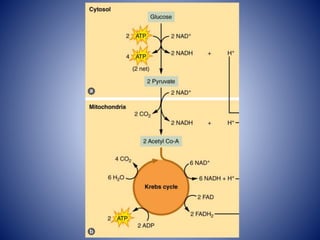
  • #29 Glycolysis and Krebs Cycle ATP 4 NADH 10 FADH 2
  • #49 Crossover point is the exercise intensity at which an individual shifts from using primarily fat metabolism to using primarily carbohydrate metabolism. High Intensity – require ATP fast – CHO is better Long term exercise – require prolonged ATP – Fat is better.