Eric J. Silva
eric@ericsilva.org
    01 March 2013
Agenda
  Introduction
  Target Audience
  Background
  Responsibilities & SOPs
  The Validation Process
  Software Development Lifecycle (SDLC)
  Computer System Development SOPs


01-Mar-2013       ©2013 Eric J. Silva      2
Introduction
  The purpose of this presentation is to give the
     audience an overview of:
       What is Computer System Validation (CSV)
       Why is CSV needed
       What processes are needed for CSV


01-Mar-2013       ©2013 Eric J. Silva                3
Target Audience
  Developers of computer systems applications
  Users of computer systems involved in testing and
   validation activities
  Personnel involved in computer systems procurement
  All concerned managers, auditors, and regulatory
   personnel
  Personnel involved in the maintenance of computer
   systems


01-Mar-2013    ©2013 Eric J. Silva                      4
Background
  In 1987 the FDA published a document entitled ‘FDA
   Guidelines on General Principles of Process Validation’
  It states the following:
       Process validation is establishing documented evidence
          which provides a high degree of assurance that a specific
          process will consistently produce a product meeting its
          predetermined specifications and quality attributes.

                   This definition indicates that validation can
                   apply to any process including process
                   managed / controlled by computer systems.

01-Mar-2013          ©2013 Eric J. Silva                              5
What is Computer System Validation

              The purpose of the validation process is to provide a high
              degree of assurance that a specific process (or in this case
              computer system) will consistently produce a product (control
              information or data) which meets predetermined
              specifications and quality attributes.


01-Mar-2013          ©2013 Eric J. Silva                                      6
Why is Validation Needed
  FDA regulations mandate the need to perform Computer System Validation and these
   regulations have the impact of law.

  Failing an FDA audit can result in FDA inspectional observations (“483s”) and warning
   letters.

  Failure to take corrective action in a timely manner can result in shutting down
   manufacturing facilities, consent decrees, and stiff financial penalties.

  The ultimate result could be loss of jobs, indictment of responsible parties (usually the
   officers of a company), and companies suffering economic instabilities resulting in
   downsizing and possibly eventual bankruptcy.


                 As a contracted resource of software and services to
                 pharmaceutical and other life sciences companies, we are
                 responsible for ensuring that our software products are compliant
                 with federal regulations.

01-Mar-2013              ©2013 Eric J. Silva                                                   7
Why is Validation Needed
  Reduces risk and legal liability


  Having the evidence that computer systems are correct
     for their purpose and operating properly represents a
     good business practice

  Software is constantly evolving to keep up with the
     increasingly complex needs of the people that use it;
     therefore validation is an ongoing necessity

01-Mar-2013       ©2013 Eric J. Silva                        8
Validation
  Validation is applied to many aspects of the healthcare and other regulated industries
   and businesses.

  Examples include:
     Services
     Equipment
     Computer Systems
     Processes


  In each case, the objective of validation is to produce documented evidence, which
   provides a high degree of assurance that all parts of the facility will consistently work
   correctly when brought into use.

  Computer systems validation includes validation of both new and existing computer
   systems.

                       Validation requires documented evidence.
                       If the validation process is not documented then it cannot be proved to
                       have occurred.

01-Mar-2013               ©2013 Eric J. Silva                                                    9
Responsibilities
  Computer system validation must be supported at different levels
     within the organization through policies, standards and
     documentation

    Corporate/Business Unit
    Site/Department Personnel
    Quality Assurance and Regulatory Units
    Corporate Management
    IT Departments

                   Smaller companies can be considered a single Corporate/
                   Business Unit, but can also have different policies based
                   on Site [geographical] differences (e.g., USA, UK, India)


01-Mar-2013          ©2013 Eric J. Silva                                       10
Responsibilities & SOPs
  Each corporate [business] unit is responsible for establishing a policy
     on computer systems validation requirements.

  Site or departments are responsible for:
     Computer system validation Standard Operating Procedures (SOPs)
     System inventory and assessment
     System specific validation protocols
     System specific validation documentation

  SOPs must:
     Comply with the Computer Systems Validation Policy and any Business
      Unit policies that may apply
     Be approved by the appropriate management for that site or
      department


01-Mar-2013          ©2013 Eric J. Silva                                     11
System and Inventory Assessment
  Site or departmental management is responsible for
     compiling and maintaining details about their
     computer systems.
       This information includes identifying the systems that
          are being used and for what purposes those systems are
          being used.


  The system inventory and assessment information is
     used to determine which systems need to be validated.


01-Mar-2013          ©2013 Eric J. Silva                           12
System Specific Validation Protocols
  Validation protocols are documents associated with
     each system identified as requiring validation.

  The protocol describes the scope, procedure to be
     followed, responsibilities and acceptance criteria for
     the validation.

  Validation protocols should comply with the SOPs.


01-Mar-2013       ©2013 Eric J. Silva                         13
Validation Documentation
  Documentation that verifies each validation activity
     must be generated and stored with the validation
     protocol in the appropriate archive.

  Validation documentation may include:
     test data
     summary reports
     procedures
     certification forms produced during the validation
      process
01-Mar-2013      ©2013 Eric J. Silva                       14
Pre-Validation Process
  Before you can validate a system, you need to identify the
     systems that require validation.

  Determining if a system requires validation involves
     analysis of the following areas:
         21 CFR Part 11 – electronic records and signatures
         Manufacturing processes
         Product [drug material] release or stability information
         Regulatory information
         Support GxP activities

  All users must be trained on current SOPs related to
     computer system development and validation.
01-Mar-2013           ©2013 Eric J. Silva                            15
System Owners
  All hardware and system/application should have a designated owner.

  Hardware Owner
     Responsible for identifying all software residing on the hardware – both system
      and application software
     Maintaining the inventory whenever changes are made
     Managing the change control process for the system software and hardware
     Working with the system/application owners to determine the impact of the
      change to the system/application

  System/Application Owner
     Defining the system (hardware and application)
     Completing the system assessment
     Ensuring that information pertaining to their specific system is correct and
       complete
     Updating the system assessment whenever changes are made to the system
     Managing the change control process for the system/application

01-Mar-2013            ©2013 Eric J. Silva                                              16
Validation Master Plan
  The validation of all computer systems will be
     documented in a Validation Master Plan (VMP)

  The Validation Master Plan will include:
     Identifying components requiring validation
     Prioritizing and justifying the validations to be
      performed
     All activities and assigned responsibilities
     Establishing site specific procedures to support
      validation
01-Mar-2013      ©2013 Eric J. Silva                      17
Types of Validation
  Prospective validation – the validation of a new system
     as it is developed

  Retrospective validation – the validation of an existing
     system


01-Mar-2013       ©2013 Eric J. Silva                         18
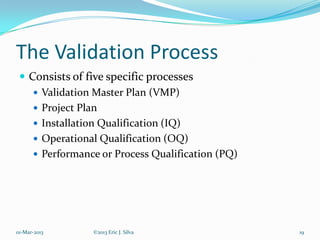
The Validation Process
  Consists of five specific processes
     Validation Master Plan (VMP)
     Project Plan
     Installation Qualification (IQ)
     Operational Qualification (OQ)
     Performance or Process Qualification (PQ)


01-Mar-2013     ©2013 Eric J. Silva               19
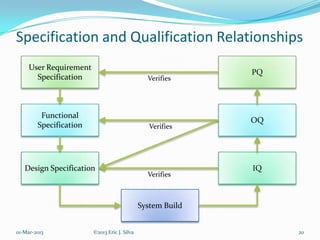
Specification and Qualification Relationships
     User Requirement
                                                             PQ
       Specification                            Verifies


         Functional
                                                             OQ
        Specification                            Verifies


   Design Specification                                      IQ
                                                Verifies


                                              System Build


01-Mar-2013             ©2013 Eric J. Silva                       20
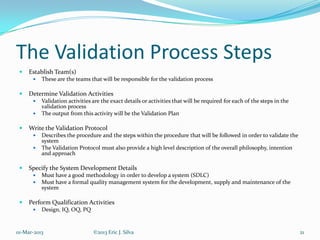
The Validation Process Steps
    Establish Team(s)
         These are the teams that will be responsible for the validation process

    Determine Validation Activities
         Validation activities are the exact details or activities that will be required for each of the steps in the
          validation process
         The output from this activity will be the Validation Plan

    Write the Validation Protocol
         Describes the procedure and the steps within the procedure that will be followed in order to validate the
          system
         The Validation Protocol must also provide a high level description of the overall philosophy, intention
          and approach

    Specify the System Development Details
         Must have a good methodology in order to develop a system (SDLC)
         Must have a formal quality management system for the development, supply and maintenance of the
          system

    Perform Qualification Activities
         Design, IQ, OQ, PQ


01-Mar-2013                     ©2013 Eric J. Silva                                                                      21
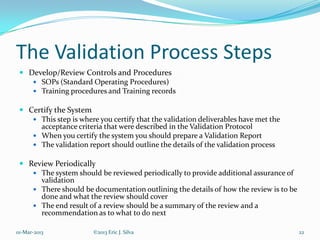
The Validation Process Steps
  Develop/Review Controls and Procedures
     SOPs (Standard Operating Procedures)
     Training procedures and Training records

  Certify the System
     This step is where you certify that the validation deliverables have met the
      acceptance criteria that were described in the Validation Protocol
     When you certify the system you should prepare a Validation Report
     The validation report should outline the details of the validation process

  Review Periodically
     The system should be reviewed periodically to provide additional assurance of
      validation
     There should be documentation outlining the details of how the review is to be
      done and what the review should cover
     The end result of a review should be a summary of the review and a
      recommendation as to what to do next

01-Mar-2013             ©2013 Eric J. Silva                                            22
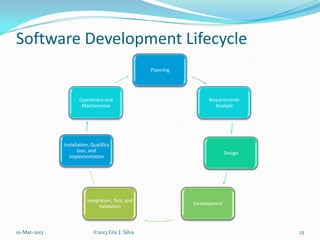
Software Development Lifecycle
                                                  Planning


                     Operations and                               Requirements
                      Maintenance                                   Analysis


              Installation, Qualifica
                     tion, and                                             Design
                 Implementation


                         Integration, Test, and
                                                             Development
                               Validation


01-Mar-2013                 ©2013 Eric J. Silva                                     23
Typical SDLC SOPs
Title                                                        Phase / Description
Computer System Lifecycle Policy                             Overview of SDLC Process
Computer System Planning                                     Planning
Computer System Requirements                                 Planning / Requirements Gathering
Computer System Assessments                                  Planning / Determining Validation Needs
Computer System Estimation                                   Planning / Time and Resource Estimation
Computer System Design and Configuration                     Design / Hardware and Software

Computer System Development                                  Build / Development, Review, and Configuration


Computer System Test Planning                                Testing / Planning, Strategy, Scripts, and Summary

Computer System Application Test Execution, Deviation, and
                                                             Testing / Test Execution and Deviations
Documentation Processes
Computer System Defect and Feature Management                Testing / Managing Defects
Computer System Release Management                           Release / Release and Archiving

Computer System Configuration Management                     Maintenance / Change Control and Maintenance


Computer System Decommissioning                              Decommissioning / Retirement of Computer System

Computer System Project Closure                              Closure / Post Release Analysis

Computer System Maintenance and Administration Activities    Maintenance / Admin and Maintenance

Computer System Change Control                               Maintenance / Change Control

 01-Mar-2013                           ©2013 Eric J. Silva                                                        24
Resources and References
  Computer System Validation (FDA)


  21 CFR Part 11


  FDA Guidance for Industry – Computer Systems Used
     in Clinical Trials

  Computer System Validation – It’s More Than Just
     Testing

01-Mar-2013        ©2013 Eric J. Silva                 25

Computer System Validation

  • 1.
  • 2.
    Agenda  Introduction  Target Audience  Background  Responsibilities & SOPs  The Validation Process  Software Development Lifecycle (SDLC)  Computer System Development SOPs 01-Mar-2013 ©2013 Eric J. Silva 2
  • 3.
    Introduction  Thepurpose of this presentation is to give the audience an overview of:  What is Computer System Validation (CSV)  Why is CSV needed  What processes are needed for CSV 01-Mar-2013 ©2013 Eric J. Silva 3
  • 4.
    Target Audience Developers of computer systems applications  Users of computer systems involved in testing and validation activities  Personnel involved in computer systems procurement  All concerned managers, auditors, and regulatory personnel  Personnel involved in the maintenance of computer systems 01-Mar-2013 ©2013 Eric J. Silva 4
  • 5.
    Background  In1987 the FDA published a document entitled ‘FDA Guidelines on General Principles of Process Validation’  It states the following:  Process validation is establishing documented evidence which provides a high degree of assurance that a specific process will consistently produce a product meeting its predetermined specifications and quality attributes. This definition indicates that validation can apply to any process including process managed / controlled by computer systems. 01-Mar-2013 ©2013 Eric J. Silva 5
  • 6.
    What is ComputerSystem Validation The purpose of the validation process is to provide a high degree of assurance that a specific process (or in this case computer system) will consistently produce a product (control information or data) which meets predetermined specifications and quality attributes. 01-Mar-2013 ©2013 Eric J. Silva 6
  • 7.
    Why is ValidationNeeded  FDA regulations mandate the need to perform Computer System Validation and these regulations have the impact of law.  Failing an FDA audit can result in FDA inspectional observations (“483s”) and warning letters.  Failure to take corrective action in a timely manner can result in shutting down manufacturing facilities, consent decrees, and stiff financial penalties.  The ultimate result could be loss of jobs, indictment of responsible parties (usually the officers of a company), and companies suffering economic instabilities resulting in downsizing and possibly eventual bankruptcy. As a contracted resource of software and services to pharmaceutical and other life sciences companies, we are responsible for ensuring that our software products are compliant with federal regulations. 01-Mar-2013 ©2013 Eric J. Silva 7
  • 8.
    Why is ValidationNeeded  Reduces risk and legal liability  Having the evidence that computer systems are correct for their purpose and operating properly represents a good business practice  Software is constantly evolving to keep up with the increasingly complex needs of the people that use it; therefore validation is an ongoing necessity 01-Mar-2013 ©2013 Eric J. Silva 8
  • 9.
    Validation  Validationis applied to many aspects of the healthcare and other regulated industries and businesses.  Examples include:  Services  Equipment  Computer Systems  Processes  In each case, the objective of validation is to produce documented evidence, which provides a high degree of assurance that all parts of the facility will consistently work correctly when brought into use.  Computer systems validation includes validation of both new and existing computer systems. Validation requires documented evidence. If the validation process is not documented then it cannot be proved to have occurred. 01-Mar-2013 ©2013 Eric J. Silva 9
  • 10.
    Responsibilities  Computersystem validation must be supported at different levels within the organization through policies, standards and documentation  Corporate/Business Unit  Site/Department Personnel  Quality Assurance and Regulatory Units  Corporate Management  IT Departments Smaller companies can be considered a single Corporate/ Business Unit, but can also have different policies based on Site [geographical] differences (e.g., USA, UK, India) 01-Mar-2013 ©2013 Eric J. Silva 10
  • 11.
    Responsibilities & SOPs  Each corporate [business] unit is responsible for establishing a policy on computer systems validation requirements.  Site or departments are responsible for:  Computer system validation Standard Operating Procedures (SOPs)  System inventory and assessment  System specific validation protocols  System specific validation documentation  SOPs must:  Comply with the Computer Systems Validation Policy and any Business Unit policies that may apply  Be approved by the appropriate management for that site or department 01-Mar-2013 ©2013 Eric J. Silva 11
  • 12.
    System and InventoryAssessment  Site or departmental management is responsible for compiling and maintaining details about their computer systems.  This information includes identifying the systems that are being used and for what purposes those systems are being used.  The system inventory and assessment information is used to determine which systems need to be validated. 01-Mar-2013 ©2013 Eric J. Silva 12
  • 13.
    System Specific ValidationProtocols  Validation protocols are documents associated with each system identified as requiring validation.  The protocol describes the scope, procedure to be followed, responsibilities and acceptance criteria for the validation.  Validation protocols should comply with the SOPs. 01-Mar-2013 ©2013 Eric J. Silva 13
  • 14.
    Validation Documentation Documentation that verifies each validation activity must be generated and stored with the validation protocol in the appropriate archive.  Validation documentation may include:  test data  summary reports  procedures  certification forms produced during the validation process 01-Mar-2013 ©2013 Eric J. Silva 14
  • 15.
    Pre-Validation Process Before you can validate a system, you need to identify the systems that require validation.  Determining if a system requires validation involves analysis of the following areas:  21 CFR Part 11 – electronic records and signatures  Manufacturing processes  Product [drug material] release or stability information  Regulatory information  Support GxP activities  All users must be trained on current SOPs related to computer system development and validation. 01-Mar-2013 ©2013 Eric J. Silva 15
  • 16.
    System Owners All hardware and system/application should have a designated owner.  Hardware Owner  Responsible for identifying all software residing on the hardware – both system and application software  Maintaining the inventory whenever changes are made  Managing the change control process for the system software and hardware  Working with the system/application owners to determine the impact of the change to the system/application  System/Application Owner  Defining the system (hardware and application)  Completing the system assessment  Ensuring that information pertaining to their specific system is correct and complete  Updating the system assessment whenever changes are made to the system  Managing the change control process for the system/application 01-Mar-2013 ©2013 Eric J. Silva 16
  • 17.
    Validation Master Plan  The validation of all computer systems will be documented in a Validation Master Plan (VMP)  The Validation Master Plan will include:  Identifying components requiring validation  Prioritizing and justifying the validations to be performed  All activities and assigned responsibilities  Establishing site specific procedures to support validation 01-Mar-2013 ©2013 Eric J. Silva 17
  • 18.
    Types of Validation  Prospective validation – the validation of a new system as it is developed  Retrospective validation – the validation of an existing system 01-Mar-2013 ©2013 Eric J. Silva 18
  • 19.
    The Validation Process  Consists of five specific processes  Validation Master Plan (VMP)  Project Plan  Installation Qualification (IQ)  Operational Qualification (OQ)  Performance or Process Qualification (PQ) 01-Mar-2013 ©2013 Eric J. Silva 19
  • 20.
    Specification and QualificationRelationships User Requirement PQ Specification Verifies Functional OQ Specification Verifies Design Specification IQ Verifies System Build 01-Mar-2013 ©2013 Eric J. Silva 20
  • 21.
    The Validation ProcessSteps  Establish Team(s)  These are the teams that will be responsible for the validation process  Determine Validation Activities  Validation activities are the exact details or activities that will be required for each of the steps in the validation process  The output from this activity will be the Validation Plan  Write the Validation Protocol  Describes the procedure and the steps within the procedure that will be followed in order to validate the system  The Validation Protocol must also provide a high level description of the overall philosophy, intention and approach  Specify the System Development Details  Must have a good methodology in order to develop a system (SDLC)  Must have a formal quality management system for the development, supply and maintenance of the system  Perform Qualification Activities  Design, IQ, OQ, PQ 01-Mar-2013 ©2013 Eric J. Silva 21
  • 22.
    The Validation ProcessSteps  Develop/Review Controls and Procedures  SOPs (Standard Operating Procedures)  Training procedures and Training records  Certify the System  This step is where you certify that the validation deliverables have met the acceptance criteria that were described in the Validation Protocol  When you certify the system you should prepare a Validation Report  The validation report should outline the details of the validation process  Review Periodically  The system should be reviewed periodically to provide additional assurance of validation  There should be documentation outlining the details of how the review is to be done and what the review should cover  The end result of a review should be a summary of the review and a recommendation as to what to do next 01-Mar-2013 ©2013 Eric J. Silva 22
  • 23.
    Software Development Lifecycle Planning Operations and Requirements Maintenance Analysis Installation, Qualifica tion, and Design Implementation Integration, Test, and Development Validation 01-Mar-2013 ©2013 Eric J. Silva 23
  • 24.
    Typical SDLC SOPs Title Phase / Description Computer System Lifecycle Policy Overview of SDLC Process Computer System Planning Planning Computer System Requirements Planning / Requirements Gathering Computer System Assessments Planning / Determining Validation Needs Computer System Estimation Planning / Time and Resource Estimation Computer System Design and Configuration Design / Hardware and Software Computer System Development Build / Development, Review, and Configuration Computer System Test Planning Testing / Planning, Strategy, Scripts, and Summary Computer System Application Test Execution, Deviation, and Testing / Test Execution and Deviations Documentation Processes Computer System Defect and Feature Management Testing / Managing Defects Computer System Release Management Release / Release and Archiving Computer System Configuration Management Maintenance / Change Control and Maintenance Computer System Decommissioning Decommissioning / Retirement of Computer System Computer System Project Closure Closure / Post Release Analysis Computer System Maintenance and Administration Activities Maintenance / Admin and Maintenance Computer System Change Control Maintenance / Change Control 01-Mar-2013 ©2013 Eric J. Silva 24
  • 25.
    Resources and References  Computer System Validation (FDA)  21 CFR Part 11  FDA Guidance for Industry – Computer Systems Used in Clinical Trials  Computer System Validation – It’s More Than Just Testing 01-Mar-2013 ©2013 Eric J. Silva 25