Presented By :
Mr. Sanket Rajiv Shinde
M. Pharmacy (QAT)
Savitribai Phule Pune University
2
Contents
Introduction
Objective
Method Development
Method Validation
Method Validation Parameters
References
 Bioanalytical Method relates specifically to determine
the concentration of drug or its metabolite or both in
biological matrix such as plasma, serum, urine , etc.
 Bioanalytical information used in human clinical
pharmacology, bioavailability (BA) and bioequivalence
(BE) studies requiring pharmacokinetic evaluation.
 Bioanalytical method is also used for non human
pharmacology/ toxicology studies (preclinical studies).
3
Introduction
4
 LC-MS/MS :
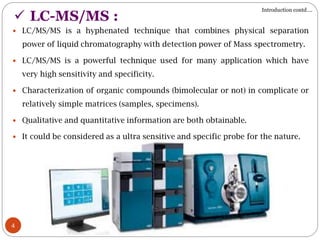
 LC/MS/MS is a hyphenated technique that combines physical separation
power of liquid chromatography with detection power of Mass spectrometry.
 LC/MS/MS is a powerful technique used for many application which have
very high sensitivity and specificity.
 Characterization of organic compounds (bimolecular or not) in complicate or
relatively simple matrices (samples, specimens).
 Qualitative and quantitative information are both obtainable.
 It could be considered as a ultra sensitive and specific probe for the nature.
Introduction contd….
5
 It can includes,
 A hyphened analytical system.
 LC separation + MS/MS identification.
 Suitable for wild range of compound-matrix combinations
analysis.
 Easy-to-use.
 General high sensitivity
 Liquid chromatography tandem mass spectrometry (LC–MS/MS),
has led to major breakthroughs in the field of quantitative
bioanalysis since the 1990s due to its inherent specificity,
sensitivity, and speed. It is now generally accepted as the preferred
technique for quantitating small molecule drugs, metabolites, and
other xenobiotic biomolecules in biological matrices (plasma,
blood, serum, urine, and tissue).
Introduction contd….
 To develop and validate highly specific, reliable and
cost effective LC-MS/MS method for determination of
drug in human plasma.
 The scope of developing and validating the
bioanalytical method is to get a suitable method which
is more accurate and precise for the analyte of interest
under given set of lab condition by using resources
available.
6
Objective
7
 Literature search for drugs
 Identification of analytical techniques and
optimization
 Reference Standard preparation
 Selection of Internal Standard
 Sample pre-treatment (Extraction
Procedure)
 Sample storage
Method Development
 Steps involved in method development:
8
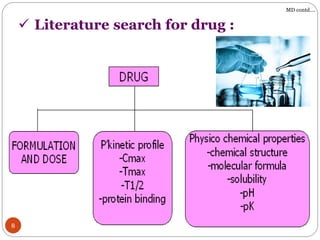
 Literature search for drug :
MD contd….
 Mode of separation
 Selection of column
 Selection of mobile phase
 Role of pH, Buffer
 Role of Temperature
 Role of flow rate
9
 Identification of analytical techniques
and optimization molecule:
MD contd….
10
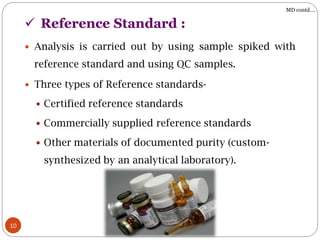
 Analysis is carried out by using sample spiked with
reference standard and using QC samples.
 Three types of Reference standards-
 Certified reference standards
 Commercially supplied reference standards
 Other materials of documented purity (custom-
synthesized by an analytical laboratory).
 Reference Standard :
MD contd….
11
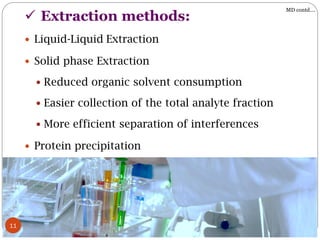
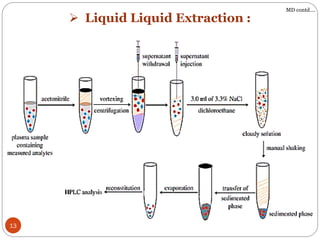
 Liquid-Liquid Extraction
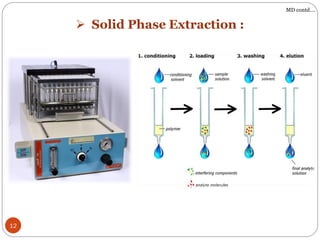
 Solid phase Extraction
 Reduced organic solvent consumption
 Easier collection of the total analyte fraction
 More efficient separation of interferences
 Protein precipitation
 Extraction methods:
MD contd….
12
 Solid Phase Extraction :
MD contd….
13
 Liquid Liquid Extraction :
MD contd….
14
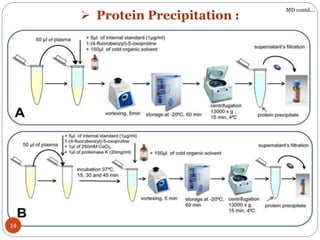
 Protein Precipitation :
MD contd….
15
Method Validation
 Validation is the process of determining the suitability of a
given methodology for providing useful analytical data.
 Validation is required for any new method to ensure that it
is capable to give reproducible and reliable results, when
used by different operators employing the same equipment
in the same or different laboratories.
 What is Validation and why should it be
done ?
16
 Bioanalytical method validation include all the procedure
that demonstrate that a particular method used for
quantitative measurement of analyte in given biological
matrix are reliable and reproducible for intended use.
Bioanalytical Method
Validation
 Need of Bioanalytical Method
Validation :
17
 It is essential to used well-characterized and fully validated Bioanalytical
methods to yield reliable results that can be satisfactorily interpreted.
 It is recognized that Bioanalytical methods and techniques are constantly
undergoing changes and improvements; they are at the cutting edge of the
technology.
 It is also important to emphasize that each Bioanalytical technique has its own
characteristics, which will vary from analyte to analyte, specific validation criteria
may need to be developed for each analyte .
 Moreover, the appropriateness of the technique may also be influenced by the
ultimate objective of the study. When sample analysis for a given study is
conducted at more than one site, it is necessary to validate the Bioanalytical
method(s) at each site and provide appropriate validation information for
different sites to establish inter-laboratory reliability.
MV contd….
18
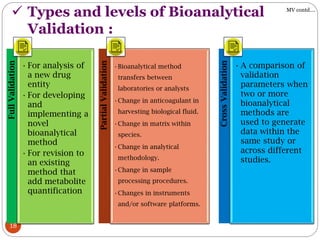
FullValidation
•For analysis of
a new drug
entity
•For developing
and
implementing a
novel
bioanalytical
method
•For revision to
an existing
method that
add metabolite
quantification
PartialValidation
•Bioanalytical method
transfers between
laboratories or analysts
•Change in anticoagulant in
harvesting biological fluid.
•Change in matrix within
species.
•Change in analytical
methodology.
•Change in sample
processing procedures.
•Changes in instruments
and/or software platforms.
CrossValidation
•A comparison of
validation
parameters when
two or more
bioanalytical
methods are
used to generate
data within the
same study or
across different
studies.
 Types and levels of Bioanalytical
Validation :
MV contd….
19
 System Suitability
 Selectivity & Specificity
 Sensitivity
 Calibration Curve
 Precision & Accuracy
 Haemolysed Effect
 Lipemic Effect
 Matrix Factor
 Recovery
 Ruggedness
 Stability
Bioanalytical Method
Validation Parameters :
MV contd….
 System suitability :
20
 System suitability experiment is performed to evaluate
suitability of instrument in terms of consistency in response,
sensitivity of instrument and autosampler carryover.
 Ability of an analytical method to differentiate and quantify
the analyte in the presence of other components in the
sample.
 Selectivity is evaluated by injecting extracted blank plasma
and comparing with the response of extracted LLOQ
samples processed with internal standard.
 Selectivity & Specificity :
MV contd….
21
 The Lower Limit of Quantification (LLOQ) is the lowest
concentration of an analyte in a sample which can be quantified
reliably, with an acceptable accuracy and precision.
 Sensitivity :
 A Calibration Curve (standard curve) is the relationship between
the response of the instrument and known concentrations of the
analyte(s).
 A Calibration Curve should be prepared for each analyte(s) in the
sample, to be analyzed.
 A sufficient number of concentration levels should be used to
adequately define the relationship between concentration and the
analyte response.
 Calibration curve :
MV contd….
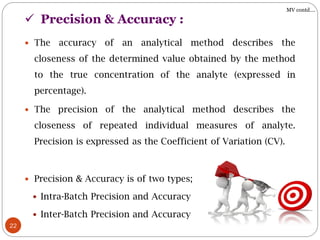
 Precision & Accuracy :
22
 The accuracy of an analytical method describes the
closeness of the determined value obtained by the method
to the true concentration of the analyte (expressed in
percentage).
 The precision of the analytical method describes the
closeness of repeated individual measures of analyte.
Precision is expressed as the Coefficient of Variation (CV).
 Precision & Accuracy is of two types;
 Intra-Batch Precision and Accuracy
 Inter-Batch Precision and Accuracy
MV contd….
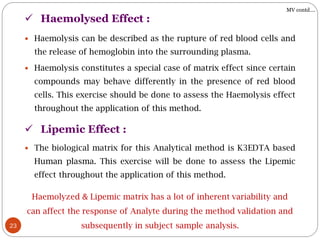
 Haemolysed Effect :
23
 Haemolysis can be described as the rupture of red blood cells and
the release of hemoglobin into the surrounding plasma.
 Haemolysis constitutes a special case of matrix effect since certain
compounds may behave differently in the presence of red blood
cells. This exercise should be done to assess the Haemolysis effect
throughout the application of this method.
 The biological matrix for this Analytical method is K3EDTA based
Human plasma. This exercise will be done to assess the Lipemic
effect throughout the application of this method.
 Lipemic Effect :
Haemolyzed & Lipemic matrix has a lot of inherent variability and
can affect the response of Analyte during the method validation and
subsequently in subject sample analysis.
MV contd….
24
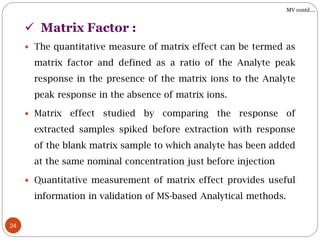
 The quantitative measure of matrix effect can be termed as
matrix factor and defined as a ratio of the Analyte peak
response in the presence of the matrix ions to the Analyte
peak response in the absence of matrix ions.
 Matrix effect studied by comparing the response of
extracted samples spiked before extraction with response
of the blank matrix sample to which analyte has been added
at the same nominal concentration just before injection
 Quantitative measurement of matrix effect provides useful
information in validation of MS-based Analytical methods.
 Matrix Factor :
MV contd….
25
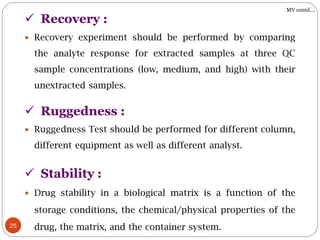
 Recovery experiment should be performed by comparing
the analyte response for extracted samples at three QC
sample concentrations (low, medium, and high) with their
unextracted samples.
 Recovery :
MV contd….
 Drug stability in a biological matrix is a function of the
storage conditions, the chemical/physical properties of the
drug, the matrix, and the container system.
 Stability :
 Ruggedness :
 Ruggedness Test should be performed for different column,
different equipment as well as different analyst.
26
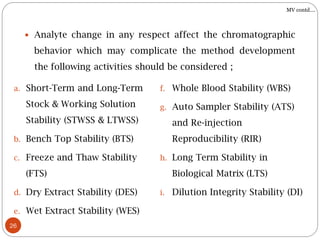
 Analyte change in any respect affect the chromatographic
behavior which may complicate the method development
the following activities should be considered ;
a. Short-Term and Long-Term
Stock & Working Solution
Stability (STWSS & LTWSS)
b. Bench Top Stability (BTS)
c. Freeze and Thaw Stability
(FTS)
d. Dry Extract Stability (DES)
e. Wet Extract Stability (WES)
f. Whole Blood Stability (WBS)
g. Auto Sampler Stability (ATS)
and Re-injection
Reproducibility (RIR)
h. Long Term Stability in
Biological Matrix (LTS)
i. Dilution Integrity Stability (DI)
MV contd….
27
1. Food and Drug Administration, FDA, Guidance for Industry: Bioanalytical Method
Validation, Rockville, MD: US Department of Health and Human Services, Food and Drug
Administration, Center for Drug Evaluation and Research, 2013.
2. US FDA Bioanalytical Method Validation Guidance for Industry (May 2018).
3. ICH, Validation of analytical procedure, International conference on Harmonization, IFPMA,
Q2B Validation of Analytical Procedures: Methodology
4. Peters F.T., Review: Bioanalytical method validation – How, how much and why, Department
of Experimental and Clinical Toxicology, Institute of Experimental and Clinical Pharmacology
and Toxicology, University of Saarland.
5. Pranay W, Bioanalytical Method Development –Determination of Drugs in Biological Fluids
2010.
6. Skoog DA, West DM, Holler FJ, Crouch SR. Fundamentals of Analytical chemistry. 18th ed.
Thomson Asia Pvt. Ltd., Chapter 1. The nature of analytical chemistry. 2004; 2-5 & 973-996.
7. Chatwal R. G., Anand K. S. Instrumental method of chemical analysis, Himalaya Publishing
House , Mumbai, 2007, 3rd edition, pp. 2.566 – 2.587, 2.624 – 2.639, 2.272- 2.302.
References
28

Bioanalytical Method Validation

  • 1.
    Presented By : Mr.Sanket Rajiv Shinde M. Pharmacy (QAT) Savitribai Phule Pune University
  • 2.
  • 3.
     Bioanalytical Methodrelates specifically to determine the concentration of drug or its metabolite or both in biological matrix such as plasma, serum, urine , etc.  Bioanalytical information used in human clinical pharmacology, bioavailability (BA) and bioequivalence (BE) studies requiring pharmacokinetic evaluation.  Bioanalytical method is also used for non human pharmacology/ toxicology studies (preclinical studies). 3 Introduction
  • 4.
    4  LC-MS/MS : LC/MS/MS is a hyphenated technique that combines physical separation power of liquid chromatography with detection power of Mass spectrometry.  LC/MS/MS is a powerful technique used for many application which have very high sensitivity and specificity.  Characterization of organic compounds (bimolecular or not) in complicate or relatively simple matrices (samples, specimens).  Qualitative and quantitative information are both obtainable.  It could be considered as a ultra sensitive and specific probe for the nature. Introduction contd….
  • 5.
    5  It canincludes,  A hyphened analytical system.  LC separation + MS/MS identification.  Suitable for wild range of compound-matrix combinations analysis.  Easy-to-use.  General high sensitivity  Liquid chromatography tandem mass spectrometry (LC–MS/MS), has led to major breakthroughs in the field of quantitative bioanalysis since the 1990s due to its inherent specificity, sensitivity, and speed. It is now generally accepted as the preferred technique for quantitating small molecule drugs, metabolites, and other xenobiotic biomolecules in biological matrices (plasma, blood, serum, urine, and tissue). Introduction contd….
  • 6.
     To developand validate highly specific, reliable and cost effective LC-MS/MS method for determination of drug in human plasma.  The scope of developing and validating the bioanalytical method is to get a suitable method which is more accurate and precise for the analyte of interest under given set of lab condition by using resources available. 6 Objective
  • 7.
    7  Literature searchfor drugs  Identification of analytical techniques and optimization  Reference Standard preparation  Selection of Internal Standard  Sample pre-treatment (Extraction Procedure)  Sample storage Method Development  Steps involved in method development:
  • 8.
    8  Literature searchfor drug : MD contd….
  • 9.
     Mode ofseparation  Selection of column  Selection of mobile phase  Role of pH, Buffer  Role of Temperature  Role of flow rate 9  Identification of analytical techniques and optimization molecule: MD contd….
  • 10.
    10  Analysis iscarried out by using sample spiked with reference standard and using QC samples.  Three types of Reference standards-  Certified reference standards  Commercially supplied reference standards  Other materials of documented purity (custom- synthesized by an analytical laboratory).  Reference Standard : MD contd….
  • 11.
    11  Liquid-Liquid Extraction Solid phase Extraction  Reduced organic solvent consumption  Easier collection of the total analyte fraction  More efficient separation of interferences  Protein precipitation  Extraction methods: MD contd….
  • 12.
    12  Solid PhaseExtraction : MD contd….
  • 13.
    13  Liquid LiquidExtraction : MD contd….
  • 14.
  • 15.
    15 Method Validation  Validationis the process of determining the suitability of a given methodology for providing useful analytical data.  Validation is required for any new method to ensure that it is capable to give reproducible and reliable results, when used by different operators employing the same equipment in the same or different laboratories.  What is Validation and why should it be done ?
  • 16.
    16  Bioanalytical methodvalidation include all the procedure that demonstrate that a particular method used for quantitative measurement of analyte in given biological matrix are reliable and reproducible for intended use. Bioanalytical Method Validation
  • 17.
     Need ofBioanalytical Method Validation : 17  It is essential to used well-characterized and fully validated Bioanalytical methods to yield reliable results that can be satisfactorily interpreted.  It is recognized that Bioanalytical methods and techniques are constantly undergoing changes and improvements; they are at the cutting edge of the technology.  It is also important to emphasize that each Bioanalytical technique has its own characteristics, which will vary from analyte to analyte, specific validation criteria may need to be developed for each analyte .  Moreover, the appropriateness of the technique may also be influenced by the ultimate objective of the study. When sample analysis for a given study is conducted at more than one site, it is necessary to validate the Bioanalytical method(s) at each site and provide appropriate validation information for different sites to establish inter-laboratory reliability. MV contd….
  • 18.
    18 FullValidation •For analysis of anew drug entity •For developing and implementing a novel bioanalytical method •For revision to an existing method that add metabolite quantification PartialValidation •Bioanalytical method transfers between laboratories or analysts •Change in anticoagulant in harvesting biological fluid. •Change in matrix within species. •Change in analytical methodology. •Change in sample processing procedures. •Changes in instruments and/or software platforms. CrossValidation •A comparison of validation parameters when two or more bioanalytical methods are used to generate data within the same study or across different studies.  Types and levels of Bioanalytical Validation : MV contd….
  • 19.
    19  System Suitability Selectivity & Specificity  Sensitivity  Calibration Curve  Precision & Accuracy  Haemolysed Effect  Lipemic Effect  Matrix Factor  Recovery  Ruggedness  Stability Bioanalytical Method Validation Parameters : MV contd….
  • 20.
     System suitability: 20  System suitability experiment is performed to evaluate suitability of instrument in terms of consistency in response, sensitivity of instrument and autosampler carryover.  Ability of an analytical method to differentiate and quantify the analyte in the presence of other components in the sample.  Selectivity is evaluated by injecting extracted blank plasma and comparing with the response of extracted LLOQ samples processed with internal standard.  Selectivity & Specificity : MV contd….
  • 21.
    21  The LowerLimit of Quantification (LLOQ) is the lowest concentration of an analyte in a sample which can be quantified reliably, with an acceptable accuracy and precision.  Sensitivity :  A Calibration Curve (standard curve) is the relationship between the response of the instrument and known concentrations of the analyte(s).  A Calibration Curve should be prepared for each analyte(s) in the sample, to be analyzed.  A sufficient number of concentration levels should be used to adequately define the relationship between concentration and the analyte response.  Calibration curve : MV contd….
  • 22.
     Precision &Accuracy : 22  The accuracy of an analytical method describes the closeness of the determined value obtained by the method to the true concentration of the analyte (expressed in percentage).  The precision of the analytical method describes the closeness of repeated individual measures of analyte. Precision is expressed as the Coefficient of Variation (CV).  Precision & Accuracy is of two types;  Intra-Batch Precision and Accuracy  Inter-Batch Precision and Accuracy MV contd….
  • 23.
     Haemolysed Effect: 23  Haemolysis can be described as the rupture of red blood cells and the release of hemoglobin into the surrounding plasma.  Haemolysis constitutes a special case of matrix effect since certain compounds may behave differently in the presence of red blood cells. This exercise should be done to assess the Haemolysis effect throughout the application of this method.  The biological matrix for this Analytical method is K3EDTA based Human plasma. This exercise will be done to assess the Lipemic effect throughout the application of this method.  Lipemic Effect : Haemolyzed & Lipemic matrix has a lot of inherent variability and can affect the response of Analyte during the method validation and subsequently in subject sample analysis. MV contd….
  • 24.
    24  The quantitativemeasure of matrix effect can be termed as matrix factor and defined as a ratio of the Analyte peak response in the presence of the matrix ions to the Analyte peak response in the absence of matrix ions.  Matrix effect studied by comparing the response of extracted samples spiked before extraction with response of the blank matrix sample to which analyte has been added at the same nominal concentration just before injection  Quantitative measurement of matrix effect provides useful information in validation of MS-based Analytical methods.  Matrix Factor : MV contd….
  • 25.
    25  Recovery experimentshould be performed by comparing the analyte response for extracted samples at three QC sample concentrations (low, medium, and high) with their unextracted samples.  Recovery : MV contd….  Drug stability in a biological matrix is a function of the storage conditions, the chemical/physical properties of the drug, the matrix, and the container system.  Stability :  Ruggedness :  Ruggedness Test should be performed for different column, different equipment as well as different analyst.
  • 26.
    26  Analyte changein any respect affect the chromatographic behavior which may complicate the method development the following activities should be considered ; a. Short-Term and Long-Term Stock & Working Solution Stability (STWSS & LTWSS) b. Bench Top Stability (BTS) c. Freeze and Thaw Stability (FTS) d. Dry Extract Stability (DES) e. Wet Extract Stability (WES) f. Whole Blood Stability (WBS) g. Auto Sampler Stability (ATS) and Re-injection Reproducibility (RIR) h. Long Term Stability in Biological Matrix (LTS) i. Dilution Integrity Stability (DI) MV contd….
  • 27.
    27 1. Food andDrug Administration, FDA, Guidance for Industry: Bioanalytical Method Validation, Rockville, MD: US Department of Health and Human Services, Food and Drug Administration, Center for Drug Evaluation and Research, 2013. 2. US FDA Bioanalytical Method Validation Guidance for Industry (May 2018). 3. ICH, Validation of analytical procedure, International conference on Harmonization, IFPMA, Q2B Validation of Analytical Procedures: Methodology 4. Peters F.T., Review: Bioanalytical method validation – How, how much and why, Department of Experimental and Clinical Toxicology, Institute of Experimental and Clinical Pharmacology and Toxicology, University of Saarland. 5. Pranay W, Bioanalytical Method Development –Determination of Drugs in Biological Fluids 2010. 6. Skoog DA, West DM, Holler FJ, Crouch SR. Fundamentals of Analytical chemistry. 18th ed. Thomson Asia Pvt. Ltd., Chapter 1. The nature of analytical chemistry. 2004; 2-5 & 973-996. 7. Chatwal R. G., Anand K. S. Instrumental method of chemical analysis, Himalaya Publishing House , Mumbai, 2007, 3rd edition, pp. 2.566 – 2.587, 2.624 – 2.639, 2.272- 2.302. References
  • 28.