Bioanalytical Method Development
Mr. Sagar Kishor savale
[Department of Pharmacy (Pharmaceutics)]
avengersagar16@gmail.com
24-12-2015 1
Department of Pharmacy (Pharmaceutics) | Sagar savale
Bioanalytical Method Development
• The quantitative determination of drug and there metabolite in biological material in order to established in
Pharmacokinetic and toxicokinetic studies is known as Bioanalytical method development.
• It can includes in number of steps - Collection, Storage, Sample Preparation, Separation, Identification and
quantification of analyte.
• It is important method for identification of analyte, removal of analyte, concentration of analyte, preconcentration
of analyte, dissolution of analyte, quantification analyte.
• It is important for new drug discovery, new drug development, preformulation studies, formulation studies,
validation of product, analysis of compound, method development studies and Bioanalytical research purpose.
• It can includes three types of techniques
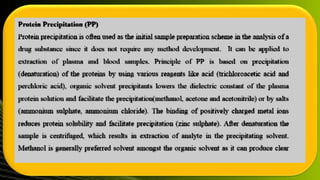
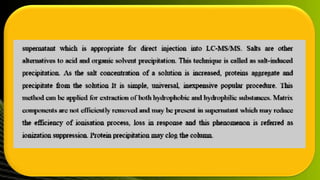
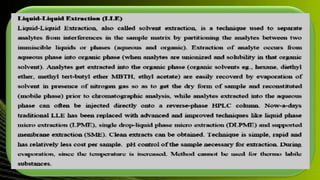
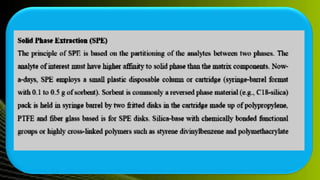
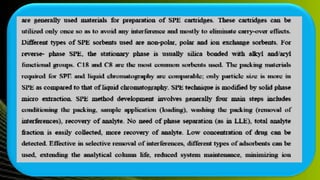
1. Protein precipitation
2. Solid phase extraction
3. Liquid – liquid extraction
24-12-2015 2
Bioanalytical Method relates specifically to determine the concentration of drug or its metabolite or both in
biological matrix such as plasma, serum, urine , etc
Bioanalytical information used in human clinical pharmacology, bioavailability (BA) and bioequivalence (BE)
studies requiring pharmacokinetic evaluation
Bioanalytical method is also used for non human pharmacology/ toxicology studies (preclinical studies)
24-12-2015 3
Why Validate Bioanalytical Methods?
The reason for validating a Bioanalytical procedure is to demonstrate the performance and reliability of a method and
hence the confidence that can be placed on the results. In addition, has stated that all Bioanalytical methods must be
validated if the results are used to support registration of a new drug or the reformulation of an existing one. It should
be noted that the initial validation is only a beginning, as a method should be monitored continually during its
application to ensure that it performs as originally validated. Validation involves documenting, through the use of
specific laboratory investigations, that the performance characteristics of the method are suitable and reliable for the
intended analytical applications.
Need of Bioanalytical Method Validation
 It is essential to used well-characterized and fully validated Bioanalytical methods to yield reliable results that can be
satisfactorily interpreted.
It is recognized that Bioanalytical methods and techniques are constantly undergoing changes and improvements; they are at the
cutting edge of the technology.
It is also important to emphasize that each Bioanalytical technique has its own characteristics, which will vary from analyte to
analyte, specific validation criteria may need to be developed for each analyte .
Moreover, the appropriateness of the technique may also be influenced by the ultimate objective of the study. When sample
analysis for a given study is conducted at more than one site, it is necessary to validate the Bioanalytical method(s) at each site
and provide appropriate validation information for different sites to establish inter-laboratory reliability.
24-12-2015 4
24-12-2015 5
24-12-2015 6
24-12-2015 7
24-12-2015 8
24-12-2015 9
24-12-2015 10
LC-MS/MS
LC/MS/MS is a hyphenated technique that combines physical separation power of liquid chromatography with
detection power of Mass spectrometry.
LC/MS/MS is a powerful technique used for many application which have very high sensitivity and specificity
Characterization of organic compounds (bimolecular or not) in complicate or relatively simple matrices (samples,
specimens).
Qualitative and quantitative information are both obtainable.
It could be considered as a ultra sensitive and specific probe for the nature.
It can includes,
1. A hyphened analytical system.
2. LC separation + MS/MS identification.
3. Suitable for wild range of compound-matrix combinations analysis.
4. Easy-to-use.
5. General high sensitivity.
24-12-2015 11
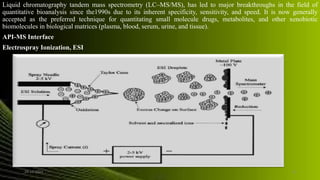
Liquid chromatography tandem mass spectrometry (LC–MS/MS), has led to major breakthroughs in the field of
quantitative bioanalysis since the1990s due to its inherent specificity, sensitivity, and speed. It is now generally
accepted as the preferred technique for quantitating small molecule drugs, metabolites, and other xenobiotic
biomolecules in biological matrices (plasma, blood, serum, urine, and tissue).
API-MS Interface
Electrospray Ionization, ESI
24-12-2015 12
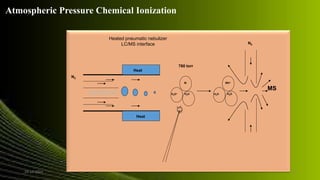
Atmospheric Pressure Chemical Ionization
24-12-2015 13
H3O+ H2O
M
H2O H2O
MH+
MS
Heat
Heat
760 torr
N2
N2
Heated pneumatic nebulizer
LC/MS interface
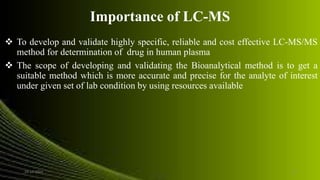
Importance of LC-MS
 To develop and validate highly specific, reliable and cost effective LC-MS/MS
method for determination of drug in human plasma
 The scope of developing and validating the Bioanalytical method is to get a
suitable method which is more accurate and precise for the analyte of interest
under given set of lab condition by using resources available
24-12-2015 14
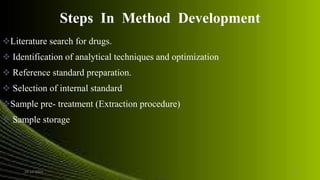
Steps In Method Development
Literature search for drugs.
 Identification of analytical techniques and optimization
 Reference standard preparation.
 Selection of internal standard
Sample pre- treatment (Extraction procedure)
 Sample storage
24-12-2015 15
Identification of analytical techniques and optimization
• Mode of separation
• Selection of column
• Selection of mobile phase
• Role of pH, Buffer
• Role of Temperature
• Role of flow rate
24-12-2015 16
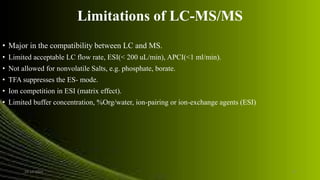
Limitations of LC-MS/MS
• Major in the compatibility between LC and MS.
• Limited acceptable LC flow rate, ESI(< 200 uL/min), APCI(<1 ml/min).
• Not allowed for nonvolatile Salts, e.g. phosphate, borate.
• TFA suppresses the ES- mode.
• Ion competition in ESI (matrix effect).
• Limited buffer concentration, %Org/water, ion-pairing or ion-exchange agents (ESI)
24-12-2015 17
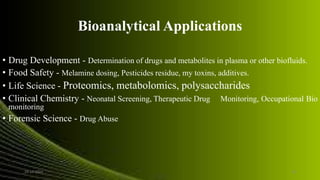
Bioanalytical Applications
• Drug Development - Determination of drugs and metabolites in plasma or other biofluids.
• Food Safety - Melamine dosing, Pesticides residue, my toxins, additives.
• Life Science - Proteomics, metabolomics, polysaccharides
• Clinical Chemistry - Neonatal Screening, Therapeutic Drug Monitoring, Occupational Bio
monitoring
• Forensic Science - Drug Abuse
24-12-2015 18
Reference
 U.S. Department of Health and Human Services Food and Drug Administration Center for Drug Evaluation and Research (CDER) Center for Veterinary Medicine (CVM) (2001) Guidance for
Industry, Bioanalytical Method Validation.
 Burhenne J (2012) Bioanalytical Method Validation. J of Anal and Bioanal Tech 3: 7.
 Ludwig H (2010) Validation of Analytical Methods. Agilent Tech 1-65.
 Kollipara S, Bende G, Agarwal N, Varshney B, Paliwal J (2011) Internatioanl guidelines for Bioanalytical method Validation: A Comparison and Discussion on Current Scenario.
Chromatographia 73: 201-217.
 Gao L1, Li J, Kasserra C, Song Q, Arjomand A, et al. (2011) Precision and accuracy in the quantitative analysis of biological samples by accelerator mass spectrometry: application in
microdose absolute bioavailability studies. Anal Chem 83: 5607-5616.
 Bansal S1, DeStefano A (2007) Key elements of bioanalytical method validation for small molecules. AAPS J 9: E109-114.
 Lang JR, Bolton S (1991) A comprehensive method validation strategy for bioanalytical applications in the pharmaceutical industry - 1. Experimental considerations. J Pharm Biomed Anal 9:
357-361.
 Blume H1, Brendel E, Brudny-Klöppel M, Grebe S, Lausecker B, et al. (2011) Workshop/conference report on EMA draft guideline on validation of bioanalytical methods. Eur J Pharm Sci 42:
300-305.
 Food and Drug Administration, FDA, Guidance for Industry: Bioanalytical Method Validation, Rockville, MD: US Department of Health and Human Services, Food and Drug Administration,
Center for Drug Evaluation and Research, 2013.
 Peters F.T., Review: Bioanalytical method validation – How, how much and why, Department of Experimental and Clinical Toxicology, Institute of Experimental and Clinical Pharmacology
and Toxicology, University of Saarland.
 Pranay W, Bioanalytical Method Development –Determination of Drugs in Biological Fluids 2010.
 Skoog DA, West DM, Holler FJ, Crouch SR. Fundamentals of Analytical chemistry. 18th ed. Thomson Asia pvt Ltd. Chapter 1. The nature of analytical chemistry. 2004; 2-5 & 973-996.
 Chatwal R. G., Anand K. S. Instrumental method of chemical analysis, Himalaya Publishing House , Mumbai, 2007, 3rd edition, pp. 2.566 – 2.587, 2.624 – 2.639, 2.272- 2.302.
 ICH, Validation of analytical procedure, International conference on Harmonization, IFPMA, Q2B Validation of Analytical Procedures: Methodology
24-12-2015 19
24-12-2015 20

Bioanlytical method development

  • 1.
    Bioanalytical Method Development Mr.Sagar Kishor savale [Department of Pharmacy (Pharmaceutics)] avengersagar16@gmail.com 24-12-2015 1 Department of Pharmacy (Pharmaceutics) | Sagar savale
  • 2.
    Bioanalytical Method Development •The quantitative determination of drug and there metabolite in biological material in order to established in Pharmacokinetic and toxicokinetic studies is known as Bioanalytical method development. • It can includes in number of steps - Collection, Storage, Sample Preparation, Separation, Identification and quantification of analyte. • It is important method for identification of analyte, removal of analyte, concentration of analyte, preconcentration of analyte, dissolution of analyte, quantification analyte. • It is important for new drug discovery, new drug development, preformulation studies, formulation studies, validation of product, analysis of compound, method development studies and Bioanalytical research purpose. • It can includes three types of techniques 1. Protein precipitation 2. Solid phase extraction 3. Liquid – liquid extraction 24-12-2015 2
  • 3.
    Bioanalytical Method relatesspecifically to determine the concentration of drug or its metabolite or both in biological matrix such as plasma, serum, urine , etc Bioanalytical information used in human clinical pharmacology, bioavailability (BA) and bioequivalence (BE) studies requiring pharmacokinetic evaluation Bioanalytical method is also used for non human pharmacology/ toxicology studies (preclinical studies) 24-12-2015 3 Why Validate Bioanalytical Methods? The reason for validating a Bioanalytical procedure is to demonstrate the performance and reliability of a method and hence the confidence that can be placed on the results. In addition, has stated that all Bioanalytical methods must be validated if the results are used to support registration of a new drug or the reformulation of an existing one. It should be noted that the initial validation is only a beginning, as a method should be monitored continually during its application to ensure that it performs as originally validated. Validation involves documenting, through the use of specific laboratory investigations, that the performance characteristics of the method are suitable and reliable for the intended analytical applications.
  • 4.
    Need of BioanalyticalMethod Validation  It is essential to used well-characterized and fully validated Bioanalytical methods to yield reliable results that can be satisfactorily interpreted. It is recognized that Bioanalytical methods and techniques are constantly undergoing changes and improvements; they are at the cutting edge of the technology. It is also important to emphasize that each Bioanalytical technique has its own characteristics, which will vary from analyte to analyte, specific validation criteria may need to be developed for each analyte . Moreover, the appropriateness of the technique may also be influenced by the ultimate objective of the study. When sample analysis for a given study is conducted at more than one site, it is necessary to validate the Bioanalytical method(s) at each site and provide appropriate validation information for different sites to establish inter-laboratory reliability. 24-12-2015 4
  • 5.
  • 6.
  • 7.
  • 8.
  • 9.
  • 10.
  • 11.
    LC-MS/MS LC/MS/MS is ahyphenated technique that combines physical separation power of liquid chromatography with detection power of Mass spectrometry. LC/MS/MS is a powerful technique used for many application which have very high sensitivity and specificity Characterization of organic compounds (bimolecular or not) in complicate or relatively simple matrices (samples, specimens). Qualitative and quantitative information are both obtainable. It could be considered as a ultra sensitive and specific probe for the nature. It can includes, 1. A hyphened analytical system. 2. LC separation + MS/MS identification. 3. Suitable for wild range of compound-matrix combinations analysis. 4. Easy-to-use. 5. General high sensitivity. 24-12-2015 11
  • 12.
    Liquid chromatography tandemmass spectrometry (LC–MS/MS), has led to major breakthroughs in the field of quantitative bioanalysis since the1990s due to its inherent specificity, sensitivity, and speed. It is now generally accepted as the preferred technique for quantitating small molecule drugs, metabolites, and other xenobiotic biomolecules in biological matrices (plasma, blood, serum, urine, and tissue). API-MS Interface Electrospray Ionization, ESI 24-12-2015 12
  • 13.
    Atmospheric Pressure ChemicalIonization 24-12-2015 13 H3O+ H2O M H2O H2O MH+ MS Heat Heat 760 torr N2 N2 Heated pneumatic nebulizer LC/MS interface
  • 14.
    Importance of LC-MS To develop and validate highly specific, reliable and cost effective LC-MS/MS method for determination of drug in human plasma  The scope of developing and validating the Bioanalytical method is to get a suitable method which is more accurate and precise for the analyte of interest under given set of lab condition by using resources available 24-12-2015 14
  • 15.
    Steps In MethodDevelopment Literature search for drugs.  Identification of analytical techniques and optimization  Reference standard preparation.  Selection of internal standard Sample pre- treatment (Extraction procedure)  Sample storage 24-12-2015 15
  • 16.
    Identification of analyticaltechniques and optimization • Mode of separation • Selection of column • Selection of mobile phase • Role of pH, Buffer • Role of Temperature • Role of flow rate 24-12-2015 16
  • 17.
    Limitations of LC-MS/MS •Major in the compatibility between LC and MS. • Limited acceptable LC flow rate, ESI(< 200 uL/min), APCI(<1 ml/min). • Not allowed for nonvolatile Salts, e.g. phosphate, borate. • TFA suppresses the ES- mode. • Ion competition in ESI (matrix effect). • Limited buffer concentration, %Org/water, ion-pairing or ion-exchange agents (ESI) 24-12-2015 17
  • 18.
    Bioanalytical Applications • DrugDevelopment - Determination of drugs and metabolites in plasma or other biofluids. • Food Safety - Melamine dosing, Pesticides residue, my toxins, additives. • Life Science - Proteomics, metabolomics, polysaccharides • Clinical Chemistry - Neonatal Screening, Therapeutic Drug Monitoring, Occupational Bio monitoring • Forensic Science - Drug Abuse 24-12-2015 18
  • 19.
    Reference  U.S. Departmentof Health and Human Services Food and Drug Administration Center for Drug Evaluation and Research (CDER) Center for Veterinary Medicine (CVM) (2001) Guidance for Industry, Bioanalytical Method Validation.  Burhenne J (2012) Bioanalytical Method Validation. J of Anal and Bioanal Tech 3: 7.  Ludwig H (2010) Validation of Analytical Methods. Agilent Tech 1-65.  Kollipara S, Bende G, Agarwal N, Varshney B, Paliwal J (2011) Internatioanl guidelines for Bioanalytical method Validation: A Comparison and Discussion on Current Scenario. Chromatographia 73: 201-217.  Gao L1, Li J, Kasserra C, Song Q, Arjomand A, et al. (2011) Precision and accuracy in the quantitative analysis of biological samples by accelerator mass spectrometry: application in microdose absolute bioavailability studies. Anal Chem 83: 5607-5616.  Bansal S1, DeStefano A (2007) Key elements of bioanalytical method validation for small molecules. AAPS J 9: E109-114.  Lang JR, Bolton S (1991) A comprehensive method validation strategy for bioanalytical applications in the pharmaceutical industry - 1. Experimental considerations. J Pharm Biomed Anal 9: 357-361.  Blume H1, Brendel E, Brudny-Klöppel M, Grebe S, Lausecker B, et al. (2011) Workshop/conference report on EMA draft guideline on validation of bioanalytical methods. Eur J Pharm Sci 42: 300-305.  Food and Drug Administration, FDA, Guidance for Industry: Bioanalytical Method Validation, Rockville, MD: US Department of Health and Human Services, Food and Drug Administration, Center for Drug Evaluation and Research, 2013.  Peters F.T., Review: Bioanalytical method validation – How, how much and why, Department of Experimental and Clinical Toxicology, Institute of Experimental and Clinical Pharmacology and Toxicology, University of Saarland.  Pranay W, Bioanalytical Method Development –Determination of Drugs in Biological Fluids 2010.  Skoog DA, West DM, Holler FJ, Crouch SR. Fundamentals of Analytical chemistry. 18th ed. Thomson Asia pvt Ltd. Chapter 1. The nature of analytical chemistry. 2004; 2-5 & 973-996.  Chatwal R. G., Anand K. S. Instrumental method of chemical analysis, Himalaya Publishing House , Mumbai, 2007, 3rd edition, pp. 2.566 – 2.587, 2.624 – 2.639, 2.272- 2.302.  ICH, Validation of analytical procedure, International conference on Harmonization, IFPMA, Q2B Validation of Analytical Procedures: Methodology 24-12-2015 19
  • 20.