Analytical
Method Validation
Paul R. Johnson
Campbell University
Pharmaceutical Sciences-PERC
QC/R&D Analytical Lab Manager
1
Guidance for Industry
Q2B Validation of Analytical
Procedures: Methodology
Center for Drug Evaluation and Research (CDER),
5600 Fishers Lane, Rockville, MD 20857 (Tel) 301-827-4573
http://www.fda.gov/cder/guidance/index.htm
or
Center for Biologics Evaluation and Research (CBER)
1401 Rockville Pike, Rockville, MD 20852-1448,
http://www.fda.gov/cber/guidelines.htm
U.S. Department of Health and Human Services
Food and Drug Administration
November 1996
ICH
http://www.ich.org/products/guidelines/quality/quality-single/article/validation-of-analytical-
procedures-text-and-methodology.html
USP 37- NF 32
<1225> VALIDATION OF COMPENDIAL PROCEDURES
2
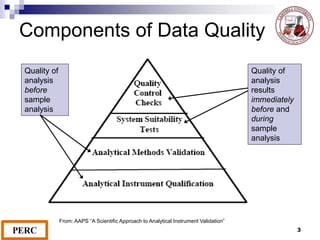
Components of Data Quality
Quality of
analysis
before
sample
analysis
Quality of
analysis
results
immediately
before and
during
sample
analysis
From: AAPS “A Scientific Approach to Analytical Instrument Validation”
3
4
Qualified vs. Validated
 Instruments are “Qualified”.
Analytical Instrument Qualification (AIQ)
 Processes are “Validated”.
Validation reserved for processes that include
analytical procedures (methods) and software
development (applications).
5
 Analytical Instrument Qualification
Documented evidence that an
instrument performs suitably for
its intended purpose and is
properly maintained and
calibrated.
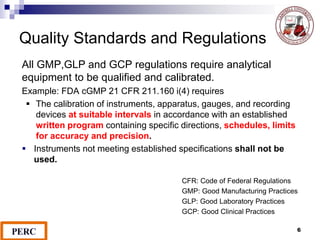
Quality Standards and Regulations
All GMP,GLP and GCP regulations require analytical
equipment to be qualified and calibrated.
Example: FDA cGMP 21 CFR 211.160 i(4) requires
 The calibration of instruments, apparatus, gauges, and recording
devices at suitable intervals in accordance with an established
written program containing specific directions, schedules, limits
for accuracy and precision.
 Instruments not meeting established specifications shall not be
used.
CFR: Code of Federal Regulations
GMP: Good Manufacturing Practices
GLP: Good Laboratory Practices
GCP: Good Clinical Practices
6
7
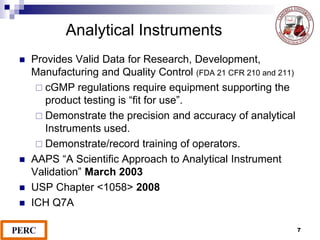
Analytical Instruments
 Provides Valid Data for Research, Development,
Manufacturing and Quality Control (FDA 21 CFR 210 and 211)
 cGMP regulations require equipment supporting the
product testing is “fit for use”.
 Demonstrate the precision and accuracy of analytical
Instruments used.
 Demonstrate/record training of operators.
 AAPS “A Scientific Approach to Analytical Instrument
Validation” March 2003
 USP Chapter <1058> 2008
 ICH Q7A
8
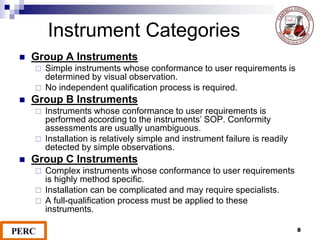
Instrument Categories
 Group A Instruments
 Simple instruments whose conformance to user requirements is
determined by visual observation.
 No independent qualification process is required.
 Group B Instruments
 Instruments whose conformance to user requirements is
performed according to the instruments’ SOP. Conformity
assessments are usually unambiguous.
 Installation is relatively simple and instrument failure is readily
detected by simple observations.
 Group C Instruments
 Complex instruments whose conformance to user requirements
is highly method specific.
 Installation can be complicated and may require specialists.
 A full-qualification process must be applied to these
instruments.
9
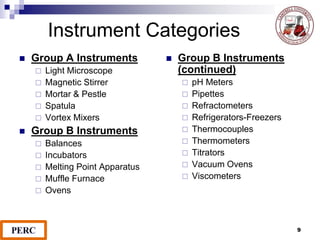
Instrument Categories
 Group A Instruments
 Light Microscope
 Magnetic Stirrer
 Mortar & Pestle
 Spatula
 Vortex Mixers
 Group B Instruments
 Balances
 Incubators
 Melting Point Apparatus
 Muffle Furnace
 Ovens
 Group B Instruments
(continued)
 pH Meters
 Pipettes
 Refractometers
 Refrigerators-Freezers
 Thermocouples
 Thermometers
 Titrators
 Vacuum Ovens
 Viscometers
10
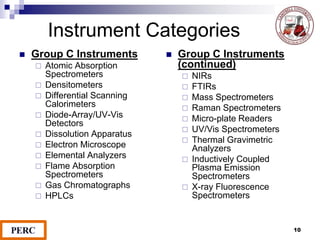
Instrument Categories
 Group C Instruments
 Atomic Absorption
Spectrometers
 Densitometers
 Differential Scanning
Calorimeters
 Diode-Array/UV-Vis
Detectors
 Dissolution Apparatus
 Electron Microscope
 Elemental Analyzers
 Flame Absorption
Spectrometers
 Gas Chromatographs
 HPLCs
 Group C Instruments
(continued)
 NIRs
 FTIRs
 Mass Spectrometers
 Raman Spectrometers
 Micro-plate Readers
 UV/Vis Spectrometers
 Thermal Gravimetric
Analyzers
 Inductively Coupled
Plasma Emission
Spectrometers
 X-ray Fluorescence
Spectrometers
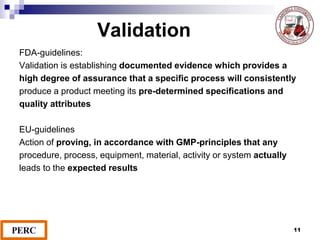
Validation
FDA-guidelines:
Validation is establishing documented evidence which provides a
high degree of assurance that a specific process will consistently
produce a product meeting its pre-determined specifications and
quality attributes
EU-guidelines
Action of proving, in accordance with GMP-principles that any
procedure, process, equipment, material, activity or system actually
leads to the expected results
11
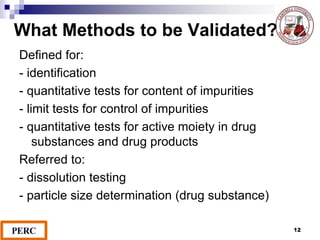
What Methods to be Validated?
Defined for:
- identification
- quantitative tests for content of impurities
- limit tests for control of impurities
- quantitative tests for active moiety in drug
substances and drug products
Referred to:
- dissolution testing
- particle size determination (drug substance)
12
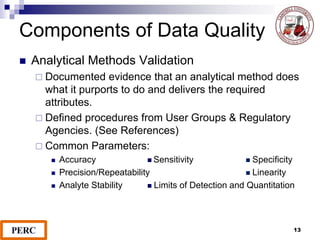
Components of Data Quality
 Analytical Methods Validation
 Documented evidence that an analytical method does
what it purports to do and delivers the required
attributes.
 Defined procedures from User Groups & Regulatory
Agencies. (See References)
 Common Parameters:
 Accuracy  Sensitivity  Specificity
 Precision/Repeatability  Linearity
 Analyte Stability  Limits of Detection and Quantitation
13
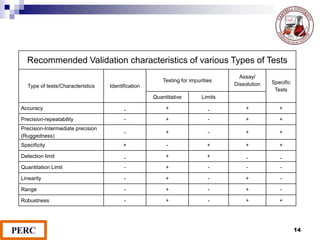
Recommended Validation characteristics of various Types of Tests
Type of tests/Characteristics Identification
Testing for impurities
Assay/
Dissolution Specific
Tests
Quantitative Limits
Accuracy - + - + +
Precision-repeatability - + - + +
Precision-Intermediate precision
(Ruggedness)
- + - + +
Specificity + - + + +
Detection limit - + + - -
Quantitation Limit - + - - -
Linearity - + - + -
Range - + - + -
Robustness - + - + +
14
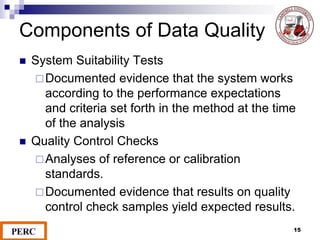
Components of Data Quality
 System Suitability Tests
Documented evidence that the system works
according to the performance expectations
and criteria set forth in the method at the time
of the analysis
 Quality Control Checks
Analyses of reference or calibration
standards.
Documented evidence that results on quality
control check samples yield expected results.
15
What is a Method
 A method is a set of instrument
parameters that define the conditions of
the instrument during the time the data is
collected.
16
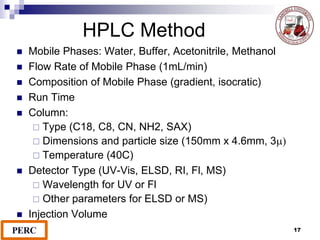
HPLC Method
 Mobile Phases: Water, Buffer, Acetonitrile, Methanol
 Flow Rate of Mobile Phase (1mL/min)
 Composition of Mobile Phase (gradient, isocratic)
 Run Time
 Column:
 Type (C18, C8, CN, NH2, SAX)
 Dimensions and particle size (150mm x 4.6mm, 3m)
 Temperature (40C)
 Detector Type (UV-Vis, ELSD, RI, Fl, MS)
 Wavelength for UV or Fl
 Other parameters for ELSD or MS)
 Injection Volume
17
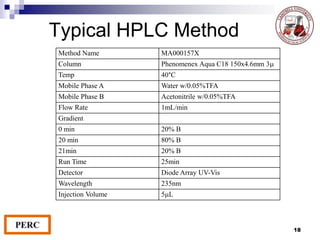
Typical HPLC Method
Method Name MA000157X
Column Phenomenex Aqua C18 150x4.6mm 3m
Temp 40°C
Mobile Phase A Water w/0.05%TFA
Mobile Phase B Acetonitrile w/0.05%TFA
Flow Rate 1mL/min
Gradient
0 min 20% B
20 min 80% B
21min 20% B
Run Time 25min
Detector Diode Array UV-Vis
Wavelength 235nm
Injection Volume 5mL
18
Method Validation
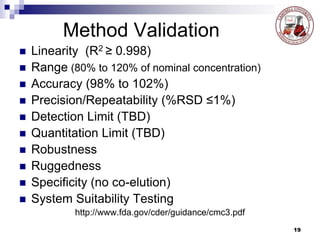
 Linearity (R2 ≥ 0.998)
 Range (80% to 120% of nominal concentration)
 Accuracy (98% to 102%)
 Precision/Repeatability (%RSD ≤1%)
 Detection Limit (TBD)
 Quantitation Limit (TBD)
 Robustness
 Ruggedness
 Specificity (no co-elution)
 System Suitability Testing
http://www.fda.gov/cder/guidance/cmc3.pdf
19
Method Validation
Linearity
The linear range of detectability that obeys Beer's Law is
dependent on the compound analyzed and detector
used. The working sample concentration and samples
tested should be in the linear range.
A linear relationship should be evaluated across the
range of the analytical method. It may be demonstrated
directly on the drug substance (by dilution of a standard
stock solution) and/or separate weighings of the drug
product components.
20
Method Validation
Linearity
21
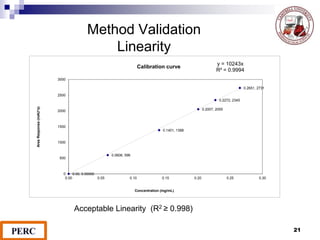
0.00, 0.00000
0.0606, 596
0.1401, 1388
0.2007, 2055
0.2272, 2345
0.2651, 2731
y = 10243x
R² = 0.9994
0
500
1000
1500
2000
2500
3000
0.00 0.05 0.10 0.15 0.20 0.25 0.30
AreaResponse(mAU*s)
Concentration (mg/mL)
Calibration curve
Acceptable Linearity (R2 ≥ 0.998)
Method Validation
Range
Range is the interval between the high and low levels of analyte
studied.
The specified range is normally derived from linearity studies and
depends on the intended application of the method. It is established
by confirming that the analytical method provides an acceptable
degree of linearity, accuracy, and precision when applied to samples
containing amounts of analyte within or at the extremes of the
specified range of the analytical method.
The following minimum specified ranges should be considered.
 For the content assay of a drug substance or a finished (drug)
product: From 80 to 120 percent of the product label strength.
 For content uniformity: Covering a minimum of 70 to 130 percent of
the product label strength.
 For some methods may be much lower depending on needs of
assay
22
Method Validation
Accuracy
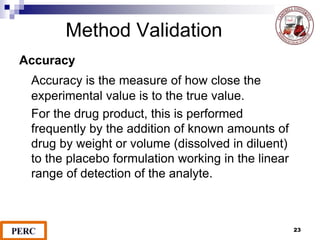
Accuracy is the measure of how close the
experimental value is to the true value.
For the drug product, this is performed
frequently by the addition of known amounts of
drug by weight or volume (dissolved in diluent)
to the placebo formulation working in the linear
range of detection of the analyte.
23
Method Validation
Accuracy
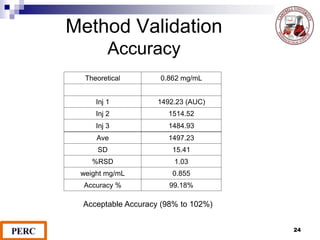
Theoretical 0.862 mg/mL
Inj 1 1492.23 (AUC)
Inj 2 1514.52
Inj 3 1484.93
Ave 1497.23
SD 15.41
%RSD 1.03
weight mg/mL 0.855
Accuracy % 99.18%
24
Acceptable Accuracy (98% to 102%)
Method Validation
Precision
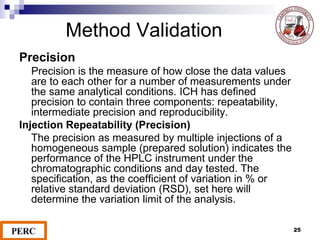
Precision is the measure of how close the data values
are to each other for a number of measurements under
the same analytical conditions. ICH has defined
precision to contain three components: repeatability,
intermediate precision and reproducibility.
Injection Repeatability (Precision)
The precision as measured by multiple injections of a
homogeneous sample (prepared solution) indicates the
performance of the HPLC instrument under the
chromatographic conditions and day tested. The
specification, as the coefficient of variation in % or
relative standard deviation (RSD), set here will
determine the variation limit of the analysis.
25
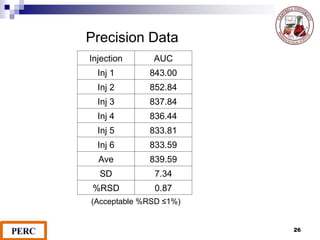
Injection AUC
Inj 1 843.00
Inj 2 852.84
Inj 3 837.84
Inj 4 836.44
Inj 5 833.81
Inj 6 833.59
Ave 839.59
SD 7.34
%RSD 0.87
Precision Data
26
(Acceptable %RSD ≤1%)
Method Validation
Limit of Detection and Limit of Quantitation
These limits are normally applied to related substances
in the drug substance or drug product. Specifications on
these limits are submitted with the regulatory impurities
method relating to release and stability of both drug
substance and drug product.
 Detection limit (LOD) is the lowest concentration of
analyte in a sample that can be detected, but not
necessarily quantified, under the stated experimental
conditions.
 Quantitation limit (LOQ) is the lowest concentration of
analyte in a sample that can be determined with
acceptable precision and accuracy under the stated
experimental conditions.
27
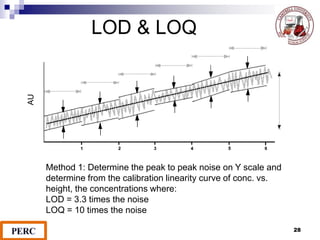
LOD & LOQ
Method 1: Determine the peak to peak noise on Y scale and
determine from the calibration linearity curve of conc. vs.
height, the concentrations where:
LOD = 3.3 times the noise
LOQ = 10 times the noise
28
AU
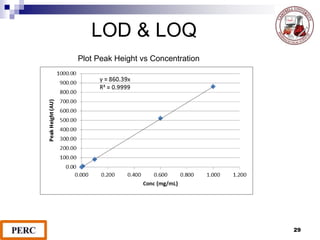
LOD & LOQ
Plot Peak Height vs Concentration
29
Method Validation
Robustness
Robustness is a measure of the method's capability to remain
unaffected by small, but deliberate variations in method parameters.
Robustness can be partly assured by good system suitability
specifications. Thus, it is important to set tight, but realistic, system
suitability specifications.
Testing varying some or all conditions, e.g., age of columns, column
type, column temperature, pH of buffer in mobile phase, reagents, is
normally performed.
30
Method Validation
Intermediate Precision (Ruggedness)
Ruggedness evaluates the reliability of the method in a
different environment other than that used during
development of the method. The objective is to ensure
that the method will provide the same results when
similar samples are analyzed once the method
development phase is over.
The method can be tested on multiple days, analysts,
instruments, etc.
31
Method Validation
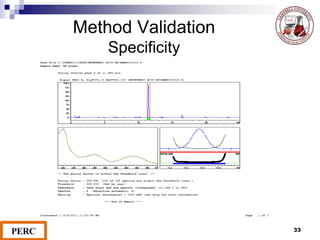
Specificity/Selectivity (Peak Purity)
The representative analyte should have no interference from other extraneous
components and be well resolved from them. A chromatogram or profile should be
generated and submitted to show that the extraneous peaks either by addition of
known compounds or samples from stress testing are baseline resolved from the
parent analyte.
Examples of the extraneous peaks are as follows:
For the drug substance or raw material, the related substances to consider are
process impurities from the synthesis process. For the drug product, the related
substances may be impurities present in the active drug, degradation products,
interaction of the active drug with excipients, extraneous components.
Submission of data from stress testing of the drug substance using acid and base
hydrolysis, temperature, photolysis and oxidation.
32
Method Validation
Specificity
33
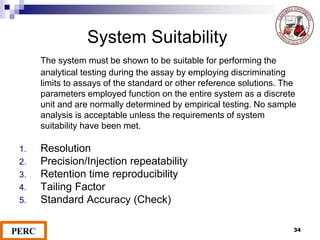
The system must be shown to be suitable for performing the
analytical testing during the assay by employing discriminating
limits to assays of the standard or other reference solutions. The
parameters employed function on the entire system as a discrete
unit and are normally determined by empirical testing. No sample
analysis is acceptable unless the requirements of system
suitability have been met.
1. Resolution
2. Precision/Injection repeatability
3. Retention time reproducibility
4. Tailing Factor
5. Standard Accuracy (Check)
System Suitability
34
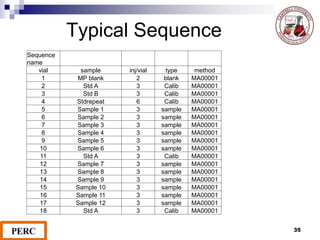
Typical Sequence
Sequence
name
vial sample inj/vial type method
1 MP blank 2 blank MA00001
2 Std A 3 Calib MA00001
3 Std B 3 Calib MA00001
4 Stdrepeat 6 Calib MA00001
5 Sample 1 3 sample MA00001
6 Sample 2 3 sample MA00001
7 Sample 3 3 sample MA00001
8 Sample 4 3 sample MA00001
9 Sample 5 3 sample MA00001
10 Sample 6 3 sample MA00001
11 Std A 3 Calib MA00001
12 Sample 7 3 sample MA00001
13 Sample 8 3 sample MA00001
14 Sample 9 3 sample MA00001
15 Sample 10 3 sample MA00001
16 Sample 11 3 sample MA00001
17 Sample 12 3 sample MA00001
18 Std A 3 Calib MA00001
35
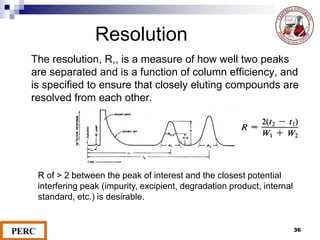
Resolution
The resolution, R,, is a measure of how well two peaks
are separated and is a function of column efficiency, and
is specified to ensure that closely eluting compounds are
resolved from each other.
R of > 2 between the peak of interest and the closest potential
interfering peak (impurity, excipient, degradation product, internal
standard, etc.) is desirable.
36
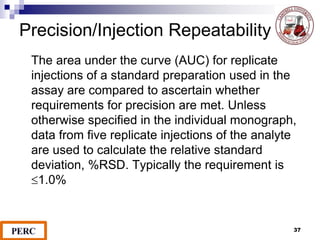
Precision/Injection Repeatability
The area under the curve (AUC) for replicate
injections of a standard preparation used in the
assay are compared to ascertain whether
requirements for precision are met. Unless
otherwise specified in the individual monograph,
data from five replicate injections of the analyte
are used to calculate the relative standard
deviation, %RSD. Typically the requirement is
1.0%
37
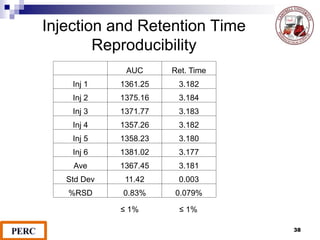
Injection and Retention Time
Reproducibility
AUC Ret. Time
Inj 1 1361.25 3.182
Inj 2 1375.16 3.184
Inj 3 1371.77 3.183
Inj 4 1357.26 3.182
Inj 5 1358.23 3.180
Inj 6 1381.02 3.177
Ave 1367.45 3.181
Std Dev 11.42 0.003
%RSD 0.83% 0.079%
38
≤ 1% ≤ 1%
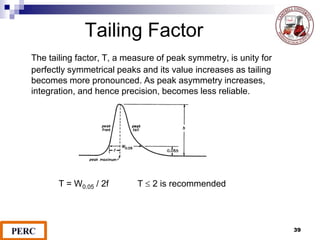
Tailing Factor
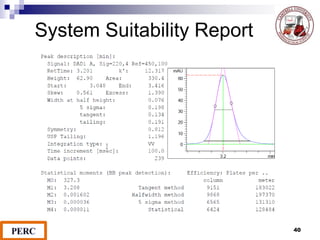
The tailing factor, T, a measure of peak symmetry, is unity for
perfectly symmetrical peaks and its value increases as tailing
becomes more pronounced. As peak asymmetry increases,
integration, and hence precision, becomes less reliable.
T = W0.05 / 2f T  2 is recommended
39
System Suitability Report
40
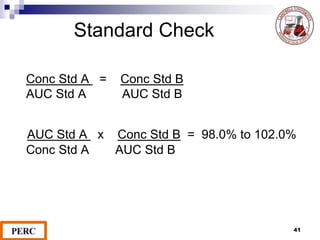
Standard Check
Conc Std A = Conc Std B
AUC Std A AUC Std B
AUC Std A x Conc Std B = 98.0% to 102.0%
Conc Std A AUC Std B
41
Questions on Method Validation
42

Analytical Method Validation

  • 1.
    Analytical Method Validation Paul R.Johnson Campbell University Pharmaceutical Sciences-PERC QC/R&D Analytical Lab Manager 1
  • 2.
    Guidance for Industry Q2BValidation of Analytical Procedures: Methodology Center for Drug Evaluation and Research (CDER), 5600 Fishers Lane, Rockville, MD 20857 (Tel) 301-827-4573 http://www.fda.gov/cder/guidance/index.htm or Center for Biologics Evaluation and Research (CBER) 1401 Rockville Pike, Rockville, MD 20852-1448, http://www.fda.gov/cber/guidelines.htm U.S. Department of Health and Human Services Food and Drug Administration November 1996 ICH http://www.ich.org/products/guidelines/quality/quality-single/article/validation-of-analytical- procedures-text-and-methodology.html USP 37- NF 32 <1225> VALIDATION OF COMPENDIAL PROCEDURES 2
  • 3.
    Components of DataQuality Quality of analysis before sample analysis Quality of analysis results immediately before and during sample analysis From: AAPS “A Scientific Approach to Analytical Instrument Validation” 3
  • 4.
    4 Qualified vs. Validated Instruments are “Qualified”. Analytical Instrument Qualification (AIQ)  Processes are “Validated”. Validation reserved for processes that include analytical procedures (methods) and software development (applications).
  • 5.
    5  Analytical InstrumentQualification Documented evidence that an instrument performs suitably for its intended purpose and is properly maintained and calibrated.
  • 6.
    Quality Standards andRegulations All GMP,GLP and GCP regulations require analytical equipment to be qualified and calibrated. Example: FDA cGMP 21 CFR 211.160 i(4) requires  The calibration of instruments, apparatus, gauges, and recording devices at suitable intervals in accordance with an established written program containing specific directions, schedules, limits for accuracy and precision.  Instruments not meeting established specifications shall not be used. CFR: Code of Federal Regulations GMP: Good Manufacturing Practices GLP: Good Laboratory Practices GCP: Good Clinical Practices 6
  • 7.
    7 Analytical Instruments  ProvidesValid Data for Research, Development, Manufacturing and Quality Control (FDA 21 CFR 210 and 211)  cGMP regulations require equipment supporting the product testing is “fit for use”.  Demonstrate the precision and accuracy of analytical Instruments used.  Demonstrate/record training of operators.  AAPS “A Scientific Approach to Analytical Instrument Validation” March 2003  USP Chapter <1058> 2008  ICH Q7A
  • 8.
    8 Instrument Categories  GroupA Instruments  Simple instruments whose conformance to user requirements is determined by visual observation.  No independent qualification process is required.  Group B Instruments  Instruments whose conformance to user requirements is performed according to the instruments’ SOP. Conformity assessments are usually unambiguous.  Installation is relatively simple and instrument failure is readily detected by simple observations.  Group C Instruments  Complex instruments whose conformance to user requirements is highly method specific.  Installation can be complicated and may require specialists.  A full-qualification process must be applied to these instruments.
  • 9.
    9 Instrument Categories  GroupA Instruments  Light Microscope  Magnetic Stirrer  Mortar & Pestle  Spatula  Vortex Mixers  Group B Instruments  Balances  Incubators  Melting Point Apparatus  Muffle Furnace  Ovens  Group B Instruments (continued)  pH Meters  Pipettes  Refractometers  Refrigerators-Freezers  Thermocouples  Thermometers  Titrators  Vacuum Ovens  Viscometers
  • 10.
    10 Instrument Categories  GroupC Instruments  Atomic Absorption Spectrometers  Densitometers  Differential Scanning Calorimeters  Diode-Array/UV-Vis Detectors  Dissolution Apparatus  Electron Microscope  Elemental Analyzers  Flame Absorption Spectrometers  Gas Chromatographs  HPLCs  Group C Instruments (continued)  NIRs  FTIRs  Mass Spectrometers  Raman Spectrometers  Micro-plate Readers  UV/Vis Spectrometers  Thermal Gravimetric Analyzers  Inductively Coupled Plasma Emission Spectrometers  X-ray Fluorescence Spectrometers
  • 11.
    Validation FDA-guidelines: Validation is establishingdocumented evidence which provides a high degree of assurance that a specific process will consistently produce a product meeting its pre-determined specifications and quality attributes EU-guidelines Action of proving, in accordance with GMP-principles that any procedure, process, equipment, material, activity or system actually leads to the expected results 11
  • 12.
    What Methods tobe Validated? Defined for: - identification - quantitative tests for content of impurities - limit tests for control of impurities - quantitative tests for active moiety in drug substances and drug products Referred to: - dissolution testing - particle size determination (drug substance) 12
  • 13.
    Components of DataQuality  Analytical Methods Validation  Documented evidence that an analytical method does what it purports to do and delivers the required attributes.  Defined procedures from User Groups & Regulatory Agencies. (See References)  Common Parameters:  Accuracy  Sensitivity  Specificity  Precision/Repeatability  Linearity  Analyte Stability  Limits of Detection and Quantitation 13
  • 14.
    Recommended Validation characteristicsof various Types of Tests Type of tests/Characteristics Identification Testing for impurities Assay/ Dissolution Specific Tests Quantitative Limits Accuracy - + - + + Precision-repeatability - + - + + Precision-Intermediate precision (Ruggedness) - + - + + Specificity + - + + + Detection limit - + + - - Quantitation Limit - + - - - Linearity - + - + - Range - + - + - Robustness - + - + + 14
  • 15.
    Components of DataQuality  System Suitability Tests Documented evidence that the system works according to the performance expectations and criteria set forth in the method at the time of the analysis  Quality Control Checks Analyses of reference or calibration standards. Documented evidence that results on quality control check samples yield expected results. 15
  • 16.
    What is aMethod  A method is a set of instrument parameters that define the conditions of the instrument during the time the data is collected. 16
  • 17.
    HPLC Method  MobilePhases: Water, Buffer, Acetonitrile, Methanol  Flow Rate of Mobile Phase (1mL/min)  Composition of Mobile Phase (gradient, isocratic)  Run Time  Column:  Type (C18, C8, CN, NH2, SAX)  Dimensions and particle size (150mm x 4.6mm, 3m)  Temperature (40C)  Detector Type (UV-Vis, ELSD, RI, Fl, MS)  Wavelength for UV or Fl  Other parameters for ELSD or MS)  Injection Volume 17
  • 18.
    Typical HPLC Method MethodName MA000157X Column Phenomenex Aqua C18 150x4.6mm 3m Temp 40°C Mobile Phase A Water w/0.05%TFA Mobile Phase B Acetonitrile w/0.05%TFA Flow Rate 1mL/min Gradient 0 min 20% B 20 min 80% B 21min 20% B Run Time 25min Detector Diode Array UV-Vis Wavelength 235nm Injection Volume 5mL 18
  • 19.
    Method Validation  Linearity(R2 ≥ 0.998)  Range (80% to 120% of nominal concentration)  Accuracy (98% to 102%)  Precision/Repeatability (%RSD ≤1%)  Detection Limit (TBD)  Quantitation Limit (TBD)  Robustness  Ruggedness  Specificity (no co-elution)  System Suitability Testing http://www.fda.gov/cder/guidance/cmc3.pdf 19
  • 20.
    Method Validation Linearity The linearrange of detectability that obeys Beer's Law is dependent on the compound analyzed and detector used. The working sample concentration and samples tested should be in the linear range. A linear relationship should be evaluated across the range of the analytical method. It may be demonstrated directly on the drug substance (by dilution of a standard stock solution) and/or separate weighings of the drug product components. 20
  • 21.
    Method Validation Linearity 21 0.00, 0.00000 0.0606,596 0.1401, 1388 0.2007, 2055 0.2272, 2345 0.2651, 2731 y = 10243x R² = 0.9994 0 500 1000 1500 2000 2500 3000 0.00 0.05 0.10 0.15 0.20 0.25 0.30 AreaResponse(mAU*s) Concentration (mg/mL) Calibration curve Acceptable Linearity (R2 ≥ 0.998)
  • 22.
    Method Validation Range Range isthe interval between the high and low levels of analyte studied. The specified range is normally derived from linearity studies and depends on the intended application of the method. It is established by confirming that the analytical method provides an acceptable degree of linearity, accuracy, and precision when applied to samples containing amounts of analyte within or at the extremes of the specified range of the analytical method. The following minimum specified ranges should be considered.  For the content assay of a drug substance or a finished (drug) product: From 80 to 120 percent of the product label strength.  For content uniformity: Covering a minimum of 70 to 130 percent of the product label strength.  For some methods may be much lower depending on needs of assay 22
  • 23.
    Method Validation Accuracy Accuracy isthe measure of how close the experimental value is to the true value. For the drug product, this is performed frequently by the addition of known amounts of drug by weight or volume (dissolved in diluent) to the placebo formulation working in the linear range of detection of the analyte. 23
  • 24.
    Method Validation Accuracy Theoretical 0.862mg/mL Inj 1 1492.23 (AUC) Inj 2 1514.52 Inj 3 1484.93 Ave 1497.23 SD 15.41 %RSD 1.03 weight mg/mL 0.855 Accuracy % 99.18% 24 Acceptable Accuracy (98% to 102%)
  • 25.
    Method Validation Precision Precision isthe measure of how close the data values are to each other for a number of measurements under the same analytical conditions. ICH has defined precision to contain three components: repeatability, intermediate precision and reproducibility. Injection Repeatability (Precision) The precision as measured by multiple injections of a homogeneous sample (prepared solution) indicates the performance of the HPLC instrument under the chromatographic conditions and day tested. The specification, as the coefficient of variation in % or relative standard deviation (RSD), set here will determine the variation limit of the analysis. 25
  • 26.
    Injection AUC Inj 1843.00 Inj 2 852.84 Inj 3 837.84 Inj 4 836.44 Inj 5 833.81 Inj 6 833.59 Ave 839.59 SD 7.34 %RSD 0.87 Precision Data 26 (Acceptable %RSD ≤1%)
  • 27.
    Method Validation Limit ofDetection and Limit of Quantitation These limits are normally applied to related substances in the drug substance or drug product. Specifications on these limits are submitted with the regulatory impurities method relating to release and stability of both drug substance and drug product.  Detection limit (LOD) is the lowest concentration of analyte in a sample that can be detected, but not necessarily quantified, under the stated experimental conditions.  Quantitation limit (LOQ) is the lowest concentration of analyte in a sample that can be determined with acceptable precision and accuracy under the stated experimental conditions. 27
  • 28.
    LOD & LOQ Method1: Determine the peak to peak noise on Y scale and determine from the calibration linearity curve of conc. vs. height, the concentrations where: LOD = 3.3 times the noise LOQ = 10 times the noise 28 AU
  • 29.
    LOD & LOQ PlotPeak Height vs Concentration 29
  • 30.
    Method Validation Robustness Robustness isa measure of the method's capability to remain unaffected by small, but deliberate variations in method parameters. Robustness can be partly assured by good system suitability specifications. Thus, it is important to set tight, but realistic, system suitability specifications. Testing varying some or all conditions, e.g., age of columns, column type, column temperature, pH of buffer in mobile phase, reagents, is normally performed. 30
  • 31.
    Method Validation Intermediate Precision(Ruggedness) Ruggedness evaluates the reliability of the method in a different environment other than that used during development of the method. The objective is to ensure that the method will provide the same results when similar samples are analyzed once the method development phase is over. The method can be tested on multiple days, analysts, instruments, etc. 31
  • 32.
    Method Validation Specificity/Selectivity (PeakPurity) The representative analyte should have no interference from other extraneous components and be well resolved from them. A chromatogram or profile should be generated and submitted to show that the extraneous peaks either by addition of known compounds or samples from stress testing are baseline resolved from the parent analyte. Examples of the extraneous peaks are as follows: For the drug substance or raw material, the related substances to consider are process impurities from the synthesis process. For the drug product, the related substances may be impurities present in the active drug, degradation products, interaction of the active drug with excipients, extraneous components. Submission of data from stress testing of the drug substance using acid and base hydrolysis, temperature, photolysis and oxidation. 32
  • 33.
  • 34.
    The system mustbe shown to be suitable for performing the analytical testing during the assay by employing discriminating limits to assays of the standard or other reference solutions. The parameters employed function on the entire system as a discrete unit and are normally determined by empirical testing. No sample analysis is acceptable unless the requirements of system suitability have been met. 1. Resolution 2. Precision/Injection repeatability 3. Retention time reproducibility 4. Tailing Factor 5. Standard Accuracy (Check) System Suitability 34
  • 35.
    Typical Sequence Sequence name vial sampleinj/vial type method 1 MP blank 2 blank MA00001 2 Std A 3 Calib MA00001 3 Std B 3 Calib MA00001 4 Stdrepeat 6 Calib MA00001 5 Sample 1 3 sample MA00001 6 Sample 2 3 sample MA00001 7 Sample 3 3 sample MA00001 8 Sample 4 3 sample MA00001 9 Sample 5 3 sample MA00001 10 Sample 6 3 sample MA00001 11 Std A 3 Calib MA00001 12 Sample 7 3 sample MA00001 13 Sample 8 3 sample MA00001 14 Sample 9 3 sample MA00001 15 Sample 10 3 sample MA00001 16 Sample 11 3 sample MA00001 17 Sample 12 3 sample MA00001 18 Std A 3 Calib MA00001 35
  • 36.
    Resolution The resolution, R,,is a measure of how well two peaks are separated and is a function of column efficiency, and is specified to ensure that closely eluting compounds are resolved from each other. R of > 2 between the peak of interest and the closest potential interfering peak (impurity, excipient, degradation product, internal standard, etc.) is desirable. 36
  • 37.
    Precision/Injection Repeatability The areaunder the curve (AUC) for replicate injections of a standard preparation used in the assay are compared to ascertain whether requirements for precision are met. Unless otherwise specified in the individual monograph, data from five replicate injections of the analyte are used to calculate the relative standard deviation, %RSD. Typically the requirement is 1.0% 37
  • 38.
    Injection and RetentionTime Reproducibility AUC Ret. Time Inj 1 1361.25 3.182 Inj 2 1375.16 3.184 Inj 3 1371.77 3.183 Inj 4 1357.26 3.182 Inj 5 1358.23 3.180 Inj 6 1381.02 3.177 Ave 1367.45 3.181 Std Dev 11.42 0.003 %RSD 0.83% 0.079% 38 ≤ 1% ≤ 1%
  • 39.
    Tailing Factor The tailingfactor, T, a measure of peak symmetry, is unity for perfectly symmetrical peaks and its value increases as tailing becomes more pronounced. As peak asymmetry increases, integration, and hence precision, becomes less reliable. T = W0.05 / 2f T  2 is recommended 39
  • 40.
  • 41.
    Standard Check Conc StdA = Conc Std B AUC Std A AUC Std B AUC Std A x Conc Std B = 98.0% to 102.0% Conc Std A AUC Std B 41
  • 42.
    Questions on MethodValidation 42

Editor's Notes

  • #2 1
  • #4 3
  • #5 4
  • #6 5
  • #7 Quote from the Code of Federal Regulations 21 CFR211.160i(4) The calibration of instruments, apparatus, gauges, and recording devices at suitable intervals in accordance with an established written program containing specific directions, schedules, limits for accuracy and precision, and provisions for remedial action in the event accuracy and/or precision limits are not met. Instruments, apparatus, gauges, and recording devices not meeting established specifications shall not be used.
  • #8 7
  • #9 8
  • #10 9
  • #11 10
  • #14 13
  • #16 15