Multivariate Statistical Analysis
• 1. Aspects of Multivariate Analysis
• 2. Principal Components
• 3. Factor Analysis
• 4. Discrimination and Classification
• 5. Clustering
Johnson, R.A., Wichern, D.W. (1982): Applied Multivariate Statistical Analysis,
Prentice Hall.
1
1. Aspects of Multivariate Analysis
Multivariate data arise whenever p ≥ 1 variables are recorded. Values of these
variables are observed for n distinct item, individuals, or experimental trials.
We use the notation xij to indicate the particular value of the ith variable that
is observed on the jth item, or trial.
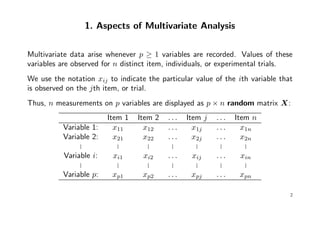
Thus, n measurements on p variables are displayed as p × n random matrix X:
Item 1 Item 2 . . . Item j . . . Item n
Variable 1: x11 x12 . . . x1j . . . x1n
Variable 2: x21 x22 . . . x2j . . . x2n
... ... ... ... ... ... ...
Variable i: xi1 xi2 . . . xij . . . xin
... ... ... ... ... ... ...
Variable p: xp1 xp2 . . . xpj . . . xpn
2
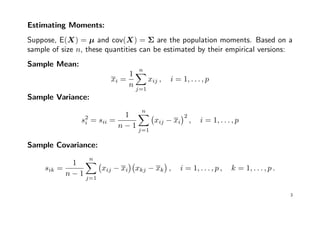
Estimating Moments:
Suppose, E(X) = µ and cov(X) = Σ are the population moments. Based on a
sample of size n, these quantities can be estimated by their empirical versions:
Sample Mean:
xi =
1
n
n
j=1
xij , i = 1, . . . , p
Sample Variance:
s2
i = sii =
1
n − 1
n
j=1
xij − xi
2
, i = 1, . . . , p
Sample Covariance:
sik =
1
n − 1
n
j=1
xij − xi xkj − xk , i = 1, . . . , p , k = 1, . . . , p .
3
Summarize all elements sik into the p × p sample variance-covariance matrix
S = sik i,k
.
Assume further, that the p × p population correlation matrix ρ is estimated by
the sample correlation matrix R with entries
rik =
sik
√
siiskk
, i = 1, . . . , p , k = 1, . . . , p ,
where rii = 1 for all i = 1, . . . , p.
> aimu <- read.table("aimu.dat", header=TRUE)
> attach(aimu)
> options(digits=2)
> mean(aimu[ ,3:8])
age height weight fvc fev1 fevp
30 177 77 553 460 83
4
> cov(aimu[ ,3:8])
age height weight fvc fev1 fevp
age 110 -16.9 16.5 -233 -302 -20.8
height -17 45.5 34.9 351 275 -1.9
weight 16 34.9 109.6 325 212 -7.6
fvc -233 351.5 324.7 5817 4192 -86.5
fev1 -302 275.2 212.0 4192 4347 162.5
fevp -21 -1.9 -7.6 -87 162 41.3
> cor(aimu[ ,3:8])
age height weight fvc fev1 fevp
age 1.00 -0.239 0.15 -0.29 -0.44 -0.309
height -0.24 1.000 0.49 0.68 0.62 -0.043
weight 0.15 0.494 1.00 0.41 0.31 -0.113
fvc -0.29 0.683 0.41 1.00 0.83 -0.177
fev1 -0.44 0.619 0.31 0.83 1.00 0.384
fevp -0.31 -0.043 -0.11 -0.18 0.38 1.000
5
Distances:
Consider the point P = (x1, x2) in the plane. The straight line (Euclidian)
distance, d(O, P), from P to the origin O = (0, 0) is (Pythagoras)
d(O, P) = x2
1 + x2
2 .
In general, if P has p coordinates so that P = (x1, x2, . . . , xp), the Euclidian
distance is
d(O, P) = x2
1 + x2
2 + · · · + x2
p .
The distance between 2 arbitrary points P and Q = (y1, y2, . . . , yp) is given by
d(P, Q) = (x1 − y1)2 + (x2 − y2)2 + · · · + (xp − yp)2 .
Each coordinate contributes equally to the calculation of the Euclidian distance.
It is often desirable to weight the coordinates.
6
Statistical distance should account for differences in variation and correlation.
Suppose we have n pairs of measurements on 2 independent variables x1 and x2:
> X <- mvrnorm(30, mu=c(0, 0), Sigma=matrix(c(9,0,0,1), 2, 2)); plot(X)
−6 −4 −2 0 2 4 6
−6−4−20246
X[,1]
X[,2]
Variability in x1 direction is much larger
than in x2 direction! Values that are a
given deviation from the origin in the
x1 direction are not as surprising as
are values in x2 direction.
It seems reasonable to weight an x2
coordinate more heavily than an x1
coordinate of the same value when
computing the distance to the origin.
7
Compute the statistical distance from the standardized coordinates
x∗
1 =
x1
√
s11
and x∗
2 =
x2
√
s22
as
d(O, P) = (x∗
1)2 + (x∗
2)2 =
x1
√
s11
2
+
x2
√
s22
2
=
x2
1
s11
+
x2
2
s22
.
This can be generalized to accommodate the calculation of statistical distance
from an arbitrary point P = (x1, x2) to any fixed point Q = (y1, y2). If the
coordinate variables vary independent of one other, the distance from P to Q is
d(P, Q) =
(x1 − y1)2
s11
+
(x2 − y2)2
s22
.
The extension to more than 2 dimensions is straightforward.
8
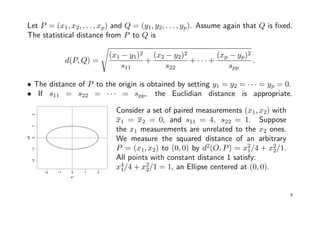
Let P = (x1, x2, . . . , xp) and Q = (y1, y2, . . . , yp). Assume again that Q is fixed.
The statistical distance from P to Q is
d(P, Q) =
(x1 − y1)2
s11
+
(x2 − y2)2
s22
+ · · · +
(xp − yp)2
spp
.
• The distance of P to the origin is obtained by setting y1 = y2 = · · · = yp = 0.
• If s11 = s22 = · · · = spp, the Euclidian distance is appropriate.
−2 −1 0 1 2
−2−1012
x1
x2
Consider a set of paired measurements (x1, x2) with
x1 = x2 = 0, and s11 = 4, s22 = 1. Suppose
the x1 measurements are unrelated to the x2 ones.
We measure the squared distance of an arbitrary
P = (x1, x2) to (0, 0) by d2
(O, P) = x2
1/4 + x2
2/1.
All points with constant distance 1 satisfy:
x4
1/4 + x2
2/1 = 1, an Ellipse centered at (0, 0).
9
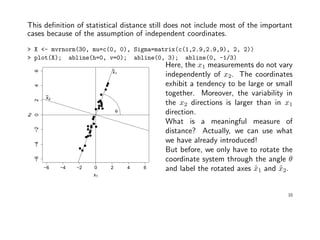
This definition of statistical distance still does not include most of the important
cases because of the assumption of independent coordinates.
> X <- mvrnorm(30, mu=c(0, 0), Sigma=matrix(c(1,2.9,2.9,9), 2, 2))
> plot(X); abline(h=0, v=0); abline(0, 3); abline(0, -1/3)
−6 −4 −2 0 2 4 6
−6−4−20246
x1
x2
θ
x~
1
x~
2
Here, the x1 measurements do not vary
independently of x2. The coordinates
exhibit a tendency to be large or small
together. Moreover, the variability in
the x2 directions is larger than in x1
direction.
What is a meaningful measure of
distance? Actually, we can use what
we have already introduced!
But before, we only have to rotate the
coordinate system through the angle θ
and label the rotated axes ˜x1 and ˜x2.
10
Now, we define the distance of a point P = (x1, x2) from the origin (0, 0) as
d(O, P) =
˜x2
1
˜s11
+
˜x2
2
˜s22
,
where ˜sii denotes the sample variance computed with the (rotated) ˜xi
measurements.
Alternative measures of distance can be useful, provided they satisfy the properties
1. d(P, Q) = d(Q, P),
2. d(P, Q) > 0 if P = Q,
3. d(P, Q) = 0 if P = Q,
4. d(P, Q) ≤ d(P, R) + d(R, Q), R being any other point different to P and Q.
11
Principle Components (PCA)
Now we try to explain the variance-covariance structure through a few linear
combinations of the original p variables X1, X2, . . . , Xp (data reduction).
Let a random vector X = (X1, X2, . . . , Xp)t
have p × p population variance-
covariance matrix var(X) = Σ.
Denote the eigenvalues of Σ by λ1 ≥ λ2 ≥ · · · ≥ λp ≥ 0.
Consider the arbitrary linear combinations with fixed vectors i
Y1 = t
1X = 11X1 + 21X2 + · · · + p1Xp
Y2 = t
2X = 12X1 + 22X2 + · · · + p2Xp
... ...
Yp = t
pX = 1pX1 + 2pX2 + · · · + ppXp
12
For these
var(Yi) = var( t
iX) = t
iΣ i
cov(Yi, Yk) = cov( t
iX, t
kX) = t
iΣ k
We define as principal components those linear combinations Y1, Y2, . . . , Yp,
which are uncorrelated and whose variances are as large as possible.
Since increasing the length of i would also increase the variances, we restrict our
search onto vectors i, which are of unit length, i.e. j
2
ij = t
i i = 1.
13
Procedure:
1. the first principal component is the linear combination T
1 X that maximizes
var( t
1X) subject to t
1 1 = 1.
2. the second principal component is the linear combination T
2 X that maximizes
var( t
2X) subject to t
2 2 = 1 and with cov( t
1X, t
2X) = 0 (uncorrelated with
the first one).
3. the ith principal component is the linear combination T
i X that maximizes
var( t
iX) subject to t
i i = 1 and with cov( t
iX, t
kX) = 0, for k < i
(uncorrelated with all the previous ones).
How to find all these vectors i ?
We will use well known some results from matrix theory.
14
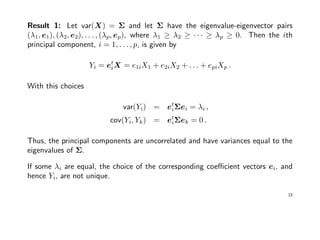
Result 1: Let var(X) = Σ and let Σ have the eigenvalue-eigenvector pairs
(λ1, e1), (λ2, e2), . . . , (λp, ep), where λ1 ≥ λ2 ≥ · · · ≥ λp ≥ 0. Then the ith
principal component, i = 1, . . . , p, is given by
Yi = et
iX = e1iX1 + e2iX2 + . . . + epiXp .
With this choices
var(Yi) = et
iΣei = λi ,
cov(Yi, Yk) = et
iΣek = 0 .
Thus, the principal components are uncorrelated and have variances equal to the
eigenvalues of Σ.
If some λi are equal, the choice of the corresponding coefficient vectors ei, and
hence Yi, are not unique.
15
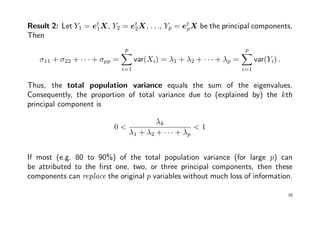
Result 2: Let Y1 = et
1X, Y2 = et
2X, . . ., Yp = et
pX be the principal components.
Then
σ11 + σ22 + · · · + σpp =
p
i=1
var(Xi) = λ1 + λ2 + · · · + λp =
p
i=1
var(Yi) .
Thus, the total population variance equals the sum of the eigenvalues.
Consequently, the proportion of total variance due to (explained by) the kth
principal component is
0 <
λk
λ1 + λ2 + · · · + λp
< 1
If most (e.g. 80 to 90%) of the total population variance (for large p) can
be attributed to the first one, two, or three principal components, then these
components can replace the original p variables without much loss of information.
16
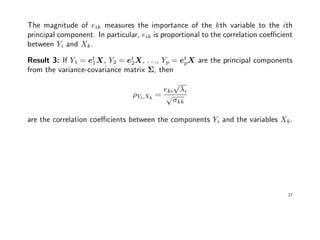
The magnitude of eik measures the importance of the kth variable to the ith
principal component. In particular, eik is proportional to the correlation coefficient
between Yi and Xk.
Result 3: If Y1 = et
1X, Y2 = et
2X, . . ., Yp = et
pX are the principal components
from the variance-covariance matrix Σ, then
ρYi,Xk
=
eki
√
λi
√
σkk
are the correlation coefficients between the components Yi and the variables Xk.
17
It is informative to consider principal components derived from multivariate normal
random variables. Suppose X ∼ Np(µ, Σ) having density function
f(x|µ, Σ) = (2π)−p/2
|Σ|−1/2
exp −
1
2
(x − µ)t
Σ−1
(x − µ) .
Then the µ centered ellipsoids of constant density are
(x − µ)t
Σ−1
(x − µ) = c2
.
In the two-dimensional case x = (x1, x2)t
this equals
1
1 − ρ2
12
x1 − µ1
√
σ11
2
+
x2 − µ2
√
σ22
2
− 2ρ12
x1 − µ1
√
σ11
x2 − µ2
√
σ22
= c2
.
These ellipsoids have axes ±c
√
λiei, i = 1, . . . , p.
18
Example: Suppose x = (x1, x2)t
∼ N2(µ, Σ), with µ = (0, 0)t
and
Σ =
σ11 = 9 σ12 = 9/4
σ21 = 9/4 σ22 = 1
giving ρ12 = (9/4)/
√
9 · 1 = 3/4.
The eigen-analysis of Σ results in
> sigma <- matrix(c(9, 9/4, 9/4, 1), 2, 2)
> e <- eigen(sigma, symmetric=TRUE); e
$values
[1] 9.58939 0.41061
$vectors
[,1] [,2]
[1,] -0.96736 0.25340
[2,] -0.25340 -0.96736
19
−3 −2 −1 0 1 2 3
−3−2−10123
x1
x2 # check length of eigenvectors
> e$vectors[2,1]^2+e$vectors[1,1]^2
[1] 1
> e$vectors[2,2]^2+e$vectors[1,2]^2
[1] 1
# slopes of major & minor axes
> e$vectors[2,1]/e$vectors[1,1]
[1] 0.2619511
> e$vectors[2,2]/e$vectors[1,2]
[1] -3.817507
# endpoints of of major&minor axes
> sqrt(e$values[1])*e$vectors[,1]
[1] -2.9956024 -0.7847013
> sqrt(e$values[2])*e$vectors[,2]
[1] 0.1623767 -0.6198741
20
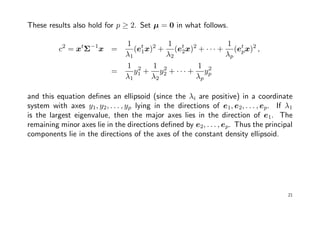
These results also hold for p ≥ 2. Set µ = 0 in what follows.
c2
= xt
Σ−1
x =
1
λ1
(et
1x)2
+
1
λ2
(et
2x)2
+ · · · +
1
λp
(et
px)2
,
=
1
λ1
y2
1 +
1
λ2
y2
2 + · · · +
1
λp
y2
p
and this equation defines an ellipsoid (since the λi are positive) in a coordinate
system with axes y1, y2, . . . , yp lying in the directions of e1, e2, . . . , ep. If λ1
is the largest eigenvalue, then the major axes lies in the direction of e1. The
remaining minor axes lie in the directions defined by e2, . . . , ep. Thus the principal
components lie in the directions of the axes of the constant density ellipsoid.
21
Principal Components obtained from Standardized Variables
Instead of using X = (X1, X2, . . . , Xp)t
we now calculate the principal
components from Z = (Z1, Z2, . . . , Zp)t
, where
Zi =
Xi − µi
√
σii
.
In matrix notation this equals
Z = V 1/2
−1
(X − µ) ,
where the diagonal standard deviation matrix V 1/2
is defined as
V 1/2
=


√
σ11
...
√
σpp

 .
22
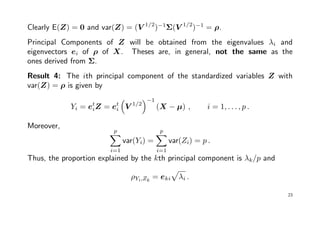
Clearly E(Z) = 0 and var(Z) = (V 1/2
)−1
Σ(V 1/2
)−1
= ρ.
Principal Components of Z will be obtained from the eigenvalues λi and
eigenvectors ei of ρ of X. Theses are, in general, not the same as the
ones derived from Σ.
Result 4: The ith principal component of the standardized variables Z with
var(Z) = ρ is given by
Yi = et
iZ = et
i V 1/2
−1
(X − µ) , i = 1, . . . , p .
Moreover,
p
i=1
var(Yi) =
p
i=1
var(Zi) = p .
Thus, the proportion explained by the kth principal component is λk/p and
ρYi,Zk
= eki λi .
23
Example cont’ed: Let again x = (x1, x2)t
∼ N2(µ, Σ), with µ = (0, 0)t
and
Σ =
9 9/4
9/4 1
=⇒ ρ =
1 3/4
3/4 1
.
The eigen-analysis of ρ now results in:
> rho <- matrix(c(1, 3/4, 3/4, 1), 2, 2)
> e <- eigen(rho, symmetric=TRUE); e
$values
[1] 1.75 0.25
$vectors
[,1] [,2]
[1,] 0.70711 0.70711
[2,] 0.70711 -0.70711
The total population variance is p = 2, and 1.75/2 = 87.5% of this variance is
already explained by the first principal component.
24
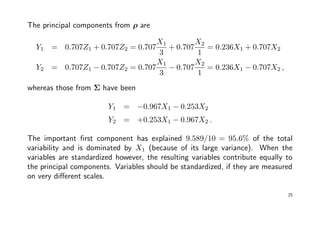
The principal components from ρ are
Y1 = 0.707Z1 + 0.707Z2 = 0.707
X1
3
+ 0.707
X2
1
= 0.236X1 + 0.707X2
Y2 = 0.707Z1 − 0.707Z2 = 0.707
X1
3
− 0.707
X2
1
= 0.236X1 − 0.707X2 ,
whereas those from Σ have been
Y1 = −0.967X1 − 0.253X2
Y2 = +0.253X1 − 0.967X2 .
The important first component has explained 9.589/10 = 95.6% of the total
variability and is dominated by X1 (because of its large variance). When the
variables are standardized however, the resulting variables contribute equally to
the principal components. Variables should be standardized, if they are measured
on very different scales.
25
Summarizing Sample Variation by Principal Components
So far we have dealt with population means µ and variances Σ. If we analyze a
sample then we have to replace Σ and µ by their empirical versions S and x.
The eigenvalues and eigenvectors are then based on S or R instead of Σ or ρ.
> library(mva)
> attach(aimu)
> options(digits=2)
> pca <- princomp(aimu[ , 3:8])
> summary(pca)
Importance of components:
Comp.1 Comp.2 Comp.3 Comp.4 Comp.5 Comp.6
Standard deviation 96.3 29.443 10.707 7.9581 4.4149 1.30332
Proportion of Variance 0.9 0.084 0.011 0.0061 0.0019 0.00016
Cumulative Proportion 0.9 0.981 0.992 0.9980 0.9998 1.00000
> pca$center # the means that were subtracted
age height weight fvc fev1 fevp
30 177 77 553 460 83
26
> pca$scale # the scalings applied to each variable
age height weight fvc fev1 fevp
1 1 1 1 1 1
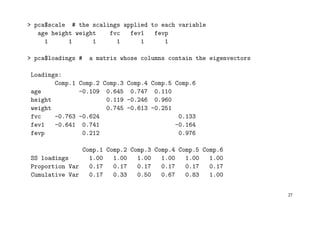
> pca$loadings # a matrix whose columns contain the eigenvectors
Loadings:
Comp.1 Comp.2 Comp.3 Comp.4 Comp.5 Comp.6
age -0.109 0.645 0.747 0.110
height 0.119 -0.246 0.960
weight 0.745 -0.613 -0.251
fvc -0.763 -0.624 0.133
fev1 -0.641 0.741 -0.164
fevp 0.212 0.976
Comp.1 Comp.2 Comp.3 Comp.4 Comp.5 Comp.6
SS loadings 1.00 1.00 1.00 1.00 1.00 1.00
Proportion Var 0.17 0.17 0.17 0.17 0.17 0.17
Cumulative Var 0.17 0.33 0.50 0.67 0.83 1.00
27
> pca$scores # values of the p principal components for each observation
Comp.1 Comp.2 Comp.3 Comp.4 Comp.5 Comp.6
1 22.84 12.998 4.06 13.131 -1.908 0.0408
2 -147.40 -6.633 -5.14 14.009 -2.130 -0.2862
3 159.64 -23.255 9.60 0.059 5.372 -0.8199
:
78 52.42 -2.409 1.68 9.169 3.716 0.6386
79 -82.87 -5.951 7.82 11.068 0.834 -0.4171
> plot(pca) # or screeplot(pca)
> plot(pca$scores[ , 1:2])
> identify(qqnorm(pca$scores[, 1])); identify(qqnorm(pca$scores[, 2]))
28
Comp.1 Comp.3 Comp.5
pcaVariances
02000400060008000
−200 −100 0 100 200
−50050
Comp.1
Comp.2
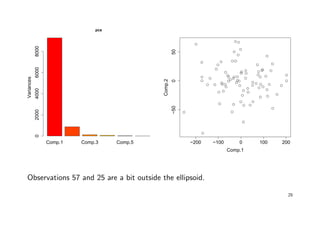
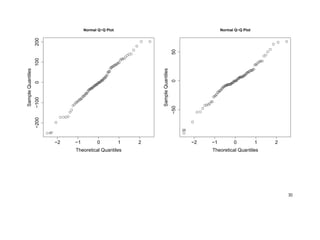
Observations 57 and 25 are a bit outside the ellipsoid.
29
−2 −1 0 1 2
−200−1000100200
Normal Q−Q Plot
Theoretical Quantiles
SampleQuantiles
57
−2 −1 0 1 2
−50050
Normal Q−Q Plot
Theoretical Quantiles
SampleQuantiles
25
30
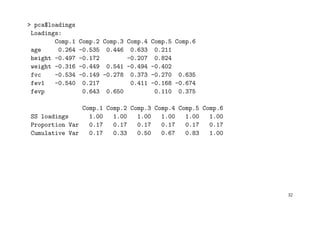
If we base the analysis on the sample correlation matrix, we get
> pca <- princomp(aimu[ , 3:8], cor=TRUE)
> summary(pca)
Importance of components:
Comp.1 Comp.2 Comp.3 Comp.4 Comp.5 Comp.6
Standard deviation 1.69 1.23 0.91 0.685 0.584 0.0800
Proportion of Variance 0.47 0.25 0.14 0.078 0.057 0.0011
Cumulative Proportion 0.47 0.73 0.86 0.942 0.999 1.0000
> pca$center
age height weight fvc fev1 fevp
30 177 77 553 460 83
> pca$scale
age height weight fvc fev1 fevp
10.4 6.7 10.4 75.8 65.5 6.4
31
> pca$loadings
Loadings:
Comp.1 Comp.2 Comp.3 Comp.4 Comp.5 Comp.6
age 0.264 -0.535 0.446 0.633 0.211
height -0.497 -0.172 -0.207 0.824
weight -0.316 -0.449 0.541 -0.494 -0.402
fvc -0.534 -0.149 -0.278 0.373 -0.270 0.635
fev1 -0.540 0.217 0.411 -0.168 -0.674
fevp 0.643 0.650 0.110 0.375
Comp.1 Comp.2 Comp.3 Comp.4 Comp.5 Comp.6
SS loadings 1.00 1.00 1.00 1.00 1.00 1.00
Proportion Var 0.17 0.17 0.17 0.17 0.17 0.17
Cumulative Var 0.17 0.33 0.50 0.67 0.83 1.00
32
Comp.1 Comp.3 Comp.5
pcaVariances
0.00.51.01.52.02.5
−4 −2 0 2
−2−1012
Comp.1
Comp.2
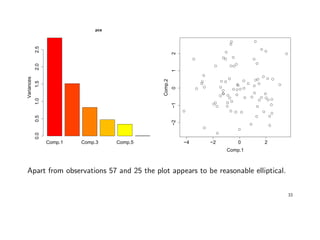
Apart from observations 57 and 25 the plot appears to be reasonable elliptical.
33
Factor Analysis
Purpose of this (controversial) technique is to describe (if possible) the covariance
relationships among many variables in terms of a few underlying but unobservable,
random quantities called factors.
Suppose variables can be grouped by their correlations. All variables within a
group are highly correlated among themselves but have small correlations with
variables in a different group. It is conceivable that each such group represents a
single underlying construct (factor), that is responsible for the correlations.
E.g., correlations from the group of test scores in French, English, Mathematics
suggest an underlying intelligence factor. A second group of variables representing
physical fitness scores might correspond to another factor.
Factor analysis can be considered as an extension of principal component analysis.
Both attempt to approximate the covariance matrix Σ.
34
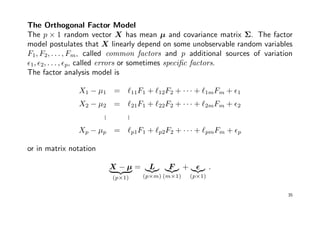
The Orthogonal Factor Model
The p × 1 random vector X has mean µ and covariance matrix Σ. The factor
model postulates that X linearly depend on some unobservable random variables
F1, F2, . . . , Fm, called common factors and p additional sources of variation
1, 2, . . . , p, called errors or sometimes specific factors.
The factor analysis model is
X1 − µ1 = 11F1 + 12F2 + · · · + 1mFm + 1
X2 − µ2 = 21F1 + 22F2 + · · · + 2mFm + 2
... ...
Xp − µp = p1F1 + p2F2 + · · · + pmFm + p
or in matrix notation
X − µ
(p×1)
= L
(p×m)
F
(m×1)
+
(p×1)
.
35
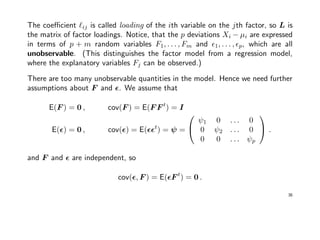
The coefficient ij is called loading of the ith variable on the jth factor, so L is
the matrix of factor loadings. Notice, that the p deviations Xi − µi are expressed
in terms of p + m random variables F1, . . . , Fm and 1, . . . , p, which are all
unobservable. (This distinguishes the factor model from a regression model,
where the explanatory variables Fj can be observed.)
There are too many unobservable quantities in the model. Hence we need further
assumptions about F and . We assume that
E(F ) = 0 , cov(F ) = E(F F t
) = I
E( ) = 0 , cov( ) = E( t
) = ψ =


ψ1 0 . . . 0
0 ψ2 . . . 0
0 0 . . . ψp

 .
and F and are independent, so
cov( , F ) = E( F t
) = 0 .
36
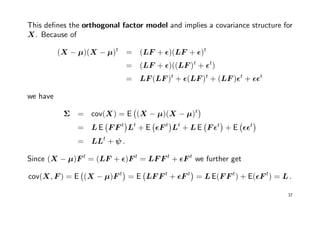
This defines the orthogonal factor model and implies a covariance structure for
X. Because of
(X − µ)(X − µ)t
= (LF + )(LF + )t
= (LF + )((LF )t
+ t
)
= LF (LF )t
+ (LF )t
+ (LF ) t
+ t
we have
Σ = cov(X) = E (X − µ)(X − µ)t
= L E F F t
Lt
+ E F t
Lt
+ L E F t
+ E t
= LLt
+ ψ .
Since (X − µ)F t
= (LF + )F t
= LF F t
+ F t
we further get
cov(X, F ) = E (X − µ)F t
= E LF F t
+ F t
= L E(F F t
) + E( F t
) = L .
37
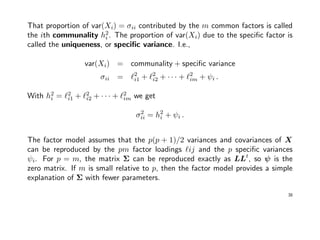
That proportion of var(Xi) = σii contributed by the m common factors is called
the ith communality h2
i . The proportion of var(Xi) due to the specific factor is
called the uniqueness, or specific variance. I.e.,
var(Xi) = communality + specific variance
σii = 2
i1 + 2
i2 + · · · + 2
im + ψi .
With h2
i = 2
i1 + 2
i2 + · · · + 2
im we get
σ2
ii = h2
i + ψi .
The factor model assumes that the p(p + 1)/2 variances and covariances of X
can be reproduced by the pm factor loadings ij and the p specific variances
ψi. For p = m, the matrix Σ can be reproduced exactly as LLt
, so ψ is the
zero matrix. If m is small relative to p, then the factor model provides a simple
explanation of Σ with fewer parameters.
38
Drawbacks:
• Most covariance matrices can not be factored as LLt
+ ψ, where m << p.
• There is some inherent ambiguity associated with the factor model: let T be
any m × m orthogonal matrix so that T T t
= T T = I. then we can rewrite the
factor model as
X − µ = LF + = LT T t
F + = L∗
F ∗
+ .
Since with L∗
= LT and F ∗
= T F we also have
E(F ∗
) = T E(F ) = 0 , and cov(F ∗
) = T t
cov(F )T = T t
T = I ,
it is impossible to distinguish the loadings in L from those in L∗
. The factors F
and F ∗
have the same statistical properties.
39
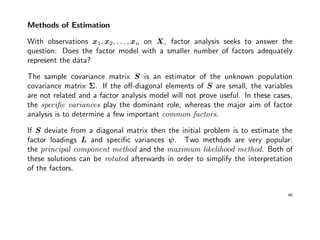
Methods of Estimation
With observations x1, x2, . . . , xn on X, factor analysis seeks to answer the
question: Does the factor model with a smaller number of factors adequately
represent the data?
The sample covariance matrix S is an estimator of the unknown population
covariance matrix Σ. If the off-diagonal elements of S are small, the variables
are not related and a factor analysis model will not prove useful. In these cases,
the specific variances play the dominant role, whereas the major aim of factor
analysis is to determine a few important common factors.
If S deviate from a diagonal matrix then the initial problem is to estimate the
factor loadings L and specific variances ψ. Two methods are very popular:
the principal component method and the maximum likelihood method. Both of
these solutions can be rotated afterwards in order to simplify the interpretation
of the factors.
40
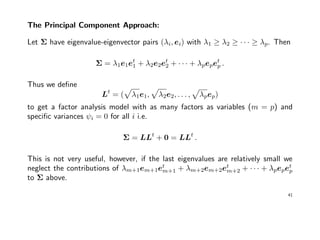
The Principal Component Approach:
Let Σ have eigenvalue-eigenvector pairs (λi, ei) with λ1 ≥ λ2 ≥ · · · ≥ λp. Then
Σ = λ1e1et
1 + λ2e2et
2 + · · · + λpepet
p .
Thus we define
Lt
= ( λ1e1, λ2e2, . . . , λpep)
to get a factor analysis model with as many factors as variables (m = p) and
specific variances ψi = 0 for all i i.e.
Σ = LLt
+ 0 = LLt
.
This is not very useful, however, if the last eigenvalues are relatively small we
neglect the contributions of λm+1em+1et
m+1 + λm+2em+2et
m+2 + · · · + λpepet
p
to Σ above.
41
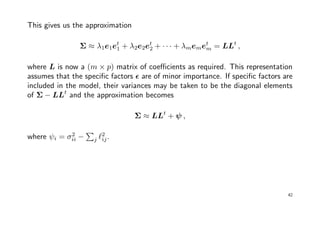
This gives us the approximation
Σ ≈ λ1e1et
1 + λ2e2et
2 + · · · + λmemet
m = LLt
,
where L is now a (m × p) matrix of coefficients as required. This representation
assumes that the specific factors are of minor importance. If specific factors are
included in the model, their variances may be taken to be the diagonal elements
of Σ − LLt
and the approximation becomes
Σ ≈ LLt
+ ψ ,
where ψi = σ2
ii − j
2
ij.
42
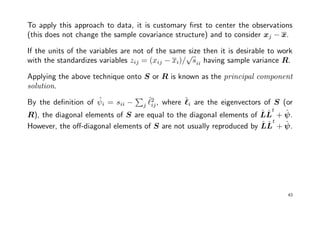
To apply this approach to data, it is customary first to center the observations
(this does not change the sample covariance structure) and to consider xj − x.
If the units of the variables are not of the same size then it is desirable to work
with the standardizes variables zij = (xij − xi)/
√
sii having sample variance R.
Applying the above technique onto S or R is known as the principal component
solution.
By the definition of ˆψi = sii − j
ˆ2
ij, where ˆi are the eigenvectors of S (or
R), the diagonal elements of S are equal to the diagonal elements of ˆLˆL
t
+ ˆψ.
However, the off-diagonal elements of S are not usually reproduced by ˆLˆL
t
+ ˆψ.
43
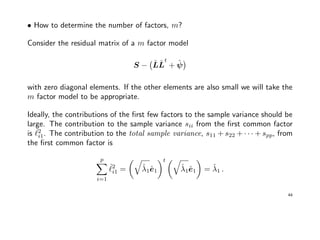
• How to determine the number of factors, m?
Consider the residual matrix of a m factor model
S − ˆLˆL
t
+ ˆψ
with zero diagonal elements. If the other elements are also small we will take the
m factor model to be appropriate.
Ideally, the contributions of the first few factors to the sample variance should be
large. The contribution to the sample variance sii from the first common factor
is ˆ2
i1. The contribution to the total sample variance, s11 + s22 + · · · + spp, from
the first common factor is
p
i=1
ˆ2
i1 = ˆλ1ˆe1
t
ˆλ1ˆe1 = ˆλ1 .
44
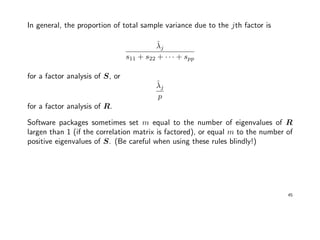
In general, the proportion of total sample variance due to the jth factor is
ˆλj
s11 + s22 + · · · + spp
for a factor analysis of S, or
ˆλj
p
for a factor analysis of R.
Software packages sometimes set m equal to the number of eigenvalues of R
largen than 1 (if the correlation matrix is factored), or equal m to the number of
positive eigenvalues of S. (Be careful when using these rules blindly!)
45
Example: In a consumer-preference study, a number of customers were asked to
rate several attributes of a new product. The correlation matrix of the responses
was calculated.
Taste 1.00 0.02 0.96 0.42 0.01
Good buy for money 0.02 1.00 0.13 0.71 0.85
Flavor 0.96 0.13 1.00 0.50 0.11
Suitable for snack 0.42 0.71 0.50 1.00 0.79
Provides lots of energy 0.01 0.85 0.11 0.79 1.00
> library(mva)
> R <- matrix(c(1.00,0.02,0.96,0.42,0.01,
0.02,1.00,0.13,0.71,0.85,
0.96,0.13,1.00,0.50,0.11,
0.42,0.71,0.50,1.00,0.79,
0.01,0.85,0.11,0.79,1.00), 5, 5)
> eigen(R)
$values
[1] 2.85309042 1.80633245 0.20449022 0.10240947 0.03367744
46
$vectors
[,1] [,2] [,3] [,4] [,5]
[1,] 0.3314539 0.60721643 0.09848524 0.1386643 0.701783012
[2,] 0.4601593 -0.39003172 0.74256408 -0.2821170 0.071674637
[3,] 0.3820572 0.55650828 0.16840896 0.1170037 -0.708716714
[4,] 0.5559769 -0.07806457 -0.60158211 -0.5682357 0.001656352
[5,] 0.4725608 -0.40418799 -0.22053713 0.7513990 0.009012569
The first 2 eigenvalues of R are the only ones being larger than 1. These two will
account for
2.853 + 1.806
5
= 0.93
of the total (standardized) sample variance. Thus we decide to set m = 2.
There is no special function available in R allowing to get the estimated factor
loadings, communalities, and specific variances (uniquenesses). Hence we directly
calculate those quantities.
47
> L <- matrix(rep(0, 10), 5, 2) # factor loadings
> for (j in 1:2) L[ ,j] <- sqrt(eigen(R)$values[j]) * eigen(R)$vectors[ ,j]
[,1] [,2]
[1,] 0.560 0.816
[2,] 0.777 -0.524
[3,] 0.645 0.748
[4,] 0.939 -0.105
[5,] 0.798 -0.543
> h2 <- diag(L %*% t(L)); h2 # communalities
[1] 0.979 0.879 0.976 0.893 0.932
> psi <- diag(R) - h2; psi # specific variances
[1] 0.0205 0.1211 0.0241 0.1071 0.0678
> R - (L %*% t(L) + diag(psi)) # residuals
[,1] [,2] [,3] [,4] [,5]
[1,] 0.0000 0.013 -0.0117 -0.020 0.0064
[2,] 0.0126 0.000 0.0205 -0.075 -0.0552
[3,] -0.0117 0.020 0.0000 -0.028 0.0012
[4,] -0.0201 -0.075 -0.0276 0.000 -0.0166
[5,] 0.0064 -0.055 0.0012 -0.017 0.0000
48
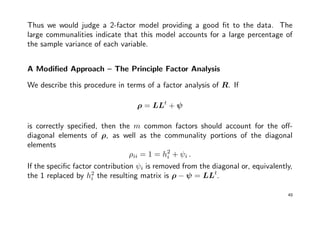
Thus we would judge a 2-factor model providing a good fit to the data. The
large communalities indicate that this model accounts for a large percentage of
the sample variance of each variable.
A Modified Approach – The Principle Factor Analysis
We describe this procedure in terms of a factor analysis of R. If
ρ = LLt
+ ψ
is correctly specified, then the m common factors should account for the off-
diagonal elements of ρ, as well as the communality portions of the diagonal
elements
ρii = 1 = h2
i + ψi .
If the specific factor contribution ψi is removed from the diagonal or, equivalently,
the 1 replaced by h2
i the resulting matrix is ρ − ψ = LLt
.
49
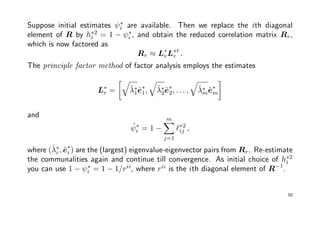
Suppose initial estimates ψ∗
i are available. Then we replace the ith diagonal
element of R by h∗2
i = 1 − ψ∗
i , and obtain the reduced correlation matrix Rr,
which is now factored as
Rr ≈ L∗
rL∗t
r .
The principle factor method of factor analysis employs the estimates
L∗
r = ˆλ∗
1ˆe∗
1, ˆλ∗
2ˆe∗
2, . . . , ˆλ∗
mˆe∗
m
and
ˆψ∗
i = 1 −
m
j=1
∗2
ij ,
where (ˆλ∗
i , ˆe∗
i ) are the (largest) eigenvalue-eigenvector pairs from Rr. Re-estimate
the communalities again and continue till convergence. As initial choice of h∗2
i
you can use 1 − ψ∗
i = 1 − 1/rii
, where rii
is the ith diagonal element of R−1
.
50
Example cont’ed:
> h2 <- 1 - 1/diag(solve(R)); h2 # initial guess
[1] 0.93 0.74 0.94 0.80 0.83
> R.r <- R; diag(R.r) <- h2
> L.star <- matrix(rep(0, 10), 5, 2) # factor loadings
> for (j in 1:2) L.star[ ,j] <- sqrt(eigen(R.r)$values[j]) * eigen(R.r)$vectors[ ,j]
> h2.star <- diag(L.star %*% t(L.star)); h2.star # communalities
[1] 0.95 0.76 0.95 0.83 0.88
> # apply 3 times to get convergence
> R.r <- R; diag(R.r) <- h2.star
> L.star <- matrix(rep(0, 10), 5, 2) # factor loadings
> for (j in 1:2) L.star[ ,j] <- sqrt(eigen(R.r)$values[j]) * eigen(R.r)$vectors[ ,j]
> h2.star <- diag(L.star %*% t(L.star)); h2.star # communalities
[1] 0.97 0.77 0.96 0.83 0.93
51
> L.star # loadings
[,1] [,2]
[1,] -0.60 -0.78
[2,] -0.71 0.51
[3,] -0.68 -0.71
[4,] -0.90 0.15
[5,] -0.77 0.58
> 1 - h2.star # specific variances
[1] 0.032 0.231 0.039 0.167 0.069
The principle components method for R can be regarded as a principal factor
method with initial communality estimates of unity (or specific variance estimates
equal to zero) and without iterating.
The only estimating procedure available in R is the maximum likelihood method.
Beside the PCA method this is the only one, which is strongly recommended and
shortly discussed now.
52
Maximum Likelihood Method
We now assume that the common factors F and the specific factors are from a
normal distribution. Then maximum likelihood estimates of the unknown factor
loadings L and the specific variances ψ may be obtained.
This strategy is the only one which is implemented in R and is now applied onto
our example.
Example cont’ed:
> factanal(covmat = R, factors=2)
Call:
factanal(factors = 2, covmat = R, rotation = "none")
Uniquenesses: [1] 0.028 0.237 0.040 0.168 0.052
Loadings:
53
Factor1 Factor2
[1,] 0.976 -0.139
[2,] 0.150 0.860
[3,] 0.979
[4,] 0.535 0.738
[5,] 0.146 0.963
Factor1 Factor2
SS loadings 2.24 2.23
Proportion Var 0.45 0.45
Cumulative Var 0.45 0.90
54
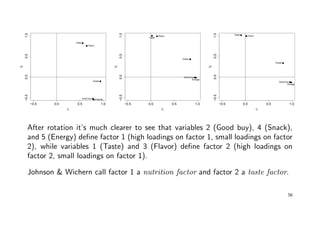
Factor Rotation
Since the original factor loadings are (a) not unique, and (b) usually not
interpretable, we rotate them until a simple structure is achieved.
We concentrate on graphical methods for m = 2. A plot of the pairs of factor
loadings (ˆi1, ˆi2), yields p points, each point corresponding to a variable. These
points can be rotated by using either the varimax or the promax criterion.
Example cont’ed: Estimates of the factor loadings from the principal component
approach were:
> L
[,1] [,2]
[1,] 0.560 0.816
[2,] 0.777 -0.524
[3,] 0.645 0.748
[4,] 0.939 -0.105
[5,] 0.798 -0.543
> varimax(L)
[,1] [,2]
[1,] 0.021 0.989
[2,] 0.937 -0.013
[3,] 0.130 0.979
[4,] 0.843 0.427
[5,] 0.965 -0.017
> promax(L)
[,1] [,2]
[1,] -0.093 1.007
[2,] 0.958 -0.124
[3,] 0.019 0.983
[4,] 0.811 0.336
[5,] 0.987 -0.131
55
−0.5 0.0 0.5 1.0
−0.50.00.51.0
l1
l2
Taste
Good buy
Flavor
Snack
Energie
−0.5 0.0 0.5 1.0
−0.50.00.51.0
l1
l2
Taste
Good buy
Flavor
Snack
Energie
−0.5 0.0 0.5 1.0
−0.50.00.51.0
l1
l2
Taste
Good buy
Flavor
Snack
Energie
After rotation it’s much clearer to see that variables 2 (Good buy), 4 (Snack),
and 5 (Energy) define factor 1 (high loadings on factor 1, small loadings on factor
2), while variables 1 (Taste) and 3 (Flavor) define factor 2 (high loadings on
factor 2, small loadings on factor 1).
Johnson & Wichern call factor 1 a nutrition factor and factor 2 a taste factor.
56
Factor Scores
In factor analysis, interest is usually centered on the parameters in the factor
model. However, the estimated values of the common factors, called factor
scores, may also be required (e.g., for diagnostic purposes).
These scores are not estimates of unknown parameters in the usual sense.
They are rather estimates of values for the unobserved random factor vectors.
Two methods are provided in factanal( ..., scores = ): the regression
method of Thomson, and the weighted least squares method of Bartlett.
Both these methods allows us to plot n such p-dimensional observations as n
m-dimensional scores.
57
Example: A factor analytic analysis of the fvc data might be as follows:
• calculate the maximum likelihood estimates of the loadings w/o rotation,
• apply a varimax rotation on these estimates and check plot of the loadings,
• estimate factor scores and plot them for the n observations.
> fa <- factanal(aimu[, 3:8], factors=2, scores="none", rotation="none"); fa
Uniquenesses:
age height weight VC FEV1 FEV1.VC
0.782 0.523 0.834 0.005 0.008 0.005
Loadings:
Factor1 Factor2
age -0.378 -0.274
height 0.682 -0.109
weight 0.378 -0.153
VC 0.960 -0.270
FEV1 0.951 0.295
FEV1.VC 0.993
58
Factor1 Factor2
SS loadings 2.587 1.256
Proportion Var 0.431 0.209
Cumulative Var 0.431 0.640
> L <- fa$loadings
> Lv <- varimax(fa$loadings); Lv
$loadings
Factor1 Factor2
age -0.2810 -0.37262
height 0.6841 0.09667
weight 0.4057 -0.03488
VC 0.9972 0.02385
FEV1 0.8225 0.56122
FEV1.VC -0.2004 0.97716
$rotmat
[,1] [,2]
[1,] 0.9559 0.2937
[2,] -0.2937 0.9559
59
> plot(L); plot(Lv)
−0.5 0.0 0.5 1.0
−0.50.00.51.0
l1
l2
age
height
weight
VC
FEV1
FEV1.VC
−0.5 0.0 0.5 1.0
−0.50.00.51.0
l1
l2
age
height
weight
VC
FEV1
FEV1.VC
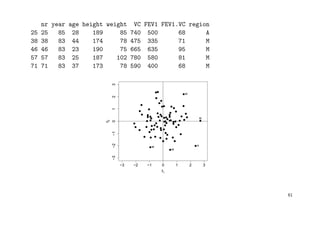
> s <- factanal(aimu[, 3:8], factors=2, scores="reg", rot="varimax")$scores
> plot(s); i <- identify(s, region); aimu[i, ]
60
nr year age height weight VC FEV1 FEV1.VC region
25 25 85 28 189 85 740 500 68 A
38 38 83 44 174 78 475 335 71 M
46 46 83 23 190 75 665 635 95 M
57 57 83 25 187 102 780 580 81 M
71 71 83 37 173 78 590 400 68 M
−3 −2 −1 0 1 2 3
−3−2−10123
f1
f2
A
M
M
M
M
A
M
M
M
M
61
Discrimination and Classification
Discriminant analysis (DA) and classification are multivariate techniques
concerned with separating distinct sets of objects (observations) and with
allocating new objects to previously defined groups (defined by a categorial
variable). There are several purposes for DA:
• (Discrimination, separation) To describe either graphically (low dimension) or
algebraically, the differential features of objects from several known collections
(populations, or groups).
• (Classification, allocation) To sort objects into 2 or more labelled classes.
Thus, we derive a rule, that is used to optimally assign a new object to the
labelled classes.
62
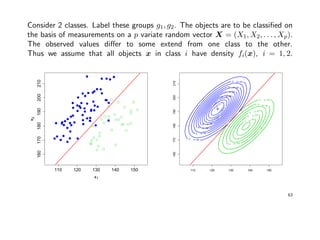
Consider 2 classes. Label these groups g1, g2. The objects are to be classified on
the basis of measurements on a p variate random vector X = (X1, X2, . . . , Xp).
The observed values differ to some extend from one class to the other.
Thus we assume that all objects x in class i have density fi(x), i = 1, 2.
110 120 130 140 150
160170180190200210
x1
x2
110 120 130 140 150
160170180190200210
63
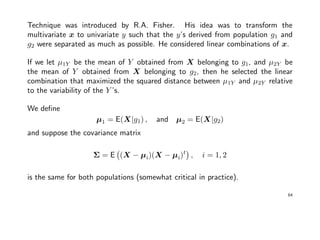
Technique was introduced by R.A. Fisher. His idea was to transform the
multivariate x to univariate y such that the y’s derived from population g1 and
g2 were separated as much as possible. He considered linear combinations of x.
If we let µ1Y be the mean of Y obtained from X belonging to g1, and µ2Y be
the mean of Y obtained from X belonging to g2, then he selected the linear
combination that maximized the squared distance between µ1Y and µ2Y relative
to the variability of the Y ’s.
We define
µ1 = E(X|g1) , and µ2 = E(X|g2)
and suppose the covariance matrix
Σ = E (X − µi)(X − µi)t
, i = 1, 2
is the same for both populations (somewhat critical in practice).
64
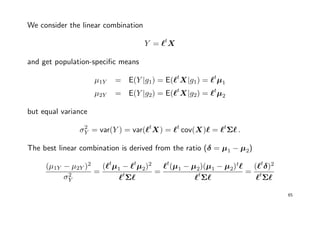
We consider the linear combination
Y = t
X
and get population-specific means
µ1Y = E(Y |g1) = E( t
X|g1) = t
µ1
µ2Y = E(Y |g2) = E( t
X|g2) = t
µ2
but equal variance
σ2
Y = var(Y ) = var( t
X) = t
cov(X) = t
Σ .
The best linear combination is derived from the ratio (δ = µ1 − µ2)
(µ1Y − µ2Y )2
σ2
Y
=
( t
µ1 − t
µ2)2
t
Σ
=
t
(µ1 − µ2)(µ1 − µ2)t
t
Σ
=
( t
δ)2
t
Σ
65
Result: Let δ = µ1 − µ2 and Y = t
X, then
( t
δ)2
t
Σ
is maximized by the choice
= cΣ−1
δ = cΣ−1
µ1 − µ2
for any c = 0. Choosing c = 1 produces the linear combination
Y = t
X = (µ1 − µ2
t
Σ−1
X
which is known as Fisher’s linear discriminant function.
66
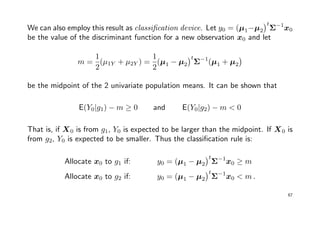
We can also employ this result as classification device. Let y0 = (µ1−µ2
t
Σ−1
x0
be the value of the discriminant function for a new observation x0 and let
m =
1
2
(µ1Y + µ2Y ) =
1
2
(µ1 − µ2
t
Σ−1
(µ1 + µ2
be the midpoint of the 2 univariate population means. It can be shown that
E(Y0|g1) − m ≥ 0 and E(Y0|g2) − m < 0
That is, if X0 is from g1, Y0 is expected to be larger than the midpoint. If X0 is
from g2, Y0 is expected to be smaller. Thus the classification rule is:
Allocate x0 to g1 if: y0 = (µ1 − µ2
t
Σ−1
x0 ≥ m
Allocate x0 to g2 if: y0 = (µ1 − µ2
t
Σ−1
x0 < m .
67
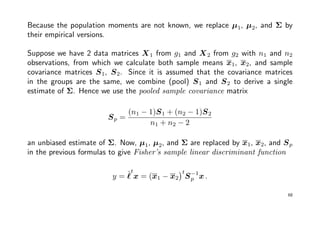
Because the population moments are not known, we replace µ1, µ2, and Σ by
their empirical versions.
Suppose we have 2 data matrices X1 from g1 and X2 from g2 with n1 and n2
observations, from which we calculate both sample means x1, x2, and sample
covariance matrices S1, S2. Since it is assumed that the covariance matrices
in the groups are the same, we combine (pool) S1 and S2 to derive a single
estimate of Σ. Hence we use the pooled sample covariance matrix
Sp =
(n1 − 1)S1 + (n2 − 1)S2
n1 + n2 − 2
an unbiased estimate of Σ. Now, µ1, µ2, and Σ are replaced by x1, x2, and Sp
in the previous formulas to give Fisher’s sample linear discriminant function
y = ˆt
x = (x1 − x2
t
S−1
p x .
68
The midpoint between both sample means is
ˆm =
1
2
(x1 − x2
t
S−1
p (x1 + x2
and the classification rule becomes
Allocate x0 to g1 if: (x1 − x2
t
S−1
p x0 ≥ ˆm
Allocate x0 to g2 if: (x1 − x2
t
S−1
p x0 < ˆm .
This idea can be easily generalized onto more than 2 classes. Moreover, instead
of using a linear discriminant function we can also use a quadratic one.
69
Example: Fisher’s Iris data
Data describing the sepal (Kelchblatt) width and length, and the petal (Bltenblatt)
width and length of 3 different Iris species (Setosa, Versicolor, Virginica) were
observed. There are 50 observation for each species.
> library(MASS)
> data(iris3)
> Iris <- data.frame(rbind(iris3[,,1], iris3[,,2], iris3[,,3]),
Sp = rep(c("s","c","v"), rep(50,3)))
> z <- lda(Sp ~ Sepal.L.+Sepal.W.+Petal.L.+Petal.W., Iris, prior = c(1,1,1)/3)
Prior probabilities of groups:
c s v
0.3333333 0.3333333 0.3333333
Group means:
Sepal.L. Sepal.W. Petal.L. Petal.W.
c 5.936 2.770 4.260 1.326
s 5.006 3.428 1.462 0.246
v 6.588 2.974 5.552 2.026
70
Coefficients of linear discriminants:
LD1 LD2
Sepal.L. -0.8293776 0.02410215
Sepal.W. -1.5344731 2.16452123
Petal.L. 2.2012117 -0.93192121
Petal.W. 2.8104603 2.83918785
Proportion of trace:
LD1 LD2
0.9912 0.0088
> predict(z, Iris)$class
[1] s s s s s s s s s s s s s s s s s s s s s s s s s s s s s s s
[32] s s s s s s s s s s s s s s s s s s s c c c c c c c c c c c c
[63] c c c c c c c c v c c c c c c c c c c c c v c c c c c c c c c
[94] c c c c c c c v v v v v v v v v v v v v v v v v v v v v v v v
[125] v v v v v v v v v c v v v v v v v v v v v v v v v v
71
> table(predict(z, Iris)$class, Iris$Sp)
c s v
c 48 0 1
s 0 50 0
v 2 0 49
> train <- sample(1:150, 75); table(Iris$Sp[train])
c s v
24 25 26
> z1 <- lda(Sp ~ Sepal.L.+Sepal.W.+Petal.L.+Petal.W., Iris,
prior = c(1,1,1)/3, subset = train)
> predict(z1, Iris[-train, ])$class
[1] s s s s s s s s s s s s s s s s s s s s s s s s s c c c c c c
[32] c c c c c c v c c c c c c c c c c c c c v v v v v v v v v v v
[63] v v v c v v v v v v v v v
> table(predict(z1, Iris[-train, ])$class, Iris[-train, ]$Sp)
c s v
c 25 0 1
s 0 25 0
v 1 0 23
72
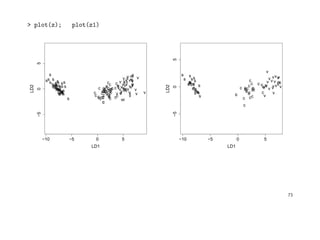
> plot(z); plot(z1)
−10 −5 0 5
−505
LD1
LD2
s
s
s s
s
s
ss
ss
s
s
ss
s
s
s
sss
s
ss
s
s
s
sss
ss
s
s
s
s
s
ss
s
s
s
s
s
ss
s
s
s
s
s c
c
c
c
c
c
c
c
c
c
c
c
c
c
c c c
c cc
c
c
cc
cc
c
cc
c cc
c c
c
c
c
c
c
c
c
c
c
c
ccccc c
v
v
v
v
v
vv
vv
v
v
v
v
v
vv
v
v
v
v
v
v
v
v
v
vvv v
v v
v
v
v
v
v
v
vv
v
vv
v
v
v
v
v
v
v
v
−10 −5 0 5
−505
LD1
LD2
v
c
c
c
v
v
c
v
s
v
c
v
s
v
c
v
c v
v
c
c
c
s
s
v
s
s
v
c
v
s
c
v
v
v
c
s vs
c c
s
c
v
v
c
v
s
s
s v
c v
s
c
c
vs
s
s
c
s
s
c
s
c
c
s
ss
s
v
v
v
s
73
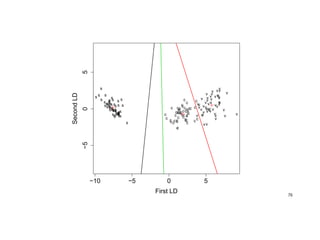
> ir.ld <- predict(z, Iris)$x # => LD1 and LD2 coordinates
> eqscplot(ir.ld, type="n", xlab="First LD", ylab="Second LD") # eq. scaled axes
> text(ir.ld, as.character(Iris$Sp)) # plot LD1 vs. LD2
> # calc group-spec. means of LD1 & LD2
> tapply(ir.ld[ , 1], Iris$Sp, mean)
c s v
1.825049 -7.607600 5.782550
> tapply(ir.ld[ , 2], Iris$Sp, mean)
c s v
-0.7278996 0.2151330 0.5127666
> # faster alternative:
> ir.m <- lda(ir.ld, Iris$Sp)$means; ir.m
LD1 LD2
c 1.825049 -0.7278996
s -7.607600 0.2151330
v 5.782550 0.5127666
> points(ir.m, pch=3, mkh=0.3, col=2) # plot group means as "+"
74
> perp <- function(x, y, ...) {
+ m <- (x+y)/2 # midpoint of the 2 group means
+ s <- -(x[1]-y[1])/(x[2]-y[2]) # perpendicular line through midpoint
+ abline(c(m[2]-s*m[1], s), ...) # draw classification regions
+ invisible()
> }
> perp(ir.m[1,], ir.m[2,], col=1) # classification decision b/w groups 1&2
> perp(ir.m[1,], ir.m[3,], col=2) # classification decision b/w groups 1&3
> perp(ir.m[2,], ir.m[3,], col=3) # classification decision b/w groups 2&3
75
−10 −5 0 5
−505
First LD
SecondLD
s
s
s
s
s
s
s
s
ss
s
s
ss
s
s
s
s
ss
s
s
s
s
s
s
sss
ss
s
s
s
s
s
ss
s
s
s
s
s
ss
s
s
s
s
s c
c
c
c
c
c
c
c
c
c
c
c
c
c
c c c
c cc
c
c
cc
c
c
c
c
c
c
cc
c c
c
c
c
c
c
c
c
c
c
c
c
c ccc c
v
v
v
v
v
v
v
v
v
v
v
v
v
v
v
v
v
v
v
v
v
v
v
v
v
vv
v v
v v
v
v
v
v
v
v
v
v
v
vv
v
v
v
v
v
v
v
v
76

Multivriada ppt ms

  • 1.
    Multivariate Statistical Analysis •1. Aspects of Multivariate Analysis • 2. Principal Components • 3. Factor Analysis • 4. Discrimination and Classification • 5. Clustering Johnson, R.A., Wichern, D.W. (1982): Applied Multivariate Statistical Analysis, Prentice Hall. 1
  • 2.
    1. Aspects ofMultivariate Analysis Multivariate data arise whenever p ≥ 1 variables are recorded. Values of these variables are observed for n distinct item, individuals, or experimental trials. We use the notation xij to indicate the particular value of the ith variable that is observed on the jth item, or trial. Thus, n measurements on p variables are displayed as p × n random matrix X: Item 1 Item 2 . . . Item j . . . Item n Variable 1: x11 x12 . . . x1j . . . x1n Variable 2: x21 x22 . . . x2j . . . x2n ... ... ... ... ... ... ... Variable i: xi1 xi2 . . . xij . . . xin ... ... ... ... ... ... ... Variable p: xp1 xp2 . . . xpj . . . xpn 2
  • 3.
    Estimating Moments: Suppose, E(X)= µ and cov(X) = Σ are the population moments. Based on a sample of size n, these quantities can be estimated by their empirical versions: Sample Mean: xi = 1 n n j=1 xij , i = 1, . . . , p Sample Variance: s2 i = sii = 1 n − 1 n j=1 xij − xi 2 , i = 1, . . . , p Sample Covariance: sik = 1 n − 1 n j=1 xij − xi xkj − xk , i = 1, . . . , p , k = 1, . . . , p . 3
  • 4.
    Summarize all elementssik into the p × p sample variance-covariance matrix S = sik i,k . Assume further, that the p × p population correlation matrix ρ is estimated by the sample correlation matrix R with entries rik = sik √ siiskk , i = 1, . . . , p , k = 1, . . . , p , where rii = 1 for all i = 1, . . . , p. > aimu <- read.table("aimu.dat", header=TRUE) > attach(aimu) > options(digits=2) > mean(aimu[ ,3:8]) age height weight fvc fev1 fevp 30 177 77 553 460 83 4
  • 5.
    > cov(aimu[ ,3:8]) ageheight weight fvc fev1 fevp age 110 -16.9 16.5 -233 -302 -20.8 height -17 45.5 34.9 351 275 -1.9 weight 16 34.9 109.6 325 212 -7.6 fvc -233 351.5 324.7 5817 4192 -86.5 fev1 -302 275.2 212.0 4192 4347 162.5 fevp -21 -1.9 -7.6 -87 162 41.3 > cor(aimu[ ,3:8]) age height weight fvc fev1 fevp age 1.00 -0.239 0.15 -0.29 -0.44 -0.309 height -0.24 1.000 0.49 0.68 0.62 -0.043 weight 0.15 0.494 1.00 0.41 0.31 -0.113 fvc -0.29 0.683 0.41 1.00 0.83 -0.177 fev1 -0.44 0.619 0.31 0.83 1.00 0.384 fevp -0.31 -0.043 -0.11 -0.18 0.38 1.000 5
  • 6.
    Distances: Consider the pointP = (x1, x2) in the plane. The straight line (Euclidian) distance, d(O, P), from P to the origin O = (0, 0) is (Pythagoras) d(O, P) = x2 1 + x2 2 . In general, if P has p coordinates so that P = (x1, x2, . . . , xp), the Euclidian distance is d(O, P) = x2 1 + x2 2 + · · · + x2 p . The distance between 2 arbitrary points P and Q = (y1, y2, . . . , yp) is given by d(P, Q) = (x1 − y1)2 + (x2 − y2)2 + · · · + (xp − yp)2 . Each coordinate contributes equally to the calculation of the Euclidian distance. It is often desirable to weight the coordinates. 6
  • 7.
    Statistical distance shouldaccount for differences in variation and correlation. Suppose we have n pairs of measurements on 2 independent variables x1 and x2: > X <- mvrnorm(30, mu=c(0, 0), Sigma=matrix(c(9,0,0,1), 2, 2)); plot(X) −6 −4 −2 0 2 4 6 −6−4−20246 X[,1] X[,2] Variability in x1 direction is much larger than in x2 direction! Values that are a given deviation from the origin in the x1 direction are not as surprising as are values in x2 direction. It seems reasonable to weight an x2 coordinate more heavily than an x1 coordinate of the same value when computing the distance to the origin. 7
  • 8.
    Compute the statisticaldistance from the standardized coordinates x∗ 1 = x1 √ s11 and x∗ 2 = x2 √ s22 as d(O, P) = (x∗ 1)2 + (x∗ 2)2 = x1 √ s11 2 + x2 √ s22 2 = x2 1 s11 + x2 2 s22 . This can be generalized to accommodate the calculation of statistical distance from an arbitrary point P = (x1, x2) to any fixed point Q = (y1, y2). If the coordinate variables vary independent of one other, the distance from P to Q is d(P, Q) = (x1 − y1)2 s11 + (x2 − y2)2 s22 . The extension to more than 2 dimensions is straightforward. 8
  • 9.
    Let P =(x1, x2, . . . , xp) and Q = (y1, y2, . . . , yp). Assume again that Q is fixed. The statistical distance from P to Q is d(P, Q) = (x1 − y1)2 s11 + (x2 − y2)2 s22 + · · · + (xp − yp)2 spp . • The distance of P to the origin is obtained by setting y1 = y2 = · · · = yp = 0. • If s11 = s22 = · · · = spp, the Euclidian distance is appropriate. −2 −1 0 1 2 −2−1012 x1 x2 Consider a set of paired measurements (x1, x2) with x1 = x2 = 0, and s11 = 4, s22 = 1. Suppose the x1 measurements are unrelated to the x2 ones. We measure the squared distance of an arbitrary P = (x1, x2) to (0, 0) by d2 (O, P) = x2 1/4 + x2 2/1. All points with constant distance 1 satisfy: x4 1/4 + x2 2/1 = 1, an Ellipse centered at (0, 0). 9
  • 10.
    This definition ofstatistical distance still does not include most of the important cases because of the assumption of independent coordinates. > X <- mvrnorm(30, mu=c(0, 0), Sigma=matrix(c(1,2.9,2.9,9), 2, 2)) > plot(X); abline(h=0, v=0); abline(0, 3); abline(0, -1/3) −6 −4 −2 0 2 4 6 −6−4−20246 x1 x2 θ x~ 1 x~ 2 Here, the x1 measurements do not vary independently of x2. The coordinates exhibit a tendency to be large or small together. Moreover, the variability in the x2 directions is larger than in x1 direction. What is a meaningful measure of distance? Actually, we can use what we have already introduced! But before, we only have to rotate the coordinate system through the angle θ and label the rotated axes ˜x1 and ˜x2. 10
  • 11.
    Now, we definethe distance of a point P = (x1, x2) from the origin (0, 0) as d(O, P) = ˜x2 1 ˜s11 + ˜x2 2 ˜s22 , where ˜sii denotes the sample variance computed with the (rotated) ˜xi measurements. Alternative measures of distance can be useful, provided they satisfy the properties 1. d(P, Q) = d(Q, P), 2. d(P, Q) > 0 if P = Q, 3. d(P, Q) = 0 if P = Q, 4. d(P, Q) ≤ d(P, R) + d(R, Q), R being any other point different to P and Q. 11
  • 12.
    Principle Components (PCA) Nowwe try to explain the variance-covariance structure through a few linear combinations of the original p variables X1, X2, . . . , Xp (data reduction). Let a random vector X = (X1, X2, . . . , Xp)t have p × p population variance- covariance matrix var(X) = Σ. Denote the eigenvalues of Σ by λ1 ≥ λ2 ≥ · · · ≥ λp ≥ 0. Consider the arbitrary linear combinations with fixed vectors i Y1 = t 1X = 11X1 + 21X2 + · · · + p1Xp Y2 = t 2X = 12X1 + 22X2 + · · · + p2Xp ... ... Yp = t pX = 1pX1 + 2pX2 + · · · + ppXp 12
  • 13.
    For these var(Yi) =var( t iX) = t iΣ i cov(Yi, Yk) = cov( t iX, t kX) = t iΣ k We define as principal components those linear combinations Y1, Y2, . . . , Yp, which are uncorrelated and whose variances are as large as possible. Since increasing the length of i would also increase the variances, we restrict our search onto vectors i, which are of unit length, i.e. j 2 ij = t i i = 1. 13
  • 14.
    Procedure: 1. the firstprincipal component is the linear combination T 1 X that maximizes var( t 1X) subject to t 1 1 = 1. 2. the second principal component is the linear combination T 2 X that maximizes var( t 2X) subject to t 2 2 = 1 and with cov( t 1X, t 2X) = 0 (uncorrelated with the first one). 3. the ith principal component is the linear combination T i X that maximizes var( t iX) subject to t i i = 1 and with cov( t iX, t kX) = 0, for k < i (uncorrelated with all the previous ones). How to find all these vectors i ? We will use well known some results from matrix theory. 14
  • 15.
    Result 1: Letvar(X) = Σ and let Σ have the eigenvalue-eigenvector pairs (λ1, e1), (λ2, e2), . . . , (λp, ep), where λ1 ≥ λ2 ≥ · · · ≥ λp ≥ 0. Then the ith principal component, i = 1, . . . , p, is given by Yi = et iX = e1iX1 + e2iX2 + . . . + epiXp . With this choices var(Yi) = et iΣei = λi , cov(Yi, Yk) = et iΣek = 0 . Thus, the principal components are uncorrelated and have variances equal to the eigenvalues of Σ. If some λi are equal, the choice of the corresponding coefficient vectors ei, and hence Yi, are not unique. 15
  • 16.
    Result 2: LetY1 = et 1X, Y2 = et 2X, . . ., Yp = et pX be the principal components. Then σ11 + σ22 + · · · + σpp = p i=1 var(Xi) = λ1 + λ2 + · · · + λp = p i=1 var(Yi) . Thus, the total population variance equals the sum of the eigenvalues. Consequently, the proportion of total variance due to (explained by) the kth principal component is 0 < λk λ1 + λ2 + · · · + λp < 1 If most (e.g. 80 to 90%) of the total population variance (for large p) can be attributed to the first one, two, or three principal components, then these components can replace the original p variables without much loss of information. 16
  • 17.
    The magnitude ofeik measures the importance of the kth variable to the ith principal component. In particular, eik is proportional to the correlation coefficient between Yi and Xk. Result 3: If Y1 = et 1X, Y2 = et 2X, . . ., Yp = et pX are the principal components from the variance-covariance matrix Σ, then ρYi,Xk = eki √ λi √ σkk are the correlation coefficients between the components Yi and the variables Xk. 17
  • 18.
    It is informativeto consider principal components derived from multivariate normal random variables. Suppose X ∼ Np(µ, Σ) having density function f(x|µ, Σ) = (2π)−p/2 |Σ|−1/2 exp − 1 2 (x − µ)t Σ−1 (x − µ) . Then the µ centered ellipsoids of constant density are (x − µ)t Σ−1 (x − µ) = c2 . In the two-dimensional case x = (x1, x2)t this equals 1 1 − ρ2 12 x1 − µ1 √ σ11 2 + x2 − µ2 √ σ22 2 − 2ρ12 x1 − µ1 √ σ11 x2 − µ2 √ σ22 = c2 . These ellipsoids have axes ±c √ λiei, i = 1, . . . , p. 18
  • 19.
    Example: Suppose x= (x1, x2)t ∼ N2(µ, Σ), with µ = (0, 0)t and Σ = σ11 = 9 σ12 = 9/4 σ21 = 9/4 σ22 = 1 giving ρ12 = (9/4)/ √ 9 · 1 = 3/4. The eigen-analysis of Σ results in > sigma <- matrix(c(9, 9/4, 9/4, 1), 2, 2) > e <- eigen(sigma, symmetric=TRUE); e $values [1] 9.58939 0.41061 $vectors [,1] [,2] [1,] -0.96736 0.25340 [2,] -0.25340 -0.96736 19
  • 20.
    −3 −2 −10 1 2 3 −3−2−10123 x1 x2 # check length of eigenvectors > e$vectors[2,1]^2+e$vectors[1,1]^2 [1] 1 > e$vectors[2,2]^2+e$vectors[1,2]^2 [1] 1 # slopes of major & minor axes > e$vectors[2,1]/e$vectors[1,1] [1] 0.2619511 > e$vectors[2,2]/e$vectors[1,2] [1] -3.817507 # endpoints of of major&minor axes > sqrt(e$values[1])*e$vectors[,1] [1] -2.9956024 -0.7847013 > sqrt(e$values[2])*e$vectors[,2] [1] 0.1623767 -0.6198741 20
  • 21.
    These results alsohold for p ≥ 2. Set µ = 0 in what follows. c2 = xt Σ−1 x = 1 λ1 (et 1x)2 + 1 λ2 (et 2x)2 + · · · + 1 λp (et px)2 , = 1 λ1 y2 1 + 1 λ2 y2 2 + · · · + 1 λp y2 p and this equation defines an ellipsoid (since the λi are positive) in a coordinate system with axes y1, y2, . . . , yp lying in the directions of e1, e2, . . . , ep. If λ1 is the largest eigenvalue, then the major axes lies in the direction of e1. The remaining minor axes lie in the directions defined by e2, . . . , ep. Thus the principal components lie in the directions of the axes of the constant density ellipsoid. 21
  • 22.
    Principal Components obtainedfrom Standardized Variables Instead of using X = (X1, X2, . . . , Xp)t we now calculate the principal components from Z = (Z1, Z2, . . . , Zp)t , where Zi = Xi − µi √ σii . In matrix notation this equals Z = V 1/2 −1 (X − µ) , where the diagonal standard deviation matrix V 1/2 is defined as V 1/2 =   √ σ11 ... √ σpp   . 22
  • 23.
    Clearly E(Z) =0 and var(Z) = (V 1/2 )−1 Σ(V 1/2 )−1 = ρ. Principal Components of Z will be obtained from the eigenvalues λi and eigenvectors ei of ρ of X. Theses are, in general, not the same as the ones derived from Σ. Result 4: The ith principal component of the standardized variables Z with var(Z) = ρ is given by Yi = et iZ = et i V 1/2 −1 (X − µ) , i = 1, . . . , p . Moreover, p i=1 var(Yi) = p i=1 var(Zi) = p . Thus, the proportion explained by the kth principal component is λk/p and ρYi,Zk = eki λi . 23
  • 24.
    Example cont’ed: Letagain x = (x1, x2)t ∼ N2(µ, Σ), with µ = (0, 0)t and Σ = 9 9/4 9/4 1 =⇒ ρ = 1 3/4 3/4 1 . The eigen-analysis of ρ now results in: > rho <- matrix(c(1, 3/4, 3/4, 1), 2, 2) > e <- eigen(rho, symmetric=TRUE); e $values [1] 1.75 0.25 $vectors [,1] [,2] [1,] 0.70711 0.70711 [2,] 0.70711 -0.70711 The total population variance is p = 2, and 1.75/2 = 87.5% of this variance is already explained by the first principal component. 24
  • 25.
    The principal componentsfrom ρ are Y1 = 0.707Z1 + 0.707Z2 = 0.707 X1 3 + 0.707 X2 1 = 0.236X1 + 0.707X2 Y2 = 0.707Z1 − 0.707Z2 = 0.707 X1 3 − 0.707 X2 1 = 0.236X1 − 0.707X2 , whereas those from Σ have been Y1 = −0.967X1 − 0.253X2 Y2 = +0.253X1 − 0.967X2 . The important first component has explained 9.589/10 = 95.6% of the total variability and is dominated by X1 (because of its large variance). When the variables are standardized however, the resulting variables contribute equally to the principal components. Variables should be standardized, if they are measured on very different scales. 25
  • 26.
    Summarizing Sample Variationby Principal Components So far we have dealt with population means µ and variances Σ. If we analyze a sample then we have to replace Σ and µ by their empirical versions S and x. The eigenvalues and eigenvectors are then based on S or R instead of Σ or ρ. > library(mva) > attach(aimu) > options(digits=2) > pca <- princomp(aimu[ , 3:8]) > summary(pca) Importance of components: Comp.1 Comp.2 Comp.3 Comp.4 Comp.5 Comp.6 Standard deviation 96.3 29.443 10.707 7.9581 4.4149 1.30332 Proportion of Variance 0.9 0.084 0.011 0.0061 0.0019 0.00016 Cumulative Proportion 0.9 0.981 0.992 0.9980 0.9998 1.00000 > pca$center # the means that were subtracted age height weight fvc fev1 fevp 30 177 77 553 460 83 26
  • 27.
    > pca$scale #the scalings applied to each variable age height weight fvc fev1 fevp 1 1 1 1 1 1 > pca$loadings # a matrix whose columns contain the eigenvectors Loadings: Comp.1 Comp.2 Comp.3 Comp.4 Comp.5 Comp.6 age -0.109 0.645 0.747 0.110 height 0.119 -0.246 0.960 weight 0.745 -0.613 -0.251 fvc -0.763 -0.624 0.133 fev1 -0.641 0.741 -0.164 fevp 0.212 0.976 Comp.1 Comp.2 Comp.3 Comp.4 Comp.5 Comp.6 SS loadings 1.00 1.00 1.00 1.00 1.00 1.00 Proportion Var 0.17 0.17 0.17 0.17 0.17 0.17 Cumulative Var 0.17 0.33 0.50 0.67 0.83 1.00 27
  • 28.
    > pca$scores #values of the p principal components for each observation Comp.1 Comp.2 Comp.3 Comp.4 Comp.5 Comp.6 1 22.84 12.998 4.06 13.131 -1.908 0.0408 2 -147.40 -6.633 -5.14 14.009 -2.130 -0.2862 3 159.64 -23.255 9.60 0.059 5.372 -0.8199 : 78 52.42 -2.409 1.68 9.169 3.716 0.6386 79 -82.87 -5.951 7.82 11.068 0.834 -0.4171 > plot(pca) # or screeplot(pca) > plot(pca$scores[ , 1:2]) > identify(qqnorm(pca$scores[, 1])); identify(qqnorm(pca$scores[, 2])) 28
  • 29.
    Comp.1 Comp.3 Comp.5 pcaVariances 02000400060008000 −200−100 0 100 200 −50050 Comp.1 Comp.2 Observations 57 and 25 are a bit outside the ellipsoid. 29
  • 30.
    −2 −1 01 2 −200−1000100200 Normal Q−Q Plot Theoretical Quantiles SampleQuantiles 57 −2 −1 0 1 2 −50050 Normal Q−Q Plot Theoretical Quantiles SampleQuantiles 25 30
  • 31.
    If we basethe analysis on the sample correlation matrix, we get > pca <- princomp(aimu[ , 3:8], cor=TRUE) > summary(pca) Importance of components: Comp.1 Comp.2 Comp.3 Comp.4 Comp.5 Comp.6 Standard deviation 1.69 1.23 0.91 0.685 0.584 0.0800 Proportion of Variance 0.47 0.25 0.14 0.078 0.057 0.0011 Cumulative Proportion 0.47 0.73 0.86 0.942 0.999 1.0000 > pca$center age height weight fvc fev1 fevp 30 177 77 553 460 83 > pca$scale age height weight fvc fev1 fevp 10.4 6.7 10.4 75.8 65.5 6.4 31
  • 32.
    > pca$loadings Loadings: Comp.1 Comp.2Comp.3 Comp.4 Comp.5 Comp.6 age 0.264 -0.535 0.446 0.633 0.211 height -0.497 -0.172 -0.207 0.824 weight -0.316 -0.449 0.541 -0.494 -0.402 fvc -0.534 -0.149 -0.278 0.373 -0.270 0.635 fev1 -0.540 0.217 0.411 -0.168 -0.674 fevp 0.643 0.650 0.110 0.375 Comp.1 Comp.2 Comp.3 Comp.4 Comp.5 Comp.6 SS loadings 1.00 1.00 1.00 1.00 1.00 1.00 Proportion Var 0.17 0.17 0.17 0.17 0.17 0.17 Cumulative Var 0.17 0.33 0.50 0.67 0.83 1.00 32
  • 33.
    Comp.1 Comp.3 Comp.5 pcaVariances 0.00.51.01.52.02.5 −4−2 0 2 −2−1012 Comp.1 Comp.2 Apart from observations 57 and 25 the plot appears to be reasonable elliptical. 33
  • 34.
    Factor Analysis Purpose ofthis (controversial) technique is to describe (if possible) the covariance relationships among many variables in terms of a few underlying but unobservable, random quantities called factors. Suppose variables can be grouped by their correlations. All variables within a group are highly correlated among themselves but have small correlations with variables in a different group. It is conceivable that each such group represents a single underlying construct (factor), that is responsible for the correlations. E.g., correlations from the group of test scores in French, English, Mathematics suggest an underlying intelligence factor. A second group of variables representing physical fitness scores might correspond to another factor. Factor analysis can be considered as an extension of principal component analysis. Both attempt to approximate the covariance matrix Σ. 34
  • 35.
    The Orthogonal FactorModel The p × 1 random vector X has mean µ and covariance matrix Σ. The factor model postulates that X linearly depend on some unobservable random variables F1, F2, . . . , Fm, called common factors and p additional sources of variation 1, 2, . . . , p, called errors or sometimes specific factors. The factor analysis model is X1 − µ1 = 11F1 + 12F2 + · · · + 1mFm + 1 X2 − µ2 = 21F1 + 22F2 + · · · + 2mFm + 2 ... ... Xp − µp = p1F1 + p2F2 + · · · + pmFm + p or in matrix notation X − µ (p×1) = L (p×m) F (m×1) + (p×1) . 35
  • 36.
    The coefficient ijis called loading of the ith variable on the jth factor, so L is the matrix of factor loadings. Notice, that the p deviations Xi − µi are expressed in terms of p + m random variables F1, . . . , Fm and 1, . . . , p, which are all unobservable. (This distinguishes the factor model from a regression model, where the explanatory variables Fj can be observed.) There are too many unobservable quantities in the model. Hence we need further assumptions about F and . We assume that E(F ) = 0 , cov(F ) = E(F F t ) = I E( ) = 0 , cov( ) = E( t ) = ψ =   ψ1 0 . . . 0 0 ψ2 . . . 0 0 0 . . . ψp   . and F and are independent, so cov( , F ) = E( F t ) = 0 . 36
  • 37.
    This defines theorthogonal factor model and implies a covariance structure for X. Because of (X − µ)(X − µ)t = (LF + )(LF + )t = (LF + )((LF )t + t ) = LF (LF )t + (LF )t + (LF ) t + t we have Σ = cov(X) = E (X − µ)(X − µ)t = L E F F t Lt + E F t Lt + L E F t + E t = LLt + ψ . Since (X − µ)F t = (LF + )F t = LF F t + F t we further get cov(X, F ) = E (X − µ)F t = E LF F t + F t = L E(F F t ) + E( F t ) = L . 37
  • 38.
    That proportion ofvar(Xi) = σii contributed by the m common factors is called the ith communality h2 i . The proportion of var(Xi) due to the specific factor is called the uniqueness, or specific variance. I.e., var(Xi) = communality + specific variance σii = 2 i1 + 2 i2 + · · · + 2 im + ψi . With h2 i = 2 i1 + 2 i2 + · · · + 2 im we get σ2 ii = h2 i + ψi . The factor model assumes that the p(p + 1)/2 variances and covariances of X can be reproduced by the pm factor loadings ij and the p specific variances ψi. For p = m, the matrix Σ can be reproduced exactly as LLt , so ψ is the zero matrix. If m is small relative to p, then the factor model provides a simple explanation of Σ with fewer parameters. 38
  • 39.
    Drawbacks: • Most covariancematrices can not be factored as LLt + ψ, where m << p. • There is some inherent ambiguity associated with the factor model: let T be any m × m orthogonal matrix so that T T t = T T = I. then we can rewrite the factor model as X − µ = LF + = LT T t F + = L∗ F ∗ + . Since with L∗ = LT and F ∗ = T F we also have E(F ∗ ) = T E(F ) = 0 , and cov(F ∗ ) = T t cov(F )T = T t T = I , it is impossible to distinguish the loadings in L from those in L∗ . The factors F and F ∗ have the same statistical properties. 39
  • 40.
    Methods of Estimation Withobservations x1, x2, . . . , xn on X, factor analysis seeks to answer the question: Does the factor model with a smaller number of factors adequately represent the data? The sample covariance matrix S is an estimator of the unknown population covariance matrix Σ. If the off-diagonal elements of S are small, the variables are not related and a factor analysis model will not prove useful. In these cases, the specific variances play the dominant role, whereas the major aim of factor analysis is to determine a few important common factors. If S deviate from a diagonal matrix then the initial problem is to estimate the factor loadings L and specific variances ψ. Two methods are very popular: the principal component method and the maximum likelihood method. Both of these solutions can be rotated afterwards in order to simplify the interpretation of the factors. 40
  • 41.
    The Principal ComponentApproach: Let Σ have eigenvalue-eigenvector pairs (λi, ei) with λ1 ≥ λ2 ≥ · · · ≥ λp. Then Σ = λ1e1et 1 + λ2e2et 2 + · · · + λpepet p . Thus we define Lt = ( λ1e1, λ2e2, . . . , λpep) to get a factor analysis model with as many factors as variables (m = p) and specific variances ψi = 0 for all i i.e. Σ = LLt + 0 = LLt . This is not very useful, however, if the last eigenvalues are relatively small we neglect the contributions of λm+1em+1et m+1 + λm+2em+2et m+2 + · · · + λpepet p to Σ above. 41
  • 42.
    This gives usthe approximation Σ ≈ λ1e1et 1 + λ2e2et 2 + · · · + λmemet m = LLt , where L is now a (m × p) matrix of coefficients as required. This representation assumes that the specific factors are of minor importance. If specific factors are included in the model, their variances may be taken to be the diagonal elements of Σ − LLt and the approximation becomes Σ ≈ LLt + ψ , where ψi = σ2 ii − j 2 ij. 42
  • 43.
    To apply thisapproach to data, it is customary first to center the observations (this does not change the sample covariance structure) and to consider xj − x. If the units of the variables are not of the same size then it is desirable to work with the standardizes variables zij = (xij − xi)/ √ sii having sample variance R. Applying the above technique onto S or R is known as the principal component solution. By the definition of ˆψi = sii − j ˆ2 ij, where ˆi are the eigenvectors of S (or R), the diagonal elements of S are equal to the diagonal elements of ˆLˆL t + ˆψ. However, the off-diagonal elements of S are not usually reproduced by ˆLˆL t + ˆψ. 43
  • 44.
    • How todetermine the number of factors, m? Consider the residual matrix of a m factor model S − ˆLˆL t + ˆψ with zero diagonal elements. If the other elements are also small we will take the m factor model to be appropriate. Ideally, the contributions of the first few factors to the sample variance should be large. The contribution to the sample variance sii from the first common factor is ˆ2 i1. The contribution to the total sample variance, s11 + s22 + · · · + spp, from the first common factor is p i=1 ˆ2 i1 = ˆλ1ˆe1 t ˆλ1ˆe1 = ˆλ1 . 44
  • 45.
    In general, theproportion of total sample variance due to the jth factor is ˆλj s11 + s22 + · · · + spp for a factor analysis of S, or ˆλj p for a factor analysis of R. Software packages sometimes set m equal to the number of eigenvalues of R largen than 1 (if the correlation matrix is factored), or equal m to the number of positive eigenvalues of S. (Be careful when using these rules blindly!) 45
  • 46.
    Example: In aconsumer-preference study, a number of customers were asked to rate several attributes of a new product. The correlation matrix of the responses was calculated. Taste 1.00 0.02 0.96 0.42 0.01 Good buy for money 0.02 1.00 0.13 0.71 0.85 Flavor 0.96 0.13 1.00 0.50 0.11 Suitable for snack 0.42 0.71 0.50 1.00 0.79 Provides lots of energy 0.01 0.85 0.11 0.79 1.00 > library(mva) > R <- matrix(c(1.00,0.02,0.96,0.42,0.01, 0.02,1.00,0.13,0.71,0.85, 0.96,0.13,1.00,0.50,0.11, 0.42,0.71,0.50,1.00,0.79, 0.01,0.85,0.11,0.79,1.00), 5, 5) > eigen(R) $values [1] 2.85309042 1.80633245 0.20449022 0.10240947 0.03367744 46
  • 47.
    $vectors [,1] [,2] [,3][,4] [,5] [1,] 0.3314539 0.60721643 0.09848524 0.1386643 0.701783012 [2,] 0.4601593 -0.39003172 0.74256408 -0.2821170 0.071674637 [3,] 0.3820572 0.55650828 0.16840896 0.1170037 -0.708716714 [4,] 0.5559769 -0.07806457 -0.60158211 -0.5682357 0.001656352 [5,] 0.4725608 -0.40418799 -0.22053713 0.7513990 0.009012569 The first 2 eigenvalues of R are the only ones being larger than 1. These two will account for 2.853 + 1.806 5 = 0.93 of the total (standardized) sample variance. Thus we decide to set m = 2. There is no special function available in R allowing to get the estimated factor loadings, communalities, and specific variances (uniquenesses). Hence we directly calculate those quantities. 47
  • 48.
    > L <-matrix(rep(0, 10), 5, 2) # factor loadings > for (j in 1:2) L[ ,j] <- sqrt(eigen(R)$values[j]) * eigen(R)$vectors[ ,j] [,1] [,2] [1,] 0.560 0.816 [2,] 0.777 -0.524 [3,] 0.645 0.748 [4,] 0.939 -0.105 [5,] 0.798 -0.543 > h2 <- diag(L %*% t(L)); h2 # communalities [1] 0.979 0.879 0.976 0.893 0.932 > psi <- diag(R) - h2; psi # specific variances [1] 0.0205 0.1211 0.0241 0.1071 0.0678 > R - (L %*% t(L) + diag(psi)) # residuals [,1] [,2] [,3] [,4] [,5] [1,] 0.0000 0.013 -0.0117 -0.020 0.0064 [2,] 0.0126 0.000 0.0205 -0.075 -0.0552 [3,] -0.0117 0.020 0.0000 -0.028 0.0012 [4,] -0.0201 -0.075 -0.0276 0.000 -0.0166 [5,] 0.0064 -0.055 0.0012 -0.017 0.0000 48
  • 49.
    Thus we wouldjudge a 2-factor model providing a good fit to the data. The large communalities indicate that this model accounts for a large percentage of the sample variance of each variable. A Modified Approach – The Principle Factor Analysis We describe this procedure in terms of a factor analysis of R. If ρ = LLt + ψ is correctly specified, then the m common factors should account for the off- diagonal elements of ρ, as well as the communality portions of the diagonal elements ρii = 1 = h2 i + ψi . If the specific factor contribution ψi is removed from the diagonal or, equivalently, the 1 replaced by h2 i the resulting matrix is ρ − ψ = LLt . 49
  • 50.
    Suppose initial estimatesψ∗ i are available. Then we replace the ith diagonal element of R by h∗2 i = 1 − ψ∗ i , and obtain the reduced correlation matrix Rr, which is now factored as Rr ≈ L∗ rL∗t r . The principle factor method of factor analysis employs the estimates L∗ r = ˆλ∗ 1ˆe∗ 1, ˆλ∗ 2ˆe∗ 2, . . . , ˆλ∗ mˆe∗ m and ˆψ∗ i = 1 − m j=1 ∗2 ij , where (ˆλ∗ i , ˆe∗ i ) are the (largest) eigenvalue-eigenvector pairs from Rr. Re-estimate the communalities again and continue till convergence. As initial choice of h∗2 i you can use 1 − ψ∗ i = 1 − 1/rii , where rii is the ith diagonal element of R−1 . 50
  • 51.
    Example cont’ed: > h2<- 1 - 1/diag(solve(R)); h2 # initial guess [1] 0.93 0.74 0.94 0.80 0.83 > R.r <- R; diag(R.r) <- h2 > L.star <- matrix(rep(0, 10), 5, 2) # factor loadings > for (j in 1:2) L.star[ ,j] <- sqrt(eigen(R.r)$values[j]) * eigen(R.r)$vectors[ ,j] > h2.star <- diag(L.star %*% t(L.star)); h2.star # communalities [1] 0.95 0.76 0.95 0.83 0.88 > # apply 3 times to get convergence > R.r <- R; diag(R.r) <- h2.star > L.star <- matrix(rep(0, 10), 5, 2) # factor loadings > for (j in 1:2) L.star[ ,j] <- sqrt(eigen(R.r)$values[j]) * eigen(R.r)$vectors[ ,j] > h2.star <- diag(L.star %*% t(L.star)); h2.star # communalities [1] 0.97 0.77 0.96 0.83 0.93 51
  • 52.
    > L.star #loadings [,1] [,2] [1,] -0.60 -0.78 [2,] -0.71 0.51 [3,] -0.68 -0.71 [4,] -0.90 0.15 [5,] -0.77 0.58 > 1 - h2.star # specific variances [1] 0.032 0.231 0.039 0.167 0.069 The principle components method for R can be regarded as a principal factor method with initial communality estimates of unity (or specific variance estimates equal to zero) and without iterating. The only estimating procedure available in R is the maximum likelihood method. Beside the PCA method this is the only one, which is strongly recommended and shortly discussed now. 52
  • 53.
    Maximum Likelihood Method Wenow assume that the common factors F and the specific factors are from a normal distribution. Then maximum likelihood estimates of the unknown factor loadings L and the specific variances ψ may be obtained. This strategy is the only one which is implemented in R and is now applied onto our example. Example cont’ed: > factanal(covmat = R, factors=2) Call: factanal(factors = 2, covmat = R, rotation = "none") Uniquenesses: [1] 0.028 0.237 0.040 0.168 0.052 Loadings: 53
  • 54.
    Factor1 Factor2 [1,] 0.976-0.139 [2,] 0.150 0.860 [3,] 0.979 [4,] 0.535 0.738 [5,] 0.146 0.963 Factor1 Factor2 SS loadings 2.24 2.23 Proportion Var 0.45 0.45 Cumulative Var 0.45 0.90 54
  • 55.
    Factor Rotation Since theoriginal factor loadings are (a) not unique, and (b) usually not interpretable, we rotate them until a simple structure is achieved. We concentrate on graphical methods for m = 2. A plot of the pairs of factor loadings (ˆi1, ˆi2), yields p points, each point corresponding to a variable. These points can be rotated by using either the varimax or the promax criterion. Example cont’ed: Estimates of the factor loadings from the principal component approach were: > L [,1] [,2] [1,] 0.560 0.816 [2,] 0.777 -0.524 [3,] 0.645 0.748 [4,] 0.939 -0.105 [5,] 0.798 -0.543 > varimax(L) [,1] [,2] [1,] 0.021 0.989 [2,] 0.937 -0.013 [3,] 0.130 0.979 [4,] 0.843 0.427 [5,] 0.965 -0.017 > promax(L) [,1] [,2] [1,] -0.093 1.007 [2,] 0.958 -0.124 [3,] 0.019 0.983 [4,] 0.811 0.336 [5,] 0.987 -0.131 55
  • 56.
    −0.5 0.0 0.51.0 −0.50.00.51.0 l1 l2 Taste Good buy Flavor Snack Energie −0.5 0.0 0.5 1.0 −0.50.00.51.0 l1 l2 Taste Good buy Flavor Snack Energie −0.5 0.0 0.5 1.0 −0.50.00.51.0 l1 l2 Taste Good buy Flavor Snack Energie After rotation it’s much clearer to see that variables 2 (Good buy), 4 (Snack), and 5 (Energy) define factor 1 (high loadings on factor 1, small loadings on factor 2), while variables 1 (Taste) and 3 (Flavor) define factor 2 (high loadings on factor 2, small loadings on factor 1). Johnson & Wichern call factor 1 a nutrition factor and factor 2 a taste factor. 56
  • 57.
    Factor Scores In factoranalysis, interest is usually centered on the parameters in the factor model. However, the estimated values of the common factors, called factor scores, may also be required (e.g., for diagnostic purposes). These scores are not estimates of unknown parameters in the usual sense. They are rather estimates of values for the unobserved random factor vectors. Two methods are provided in factanal( ..., scores = ): the regression method of Thomson, and the weighted least squares method of Bartlett. Both these methods allows us to plot n such p-dimensional observations as n m-dimensional scores. 57
  • 58.
    Example: A factoranalytic analysis of the fvc data might be as follows: • calculate the maximum likelihood estimates of the loadings w/o rotation, • apply a varimax rotation on these estimates and check plot of the loadings, • estimate factor scores and plot them for the n observations. > fa <- factanal(aimu[, 3:8], factors=2, scores="none", rotation="none"); fa Uniquenesses: age height weight VC FEV1 FEV1.VC 0.782 0.523 0.834 0.005 0.008 0.005 Loadings: Factor1 Factor2 age -0.378 -0.274 height 0.682 -0.109 weight 0.378 -0.153 VC 0.960 -0.270 FEV1 0.951 0.295 FEV1.VC 0.993 58
  • 59.
    Factor1 Factor2 SS loadings2.587 1.256 Proportion Var 0.431 0.209 Cumulative Var 0.431 0.640 > L <- fa$loadings > Lv <- varimax(fa$loadings); Lv $loadings Factor1 Factor2 age -0.2810 -0.37262 height 0.6841 0.09667 weight 0.4057 -0.03488 VC 0.9972 0.02385 FEV1 0.8225 0.56122 FEV1.VC -0.2004 0.97716 $rotmat [,1] [,2] [1,] 0.9559 0.2937 [2,] -0.2937 0.9559 59
  • 60.
    > plot(L); plot(Lv) −0.50.0 0.5 1.0 −0.50.00.51.0 l1 l2 age height weight VC FEV1 FEV1.VC −0.5 0.0 0.5 1.0 −0.50.00.51.0 l1 l2 age height weight VC FEV1 FEV1.VC > s <- factanal(aimu[, 3:8], factors=2, scores="reg", rot="varimax")$scores > plot(s); i <- identify(s, region); aimu[i, ] 60
  • 61.
    nr year ageheight weight VC FEV1 FEV1.VC region 25 25 85 28 189 85 740 500 68 A 38 38 83 44 174 78 475 335 71 M 46 46 83 23 190 75 665 635 95 M 57 57 83 25 187 102 780 580 81 M 71 71 83 37 173 78 590 400 68 M −3 −2 −1 0 1 2 3 −3−2−10123 f1 f2 A M M M M A M M M M 61
  • 62.
    Discrimination and Classification Discriminantanalysis (DA) and classification are multivariate techniques concerned with separating distinct sets of objects (observations) and with allocating new objects to previously defined groups (defined by a categorial variable). There are several purposes for DA: • (Discrimination, separation) To describe either graphically (low dimension) or algebraically, the differential features of objects from several known collections (populations, or groups). • (Classification, allocation) To sort objects into 2 or more labelled classes. Thus, we derive a rule, that is used to optimally assign a new object to the labelled classes. 62
  • 63.
    Consider 2 classes.Label these groups g1, g2. The objects are to be classified on the basis of measurements on a p variate random vector X = (X1, X2, . . . , Xp). The observed values differ to some extend from one class to the other. Thus we assume that all objects x in class i have density fi(x), i = 1, 2. 110 120 130 140 150 160170180190200210 x1 x2 110 120 130 140 150 160170180190200210 63
  • 64.
    Technique was introducedby R.A. Fisher. His idea was to transform the multivariate x to univariate y such that the y’s derived from population g1 and g2 were separated as much as possible. He considered linear combinations of x. If we let µ1Y be the mean of Y obtained from X belonging to g1, and µ2Y be the mean of Y obtained from X belonging to g2, then he selected the linear combination that maximized the squared distance between µ1Y and µ2Y relative to the variability of the Y ’s. We define µ1 = E(X|g1) , and µ2 = E(X|g2) and suppose the covariance matrix Σ = E (X − µi)(X − µi)t , i = 1, 2 is the same for both populations (somewhat critical in practice). 64
  • 65.
    We consider thelinear combination Y = t X and get population-specific means µ1Y = E(Y |g1) = E( t X|g1) = t µ1 µ2Y = E(Y |g2) = E( t X|g2) = t µ2 but equal variance σ2 Y = var(Y ) = var( t X) = t cov(X) = t Σ . The best linear combination is derived from the ratio (δ = µ1 − µ2) (µ1Y − µ2Y )2 σ2 Y = ( t µ1 − t µ2)2 t Σ = t (µ1 − µ2)(µ1 − µ2)t t Σ = ( t δ)2 t Σ 65
  • 66.
    Result: Let δ= µ1 − µ2 and Y = t X, then ( t δ)2 t Σ is maximized by the choice = cΣ−1 δ = cΣ−1 µ1 − µ2 for any c = 0. Choosing c = 1 produces the linear combination Y = t X = (µ1 − µ2 t Σ−1 X which is known as Fisher’s linear discriminant function. 66
  • 67.
    We can alsoemploy this result as classification device. Let y0 = (µ1−µ2 t Σ−1 x0 be the value of the discriminant function for a new observation x0 and let m = 1 2 (µ1Y + µ2Y ) = 1 2 (µ1 − µ2 t Σ−1 (µ1 + µ2 be the midpoint of the 2 univariate population means. It can be shown that E(Y0|g1) − m ≥ 0 and E(Y0|g2) − m < 0 That is, if X0 is from g1, Y0 is expected to be larger than the midpoint. If X0 is from g2, Y0 is expected to be smaller. Thus the classification rule is: Allocate x0 to g1 if: y0 = (µ1 − µ2 t Σ−1 x0 ≥ m Allocate x0 to g2 if: y0 = (µ1 − µ2 t Σ−1 x0 < m . 67
  • 68.
    Because the populationmoments are not known, we replace µ1, µ2, and Σ by their empirical versions. Suppose we have 2 data matrices X1 from g1 and X2 from g2 with n1 and n2 observations, from which we calculate both sample means x1, x2, and sample covariance matrices S1, S2. Since it is assumed that the covariance matrices in the groups are the same, we combine (pool) S1 and S2 to derive a single estimate of Σ. Hence we use the pooled sample covariance matrix Sp = (n1 − 1)S1 + (n2 − 1)S2 n1 + n2 − 2 an unbiased estimate of Σ. Now, µ1, µ2, and Σ are replaced by x1, x2, and Sp in the previous formulas to give Fisher’s sample linear discriminant function y = ˆt x = (x1 − x2 t S−1 p x . 68
  • 69.
    The midpoint betweenboth sample means is ˆm = 1 2 (x1 − x2 t S−1 p (x1 + x2 and the classification rule becomes Allocate x0 to g1 if: (x1 − x2 t S−1 p x0 ≥ ˆm Allocate x0 to g2 if: (x1 − x2 t S−1 p x0 < ˆm . This idea can be easily generalized onto more than 2 classes. Moreover, instead of using a linear discriminant function we can also use a quadratic one. 69
  • 70.
    Example: Fisher’s Irisdata Data describing the sepal (Kelchblatt) width and length, and the petal (Bltenblatt) width and length of 3 different Iris species (Setosa, Versicolor, Virginica) were observed. There are 50 observation for each species. > library(MASS) > data(iris3) > Iris <- data.frame(rbind(iris3[,,1], iris3[,,2], iris3[,,3]), Sp = rep(c("s","c","v"), rep(50,3))) > z <- lda(Sp ~ Sepal.L.+Sepal.W.+Petal.L.+Petal.W., Iris, prior = c(1,1,1)/3) Prior probabilities of groups: c s v 0.3333333 0.3333333 0.3333333 Group means: Sepal.L. Sepal.W. Petal.L. Petal.W. c 5.936 2.770 4.260 1.326 s 5.006 3.428 1.462 0.246 v 6.588 2.974 5.552 2.026 70
  • 71.
    Coefficients of lineardiscriminants: LD1 LD2 Sepal.L. -0.8293776 0.02410215 Sepal.W. -1.5344731 2.16452123 Petal.L. 2.2012117 -0.93192121 Petal.W. 2.8104603 2.83918785 Proportion of trace: LD1 LD2 0.9912 0.0088 > predict(z, Iris)$class [1] s s s s s s s s s s s s s s s s s s s s s s s s s s s s s s s [32] s s s s s s s s s s s s s s s s s s s c c c c c c c c c c c c [63] c c c c c c c c v c c c c c c c c c c c c v c c c c c c c c c [94] c c c c c c c v v v v v v v v v v v v v v v v v v v v v v v v [125] v v v v v v v v v c v v v v v v v v v v v v v v v v 71
  • 72.
    > table(predict(z, Iris)$class,Iris$Sp) c s v c 48 0 1 s 0 50 0 v 2 0 49 > train <- sample(1:150, 75); table(Iris$Sp[train]) c s v 24 25 26 > z1 <- lda(Sp ~ Sepal.L.+Sepal.W.+Petal.L.+Petal.W., Iris, prior = c(1,1,1)/3, subset = train) > predict(z1, Iris[-train, ])$class [1] s s s s s s s s s s s s s s s s s s s s s s s s s c c c c c c [32] c c c c c c v c c c c c c c c c c c c c v v v v v v v v v v v [63] v v v c v v v v v v v v v > table(predict(z1, Iris[-train, ])$class, Iris[-train, ]$Sp) c s v c 25 0 1 s 0 25 0 v 1 0 23 72
  • 73.
    > plot(z); plot(z1) −10−5 0 5 −505 LD1 LD2 s s s s s s ss ss s s ss s s s sss s ss s s s sss ss s s s s s ss s s s s s ss s s s s s c c c c c c c c c c c c c c c c c c cc c c cc cc c cc c cc c c c c c c c c c c c c ccccc c v v v v v vv vv v v v v v vv v v v v v v v v v vvv v v v v v v v v v vv v vv v v v v v v v v −10 −5 0 5 −505 LD1 LD2 v c c c v v c v s v c v s v c v c v v c c c s s v s s v c v s c v v v c s vs c c s c v v c v s s s v c v s c c vs s s c s s c s c c s ss s v v v s 73
  • 74.
    > ir.ld <-predict(z, Iris)$x # => LD1 and LD2 coordinates > eqscplot(ir.ld, type="n", xlab="First LD", ylab="Second LD") # eq. scaled axes > text(ir.ld, as.character(Iris$Sp)) # plot LD1 vs. LD2 > # calc group-spec. means of LD1 & LD2 > tapply(ir.ld[ , 1], Iris$Sp, mean) c s v 1.825049 -7.607600 5.782550 > tapply(ir.ld[ , 2], Iris$Sp, mean) c s v -0.7278996 0.2151330 0.5127666 > # faster alternative: > ir.m <- lda(ir.ld, Iris$Sp)$means; ir.m LD1 LD2 c 1.825049 -0.7278996 s -7.607600 0.2151330 v 5.782550 0.5127666 > points(ir.m, pch=3, mkh=0.3, col=2) # plot group means as "+" 74
  • 75.
    > perp <-function(x, y, ...) { + m <- (x+y)/2 # midpoint of the 2 group means + s <- -(x[1]-y[1])/(x[2]-y[2]) # perpendicular line through midpoint + abline(c(m[2]-s*m[1], s), ...) # draw classification regions + invisible() > } > perp(ir.m[1,], ir.m[2,], col=1) # classification decision b/w groups 1&2 > perp(ir.m[1,], ir.m[3,], col=2) # classification decision b/w groups 1&3 > perp(ir.m[2,], ir.m[3,], col=3) # classification decision b/w groups 2&3 75
  • 76.
    −10 −5 05 −505 First LD SecondLD s s s s s s s s ss s s ss s s s s ss s s s s s s sss ss s s s s s ss s s s s s ss s s s s s c c c c c c c c c c c c c c c c c c cc c c cc c c c c c c cc c c c c c c c c c c c c c c ccc c v v v v v v v v v v v v v v v v v v v v v v v v v vv v v v v v v v v v v v v v vv v v v v v v v v 76