Chapter 1 : 
statistical vs. real models 
Statistical models 
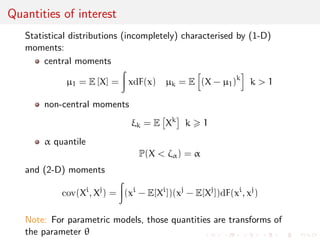
Quantities of interest 
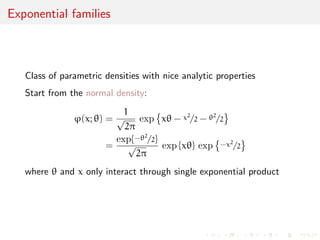
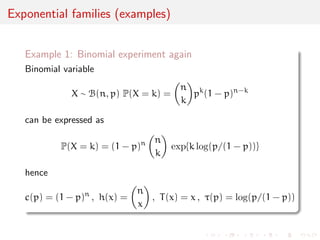
Exponential families
Statistical models 
For most of the course, we assume that the data is a random 
sample x1, . . . , xn and that 
x1, . . . , xn  F(x) 
as i.i.d. variables or as transforms of i.i.d. variables 
Motivation: 
Repetition of observations increases information about F, by virtue 
of probabilistic limit theorems (LLN, CLT)
Statistical models 
For most of the course, we assume that the data is a random 
sample x1, . . . , xn and that 
x1, . . . , xn  F(x) 
as i.i.d. variables or as transforms of i.i.d. variables 
Motivation: 
Repetition of observations increases information about F, by virtue 
of probabilistic limit theorems (LLN, CLT) 
Warning 1: Some aspects of F may ultimately remain unavailable
Statistical models 
For most of the course, we assume that the data is a random 
sample x1, . . . , xn and that 
x1, . . . , xn  F(x) 
as i.i.d. variables or as transforms of i.i.d. variables 
Motivation: 
Repetition of observations increases information about F, by virtue 
of probabilistic limit theorems (LLN, CLT) 
Warning 2: The model is always wrong, even though we behave as 
if...
Limit of averages 
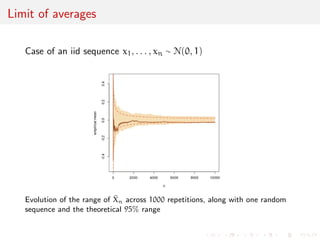
Case of an iid sequence x1, . . . , xn  N(0, 1) 
Evolution of the range of X 
n across 1000 repetitions, along with one random 
sequence and the theoretical 95% range
Limit theorems 
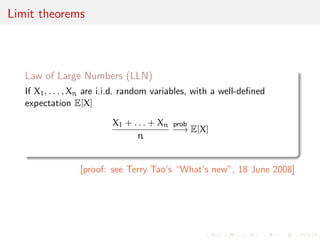
Law of Large Numbers (LLN) 
If X1, . . . ,Xn are i.i.d. random variables, with a well-de
ned 
expectation E[X] 
X1 + . . . + Xn 
n 
prob 
! E[X] 
[proof: see Terry Tao's What's new, 18 June 2008]
Limit theorems 
Law of Large Numbers (LLN) 
If X1, . . . ,Xn are i.i.d. random variables, with a well-de
ned 
expectation E[X] 
X1 + . . . + Xn 
n 
a.s. 
! E[X] 
[proof: see Terry Tao's What's new, 18 June 2008]
Limit theorems 
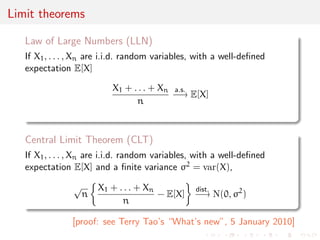
Law of Large Numbers (LLN) 
If X1, . . . ,Xn are i.i.d. random variables, with a well-de
ned 
expectation E[X] 
X1 + . . . + Xn 
n 
a.s. 
! E[X] 
Central Limit Theorem (CLT) 
If X1, . . . ,Xn are i.i.d. random variables, with a well-de
ned 
expectation E[X] and a
nite variance 2 = var(X), 
p 
n
X1 + . . . + Xn 
n 
- E[X] 

 
dist. 
! N(0, 2) 
[proof: see Terry Tao's What's new, 5 January 2010]
Limit theorems 
Central Limit Theorem (CLT) 
If X1, . . . ,Xn are i.i.d. random variables, with a well-de
ned 
expectation E[X] and a
nite variance 2 = var(X), 
p 
n
X1 + . . . + Xn 
n 
- E[X] 

 
dist. 
! N(0, 2) 
[proof: see Terry Tao's What's new, 5 January 2010] 
Continuity Theorem 
If 
Xn 
dist. 
! a 
and g is continuous at a, then 
g(Xn) 
dist. 
! g(a)
Limit theorems 
Central Limit Theorem (CLT) 
If X1, . . . ,Xn are i.i.d. random variables, with a well-de
ned 
expectation E[X] and a
nite variance 2 = var(X), 
p 
n
X1 + . . . + Xn 
n 
- E[X] 

 
dist. 
! N(0, 2) 
[proof: see Terry Tao's What's new, 5 January 2010] 
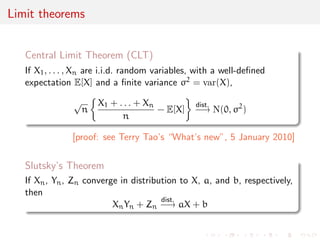
Slutsky's Theorem 
If Xn, Yn, Zn converge in distribution to X, a, and b, respectively, 
then 
XnYn + Zn 
dist. 
! aX + b
Limit theorems 
Central Limit Theorem (CLT) 
If X1, . . . ,Xn are i.i.d. random variables, with a well-de
ned 
expectation E[X] and a
nite variance 2 = var(X), 
p 
n
X1 + . . . + Xn 
n 
- E[X] 

 
dist. 
! N(0, 2) 
[proof: see Terry Tao's What's new, 5 January 2010] 
Delta method's Theorem 
If p 
nfXn - g 
dist. 
! Np(0,
) 
and g : Rp ! Rq is a continuously dierentiable function on a 
neighbourhood of  2 Rp, with a non-zero gradient rg(), then 
p 
n fg(Xn) - g()g 
dist. 
! Nq(0,rg()T
rg())
Exemple 1: Binomial sample 
Case # 1: Observation of i.i.d. Bernoulli variables 
xi  B(p) 
with unknown parameter p (e.g., opinion poll) 
Case # 2: Observation of independent Bernoulli variables 
xi  B(pi) 
with unknown and dierent parameters pi (e.g., opinion poll, 
u 
epidemics) 
Transform of i.i.d. u1, . . . , un: 
xi = I(ui 6 pi)
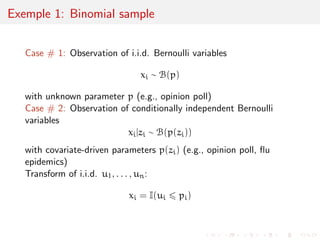
Exemple 1: Binomial sample 
Case # 1: Observation of i.i.d. Bernoulli variables 
xi  B(p) 
with unknown parameter p (e.g., opinion poll) 
Case # 2: Observation of conditionally independent Bernoulli 
variables 
xijzi  B(p(zi)) 
with covariate-driven parameters p(zi) (e.g., opinion poll, 
u 
epidemics) 
Transform of i.i.d. u1, . . . , un: 
xi = I(ui 6 pi)
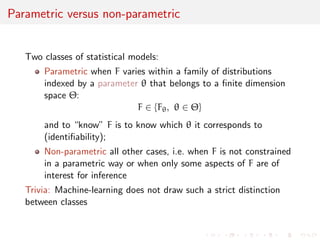
Parametric versus non-parametric 
Two classes of statistical models: 
Parametric when F varies within a family of distributions 
indexed by a parameter  that belongs to a
nite dimension 
space : 
F 2 fF,  2 g 
and to know F is to know which  it corresponds to 
(identi
ability); 
Non-parametric all other cases, i.e. when F is not constrained 
in a parametric way or when only some aspects of F are of 
interest for inference 
Trivia: Machine-learning does not draw such a strict distinction 
between classes
Parametric versus non-parametric 
Two classes of statistical models: 
Parametric when F varies within a family of distributions 
indexed by a parameter  that belongs to a
nite dimension 
space : 
F 2 fF,  2 g 
and to know F is to know which  it corresponds to 
(identi
ability); 
Non-parametric all other cases, i.e. when F is not constrained 
in a parametric way or when only some aspects of F are of 
interest for inference 
Trivia: Machine-learning does not draw such a strict distinction 
between classes
Non-parametric models 
In non-parametric models, there may still be constraints on the 
range of F`s as for instance 
EF[YjX = x] = 	(
Tx), varF(YjX = x) = 2 
in which case the statistical inference only deals with estimating or 
testing the constrained aspects or providing prediction. 
Note: Estimating a density or a regression function like 	(
Tx) is 
only of interest in a restricted number of cases
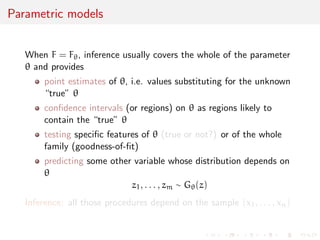
Parametric models 
When F = F, inference usually covers the whole of the parameter 
 and provides 
point estimates of , i.e. values substituting for the unknown 
true  
con
dence intervals (or regions) on  as regions likely to 
contain the true  
testing speci
c features of  (true or not?) or of the whole 
family (goodness-of-
t) 
predicting some other variable whose distribution depends on 
 
z1, . . . , zm  G(z) 
Inference: all those procedures depend on the sample (x1, . . . , xn)
Parametric models 
When F = F, inference usually covers the whole of the parameter 
 and provides 
point estimates of , i.e. values substituting for the unknown 
true  
con
dence intervals (or regions) on  as regions likely to 
contain the true  
testing speci
c features of  (true or not?) or of the whole 
family (goodness-of-

Statistics (1): estimation, Chapter 1: Models

  • 1.
    Chapter 1 : statistical vs. real models Statistical models Quantities of interest Exponential families
  • 2.
    Statistical models Formost of the course, we assume that the data is a random sample x1, . . . , xn and that x1, . . . , xn F(x) as i.i.d. variables or as transforms of i.i.d. variables Motivation: Repetition of observations increases information about F, by virtue of probabilistic limit theorems (LLN, CLT)
  • 3.
    Statistical models Formost of the course, we assume that the data is a random sample x1, . . . , xn and that x1, . . . , xn F(x) as i.i.d. variables or as transforms of i.i.d. variables Motivation: Repetition of observations increases information about F, by virtue of probabilistic limit theorems (LLN, CLT) Warning 1: Some aspects of F may ultimately remain unavailable
  • 4.
    Statistical models Formost of the course, we assume that the data is a random sample x1, . . . , xn and that x1, . . . , xn F(x) as i.i.d. variables or as transforms of i.i.d. variables Motivation: Repetition of observations increases information about F, by virtue of probabilistic limit theorems (LLN, CLT) Warning 2: The model is always wrong, even though we behave as if...
  • 5.
    Limit of averages Case of an iid sequence x1, . . . , xn N(0, 1) Evolution of the range of X n across 1000 repetitions, along with one random sequence and the theoretical 95% range
  • 6.
    Limit theorems Lawof Large Numbers (LLN) If X1, . . . ,Xn are i.i.d. random variables, with a well-de
  • 7.
    ned expectation E[X] X1 + . . . + Xn n prob ! E[X] [proof: see Terry Tao's What's new, 18 June 2008]
  • 8.
    Limit theorems Lawof Large Numbers (LLN) If X1, . . . ,Xn are i.i.d. random variables, with a well-de
  • 9.
    ned expectation E[X] X1 + . . . + Xn n a.s. ! E[X] [proof: see Terry Tao's What's new, 18 June 2008]
  • 10.
    Limit theorems Lawof Large Numbers (LLN) If X1, . . . ,Xn are i.i.d. random variables, with a well-de
  • 11.
    ned expectation E[X] X1 + . . . + Xn n a.s. ! E[X] Central Limit Theorem (CLT) If X1, . . . ,Xn are i.i.d. random variables, with a well-de
  • 12.
  • 13.
    nite variance 2= var(X), p n
  • 14.
    X1 + .. . + Xn n - E[X] dist. ! N(0, 2) [proof: see Terry Tao's What's new, 5 January 2010]
  • 15.
    Limit theorems CentralLimit Theorem (CLT) If X1, . . . ,Xn are i.i.d. random variables, with a well-de
  • 16.
  • 17.
    nite variance 2= var(X), p n
  • 18.
    X1 + .. . + Xn n - E[X] dist. ! N(0, 2) [proof: see Terry Tao's What's new, 5 January 2010] Continuity Theorem If Xn dist. ! a and g is continuous at a, then g(Xn) dist. ! g(a)
  • 19.
    Limit theorems CentralLimit Theorem (CLT) If X1, . . . ,Xn are i.i.d. random variables, with a well-de
  • 20.
  • 21.
    nite variance 2= var(X), p n
  • 22.
    X1 + .. . + Xn n - E[X] dist. ! N(0, 2) [proof: see Terry Tao's What's new, 5 January 2010] Slutsky's Theorem If Xn, Yn, Zn converge in distribution to X, a, and b, respectively, then XnYn + Zn dist. ! aX + b
  • 23.
    Limit theorems CentralLimit Theorem (CLT) If X1, . . . ,Xn are i.i.d. random variables, with a well-de
  • 24.
  • 25.
    nite variance 2= var(X), p n
  • 26.
    X1 + .. . + Xn n - E[X] dist. ! N(0, 2) [proof: see Terry Tao's What's new, 5 January 2010] Delta method's Theorem If p nfXn - g dist. ! Np(0, ) and g : Rp ! Rq is a continuously dierentiable function on a neighbourhood of 2 Rp, with a non-zero gradient rg(), then p n fg(Xn) - g()g dist. ! Nq(0,rg()T rg())
  • 27.
    Exemple 1: Binomialsample Case # 1: Observation of i.i.d. Bernoulli variables xi B(p) with unknown parameter p (e.g., opinion poll) Case # 2: Observation of independent Bernoulli variables xi B(pi) with unknown and dierent parameters pi (e.g., opinion poll, u epidemics) Transform of i.i.d. u1, . . . , un: xi = I(ui 6 pi)
  • 28.
    Exemple 1: Binomialsample Case # 1: Observation of i.i.d. Bernoulli variables xi B(p) with unknown parameter p (e.g., opinion poll) Case # 2: Observation of conditionally independent Bernoulli variables xijzi B(p(zi)) with covariate-driven parameters p(zi) (e.g., opinion poll, u epidemics) Transform of i.i.d. u1, . . . , un: xi = I(ui 6 pi)
  • 29.
    Parametric versus non-parametric Two classes of statistical models: Parametric when F varies within a family of distributions indexed by a parameter that belongs to a
  • 30.
    nite dimension space: F 2 fF, 2 g and to know F is to know which it corresponds to (identi
  • 31.
    ability); Non-parametric allother cases, i.e. when F is not constrained in a parametric way or when only some aspects of F are of interest for inference Trivia: Machine-learning does not draw such a strict distinction between classes
  • 32.
    Parametric versus non-parametric Two classes of statistical models: Parametric when F varies within a family of distributions indexed by a parameter that belongs to a
  • 33.
    nite dimension space: F 2 fF, 2 g and to know F is to know which it corresponds to (identi
  • 34.
    ability); Non-parametric allother cases, i.e. when F is not constrained in a parametric way or when only some aspects of F are of interest for inference Trivia: Machine-learning does not draw such a strict distinction between classes
  • 35.
    Non-parametric models Innon-parametric models, there may still be constraints on the range of F`s as for instance EF[YjX = x] = (
  • 36.
    Tx), varF(YjX =x) = 2 in which case the statistical inference only deals with estimating or testing the constrained aspects or providing prediction. Note: Estimating a density or a regression function like (
  • 37.
    Tx) is onlyof interest in a restricted number of cases
  • 38.
    Parametric models WhenF = F, inference usually covers the whole of the parameter and provides point estimates of , i.e. values substituting for the unknown true con
  • 39.
    dence intervals (orregions) on as regions likely to contain the true testing speci
  • 40.
    c features of (true or not?) or of the whole family (goodness-of-
  • 41.
    t) predicting someother variable whose distribution depends on z1, . . . , zm G(z) Inference: all those procedures depend on the sample (x1, . . . , xn)
  • 42.
    Parametric models WhenF = F, inference usually covers the whole of the parameter and provides point estimates of , i.e. values substituting for the unknown true con
  • 43.
    dence intervals (orregions) on as regions likely to contain the true testing speci
  • 44.
    c features of (true or not?) or of the whole family (goodness-of-