PROBABILITY DISTRIBUTIONS : BINOMIAL DISTRIBUTION

                DEFINITIONS /CONCEPTS                                                EXAMPLES

1    A random variable is a quantity that cannot be         1. Experiment:
     predicted in advance but is determined by the             A coin is tossed 4 times.
     outcomes of an experiment.
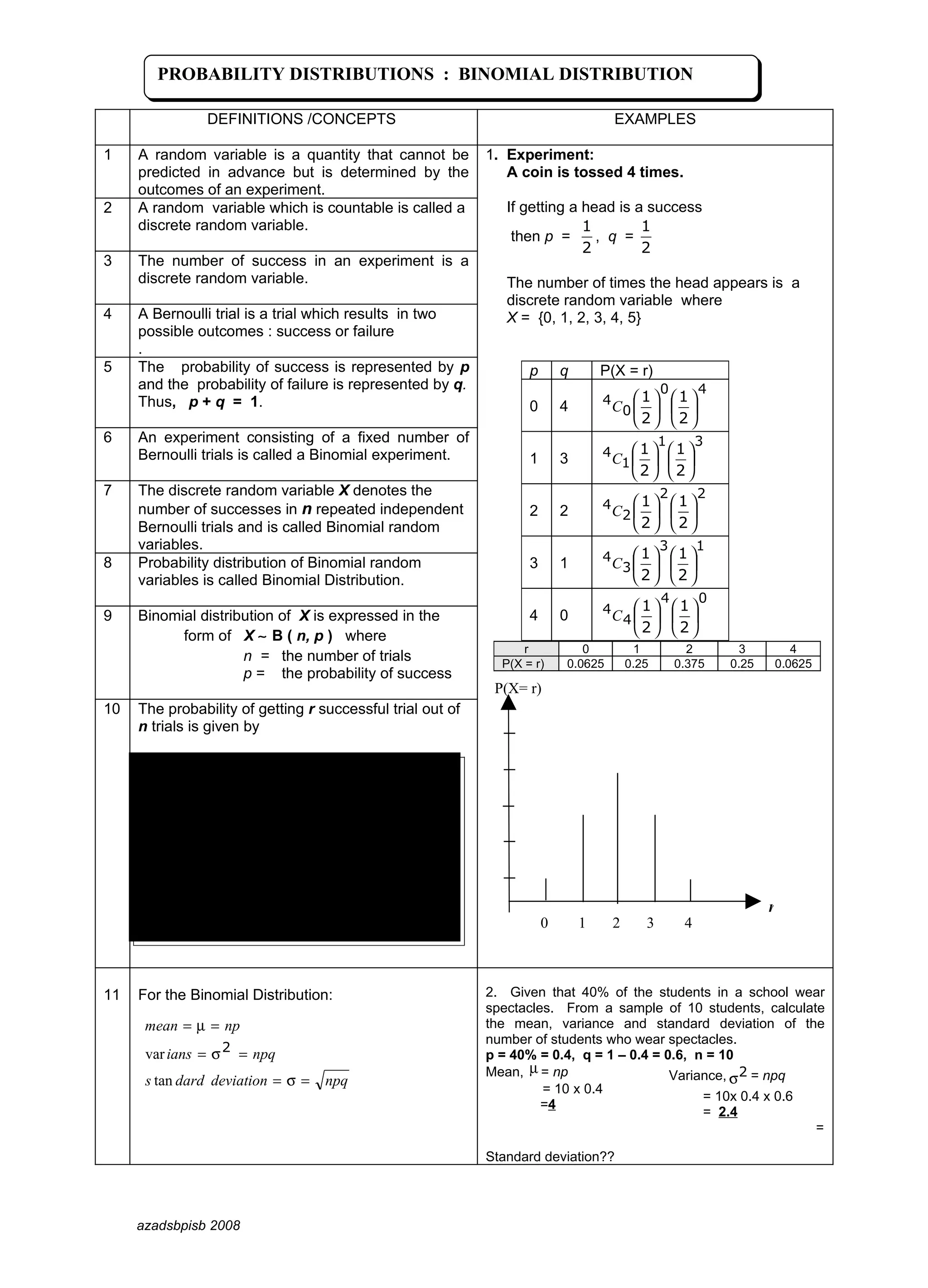
2    A random variable which is countable is called a          If getting a head is a success
     discrete random variable.                                              1        1
                                                                then p =      , q =
                                                                            2        2
3    The number of success in an experiment is a
     discrete random variable.                                 The number of times the head appears is a
                                                               discrete random variable where
4    A Bernoulli trial is a trial which results in two         X = {0, 1, 2, 3, 4, 5}
     possible outcomes : success or failure
     .
5    The probability of success is represented by p                p       q       P(X = r)
     and the probability of failure is represented by q.                                   0      4
     Thus, p + q = 1.                                                              4C  1   1 
                                                                   0       4         0   
                                                                                         2 2
6    An experiment consisting of a fixed number of                                         1      3
     Bernoulli trials is called a Binomial experiment.                             4C  1   1 
                                                                   1       3         1    
                                                                                         2 2
7    The discrete random variable X denotes the                                            2      2
     number of successes in n repeated independent                                 4C  1   1 
                                                                   2       2         2   
     Bernoulli trials and is called Binomial random                                      2 2
     variables.                                                                            3     1
                                                                                   4C  1   1 
8    Probability distribution of Binomial random                   3       1         3    
     variables is called Binomial Distribution.                                          2 2
                                                                                           4      0
                                                                                   4C  1   1 
9    Binomial distribution of X is expressed in the                4       0         4    
           form of X ∼ B ( n, p ) where                                                  2 2
                                                                  r           0          1       2      3        4
                     n = the number of trials                 P(X = r)     0.0625       0.25   0.375   0.25   0.0625
                     p = the probability of success
                                                             P(X= r)
10   The probability of getting r successful trial out of
     n trials is given by


                  P(X = r) = n C r p r q n− r
                             where
      P   = probability
      X   = binomial discrete random variable
      r   = number of successes (r = 0, 1, 2, …., n)
      n   = number of trials
      p   = probability of success ( 0 < p < 1 )
      q   = probability of failure (q = 1 - p )                                                               r
                                                                       0       1    2      3    4


11   For the Binomial Distribution:                         2. Given that 40% of the students in a school wear
                                                            spectacles. From a sample of 10 students, calculate
      mean = µ = np                                         the mean, variance and standard deviation of the
                                                            number of students who wear spectacles.
      var ians = σ 2 = npq                                  p = 40% = 0.4, q = 1 – 0.4 = 0.6, n = 10
                                                            Mean, µ = np                  Variance, σ 2 = npq
      s tan dard deviation = σ =   npq
                                                                     = 10 x 0.4
                                                                                               = 10x 0.4 x 0.6
                                                                     =4
                                                                                               = 2.4
                                                                                                               =

                                                            Standard deviation??


     azadsbpisb 2008
azadsbpisb 2008

Pro dist

  • 1.
    PROBABILITY DISTRIBUTIONS :BINOMIAL DISTRIBUTION DEFINITIONS /CONCEPTS EXAMPLES 1 A random variable is a quantity that cannot be 1. Experiment: predicted in advance but is determined by the A coin is tossed 4 times. outcomes of an experiment. 2 A random variable which is countable is called a If getting a head is a success discrete random variable. 1 1 then p = , q = 2 2 3 The number of success in an experiment is a discrete random variable. The number of times the head appears is a discrete random variable where 4 A Bernoulli trial is a trial which results in two X = {0, 1, 2, 3, 4, 5} possible outcomes : success or failure . 5 The probability of success is represented by p p q P(X = r) and the probability of failure is represented by q. 0 4 Thus, p + q = 1. 4C  1   1  0 4 0    2 2 6 An experiment consisting of a fixed number of 1 3 Bernoulli trials is called a Binomial experiment. 4C  1   1  1 3 1     2 2 7 The discrete random variable X denotes the 2 2 number of successes in n repeated independent 4C  1   1  2 2 2    Bernoulli trials and is called Binomial random 2 2 variables. 3 1 4C  1   1  8 Probability distribution of Binomial random 3 1 3     variables is called Binomial Distribution. 2 2 4 0 4C  1   1  9 Binomial distribution of X is expressed in the 4 0 4     form of X ∼ B ( n, p ) where 2 2 r 0 1 2 3 4 n = the number of trials P(X = r) 0.0625 0.25 0.375 0.25 0.0625 p = the probability of success P(X= r) 10 The probability of getting r successful trial out of n trials is given by P(X = r) = n C r p r q n− r where P = probability X = binomial discrete random variable r = number of successes (r = 0, 1, 2, …., n) n = number of trials p = probability of success ( 0 < p < 1 ) q = probability of failure (q = 1 - p ) r 0 1 2 3 4 11 For the Binomial Distribution: 2. Given that 40% of the students in a school wear spectacles. From a sample of 10 students, calculate mean = µ = np the mean, variance and standard deviation of the number of students who wear spectacles. var ians = σ 2 = npq p = 40% = 0.4, q = 1 – 0.4 = 0.6, n = 10 Mean, µ = np Variance, σ 2 = npq s tan dard deviation = σ = npq = 10 x 0.4 = 10x 0.4 x 0.6 =4 = 2.4 = Standard deviation?? azadsbpisb 2008
  • 2.