Download to read offline

![Let f(x)=0 be the given equation and x0 be an approximate root of the
equation.
If x1 = x0 + h be the exact root then f(x1)=0.
i.e., f(x0 + h)=0
f(x0) + hf′ x0 +
ℎ2
2!
f′′ x0 + ⋯ = 0 [By Taylor
Series]
Since h is small, neglecting ℎ2
and higher powers of h,
f x0 + hf′
x0 = 0
h = −
f(x0)
f′(x0)
∴ x1 = x0 + h = x0 −
f(x0)
f′(x0)
Similarly, starting with x1, a still better approximation x2 is obtained.
x2 = x1 −
f(x1)
f′(x1)
In general, x = x −
f(xn)](https://image.slidesharecdn.com/newtonraphsonmethod-180921082758/85/Newton-raphson-method-2-320.jpg)
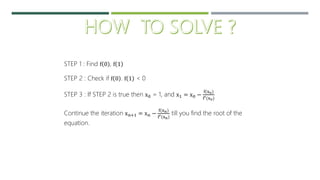
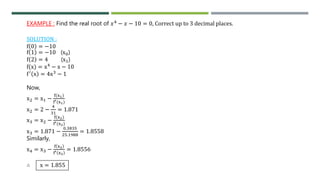


The document describes the Newton-Raphson method to find an approximate root of an equation. It explains that given an approximate root x0, the method iteratively calculates better approximations x1, x2, etc. until converging on the exact root. Each new approximation xn+1 is calculated as xn - f(xn)/f'(xn), where f(x) is the original equation, and f'(x) is its derivative. An example applies the method to find the real root of x4 - x - 10 = 0, obtaining the value 1.855 after 4 iterations.


