Lesson #12
MAT 1372 Statistics with Probability
Dr. Bonanome
Binomial Experiments
1. The experiment is repeated for a fixed number of
trials, where each trial is independent of other trials.
2. There are only two possible outcomes of interest for
each trial. The outcomes can be classified as a
success (S) or as a failure (F).
3. The probability of a success P(S) is the same for
each trial.
4. The random variable x counts the number of
successful trials.
© 2012 Pearson Education, Inc. All rights reserved. 2 of 63
Notation for Binomial Experiments
Symbol Description
n The number of times a trial is repeated
p = P(S) The probability of success in a single trial
q = P(F) The probability of failure in a single trial
(q = 1 – p)
x The random variable represents a count of
the number of successes in n trials:
x = 0, 1, 2, 3, … , n.
© 2012 Pearson Education, Inc. All rights reserved. 3 of 63
Example: Binomial Experiments
Decide whether the experiment is a binomial
experiment. If it is, specify the values of n, p, and q, and
list the possible values of the random variable x.
1. A certain surgical procedure has an 85% chance of
success. A doctor performs the procedure on eight
patients. The random variable represents the number
of successful surgeries.
© 2012 Pearson Education, Inc. All rights reserved. 4 of 63
Solution: Binomial Experiments
Binomial Experiment
1. Each surgery represents a trial. There are eight
surgeries, and each one is independent of the others.
2. There are only two possible outcomes of interest for
each surgery: a success (S) or a failure (F).
3. The probability of a success, P(S), is 0.85 for each
surgery.
4. The random variable x counts the number of
successful surgeries.
© 2012 Pearson Education, Inc. All rights reserved. 5 of 63
Solution: Binomial Experiments
Binomial Experiment
• n = 8 (number of trials)
• p = 0.85 (probability of success)
• q = 1 – p = 1 – 0.85 = 0.15 (probability of failure)
• x = 0, 1, 2, 3, 4, 5, 6, 7, 8 (number of successful
surgeries)
© 2012 Pearson Education, Inc. All rights reserved. 6 of 63
Example: Binomial Experiments
Decide whether the experiment is a binomial
experiment. If it is, specify the values of n, p, and q, and
list the possible values of the random variable x.
2. A jar contains five red marbles, nine blue marbles, and
six green marbles. You randomly select three marbles
from the jar, without replacement. The random
variable represents the number of red marbles.
© 2012 Pearson Education, Inc. All rights reserved. 7 of 63
Solution: Binomial Experiments
Not a Binomial Experiment
• The probability of selecting a red marble on the first
trial is 5/20.
• Because the marble is not replaced, the probability of
success (red) for subsequent trials is no longer 5/20.
• The trials are not independent and the probability of
a success is not the same for each trial.
© 2012 Pearson Education, Inc. All rights reserved. 8 of 63
Binomial Probability Formula
• The probability of exactly x successes in n trials is
!
( )
( )! !
x n x x n x
n x
n
P x C p q p q
n x x
 
 

• n = number of trials
• p = probability of success
• q = 1 – p probability of failure
• x = number of successes in n trials
© 2012 Pearson Education, Inc. All rights reserved. 9 of 63
Example: Finding Binomial Probabilities
Microfracture knee surgery has a 75% chance of success
on patients with degenerative knees. The surgery is
performed on three patients. Find the probability of the
surgery being successful on exactly two patients.
© 2012 Pearson Education, Inc. All rights reserved. 10 of 63
Solution: Finding Binomial Probabilities
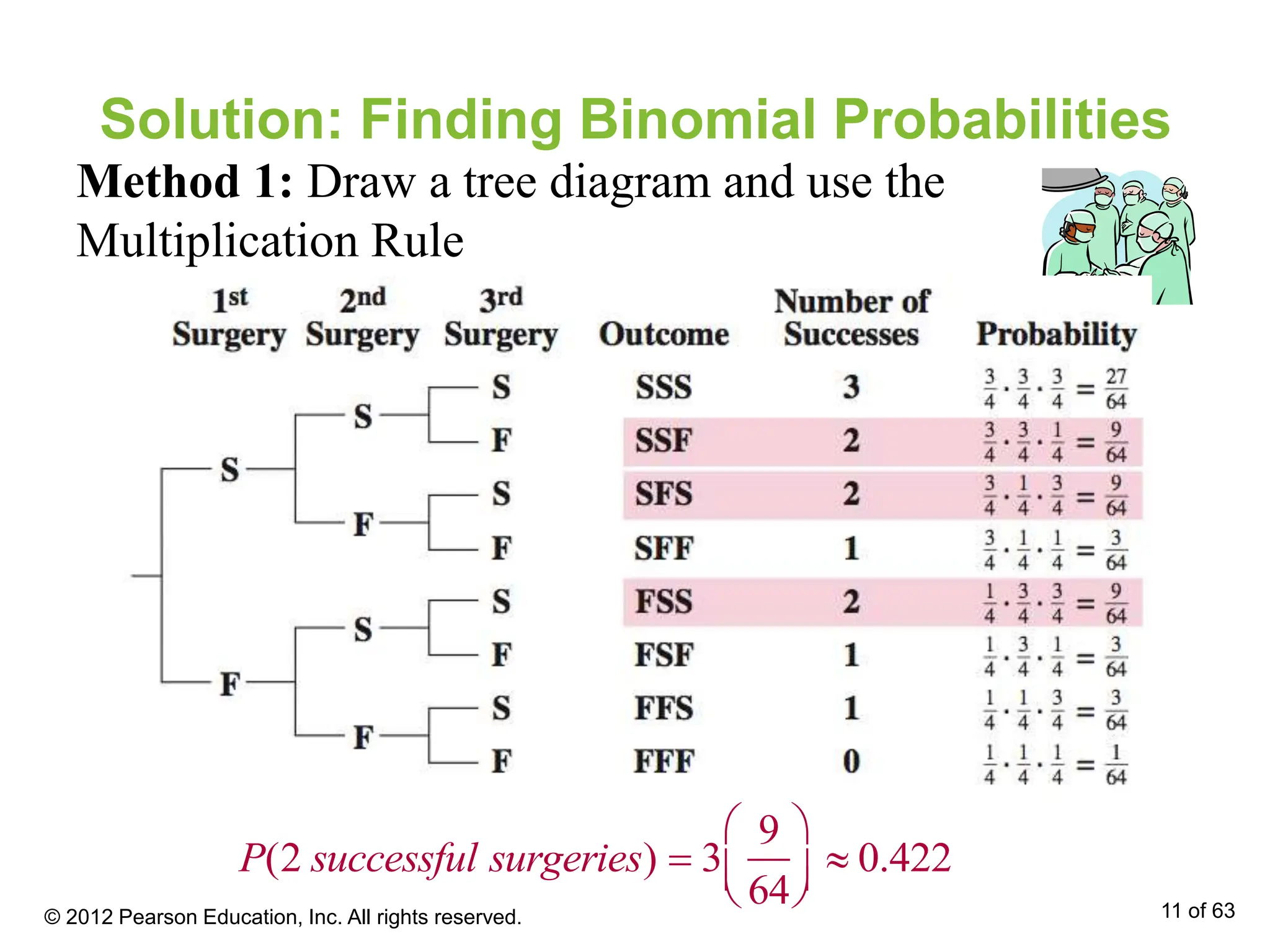
Method 1: Draw a tree diagram and use the
Multiplication Rule
P(2 successful surgeries)  3
9
64





  0.422
© 2012 Pearson Education, Inc. All rights reserved. 11 of 63
Solution: Finding Binomial Probabilities
Method 2: Binomial Probability Formula
P(2 successful surgeries)  3
C2
3
4






2
1
4






32

3!
(3 2)!2!
3
4






2
1
4






1
 3
9
16






1
4





 
27
64
 0.422
3 1
3, , 1 , 2
4 4
n p q p x
     
© 2012 Pearson Education, Inc. All rights reserved. 12 of 63
Binomial Probability Distribution
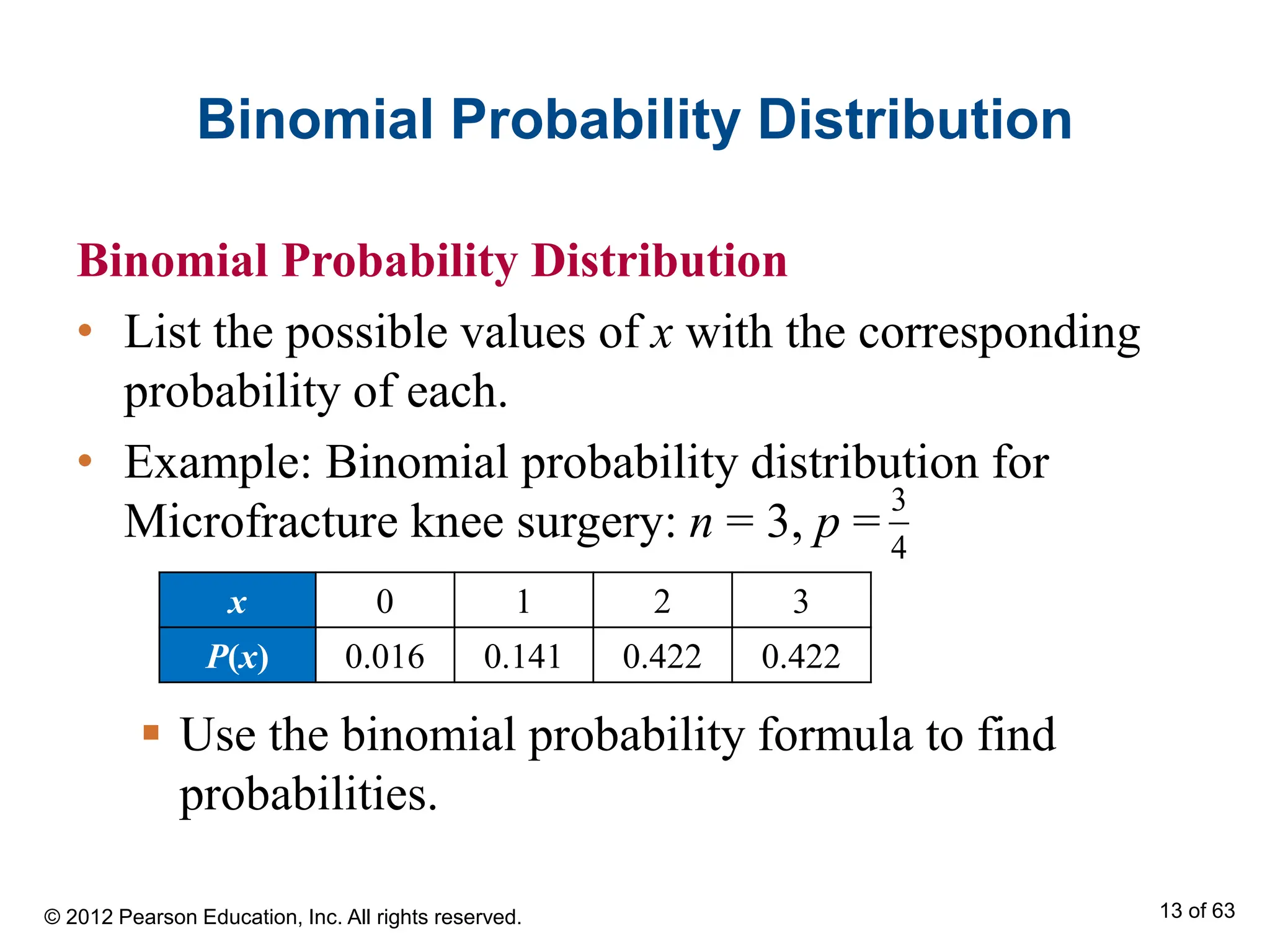
• List the possible values of x with the corresponding
probability of each.
• Example: Binomial probability distribution for
Microfracture knee surgery: n = 3, p =
 Use the binomial probability formula to find
probabilities.
x 0 1 2 3
P(x) 0.016 0.141 0.422 0.422
3
4
© 2012 Pearson Education, Inc. All rights reserved. 13 of 63
Example: Constructing a Binomial
Distribution
In a survey, U.S. adults were asked to give reasons why
they liked texting on their cellular phones. Seven adults
who participated in the survey are randomly selected and
asked whether they like texting because it is quicker than
calling. Create a binomial
probability distribution for
the number of adults who
respond yes.
© 2012 Pearson Education, Inc. All rights reserved. 14 of 63
Solution: Constructing a Binomial
Distribution
• 56% of adults like texting because it is quicker than
calling.
• n = 7, p = 0.56, q = 0.44, x = 0, 1, 2, 3, 4, 5, 6, 7
P(0) = 7C0(0.56)0(0.44)7 = 1(0.56)0(0.44)7 ≈ 0.0032
P(1) = 7C1(0.56)1(0.44)6 = 7(0.56)1(0.44)6 ≈ 0.0284
P(2) = 7C2(0.56)2(0.44)5 = 21(0.56)2(0.44)5 ≈ 0.1086
P(3) = 7C3(0.56)3(0.44)4 = 35(0.56)3(0.44)4 ≈ 0.2304
P(4) = 7C4(0.56)4(0.44)3 = 35(0.56)4(0.44)3 ≈ 0.2932
P(5) = 7C5(0.56)5(0.44)2 = 21(0.56)5(0.44)2 ≈ 0.2239
P(6) = 7C6(0.56)6(0.44)1 = 7(0.56)6(0.44)1 ≈ 0.0950
P(7) = 7C7(0.56)7(0.44)0 = 1(0.56)7(0.44)0 ≈ 0.0173
© 2012 Pearson Education, Inc. All rights reserved. 15 of 63
Solution: Constructing a Binomial
Distribution
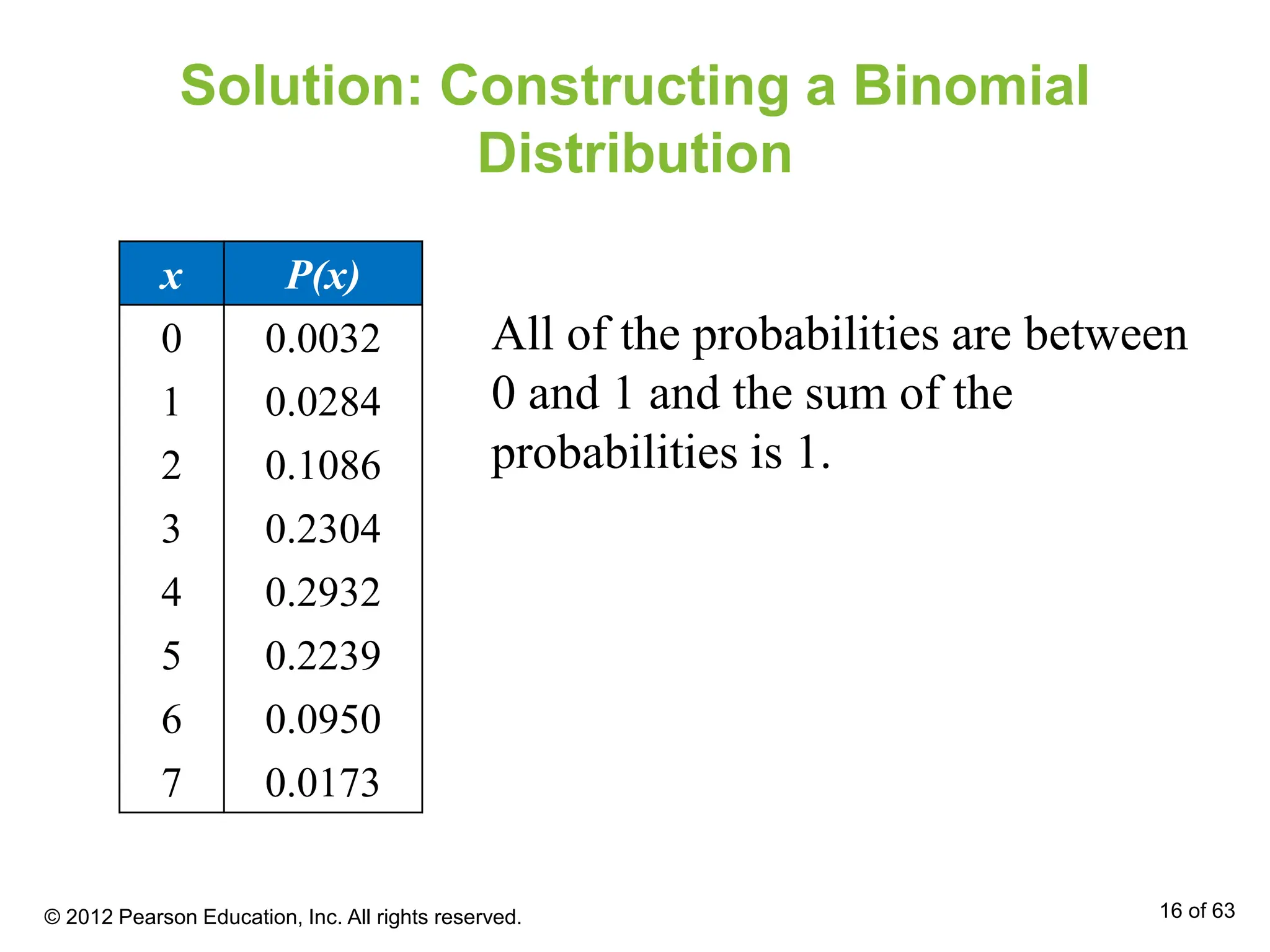
x P(x)
0 0.0032
1 0.0284
2 0.1086
3 0.2304
4 0.2932
5 0.2239
6 0.0950
7 0.0173
All of the probabilities are between
0 and 1 and the sum of the
probabilities is 1.
© 2012 Pearson Education, Inc. All rights reserved. 16 of 63
Example: Finding Binomial Probabilities
Using Technology
The results of a recent survey indicate that 67% of U.S.
adults consider air conditioning a necessity. If you
randomly select 100 adults, what is the probability that
exactly 75 adults consider air conditioning a necessity?
Use a technology tool to find the probability. (Source:
Opinion Research Corporation)
Solution:
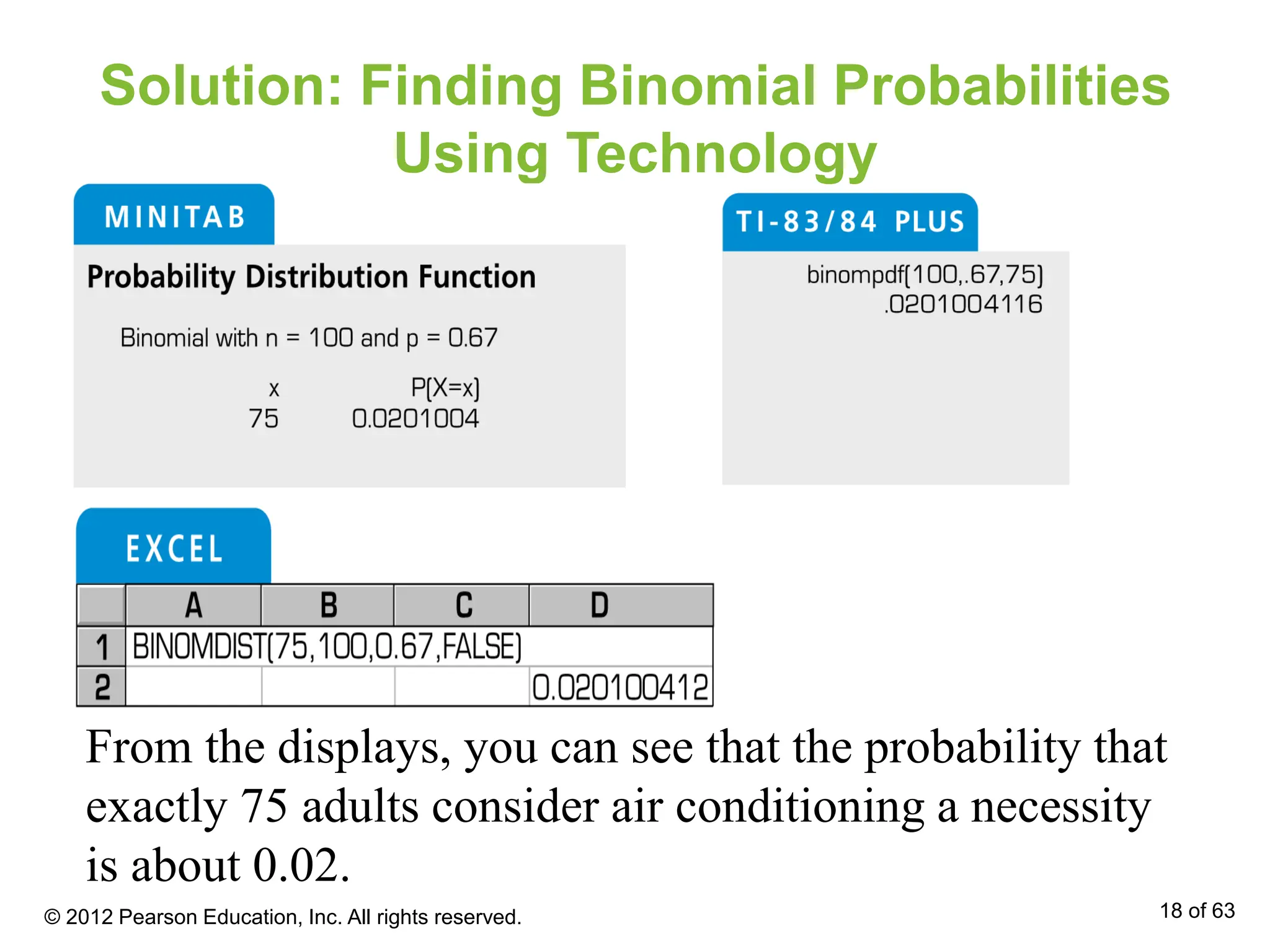
• Binomial with n = 100, p = 0.67, x = 75
© 2012 Pearson Education, Inc. All rights reserved. 17 of 63
Solution: Finding Binomial Probabilities
Using Technology
From the displays, you can see that the probability that
exactly 75 adults consider air conditioning a necessity
is about 0.02.
© 2012 Pearson Education, Inc. All rights reserved. 18 of 63
Example: Finding Binomial Probabilities
A survey indicates that 41% of women in the U.S.
consider reading their favorite leisure-time activity. You
randomly select four U.S. women and ask them if
reading is their favorite leisure-time activity. Find the
probability that at least two of them respond yes.
Solution:
• n = 4, p = 0.41, q = 0.59
• At least two means two or more.
• Find the sum of P(2), P(3), and P(4).
© 2012 Pearson Education, Inc. All rights reserved. 19 of 63
Solution: Finding Binomial Probabilities
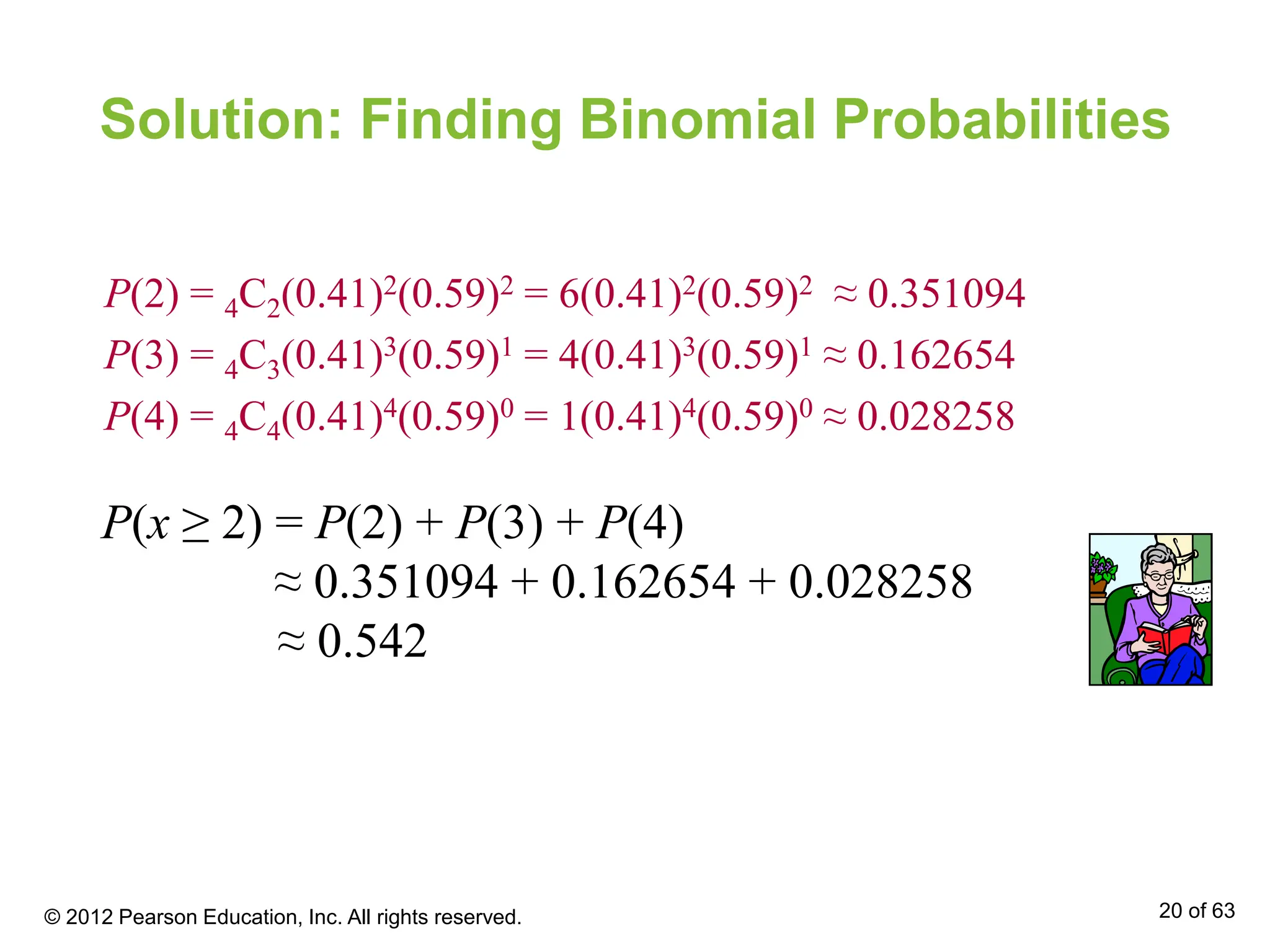
P(2) = 4C2(0.41)2(0.59)2 = 6(0.41)2(0.59)2 ≈ 0.351094
P(3) = 4C3(0.41)3(0.59)1 = 4(0.41)3(0.59)1 ≈ 0.162654
P(4) = 4C4(0.41)4(0.59)0 = 1(0.41)4(0.59)0 ≈ 0.028258
P(x ≥ 2) = P(2) + P(3) + P(4)
≈ 0.351094 + 0.162654 + 0.028258
≈ 0.542
© 2012 Pearson Education, Inc. All rights reserved. 20 of 63
Example: Finding Binomial Probabilities
Using a Table
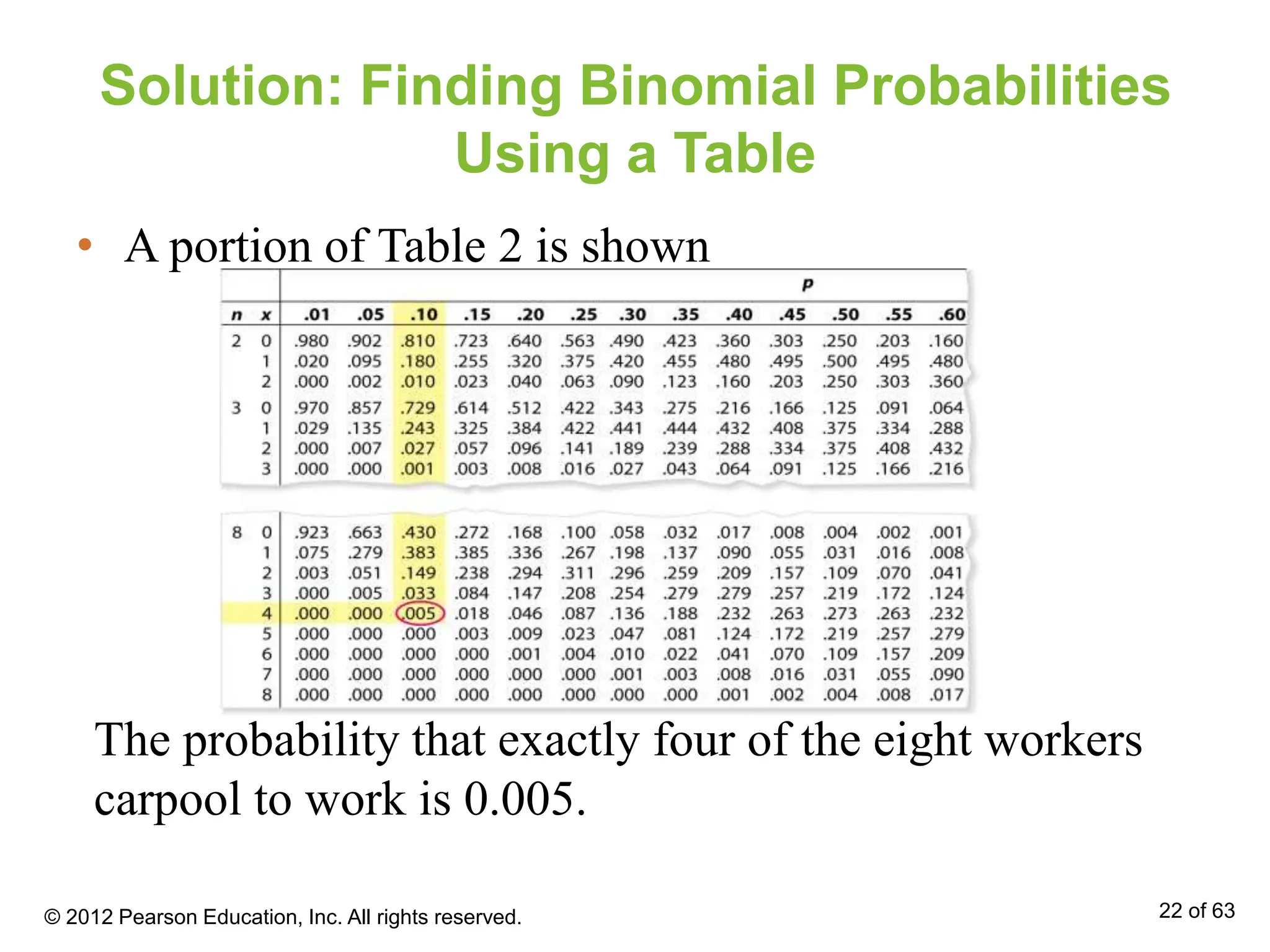
About ten percent of workers (16 years and over) in the
United States commute to their jobs by carpooling. You
randomly select eight workers. What is the probability
that exactly four of them carpool to work? Use a table to
find the probability. (Source: American Community Survey)
Solution:
• Binomial with n = 8, p = 0.10, x = 4
© 2012 Pearson Education, Inc. All rights reserved. 21 of 63
Solution: Finding Binomial Probabilities
Using a Table
• A portion of Table 2 is shown
The probability that exactly four of the eight workers
carpool to work is 0.005.
© 2012 Pearson Education, Inc. All rights reserved. 22 of 63
Example: Graphing a Binomial
Distribution
Sixty percent of households in the U.S. own a video
game console. You randomly select six households and
ask each if they own a video game console. Construct a
probability distribution for the random variable x. Then
graph the distribution. (Source: Deloitte, LLP)
Solution:
• n = 6, p = 0.6, q = 0.4
• Find the probability for each value of x
© 2012 Pearson Education, Inc. All rights reserved. 23 of 63
Solution: Graphing a Binomial
Distribution
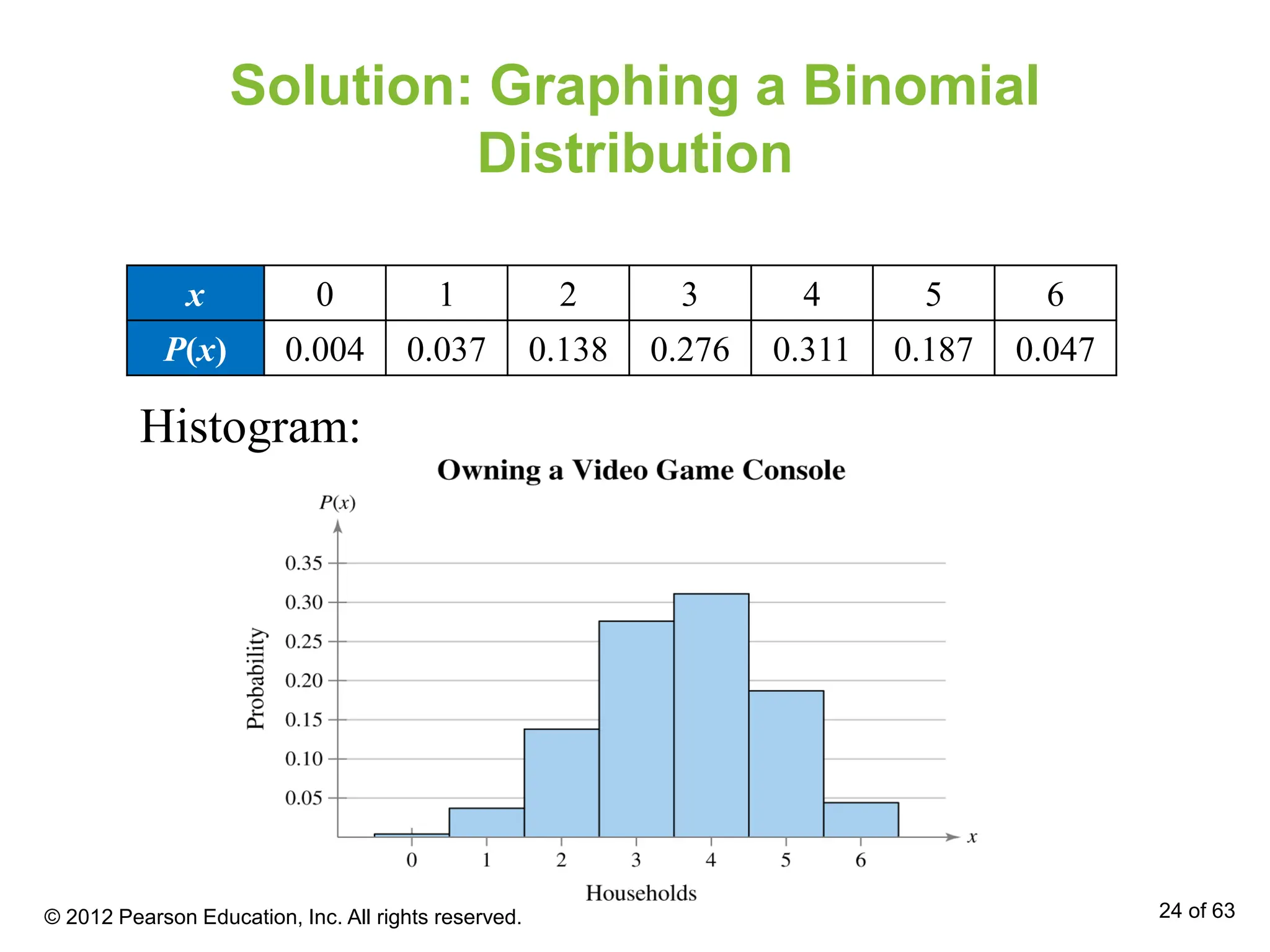
x 0 1 2 3 4 5 6
P(x) 0.004 0.037 0.138 0.276 0.311 0.187 0.047
Histogram:
© 2012 Pearson Education, Inc. All rights reserved. 24 of 63
Mean, Variance, and Standard Deviation
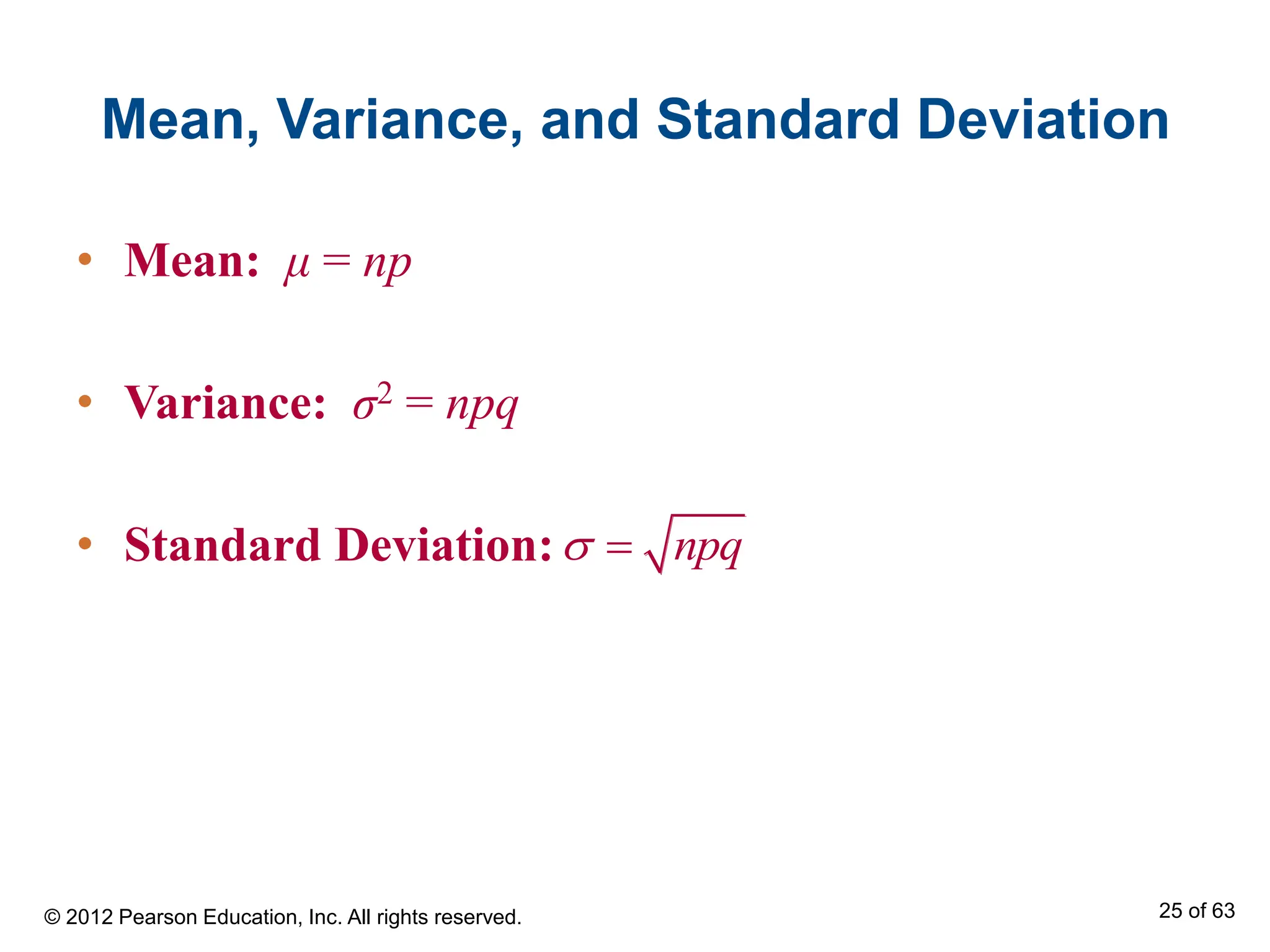
• Mean: μ = np
• Variance: σ2 = npq
• Standard Deviation: npq
 
© 2012 Pearson Education, Inc. All rights reserved. 25 of 63
Example: Finding the Mean, Variance,
and Standard Deviation
In Pittsburgh, Pennsylvania, about 56% of the days in a
year are cloudy. Find the mean, variance, and standard
deviation for the number of cloudy days during the
month of June. Interpret the results and determine any
unusual values. (Source: National Climatic Data Center)
Solution: n = 30, p = 0.56, q = 0.44
Mean: μ = np = 30∙0.56 = 16.8
Variance: σ2 = npq = 30∙0.56∙0.44 ≈ 7.4
Standard Deviation: 30 0.56 0.44 2.7
npq
     
© 2012 Pearson Education, Inc. All rights reserved. 26 of 63
Solution: Finding the Mean, Variance, and
Standard Deviation
μ = 16.8 σ2 ≈ 7.4 σ ≈ 2.7
• On average, there are 16.8 cloudy days during the
month of June.
• The standard deviation is about 2.7 days.
• Values that are more than two standard deviations
from the mean are considered unusual.
 16.8 – 2(2.7) =11.4, a June with 11 cloudy days
or fewer would be unusual.
 16.8 + 2(2.7) = 22.2, a June with 23 cloudy days
or more would also be unusual.
© 2012 Pearson Education, Inc. All rights reserved. 27 of 63

Management business for management studies

  • 1.
    Lesson #12 MAT 1372Statistics with Probability Dr. Bonanome
  • 2.
    Binomial Experiments 1. Theexperiment is repeated for a fixed number of trials, where each trial is independent of other trials. 2. There are only two possible outcomes of interest for each trial. The outcomes can be classified as a success (S) or as a failure (F). 3. The probability of a success P(S) is the same for each trial. 4. The random variable x counts the number of successful trials. © 2012 Pearson Education, Inc. All rights reserved. 2 of 63
  • 3.
    Notation for BinomialExperiments Symbol Description n The number of times a trial is repeated p = P(S) The probability of success in a single trial q = P(F) The probability of failure in a single trial (q = 1 – p) x The random variable represents a count of the number of successes in n trials: x = 0, 1, 2, 3, … , n. © 2012 Pearson Education, Inc. All rights reserved. 3 of 63
  • 4.
    Example: Binomial Experiments Decidewhether the experiment is a binomial experiment. If it is, specify the values of n, p, and q, and list the possible values of the random variable x. 1. A certain surgical procedure has an 85% chance of success. A doctor performs the procedure on eight patients. The random variable represents the number of successful surgeries. © 2012 Pearson Education, Inc. All rights reserved. 4 of 63
  • 5.
    Solution: Binomial Experiments BinomialExperiment 1. Each surgery represents a trial. There are eight surgeries, and each one is independent of the others. 2. There are only two possible outcomes of interest for each surgery: a success (S) or a failure (F). 3. The probability of a success, P(S), is 0.85 for each surgery. 4. The random variable x counts the number of successful surgeries. © 2012 Pearson Education, Inc. All rights reserved. 5 of 63
  • 6.
    Solution: Binomial Experiments BinomialExperiment • n = 8 (number of trials) • p = 0.85 (probability of success) • q = 1 – p = 1 – 0.85 = 0.15 (probability of failure) • x = 0, 1, 2, 3, 4, 5, 6, 7, 8 (number of successful surgeries) © 2012 Pearson Education, Inc. All rights reserved. 6 of 63
  • 7.
    Example: Binomial Experiments Decidewhether the experiment is a binomial experiment. If it is, specify the values of n, p, and q, and list the possible values of the random variable x. 2. A jar contains five red marbles, nine blue marbles, and six green marbles. You randomly select three marbles from the jar, without replacement. The random variable represents the number of red marbles. © 2012 Pearson Education, Inc. All rights reserved. 7 of 63
  • 8.
    Solution: Binomial Experiments Nota Binomial Experiment • The probability of selecting a red marble on the first trial is 5/20. • Because the marble is not replaced, the probability of success (red) for subsequent trials is no longer 5/20. • The trials are not independent and the probability of a success is not the same for each trial. © 2012 Pearson Education, Inc. All rights reserved. 8 of 63
  • 9.
    Binomial Probability Formula BinomialProbability Formula • The probability of exactly x successes in n trials is ! ( ) ( )! ! x n x x n x n x n P x C p q p q n x x      • n = number of trials • p = probability of success • q = 1 – p probability of failure • x = number of successes in n trials © 2012 Pearson Education, Inc. All rights reserved. 9 of 63
  • 10.
    Example: Finding BinomialProbabilities Microfracture knee surgery has a 75% chance of success on patients with degenerative knees. The surgery is performed on three patients. Find the probability of the surgery being successful on exactly two patients. © 2012 Pearson Education, Inc. All rights reserved. 10 of 63
  • 11.
    Solution: Finding BinomialProbabilities Method 1: Draw a tree diagram and use the Multiplication Rule P(2 successful surgeries)  3 9 64        0.422 © 2012 Pearson Education, Inc. All rights reserved. 11 of 63
  • 12.
    Solution: Finding BinomialProbabilities Method 2: Binomial Probability Formula P(2 successful surgeries)  3 C2 3 4       2 1 4       32  3! (3 2)!2! 3 4       2 1 4       1  3 9 16       1 4        27 64  0.422 3 1 3, , 1 , 2 4 4 n p q p x       © 2012 Pearson Education, Inc. All rights reserved. 12 of 63
  • 13.
    Binomial Probability Distribution BinomialProbability Distribution • List the possible values of x with the corresponding probability of each. • Example: Binomial probability distribution for Microfracture knee surgery: n = 3, p =  Use the binomial probability formula to find probabilities. x 0 1 2 3 P(x) 0.016 0.141 0.422 0.422 3 4 © 2012 Pearson Education, Inc. All rights reserved. 13 of 63
  • 14.
    Example: Constructing aBinomial Distribution In a survey, U.S. adults were asked to give reasons why they liked texting on their cellular phones. Seven adults who participated in the survey are randomly selected and asked whether they like texting because it is quicker than calling. Create a binomial probability distribution for the number of adults who respond yes. © 2012 Pearson Education, Inc. All rights reserved. 14 of 63
  • 15.
    Solution: Constructing aBinomial Distribution • 56% of adults like texting because it is quicker than calling. • n = 7, p = 0.56, q = 0.44, x = 0, 1, 2, 3, 4, 5, 6, 7 P(0) = 7C0(0.56)0(0.44)7 = 1(0.56)0(0.44)7 ≈ 0.0032 P(1) = 7C1(0.56)1(0.44)6 = 7(0.56)1(0.44)6 ≈ 0.0284 P(2) = 7C2(0.56)2(0.44)5 = 21(0.56)2(0.44)5 ≈ 0.1086 P(3) = 7C3(0.56)3(0.44)4 = 35(0.56)3(0.44)4 ≈ 0.2304 P(4) = 7C4(0.56)4(0.44)3 = 35(0.56)4(0.44)3 ≈ 0.2932 P(5) = 7C5(0.56)5(0.44)2 = 21(0.56)5(0.44)2 ≈ 0.2239 P(6) = 7C6(0.56)6(0.44)1 = 7(0.56)6(0.44)1 ≈ 0.0950 P(7) = 7C7(0.56)7(0.44)0 = 1(0.56)7(0.44)0 ≈ 0.0173 © 2012 Pearson Education, Inc. All rights reserved. 15 of 63
  • 16.
    Solution: Constructing aBinomial Distribution x P(x) 0 0.0032 1 0.0284 2 0.1086 3 0.2304 4 0.2932 5 0.2239 6 0.0950 7 0.0173 All of the probabilities are between 0 and 1 and the sum of the probabilities is 1. © 2012 Pearson Education, Inc. All rights reserved. 16 of 63
  • 17.
    Example: Finding BinomialProbabilities Using Technology The results of a recent survey indicate that 67% of U.S. adults consider air conditioning a necessity. If you randomly select 100 adults, what is the probability that exactly 75 adults consider air conditioning a necessity? Use a technology tool to find the probability. (Source: Opinion Research Corporation) Solution: • Binomial with n = 100, p = 0.67, x = 75 © 2012 Pearson Education, Inc. All rights reserved. 17 of 63
  • 18.
    Solution: Finding BinomialProbabilities Using Technology From the displays, you can see that the probability that exactly 75 adults consider air conditioning a necessity is about 0.02. © 2012 Pearson Education, Inc. All rights reserved. 18 of 63
  • 19.
    Example: Finding BinomialProbabilities A survey indicates that 41% of women in the U.S. consider reading their favorite leisure-time activity. You randomly select four U.S. women and ask them if reading is their favorite leisure-time activity. Find the probability that at least two of them respond yes. Solution: • n = 4, p = 0.41, q = 0.59 • At least two means two or more. • Find the sum of P(2), P(3), and P(4). © 2012 Pearson Education, Inc. All rights reserved. 19 of 63
  • 20.
    Solution: Finding BinomialProbabilities P(2) = 4C2(0.41)2(0.59)2 = 6(0.41)2(0.59)2 ≈ 0.351094 P(3) = 4C3(0.41)3(0.59)1 = 4(0.41)3(0.59)1 ≈ 0.162654 P(4) = 4C4(0.41)4(0.59)0 = 1(0.41)4(0.59)0 ≈ 0.028258 P(x ≥ 2) = P(2) + P(3) + P(4) ≈ 0.351094 + 0.162654 + 0.028258 ≈ 0.542 © 2012 Pearson Education, Inc. All rights reserved. 20 of 63
  • 21.
    Example: Finding BinomialProbabilities Using a Table About ten percent of workers (16 years and over) in the United States commute to their jobs by carpooling. You randomly select eight workers. What is the probability that exactly four of them carpool to work? Use a table to find the probability. (Source: American Community Survey) Solution: • Binomial with n = 8, p = 0.10, x = 4 © 2012 Pearson Education, Inc. All rights reserved. 21 of 63
  • 22.
    Solution: Finding BinomialProbabilities Using a Table • A portion of Table 2 is shown The probability that exactly four of the eight workers carpool to work is 0.005. © 2012 Pearson Education, Inc. All rights reserved. 22 of 63
  • 23.
    Example: Graphing aBinomial Distribution Sixty percent of households in the U.S. own a video game console. You randomly select six households and ask each if they own a video game console. Construct a probability distribution for the random variable x. Then graph the distribution. (Source: Deloitte, LLP) Solution: • n = 6, p = 0.6, q = 0.4 • Find the probability for each value of x © 2012 Pearson Education, Inc. All rights reserved. 23 of 63
  • 24.
    Solution: Graphing aBinomial Distribution x 0 1 2 3 4 5 6 P(x) 0.004 0.037 0.138 0.276 0.311 0.187 0.047 Histogram: © 2012 Pearson Education, Inc. All rights reserved. 24 of 63
  • 25.
    Mean, Variance, andStandard Deviation • Mean: μ = np • Variance: σ2 = npq • Standard Deviation: npq   © 2012 Pearson Education, Inc. All rights reserved. 25 of 63
  • 26.
    Example: Finding theMean, Variance, and Standard Deviation In Pittsburgh, Pennsylvania, about 56% of the days in a year are cloudy. Find the mean, variance, and standard deviation for the number of cloudy days during the month of June. Interpret the results and determine any unusual values. (Source: National Climatic Data Center) Solution: n = 30, p = 0.56, q = 0.44 Mean: μ = np = 30∙0.56 = 16.8 Variance: σ2 = npq = 30∙0.56∙0.44 ≈ 7.4 Standard Deviation: 30 0.56 0.44 2.7 npq       © 2012 Pearson Education, Inc. All rights reserved. 26 of 63
  • 27.
    Solution: Finding theMean, Variance, and Standard Deviation μ = 16.8 σ2 ≈ 7.4 σ ≈ 2.7 • On average, there are 16.8 cloudy days during the month of June. • The standard deviation is about 2.7 days. • Values that are more than two standard deviations from the mean are considered unusual.  16.8 – 2(2.7) =11.4, a June with 11 cloudy days or fewer would be unusual.  16.8 + 2(2.7) = 22.2, a June with 23 cloudy days or more would also be unusual. © 2012 Pearson Education, Inc. All rights reserved. 27 of 63