Line coding refers to converting digital data into digital signals for transmission. There are several characteristics line coding schemes should have, such as low complexity, noise tolerance, no DC component, error detection capability, and self-synchronization. Common line coding techniques include unipolar, polar, and bipolar coding. Specific techniques discussed include non-return to zero (NRZ), return to zero (RZ), Manchester, and differential Manchester coding. These techniques vary in their voltage levels, presence of a DC component, synchronization capabilities, and bandwidth requirements.
Introduction to line coding, network hardware, software, and communication protocols.
Definition of line coding for digital data transmission, characteristics, and the impact of DC components.
Classification of line coding techniques into Unipolar, Polar, and Bipolar categories.Polar encoding with two voltage levels and introduction of NRZ encoding schemes.NRZ encoding detail, advantages over noise detection, and limitations regarding DC components.
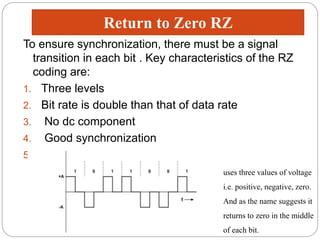
RZ coding ensures synchronization with three voltage levels, its bandwidth constraint, and modern alternatives.
Characteristics and synchronization aspects of Manchester and Differential Manchester encoding with their bandwidth requirements.
UNIT-1
Introductory Concepts: Networkhardware, Network
software, topologies, Protocols and standards, OSI model,
TCP model, TCP/IP model, Physical Layer: Digital and
Analog Signals, Periodic Analog Signals, Signal
Transmission, Limitations of Data Rate, Digital Data
Transmission, Performance Measures, Line Coding,
Digital Modulation, Media and Digital Transmission
System
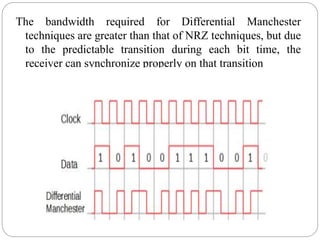
3.
Line Coding (DigitalTransmission)
Line coding refers to the process of converting digital
data into digital signals. Whenever we transmit data it is
in the form of digital signals, so with the help of line
coding, we can convert a sequence to bits (or encoding)
into a digital signal which then again converted into bits by
the receiver (or can be said as decoded by the receiver). For
all this to happen we need line coding schemes which could
also be able to avoid overlapping and distortion of signals.
4.
Characteristics of linecoding
schemes:
1. Less complexity.
2. Should have noise and interference tolerance.
3. No DC component (or say low-frequency component)
should be there because it can't be transferred to larger
distances.
4. Should have error detection capability.
5. Should be self-synchronized.
5.
Line coding toconvert digital data to digital signal
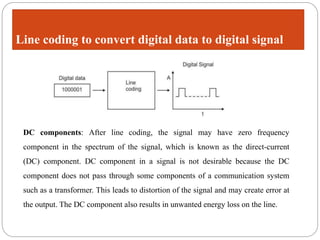
DC components: After line coding, the signal may have zero frequency
component in the spectrum of the signal, which is known as the direct-current
(DC) component. DC component in a signal is not desirable because the DC
component does not pass through some components of a communication system
such as a transformer. This leads to distortion of the signal and may create error at
the output. The DC component also results in unwanted energy loss on the line.
6.
Line Coding Techniques
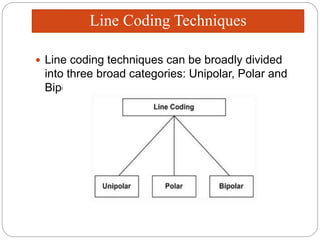
Line coding techniques can be broadly divided
into three broad categories: Unipolar, Polar and
Bipolar
7.
Unipolar
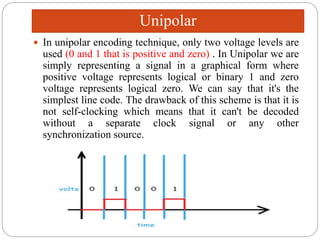
In unipolarencoding technique, only two voltage levels are
used (0 and 1 that is positive and zero) . In Unipolar we are
simply representing a signal in a graphical form where
positive voltage represents logical or binary 1 and zero
voltage represents logical zero. We can say that it's the
simplest line code. The drawback of this scheme is that it is
not self-clocking which means that it can't be decoded
without a separate clock signal or any other
synchronization source.
8.
Polar
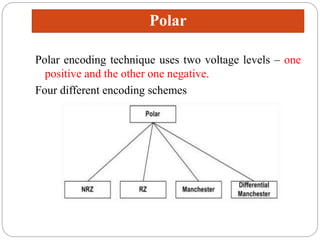
Polar encoding techniqueuses two voltage levels – one
positive and the other one negative.
Four different encoding schemes
9.
Non Return tozero (NRZ)
The most common and easiest way to transmit digital
signals is to use two different voltage levels for the two
binary digits. Usually a negative voltage is used to
represent one binary value and a positive voltage to
represent the other. The data is encoded as the presence
or absence of a signal transition at the beginning of the
bit time.
10.
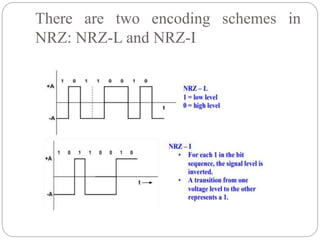
There are twoencoding schemes in
NRZ: NRZ-L and NRZ-I
11.
The advantages ofNRZ coding are:
1. Detecting a transition in presence of noise is more
reliable than to compare a value to a threshold.
2. NRZ codes are easy to engineer and it makes efficient
use of bandwidth.
It may be noted that most of the energy is concentrated between 0 and half the
bit rate. The main limitations are the presence of a dc component and the lack
of synchronization capability. When there is long sequence of 0’s or 1’s, the
receiving side will fail to regenerate the clock and synchronization between
the transmitter and receiver clocks will fail.
12.
Return to ZeroRZ
To ensure synchronization, there must be a signal
transition in each bit . Key characteristics of the RZ
coding are:
1. Three levels
2. Bit rate is double than that of data rate
3. No dc component
4. Good synchronization
5. Main limitation is the increase in bandwidth
uses three values of voltage
i.e. positive, negative, zero.
And as the name suggests it
returns to zero in the middle
of each bit.
13.
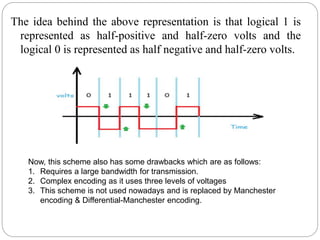
The idea behindthe above representation is that logical 1 is
represented as half-positive and half-zero volts and the
logical 0 is represented as half negative and half-zero volts.
Now, this scheme also has some drawbacks which are as follows:
1. Requires a large bandwidth for transmission.
2. Complex encoding as it uses three levels of voltages
3. This scheme is not used nowadays and is replaced by Manchester
encoding & Differential-Manchester encoding.
14.
Manchester coding
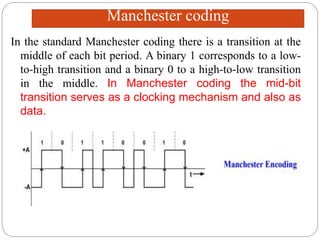
In thestandard Manchester coding there is a transition at the
middle of each bit period. A binary 1 corresponds to a low-
to-high transition and a binary 0 to a high-to-low transition
in the middle. In Manchester coding the mid-bit
transition serves as a clocking mechanism and also as
data.
15.
Differential Manchester coding
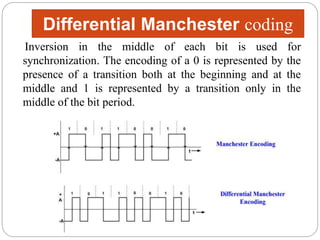
Inversionin the middle of each bit is used for
synchronization. The encoding of a 0 is represented by the
presence of a transition both at the beginning and at the
middle and 1 is represented by a transition only in the
middle of the bit period.
16.
The bandwidth requiredfor Differential Manchester
techniques are greater than that of NRZ techniques, but due
to the predictable transition during each bit time, the
receiver can synchronize properly on that transition
17.
The area whereManchester encoding, and Differential
Manchester encoding are limited is the bandwidth. The
minimum bandwidth of Manchester encoding, and
Differential Manchester encoding is twice as that of NRZ.
Key characteristics are:
1. Two levels
2. No DC component
3. Good synchronization
4. Higher bandwidth due to doubling of bit rate with
respect to data rate