Renewable Energy Sources
• Lecture Question
– What are the renewable energy sources? Make a list, as
comprehensive as possible.
– What are the environmental impacts of these energy sources?
– Renewable Energy Sources
• Radiant solar energy
– Solar heating (passive and active), solar power plants, photovoltaic
cells
• Biomass energy
– Direct: combustion of biomass
– Indirect: chemical conversion to biofuel
• Wind energy
• Hydro energy
• Geothermal energy
– Power plants, direct use, heat pumps
• Ocean energy
– Tidal; salinity-driven
Hydro Energy
• Advantages
– Cheap to operate
• Long life and lower operating costs than all other power plants
– Renewable
– High yield
• Lower energy cost than any other method
– Pretty plentiful
• Some countries depend almost entirely on it
– Not intermittent (if reservoir is large enough)
– Reservoirs have multiple uses
• Flood control, drinking water, aquaculture, recreation
– Less air pollution than fossil fuel combustion
Hydro Energy
• Disadvantages:
– Human population displacement
– More significant breeding ground for disease
– Reduces availability of water downstream
– Ecosystem impacts
• Barriers to migrating fish
• Loss of biodiversity both upstream and downstream
• Coastal erosion
• Reduces nutrient flow (dissolved and particulate)
– Water pollution problems
• Low dissolved oxygen (DO)
• Increased H2S toxicity; other DO-related problems
• Siltation a big problem (also shortens dam life)
– Air pollution
• Actually may be a significant source of GHGs (CH4, N2O, CO2)
– Decommissioning is a big problem
• The Size Issue
– Many (most) of the above problems are significantly worse for larger dams
– However, small dams have shorter lifetimes, less capacity, and are more
intermittent
Wind Energy
• How it works
– Wind turbines directly generate electricity
– Quite efficient (not a heat engine)
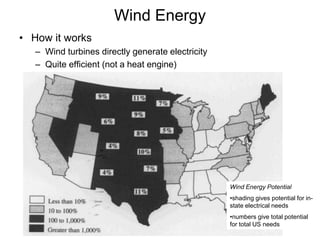
Wind Energy Potential
•shading gives potential for in-
state electrical needs
•numbers give total potential
for total US needs
Wind Energy
• Advantages
– High net energy yield
– Renewable and free
– Very clean source of energy
• No pollution (air or water) during operation
– Long operating life
– Low operating/maintenance costs
– Can be quickly built; not too expensive
– Now almost competitive with hydro and fossil fuels
– Land can be used for other purposes
• Can combine wind and agricultural farms
Wind Energy
• Disadvantages
– Energy storage issues
• An intermittent source of energy; need backup (eg stored energy)
for low-wind days
• Or must be connected to the electrical grid
– Only practical in areas that are windy enough
– Visual pollution
– Danger to birds
• New (slow turning) designs largely eliminate this problem
– Low energy density of wind
• Must use large areas of land
Biomass Energy
• What is it?
– Biomass energy is the use of living and recently dead biological material as
an energy source
– Ultimately dependent on the capture of solar energy and conversion to a
chemical (carbohydrate) fuel
– Theoretically it is a carbon neutral and renewable source of energy
• How it works?
– Traditional: forest management, using wood as fuel
– Use of biodegradable waste
• Examples: manure, crop residue, sewage, municipal solid waste
– Recent interest in agricultural production of energy crops
• Should be high yield and low maintenance
• Examples: corn, sugarcane, switchgrass, hemp, willow, palm oil, rapeseed, and
many others
• Does not have to be a food crop
• Recent interest in bioengineered (GM) plants as fuel sources
– Production of a liquid or gaseous biofuel
• Biogas due to the breakdown of biomass in the absence of O2
– Includes capture of landfill methane
• Bioethanol from fermentation, often from corn. Cellulosic bioethanol is usually
from a grass (switchgrass)
• Biodiesel from rapeseed and other sources
Biomass Energy
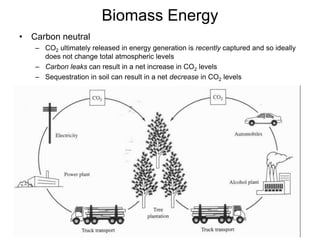
• Carbon neutral
– CO2 ultimately released in energy generation is recently captured and so ideally
does not change total atmospheric levels
– Carbon leaks can result in a net increase in CO2 levels
– Sequestration in soil can result in a net decrease in CO2 levels
Biomass Energy
• Advantages
– Versatile
– Renewable
– No net CO2 emissions (ideally)
– Emits less SO2 and NOx than fossil fuels
• Disadvantages
– Low energy density/yield
• In some cases (eg, corn-derived bioethanol) may yield no net energy
– Land conversion
• Biodiversity loss
• Possible decrease in agricultural food productivity
– Usual problems associated with intensive agriculture
• Nutrient pollution
• Soil depletion
• Soil erosion
• Other water pollution problems
Geothermal Energy
• How it works
– Geothermal power plants
• Use earth’s heat to power steam turbines
– Geothermal direct use
• Use hot springs (etc) as heat source
– Geothermal heat pumps
• Advantages
– Renewable
– Easy to exploit in some cases
– CO2 production less than with fossil fuels
– High net energy yield
• Disadvantages
– Not available everywhere
– H2S pollution
– Produces some water pollution (somewhat similar to mining)
Radiant Solar Energy
• How it works
– Solar power plants
• Steam produced to turn turbine
– Solar heating
• Active and passive systems
– Photovoltaic cells
• “Solar batteries” use special semiconductors
• Advantages
– Renewable and free
– High energy yield
– A very clean source of energy
• No air/water pollution during operation
– Low operating costs
• Will pay for themselves over time
• Disadvantages
– Intermittent source
• Energy storage issues
– Low energy density
• Requires pretty much land
The Hydrogen Economy
• Lecture Questions
– What is the hydrogen economy?
– Explain how the hydrogen economy could potentially serve as the basis
for a renewable energy system that emits little or no air pollution
• Definition
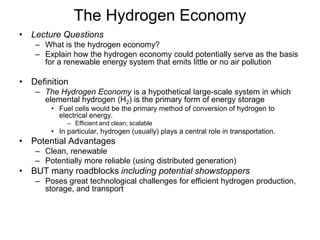
– The Hydrogen Economy is a hypothetical large-scale system in which
elemental hydrogen (H2) is the primary form of energy storage
• Fuel cells would be the primary method of conversion of hydrogen to
electrical energy.
– Efficient and clean; scalable
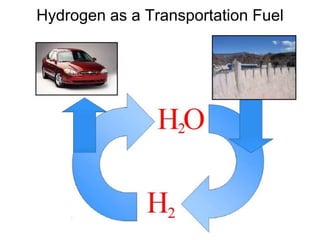
• In particular, hydrogen (usually) plays a central role in transportation.
• Potential Advantages
– Clean, renewable
– Potentially more reliable (using distributed generation)
• BUT many roadblocks including potential showstoppers
– Poses great technological challenges for efficient hydrogen production,
storage, and transport
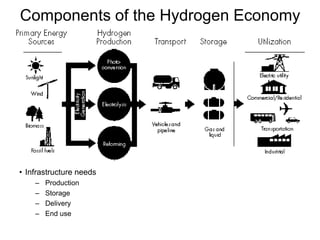
Components of the Hydrogen Economy
• Infrastructure needs
– Production
– Storage
– Delivery
– End use
Hydrogen as a Transportation Fuel
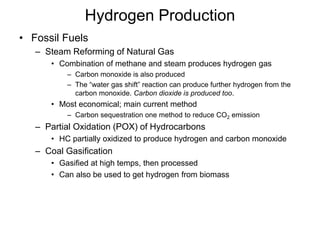
Hydrogen Production
• Fossil Fuels
– Steam Reforming of Natural Gas
• Combination of methane and steam produces hydrogen gas
– Carbon monoxide is also produced
– The “water gas shift” reaction can produce further hydrogen from the
carbon monoxide. Carbon dioxide is produced too.
• Most economical; main current method
– Carbon sequestration one method to reduce CO2 emission
– Partial Oxidation (POX) of Hydrocarbons
• HC partially oxidized to produce hydrogen and carbon monoxide
– Coal Gasification
• Gasified at high temps, then processed
• Can also be used to get hydrogen from biomass
Hydrogen Production
• Electrolysis
– Efficiencies 70-85%
– Produces highest purity of hydrogen
– Currently, the electricity consumed is usually worth more than
the hydrogen produced
• Experimental methods
– Biological hydrogen production
– Direct photolysis
– Thermolysis
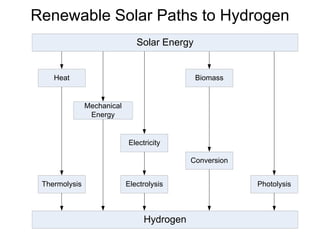
Renewable Solar Paths to Hydrogen
Solar Energy
Hydrogen
Heat
Thermolysis
Biomass
Conversion
Photolysis
Mechanical
Energy
Electricity
Electrolysis
Hydrogen Storage
• Large-Scale Stationary Storage
– Underground in depleted oil/gas fields, aquifers, caverns
• Intermediate- and Small-Scale Stationary/Mobile Storage
– The focus of most current research
– As a liquid
• Advantage: higher energy density, cheaper transport
• Disadvantage: economic/energy cost of liquefaction is significant
– As a compressed gas
• Probably best short-term method, particularly with advanced materials to decrease
weight
• Advantages
– Rapid charging/discharging
– Lower costs than liquid storage
• Disadvantages:
– Low energy density, Probably still acceptable for motor vehicles
– Safety (esp public perception)
– Metal hydrides
• Hydrogen is absorbed under pressure, released when heated
• Less filling pressure needed
• Low energy density, long recharge time, expensive
• Experimental Methods
– Improved hydrides; carbon nanotubes; many other materials (eg conversion to
ammonia)
Chemical Batteries
• Lecture Questions
– What are batteries and how do they work?
– What’s the difference between a “regular” and a “rechargeable” battery?
Why are rechargeable batteries sometimes referred to as “storage”
batteries?
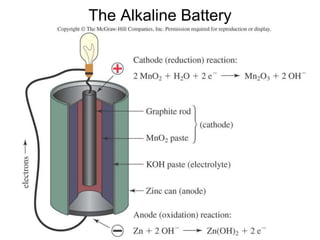
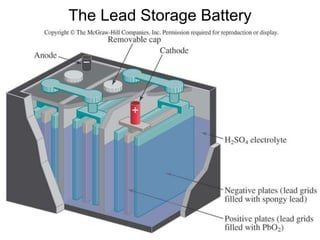
– Chemical batteries are based on reduction-oxidation (redox) reactions,
which are reactions where electron transfer occurs.
• The oxidation half-reaction occurs at the anode
• Electrons flow from the anode, through an external circuit, and to the
cathode, where the reduction half-reaction occurs
– Chemical batteries are a very efficient method of generating electricity
• Efficiencies of 80% are regularly achieved
• Significantly (2-3 times) more efficient than heat engines
– Rechargeable batteries can be hooked up to an external source of
electricity to regenerate the redox reactants through electrolysis.
• Rechargeable batteries thus provide a means of storing electricity in
chemical form. They are thus sometimes called storage batteries.
The Alkaline Battery
The Lead Storage Battery
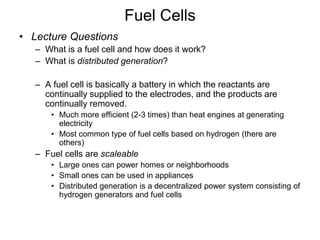
Fuel Cells
• Lecture Questions
– What is a fuel cell and how does it work?
– What is distributed generation?
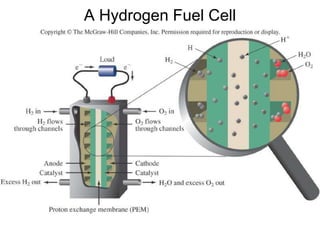
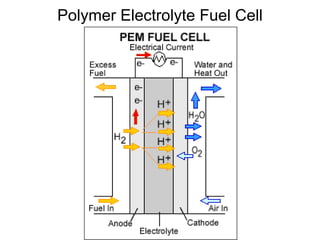
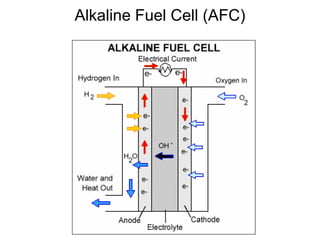
– A fuel cell is basically a battery in which the reactants are
continually supplied to the electrodes, and the products are
continually removed.
• Much more efficient (2-3 times) than heat engines at generating
electricity
• Most common type of fuel cells based on hydrogen (there are
others)
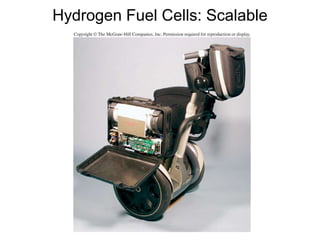
– Fuel cells are scaleable
• Large ones can power homes or neighborhoods
• Small ones can be used in appliances
• Distributed generation is a decentralized power system consisting of
hydrogen generators and fuel cells
A Hydrogen Fuel Cell
Hydrogen Fuel Cells: Scalable
Polymer Electrolyte Fuel Cell
Alkaline Fuel Cell (AFC)

Renewable energy sources

  • 1.
  • 2.
    Renewable Energy Sources •Lecture Question – What are the renewable energy sources? Make a list, as comprehensive as possible. – What are the environmental impacts of these energy sources? – Renewable Energy Sources • Radiant solar energy – Solar heating (passive and active), solar power plants, photovoltaic cells • Biomass energy – Direct: combustion of biomass – Indirect: chemical conversion to biofuel • Wind energy • Hydro energy • Geothermal energy – Power plants, direct use, heat pumps • Ocean energy – Tidal; salinity-driven
  • 3.
    Hydro Energy • Advantages –Cheap to operate • Long life and lower operating costs than all other power plants – Renewable – High yield • Lower energy cost than any other method – Pretty plentiful • Some countries depend almost entirely on it – Not intermittent (if reservoir is large enough) – Reservoirs have multiple uses • Flood control, drinking water, aquaculture, recreation – Less air pollution than fossil fuel combustion
  • 4.
    Hydro Energy • Disadvantages: –Human population displacement – More significant breeding ground for disease – Reduces availability of water downstream – Ecosystem impacts • Barriers to migrating fish • Loss of biodiversity both upstream and downstream • Coastal erosion • Reduces nutrient flow (dissolved and particulate) – Water pollution problems • Low dissolved oxygen (DO) • Increased H2S toxicity; other DO-related problems • Siltation a big problem (also shortens dam life) – Air pollution • Actually may be a significant source of GHGs (CH4, N2O, CO2) – Decommissioning is a big problem • The Size Issue – Many (most) of the above problems are significantly worse for larger dams – However, small dams have shorter lifetimes, less capacity, and are more intermittent
  • 5.
    Wind Energy • Howit works – Wind turbines directly generate electricity – Quite efficient (not a heat engine) Wind Energy Potential •shading gives potential for in- state electrical needs •numbers give total potential for total US needs
  • 6.
    Wind Energy • Advantages –High net energy yield – Renewable and free – Very clean source of energy • No pollution (air or water) during operation – Long operating life – Low operating/maintenance costs – Can be quickly built; not too expensive – Now almost competitive with hydro and fossil fuels – Land can be used for other purposes • Can combine wind and agricultural farms
  • 7.
    Wind Energy • Disadvantages –Energy storage issues • An intermittent source of energy; need backup (eg stored energy) for low-wind days • Or must be connected to the electrical grid – Only practical in areas that are windy enough – Visual pollution – Danger to birds • New (slow turning) designs largely eliminate this problem – Low energy density of wind • Must use large areas of land
  • 8.
    Biomass Energy • Whatis it? – Biomass energy is the use of living and recently dead biological material as an energy source – Ultimately dependent on the capture of solar energy and conversion to a chemical (carbohydrate) fuel – Theoretically it is a carbon neutral and renewable source of energy • How it works? – Traditional: forest management, using wood as fuel – Use of biodegradable waste • Examples: manure, crop residue, sewage, municipal solid waste – Recent interest in agricultural production of energy crops • Should be high yield and low maintenance • Examples: corn, sugarcane, switchgrass, hemp, willow, palm oil, rapeseed, and many others • Does not have to be a food crop • Recent interest in bioengineered (GM) plants as fuel sources – Production of a liquid or gaseous biofuel • Biogas due to the breakdown of biomass in the absence of O2 – Includes capture of landfill methane • Bioethanol from fermentation, often from corn. Cellulosic bioethanol is usually from a grass (switchgrass) • Biodiesel from rapeseed and other sources
  • 9.
    Biomass Energy • Carbonneutral – CO2 ultimately released in energy generation is recently captured and so ideally does not change total atmospheric levels – Carbon leaks can result in a net increase in CO2 levels – Sequestration in soil can result in a net decrease in CO2 levels
  • 10.
    Biomass Energy • Advantages –Versatile – Renewable – No net CO2 emissions (ideally) – Emits less SO2 and NOx than fossil fuels • Disadvantages – Low energy density/yield • In some cases (eg, corn-derived bioethanol) may yield no net energy – Land conversion • Biodiversity loss • Possible decrease in agricultural food productivity – Usual problems associated with intensive agriculture • Nutrient pollution • Soil depletion • Soil erosion • Other water pollution problems
  • 11.
    Geothermal Energy • Howit works – Geothermal power plants • Use earth’s heat to power steam turbines – Geothermal direct use • Use hot springs (etc) as heat source – Geothermal heat pumps • Advantages – Renewable – Easy to exploit in some cases – CO2 production less than with fossil fuels – High net energy yield • Disadvantages – Not available everywhere – H2S pollution – Produces some water pollution (somewhat similar to mining)
  • 12.
    Radiant Solar Energy •How it works – Solar power plants • Steam produced to turn turbine – Solar heating • Active and passive systems – Photovoltaic cells • “Solar batteries” use special semiconductors • Advantages – Renewable and free – High energy yield – A very clean source of energy • No air/water pollution during operation – Low operating costs • Will pay for themselves over time • Disadvantages – Intermittent source • Energy storage issues – Low energy density • Requires pretty much land
  • 13.
    The Hydrogen Economy •Lecture Questions – What is the hydrogen economy? – Explain how the hydrogen economy could potentially serve as the basis for a renewable energy system that emits little or no air pollution • Definition – The Hydrogen Economy is a hypothetical large-scale system in which elemental hydrogen (H2) is the primary form of energy storage • Fuel cells would be the primary method of conversion of hydrogen to electrical energy. – Efficient and clean; scalable • In particular, hydrogen (usually) plays a central role in transportation. • Potential Advantages – Clean, renewable – Potentially more reliable (using distributed generation) • BUT many roadblocks including potential showstoppers – Poses great technological challenges for efficient hydrogen production, storage, and transport
  • 14.
    Components of theHydrogen Economy • Infrastructure needs – Production – Storage – Delivery – End use
  • 15.
    Hydrogen as aTransportation Fuel
  • 16.
    Hydrogen Production • FossilFuels – Steam Reforming of Natural Gas • Combination of methane and steam produces hydrogen gas – Carbon monoxide is also produced – The “water gas shift” reaction can produce further hydrogen from the carbon monoxide. Carbon dioxide is produced too. • Most economical; main current method – Carbon sequestration one method to reduce CO2 emission – Partial Oxidation (POX) of Hydrocarbons • HC partially oxidized to produce hydrogen and carbon monoxide – Coal Gasification • Gasified at high temps, then processed • Can also be used to get hydrogen from biomass
  • 17.
    Hydrogen Production • Electrolysis –Efficiencies 70-85% – Produces highest purity of hydrogen – Currently, the electricity consumed is usually worth more than the hydrogen produced • Experimental methods – Biological hydrogen production – Direct photolysis – Thermolysis
  • 18.
    Renewable Solar Pathsto Hydrogen Solar Energy Hydrogen Heat Thermolysis Biomass Conversion Photolysis Mechanical Energy Electricity Electrolysis
  • 19.
    Hydrogen Storage • Large-ScaleStationary Storage – Underground in depleted oil/gas fields, aquifers, caverns • Intermediate- and Small-Scale Stationary/Mobile Storage – The focus of most current research – As a liquid • Advantage: higher energy density, cheaper transport • Disadvantage: economic/energy cost of liquefaction is significant – As a compressed gas • Probably best short-term method, particularly with advanced materials to decrease weight • Advantages – Rapid charging/discharging – Lower costs than liquid storage • Disadvantages: – Low energy density, Probably still acceptable for motor vehicles – Safety (esp public perception) – Metal hydrides • Hydrogen is absorbed under pressure, released when heated • Less filling pressure needed • Low energy density, long recharge time, expensive • Experimental Methods – Improved hydrides; carbon nanotubes; many other materials (eg conversion to ammonia)
  • 20.
    Chemical Batteries • LectureQuestions – What are batteries and how do they work? – What’s the difference between a “regular” and a “rechargeable” battery? Why are rechargeable batteries sometimes referred to as “storage” batteries? – Chemical batteries are based on reduction-oxidation (redox) reactions, which are reactions where electron transfer occurs. • The oxidation half-reaction occurs at the anode • Electrons flow from the anode, through an external circuit, and to the cathode, where the reduction half-reaction occurs – Chemical batteries are a very efficient method of generating electricity • Efficiencies of 80% are regularly achieved • Significantly (2-3 times) more efficient than heat engines – Rechargeable batteries can be hooked up to an external source of electricity to regenerate the redox reactants through electrolysis. • Rechargeable batteries thus provide a means of storing electricity in chemical form. They are thus sometimes called storage batteries.
  • 21.
  • 22.
  • 23.
    Fuel Cells • LectureQuestions – What is a fuel cell and how does it work? – What is distributed generation? – A fuel cell is basically a battery in which the reactants are continually supplied to the electrodes, and the products are continually removed. • Much more efficient (2-3 times) than heat engines at generating electricity • Most common type of fuel cells based on hydrogen (there are others) – Fuel cells are scaleable • Large ones can power homes or neighborhoods • Small ones can be used in appliances • Distributed generation is a decentralized power system consisting of hydrogen generators and fuel cells
  • 24.
  • 25.
  • 26.
  • 27.