
Phyllodes
tumor:Management
Dr Shambhavi Sharma
Resident 1st year
Introduction
• Also known as serocystic disease of Brodie or cystosarcoma phyllodes
• Greek word
Phyllon = leaf
Sarcoma = fleshy tumor
Epidemiology
• Age: over the age of 40
• Sex: almost exclusively on females
• Occurrence: 1% of tumors of breast, 2.5% of fibroepithelial tumors
• Mostly benign
• Average annual incidence rate of malignant phyllodes tumor is
2.1/million women
• May be associated with Li Freumani syndrome
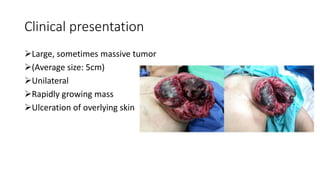
Clinical presentation
Large, sometimes massive tumor
(Average size: 5cm)
Unilateral
Rapidly growing mass
Ulceration of overlying skin
Examination
Stretched,red,dilated veins
Smooth ,non tender, fluctuant
necrosis and hence cystic areas
Warmer,notfixed to skin or deeper muscles or chest wall
No nipple retraction
Lymph nodes palpaple (20%) (mostly reactive
Malignant phyllodes
More aggressive
Metastasize hematogenously
Lung, skeleton, heart, and liver – most common metastatic site
Mortality rate: 30%
May present with dyspnea, fatigue, and bone pain
Malignant phyllodes
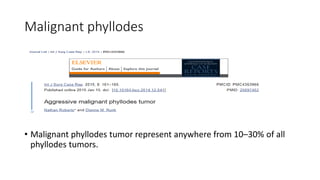
• Malignant phyllodes tumor represent anywhere from 10–30% of all
phyllodes tumors.
ultrasonography
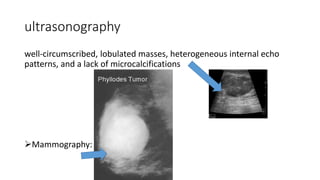
well-circumscribed, lobulated masses, heterogeneous internal echo
patterns, and a lack of microcalcifications
Mammography:
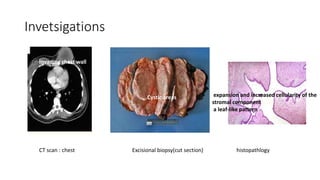
Invetsigations
CT scan : chest Excisional biopsy(cut section) histopathlogy
Invading chest wall
Cystic areas expansion and increased cellularity of the
stromal component
a leaf-like pattern
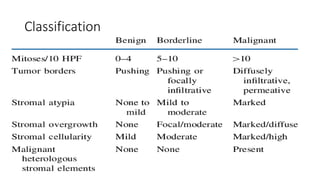
Classification
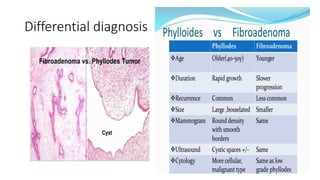
Differential diagnosis
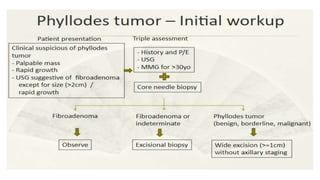
TREATMENT:
SURGERY
• Complete Excision
2cm margin for small tumors
5cm margin for large tumor
• Lumpectomy/Wide Local Excision /Mastectomy depending on Size
• Axillary Lymph Node Dissection : usually not necessary
Postoperative adjuvant therapy
ADJUVANT CHEMOTHERAPY?
• role is Controversial!
• Should be considered for Malignant Phyllodes tumour
Adjuvant radiotherapy
•Not indicated for tumours that are Widely Excised
• Indicated for Borderline or Malignant Phyllodes tumours
• Reduces Local Recurrence but does not impact Survival.
• Rarely indicated following Mastectomy
Adjuvant hormone therapy
• No place for Hormonal therapy in Phyllodes Tumours
Post op complications
• Infection
• Seroma formation
• Local or distant recurrence
Follow up
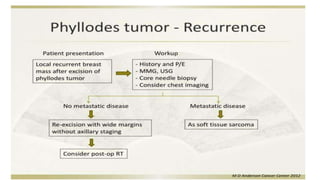
• Most recurrence occur within first 2 years
• Clinical Follow-Up:
• Every 6 months in the First 2 years
• Then Annually
Annual Mammography: for Lumpectomy & Wide Local Excision cases
Chest X-ray/Chest Computed Tomography: 6 Monthly For Large (≥5 cm)
or Malignant Phyllodes Tumours
Prognosis
majority of patients with Benign and Borderline Phyllodes Tumours
Cured by Surgery
The 5 Year Survival Rate for Malignant Phyllodes Tumours
approximately 60-80%
complications
• Emotional distress due to the presence of breast cancer
• Ulceration of overlying skin may lead to secondary bacterial and/or fungal
infections
• Metastasis of the tumor to local and regional sites including to lymph nodes and
skin
• Recurrence of the tumor on incomplete surgical removal
• Side effects of chemotherapy: nausea, vomiting, hair loss, decreased appetite,
mouth sores, fatigue, low blood cell counts, and a higher chance of developing
infections
• Side effects of radiation therapy : sunburn-like rashes, red or dry
skin, heaviness of the breasts, general fatigue
• Lymphedema (swelling of an arm)
may form weeks to years after treatment that involves radiation
therapy to the axillary lymph node
THANK YOU

Phyllodes tumor

  • 1.
  • 2.
    Introduction • Also knownas serocystic disease of Brodie or cystosarcoma phyllodes • Greek word Phyllon = leaf Sarcoma = fleshy tumor
  • 3.
    Epidemiology • Age: overthe age of 40 • Sex: almost exclusively on females • Occurrence: 1% of tumors of breast, 2.5% of fibroepithelial tumors • Mostly benign • Average annual incidence rate of malignant phyllodes tumor is 2.1/million women • May be associated with Li Freumani syndrome
  • 4.
    Clinical presentation Large, sometimesmassive tumor (Average size: 5cm) Unilateral Rapidly growing mass Ulceration of overlying skin
  • 5.
    Examination Stretched,red,dilated veins Smooth ,nontender, fluctuant necrosis and hence cystic areas Warmer,notfixed to skin or deeper muscles or chest wall No nipple retraction Lymph nodes palpaple (20%) (mostly reactive
  • 6.
    Malignant phyllodes More aggressive Metastasizehematogenously Lung, skeleton, heart, and liver – most common metastatic site Mortality rate: 30% May present with dyspnea, fatigue, and bone pain
  • 7.
    Malignant phyllodes • Malignantphyllodes tumor represent anywhere from 10–30% of all phyllodes tumors.
  • 8.
    ultrasonography well-circumscribed, lobulated masses,heterogeneous internal echo patterns, and a lack of microcalcifications Mammography:
  • 9.
    Invetsigations CT scan :chest Excisional biopsy(cut section) histopathlogy Invading chest wall Cystic areas expansion and increased cellularity of the stromal component a leaf-like pattern
  • 10.
  • 11.
  • 13.
    TREATMENT: SURGERY • Complete Excision 2cmmargin for small tumors 5cm margin for large tumor • Lumpectomy/Wide Local Excision /Mastectomy depending on Size • Axillary Lymph Node Dissection : usually not necessary
  • 14.
    Postoperative adjuvant therapy ADJUVANTCHEMOTHERAPY? • role is Controversial! • Should be considered for Malignant Phyllodes tumour
  • 15.
    Adjuvant radiotherapy •Not indicatedfor tumours that are Widely Excised • Indicated for Borderline or Malignant Phyllodes tumours • Reduces Local Recurrence but does not impact Survival. • Rarely indicated following Mastectomy
  • 16.
    Adjuvant hormone therapy •No place for Hormonal therapy in Phyllodes Tumours
  • 17.
    Post op complications •Infection • Seroma formation • Local or distant recurrence
  • 18.
    Follow up • Mostrecurrence occur within first 2 years • Clinical Follow-Up: • Every 6 months in the First 2 years • Then Annually Annual Mammography: for Lumpectomy & Wide Local Excision cases Chest X-ray/Chest Computed Tomography: 6 Monthly For Large (≥5 cm) or Malignant Phyllodes Tumours
  • 20.
    Prognosis majority of patientswith Benign and Borderline Phyllodes Tumours Cured by Surgery The 5 Year Survival Rate for Malignant Phyllodes Tumours approximately 60-80%
  • 21.
    complications • Emotional distressdue to the presence of breast cancer • Ulceration of overlying skin may lead to secondary bacterial and/or fungal infections • Metastasis of the tumor to local and regional sites including to lymph nodes and skin • Recurrence of the tumor on incomplete surgical removal • Side effects of chemotherapy: nausea, vomiting, hair loss, decreased appetite, mouth sores, fatigue, low blood cell counts, and a higher chance of developing infections
  • 22.
    • Side effectsof radiation therapy : sunburn-like rashes, red or dry skin, heaviness of the breasts, general fatigue • Lymphedema (swelling of an arm) may form weeks to years after treatment that involves radiation therapy to the axillary lymph node
  • 23.