Breast pathology - 1
    Dr.CSBR.Prasad, M.D.
Cases
Cases
Cases
Cases
Cases


Left image – affected breast   Right image – Normal breast
Cases


60yo male
1       2


Cases
Cases
Cases
Cases
Cases
Cases
Breast pathology
Mammary gland – Normal features


  1. Covered by skin & subcutaneous tissue
  2. Rests on pectoralis muscle
  3. Pectoral fascia separates it from the pectoral muscles
Breast – Normal features
• Modified skin appendage.
• Composed of specialized epithelium and stroma
  that gives rise to both benign and malignant
  lesions.
• 6-10 major ductal system originate at the nipple.
• Keratinizing sq.epithelium of overlying skin
  continues into the ducts and then abruptly changes
  to a double layered cuboidal epithelium.
• Surrounding areolar skin is pigmented &
  supported by smooth muscle.
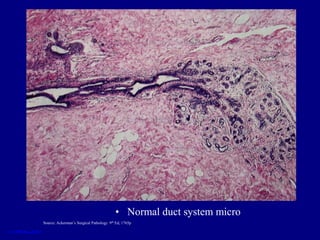
• Normal duct system micro
Source: Ackerman’s Surgical Pathology 9th Ed, 1765p
Breast – Normal features

• Morphofunctional unit of the organ is SINGLE
  GLAND composed of 2major parts:
  1-TDLU (secretory unit of the gland)
      a-lobule
      b-terminal ductule
  2-Large duct system
Breast – Normal features

• Importance of division of mammary gland
  unit into 2 major portions resides in its
  relation to disease of this organs.
• TDLU (FCD, Ductal hyperplasia,
  Carcinoma)
• Large duct system (Solitary papilloma,
  ductectasia, rare ductal carcinomas)
Normal anatomy and possible
    pathological lesions
3910
Source: Ackerman’s Surgical Pathology 9th Ed, 1765p
Histology
Histology

Epithelium & Stroma:
• Ducts and lobules are lined by 2 cell types
          1-Myoepithelial cell lying on the BM.
          2-Epithelial cells lines the lumen.
• Stroma
      1-Interlobular stroma
      2-Intralobular stroma (hormonally responsive)
Normal histology


The normal microscopic appearance of female breast tissue is shown here. There is
   a larger duct to the right and lobules to the left. A collagenous stroma extends
   between the structures (Interlobular – Red stars). Intralobular stroma is
   hormonally responsive (Blue Stars). A variable amount of adipose tissue can be
   admixed with these elements.              Source: webpath
Normal histology


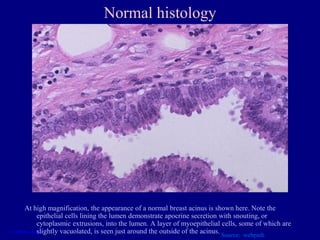
At high magnification, the appearance of a normal breast acinus is shown here. Note the
    epithelial cells lining the lumen demonstrate apocrine secretion with snouting, or
    cytoplasmic extrusions, into the lumen. A layer of myoepithelial cells, some of which are
    slightly vacuolated, is seen just around the outside of the acinus.
                                                                    Source: webpath
Epithelial markers

            • EMA
            • Milk Fat Globule Membrane antigen
            • alfa-Lactalbumin


Source: Ackerman’s Surgical Pathology 9th Ed, 1765p
Normal histology


An immunoperoxidase stain with antibody to actin demonstrates the
   myoepithelial cell layer around the breast acinus. The myoepithelial cells are
   contractile and are very sensitive to oxytocin.
       Source: webpath
Markers for Myoepithelium
                     •      S-100 protein
                     •      P-Cadherin
                     •      SMA
                     •      Calponin
                     •      Smooth muscle myosin-heavy chain
                     •      Maspin
                     •      Caldesmon
                     •      p63
Source: Ackerman’s Surgical Pathology 9th Ed, 1765p
Disorders of development

1. Milk line remnants.
2. Accessory axillary breast tissue.
3. Congenital nipple inversion.
Milk line remnants
       “POLYTHELIA”


Epidermal thickening along the milk line
 extending from axilla to perineum.
Milk line remnants
The classification established by Kajava in 1915 is still valid: (De Cholnoky,
      1939)
1.    Complete SN: Nipple + areola + glandular breast tissue
2.    SN: Nipple + glandular tissue (no areola)
3.    SN: Areola + glandular tissue (no nipple)
4.    Aberrant glandular tissue only
5.    SN: Nipple + areola + pseudomamma (fat tissue that replaces the
      glandular tissue)
6.    SN: Nipple only (the most common SN)
7.    SN: Areola only (polythelia areolaris)
8.    Patch of hair only (polythelia pilosa)
Disorders of development
   Milk line remnants
Disorders of development
     Accessory axillary breast tissue

In some persons normal ductal system extends
  into subcutaneous tissue of the chest wall
  and into the axillay fossa.
Importance: Therapeutic mastectomy might
  remove the entire breast but not remove all
  breast epithelium.
Hence cannot compeltely eliminate the risk of
  developing breast cancer.
Disorders of development
Accessory axillary breast tissue
Disorders of development
      Congenital nipple inversion


It may be bilateral or unilateral.

Importance: may be mistaken for carcinoma
  or inflammation.
Disorders of development
Congenital nipple inversion
Clinical presentations

•    Symptomatic:
1.   Pain
2.   Palpable mass
3.   Nipple discharge
•    Asymptomatic (mammography screening)
1.   Densities
2.   Calcifications
Clincal presentations
                   PAIN
•    Mastalgia / mastodynia
•    Cyclical / non-cyclical
1.   Ruptured cyst
2.   Injury
3.   Infection
4.   Some times without any specific lesion
Note: only about 10% of breast carcinoma patients present
with pain.
Clincal presentations
        PALPABLE MASSES
• Notable points:
1. Masses must be distingusihed from the normal
   nodularity of the breast.
2. Breast masses usually does not become palpable
   until it’s about 2cms in diameter.
3. Likelyhood of malignancy in a papable mass
   increses with age
       ---- <40yrs (only 10% of masses are
   malignant)
       ---- >50yrs (about 60% of the masses are
   malignant)
Clincal presentations
     Nipple discharge


• Gains importance only if it’s
1. Spontaneous &
2. Unilateral
Clincal presentations
           Nipple discharge
• Types of discharges:
1. Milky (>prolactin, hypothyroidism, anovulatory
   cycle, OCs, M-Dopa, phenothiazines) (Not
   associated with malignancy)
2. Serosanguinous (most commonly associated
   with benign lesion)
3. Bloody (most commonly associated with benign
   lesion – duct papillomas)
Acute mastitis
•    Pyogenic infections
•    Occurs during first few weeks of lactation
•    Pathogens:
1.   Staphylococcus
2.   Streptococcus
Acute mastitis
1. Breast mass
2. Fever
3. Erythematous painful breasts
4. If not Tx it may spread to entire breast
 Complictions:
---fibrous scarring
---may be mistaken for carcinoma
Acute mastitis


During lactation, or at other times with dermatologic conditions that allow cracks and
   fissures to form in the skin of the nipple, infectious organisms can invade into breast
   and result in acute inflammation, and this may progress to breast abscess formation
   (Circle). The most common organism is Staphylococcus aureus. Organization with
   fibrous scar formation around the abscess can mimic a carcinoma on physical
   examination, by mammography, and grossly.
Acute mastitis


While breast-feeding the baby, the skin of the breast may become irritated and
  inflamed. The skin may fissure, predisposing to infection. Acute mastitis
  typically involves just one breast and is most often caused by Staphylococcus
  aureus, though other bacterial organisms such as streptococci can produce this
  condition, with neutrophilic infiltrates microscopically. If untreated by
  antibiotic therapy, spread of infection and abscess formation can occur.
Granulomatous mastitis

• Chronic non-specific mastitis
Etiology:
1. Systemic granulomatous disease
    (Sarcoidosis, Wegener’s)
2. Inections (TB, Fungal)
3. Silicone breast implants
4. Idiopathic (hypersensitivity to luminal
    secretions)
Periductal mastitis
    Recurrent sub areolar abscesses
          “ZUSKA disease”

•   Painful erythematous subareolar masses
•   >90% are smokers (vit-A deficiency)
•   Seen both in males and females
•   Not associated with lactation
Periductal mastitis
    Recurrent sub areolar abscesses
          “ZUSKA disease”


Subareolar abscess with fistulous opening at the edge of areola
Periductal mastitis
   Recurrent sub areolar abscesses
         “ZUSKA disease”
Pathlogy:
1. Keratinization of epithelium extending to an
   abnormal depth into the orifices of the nipple
   ducts.
2. Keratin plugs block the ductal system and causes
   dilatation & eventual rupture of the ducts.
3. Intense chronic granulomatous inflammatory
   response develops to ketain spilled into
   periductal tissue.
Periductal mastitis
  Recurrent sub areolar abscesses
        “ZUSKA disease”


Source: Robbins Pathologic basis of disease, 8th ed. 1125p

                              • 3945
Mammary ductectasia
• 4th to 7th decade of life.
• Usually seen in multiparous women.
• NOT assocated with cigarette smoking.
Clinically:
• Nipple discharge.
• Retraction of nipple.
• Palpable dilated ducts in the subareolar area.
Mammary ductectasia

• Gross:
    1-Poorly defined indurated area.
    2-Ropyness of the surface.
    3-c/s shows dilation of one or more large
  ducts containing cheesy inspissated
  secretions.
Mammary ductectasia
• Microscopically:
   1-Dilated ducts with necrotic & atrophic
  epithelium
   2-Lumen filled with powdery debri and foam
  cells
   3-Periductal & insterstitial chronic inflammaotry
  cell infiltration (Ly, Plas, Histio, Giant cells)

Note: Plasma cell mastitis (when numerous plasma
 cells are seen)
      Obliteration mastitis (when inflammatory
 scarring obliterates the lumen of the ducts)
Mammary ductectasia


     • 3955
Source: Ackerman’s Surgical Pathology 9th Ed.
FAT NECROSIS

• Usually seen in obese & pendulous breasts
• Generally iniciated by trauma or prior
  surgery
• It presents as painless palpable mass
FAT NECROSIS


• 3914
FAT NECROSIS

Gross:
1. Central pale cystic area of necrosis
2. Chalky white areas
FAT NECROSIS


• Lipid filled spaces surrounded by neutrophils, lymphocytes,
  plasma cells and histiocytes having foamy cytoplasm
• FB type giant cell reaction
• Fibrosis & calcifiction
FAT NECROSIS


• Lipid filled spaces surrounded by neutrophils, lymphocytes,
  plasma cells and histiocytes having foamy cytoplasm
• FB type giant cell reaction
• Fibrosis & calcifiction
Non-proliferative breast changes – FCD


 •   Form palpable masses
 •   Calcifications
 •   Spontaneous unilateral nipple discharge
 •   They mey disappear after FNAC
Non-proliferative breast changes – FCD


There are 3 principle patterns of morphologic
   changes
1. Cyst formation with apocrine metaplasia
2. Fibrosis
3. Adenosis
Non-proliferative breast changes – FCD


CYSTS:
• Cysts form by dilation and unfolding of
  lobule.
• Cystic lobules coalesce to form larger cysts.
• Cysts lined by flattened atrophic or apocrine
  epithelium
• Papillary projections
• Calcification is common (‘Milk of calcium’)
Fibrocystic Change (FCC)


This is the gross appearance of fibrocystic changes in the breast. A 1.5 cm cyst is
   noted here. This can lead to palpation of an ill-defined "lump" in the breast.
   Sometimes, fibrocystic changes produce a more diffusely lumpy breast.
                Source: webpath
Fibrocystic Change (FCC)


This is the histologic appearance of fibrocystic changes in breast. There are
   cystically dilated ducts, areas of lobules that are laced with abundant
   fibrous connective tissue (sclerosing adenosis), and stromal fibrosis.
   There is even a small area of microcalcification seen just to the upper
   right of center. No atypical changes are seen here. Source: webpath
Fibrocystic Change (FCC)


Another example of microscopic fibrocystic changes of the breast are shown here.
   Fibrocystic changes account for the majority of "breast lumps" that are found in
   women of reproductive years, particularly between age 30 and menopause.
              Source: webpath
Fibrocystic Change (FCC)


There is prominent apocrine change of the cells lining the cysts in this example of
   fibrocystic changes of breast. Note the tall, pink, columnar nature of the
   epithelial cells. This appearance is benign.        Source: webpath
Non-proliferative breast changes – FCD


FIBROSIS:
 Rupture & release of secretory material into
  the adjacent stroma elicit inflammation and
  fibrosis.
ADENOSIS:
  Increase in number of acini per lobule
  ‘Blunt duct adenosis’
Fibrocystic Change (FCC)


Prominent sclerosing adenosis, one of the features of fibrocystic changes, is demonstrated
   by the appearance of a proliferation of small ducts in a fibrous stroma. Although it is
   benign, the gross and mammographic appearance may mimic carcinoma, and it can be
   difficult to distinguish from carcinoma on frozen section. Source: webpath
FCC

This mammogram demonstrates a
   suspicious lesion that could be a
   carcinoma or just an area of
   pronounced sclerosis with
   fibrocystic changes. On biopsy, this
   was benign.


   Source: webpath
PROLIFERATIVE LESIONS


     1-without atypia
     2-with atypia
Proliferative breast disease
             without atypia
• Rarely form palpable masses
• They are often detected
     ---radiographically (densities, calcifications)
     ---in biopsies
• Proliferation of ductal epithelium & or stroma
  without cellular abnormalities suggestive of
  malignancy
Proliferative breast disease
           without atypia
Entities include:
1. Florid epithelial hyperplasia
2. Sclerosing adenosis
3. Complex sclerosing lesion
4. Papillomas
5. Fibroadenomas with complex features
Proliferative breast disease
            without atypia
EPITHELIAL HYPERPLASIA:
• Def: presence of >2 cell layers of epithelium
• >4 cell layers designates it as moderate to florid
  hyperplasia
• When they fill the lumen it can be differentiated
  from CIS by finding fenestrations are the
  periphery of the cellular masses.
Proliferative breast disease
            without atypia
SCLEROSING ADENOSIS:
• Increase in # of acini per terminal duct at least
  twice the normal.
• Normal lobular arrangement is maintained.
• Acini are characteristically dilated at the
  periphery.
• Myoepithelial cells are usually prominent.
• Sclerosis
• Calcifications are frequently present with in the
  lumen of acini.
Proliferative breast disease
            without atypia
COMPLEX SCLEROSING LESION:
• Stellate scar
• Centrally entrapped glands in hyalinized stroma
Complex sclerosing lesion include:
1. Radial scar
2. Radial scar related lesion with sclerosing
   adenosis, papilloma formation
3. Epithelial hyperplasia
Proliferative breast disease
            without atypia
PAPILLOMAS:
• Multiple branching fibrovascular cores
• Lined by luminal & myoepithelial cells
• Growth occurs within a dilated duct
• Epithelial hyperplasia and apocrine metaplasia are
  frequently seen
• Large duct papillomas are single and situated
  nearer to the nipple
• Small duct papillomas are multiple and located
  deeper within ductal system (more prone for Ca.)
These breast ducts demonstrate epithelial hyperplasia. The epithelial
   cells are multilayered. There is no atypia. Thus, just as with
   fibrocystic changes such as fibrosis, cysts, and sclerosing adenosis,
   there is no increased risk for carcinoma. Source: webpath
More florid ductal epithelial hyperplasia of the breast is shown here. There is a
  slightly increased risk (1.5 to 2 times normal) for breast carcinoma when such
  changes are present.           Source: webpath
Proliferative breast disease
        with atypia

      • This includes:
         1-ADH
         2-ALH
Proliferative breast disease
    with atypia - ADH
This is atypical ductal epithelial hyperplasia of the breast. A significantly
   increased risk (5 times normal) for breast carcinoma occurs with
   cytologically atypical epithelial hyperplasia.
Proliferative breast disease
    with atypia - ALH
END
Contact:
Dr.CSBR.Prasad, M.d.,
Associate Professor of Pathology,
Sri Devaraj Urs Medical College,
Kolar-563101,
Karnataka,
INDIA.

CSBRPRASAD@REDIFFMAIL.COM

Breast pathology 1

  • 1.
    Breast pathology -1 Dr.CSBR.Prasad, M.D.
  • 2.
  • 3.
  • 4.
  • 5.
  • 6.
    Cases Left image –affected breast Right image – Normal breast
  • 7.
  • 8.
    1 2 Cases
  • 9.
  • 10.
  • 11.
  • 12.
  • 13.
  • 14.
  • 15.
    Mammary gland –Normal features 1. Covered by skin & subcutaneous tissue 2. Rests on pectoralis muscle 3. Pectoral fascia separates it from the pectoral muscles
  • 16.
    Breast – Normalfeatures • Modified skin appendage. • Composed of specialized epithelium and stroma that gives rise to both benign and malignant lesions. • 6-10 major ductal system originate at the nipple. • Keratinizing sq.epithelium of overlying skin continues into the ducts and then abruptly changes to a double layered cuboidal epithelium. • Surrounding areolar skin is pigmented & supported by smooth muscle.
  • 17.
    • Normal ductsystem micro Source: Ackerman’s Surgical Pathology 9th Ed, 1765p
  • 18.
    Breast – Normalfeatures • Morphofunctional unit of the organ is SINGLE GLAND composed of 2major parts: 1-TDLU (secretory unit of the gland) a-lobule b-terminal ductule 2-Large duct system
  • 19.
    Breast – Normalfeatures • Importance of division of mammary gland unit into 2 major portions resides in its relation to disease of this organs. • TDLU (FCD, Ductal hyperplasia, Carcinoma) • Large duct system (Solitary papilloma, ductectasia, rare ductal carcinomas)
  • 20.
    Normal anatomy andpossible pathological lesions
  • 21.
    3910 Source: Ackerman’s SurgicalPathology 9th Ed, 1765p
  • 22.
  • 23.
    Histology Epithelium & Stroma: •Ducts and lobules are lined by 2 cell types 1-Myoepithelial cell lying on the BM. 2-Epithelial cells lines the lumen. • Stroma 1-Interlobular stroma 2-Intralobular stroma (hormonally responsive)
  • 24.
    Normal histology The normalmicroscopic appearance of female breast tissue is shown here. There is a larger duct to the right and lobules to the left. A collagenous stroma extends between the structures (Interlobular – Red stars). Intralobular stroma is hormonally responsive (Blue Stars). A variable amount of adipose tissue can be admixed with these elements. Source: webpath
  • 25.
    Normal histology At highmagnification, the appearance of a normal breast acinus is shown here. Note the epithelial cells lining the lumen demonstrate apocrine secretion with snouting, or cytoplasmic extrusions, into the lumen. A layer of myoepithelial cells, some of which are slightly vacuolated, is seen just around the outside of the acinus. Source: webpath
  • 26.
    Epithelial markers • EMA • Milk Fat Globule Membrane antigen • alfa-Lactalbumin Source: Ackerman’s Surgical Pathology 9th Ed, 1765p
  • 27.
    Normal histology An immunoperoxidasestain with antibody to actin demonstrates the myoepithelial cell layer around the breast acinus. The myoepithelial cells are contractile and are very sensitive to oxytocin. Source: webpath
  • 28.
    Markers for Myoepithelium • S-100 protein • P-Cadherin • SMA • Calponin • Smooth muscle myosin-heavy chain • Maspin • Caldesmon • p63 Source: Ackerman’s Surgical Pathology 9th Ed, 1765p
  • 29.
    Disorders of development 1.Milk line remnants. 2. Accessory axillary breast tissue. 3. Congenital nipple inversion.
  • 30.
    Milk line remnants “POLYTHELIA” Epidermal thickening along the milk line extending from axilla to perineum.
  • 31.
    Milk line remnants Theclassification established by Kajava in 1915 is still valid: (De Cholnoky, 1939) 1. Complete SN: Nipple + areola + glandular breast tissue 2. SN: Nipple + glandular tissue (no areola) 3. SN: Areola + glandular tissue (no nipple) 4. Aberrant glandular tissue only 5. SN: Nipple + areola + pseudomamma (fat tissue that replaces the glandular tissue) 6. SN: Nipple only (the most common SN) 7. SN: Areola only (polythelia areolaris) 8. Patch of hair only (polythelia pilosa)
  • 32.
    Disorders of development Milk line remnants
  • 33.
    Disorders of development Accessory axillary breast tissue In some persons normal ductal system extends into subcutaneous tissue of the chest wall and into the axillay fossa. Importance: Therapeutic mastectomy might remove the entire breast but not remove all breast epithelium. Hence cannot compeltely eliminate the risk of developing breast cancer.
  • 34.
    Disorders of development Accessoryaxillary breast tissue
  • 35.
    Disorders of development Congenital nipple inversion It may be bilateral or unilateral. Importance: may be mistaken for carcinoma or inflammation.
  • 36.
  • 37.
    Clinical presentations • Symptomatic: 1. Pain 2. Palpable mass 3. Nipple discharge • Asymptomatic (mammography screening) 1. Densities 2. Calcifications
  • 38.
    Clincal presentations PAIN • Mastalgia / mastodynia • Cyclical / non-cyclical 1. Ruptured cyst 2. Injury 3. Infection 4. Some times without any specific lesion Note: only about 10% of breast carcinoma patients present with pain.
  • 39.
    Clincal presentations PALPABLE MASSES • Notable points: 1. Masses must be distingusihed from the normal nodularity of the breast. 2. Breast masses usually does not become palpable until it’s about 2cms in diameter. 3. Likelyhood of malignancy in a papable mass increses with age ---- <40yrs (only 10% of masses are malignant) ---- >50yrs (about 60% of the masses are malignant)
  • 40.
    Clincal presentations Nipple discharge • Gains importance only if it’s 1. Spontaneous & 2. Unilateral
  • 41.
    Clincal presentations Nipple discharge • Types of discharges: 1. Milky (>prolactin, hypothyroidism, anovulatory cycle, OCs, M-Dopa, phenothiazines) (Not associated with malignancy) 2. Serosanguinous (most commonly associated with benign lesion) 3. Bloody (most commonly associated with benign lesion – duct papillomas)
  • 43.
    Acute mastitis • Pyogenic infections • Occurs during first few weeks of lactation • Pathogens: 1. Staphylococcus 2. Streptococcus
  • 44.
    Acute mastitis 1. Breastmass 2. Fever 3. Erythematous painful breasts 4. If not Tx it may spread to entire breast Complictions: ---fibrous scarring ---may be mistaken for carcinoma
  • 45.
    Acute mastitis During lactation,or at other times with dermatologic conditions that allow cracks and fissures to form in the skin of the nipple, infectious organisms can invade into breast and result in acute inflammation, and this may progress to breast abscess formation (Circle). The most common organism is Staphylococcus aureus. Organization with fibrous scar formation around the abscess can mimic a carcinoma on physical examination, by mammography, and grossly.
  • 46.
    Acute mastitis While breast-feedingthe baby, the skin of the breast may become irritated and inflamed. The skin may fissure, predisposing to infection. Acute mastitis typically involves just one breast and is most often caused by Staphylococcus aureus, though other bacterial organisms such as streptococci can produce this condition, with neutrophilic infiltrates microscopically. If untreated by antibiotic therapy, spread of infection and abscess formation can occur.
  • 47.
    Granulomatous mastitis • Chronicnon-specific mastitis Etiology: 1. Systemic granulomatous disease (Sarcoidosis, Wegener’s) 2. Inections (TB, Fungal) 3. Silicone breast implants 4. Idiopathic (hypersensitivity to luminal secretions)
  • 48.
    Periductal mastitis Recurrent sub areolar abscesses “ZUSKA disease” • Painful erythematous subareolar masses • >90% are smokers (vit-A deficiency) • Seen both in males and females • Not associated with lactation
  • 49.
    Periductal mastitis Recurrent sub areolar abscesses “ZUSKA disease” Subareolar abscess with fistulous opening at the edge of areola
  • 50.
    Periductal mastitis Recurrent sub areolar abscesses “ZUSKA disease” Pathlogy: 1. Keratinization of epithelium extending to an abnormal depth into the orifices of the nipple ducts. 2. Keratin plugs block the ductal system and causes dilatation & eventual rupture of the ducts. 3. Intense chronic granulomatous inflammatory response develops to ketain spilled into periductal tissue.
  • 51.
    Periductal mastitis Recurrent sub areolar abscesses “ZUSKA disease” Source: Robbins Pathologic basis of disease, 8th ed. 1125p • 3945
  • 52.
    Mammary ductectasia • 4thto 7th decade of life. • Usually seen in multiparous women. • NOT assocated with cigarette smoking. Clinically: • Nipple discharge. • Retraction of nipple. • Palpable dilated ducts in the subareolar area.
  • 53.
    Mammary ductectasia • Gross: 1-Poorly defined indurated area. 2-Ropyness of the surface. 3-c/s shows dilation of one or more large ducts containing cheesy inspissated secretions.
  • 54.
    Mammary ductectasia • Microscopically: 1-Dilated ducts with necrotic & atrophic epithelium 2-Lumen filled with powdery debri and foam cells 3-Periductal & insterstitial chronic inflammaotry cell infiltration (Ly, Plas, Histio, Giant cells) Note: Plasma cell mastitis (when numerous plasma cells are seen) Obliteration mastitis (when inflammatory scarring obliterates the lumen of the ducts)
  • 55.
    Mammary ductectasia • 3955 Source: Ackerman’s Surgical Pathology 9th Ed.
  • 56.
    FAT NECROSIS • Usuallyseen in obese & pendulous breasts • Generally iniciated by trauma or prior surgery • It presents as painless palpable mass
  • 57.
  • 58.
    FAT NECROSIS Gross: 1. Centralpale cystic area of necrosis 2. Chalky white areas
  • 59.
    FAT NECROSIS • Lipidfilled spaces surrounded by neutrophils, lymphocytes, plasma cells and histiocytes having foamy cytoplasm • FB type giant cell reaction • Fibrosis & calcifiction
  • 60.
    FAT NECROSIS • Lipidfilled spaces surrounded by neutrophils, lymphocytes, plasma cells and histiocytes having foamy cytoplasm • FB type giant cell reaction • Fibrosis & calcifiction
  • 61.
  • 62.
    Non-proliferative breast changes– FCD • Form palpable masses • Calcifications • Spontaneous unilateral nipple discharge • They mey disappear after FNAC
  • 63.
    Non-proliferative breast changes– FCD There are 3 principle patterns of morphologic changes 1. Cyst formation with apocrine metaplasia 2. Fibrosis 3. Adenosis
  • 64.
    Non-proliferative breast changes– FCD CYSTS: • Cysts form by dilation and unfolding of lobule. • Cystic lobules coalesce to form larger cysts. • Cysts lined by flattened atrophic or apocrine epithelium • Papillary projections • Calcification is common (‘Milk of calcium’)
  • 65.
    Fibrocystic Change (FCC) Thisis the gross appearance of fibrocystic changes in the breast. A 1.5 cm cyst is noted here. This can lead to palpation of an ill-defined "lump" in the breast. Sometimes, fibrocystic changes produce a more diffusely lumpy breast. Source: webpath
  • 66.
    Fibrocystic Change (FCC) Thisis the histologic appearance of fibrocystic changes in breast. There are cystically dilated ducts, areas of lobules that are laced with abundant fibrous connective tissue (sclerosing adenosis), and stromal fibrosis. There is even a small area of microcalcification seen just to the upper right of center. No atypical changes are seen here. Source: webpath
  • 67.
    Fibrocystic Change (FCC) Anotherexample of microscopic fibrocystic changes of the breast are shown here. Fibrocystic changes account for the majority of "breast lumps" that are found in women of reproductive years, particularly between age 30 and menopause. Source: webpath
  • 68.
    Fibrocystic Change (FCC) Thereis prominent apocrine change of the cells lining the cysts in this example of fibrocystic changes of breast. Note the tall, pink, columnar nature of the epithelial cells. This appearance is benign. Source: webpath
  • 69.
    Non-proliferative breast changes– FCD FIBROSIS: Rupture & release of secretory material into the adjacent stroma elicit inflammation and fibrosis. ADENOSIS: Increase in number of acini per lobule ‘Blunt duct adenosis’
  • 70.
    Fibrocystic Change (FCC) Prominentsclerosing adenosis, one of the features of fibrocystic changes, is demonstrated by the appearance of a proliferation of small ducts in a fibrous stroma. Although it is benign, the gross and mammographic appearance may mimic carcinoma, and it can be difficult to distinguish from carcinoma on frozen section. Source: webpath
  • 71.
    FCC This mammogram demonstratesa suspicious lesion that could be a carcinoma or just an area of pronounced sclerosis with fibrocystic changes. On biopsy, this was benign. Source: webpath
  • 72.
  • 73.
    PROLIFERATIVE LESIONS 1-without atypia 2-with atypia
  • 74.
    Proliferative breast disease without atypia • Rarely form palpable masses • They are often detected ---radiographically (densities, calcifications) ---in biopsies • Proliferation of ductal epithelium & or stroma without cellular abnormalities suggestive of malignancy
  • 75.
    Proliferative breast disease without atypia Entities include: 1. Florid epithelial hyperplasia 2. Sclerosing adenosis 3. Complex sclerosing lesion 4. Papillomas 5. Fibroadenomas with complex features
  • 76.
    Proliferative breast disease without atypia EPITHELIAL HYPERPLASIA: • Def: presence of >2 cell layers of epithelium • >4 cell layers designates it as moderate to florid hyperplasia • When they fill the lumen it can be differentiated from CIS by finding fenestrations are the periphery of the cellular masses.
  • 77.
    Proliferative breast disease without atypia SCLEROSING ADENOSIS: • Increase in # of acini per terminal duct at least twice the normal. • Normal lobular arrangement is maintained. • Acini are characteristically dilated at the periphery. • Myoepithelial cells are usually prominent. • Sclerosis • Calcifications are frequently present with in the lumen of acini.
  • 78.
    Proliferative breast disease without atypia COMPLEX SCLEROSING LESION: • Stellate scar • Centrally entrapped glands in hyalinized stroma Complex sclerosing lesion include: 1. Radial scar 2. Radial scar related lesion with sclerosing adenosis, papilloma formation 3. Epithelial hyperplasia
  • 79.
    Proliferative breast disease without atypia PAPILLOMAS: • Multiple branching fibrovascular cores • Lined by luminal & myoepithelial cells • Growth occurs within a dilated duct • Epithelial hyperplasia and apocrine metaplasia are frequently seen • Large duct papillomas are single and situated nearer to the nipple • Small duct papillomas are multiple and located deeper within ductal system (more prone for Ca.)
  • 80.
    These breast ductsdemonstrate epithelial hyperplasia. The epithelial cells are multilayered. There is no atypia. Thus, just as with fibrocystic changes such as fibrosis, cysts, and sclerosing adenosis, there is no increased risk for carcinoma. Source: webpath
  • 81.
    More florid ductalepithelial hyperplasia of the breast is shown here. There is a slightly increased risk (1.5 to 2 times normal) for breast carcinoma when such changes are present. Source: webpath
  • 82.
    Proliferative breast disease with atypia • This includes: 1-ADH 2-ALH
  • 83.
  • 84.
    This is atypicalductal epithelial hyperplasia of the breast. A significantly increased risk (5 times normal) for breast carcinoma occurs with cytologically atypical epithelial hyperplasia.
  • 85.
  • 87.
  • 88.
    Contact: Dr.CSBR.Prasad, M.d., Associate Professorof Pathology, Sri Devaraj Urs Medical College, Kolar-563101, Karnataka, INDIA. CSBRPRASAD@REDIFFMAIL.COM