Kipling’s honest serving men I keep six honest serving-men (They taught me all I knew); Their names are What and Why and When And How and Where and Who. Rudyard Kipling
MRI: What, Why and When? Dr Keshav Kulkarni Consultant Radiologist
ā€œ Without history human is demoted to lower animalsā€ Dr Isidor Rabi (Nobel in 1944), discovered NMR (Nuclear Magnetic Resonance) in the late 1930s, but considered it to be an artefact of his apparatus!  Bloch and Purcell were awarded the Nobel Prize for Physics in 1952 for the discovery of NMR, and is widely used in assessing complex chemical compunds.
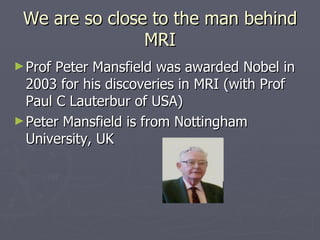
We are so close to the man behind MRI Prof Peter Mansfield was awarded Nobel in 2003 for his discoveries in MRI (with Prof Paul C Lauterbur of USA) Peter Mansfield is from Nottingham University, UK
MRI: What is it? Magnetic Resonance Imaging Magnet Radio Frequency Imaging
WE ARE MAGNETS! Really?
We all are made up of elements 92 elements occur naturally on earth.  Human body is built of only 26 elements.  Oxygen, hydrogen, carbon, nitrogen  elements constitute 96 % of human body mass.  Oxygen is 65 % of body mass; carbon is 18.5 %,  hydrogen 9.5 % , nitrogen 3.2 %. Let us ignore all elements but Hydrogen.
Why hydrogen? Simplest element with atomic number of 1 and atomic weight of 1 When in ionic state (H+), it is nothing but a proton. Proton is not only positively charged, but also has magnetic spin (wobble)! MRI utilizes this magnetic spin property of protons of hydrogen to elicit images!! We are magnets!
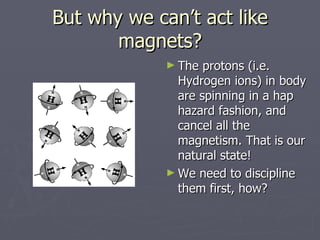
But why we can’t act like magnets? The protons (i.e. Hydrogen ions) in body are spinning in a hap hazard fashion, and cancel all the magnetism. That is our natural state! We need to discipline them first, how?
We need a big magnet from outside! Magnetic field strength: 0.3 – 7 T (2500 times more than earth’s magnetic field). Average field strength – 1.5 T Open magnet – less field strength, less claustrophobic Closed magnet – more field strength, claustrophobic
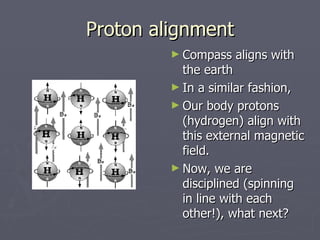
Proton alignment Compass aligns with the earth In a similar fashion, Our body protons (hydrogen) align with this external magnetic field. Now, we are disciplined (spinning in line with each other!), what next?
Now, its time to listen to radio in RESONANCE. Pushing a swing in time with natural interval of the swing will make the swing higher and higher. Similarly, radio frequency pulses in resonance push the aligned protons (H+) to a higher energy level.
What is Radio Frequency pulse? Same as Radio waves – high wavelength, low energy electromagnetic waves Radiofrequency coils Act as transmitter and receiver Different types of coils
Turn off the radio The higher energy gained by the protons is retransmitted (NMR signal) The original magnetization begins to recover (T1) The excessive spin begins to dephase (T2)
Now, we re-transmit the energy for image processing The emitted energy is too small (despite 2500 times the magnetic field with resonance RF pulse) to convert them into images. Hence, repeated ā€œON-OFFā€ of RF pulses are required. The emitted energy is stored (K-space), analysed and converted into images.  What kind of images?
What kind of images? T1WI T2WI PDWI DWI ADC GE Perfusion images fMRI BOLD images MRA MRV Post-Gd images Volumetric images MR arthrograms FLAIR STIR Etc etc etc
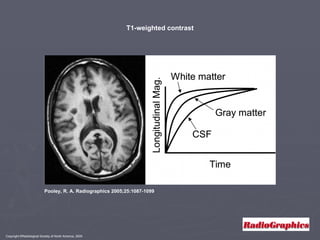
Copyright ©Radiological Society of North America, 2005 Pooley, R. A. Radiographics 2005;25:1087-1099 T1-weighted contrast
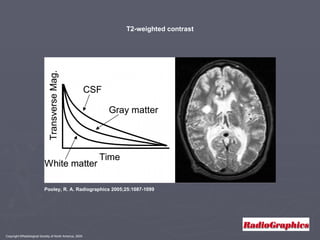
Copyright ©Radiological Society of North America, 2005 Pooley, R. A. Radiographics 2005;25:1087-1099 T2-weighted contrast
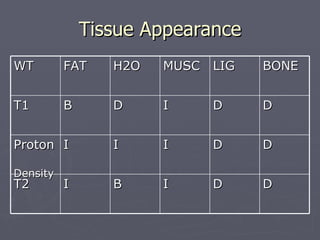
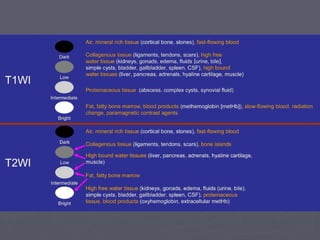
Tissue Appearance WT FAT H2O MUSC LIG BONE T1 B D I D D Proton  Density I I I D D T2 I B I D D
Ā 
A bit of sequence exercise
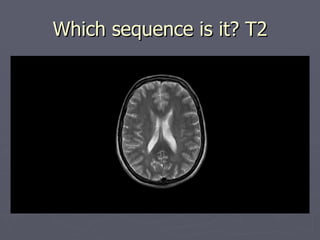
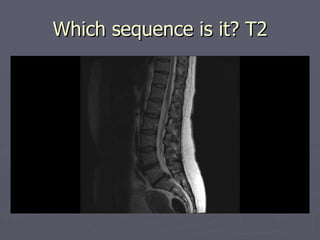
Which sequence is it? T2
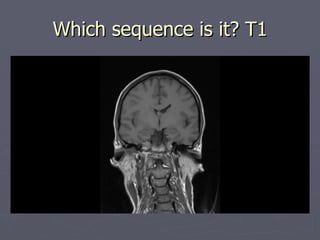
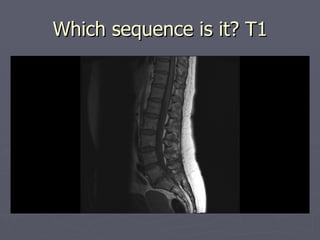
Which sequence is it? T1
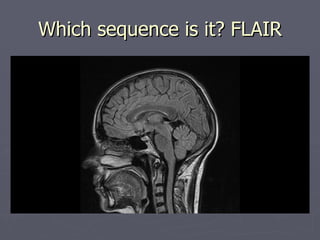
Which sequence is it? FLAIR
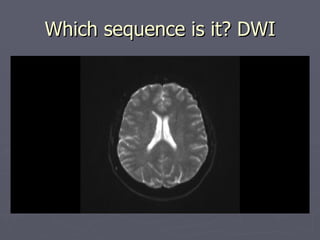
Which sequence is it? DWI
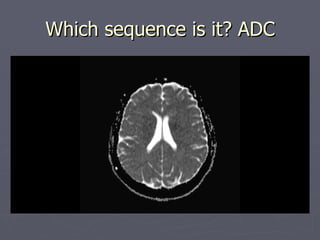
Which sequence is it? ADC
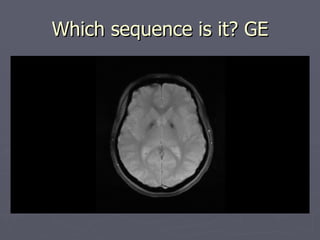
Which sequence is it? GE
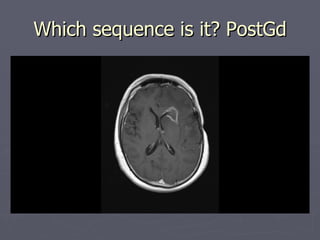
Which sequence is it? PostGd
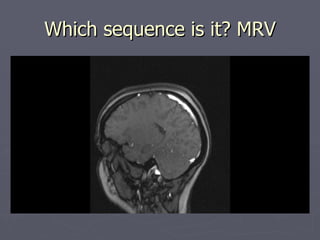
Which sequence is it? MRV
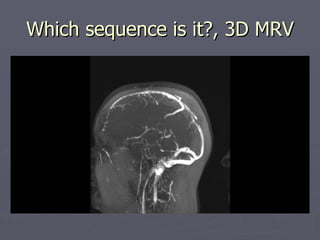
Which sequence is it?, 3D MRV
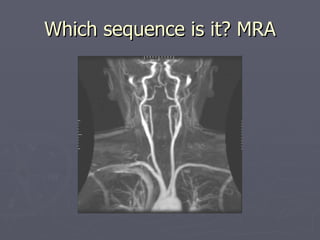
Which sequence is it? MRA
Which sequence is it? T2
Which sequence is it? T1
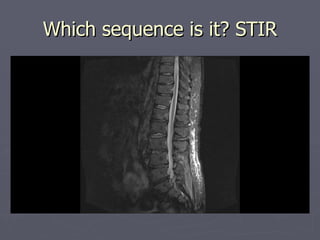
Which sequence is it? STIR
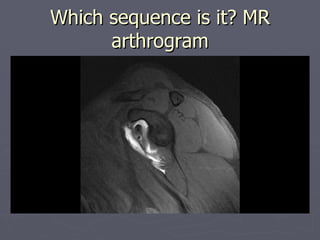
Which sequence is it? MR arthrogram
I hope I was able to confuse you!
How MR is done?
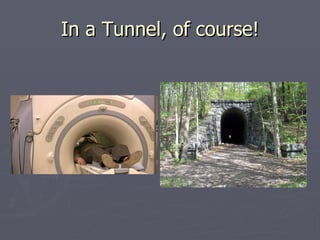
In a Tunnel, of course!
Before entering tunnel, there is  a checklist! No mobiles, no credit cards, please! Known potential safety concerns due to large static magnetic field: Internal cardiac pacemakers Steel cerebral aneurysm clips (ferromagnetic) Small steel slivers embedded in eye Life-support equipment with magnetic steel Cochlear implants Stents anywhere in the body
Further checklist! Malfunction: ICDs, neurostimulators, bone growth stimulators (prosthetic heart valves) Superficial burns (uninsulated wire leads) NEED sedation: infants, younger peds, agitated adults (claustrophobia) Precautions: magnetic plastic cards, watches, hearing aids, ferromagnetic steel objects (LEAVE OUTSIDE) Loud noise (long-term hearing loss) Pregnancy!
Is entering the tunnel safe?  No definite long-term harmful effects Pregnancy is a relative contraindication, as we will never be able to tell with 100% certainty that MRI is 100% safe during pregnancy! Babies and children need sedation or GA Some people fear tunnels (claustrophobia)
What happens in MRI? Stay still for 15 minutes to 45 minutes! Noise, Noise and Noise! Listen to music in darkness Alien (radiographers) like voices in between, ā€œanother 5 minutes to goā€,or, ā€œplease stay stillā€. Somebody can come and inject.
Clinical Aspects of MRI
When to MRI? When everything else fails, there is MRI When you want to borrow time from the patient, request MRI and hope that the waiting time will take care of the patient
Advantages of MRI No ionizing radiation & no short/long-term effects demonstrated  Variable thickness, any plane Better contrast resolution & tissue discrimination Various sequences to play with to characterise the abnormal tissue Many details without I.V contrast
Disadvantages of MRI Time consuming Not easily available (long waiting list) No on-call service Need to tweak sequences as per the clinical questions; hence cannot be generalised Pain abdomen - ? cause
Nothing is perfect in this world MRI has limitations: Bone Air Time consuming Poor spatial resolution Expertise!
We presumed MR contrast is safe  No side effects No allergy ( as with Iodine) Can be used in renal impairment Can be used as CT contrast when a patient has impaired renal functions!
Necrotising Systemic Fibrosis No cases identified prior to 1997 Initial research were targeting dialysis and/or renal transplant as triggering cause (someone even suggested Anthrax ourbreak!) Two reports in 2006 changed it all! Disfiguring and potentially disabling or fatal disorder involving skin, muscles, lungs, pleura, pericardium, and bones.
We need to get used to artefacts, and sometimes are major limitations
How to get the best from MRI? Ask a specific question Get a specific answer Because the sequences can be tailored accordingly.
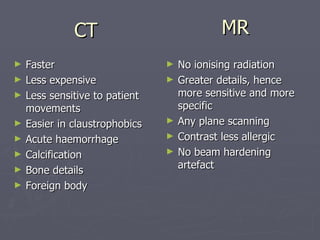
MR Faster Less expensive Less sensitive to patient movements Easier in claustrophobics Acute haemorrhage Calcification Bone details Foreign body No ionising radiation Greater details, hence more sensitive and more specific Any plane scanning Contrast less allergic No beam hardening artefact CT
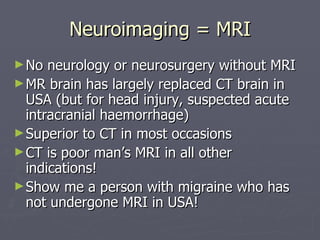
Neuroimaging = MRI No neurology or neurosurgery without MRI MR brain has largely replaced CT brain in USA (but for head injury, suspected acute intracranial haemorrhage) Superior to CT in most occasions  CT is poor man’s MRI in all other indications! Show me a person with migraine who has not undergone MRI in USA!
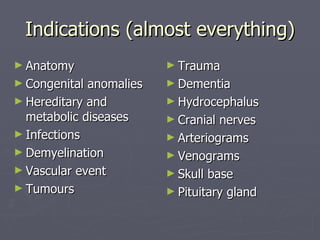
Indications (almost everything) Anatomy Congenital anomalies Hereditary and metabolic diseases Infections Demyelination Vascular event Tumours Trauma Dementia Hydrocephalus Cranial nerves Arteriograms Venograms Skull base Pituitary gland
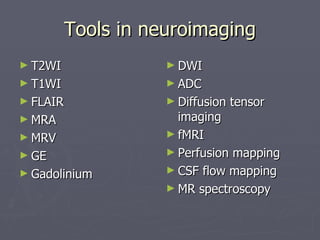
Tools in neuroimaging T2WI T1WI FLAIR MRA MRV GE Gadolinium DWI ADC Diffusion tensor imaging fMRI Perfusion mapping CSF flow mapping MR spectroscopy
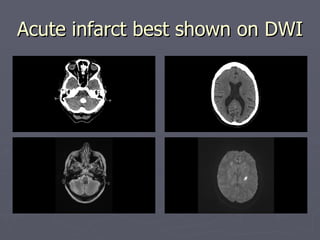
Stroke imaging MR superior to CT in diagnosing hyperacute infarct MR is as sensitive as CT in diagnosing acute intracranial haemorrhage MR is more expensive and less easily available compared to CT in the UK CT is currently widely used to exlcude haemorhage before thrombolysis
Acute infarct best shown on DWI
When to skip CT? Babies and children (avoid ionising radiation) Evaluation of headache (controversial in NHS setting) Suspected demyelination, dysmyelination, vasculitis, SOLs, hydrocephalus, pituitary lesions Non-invasive, non-contrast MRA and MRV Cranial nerve evaluation
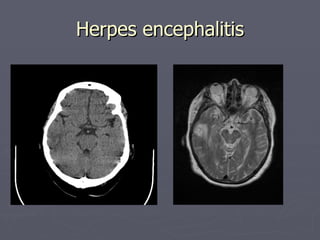
Herpes encephalitis
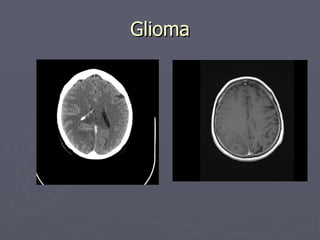
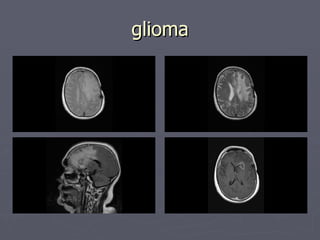
Glioma
Spine imaging MR is the investigation of choice Conventional CT, CT myelogram and conventional myelogram are no longer performed, unless MR is contraindicated. Indications and contraindications – same First line of investigation in suspected spinal infection, cord compression, cauda equina, sciatica
Disc lesion and MRI Virtually everyone after the age of 40 years will have at least one degenerative disc/ end plate Not all patients with sciatica will have a positive MRI Ask MRI to answer a specific question; otherwise MRI might completely mislead the clinician.
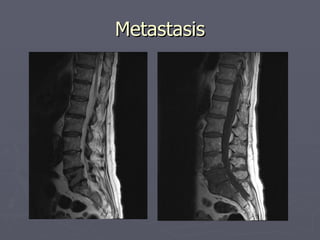
Metastasis
Head and Neck imaging MR is complementary or second line of investigation in many of head and neck pathologies Superior to CT in staging head and neck malignancies Characterise the head and neck lesions better than CT Complementary to CT in petrous temporal and paranasal sinus evaluation First line of investigation in orbital lesions
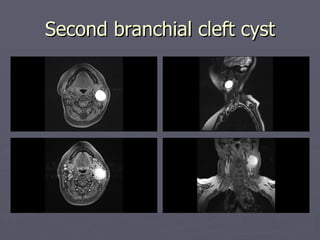
Second branchial cleft cyst
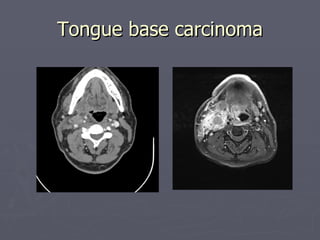
Tongue base carcinoma
Musculoskeletal imaging Initial evaluation of bones – Plain films; then MRI MRI sensitive than CT in diagnosing occult fractures Initial evaluation of soft tissues – USG; then MRI Joint imaging = MRI
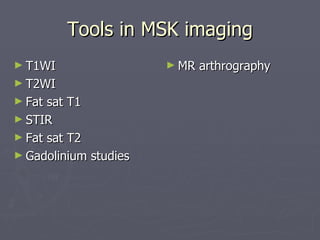
Tools in MSK imaging T1WI T2WI Fat sat T1 STIR Fat sat T2 Gadolinium studies MR arthrography
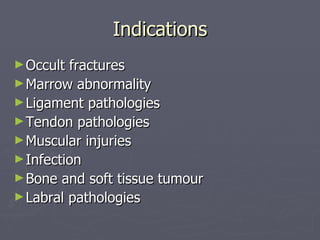
Indications Occult fractures Marrow abnormality Ligament pathologies Tendon pathologies Muscular injuries Infection Bone and soft tissue tumour Labral pathologies
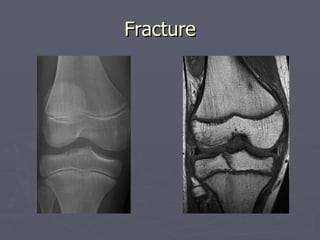
Fracture
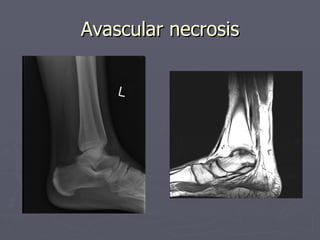
Avascular necrosis
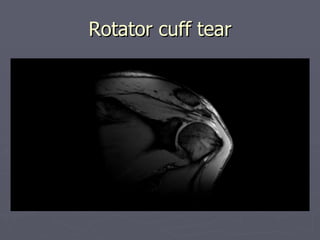
Rotator cuff tear
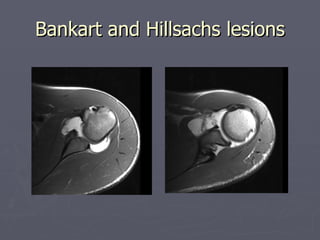
Bankart and Hillsachs lesions
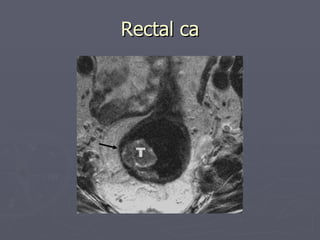
Abdominal MRI Problem solving tool in liver, pancreatic, renal and adrenal lesions Primary modality in local staging of rectal ca, endometrial ca, cervical ca, prostate ca, vaginal ca Non-invasive modality in evaluating pancreaticobiliary tract – MRCP Scrotal and penile imaging Uterus and ovary imaging
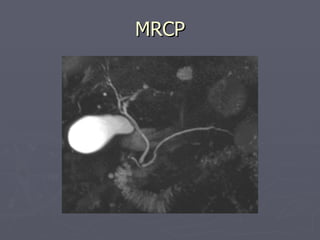
MRCP
Rectal ca
Vascular MRI Peripheral vascular arteriogram with or without I.V contrast Aortogram  Dissection Pulmonary arteriogram When CT is contraindicated
Cardiac MRI Coming in a big way Very useful in congenital heart diseases, cardiomyopathies Evidence is emerging in the evaluation of myocardial infarction
Breast MRI Problem solving Breast implants Recurrence Multifocal disease
Foetal MRI Assessment of congenital anomalies Placental abnormalities Twin assessment
Summary Expensive time-consuming investigation Complex physics, too many sequences, difficult to interpret to untrained eyes Relatively safe, but there are definite contraindications Ask specific question to get the right answer
Summary MRI invaluable imaging tool in the diagnosis of various diseases from head to toe Chief modality in neuroimaging, and musculoskeletal imaging Problem solving tool in abdominal pathologies Invaluable tool in local staging of most of the malignancies
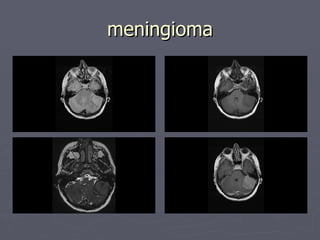
meningioma
glioma

Basics Of MRI

  • 1.
    Kipling’s honest servingmen I keep six honest serving-men (They taught me all I knew); Their names are What and Why and When And How and Where and Who. Rudyard Kipling
  • 2.
    MRI: What, Whyand When? Dr Keshav Kulkarni Consultant Radiologist
  • 3.
    ā€œ Without historyhuman is demoted to lower animalsā€ Dr Isidor Rabi (Nobel in 1944), discovered NMR (Nuclear Magnetic Resonance) in the late 1930s, but considered it to be an artefact of his apparatus! Bloch and Purcell were awarded the Nobel Prize for Physics in 1952 for the discovery of NMR, and is widely used in assessing complex chemical compunds.
  • 4.
    We are soclose to the man behind MRI Prof Peter Mansfield was awarded Nobel in 2003 for his discoveries in MRI (with Prof Paul C Lauterbur of USA) Peter Mansfield is from Nottingham University, UK
  • 5.
    MRI: What isit? Magnetic Resonance Imaging Magnet Radio Frequency Imaging
  • 6.
  • 7.
    We all aremade up of elements 92 elements occur naturally on earth. Human body is built of only 26 elements. Oxygen, hydrogen, carbon, nitrogen elements constitute 96 % of human body mass. Oxygen is 65 % of body mass; carbon is 18.5 %, hydrogen 9.5 % , nitrogen 3.2 %. Let us ignore all elements but Hydrogen.
  • 8.
    Why hydrogen? Simplestelement with atomic number of 1 and atomic weight of 1 When in ionic state (H+), it is nothing but a proton. Proton is not only positively charged, but also has magnetic spin (wobble)! MRI utilizes this magnetic spin property of protons of hydrogen to elicit images!! We are magnets!
  • 9.
    But why wecan’t act like magnets? The protons (i.e. Hydrogen ions) in body are spinning in a hap hazard fashion, and cancel all the magnetism. That is our natural state! We need to discipline them first, how?
  • 10.
    We need abig magnet from outside! Magnetic field strength: 0.3 – 7 T (2500 times more than earth’s magnetic field). Average field strength – 1.5 T Open magnet – less field strength, less claustrophobic Closed magnet – more field strength, claustrophobic
  • 11.
    Proton alignment Compassaligns with the earth In a similar fashion, Our body protons (hydrogen) align with this external magnetic field. Now, we are disciplined (spinning in line with each other!), what next?
  • 12.
    Now, its timeto listen to radio in RESONANCE. Pushing a swing in time with natural interval of the swing will make the swing higher and higher. Similarly, radio frequency pulses in resonance push the aligned protons (H+) to a higher energy level.
  • 13.
    What is RadioFrequency pulse? Same as Radio waves – high wavelength, low energy electromagnetic waves Radiofrequency coils Act as transmitter and receiver Different types of coils
  • 14.
    Turn off theradio The higher energy gained by the protons is retransmitted (NMR signal) The original magnetization begins to recover (T1) The excessive spin begins to dephase (T2)
  • 15.
    Now, we re-transmitthe energy for image processing The emitted energy is too small (despite 2500 times the magnetic field with resonance RF pulse) to convert them into images. Hence, repeated ā€œON-OFFā€ of RF pulses are required. The emitted energy is stored (K-space), analysed and converted into images. What kind of images?
  • 16.
    What kind ofimages? T1WI T2WI PDWI DWI ADC GE Perfusion images fMRI BOLD images MRA MRV Post-Gd images Volumetric images MR arthrograms FLAIR STIR Etc etc etc
  • 17.
    Copyright ©Radiological Societyof North America, 2005 Pooley, R. A. Radiographics 2005;25:1087-1099 T1-weighted contrast
  • 18.
    Copyright ©Radiological Societyof North America, 2005 Pooley, R. A. Radiographics 2005;25:1087-1099 T2-weighted contrast
  • 19.
    Tissue Appearance WTFAT H2O MUSC LIG BONE T1 B D I D D Proton Density I I I D D T2 I B I D D
  • 20.
  • 21.
    A bit ofsequence exercise
  • 22.
  • 23.
  • 24.
  • 25.
  • 26.
  • 27.
  • 28.
  • 29.
  • 30.
    Which sequence isit?, 3D MRV
  • 31.
  • 32.
  • 33.
  • 34.
  • 35.
    Which sequence isit? MR arthrogram
  • 36.
    I hope Iwas able to confuse you!
  • 37.
    How MR isdone?
  • 38.
    In a Tunnel,of course!
  • 39.
    Before entering tunnel,there is a checklist! No mobiles, no credit cards, please! Known potential safety concerns due to large static magnetic field: Internal cardiac pacemakers Steel cerebral aneurysm clips (ferromagnetic) Small steel slivers embedded in eye Life-support equipment with magnetic steel Cochlear implants Stents anywhere in the body
  • 40.
    Further checklist! Malfunction:ICDs, neurostimulators, bone growth stimulators (prosthetic heart valves) Superficial burns (uninsulated wire leads) NEED sedation: infants, younger peds, agitated adults (claustrophobia) Precautions: magnetic plastic cards, watches, hearing aids, ferromagnetic steel objects (LEAVE OUTSIDE) Loud noise (long-term hearing loss) Pregnancy!
  • 41.
    Is entering thetunnel safe? No definite long-term harmful effects Pregnancy is a relative contraindication, as we will never be able to tell with 100% certainty that MRI is 100% safe during pregnancy! Babies and children need sedation or GA Some people fear tunnels (claustrophobia)
  • 42.
    What happens inMRI? Stay still for 15 minutes to 45 minutes! Noise, Noise and Noise! Listen to music in darkness Alien (radiographers) like voices in between, ā€œanother 5 minutes to goā€,or, ā€œplease stay stillā€. Somebody can come and inject.
  • 43.
  • 44.
    When to MRI?When everything else fails, there is MRI When you want to borrow time from the patient, request MRI and hope that the waiting time will take care of the patient
  • 45.
    Advantages of MRINo ionizing radiation & no short/long-term effects demonstrated Variable thickness, any plane Better contrast resolution & tissue discrimination Various sequences to play with to characterise the abnormal tissue Many details without I.V contrast
  • 46.
    Disadvantages of MRITime consuming Not easily available (long waiting list) No on-call service Need to tweak sequences as per the clinical questions; hence cannot be generalised Pain abdomen - ? cause
  • 47.
    Nothing is perfectin this world MRI has limitations: Bone Air Time consuming Poor spatial resolution Expertise!
  • 48.
    We presumed MRcontrast is safe No side effects No allergy ( as with Iodine) Can be used in renal impairment Can be used as CT contrast when a patient has impaired renal functions!
  • 49.
    Necrotising Systemic FibrosisNo cases identified prior to 1997 Initial research were targeting dialysis and/or renal transplant as triggering cause (someone even suggested Anthrax ourbreak!) Two reports in 2006 changed it all! Disfiguring and potentially disabling or fatal disorder involving skin, muscles, lungs, pleura, pericardium, and bones.
  • 50.
    We need toget used to artefacts, and sometimes are major limitations
  • 51.
    How to getthe best from MRI? Ask a specific question Get a specific answer Because the sequences can be tailored accordingly.
  • 52.
    MR Faster Lessexpensive Less sensitive to patient movements Easier in claustrophobics Acute haemorrhage Calcification Bone details Foreign body No ionising radiation Greater details, hence more sensitive and more specific Any plane scanning Contrast less allergic No beam hardening artefact CT
  • 53.
    Neuroimaging = MRINo neurology or neurosurgery without MRI MR brain has largely replaced CT brain in USA (but for head injury, suspected acute intracranial haemorrhage) Superior to CT in most occasions CT is poor man’s MRI in all other indications! Show me a person with migraine who has not undergone MRI in USA!
  • 54.
    Indications (almost everything)Anatomy Congenital anomalies Hereditary and metabolic diseases Infections Demyelination Vascular event Tumours Trauma Dementia Hydrocephalus Cranial nerves Arteriograms Venograms Skull base Pituitary gland
  • 55.
    Tools in neuroimagingT2WI T1WI FLAIR MRA MRV GE Gadolinium DWI ADC Diffusion tensor imaging fMRI Perfusion mapping CSF flow mapping MR spectroscopy
  • 56.
    Stroke imaging MRsuperior to CT in diagnosing hyperacute infarct MR is as sensitive as CT in diagnosing acute intracranial haemorrhage MR is more expensive and less easily available compared to CT in the UK CT is currently widely used to exlcude haemorhage before thrombolysis
  • 57.
    Acute infarct bestshown on DWI
  • 58.
    When to skipCT? Babies and children (avoid ionising radiation) Evaluation of headache (controversial in NHS setting) Suspected demyelination, dysmyelination, vasculitis, SOLs, hydrocephalus, pituitary lesions Non-invasive, non-contrast MRA and MRV Cranial nerve evaluation
  • 59.
  • 60.
  • 61.
    Spine imaging MRis the investigation of choice Conventional CT, CT myelogram and conventional myelogram are no longer performed, unless MR is contraindicated. Indications and contraindications – same First line of investigation in suspected spinal infection, cord compression, cauda equina, sciatica
  • 62.
    Disc lesion andMRI Virtually everyone after the age of 40 years will have at least one degenerative disc/ end plate Not all patients with sciatica will have a positive MRI Ask MRI to answer a specific question; otherwise MRI might completely mislead the clinician.
  • 63.
  • 64.
    Head and Neckimaging MR is complementary or second line of investigation in many of head and neck pathologies Superior to CT in staging head and neck malignancies Characterise the head and neck lesions better than CT Complementary to CT in petrous temporal and paranasal sinus evaluation First line of investigation in orbital lesions
  • 65.
  • 66.
  • 67.
    Musculoskeletal imaging Initialevaluation of bones – Plain films; then MRI MRI sensitive than CT in diagnosing occult fractures Initial evaluation of soft tissues – USG; then MRI Joint imaging = MRI
  • 68.
    Tools in MSKimaging T1WI T2WI Fat sat T1 STIR Fat sat T2 Gadolinium studies MR arthrography
  • 69.
    Indications Occult fracturesMarrow abnormality Ligament pathologies Tendon pathologies Muscular injuries Infection Bone and soft tissue tumour Labral pathologies
  • 70.
  • 71.
  • 72.
  • 73.
  • 74.
    Abdominal MRI Problemsolving tool in liver, pancreatic, renal and adrenal lesions Primary modality in local staging of rectal ca, endometrial ca, cervical ca, prostate ca, vaginal ca Non-invasive modality in evaluating pancreaticobiliary tract – MRCP Scrotal and penile imaging Uterus and ovary imaging
  • 75.
  • 76.
  • 77.
    Vascular MRI Peripheralvascular arteriogram with or without I.V contrast Aortogram Dissection Pulmonary arteriogram When CT is contraindicated
  • 78.
    Cardiac MRI Comingin a big way Very useful in congenital heart diseases, cardiomyopathies Evidence is emerging in the evaluation of myocardial infarction
  • 79.
    Breast MRI Problemsolving Breast implants Recurrence Multifocal disease
  • 80.
    Foetal MRI Assessmentof congenital anomalies Placental abnormalities Twin assessment
  • 81.
    Summary Expensive time-consuminginvestigation Complex physics, too many sequences, difficult to interpret to untrained eyes Relatively safe, but there are definite contraindications Ask specific question to get the right answer
  • 82.
    Summary MRI invaluableimaging tool in the diagnosis of various diseases from head to toe Chief modality in neuroimaging, and musculoskeletal imaging Problem solving tool in abdominal pathologies Invaluable tool in local staging of most of the malignancies
  • 83.
  • 84.