

Dr. Shahnawaz Alam
Mch-neurosurgery
Guided by:-Dr. Vikas Chandra Jha
HOD Neurosurgery
Moderated by:-Dr. Saraj kumar Singh
Asst.Prof. (Dept. of Neurosurgery)
MR Spectroscopy
Brain
Outline
• Introduction
• Basic principles
• Data Acquisition
• Technical issues
• Detectable metabolites and their significance
• Clinical applications
Introduction
• Magnetic resonance spectroscopy (MRS) is a technique which gives us a
glimse into the neurochemical state of the brain.
• MRS Brain: A bridge b/w the anatomic and physiological information and the
metabolic characteristics of tissue.
• MRS uses the same hardware as conventional MRI, complementry to MRI.
• Used a RF-Coil (similar to MRI but >1.5 T) & a dedicated software package.
• Operator & interpreter dependent, many CNS disorders have overlapping
MRS-features.
Application
Diagnostics:
• Metabolic changes in pathology may not be apparent from anatomic images
• Metabolic changes may precede anatomic changes
Differentiate among different diseases
• E.g; grade and classify tumor types by MRS patterns/identifying a suitable
biopsy site
• Differentiate neoplasm from ‘MRI mimics’
Monitoring therapeutic treatments
• E.g; radiation necrosis and tumor recurrence look the same in conventional
images, very different metabolically
Others
• Understand pathogenesis of diseases/provide prognostic information in
neonatal hypoxia/ischemia
• Diagnosis of leukodystrophies and mitochondrial disorders
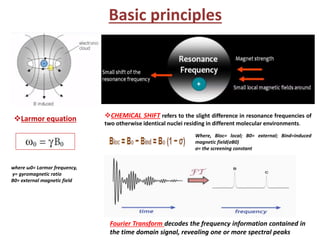
Basic principles
Where, Bloc= local; B0= external; Bind=induced
magnetic field(σB0)
σ= the screening constant
Larmor equation
where ω0= Larmor frequency,
γ= gyromagnetic ratio
B0= external magnetic field
CHEMICAL SHIFT refers to the slight difference in resonance frequencies of
two otherwise identical nuclei residing in different molecular environments.
Fourier Transform decodes the frequency information contained in
the time domain signal, revealing one or more spectral peaks
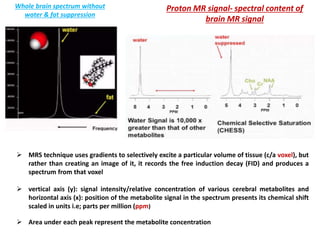
Proton MR signal- spectral content of
brain MR signal
 MRS technique uses gradients to selectively excite a particular volume of tissue (c/a voxel), but
rather than creating an image of it, it records the free induction decay (FID) and produces a
spectrum from that voxel
 vertical axis (y): signal intensity/relative concentration of various cerebral metabolites and
horizontal axis (x): position of the metabolite signal in the spectrum presents its chemical shift
scaled in units i.e; parts per million (ppm)
 Area under each peak represent the metabolite concentration
Whole brain spectrum without
water & fat suppression
Methods Of Stereoscopy Localization Techniques
 Distinguished by the nature and timing of RF-pulses and the types of signal
generated
1. Point RESolved Spectroscopy (PRESS) is the most popular method for ¹H
spectroscopy. It uses 3 RF-pulses (90º−180º−180º) and generates a spin-
echo signal.
2. Stimulated Echo Acquisition Mode (STEAM) uses three 90º-pulses and generates
a stimulated echo.
CHESS (CHEmical Shift Selective saturation)
 CHESS was originally developed as a technique for fat suppression in conventional MR
imaging, where it is commonly known by the generic name "fat-sat".
 By tuning the CHESS pulses to the resonant frequency of water instead of fat & vice
versa water & fat suppression can be obtained.
 A CHESS pulse selectively rotates water magnetization into the transverse plane where
it is immediately dephased by application of a strong spoiler gradient.
Outer volume suppression (OVS)
Inversion recovery (IR) method for
fat suppression
Other methods of fat suppression
Data Acquisition
SINGLE VOXEL MRS/SVS
• 2x2x2 cm3 voxels positioned in the Frontal cortex/ White matter semiovale/ Basal ganglia
• Based on the point resolved spectroscopy (PRESS)/ the stimulated echo acquisition mode (STEAM)
• Short scan time, 3-5 mint/ Usually with short TE/ High quality spectrum/ Good field homogenicity
• Accurate quantification of metabolites (Metabolic screening)
• Useful in clinical practice for several reasons (widely available, short scan times, short TE contains signals from
more compounds)
• Disadvantage is that it does not address spatial heterogeneity of spectral patterns and in the context of brain
tumors (important, espl for Rx planning in case of radiation or surgical resection)
MULTIPLE VOXEL MRS
• Also k/a magnetic resonance spectroscopic imaging (MRSI)/ Chemical Shift Imaging
(CSI)
• 1x1x1 cm3 , collect the spectral data of a whole grid of many voxels
• Lesion’s heterogeneity is better assessed
• Technically more challenging due
to:
 Significant magnetic field
inhomogeneity across the entire
volume of interest
 “Voxel bleeding,” which is a
spectral degradation due to
inter-voxel contamination
 Longer data acquisition times
 Challenging post-processing of
large multidimensional datasets
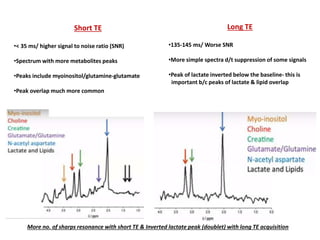
Short TE
•< 35 ms/ higher signal to noise ratio (SNR)
•Spectrum with more metabolites peaks
•Peaks include myoinositol/glutamine-glutamate
•Peak overlap much more common
Long TE
•135-145 ms/ Worse SNR
•More simple spectra d/t suppression of some signals
•Peak of lactate inverted below the baseline- this is
important b/c peaks of lactate & lipid overlap
More no. of sharps resonance with short TE & Inverted lactate peak (doublet) with long TE acquisition
Seen with long TE- NAA/Cr/Cho/Lac (if present)
Seen with short TE - Lip/GLX/ mI
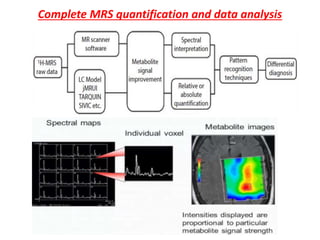
Complete MRS quantification and data analysis
Technical issues of MRS
• Increased B0 increases SNR and chemical shift leading to improved
spectral resolution and better visualization of the weakly represented
neurochemicals But it increase spatial misregistration and magnetic
susceptibility of the paramagnetic materials.
• Adequate voxel position to avoid fat/csf/air/bones/calcification/metals
• Subject movement can be a significant source of artifact in MRS
• Good quality spectra require careful pre-scanning and shimming (process
of optimizing the magnetic field homogeneity over the ROI), as well as
good fat and water suppression
• Optimal post-processing and correct interpretation are key aspects in
clinical MRS
• Filtering, phase-correction, and baseline correction improve MRS data
• Effects of Gadolinium on spectra are negligible
Brain Metabolites And Their
Significance
N-acetylaspartate (NAA)
• Peak at 2.02 ppm; Highest peak in normal brain; Marker of neuronal & axonal viability and
density
• Exclusively found in CNS both grey & white matter; synthesized in brain mitochondria
• Absence/decreased conc. is a sign of neuronal damage (neoplasm/white matter dis.)
• Low NAA in many white matter diseases, including leukodystrophies/MS) /hypoxic
encephalopathy/chronic stages of stoke and tumors
• Increased NAA is nearly specific for Canavan dis. (D/t deficiency of aspartoacylase (ASPA),
which is the enzyme that degrades NAA to acetate and aspartate)
• Its concentration shows rergional variability but undergoes large developmental changes,
almost doubling from birth to adulthood
• Not demonstrated in meningioma or mets.
Choline (Cho)
• Peak at 3.22; [tCho(free choline (Cho),phosphocholine (PC) and glycerophosphocholine (GPC)]
• Metabolic index of membrane density and integrity as well as membrane turnover
• Elevation of tCho include accelerated membrane synthesis of rapidly dividing cancer cells in brain
tumors - correlate with degree of malignancy
• Also increase in cerebral infractions, infectious diseases and inflammatory-demyelinating diseases ;
non-specific
• A marked physiologic regional variability with higher concentrations observed in the pons and
lower levels in the vermis and dentate
Creatine (Cr)
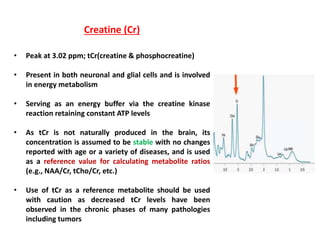
• Peak at 3.02 ppm; tCr(creatine & phosphocreatine)
• Present in both neuronal and glial cells and is involved
in energy metabolism
• Serving as an energy buffer via the creatine kinase
reaction retaining constant ATP levels
• As tCr is not naturally produced in the brain, its
concentration is assumed to be stable with no changes
reported with age or a variety of diseases, and is used
as a reference value for calculating metabolite ratios
(e.g., NAA/Cr, tCho/Cr, etc.)
• Use of tCr as a reference metabolite should be used
with caution as decreased tCr levels have been
observed in the chronic phases of many pathologies
including tumors
Lactate (Lac)
• Peak doublet at 1.33 ppm; Peak not seen in normal brain
• Increased in anaerobic metabolism: Cerebral hypoxia/
ischemia/seizure/Metabolic disorders (esp. mitochondrial)/
Acute inflammation
• Tiss. with poor washout like cysts/necrotic or cystic tumors/
NPH
• Any detectable increase of lactate and lipid resonances can
therefore be considered abnormal
• The peak of Lac when present project above baseline on short
TE and inverts below the baseline on long TE sequences
Lipids (Lip)
• Two peaks of Lip at 0.9 ppm &
1.3 ppm; Only visualized on
Short TE
• Absent in normal brain
• Lip peak seen in necrotic mets &
primary malignant tumors
 Prominent Lac/Lip. Peak seen seen in tuberculosis &
toxoplasmosis
Commonly used Metabolite ratio :
 NAA/Cr ratio: Normal 2; Abnormal <1.6; s/o decline NAA
 Cho/Cr ratio: 1.2/>1.5; s/o malignant tumor
 NAA/Cho ratio: 1.6/<1.2; s/o malignant tumor
 In MRS :
1. NAA- considered as “GOOD” metabolite (represent neuronal health)
2. Cho- “BAD” (Tumors)
3. Lipid/Lactate- “UGLY” (anaerobic/necrotic)
Myoinositol (mI)
• Peak at 3.56 ppm/ glial and myelin
degradation marker/ malignant tumor
indicator
• Elevated in gliosis/inflammation/ad
• Involved in the activation of protein
kinase-C, which leads to production of
proteolytic enzymes found in malignant
and aggressive cerebral tumors, serving
as a possible index for glioma grading
• Altered levels in degenerative and
demyelinating diseases
Glutamate-Glutamine (Glx)
• Peak at 2.05-2.50 ppm; Glx complex plays a role in
detoxification and regulation of neurotransmitters
• Glu is the major excitatory neurotransmitter in the
mammalian brain and the direct precursor for the
major inhibitory neurotransmitter, γ-aminobutyric
acid (GABA)
• Increased levels of are markers of epileptogenic
processes/also found in hepatic encephalopathy
• Decreased levels observed in AD, dementia and
patients with chronic schizophrenia
• Glx complex increments have also been observed
in the peritumoral brain edema correlated with
neuronal loss and demyelination
“Left shoulder of NAA”
Alanine (Ala)
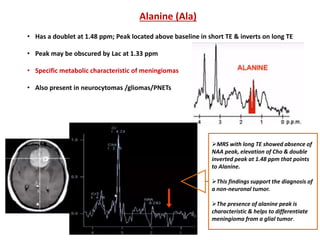
• Has a doublet at 1.48 ppm; Peak located above baseline in short TE & inverts on long TE
• Peak may be obscured by Lac at 1.33 ppm
• Specific metabolic characteristic of meningiomas
• Also present in neurocytomas /gliomas/PNETs
MRS with long TE showed absence of
NAA peak, elevation of Cho & double
inverted peak at 1.48 ppm that points
to Alanine.
This findings support the diagnosis of
a non-neuronal tumor.
The presence of alanine peak is
characteristic & helps to differentiate
meningioma from a glial tumor.
Less Commonly Detected Metabolites
• Include Alanine,Glycine,Taurine,Glutathione, and several other AAs such as Succinate,
Acetate,Valine and Leucine
 Glycine (Gly-3.55 ppm); an inhibitory neurotransmitter; distributed mainly in astrocytes
 Overlapping with mI; therefore, its detection is impossible in a nonprocessed spectrum
 High levels observed in glioblastomas, medulloblastomas, ependymomas and neurocytomas
 May provide a noticeable metabolic feature for the distinction of GBMs from lower grade
astrocytomas/ primary gliomas from recurrence and glial tumors from metastatic brain tumors
 Taurine (Tau–3.25 ppm and 3.42 ppm); two triplets; significantly overlapping with Cho and Mi
 High levels observed in medulloblastoma, adenoma and metastatic renal cell carcinoma
 Increased levels also reported in the medial prefrontal cortex in schizophrenic patients
• Finally, several other amino Acids such as Succinate at 2.4 ppm, Acetate
at 1.92 ppm, Valine and Leucine at 0.9 ppm, together with Alanine and
Lactate, are the major spectral findings of bacterial and parasitic diseases
• Acetate and Succinate presumably originate from enhanced glycolysis of
the bacterial organism
• The amino acids Valine and Leukine are known to be the end-products of
proteolysis by enzymes released in pus
• Specifically, Leucine and Valine peaks have been detected in
cystercercosis lesions
 Glutathione (GSH–2.9 ppm) ; important role against oxidative stress
 Significantly elevated in meningiomas when compared to other tumors
showing, as well, an inverse relationship with glioma malignancy
Clinical applications
MRS of normal white matter
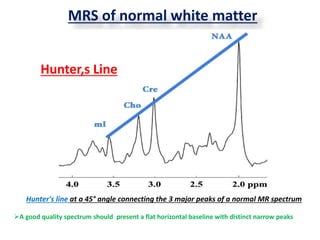
A good quality spectrum should present a flat horizontal baseline with distinct narrow peaks
Hunter's line at a 45° angle connecting the 3 major peaks of a normal MR spectrum
Hunter,s Line
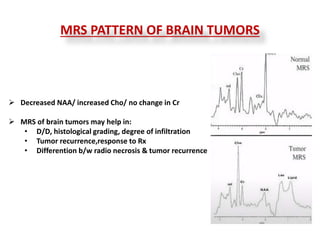
MRS PATTERN OF BRAIN TUMORS
 Decreased NAA/ increased Cho/ no change in Cr
 MRS of brain tumors may help in:
• D/D, histological grading, degree of infiltration
• Tumor recurrence,response to Rx
• Differention b/w radio necrosis & tumor recurrence
MENINGIOMA
• Alnine doublet at 1.4 ppm
• Elevation of Cho
• Lactate peak at 1.3 ppm
• Absent NAA- non neuronal tumor
• Mobile lipids & high choline suggests an aggressive lesion
43 yrs/F, focal neurological deficit
GBM
• MRS, a 2x2x2 cm3 voxel placed over the nodular portion of lesion, spectral waveform obtained at short TE
• Sharp doublet of lactate at 0.9 to 1.3 ppm, short peaks s/o markedly reduced NAA at 2.02 ppm & Cr at 3.02 ppm
• Sharp long peak of raised choline at 3.03 ppm, raised Cho/Cr ratio
55 yrs/M, headache & vomiting
Short TE spectra from peritumoral areas of GBM & mets
PYOGENIC ABSCESS
• MRS by using short TE from the centre of the
lesion
• Shows resonances of AAs at 0.9 ppm, Lip/Lac at
1.3 ppm, Ac at 1.9 ppm and Suc at 2.4 ppm
• Pus culture grew B.fragilis
PRIMARY CNS LYMPHOMA
Left periventricular mass of
homogenous T2- hyperintense
signal & prominent restricted
diffusion
• MRS revealed large Cho peak with reversed Cho/Cr ratio
• Prominent Lac & mI peaks is also seen
• These findings are consistent of primary CNS lymphoma
• Toxoplasmosis difficult to differentiate from PCNL/
pyogenic abscess (MRS: Cho reduced significantly with
prominent Lac/Lip.)
HYDATID CYST
• Multiple intra-axial unilocular
lesions with unclear fluid
content being hyperintense on
FLAIR WIs with some debries
seen in dependent position
• Mild edema seen around the
lesion s/o supreradded infection
• No evidence of diffusion
restriction, CE, or significant
mass effect
• On single voxel MRS at short TE
from right to left:
 Sharp duoblet of Lac at 1.3 ppm
 No peak of NAA at 2.01 ppm
 No peak of Cr at 3.03 ppm
 No peak of Cho at 3.2 ppm
RECURRENT TUMOR AND RADIATION NECROSIS
• MRS from voxel 10 showed low level of
Cho, Cr and NAA typical for radiation
necrosis
• The presence of Lip may support radiation
necrosis
• Patient with extensive edema in left fronto-
parietal region following radiation necrosis
• MRS from voxel 1 s/o normal findings
RECURRENT TUMOR AND RADIATION NECROSIS
To differentiate it, combination of perfusion
imaging with MRS very useful.
Radiation necrosis
Low CBV with slight increase in Cho/Cr ratio
Recurrent tumor
High CBV with markedincrease in Cho/Cr ratio
Therapeutic Planning- Image Guided Biopsy
Childhood X-ALD
 Symmetrical lesions in B/l parieto-occipital regions
 Enhancement of advancing edge is characteristic
 MRS- decrease NAA & mI, increase Cho
CANAVAN DISEASE
 Diffuse low density of white matter (cystic white matter change)
 Subcortical arcuate fibers predominently involved
REFERENCES
1. Advanced MR Neuroimaging from Theory to Clinical Practice BY Ioannis
Tsougos
2. Youmans and Winn Neurological Surgery
THANKYOU

MR spectroscopy

  • 1.
    Dr. Shahnawaz Alam Mch-neurosurgery Guidedby:-Dr. Vikas Chandra Jha HOD Neurosurgery Moderated by:-Dr. Saraj kumar Singh Asst.Prof. (Dept. of Neurosurgery) MR Spectroscopy Brain
  • 2.
    Outline • Introduction • Basicprinciples • Data Acquisition • Technical issues • Detectable metabolites and their significance • Clinical applications
  • 3.
    Introduction • Magnetic resonancespectroscopy (MRS) is a technique which gives us a glimse into the neurochemical state of the brain. • MRS Brain: A bridge b/w the anatomic and physiological information and the metabolic characteristics of tissue. • MRS uses the same hardware as conventional MRI, complementry to MRI. • Used a RF-Coil (similar to MRI but >1.5 T) & a dedicated software package. • Operator & interpreter dependent, many CNS disorders have overlapping MRS-features.
  • 4.
    Application Diagnostics: • Metabolic changesin pathology may not be apparent from anatomic images • Metabolic changes may precede anatomic changes Differentiate among different diseases • E.g; grade and classify tumor types by MRS patterns/identifying a suitable biopsy site • Differentiate neoplasm from ‘MRI mimics’ Monitoring therapeutic treatments • E.g; radiation necrosis and tumor recurrence look the same in conventional images, very different metabolically Others • Understand pathogenesis of diseases/provide prognostic information in neonatal hypoxia/ischemia • Diagnosis of leukodystrophies and mitochondrial disorders
  • 5.
    Basic principles Where, Bloc=local; B0= external; Bind=induced magnetic field(σB0) σ= the screening constant Larmor equation where ω0= Larmor frequency, γ= gyromagnetic ratio B0= external magnetic field CHEMICAL SHIFT refers to the slight difference in resonance frequencies of two otherwise identical nuclei residing in different molecular environments. Fourier Transform decodes the frequency information contained in the time domain signal, revealing one or more spectral peaks
  • 6.
    Proton MR signal-spectral content of brain MR signal  MRS technique uses gradients to selectively excite a particular volume of tissue (c/a voxel), but rather than creating an image of it, it records the free induction decay (FID) and produces a spectrum from that voxel  vertical axis (y): signal intensity/relative concentration of various cerebral metabolites and horizontal axis (x): position of the metabolite signal in the spectrum presents its chemical shift scaled in units i.e; parts per million (ppm)  Area under each peak represent the metabolite concentration Whole brain spectrum without water & fat suppression
  • 7.
    Methods Of StereoscopyLocalization Techniques  Distinguished by the nature and timing of RF-pulses and the types of signal generated 1. Point RESolved Spectroscopy (PRESS) is the most popular method for ¹H spectroscopy. It uses 3 RF-pulses (90º−180º−180º) and generates a spin- echo signal. 2. Stimulated Echo Acquisition Mode (STEAM) uses three 90º-pulses and generates a stimulated echo.
  • 8.
    CHESS (CHEmical ShiftSelective saturation)  CHESS was originally developed as a technique for fat suppression in conventional MR imaging, where it is commonly known by the generic name "fat-sat".  By tuning the CHESS pulses to the resonant frequency of water instead of fat & vice versa water & fat suppression can be obtained.  A CHESS pulse selectively rotates water magnetization into the transverse plane where it is immediately dephased by application of a strong spoiler gradient.
  • 9.
    Outer volume suppression(OVS) Inversion recovery (IR) method for fat suppression Other methods of fat suppression
  • 10.
  • 11.
    SINGLE VOXEL MRS/SVS •2x2x2 cm3 voxels positioned in the Frontal cortex/ White matter semiovale/ Basal ganglia • Based on the point resolved spectroscopy (PRESS)/ the stimulated echo acquisition mode (STEAM) • Short scan time, 3-5 mint/ Usually with short TE/ High quality spectrum/ Good field homogenicity • Accurate quantification of metabolites (Metabolic screening) • Useful in clinical practice for several reasons (widely available, short scan times, short TE contains signals from more compounds) • Disadvantage is that it does not address spatial heterogeneity of spectral patterns and in the context of brain tumors (important, espl for Rx planning in case of radiation or surgical resection)
  • 12.
    MULTIPLE VOXEL MRS •Also k/a magnetic resonance spectroscopic imaging (MRSI)/ Chemical Shift Imaging (CSI) • 1x1x1 cm3 , collect the spectral data of a whole grid of many voxels • Lesion’s heterogeneity is better assessed • Technically more challenging due to:  Significant magnetic field inhomogeneity across the entire volume of interest  “Voxel bleeding,” which is a spectral degradation due to inter-voxel contamination  Longer data acquisition times  Challenging post-processing of large multidimensional datasets
  • 13.
    Short TE •< 35ms/ higher signal to noise ratio (SNR) •Spectrum with more metabolites peaks •Peaks include myoinositol/glutamine-glutamate •Peak overlap much more common Long TE •135-145 ms/ Worse SNR •More simple spectra d/t suppression of some signals •Peak of lactate inverted below the baseline- this is important b/c peaks of lactate & lipid overlap More no. of sharps resonance with short TE & Inverted lactate peak (doublet) with long TE acquisition
  • 14.
    Seen with longTE- NAA/Cr/Cho/Lac (if present) Seen with short TE - Lip/GLX/ mI
  • 15.
    Complete MRS quantificationand data analysis
  • 16.
    Technical issues ofMRS • Increased B0 increases SNR and chemical shift leading to improved spectral resolution and better visualization of the weakly represented neurochemicals But it increase spatial misregistration and magnetic susceptibility of the paramagnetic materials. • Adequate voxel position to avoid fat/csf/air/bones/calcification/metals • Subject movement can be a significant source of artifact in MRS • Good quality spectra require careful pre-scanning and shimming (process of optimizing the magnetic field homogeneity over the ROI), as well as good fat and water suppression • Optimal post-processing and correct interpretation are key aspects in clinical MRS • Filtering, phase-correction, and baseline correction improve MRS data • Effects of Gadolinium on spectra are negligible
  • 17.
    Brain Metabolites AndTheir Significance
  • 18.
    N-acetylaspartate (NAA) • Peakat 2.02 ppm; Highest peak in normal brain; Marker of neuronal & axonal viability and density • Exclusively found in CNS both grey & white matter; synthesized in brain mitochondria • Absence/decreased conc. is a sign of neuronal damage (neoplasm/white matter dis.) • Low NAA in many white matter diseases, including leukodystrophies/MS) /hypoxic encephalopathy/chronic stages of stoke and tumors • Increased NAA is nearly specific for Canavan dis. (D/t deficiency of aspartoacylase (ASPA), which is the enzyme that degrades NAA to acetate and aspartate) • Its concentration shows rergional variability but undergoes large developmental changes, almost doubling from birth to adulthood • Not demonstrated in meningioma or mets.
  • 19.
    Choline (Cho) • Peakat 3.22; [tCho(free choline (Cho),phosphocholine (PC) and glycerophosphocholine (GPC)] • Metabolic index of membrane density and integrity as well as membrane turnover • Elevation of tCho include accelerated membrane synthesis of rapidly dividing cancer cells in brain tumors - correlate with degree of malignancy • Also increase in cerebral infractions, infectious diseases and inflammatory-demyelinating diseases ; non-specific • A marked physiologic regional variability with higher concentrations observed in the pons and lower levels in the vermis and dentate
  • 20.
    Creatine (Cr) • Peakat 3.02 ppm; tCr(creatine & phosphocreatine) • Present in both neuronal and glial cells and is involved in energy metabolism • Serving as an energy buffer via the creatine kinase reaction retaining constant ATP levels • As tCr is not naturally produced in the brain, its concentration is assumed to be stable with no changes reported with age or a variety of diseases, and is used as a reference value for calculating metabolite ratios (e.g., NAA/Cr, tCho/Cr, etc.) • Use of tCr as a reference metabolite should be used with caution as decreased tCr levels have been observed in the chronic phases of many pathologies including tumors
  • 21.
    Lactate (Lac) • Peakdoublet at 1.33 ppm; Peak not seen in normal brain • Increased in anaerobic metabolism: Cerebral hypoxia/ ischemia/seizure/Metabolic disorders (esp. mitochondrial)/ Acute inflammation • Tiss. with poor washout like cysts/necrotic or cystic tumors/ NPH • Any detectable increase of lactate and lipid resonances can therefore be considered abnormal • The peak of Lac when present project above baseline on short TE and inverts below the baseline on long TE sequences Lipids (Lip) • Two peaks of Lip at 0.9 ppm & 1.3 ppm; Only visualized on Short TE • Absent in normal brain • Lip peak seen in necrotic mets & primary malignant tumors  Prominent Lac/Lip. Peak seen seen in tuberculosis & toxoplasmosis
  • 22.
    Commonly used Metaboliteratio :  NAA/Cr ratio: Normal 2; Abnormal <1.6; s/o decline NAA  Cho/Cr ratio: 1.2/>1.5; s/o malignant tumor  NAA/Cho ratio: 1.6/<1.2; s/o malignant tumor  In MRS : 1. NAA- considered as “GOOD” metabolite (represent neuronal health) 2. Cho- “BAD” (Tumors) 3. Lipid/Lactate- “UGLY” (anaerobic/necrotic)
  • 23.
    Myoinositol (mI) • Peakat 3.56 ppm/ glial and myelin degradation marker/ malignant tumor indicator • Elevated in gliosis/inflammation/ad • Involved in the activation of protein kinase-C, which leads to production of proteolytic enzymes found in malignant and aggressive cerebral tumors, serving as a possible index for glioma grading • Altered levels in degenerative and demyelinating diseases
  • 24.
    Glutamate-Glutamine (Glx) • Peakat 2.05-2.50 ppm; Glx complex plays a role in detoxification and regulation of neurotransmitters • Glu is the major excitatory neurotransmitter in the mammalian brain and the direct precursor for the major inhibitory neurotransmitter, γ-aminobutyric acid (GABA) • Increased levels of are markers of epileptogenic processes/also found in hepatic encephalopathy • Decreased levels observed in AD, dementia and patients with chronic schizophrenia • Glx complex increments have also been observed in the peritumoral brain edema correlated with neuronal loss and demyelination “Left shoulder of NAA”
  • 25.
    Alanine (Ala) • Hasa doublet at 1.48 ppm; Peak located above baseline in short TE & inverts on long TE • Peak may be obscured by Lac at 1.33 ppm • Specific metabolic characteristic of meningiomas • Also present in neurocytomas /gliomas/PNETs MRS with long TE showed absence of NAA peak, elevation of Cho & double inverted peak at 1.48 ppm that points to Alanine. This findings support the diagnosis of a non-neuronal tumor. The presence of alanine peak is characteristic & helps to differentiate meningioma from a glial tumor.
  • 26.
    Less Commonly DetectedMetabolites • Include Alanine,Glycine,Taurine,Glutathione, and several other AAs such as Succinate, Acetate,Valine and Leucine  Glycine (Gly-3.55 ppm); an inhibitory neurotransmitter; distributed mainly in astrocytes  Overlapping with mI; therefore, its detection is impossible in a nonprocessed spectrum  High levels observed in glioblastomas, medulloblastomas, ependymomas and neurocytomas  May provide a noticeable metabolic feature for the distinction of GBMs from lower grade astrocytomas/ primary gliomas from recurrence and glial tumors from metastatic brain tumors  Taurine (Tau–3.25 ppm and 3.42 ppm); two triplets; significantly overlapping with Cho and Mi  High levels observed in medulloblastoma, adenoma and metastatic renal cell carcinoma  Increased levels also reported in the medial prefrontal cortex in schizophrenic patients
  • 27.
    • Finally, severalother amino Acids such as Succinate at 2.4 ppm, Acetate at 1.92 ppm, Valine and Leucine at 0.9 ppm, together with Alanine and Lactate, are the major spectral findings of bacterial and parasitic diseases • Acetate and Succinate presumably originate from enhanced glycolysis of the bacterial organism • The amino acids Valine and Leukine are known to be the end-products of proteolysis by enzymes released in pus • Specifically, Leucine and Valine peaks have been detected in cystercercosis lesions  Glutathione (GSH–2.9 ppm) ; important role against oxidative stress  Significantly elevated in meningiomas when compared to other tumors showing, as well, an inverse relationship with glioma malignancy
  • 28.
  • 29.
    MRS of normalwhite matter A good quality spectrum should present a flat horizontal baseline with distinct narrow peaks Hunter's line at a 45° angle connecting the 3 major peaks of a normal MR spectrum Hunter,s Line
  • 30.
    MRS PATTERN OFBRAIN TUMORS  Decreased NAA/ increased Cho/ no change in Cr  MRS of brain tumors may help in: • D/D, histological grading, degree of infiltration • Tumor recurrence,response to Rx • Differention b/w radio necrosis & tumor recurrence
  • 31.
    MENINGIOMA • Alnine doubletat 1.4 ppm • Elevation of Cho • Lactate peak at 1.3 ppm • Absent NAA- non neuronal tumor • Mobile lipids & high choline suggests an aggressive lesion 43 yrs/F, focal neurological deficit
  • 32.
    GBM • MRS, a2x2x2 cm3 voxel placed over the nodular portion of lesion, spectral waveform obtained at short TE • Sharp doublet of lactate at 0.9 to 1.3 ppm, short peaks s/o markedly reduced NAA at 2.02 ppm & Cr at 3.02 ppm • Sharp long peak of raised choline at 3.03 ppm, raised Cho/Cr ratio 55 yrs/M, headache & vomiting
  • 33.
    Short TE spectrafrom peritumoral areas of GBM & mets
  • 34.
    PYOGENIC ABSCESS • MRSby using short TE from the centre of the lesion • Shows resonances of AAs at 0.9 ppm, Lip/Lac at 1.3 ppm, Ac at 1.9 ppm and Suc at 2.4 ppm • Pus culture grew B.fragilis
  • 35.
    PRIMARY CNS LYMPHOMA Leftperiventricular mass of homogenous T2- hyperintense signal & prominent restricted diffusion • MRS revealed large Cho peak with reversed Cho/Cr ratio • Prominent Lac & mI peaks is also seen • These findings are consistent of primary CNS lymphoma • Toxoplasmosis difficult to differentiate from PCNL/ pyogenic abscess (MRS: Cho reduced significantly with prominent Lac/Lip.)
  • 36.
    HYDATID CYST • Multipleintra-axial unilocular lesions with unclear fluid content being hyperintense on FLAIR WIs with some debries seen in dependent position • Mild edema seen around the lesion s/o supreradded infection • No evidence of diffusion restriction, CE, or significant mass effect • On single voxel MRS at short TE from right to left:  Sharp duoblet of Lac at 1.3 ppm  No peak of NAA at 2.01 ppm  No peak of Cr at 3.03 ppm  No peak of Cho at 3.2 ppm
  • 37.
    RECURRENT TUMOR ANDRADIATION NECROSIS • MRS from voxel 10 showed low level of Cho, Cr and NAA typical for radiation necrosis • The presence of Lip may support radiation necrosis • Patient with extensive edema in left fronto- parietal region following radiation necrosis • MRS from voxel 1 s/o normal findings
  • 38.
    RECURRENT TUMOR ANDRADIATION NECROSIS To differentiate it, combination of perfusion imaging with MRS very useful. Radiation necrosis Low CBV with slight increase in Cho/Cr ratio Recurrent tumor High CBV with markedincrease in Cho/Cr ratio
  • 40.
  • 41.
    Childhood X-ALD  Symmetricallesions in B/l parieto-occipital regions  Enhancement of advancing edge is characteristic  MRS- decrease NAA & mI, increase Cho
  • 42.
    CANAVAN DISEASE  Diffuselow density of white matter (cystic white matter change)  Subcortical arcuate fibers predominently involved
  • 43.
    REFERENCES 1. Advanced MRNeuroimaging from Theory to Clinical Practice BY Ioannis Tsougos 2. Youmans and Winn Neurological Surgery THANKYOU