Magnetic Resonance Imaging
           (MRI)
       Dr. Sreedhar Rao
        Associate Professor
      Department of Rog Nidan
Outline
•   What is MRI of the Body?
•   Some common uses of the procedure
•   Preparation for the procedure
•   Equipment
•   How does the procedure work?
•   How is the procedure performed?
•   Benefits vs. risks
•   Limitations of MRI of the Body
What is MRI of the Body?
• A noninvasive medical test that helps
  physicians diagnose and treat medical
  conditions.
• MRI uses a powerful magnetic field, radio
  frequency pulses and a computer to produce
  detailed pictures of organs, soft tissues, bone
  and virtually all other internal body structures.
• The images can then be examined on a
  computer monitor, transmitted electronically,
  printed or copied to a CD.
• MRI does not use ionizing radiation (x-rays).
Detailed MR images allow physicians to :

• better evaluate various parts of the
  body and

• determine the presence of certain
  diseases that may not be assessed
  adequately with other imaging
  methods such as x-ray, ultrasound or
  computed tomography
Some common uses of the procedure
MR imaging of the body is performed to
  evaluate:
• organs of the chest and abdomen—including
  the heart, liver, biliary tract, kidneys, spleen,
  bowel, pancreas and adrenal glands.
• pelvic organs including the reproductive
  organs in the male (prostate and testicles) and
  the female (uterus, cervix and ovaries).
• blood vessels (MR Angiography).
• breasts.
Physicians use the MR examination to help diagnose
    or monitor treatment for conditions such as:
• tumors of the chest, abdomen or pelvis.
• certain types of heart problems.
• blockages, enlargements or anatomical
  variants of blood vessels, including the aorta,
  renal arteries, and arteries in the legs.
• diseases of the liver, such as cirrhosis and
  tumors, and that of other abdominal organs,
  including the bile ducts, gallbladder, and
  pancreatic ducts.
• diseases of the small intestine, colon, rectum
  and anus.
• cysts and solid tumors in the kidneys and
  other parts of the urinary tract.
• tumors and other abnormalities of the
  reproductive organs (e.g., uterus, ovaries,
  testicles, prostate).
• causes of pelvic pain in women, such as
  fibroids, endometriosis and adenomyosis.
• suspected uterine congenital abnormalities in
  women undergoing evaluation for infertility.
• breast cancer and implants.
• fetal assessment in pregnant women.
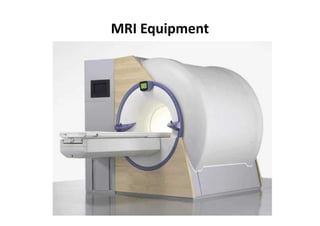
MRI Equipment
MRI Equipment
• The traditional MRI unit is a large cylinder-shaped
  tube surrounded by a circular magnet.
• Patient will lie on a moveable examination table
  that slides into the center of the magnet.
• Some MRI units, called short-bore systems, are
  designed so that the magnet does not completely
  surround patient;
• others are open on the sides (open MRI).
• These units are especially helpful for examining
  patients who are fearful of being in a closed
  space and for those who are very obese.
• Newer open MRI units provide very high quality
  images for many types of exams;
• however, open MRI units with older magnets
  may not provide this same image quality.
• Certain types of exams cannot be performed
  using open MRI.
• The computer workstation that processes the
  imaging information is located in a separate
  room from the scanner.
How does the procedure work?
• Unlike conventional x-ray examinations and
  computed tomography (CT) scans, MRI does not
  depend on ionizing radiation.
• Instead, while in the magnet, radio waves
  redirect the axes of spinning protons, which are
  the nuclei of hydrogen atoms, in a strong
  magnetic field.
• The magnetic field is produced by passing an
  electric current through wire coils in most MRI
  units.
• Other coils, located in the machine and in some
  cases, placed around the part of the body being
  imaged, send and receive radio waves, producing
  signals that are detected by the coils.
• A computer then processes the signals and
  generates a series of images each of which
  shows a thin slice of the body.
• The images can then be studied from different
  angles by the interpreting radiologist.
• Frequently, the differentiation of abnormal
  (diseased) tissue from normal tissues is better
  with MRI than with other imaging modalities
  such as x-ray, CT and ultrasound.
How is the procedure performed?
• MRI examinations may be performed on
  outpatients or inpatients.
• Patient will be positioned on the moveable
  examination table.
• Straps and bolsters may be used to help you
  stay still and maintain the correct position
  during imaging.
• Devices that contain coils capable of sending
  and receiving radio waves may be placed
  around or adjacent to the area of the body
  being studied.
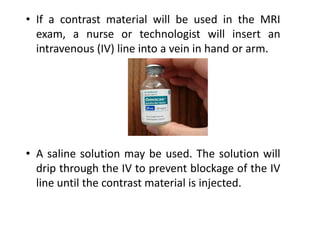
• If a contrast material will be used in the MRI
  exam, a nurse or technologist will insert an
  intravenous (IV) line into a vein in hand or arm.


• A saline solution may be used. The solution will
  drip through the IV to prevent blockage of the IV
  line until the contrast material is injected.
• If a contrast material is used during the examination, it
  will be injected into the intravenous line (IV) after an
  initial series of scans.
• Additional series of images will be taken during or
  following the injection.
• When the examination is completed, the patient may
  be asked to wait until the technologist or radiologist
  checks the images in case additional images are
  needed.
• Intravenous line will be removed.
• MRI exams generally include multiple runs
  (sequences), some of which may last several minutes.
• Depending on the type of exam and the equipment
  used, the entire exam is usually completed in 15 to 45
  minutes.
Who interprets the results?
• A radiologist, a physician specifically trained to
  supervise and interpret radiology examinations, will
  analyze the images and send a signed report to primary
  care or referring physician.
• Sometimes a follow-up exam is done because a
  suspicious or questionable finding needs clarification
  with additional views or a special imaging technique.
• A follow-up examination may be necessary so that any
  change in a known abnormality can be detected over
  time.
• Follow-up examinations are sometimes the best way to
  see if treatment is working or if an abnormality is
  stable over time.
Benefits vs. risks
Benefits
• MRI is a noninvasive imaging technique that does not
  involve exposure to ionizing radiation.
• MR images of the soft-tissue structures of the body—
  such as the heart, liver and many other organs— is
  more likely in some instances to identify and accurately
  characterize diseases than other imaging methods.
• This detail makes MRI an invaluable tool in early
  diagnosis and evaluation of many focal lesions and
  tumors.
• MRI has proven valuable in diagnosing a broad range of
  conditions, including cancer, heart and vascular
  disease, and muscular and bone abnormalities.
• MRI enables the discovery of abnormalities
  that might be obscured by bone with other
  imaging methods.
• MRI allows physicians to assess the biliary
  system noninvasively and without contrast
  injection.
• The contrast material used in MRI exams is
  less likely to produce an allergic reaction than
  the iodine-based contrast materials used for
  conventional x-rays and CT scanning.
• MRI provides a noninvasive alternative to x-
  ray, angiography and CT for diagnosing
  problems of the heart and blood vessels.
Risks
• The MRI examination poses almost no risk to the
  average patient when appropriate safety guidelines are
  followed.
• If sedation is used there are risks of excessive sedation.
  The technologist or nurse monitors your vital signs to
  minimize this risk.
• Although the strong magnetic field is not harmful in
  itself, implanted medical devices that contain metal
  may malfunction or cause problems during an MRI
  exam.
• There is a very slight risk of an allergic reaction if
  contrast material is injected. Such reactions usually are
  mild and easily controlled by medication.
• If you experience allergic symptoms, a radiologist or
  other physician will be available for immediate
  assistance.
• Nephrogenic systemic fibrosis is currently a
  recognized, but rare, complication of MRI
  believed to be caused by the injection of high
  doses of gadolinium contrast material in patients
  with very poor kidney function.
• Manufacturers of intravenous contrast indicate
  mothers should not breastfeed their babies for
  24-48 hours after contrast medium is given.
• However, both the American College of Radiology
  (ACR) and the European Society of Urogenital
  Radiology note that the available data suggest
  that it is safe to continue breastfeeding after
  receiving intravenous contrast.
Limitations of MRI of the Body
• High-quality images are assured only if you are able
  to remain perfectly still or hold your breath, if
  requested to do so, while the images are being
  recorded.
• If you are anxious, confused or in severe pain, you
  may find it difficult to lie still during imaging.
• A person who is very large may not fit into the
  opening of a conventional MRI machine.
• The presence of an implant or other metallic object
  sometimes makes it difficult to obtain clear images.
  Patient movement can have the same effect.
• Breathing may cause artifacts, or image
  distortions, during MRIs of the chest, abdomen
  and pelvis.
• Bowel motion is another source of motion
  artifacts in abdomen and pelvic MRI studies.
• This is less of a problem with state-of-the art
  scanners and techniques.
• Although there is no reason to believe that
  magnetic resonance imaging harms the fetus,
  pregnant women usually are advised not to have
  an MRI exam unless medically necessary.
• MRI may not always distinguish between cancer
  tissue and edema fluid.
• MRI typically costs more and may take more time
  to perform than other imaging modalities.

Basics of MRI

  • 1.
    Magnetic Resonance Imaging (MRI) Dr. Sreedhar Rao Associate Professor Department of Rog Nidan
  • 2.
    Outline • What is MRI of the Body? • Some common uses of the procedure • Preparation for the procedure • Equipment • How does the procedure work? • How is the procedure performed? • Benefits vs. risks • Limitations of MRI of the Body
  • 3.
    What is MRIof the Body? • A noninvasive medical test that helps physicians diagnose and treat medical conditions. • MRI uses a powerful magnetic field, radio frequency pulses and a computer to produce detailed pictures of organs, soft tissues, bone and virtually all other internal body structures. • The images can then be examined on a computer monitor, transmitted electronically, printed or copied to a CD. • MRI does not use ionizing radiation (x-rays).
  • 4.
    Detailed MR imagesallow physicians to : • better evaluate various parts of the body and • determine the presence of certain diseases that may not be assessed adequately with other imaging methods such as x-ray, ultrasound or computed tomography
  • 5.
    Some common usesof the procedure MR imaging of the body is performed to evaluate: • organs of the chest and abdomen—including the heart, liver, biliary tract, kidneys, spleen, bowel, pancreas and adrenal glands. • pelvic organs including the reproductive organs in the male (prostate and testicles) and the female (uterus, cervix and ovaries). • blood vessels (MR Angiography). • breasts.
  • 6.
    Physicians use theMR examination to help diagnose or monitor treatment for conditions such as: • tumors of the chest, abdomen or pelvis. • certain types of heart problems. • blockages, enlargements or anatomical variants of blood vessels, including the aorta, renal arteries, and arteries in the legs. • diseases of the liver, such as cirrhosis and tumors, and that of other abdominal organs, including the bile ducts, gallbladder, and pancreatic ducts. • diseases of the small intestine, colon, rectum and anus.
  • 7.
    • cysts andsolid tumors in the kidneys and other parts of the urinary tract. • tumors and other abnormalities of the reproductive organs (e.g., uterus, ovaries, testicles, prostate). • causes of pelvic pain in women, such as fibroids, endometriosis and adenomyosis. • suspected uterine congenital abnormalities in women undergoing evaluation for infertility. • breast cancer and implants. • fetal assessment in pregnant women.
  • 8.
  • 9.
    MRI Equipment • Thetraditional MRI unit is a large cylinder-shaped tube surrounded by a circular magnet. • Patient will lie on a moveable examination table that slides into the center of the magnet. • Some MRI units, called short-bore systems, are designed so that the magnet does not completely surround patient; • others are open on the sides (open MRI). • These units are especially helpful for examining patients who are fearful of being in a closed space and for those who are very obese.
  • 10.
    • Newer openMRI units provide very high quality images for many types of exams; • however, open MRI units with older magnets may not provide this same image quality. • Certain types of exams cannot be performed using open MRI. • The computer workstation that processes the imaging information is located in a separate room from the scanner.
  • 11.
    How does theprocedure work? • Unlike conventional x-ray examinations and computed tomography (CT) scans, MRI does not depend on ionizing radiation. • Instead, while in the magnet, radio waves redirect the axes of spinning protons, which are the nuclei of hydrogen atoms, in a strong magnetic field. • The magnetic field is produced by passing an electric current through wire coils in most MRI units. • Other coils, located in the machine and in some cases, placed around the part of the body being imaged, send and receive radio waves, producing signals that are detected by the coils.
  • 12.
    • A computerthen processes the signals and generates a series of images each of which shows a thin slice of the body. • The images can then be studied from different angles by the interpreting radiologist. • Frequently, the differentiation of abnormal (diseased) tissue from normal tissues is better with MRI than with other imaging modalities such as x-ray, CT and ultrasound.
  • 13.
    How is theprocedure performed? • MRI examinations may be performed on outpatients or inpatients. • Patient will be positioned on the moveable examination table. • Straps and bolsters may be used to help you stay still and maintain the correct position during imaging. • Devices that contain coils capable of sending and receiving radio waves may be placed around or adjacent to the area of the body being studied.
  • 14.
    • If acontrast material will be used in the MRI exam, a nurse or technologist will insert an intravenous (IV) line into a vein in hand or arm. • A saline solution may be used. The solution will drip through the IV to prevent blockage of the IV line until the contrast material is injected.
  • 15.
    • If acontrast material is used during the examination, it will be injected into the intravenous line (IV) after an initial series of scans. • Additional series of images will be taken during or following the injection. • When the examination is completed, the patient may be asked to wait until the technologist or radiologist checks the images in case additional images are needed. • Intravenous line will be removed. • MRI exams generally include multiple runs (sequences), some of which may last several minutes. • Depending on the type of exam and the equipment used, the entire exam is usually completed in 15 to 45 minutes.
  • 16.
    Who interprets theresults? • A radiologist, a physician specifically trained to supervise and interpret radiology examinations, will analyze the images and send a signed report to primary care or referring physician. • Sometimes a follow-up exam is done because a suspicious or questionable finding needs clarification with additional views or a special imaging technique. • A follow-up examination may be necessary so that any change in a known abnormality can be detected over time. • Follow-up examinations are sometimes the best way to see if treatment is working or if an abnormality is stable over time.
  • 17.
    Benefits vs. risks Benefits •MRI is a noninvasive imaging technique that does not involve exposure to ionizing radiation. • MR images of the soft-tissue structures of the body— such as the heart, liver and many other organs— is more likely in some instances to identify and accurately characterize diseases than other imaging methods. • This detail makes MRI an invaluable tool in early diagnosis and evaluation of many focal lesions and tumors. • MRI has proven valuable in diagnosing a broad range of conditions, including cancer, heart and vascular disease, and muscular and bone abnormalities.
  • 18.
    • MRI enablesthe discovery of abnormalities that might be obscured by bone with other imaging methods. • MRI allows physicians to assess the biliary system noninvasively and without contrast injection. • The contrast material used in MRI exams is less likely to produce an allergic reaction than the iodine-based contrast materials used for conventional x-rays and CT scanning. • MRI provides a noninvasive alternative to x- ray, angiography and CT for diagnosing problems of the heart and blood vessels.
  • 19.
    Risks • The MRIexamination poses almost no risk to the average patient when appropriate safety guidelines are followed. • If sedation is used there are risks of excessive sedation. The technologist or nurse monitors your vital signs to minimize this risk. • Although the strong magnetic field is not harmful in itself, implanted medical devices that contain metal may malfunction or cause problems during an MRI exam. • There is a very slight risk of an allergic reaction if contrast material is injected. Such reactions usually are mild and easily controlled by medication. • If you experience allergic symptoms, a radiologist or other physician will be available for immediate assistance.
  • 20.
    • Nephrogenic systemicfibrosis is currently a recognized, but rare, complication of MRI believed to be caused by the injection of high doses of gadolinium contrast material in patients with very poor kidney function. • Manufacturers of intravenous contrast indicate mothers should not breastfeed their babies for 24-48 hours after contrast medium is given. • However, both the American College of Radiology (ACR) and the European Society of Urogenital Radiology note that the available data suggest that it is safe to continue breastfeeding after receiving intravenous contrast.
  • 21.
    Limitations of MRIof the Body • High-quality images are assured only if you are able to remain perfectly still or hold your breath, if requested to do so, while the images are being recorded. • If you are anxious, confused or in severe pain, you may find it difficult to lie still during imaging. • A person who is very large may not fit into the opening of a conventional MRI machine. • The presence of an implant or other metallic object sometimes makes it difficult to obtain clear images. Patient movement can have the same effect.
  • 22.
    • Breathing maycause artifacts, or image distortions, during MRIs of the chest, abdomen and pelvis. • Bowel motion is another source of motion artifacts in abdomen and pelvic MRI studies. • This is less of a problem with state-of-the art scanners and techniques. • Although there is no reason to believe that magnetic resonance imaging harms the fetus, pregnant women usually are advised not to have an MRI exam unless medically necessary. • MRI may not always distinguish between cancer tissue and edema fluid. • MRI typically costs more and may take more time to perform than other imaging modalities.