Magnetic Resonance Imaging The MRI Scanner
How does it work?  The Basics Patient is bathed in a magnetic field 5000 times stronger than the earths This field causes some of the body’s nuclei to behave like tiny compasses and line up Then the nuclei are hit by pulsing radio waves Once the pulses stop the nuclei go back to their state induced by the magnet The energy now released by the nuclei acts like miniature radio stations giving out a signal These radio waves are picked up by a computer where they are translated into an image.
What is so good about MRI? They have given doctors the chance to detect cancers earlier than ever before They allow a view into the body without surgery They are a non invasive way of diagnosing diseases and conditions Gives a clearer set of images than CAT scans do.
Contraindications The strength of the magnet is 5000 times stronger than the earth So all metals must be removed! People with pacemakers cannot have a scan If you have any metal fragments in the eye you cannot have a scan – it would rip the eye open. These magnets are so powerful they could pull a car in! There has not been enough research done on babies and magnetism, so pregnant women shouldn’t have one done before the 4 th  month of pregnancy – unless it is highly necessary.
How it works – in depth The body is made of billions of atoms The nuclei spins on an axis, a bit like a spinning top The atom that the MRI uses is the hydrogen atom It has a single proton and is the most strongly affected by the  Magnetic  field – it is more likely to line up than other atoms Inside the magnetic field the protons are lined up and ready to go..
The MRI scanner now releases a Radio Frequency that is only picked up by hydrogen This RF makes the protons spin at a particular frequency, in a particular direction – This is the  Resonance  bit When the RF is turned off, the nuclei start to lose the energy and return to where they were in the magnetic field The coil now picks up that excess energy and sends the signals to the computer – which is the  Imaging  part of the scan
How the image is made Often, patients are injected with a contrast dye during the scan The dye will reach different tissues at different rates The image being sent back to the computer will have different strengths depending on the level of contrast dye in the tissues
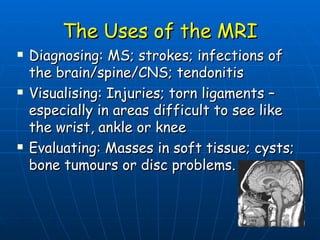
The Uses of the MRI Diagnosing: MS; strokes; infections of the brain/spine/CNS; tendonitis Visualising: Injuries; torn ligaments – especially in areas difficult to see like the wrist, ankle or knee Evaluating: Masses in soft tissue; cysts; bone tumours or disc problems.
The Future of MRI MRI research is ever changing. Smaller, lighter machines are always been developed. Work is on going to develop area specific machines to scan small areas like feet, arms, hands. Ventilation dynamic research is being tested with Helium to examine lung function Brain mapping is having and will continue to grow and give us a better image of how the brain works than ever before
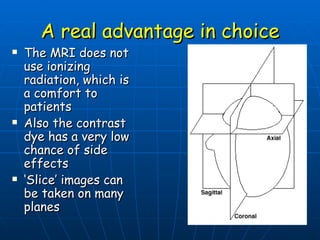
A real advantage in choice The MRI does not use ionizing radiation, which is a comfort to patients Also the contrast dye has a very low chance of side effects ‘ Slice’ images can be taken on many planes
And the disadvantages? Claustrophobia.  Patients are in a very enclosed space. Weight and size.  There are limitations to how big a patient can be. Noise.  The scanner is very noisy. Keeping still.  Patients have to keep very still for extended periods of time. Cost.  A scanner is very, very expensive, therefore scanning is also costly. Medical Contraindications.  Pacemakers, metal objects in body etc.

Magnetic Resonance Imaging

  • 1.
  • 2.
    How does itwork? The Basics Patient is bathed in a magnetic field 5000 times stronger than the earths This field causes some of the body’s nuclei to behave like tiny compasses and line up Then the nuclei are hit by pulsing radio waves Once the pulses stop the nuclei go back to their state induced by the magnet The energy now released by the nuclei acts like miniature radio stations giving out a signal These radio waves are picked up by a computer where they are translated into an image.
  • 3.
    What is sogood about MRI? They have given doctors the chance to detect cancers earlier than ever before They allow a view into the body without surgery They are a non invasive way of diagnosing diseases and conditions Gives a clearer set of images than CAT scans do.
  • 4.
    Contraindications The strengthof the magnet is 5000 times stronger than the earth So all metals must be removed! People with pacemakers cannot have a scan If you have any metal fragments in the eye you cannot have a scan – it would rip the eye open. These magnets are so powerful they could pull a car in! There has not been enough research done on babies and magnetism, so pregnant women shouldn’t have one done before the 4 th month of pregnancy – unless it is highly necessary.
  • 5.
    How it works– in depth The body is made of billions of atoms The nuclei spins on an axis, a bit like a spinning top The atom that the MRI uses is the hydrogen atom It has a single proton and is the most strongly affected by the Magnetic field – it is more likely to line up than other atoms Inside the magnetic field the protons are lined up and ready to go..
  • 6.
    The MRI scannernow releases a Radio Frequency that is only picked up by hydrogen This RF makes the protons spin at a particular frequency, in a particular direction – This is the Resonance bit When the RF is turned off, the nuclei start to lose the energy and return to where they were in the magnetic field The coil now picks up that excess energy and sends the signals to the computer – which is the Imaging part of the scan
  • 7.
    How the imageis made Often, patients are injected with a contrast dye during the scan The dye will reach different tissues at different rates The image being sent back to the computer will have different strengths depending on the level of contrast dye in the tissues
  • 8.
    The Uses ofthe MRI Diagnosing: MS; strokes; infections of the brain/spine/CNS; tendonitis Visualising: Injuries; torn ligaments – especially in areas difficult to see like the wrist, ankle or knee Evaluating: Masses in soft tissue; cysts; bone tumours or disc problems.
  • 9.
    The Future ofMRI MRI research is ever changing. Smaller, lighter machines are always been developed. Work is on going to develop area specific machines to scan small areas like feet, arms, hands. Ventilation dynamic research is being tested with Helium to examine lung function Brain mapping is having and will continue to grow and give us a better image of how the brain works than ever before
  • 10.
    A real advantagein choice The MRI does not use ionizing radiation, which is a comfort to patients Also the contrast dye has a very low chance of side effects ‘ Slice’ images can be taken on many planes
  • 11.
    And the disadvantages?Claustrophobia. Patients are in a very enclosed space. Weight and size. There are limitations to how big a patient can be. Noise. The scanner is very noisy. Keeping still. Patients have to keep very still for extended periods of time. Cost. A scanner is very, very expensive, therefore scanning is also costly. Medical Contraindications. Pacemakers, metal objects in body etc.