MAGNETIC RESONANCE IMAGING
Seminar - 9
Presented by
N.Narmatha
II year pg
INTRODUCTION
• Paul Lauterbur described the first magnetic resonance image in
1973
• Peter Mansfield further developed use of the magnetic field and
the mathematical analysis of the signals for image reconstruction.
• MRI was developed for clinical use around 1980
INDICATIONS
• Assessment of intracranial lesions and the pituitary ,spinal cord.
• Tumor staging—evaluation of the site, size and extent of soft tissue
tumors and tumor like lesions, involving
– The salivary glands.
– The pharynx.
– The larynx.
• Investigations of the TMJ to show the marrow changes and soft
tissue components of the joint including the disk.
ABSOLUTE CONTRAINDICATION
• Patient with implanted metallic foreign objects or
medical devices that consist of or contain ferromagnetic metals
(e.g., cardiac pacemakers, some cerebral aneurysm clips or
ferrous foreign bodies in the eye).
Patient is placed inside large magnet
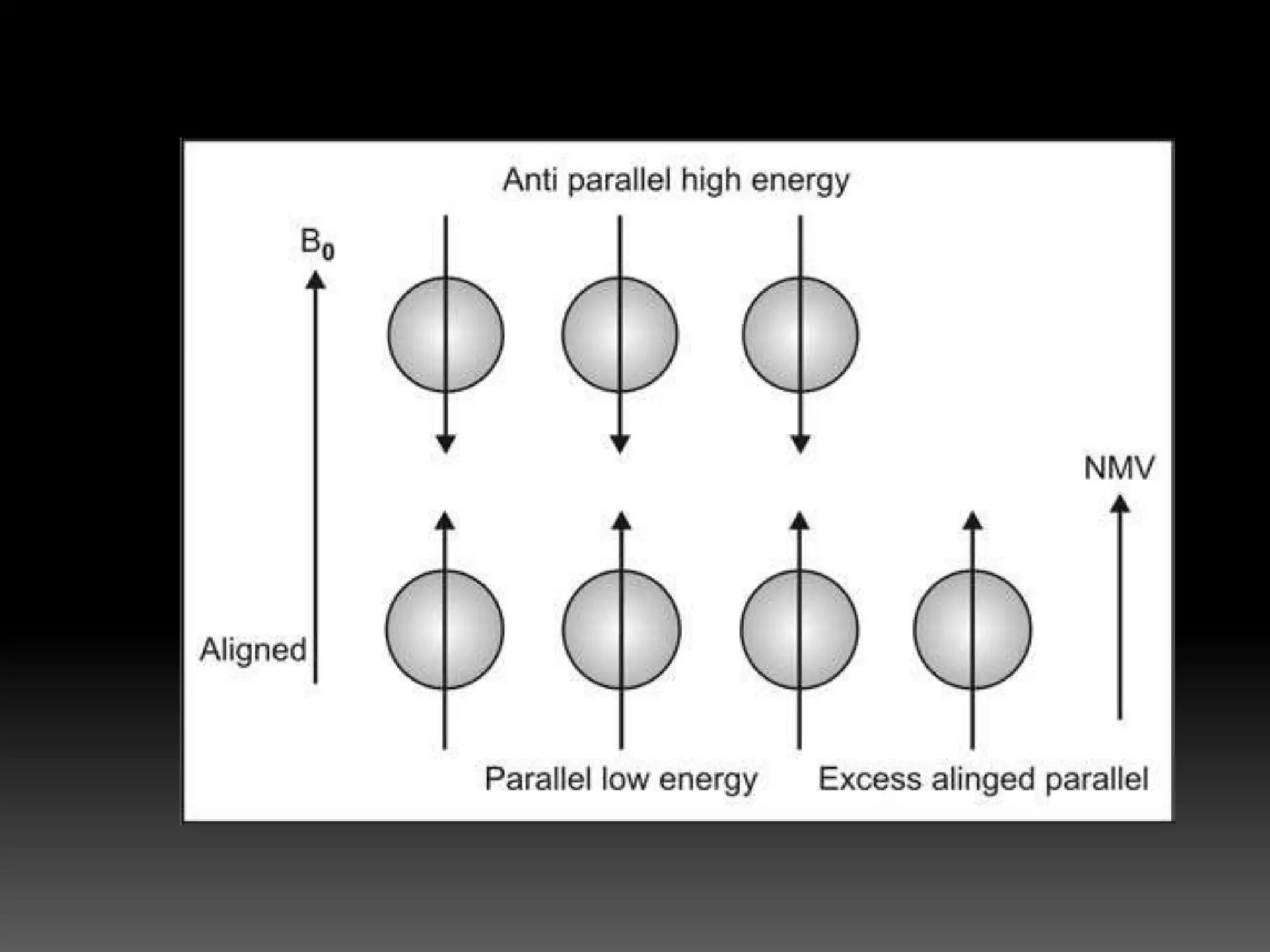
Magnetic field - nuclei of hydrogen atom to align
Scanner – radiofrequency pulse - Hydrogen nuclei
Resonate (absorb energy)
RF pulse is turned off
Stored energy is released from the body
Signal (coil)
MR image
• Nucleons – individual protons and neutrons in the nuclei of all
atoms
SPIN
• Hydrogen - most abundant
of these atoms in the body.
Nuclei that do not exhibit this
characteristic will not produce an
NMR signal.
MAGNETIC DIPOLES
• Magnetic resonance active nuclei, are hydrogen, carbon13,
nitrogen 15, oxygen 17, fluorine 19, sodium 23, and phosphorus
31.
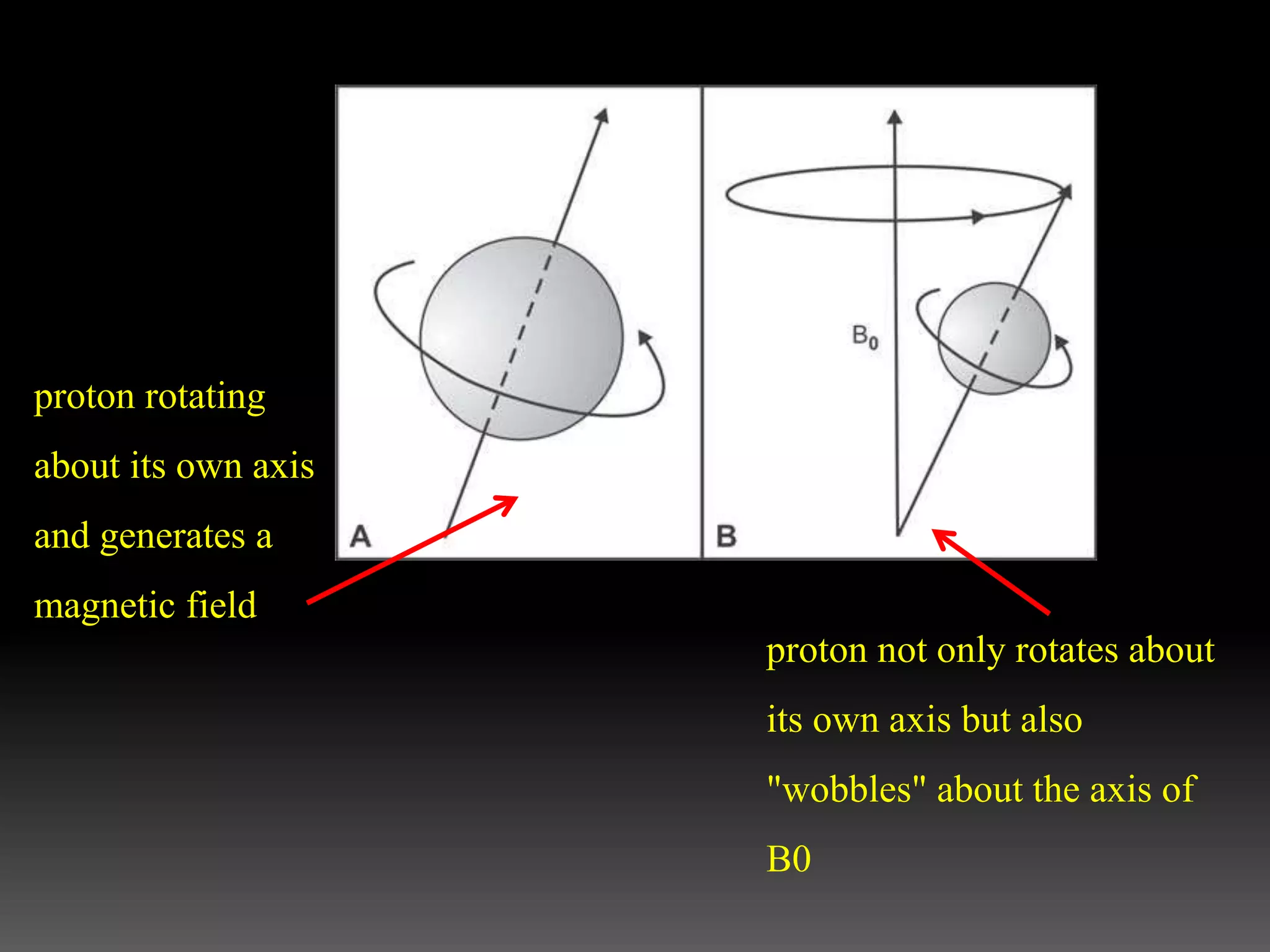
proton rotating
about its own axis
and generates a
magnetic field
proton not only rotates about
its own axis but also
"wobbles" about the axis of
B0
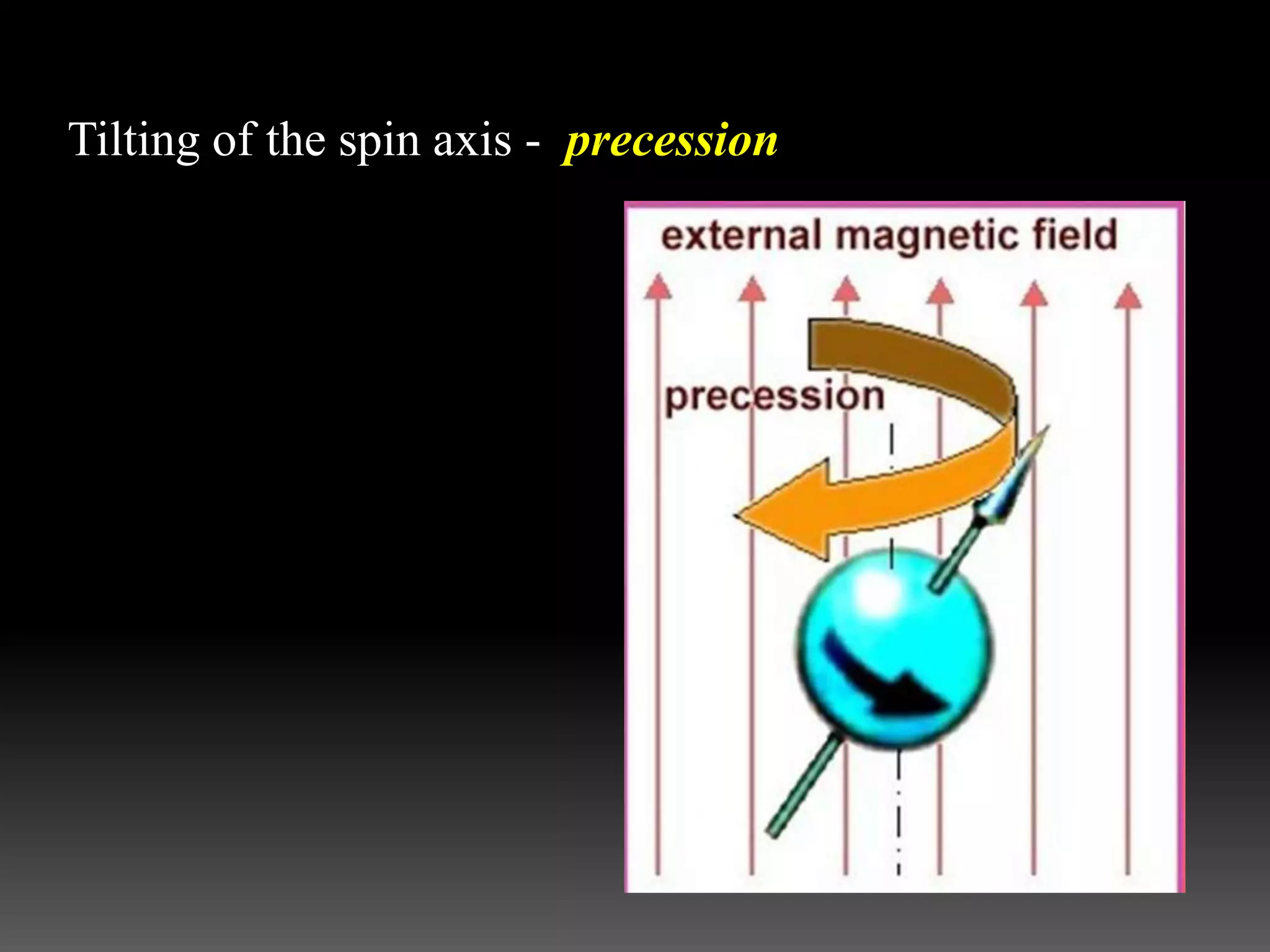
Tilting of the spin axis - precession
• The rate or frequency of precession is called the precessional
resonance, or larmor frequency.
an external field depends on the strength of the field.
f Larmor= μ B0
• Magnetic resonance field strengths - 0.1 to 4 tesla (T)
• 1.5 T - most common.
• The larmor precession frequency of Hydrogen is 63.86 megahertz
RESONANCE
• Nuclei can be made to undergo transition from one energy state to
another by absorbing or releasing energy
• Electromagnetic energy in the RF portion of the electromagnetic
spectrum - Energy required for transition
Longitudinal Magnetic Vector
Transverse Magnetic Vector
90-degree RF pulse or having a flip
angle of 90 degrees - will give the
maximum transverse magnetization
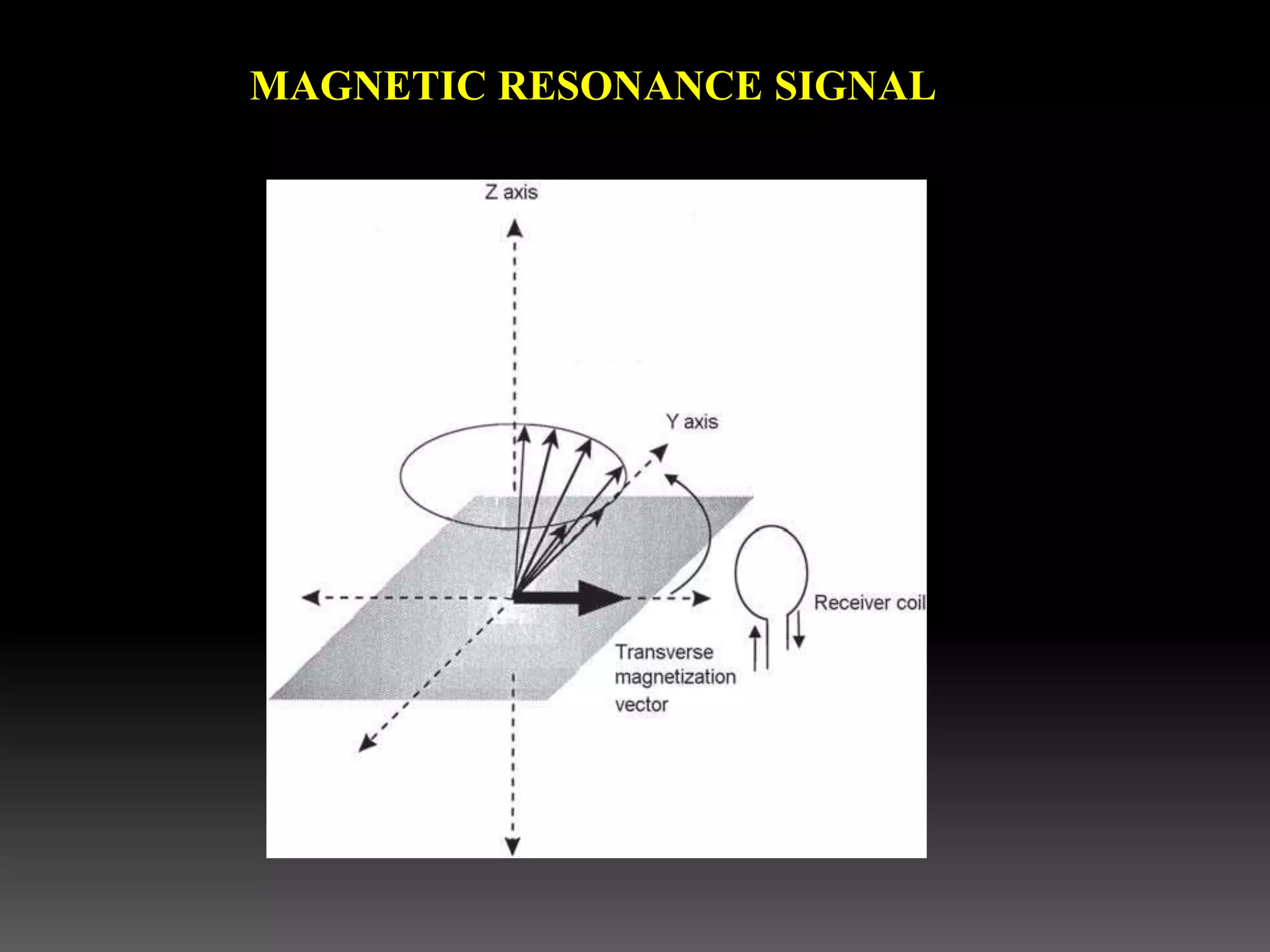
MAGNETIC RESONANCE SIGNAL
• Tightly bound hydrogen atoms - produce only a weak signal.
• Loosely bound or mobile hydrogen atoms - react to the RF pulse
- produce a detectable signal at the end of the RF pulse.
• The concentration of loosely bound hydrogen nuclei available
to create the signal is referred to as the proton density or spin
density of the tissue in question
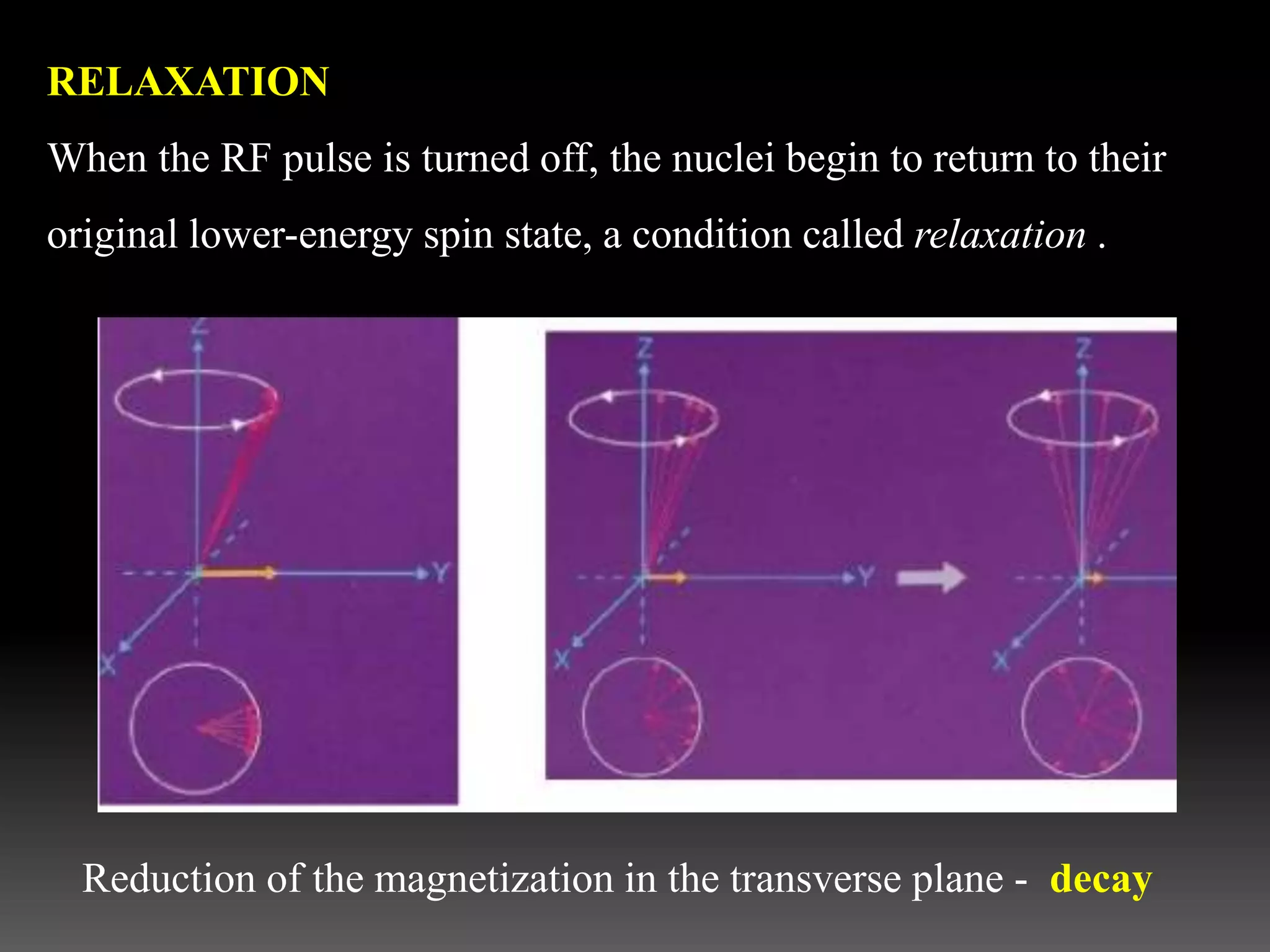
RELAXATION
When the RF pulse is turned off, the nuclei begin to return to their
original lower-energy spin state, a condition called relaxation .
Reduction of the magnetization in the transverse plane - decay
Free induction decay (FID) signal - reduced voltage induced in the
receiving coil
Results from the
• loss of the transverse net
magnetization vector.
• return of the net magnetization vector to the longitudinal plane
and dephasing of the hydrogen nuclei.
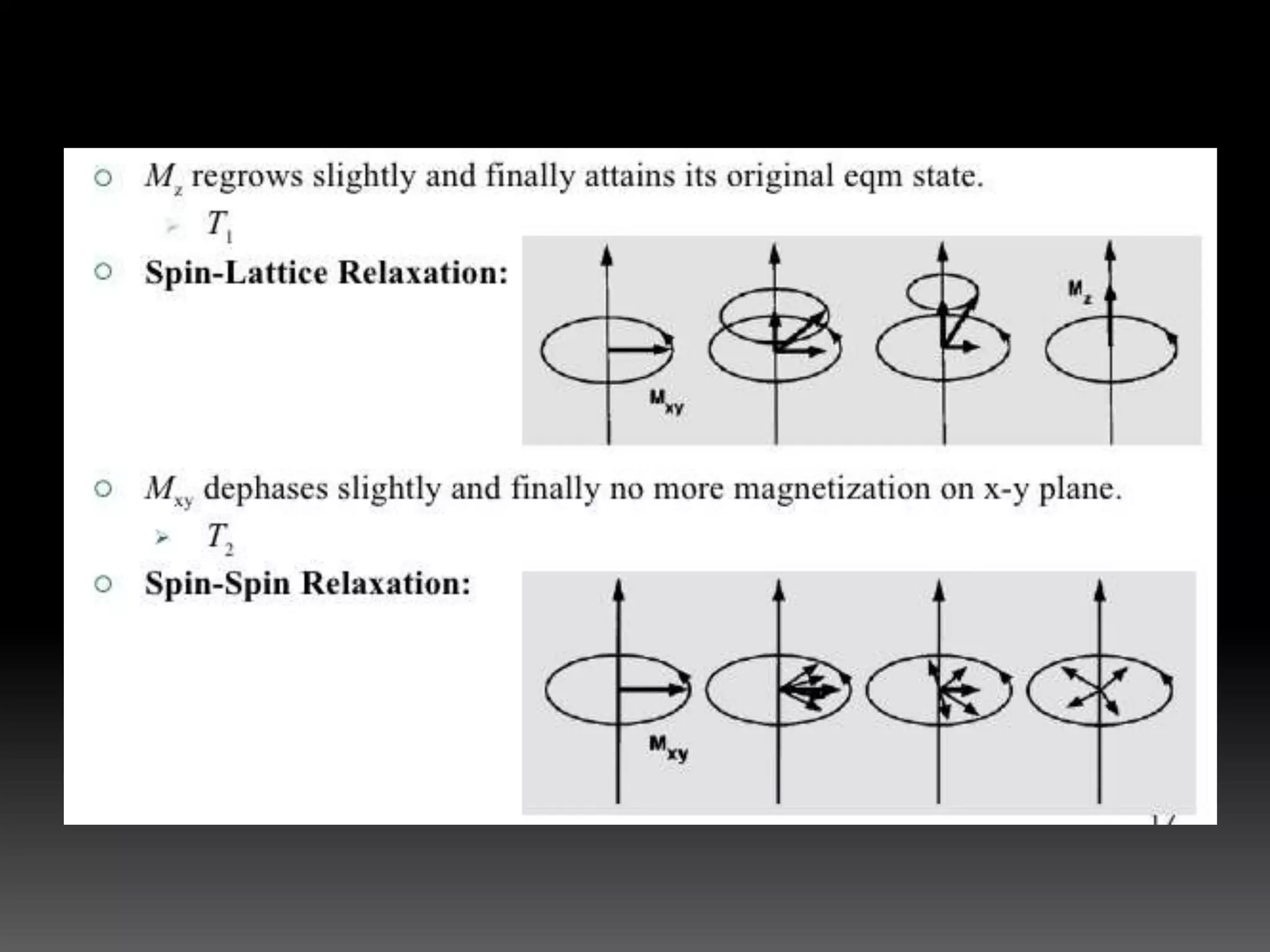
T1 RELAXATION
Individual hydrogen nuclei (spin)
Energy transfer
Surrounding molecules (lattice)
Recovery of the longitudinal magnetization
• Time required for 63% of the net magnetization to return to
equilibrium by this transfer of energy – T1 relaxation time or
spin-lattice relaxation time
T2 RELAXATION TIME
The time constant that describes the exponential rate of loss of
transverse magnetization - T2 relaxation time or the spin-spin
relaxation time.
RADIOFREQUENCY PULSES SEQUENCES
TR time - duration between repeat RF pulses
• Determines the amount of T1 relaxation that has occurred at
the time the signal is collected
TE time - time after application of the RF pulse when the magnetic
resonance signal is read.
• It controls the amount of T2 relaxation that has occurred
when the signal is collected.
A BASIC PULSE SEQUENCE
TISSUE CONTRAST
Image contrast between tissues is governed by
• Intrinsic features of the tissues
• Proton density,
• T1 and T2 times,
• TR and TE times
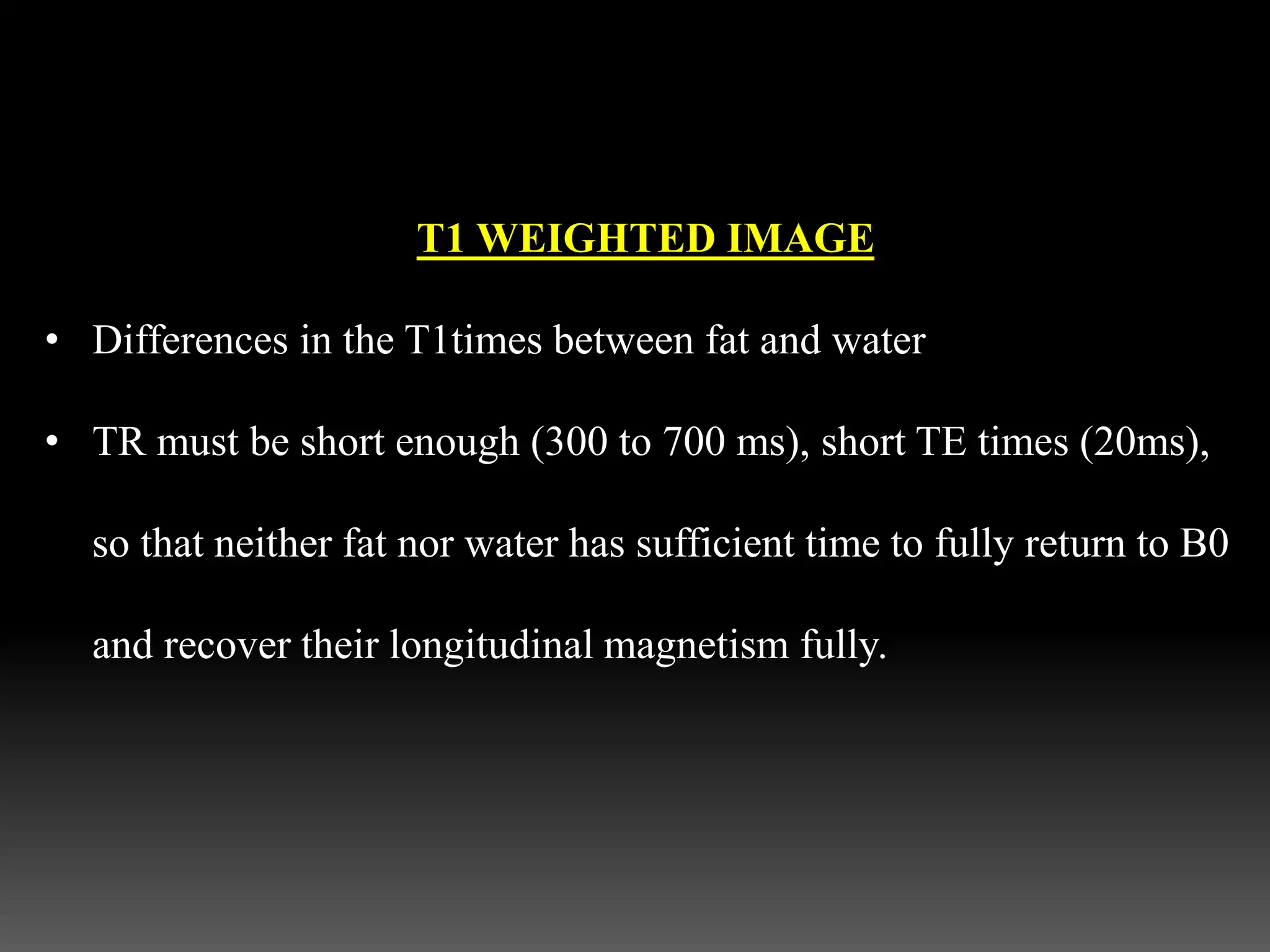
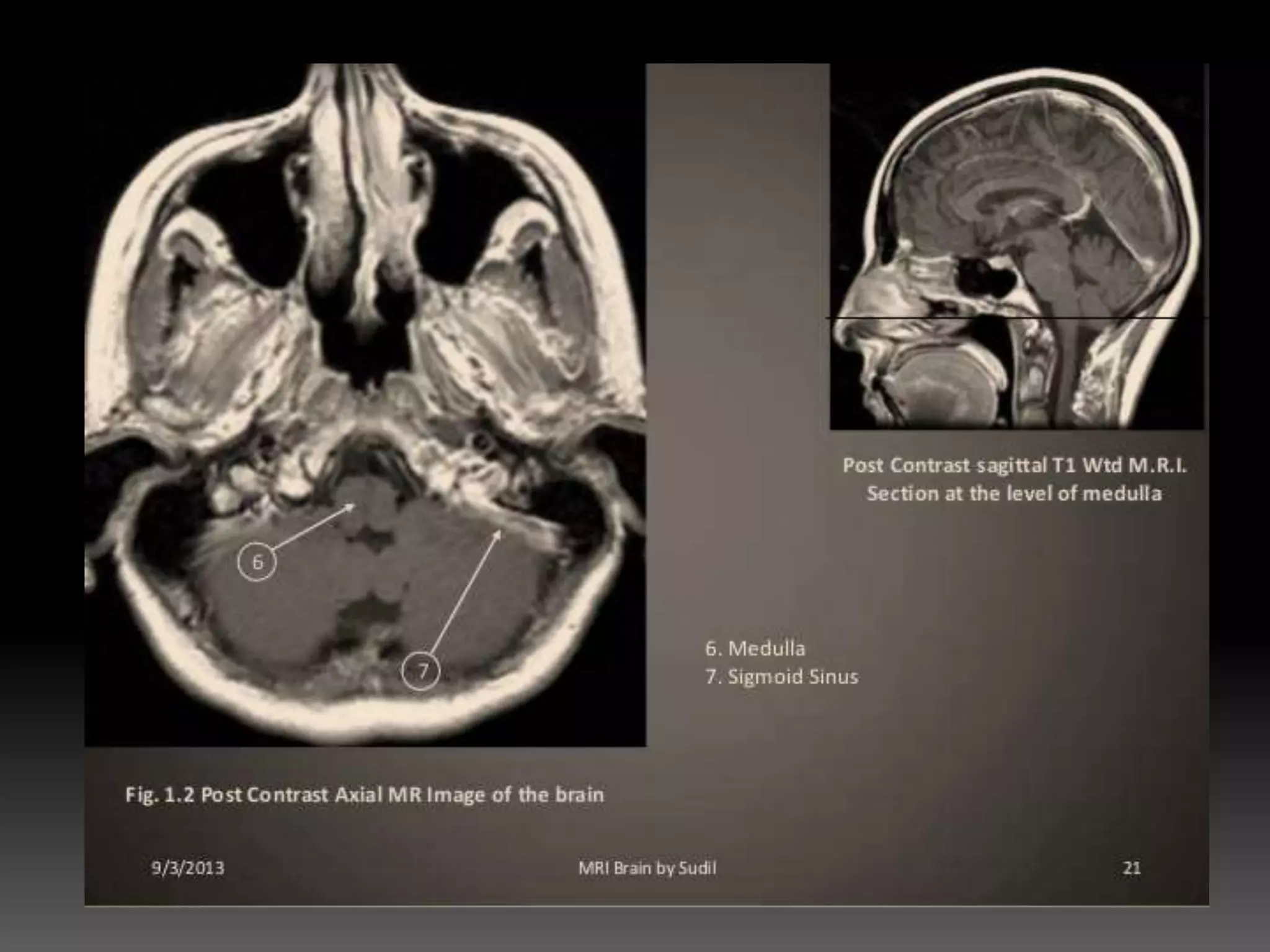
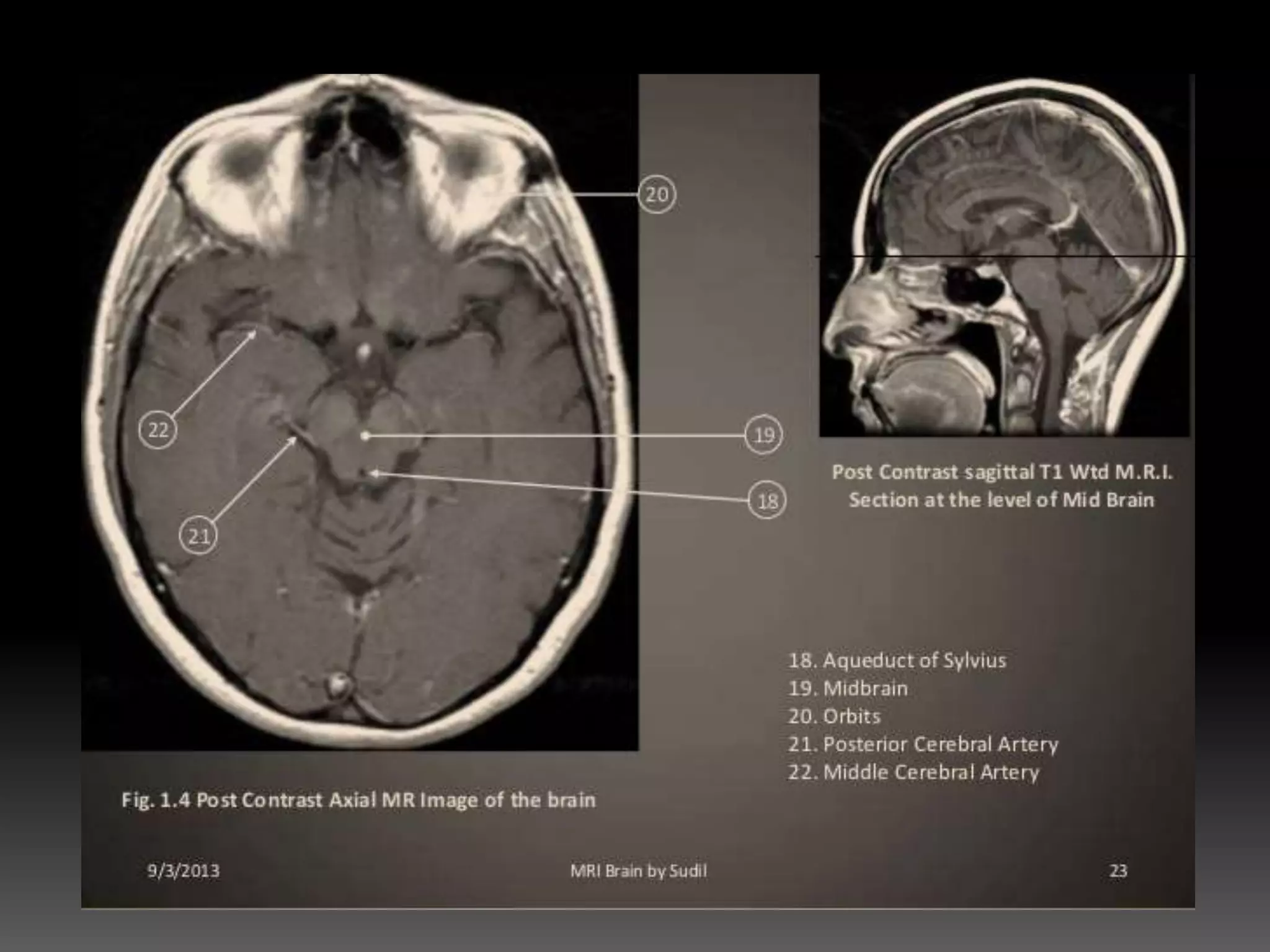
T1 WEIGHTED IMAGE
• Differences in the T1times between fat and water
• TR must be short enough (300 to 700 ms), short TE times (20ms),
so that neither fat nor water has sufficient time to fully return to B0
and recover their longitudinal magnetism fully.
• Tissues with fast T1 times – fat - appear bright
• Long T1 times - cerebrospinal fluid (water) - appear dark.
• More commonly used to demonstrate anatomy.
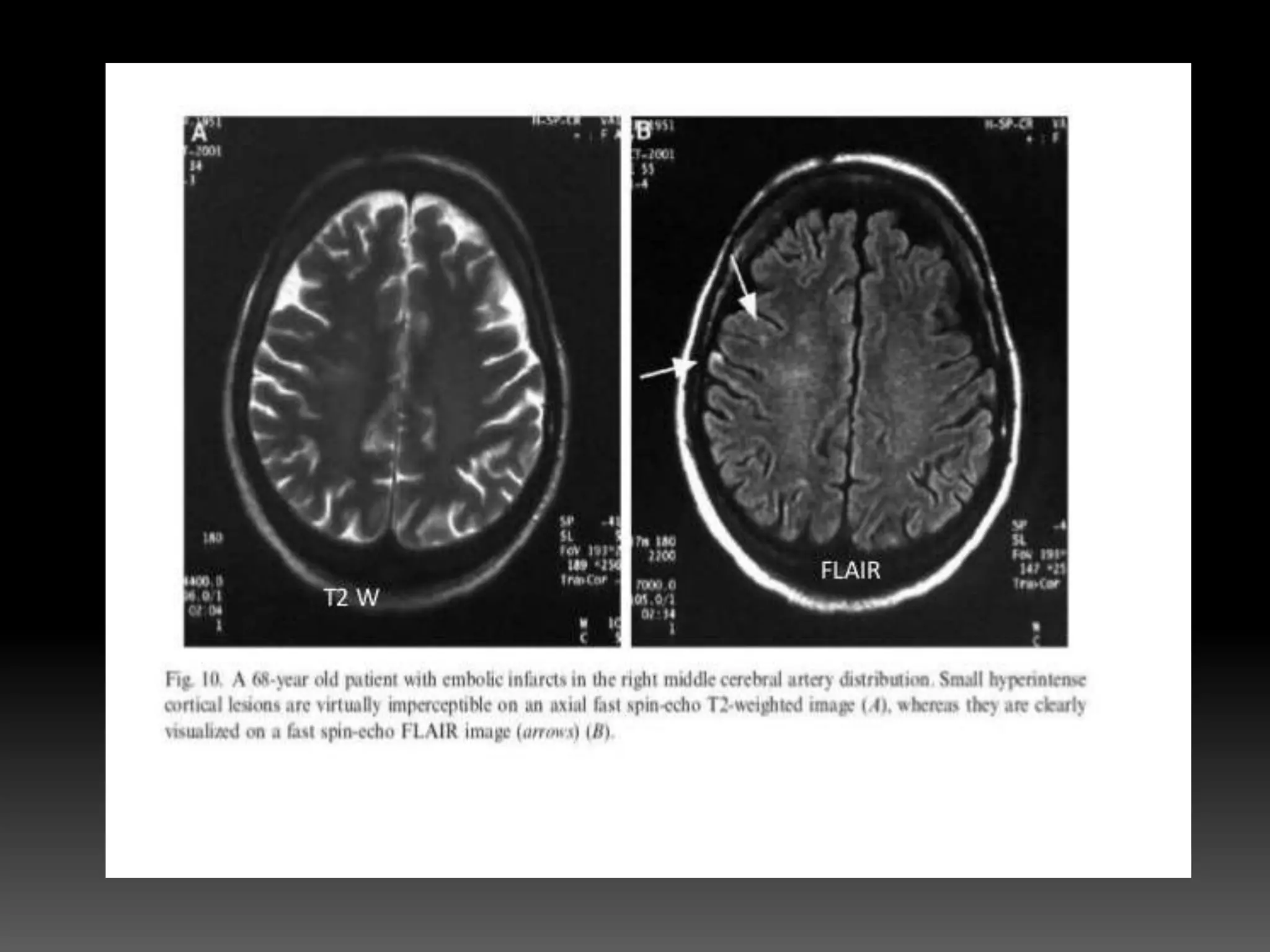
T2 weighted image
• Differences in the T2 times between fat and water
• To achieve T2 weighting,
• TE must be long enough(60 ms or more) to give both fat
and water time to decay. Long TR times(2000 ms)
• If the TE is too short, neither fat nor water has time to
decay, and therefore the differences in their T2 times are
not demonstrated
• Tissues with long T2 times – CSF or temporomandibular (TMJ)
joint Fluid - appear bright
• Tissues with short T2 times – Fat - appear dark.
• Most commonly used for identifying inflammatory or other
pathologic changes.
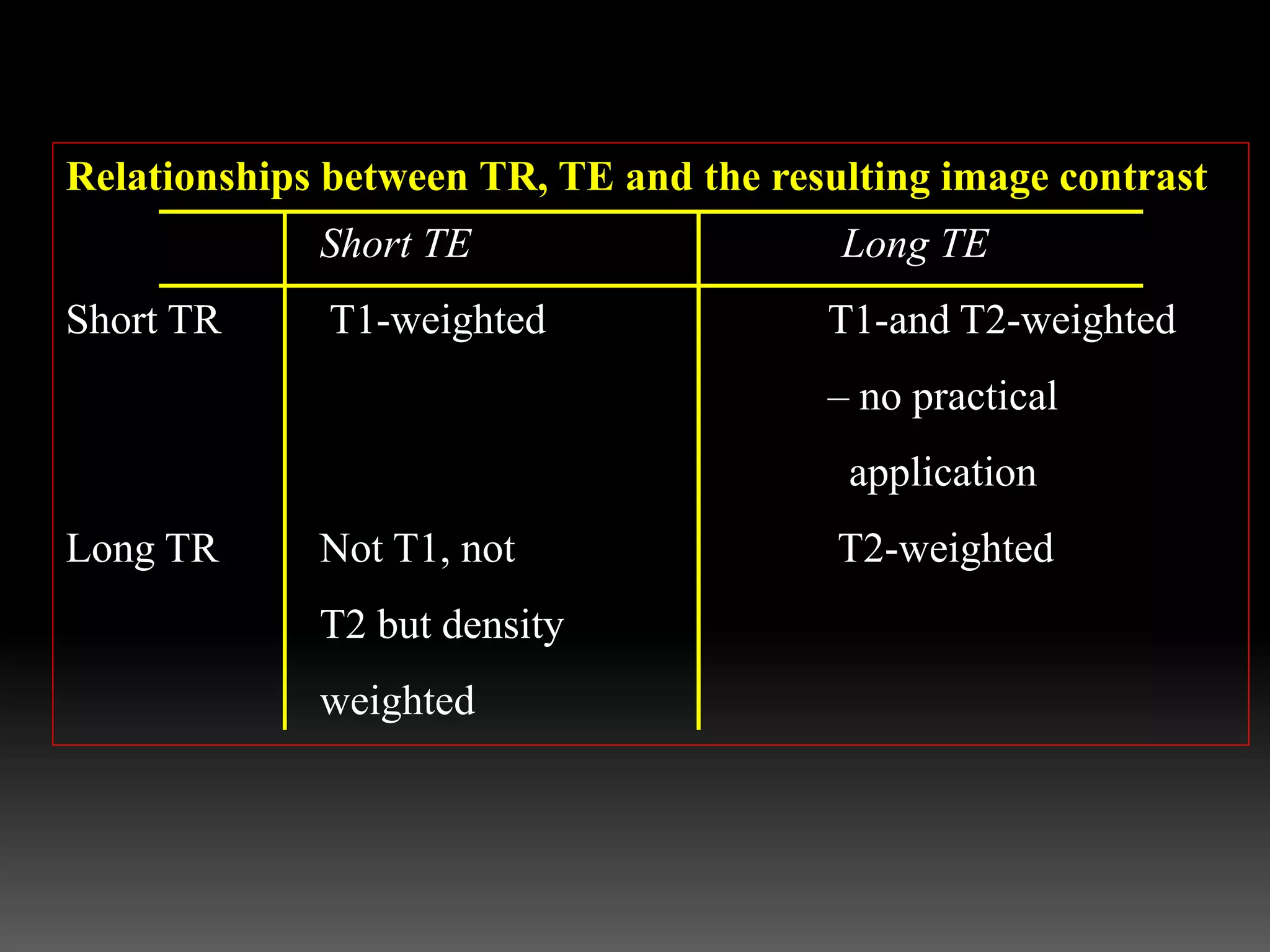
Relationships between TR, TE and the resulting image contrast
Short TE Long TE
Short TR T1-weighted T1-and T2-weighted
– no practical
application
Long TR Not T1, not T2-weighted
T2 but density
weighted
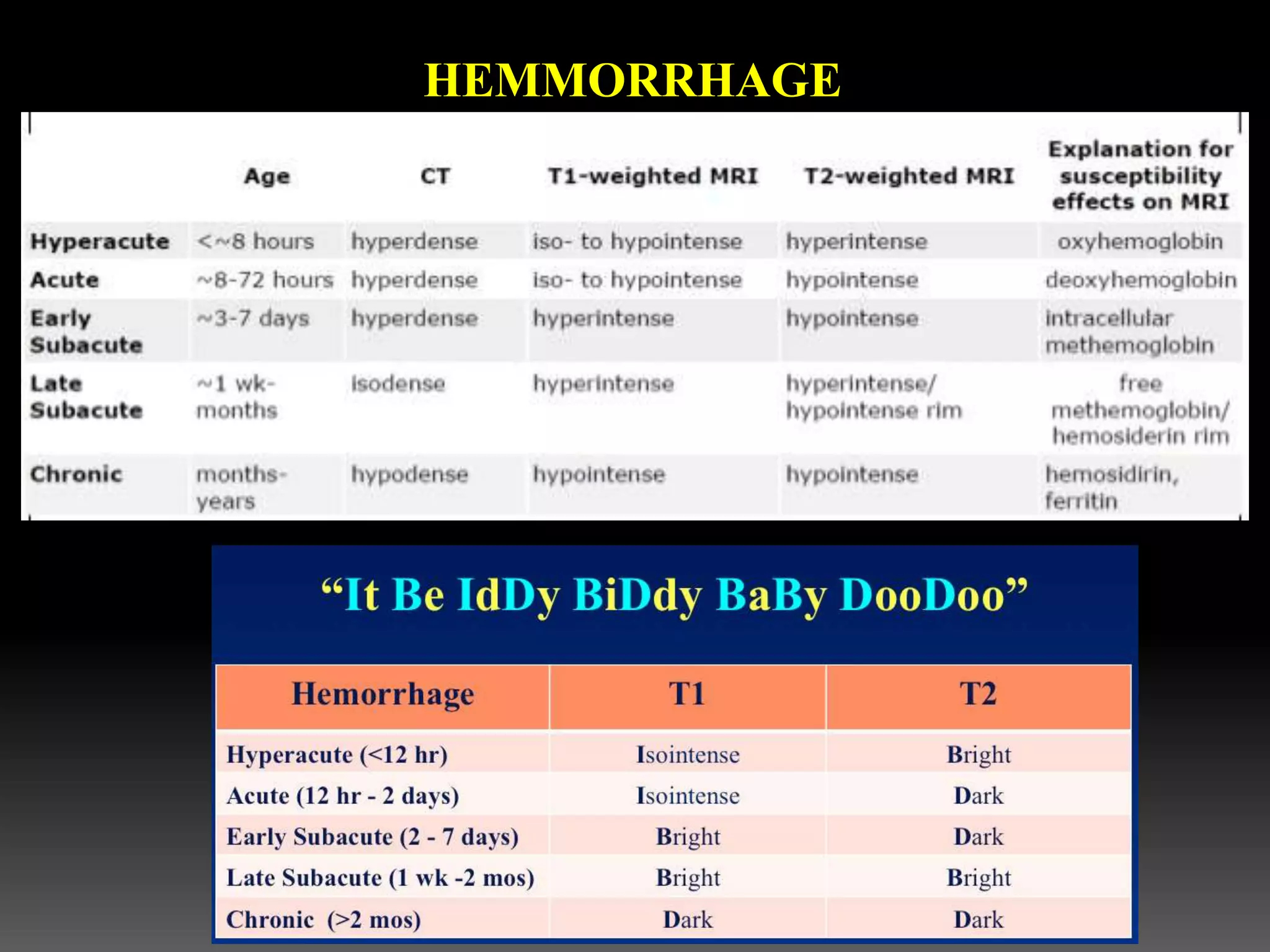
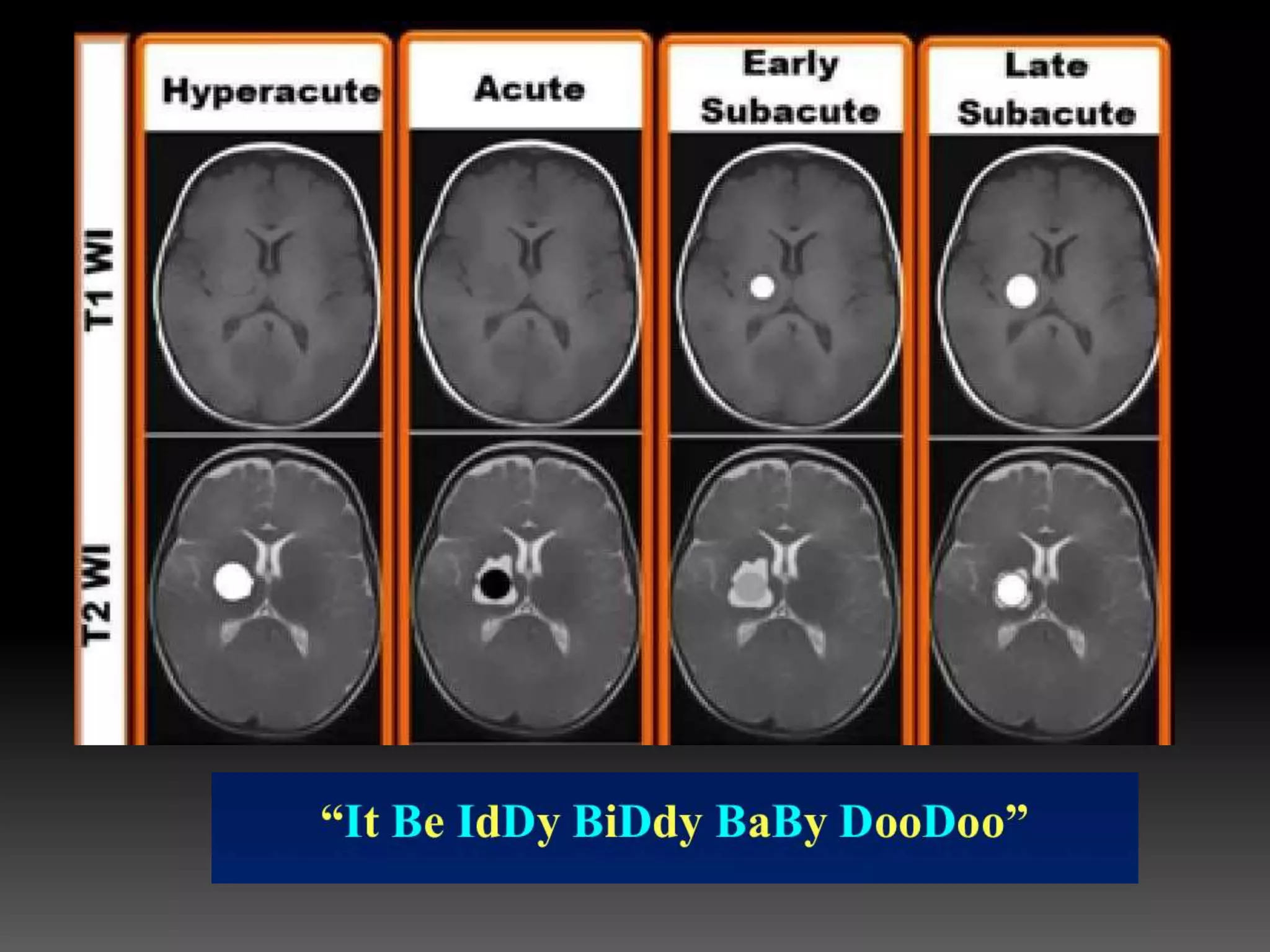
HEMMORRHAGE
CONTRAST AGENTS
• Gadolinium - administered intravenously to improve tissue
contrast
• It shortens the T1 relaxation times of enhancing tissues - making
them appear brighter.
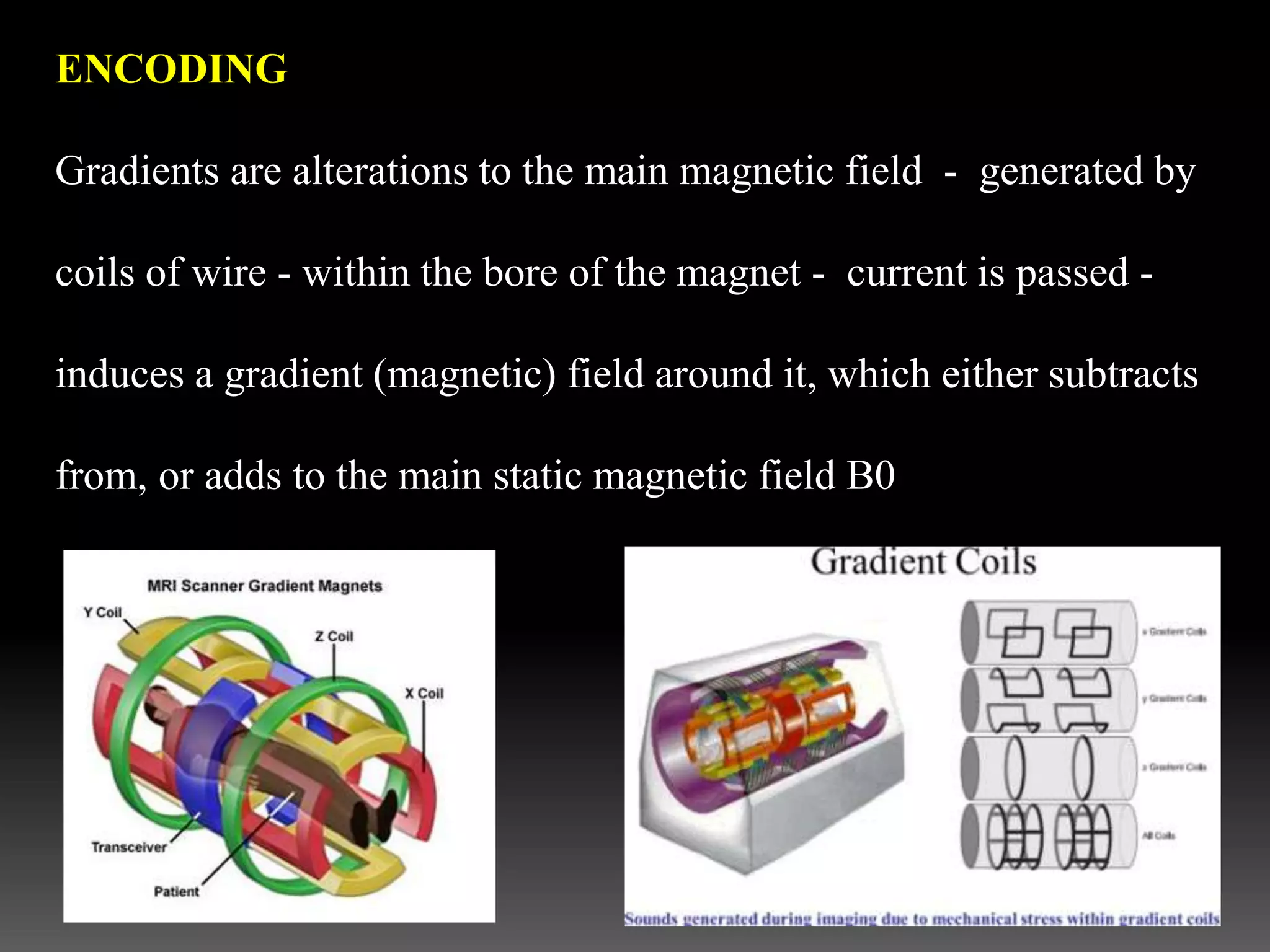
ENCODING
Gradients are alterations to the main magnetic field - generated by
coils of wire - within the bore of the magnet - current is passed -
induces a gradient (magnetic) field around it, which either subtracts
from, or adds to the main static magnetic field B0
Gradients - used to either dephase or rephrase the magnetic
movements of nuclei , can also perform
– Slice selection: locating a slice within the scan plane
Selected(Z)
– Frequency encoding: spatially locating (encoding) signal along
the long axis of the anatomy.(Y)
– Phase encoding: spatially locating (encoding) signal along the
short axis of the anatomy.(X)
• The data of each signal position is collected - information is
stored in the array processor of the system computer in K space -
then converted mathematically by a process called as Fast
Fourier Transform
Slice selection – exclusive excitation of spins in one slice performed
by the coincident combination of a gradient magnetic field and a
narrow bandwidth or slice selective RF pulse at a specific Larmor
frequency.
• Slice thickness – the thickness of an imaging slice.
Abnormalities on MRI is refered as
IMAGING PLANES
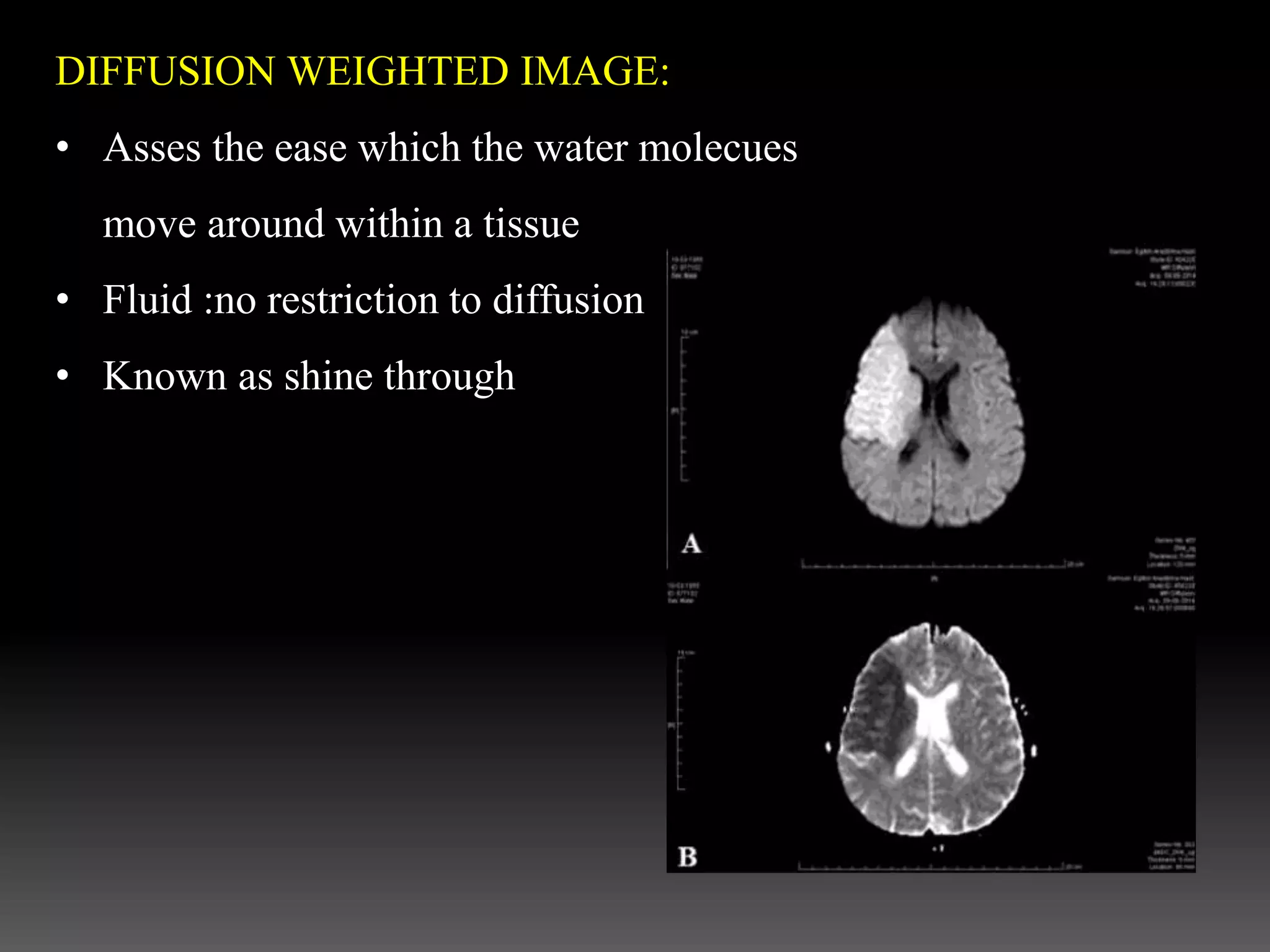
DIFFUSION WEIGHTED IMAGE:
• Asses the ease which the water molecues
move around within a tissue
• Fluid :no restriction to diffusion
• Known as shine through
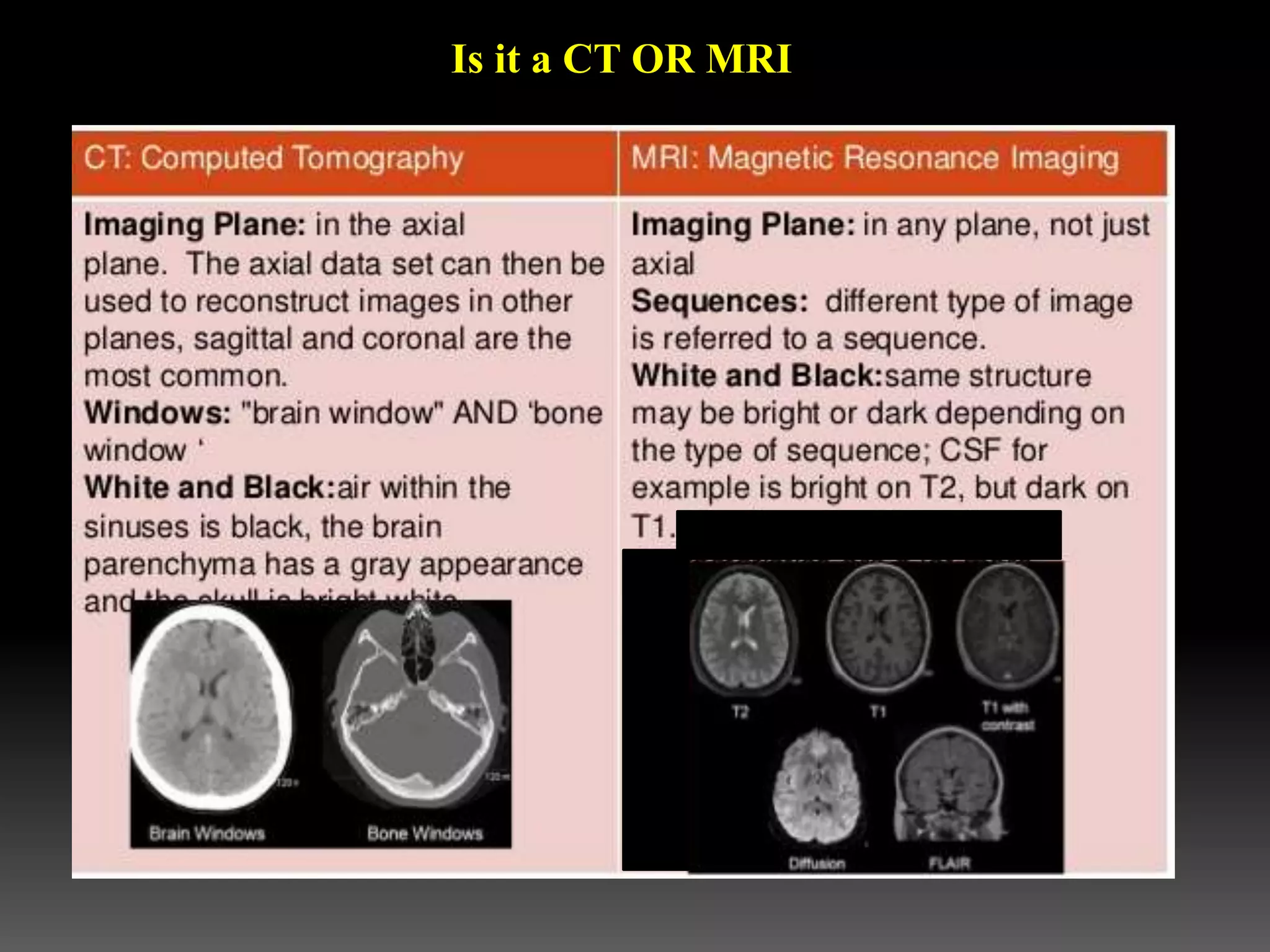
Is it a CT OR MRI
Advantages :
• Best contrast resolution of soft tissues
• No ionizing radiation
• Direct multiplanar imaging is possible without reorienting the
patient
DISADVANTAGES
• Long imaging times
• Potential hazard imposed by ferromagnetic metals in the vicinity
of the imaging magnet.
• Claustrophobic
 Metals used in dentistry for restorations or orthodontics will not
move but may distort the image in their vicinity.
 Titanium implants cause only minor image degradation.
References:
1. Textbook of Dental and Maxillofacial Radiology,
Freny R Karjodkar,3rd edition
2. Principles and interpretion of oral radiology,white
and pharoah.
3. MRI – essentials in practice
4.Handbook of MRITechnique Catherine Westbrook
THANKYOU

9 mri

  • 1.
    MAGNETIC RESONANCE IMAGING Seminar- 9 Presented by N.Narmatha II year pg
  • 2.
    INTRODUCTION • Paul Lauterburdescribed the first magnetic resonance image in 1973 • Peter Mansfield further developed use of the magnetic field and the mathematical analysis of the signals for image reconstruction. • MRI was developed for clinical use around 1980
  • 3.
    INDICATIONS • Assessment ofintracranial lesions and the pituitary ,spinal cord. • Tumor staging—evaluation of the site, size and extent of soft tissue tumors and tumor like lesions, involving – The salivary glands. – The pharynx. – The larynx. • Investigations of the TMJ to show the marrow changes and soft tissue components of the joint including the disk.
  • 4.
    ABSOLUTE CONTRAINDICATION • Patientwith implanted metallic foreign objects or medical devices that consist of or contain ferromagnetic metals (e.g., cardiac pacemakers, some cerebral aneurysm clips or ferrous foreign bodies in the eye).
  • 6.
    Patient is placedinside large magnet Magnetic field - nuclei of hydrogen atom to align Scanner – radiofrequency pulse - Hydrogen nuclei Resonate (absorb energy) RF pulse is turned off Stored energy is released from the body Signal (coil) MR image
  • 7.
    • Nucleons –individual protons and neutrons in the nuclei of all atoms SPIN
  • 8.
    • Hydrogen -most abundant of these atoms in the body. Nuclei that do not exhibit this characteristic will not produce an NMR signal.
  • 9.
    MAGNETIC DIPOLES • Magneticresonance active nuclei, are hydrogen, carbon13, nitrogen 15, oxygen 17, fluorine 19, sodium 23, and phosphorus 31.
  • 12.
    proton rotating about itsown axis and generates a magnetic field proton not only rotates about its own axis but also "wobbles" about the axis of B0
  • 13.
    Tilting of thespin axis - precession
  • 14.
    • The rateor frequency of precession is called the precessional resonance, or larmor frequency. an external field depends on the strength of the field. f Larmor= μ B0 • Magnetic resonance field strengths - 0.1 to 4 tesla (T) • 1.5 T - most common. • The larmor precession frequency of Hydrogen is 63.86 megahertz
  • 15.
    RESONANCE • Nuclei canbe made to undergo transition from one energy state to another by absorbing or releasing energy • Electromagnetic energy in the RF portion of the electromagnetic spectrum - Energy required for transition
  • 16.
  • 17.
  • 18.
    90-degree RF pulseor having a flip angle of 90 degrees - will give the maximum transverse magnetization
  • 19.
  • 20.
    • Tightly boundhydrogen atoms - produce only a weak signal. • Loosely bound or mobile hydrogen atoms - react to the RF pulse - produce a detectable signal at the end of the RF pulse. • The concentration of loosely bound hydrogen nuclei available to create the signal is referred to as the proton density or spin density of the tissue in question
  • 21.
    RELAXATION When the RFpulse is turned off, the nuclei begin to return to their original lower-energy spin state, a condition called relaxation . Reduction of the magnetization in the transverse plane - decay
  • 22.
    Free induction decay(FID) signal - reduced voltage induced in the receiving coil Results from the • loss of the transverse net magnetization vector. • return of the net magnetization vector to the longitudinal plane and dephasing of the hydrogen nuclei.
  • 23.
    T1 RELAXATION Individual hydrogennuclei (spin) Energy transfer Surrounding molecules (lattice) Recovery of the longitudinal magnetization
  • 25.
    • Time requiredfor 63% of the net magnetization to return to equilibrium by this transfer of energy – T1 relaxation time or spin-lattice relaxation time T2 RELAXATION TIME The time constant that describes the exponential rate of loss of transverse magnetization - T2 relaxation time or the spin-spin relaxation time.
  • 27.
    RADIOFREQUENCY PULSES SEQUENCES TRtime - duration between repeat RF pulses • Determines the amount of T1 relaxation that has occurred at the time the signal is collected TE time - time after application of the RF pulse when the magnetic resonance signal is read. • It controls the amount of T2 relaxation that has occurred when the signal is collected.
  • 28.
    A BASIC PULSESEQUENCE
  • 29.
    TISSUE CONTRAST Image contrastbetween tissues is governed by • Intrinsic features of the tissues • Proton density, • T1 and T2 times, • TR and TE times
  • 30.
    T1 WEIGHTED IMAGE •Differences in the T1times between fat and water • TR must be short enough (300 to 700 ms), short TE times (20ms), so that neither fat nor water has sufficient time to fully return to B0 and recover their longitudinal magnetism fully.
  • 31.
    • Tissues withfast T1 times – fat - appear bright • Long T1 times - cerebrospinal fluid (water) - appear dark. • More commonly used to demonstrate anatomy.
  • 32.
    T2 weighted image •Differences in the T2 times between fat and water • To achieve T2 weighting, • TE must be long enough(60 ms or more) to give both fat and water time to decay. Long TR times(2000 ms) • If the TE is too short, neither fat nor water has time to decay, and therefore the differences in their T2 times are not demonstrated
  • 33.
    • Tissues withlong T2 times – CSF or temporomandibular (TMJ) joint Fluid - appear bright • Tissues with short T2 times – Fat - appear dark. • Most commonly used for identifying inflammatory or other pathologic changes.
  • 35.
    Relationships between TR,TE and the resulting image contrast Short TE Long TE Short TR T1-weighted T1-and T2-weighted – no practical application Long TR Not T1, not T2-weighted T2 but density weighted
  • 37.
  • 40.
    CONTRAST AGENTS • Gadolinium- administered intravenously to improve tissue contrast • It shortens the T1 relaxation times of enhancing tissues - making them appear brighter.
  • 41.
    ENCODING Gradients are alterationsto the main magnetic field - generated by coils of wire - within the bore of the magnet - current is passed - induces a gradient (magnetic) field around it, which either subtracts from, or adds to the main static magnetic field B0
  • 43.
    Gradients - usedto either dephase or rephrase the magnetic movements of nuclei , can also perform – Slice selection: locating a slice within the scan plane Selected(Z) – Frequency encoding: spatially locating (encoding) signal along the long axis of the anatomy.(Y) – Phase encoding: spatially locating (encoding) signal along the short axis of the anatomy.(X)
  • 44.
    • The dataof each signal position is collected - information is stored in the array processor of the system computer in K space - then converted mathematically by a process called as Fast Fourier Transform
  • 45.
    Slice selection –exclusive excitation of spins in one slice performed by the coincident combination of a gradient magnetic field and a narrow bandwidth or slice selective RF pulse at a specific Larmor frequency.
  • 46.
    • Slice thickness– the thickness of an imaging slice.
  • 47.
    Abnormalities on MRIis refered as
  • 48.
  • 60.
    DIFFUSION WEIGHTED IMAGE: •Asses the ease which the water molecues move around within a tissue • Fluid :no restriction to diffusion • Known as shine through
  • 65.
    Is it aCT OR MRI
  • 66.
    Advantages : • Bestcontrast resolution of soft tissues • No ionizing radiation • Direct multiplanar imaging is possible without reorienting the patient
  • 67.
    DISADVANTAGES • Long imagingtimes • Potential hazard imposed by ferromagnetic metals in the vicinity of the imaging magnet. • Claustrophobic  Metals used in dentistry for restorations or orthodontics will not move but may distort the image in their vicinity.  Titanium implants cause only minor image degradation.
  • 68.
    References: 1. Textbook ofDental and Maxillofacial Radiology, Freny R Karjodkar,3rd edition 2. Principles and interpretion of oral radiology,white and pharoah. 3. MRI – essentials in practice 4.Handbook of MRITechnique Catherine Westbrook
  • 69.