
BASICS OF MRI


         Presented by:-

         Pranali. N. Kulkarni
         Ganesh M. Nair
         Aaditee S. Kulkarni
         Omkar Haldonkar
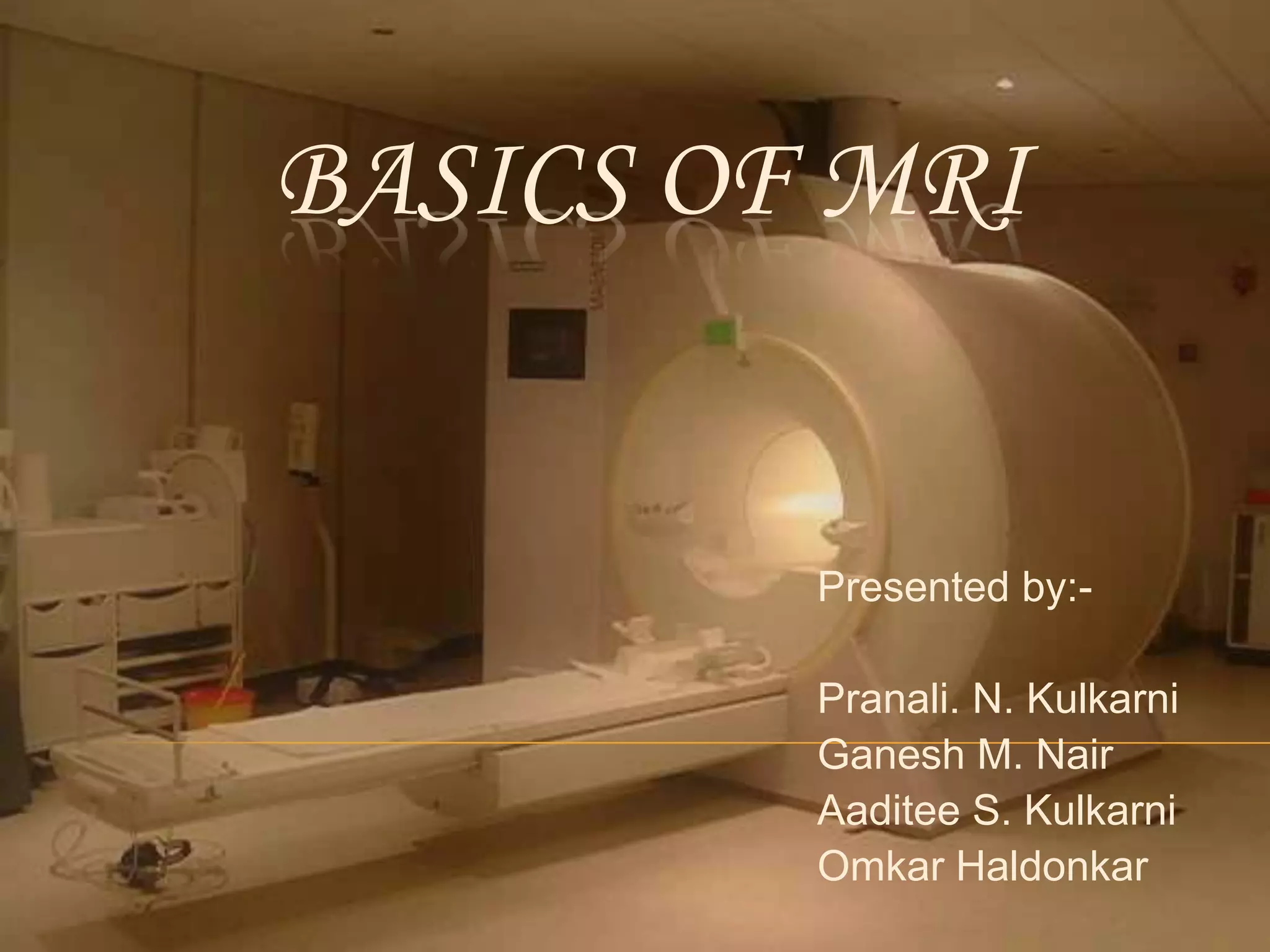
MAGNETIC RESONANCE IMAGING


                Magnetic resonance imaging
                 (MRI) is a medical imaging
                 technique used in radiology to
                 visualize internal structures of
                 the body in detail.
WHAT IS A SPIN????
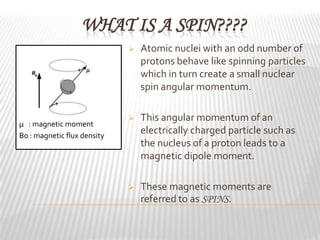
                                Atomic nuclei with an odd number of
                                 protons behave like spinning particles
                                 which in turn create a small nuclear
                                 spin angular momentum.

                                This angular momentum of an
µ : magnetic moment
Bo : magnetic flux density
                                 electrically charged particle such as
                                 the nucleus of a proton leads to a
                                 magnetic dipole moment.

                                These magnetic moments are
                                 referred to as SPINS.
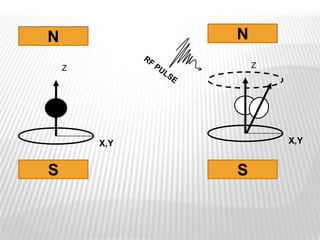
PRECESSION AND LARMOR FREQUENCY

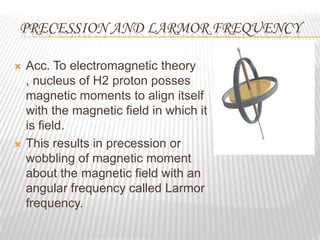
   Acc. To electromagnetic theory
    , nucleus of H2 proton posses
    magnetic moments to align itself
    with the magnetic field in which it
    is field.
   This results in precession or
    wobbling of magnetic moment
    about the magnetic field with an
    angular frequency called Larmor
    frequency.
N             N
    Z             Z


        X,Y           X,Y


S             S
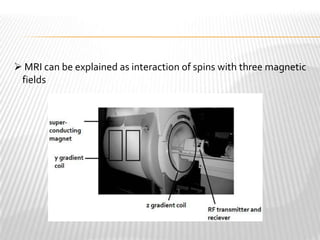
 MRI can be explained as interaction of spins with three magnetic
 fields
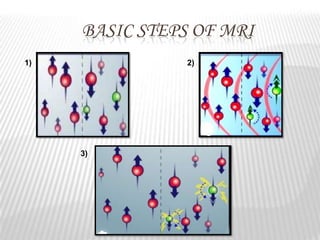
BASIC STEPS OF MRI
1)              2)


     3)
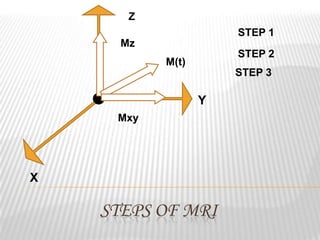
Z
                      STEP 1
      Mz
                      STEP 2
           M(t)
                      STEP 3

                  Y
     Mxy


X

    STEPS OF MRI
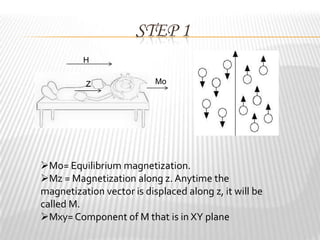
STEP 1
          H


          Z                Mo


Mo= Equilibrium magnetization.
Mz = Magnetization along z. Anytime the
magnetization vector is displaced along z, it will be
called M.
Mxy= Component of M that is in XY plane
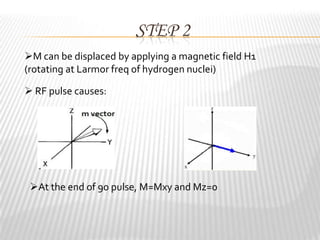
STEP 2
M can be displaced by applying a magnetic field H1
(rotating at Larmor freq of hydrogen nuclei)

 RF pulse causes:


 At the end of 90 pulse, M=Mxy and Mz=0
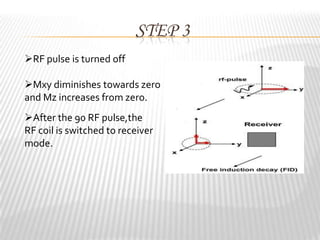
STEP 3
RF pulse is turned off

Mxy diminishes towards zero
and Mz increases from zero.
After the 90 RF pulse,the
RF coil is switched to receiver
mode.
VOLTA   FREE INDUCTION DECAY
 GE


                        TIME
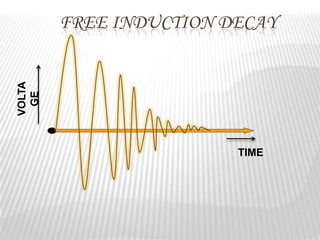
FREE INDUCTION DECAY

 At room temp. more protons are in a low
  energy state.
 The excited proton tends to return to low
  energy state with a spontaneous decay.
 This decay is exponential in nature
Basics of mri

Basics of mri

  • 1.
    BASICS OF MRI Presented by:- Pranali. N. Kulkarni Ganesh M. Nair Aaditee S. Kulkarni Omkar Haldonkar
  • 2.
    MAGNETIC RESONANCE IMAGING  Magnetic resonance imaging (MRI) is a medical imaging technique used in radiology to visualize internal structures of the body in detail.
  • 3.
    WHAT IS ASPIN????  Atomic nuclei with an odd number of protons behave like spinning particles which in turn create a small nuclear spin angular momentum.  This angular momentum of an µ : magnetic moment Bo : magnetic flux density electrically charged particle such as the nucleus of a proton leads to a magnetic dipole moment.  These magnetic moments are referred to as SPINS.
  • 4.
    PRECESSION AND LARMORFREQUENCY  Acc. To electromagnetic theory , nucleus of H2 proton posses magnetic moments to align itself with the magnetic field in which it is field.  This results in precession or wobbling of magnetic moment about the magnetic field with an angular frequency called Larmor frequency.
  • 5.
    N N Z Z X,Y X,Y S S
  • 6.
     MRI canbe explained as interaction of spins with three magnetic fields
  • 7.
    BASIC STEPS OFMRI 1) 2) 3)
  • 8.
    Z STEP 1 Mz STEP 2 M(t) STEP 3 Y Mxy X STEPS OF MRI
  • 9.
    STEP 1 H Z Mo Mo= Equilibrium magnetization. Mz = Magnetization along z. Anytime the magnetization vector is displaced along z, it will be called M. Mxy= Component of M that is in XY plane
  • 10.
    STEP 2 M canbe displaced by applying a magnetic field H1 (rotating at Larmor freq of hydrogen nuclei)  RF pulse causes: At the end of 90 pulse, M=Mxy and Mz=0
  • 11.
    STEP 3 RF pulseis turned off Mxy diminishes towards zero and Mz increases from zero. After the 90 RF pulse,the RF coil is switched to receiver mode.
  • 12.
    VOLTA FREE INDUCTION DECAY GE TIME
  • 13.
    FREE INDUCTION DECAY At room temp. more protons are in a low energy state.  The excited proton tends to return to low energy state with a spontaneous decay.  This decay is exponential in nature