BASIC ROBOTICS WORKSHOP PART I. An Introduction to Robotics Pratik Dhaboo  Email: pratik@awishcar.com; F,T: @pratik2222 Founder, Awishcar.com
Contents Basic Robotics Basic Electronics Input Devices Sensors & Transducers Data Acquisition Output Devices Actuators Drives Microcontrollers The iBOT Circuit
BASIC ROBOTICS
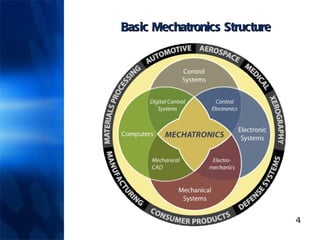
Basic Mechatronics Structure
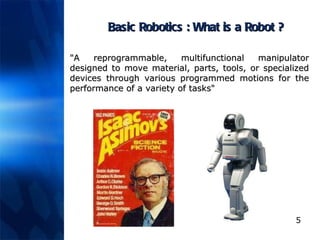
Basic Robotics : What is a Robot ? "A reprogrammable, multifunctional manipulator designed to move material, parts, tools, or specialized devices through various programmed motions for the performance of a variety of tasks"
Basic Robotics : Laws of Robotics A robot may not injure a human being or, through inaction, allow a human being to come to harm.  A robot must obey orders given to it by human beings, except where such orders would conflict with the First Law.  A robot must protect its own existence as long as such protection does not conflict with the First or Second Law.  0. A robot may not harm humanity, or, by inaction, allow humanity to come to harm
Basic Robotics : Terminology android \An "droid\ ([a^]n"droid),  A machine or automaton in the form of a human being. Possessing human features. n. An automaton that is created from biological materials and resembles a human being. Also called humanoid. Au-ton-o-mous  adj.  Not controlled by others or by outside forces; independent: an autonomous judiciary; an autonomous division of a corporate conglomerate.  Independent in mind or judgment; self-directed.
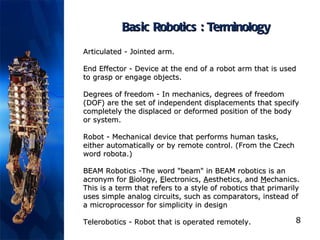
Basic Robotics : Terminology Articulated  - Jointed arm.  End Effector  - Device at the end of a robot arm that is used to grasp or engage objects.  Degrees of freedom  -  In mechanics, degrees of freedom (DOF) are the set of independent displacements that specify completely the displaced or deformed position of the body or system.   Robot  - Mechanical device that performs human tasks, either automatically or by remote control. (From the Czech word robota.)  BEAM Robotics  -The word "beam" in BEAM robotics is an acronym for  B iology,  E lectronics,  A esthetics, and  M echanics. This is a term that refers to a style of robotics that primarily uses simple analog circuits, such as comparators, instead of a microprocessor for simplicity in design Telerobotics  - Robot that is operated remotely.
BASIC  ELECTRONICS
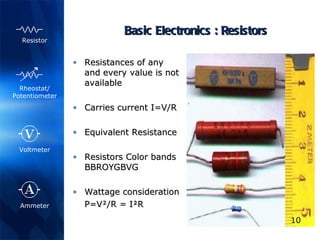
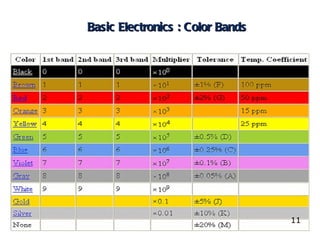
Basic Electronics : Resistors Resistances of any and every value is not available Carries current I=V/R Equivalent Resistance  Resistors Color bands BBROYGBVG Wattage consideration P=V/R = IR Resistor Rheostat/ Potentiometer Voltmeter Ammeter
Basic Electronics : Color Bands
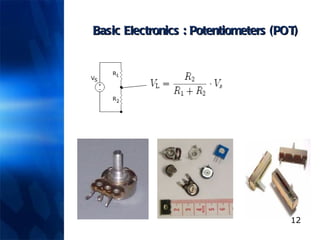
Basic Electronics : Potentiometers (POT)
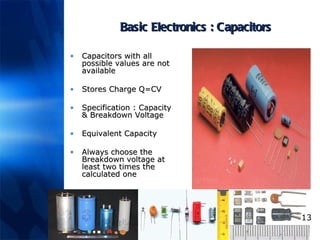
Basic Electronics : Capacitors Capacitors with all possible values are not available  Stores Charge Q=CV Specification : Capacity & Breakdown Voltage Equivalent Capacity Always choose the Breakdown voltage at least two times the calculated one
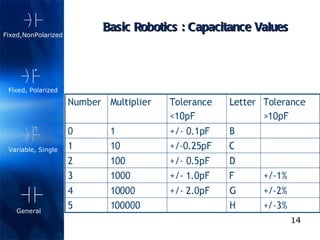
Basic Robotics : Capacitance Values Fixed, Polarized   Variable, Single  Fixed,NonPolarized General
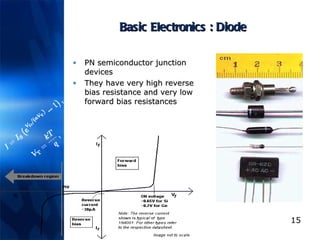
Basic Electronics : Diode PN semiconductor junction devices They have very high reverse bias resistance and very low forward bias resistances
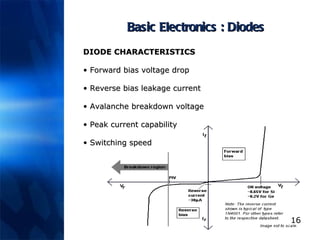
Basic Electronics : Diodes DIODE CHARACTERISTICS Forward bias voltage drop  Reverse bias leakage current  Avalanche breakdown voltage  Peak current capability  Switching speed
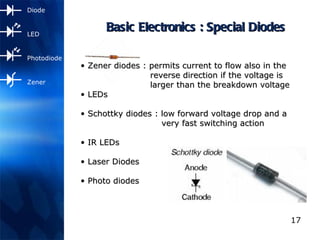
Basic Electronics : Special Diodes Zener diodes :  permits current to flow also in the    reverse direction if the voltage is    larger than the breakdown voltage LEDs Schottky diodes :  low forward voltage drop and a    very fast switching action IR LEDs Laser Diodes Photo diodes Diode   LED   Photodiode   Zener
Basic Electronics : Terminology Rectifier Freewheeling diodes Charger design Voltage regulation and reference Photo transmitter Photo sensor
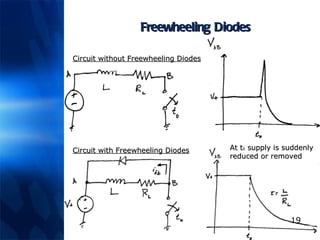
Freewheeling Diodes Circuit without Freewheeling Diodes Circuit with Freewheeling Diodes At t 0  supply is suddenly reduced or removed
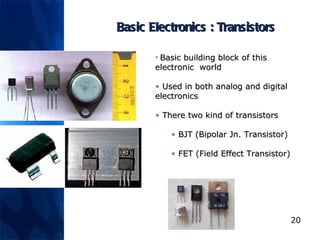
Basic Electronics : Transistors Basic building block of this  electronic  world Used in both analog and digital electronics There two kind of transistors BJT (Bipolar Jn. Transistor) FET (Field Effect Transistor)
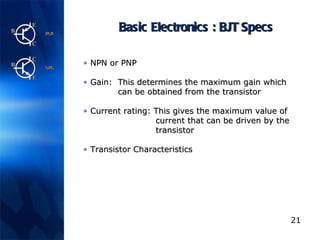
Basic Electronics : BJT Specs NPN or PNP Gain:  This determines the maximum gain which   can be obtained from the transistor Current rating:  This gives the maximum value of    current that can be driven by the    transistor Transistor Characteristics
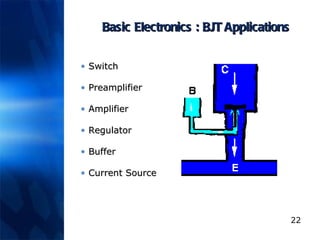
Basic Electronics : BJT Applications Switch Preamplifier Amplifier Regulator Buffer Current Source
Basic Electronics : BJT Thumb Rules Don’t expect the gain to equal to the claimed value  Always take the gain as 75 to 80% of the claimed value  Select a transistor which has current rating double your current requirement
Basic Electronics : MOSFET  (Metal Oxide Semiconductor Field Effect Transistor) These are voltage controlled devices Very high input impedance (Order of tens of MegaOhms) Analogous to BJT but with some modification
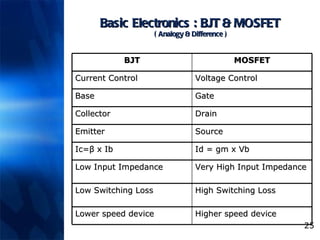
Basic Electronics : BJT & MOSFET  ( Analogy & Difference ) BJT MOSFET Current Control Voltage Control Base Gate Collector Drain Emitter Source Ic= β  x Ib Id = gm x Vb Low Input Impedance Very High Input Impedance Low Switching Loss High Switching Loss Lower  speed device Higher  speed device
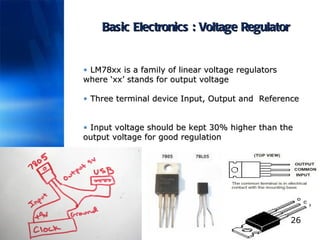
Basic Electronics : Voltage Regulator LM78xx is a family of linear voltage regulators where ‘xx’ stands for output voltage Three terminal device Input, Output and  Reference  Input voltage should be kept 30% higher than the output voltage for good regulation
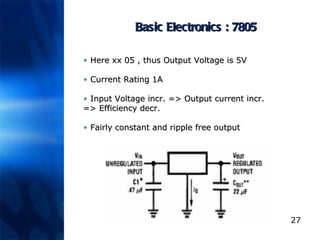
Basic Electronics : 7805 Here xx 05 , thus Output Voltage is 5V Current Rating 1A Input Voltage incr. => Output current incr.  => Efficiency decr. Fairly constant and ripple free output
INPUT  DEVICES
INPUT DEVICES Transducers  :  A transducer is a device, usually   electrical, electronic, or electro-  mechanical, that converts one type   of energy to another for various   purposes including measurement   or information transfer  Sensors  :  A sensor is a type of transducer which    uses one type of energy, a signal of    some sort, and converts it into a    reading for the purpose of information    transfer.
Input Devices : Sensor Classification Based on Conversion Principle Based on Physical Quantity Based on Material Used Types of Output Active & Passive Current Source
Input Devices : Popular Sensors Potentiometer LDR Photodiode Phototransistor IR, UV Sensors Temperature Sensors Proximity Sensors
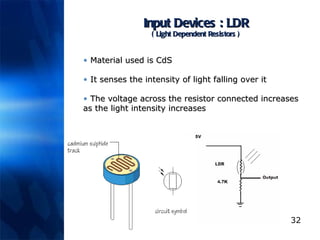
Input Devices : LDR ( Light Dependent Resistors ) Material used is CdS It senses the intensity of light falling over it The voltage across the resistor connected increases as the light intensity increases
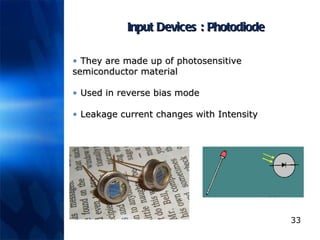
Input Devices : Photodiode They are made up of photosensitive semiconductor material Used in reverse bias mode Leakage current changes with Intensity
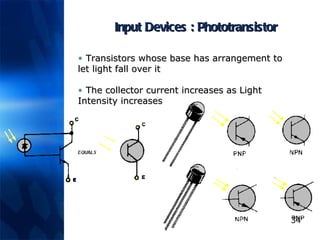
Input Devices : Phototransistor Transistors whose base has arrangement to let light fall over it The collector current increases as Light Intensity increases
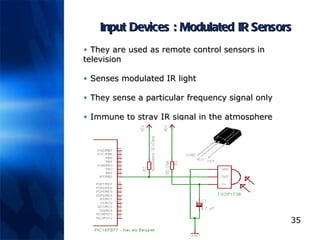
Input Devices : Modulated IR Sensors They are used as remote control sensors in television Senses modulated IR light They sense a particular frequency signal only Immune to stray IR signal in the atmosphere
OUTPUT  DEVICES
Output Devices Actuators :  An actuator is a mechanical device     for moving or controlling a mechanism    or system.  Motor :  An electric motor uses electrical energy to    produce mechanical energy. The reverse    process, that of using mechanical energy to    produce electrical energy, is accomplished by    a generator or dynamo.  Relays :  A relay is an electrical switch that opens    and closes under the control of another      electrical circuit. In the original form, the    switch is operated by an electromagnet to    open or close one or many sets of contacts.
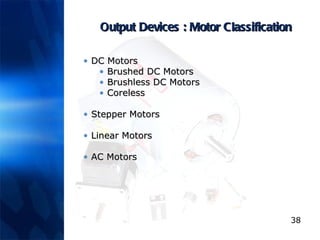
Output Devices : Motor Classification DC Motors Brushed DC Motors Brushless DC Motors Coreless Stepper Motors Linear Motors AC Motors
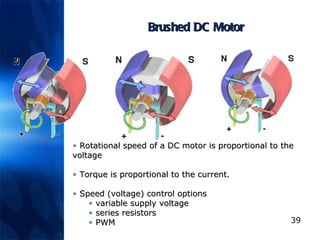
Brushed DC Motor Rotational speed of a DC motor is proportional to the voltage   Torque is proportional to the current.   Speed (voltage) control options variable supply voltage series resistors  PWM
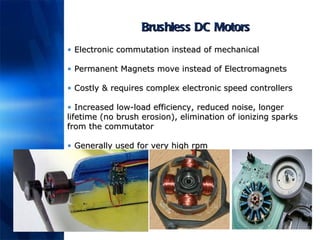
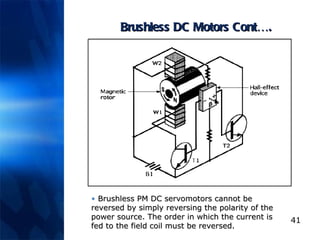
Brushless DC Motors Electronic commutation instead of mechanical Permanent Magnets move instead of Electromagnets Costly & requires complex electronic speed controllers Increased low-load efficiency,  reduced noise, longer lifetime (no brush erosion), elimination of ionizing sparks from the commutator   Generally used for very high rpm
Brushless DC Motors Cont…. Brushless PM DC servomotors cannot be reversed by simply reversing the polarity of the power source. The order in which the current is fed to the field coil must be reversed.
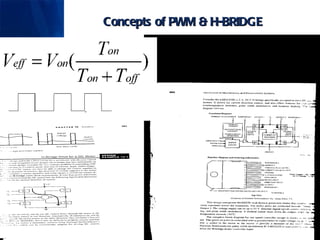
Concepts of PWM & H-BRIDGE
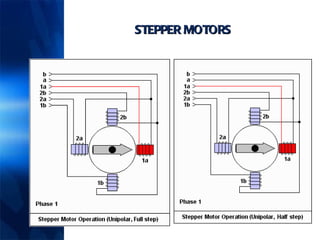
STEPPER MOTORS
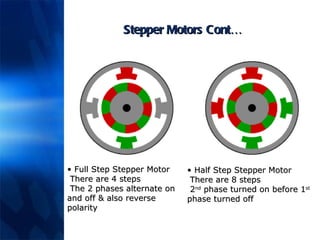
Stepper Motors Cont… Full Step Stepper Motor  There are 4 steps  The 2 phases alternate on and off & also reverse polarity Half Step Stepper Motor  There are 8 steps  2 nd  phase turned on before 1 st  phase turned off
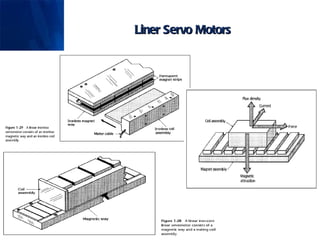
Liner Servo Motors
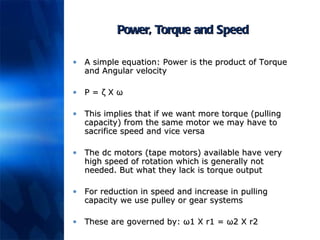
Power, Torque and Speed A simple equation: Power is the product of Torque and Angular velocity P =  ζ X ω This implies that if we want more torque (pulling capacity) from the same motor we may have to sacrifice speed and vice versa The dc motors (tape motors) available have very high speed of rotation which is generally not needed. But what they lack is torque output For reduction in speed and increase in pulling capacity we use pulley or gear systems These are governed by:  ω1 X r1 = ω2 X r2
Wheeled Locomotion Systems Differential drive Car type drive Skid steer drive Articulated drive Synchronous drive Pivot drive Dual differential drive
Differential Drive This is the most commonly used form of locomotion system used in mobile robots as it’s the simplest and easiest to implement It has a free moving wheel in the front accompanied with a left and right wheel.The two wheels are separately powered When the wheels move in the same direction the machine moves in that direction. Turning is achieved by making the wheels oppose each other’s motion, thus generating a couple
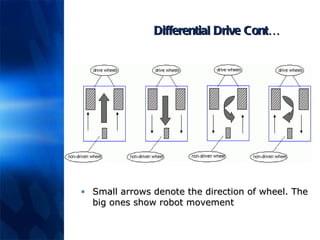
Differential Drive Cont… Small arrows denote the direction of wheel. The big ones show robot movement
Differential Drive Cont… In-place (zero turning radius) rotation is done by turning the drive wheels at the same rate in the opposite direction Arbitrary motion paths can be implemented by dynamically modifying the angular velocity and/or direction of the drive wheels Total of two motors are required, both of them are responsible for translation and rotational motion
Differential Drive Analysis Simplicity and ease of use makes it the most preferred system by beginners Independent drives makes it difficult for straight line motion. The differences in motors and frictional profile of the two wheels cause them to move with slight turning effect The above drawback must be countered with appropriate feedback system. Suitable for human controlled remote robots
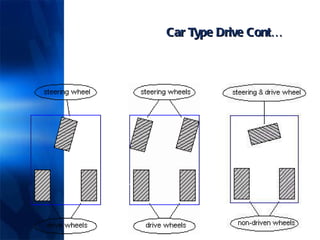
Car Type Drive This is the car type drive and the most common in real world but not in robot world It is characterized by a pair of driving wheels and a separate pair of steering wheels The translation and rotation are independent of each other. But translation and rotation are interlinked hence this system faces severe path planning problem
Car Type Drive Cont…
Disadvantages Of Car Type Drive The turning mechanism must be accurately controlled. A slight inaccuracy may cause large odometry errors The system is Non – Holonomic hence path planning is extremely difficult as well as inaccurate There are no direct directional actuators
Holonomic Systems A Non-Holonomic system is one in which the actuators do not directly control one or more of the degrees-of-freedom of the system, but instead are coupled such that orientation becomes much more complicated than in a Holonomic system Any robot architecture that allows for direct and, possibly simultaneous, motion along the x and y axes would be Holonomic
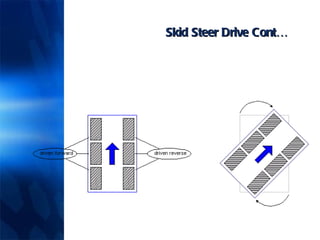
Skid Steer Drive A close relative of the differential drive system It is mostly used in tracked machines e.g. tanks. Also finds application in some four / six wheeled robots The left and right wheels are driven independently Steering is accomplished by actuating each side at a different rate or in a different direction, causing the wheels or tracks to slip, or skid, on the ground
Skid Steer Drive Cont…
Differences With Differential Drive Multiple drive wheels on each side give increased traction. The effect is even greater for tracked machines Skidding causes the wheels to loose contact with the surface beneath and position tracking becomes difficult Rest of it’s properties are more or less like the differential drive system
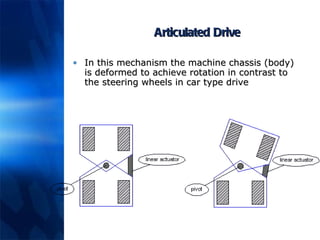
Articulated Drive In this mechanism the machine chassis (body) is deformed to achieve rotation in contrast to the steering wheels in car type drive
Articulated Drive Cont… Two actuators (motors) are needed. One to drive the wheels and the other to change the pivot angle This system shares most of it’s features with the car type mechanism This is too an example of Non – Holonomic System
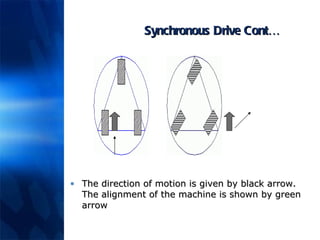
Synchronous Drive As the name suggests, it uses synchronous rotation of its wheels to achieve motion & turns It is made up of a system of motors. One set of which drive the wheels and the other set turns the wheels in a synchronous fashion The two sets can be directly mechanically coupled as they always move in the same direction with same speed
Synchronous Drive Cont… The direction of motion is given by black arrow. The alignment of the machine is shown by green arrow
Advantages of Synchronous   Drive The use of separate motors for translation and wheel turning guarantees straight line motion without the need for dynamic feedback control This system is somewhat complex in designing but further use is much simpler
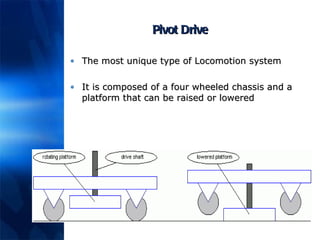
Pivot Drive The most unique type of Locomotion system It is composed of a four wheeled chassis and a platform that can be raised or lowered
Pivot Drive Cont… The wheels are driven by a motor for translation motion in a straight line For rotation one motor is needed to lower/raise the platform & another to rotate the chassis around the platform This system can guarantee perfect straight line motion as well as accurate in – place turns to a desired heading
Complexity of Pivot Drive The system is quite complex in design A still more complex design uses only two motors. The wheels and the platform rotation are coupled to a single motor. When in translation the platform has no effect as it is above ground. And when turning, the wheels are off the ground due to the lowered platform The machine is restricted to only in – place turns. This may be an hindrance in some cases
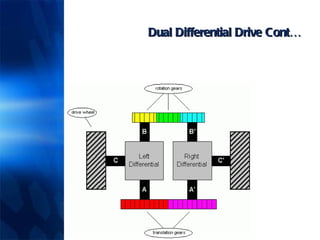
Dual Differential Drive It offers the flexibility of the differential drive along with a fairly better accuracy in movement The design is achieved using a unique arrangement of gears It guarantees straight line translation along with spot turning
Dual Differential Drive Cont…

Basic robotics workshop

  • 1.
    BASIC ROBOTICS WORKSHOPPART I. An Introduction to Robotics Pratik Dhaboo Email: pratik@awishcar.com; F,T: @pratik2222 Founder, Awishcar.com
  • 2.
    Contents Basic RoboticsBasic Electronics Input Devices Sensors & Transducers Data Acquisition Output Devices Actuators Drives Microcontrollers The iBOT Circuit
  • 3.
  • 4.
  • 5.
    Basic Robotics :What is a Robot ? "A reprogrammable, multifunctional manipulator designed to move material, parts, tools, or specialized devices through various programmed motions for the performance of a variety of tasks"
  • 6.
    Basic Robotics :Laws of Robotics A robot may not injure a human being or, through inaction, allow a human being to come to harm. A robot must obey orders given to it by human beings, except where such orders would conflict with the First Law. A robot must protect its own existence as long as such protection does not conflict with the First or Second Law. 0. A robot may not harm humanity, or, by inaction, allow humanity to come to harm
  • 7.
    Basic Robotics :Terminology android \An "droid\ ([a^]n"droid), A machine or automaton in the form of a human being. Possessing human features. n. An automaton that is created from biological materials and resembles a human being. Also called humanoid. Au-ton-o-mous adj. Not controlled by others or by outside forces; independent: an autonomous judiciary; an autonomous division of a corporate conglomerate. Independent in mind or judgment; self-directed.
  • 8.
    Basic Robotics :Terminology Articulated - Jointed arm. End Effector - Device at the end of a robot arm that is used to grasp or engage objects. Degrees of freedom - In mechanics, degrees of freedom (DOF) are the set of independent displacements that specify completely the displaced or deformed position of the body or system. Robot - Mechanical device that performs human tasks, either automatically or by remote control. (From the Czech word robota.) BEAM Robotics -The word "beam" in BEAM robotics is an acronym for B iology, E lectronics, A esthetics, and M echanics. This is a term that refers to a style of robotics that primarily uses simple analog circuits, such as comparators, instead of a microprocessor for simplicity in design Telerobotics - Robot that is operated remotely.
  • 9.
  • 10.
    Basic Electronics :Resistors Resistances of any and every value is not available Carries current I=V/R Equivalent Resistance Resistors Color bands BBROYGBVG Wattage consideration P=V/R = IR Resistor Rheostat/ Potentiometer Voltmeter Ammeter
  • 11.
  • 12.
    Basic Electronics :Potentiometers (POT)
  • 13.
    Basic Electronics :Capacitors Capacitors with all possible values are not available Stores Charge Q=CV Specification : Capacity & Breakdown Voltage Equivalent Capacity Always choose the Breakdown voltage at least two times the calculated one
  • 14.
    Basic Robotics :Capacitance Values Fixed, Polarized Variable, Single Fixed,NonPolarized General
  • 15.
    Basic Electronics :Diode PN semiconductor junction devices They have very high reverse bias resistance and very low forward bias resistances
  • 16.
    Basic Electronics :Diodes DIODE CHARACTERISTICS Forward bias voltage drop Reverse bias leakage current Avalanche breakdown voltage Peak current capability Switching speed
  • 17.
    Basic Electronics :Special Diodes Zener diodes : permits current to flow also in the reverse direction if the voltage is larger than the breakdown voltage LEDs Schottky diodes : low forward voltage drop and a very fast switching action IR LEDs Laser Diodes Photo diodes Diode LED Photodiode Zener
  • 18.
    Basic Electronics :Terminology Rectifier Freewheeling diodes Charger design Voltage regulation and reference Photo transmitter Photo sensor
  • 19.
    Freewheeling Diodes Circuitwithout Freewheeling Diodes Circuit with Freewheeling Diodes At t 0 supply is suddenly reduced or removed
  • 20.
    Basic Electronics :Transistors Basic building block of this electronic world Used in both analog and digital electronics There two kind of transistors BJT (Bipolar Jn. Transistor) FET (Field Effect Transistor)
  • 21.
    Basic Electronics :BJT Specs NPN or PNP Gain: This determines the maximum gain which can be obtained from the transistor Current rating: This gives the maximum value of current that can be driven by the transistor Transistor Characteristics
  • 22.
    Basic Electronics :BJT Applications Switch Preamplifier Amplifier Regulator Buffer Current Source
  • 23.
    Basic Electronics :BJT Thumb Rules Don’t expect the gain to equal to the claimed value Always take the gain as 75 to 80% of the claimed value Select a transistor which has current rating double your current requirement
  • 24.
    Basic Electronics :MOSFET (Metal Oxide Semiconductor Field Effect Transistor) These are voltage controlled devices Very high input impedance (Order of tens of MegaOhms) Analogous to BJT but with some modification
  • 25.
    Basic Electronics :BJT & MOSFET ( Analogy & Difference ) BJT MOSFET Current Control Voltage Control Base Gate Collector Drain Emitter Source Ic= β x Ib Id = gm x Vb Low Input Impedance Very High Input Impedance Low Switching Loss High Switching Loss Lower speed device Higher speed device
  • 26.
    Basic Electronics :Voltage Regulator LM78xx is a family of linear voltage regulators where ‘xx’ stands for output voltage Three terminal device Input, Output and Reference Input voltage should be kept 30% higher than the output voltage for good regulation
  • 27.
    Basic Electronics :7805 Here xx 05 , thus Output Voltage is 5V Current Rating 1A Input Voltage incr. => Output current incr. => Efficiency decr. Fairly constant and ripple free output
  • 28.
  • 29.
    INPUT DEVICES Transducers : A transducer is a device, usually electrical, electronic, or electro- mechanical, that converts one type of energy to another for various purposes including measurement or information transfer Sensors : A sensor is a type of transducer which uses one type of energy, a signal of some sort, and converts it into a reading for the purpose of information transfer.
  • 30.
    Input Devices :Sensor Classification Based on Conversion Principle Based on Physical Quantity Based on Material Used Types of Output Active & Passive Current Source
  • 31.
    Input Devices :Popular Sensors Potentiometer LDR Photodiode Phototransistor IR, UV Sensors Temperature Sensors Proximity Sensors
  • 32.
    Input Devices :LDR ( Light Dependent Resistors ) Material used is CdS It senses the intensity of light falling over it The voltage across the resistor connected increases as the light intensity increases
  • 33.
    Input Devices :Photodiode They are made up of photosensitive semiconductor material Used in reverse bias mode Leakage current changes with Intensity
  • 34.
    Input Devices :Phototransistor Transistors whose base has arrangement to let light fall over it The collector current increases as Light Intensity increases
  • 35.
    Input Devices :Modulated IR Sensors They are used as remote control sensors in television Senses modulated IR light They sense a particular frequency signal only Immune to stray IR signal in the atmosphere
  • 36.
  • 37.
    Output Devices Actuators: An actuator is a mechanical device for moving or controlling a mechanism or system. Motor : An electric motor uses electrical energy to produce mechanical energy. The reverse process, that of using mechanical energy to produce electrical energy, is accomplished by a generator or dynamo. Relays : A relay is an electrical switch that opens and closes under the control of another electrical circuit. In the original form, the switch is operated by an electromagnet to open or close one or many sets of contacts.
  • 38.
    Output Devices :Motor Classification DC Motors Brushed DC Motors Brushless DC Motors Coreless Stepper Motors Linear Motors AC Motors
  • 39.
    Brushed DC MotorRotational speed of a DC motor is proportional to the voltage Torque is proportional to the current. Speed (voltage) control options variable supply voltage series resistors PWM
  • 40.
    Brushless DC MotorsElectronic commutation instead of mechanical Permanent Magnets move instead of Electromagnets Costly & requires complex electronic speed controllers Increased low-load efficiency, reduced noise, longer lifetime (no brush erosion), elimination of ionizing sparks from the commutator Generally used for very high rpm
  • 41.
    Brushless DC MotorsCont…. Brushless PM DC servomotors cannot be reversed by simply reversing the polarity of the power source. The order in which the current is fed to the field coil must be reversed.
  • 42.
    Concepts of PWM& H-BRIDGE
  • 43.
  • 44.
    Stepper Motors Cont…Full Step Stepper Motor There are 4 steps The 2 phases alternate on and off & also reverse polarity Half Step Stepper Motor There are 8 steps 2 nd phase turned on before 1 st phase turned off
  • 45.
  • 46.
    Power, Torque andSpeed A simple equation: Power is the product of Torque and Angular velocity P = ζ X ω This implies that if we want more torque (pulling capacity) from the same motor we may have to sacrifice speed and vice versa The dc motors (tape motors) available have very high speed of rotation which is generally not needed. But what they lack is torque output For reduction in speed and increase in pulling capacity we use pulley or gear systems These are governed by: ω1 X r1 = ω2 X r2
  • 47.
    Wheeled Locomotion SystemsDifferential drive Car type drive Skid steer drive Articulated drive Synchronous drive Pivot drive Dual differential drive
  • 48.
    Differential Drive Thisis the most commonly used form of locomotion system used in mobile robots as it’s the simplest and easiest to implement It has a free moving wheel in the front accompanied with a left and right wheel.The two wheels are separately powered When the wheels move in the same direction the machine moves in that direction. Turning is achieved by making the wheels oppose each other’s motion, thus generating a couple
  • 49.
    Differential Drive Cont…Small arrows denote the direction of wheel. The big ones show robot movement
  • 50.
    Differential Drive Cont…In-place (zero turning radius) rotation is done by turning the drive wheels at the same rate in the opposite direction Arbitrary motion paths can be implemented by dynamically modifying the angular velocity and/or direction of the drive wheels Total of two motors are required, both of them are responsible for translation and rotational motion
  • 51.
    Differential Drive AnalysisSimplicity and ease of use makes it the most preferred system by beginners Independent drives makes it difficult for straight line motion. The differences in motors and frictional profile of the two wheels cause them to move with slight turning effect The above drawback must be countered with appropriate feedback system. Suitable for human controlled remote robots
  • 52.
    Car Type DriveThis is the car type drive and the most common in real world but not in robot world It is characterized by a pair of driving wheels and a separate pair of steering wheels The translation and rotation are independent of each other. But translation and rotation are interlinked hence this system faces severe path planning problem
  • 53.
  • 54.
    Disadvantages Of CarType Drive The turning mechanism must be accurately controlled. A slight inaccuracy may cause large odometry errors The system is Non – Holonomic hence path planning is extremely difficult as well as inaccurate There are no direct directional actuators
  • 55.
    Holonomic Systems ANon-Holonomic system is one in which the actuators do not directly control one or more of the degrees-of-freedom of the system, but instead are coupled such that orientation becomes much more complicated than in a Holonomic system Any robot architecture that allows for direct and, possibly simultaneous, motion along the x and y axes would be Holonomic
  • 56.
    Skid Steer DriveA close relative of the differential drive system It is mostly used in tracked machines e.g. tanks. Also finds application in some four / six wheeled robots The left and right wheels are driven independently Steering is accomplished by actuating each side at a different rate or in a different direction, causing the wheels or tracks to slip, or skid, on the ground
  • 57.
  • 58.
    Differences With DifferentialDrive Multiple drive wheels on each side give increased traction. The effect is even greater for tracked machines Skidding causes the wheels to loose contact with the surface beneath and position tracking becomes difficult Rest of it’s properties are more or less like the differential drive system
  • 59.
    Articulated Drive Inthis mechanism the machine chassis (body) is deformed to achieve rotation in contrast to the steering wheels in car type drive
  • 60.
    Articulated Drive Cont…Two actuators (motors) are needed. One to drive the wheels and the other to change the pivot angle This system shares most of it’s features with the car type mechanism This is too an example of Non – Holonomic System
  • 61.
    Synchronous Drive Asthe name suggests, it uses synchronous rotation of its wheels to achieve motion & turns It is made up of a system of motors. One set of which drive the wheels and the other set turns the wheels in a synchronous fashion The two sets can be directly mechanically coupled as they always move in the same direction with same speed
  • 62.
    Synchronous Drive Cont…The direction of motion is given by black arrow. The alignment of the machine is shown by green arrow
  • 63.
    Advantages of Synchronous Drive The use of separate motors for translation and wheel turning guarantees straight line motion without the need for dynamic feedback control This system is somewhat complex in designing but further use is much simpler
  • 64.
    Pivot Drive Themost unique type of Locomotion system It is composed of a four wheeled chassis and a platform that can be raised or lowered
  • 65.
    Pivot Drive Cont…The wheels are driven by a motor for translation motion in a straight line For rotation one motor is needed to lower/raise the platform & another to rotate the chassis around the platform This system can guarantee perfect straight line motion as well as accurate in – place turns to a desired heading
  • 66.
    Complexity of PivotDrive The system is quite complex in design A still more complex design uses only two motors. The wheels and the platform rotation are coupled to a single motor. When in translation the platform has no effect as it is above ground. And when turning, the wheels are off the ground due to the lowered platform The machine is restricted to only in – place turns. This may be an hindrance in some cases
  • 67.
    Dual Differential DriveIt offers the flexibility of the differential drive along with a fairly better accuracy in movement The design is achieved using a unique arrangement of gears It guarantees straight line translation along with spot turning
  • 68.