PASSWORD BASED
DOOR LOCKING
SECURITY SYSTEM
PRESENTED BY:
Anuj Kumar Gupta (04270102811)
Prachi Sharma (04570102811)
Surabhi (07770102811)
Sahil Pandey (07970102811)
CONTENT
 OBJECTIVE
 INTRODUCTION
 COMPONENTS USED
 CIRCUIT DIAGRAM
 SOFTWARE DESCRIPTION
 ADVANTAGES
 DISADVANTAGES
 FINAL PROJECT
 FUTURE SCOPE
 CONCLUSION
 REFERENCES
OBJECTIVE
 Increase the security level to prevent an
unauthorized unlocking of the door.
 Give the flexibility to the user to change or reset the
password in case the user forgets that combination.
 Lock the door by using password.
 To give user more secure yet cost-efficient way of
door locking system.
INTRODUCTION
Since the main intension of this project is to design
a security Door locks system. In order to fulfill this
application there are few steps that has been
performed i.e.
 Designing the power supply for the entire circuitry.
 Selection of microcontroller that suits our
application.
 Selection Key pad.
 Selection of DC motor.
 Selection of buzzer according to the requirement.
Complete studies of all the above points are useful
to develop this project.
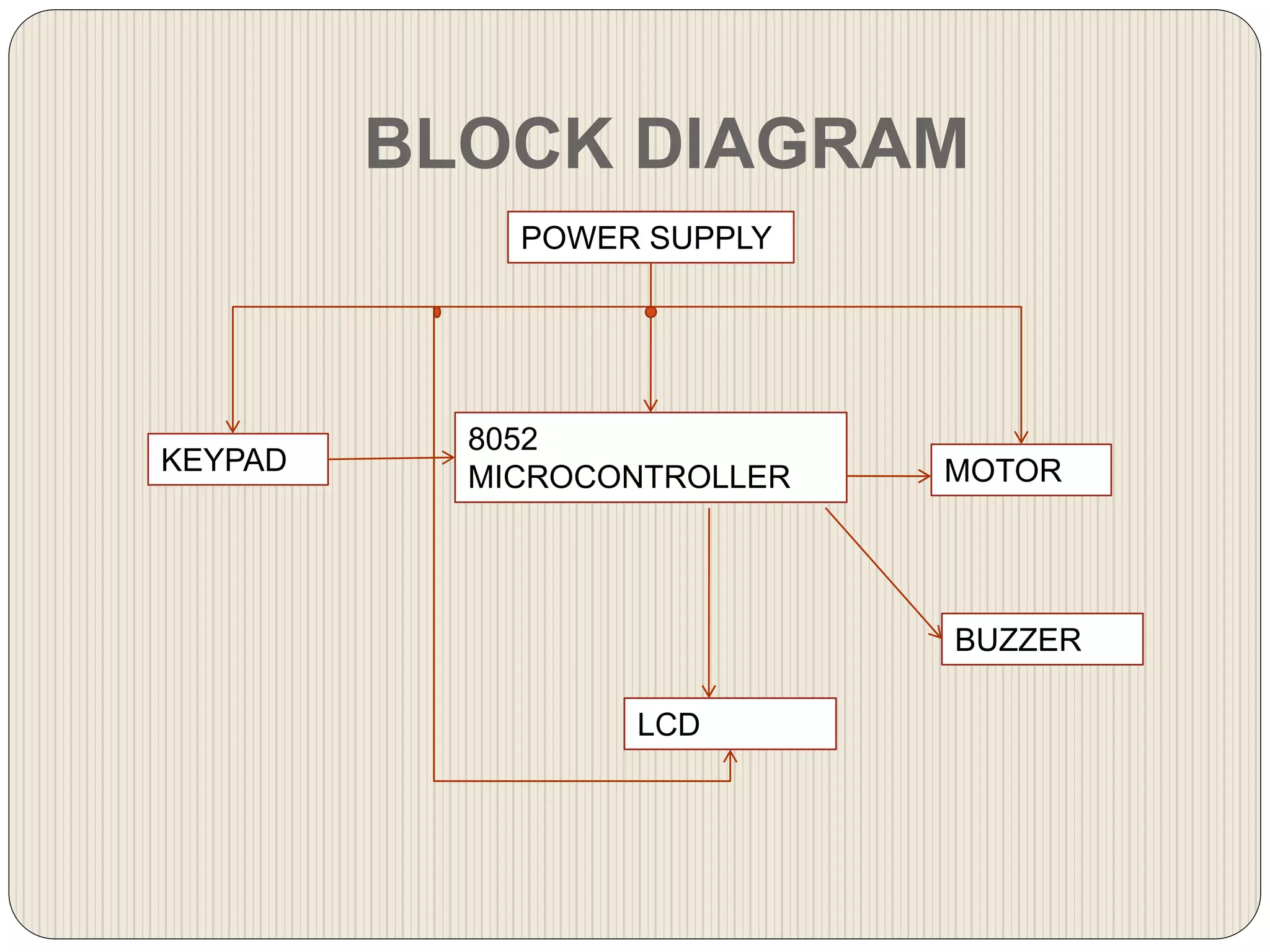
BLOCK DIAGRAM
8052
MICROCONTROLLER
LCD
BUZZER
POWER SUPPLY
KEYPAD MOTOR
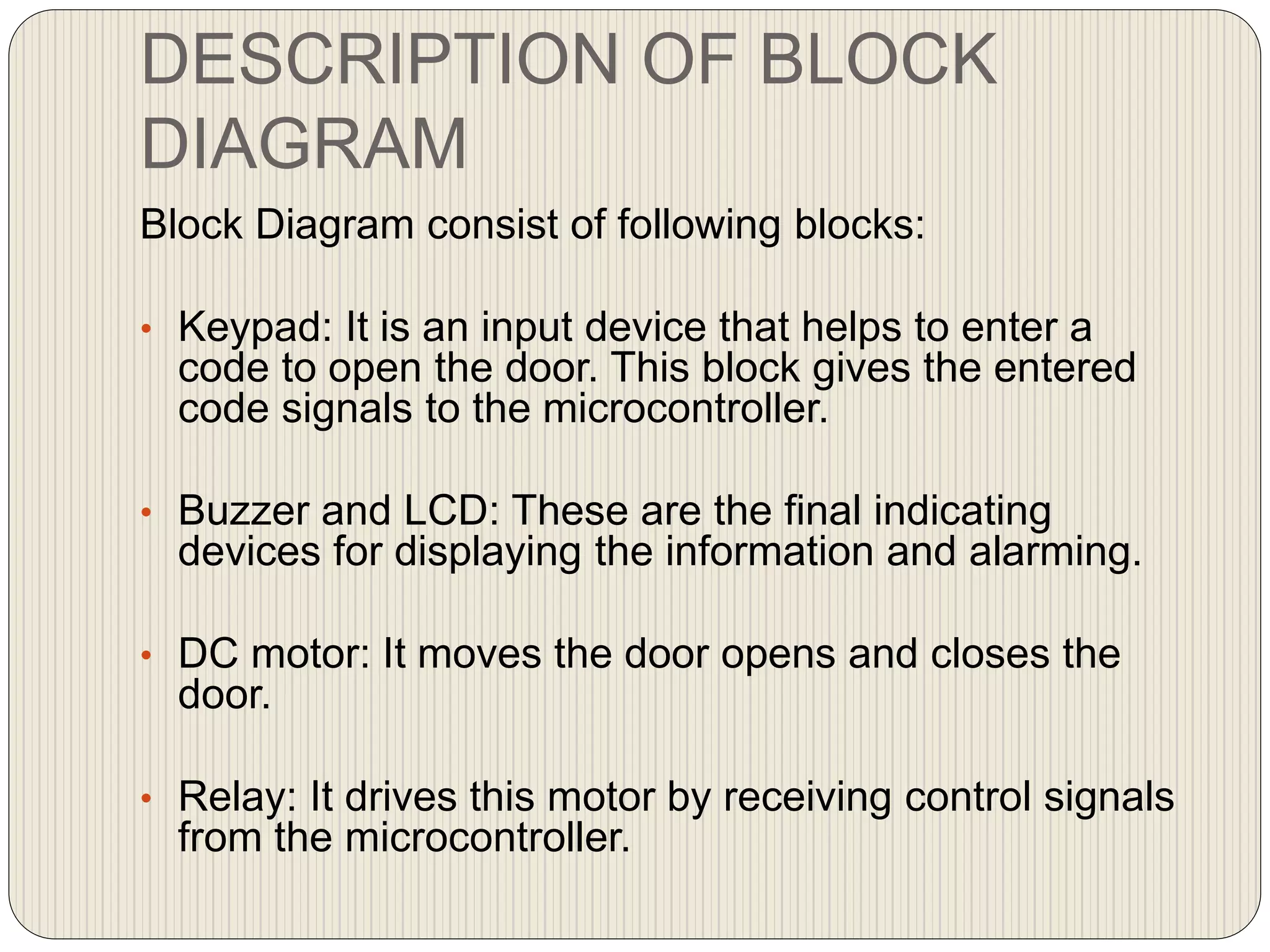
DESCRIPTION OF BLOCK
DIAGRAM
Block Diagram consist of following blocks:
• Keypad: It is an input device that helps to enter a
code to open the door. This block gives the entered
code signals to the microcontroller.
• Buzzer and LCD: These are the final indicating
devices for displaying the information and alarming.
• DC motor: It moves the door opens and closes the
door.
• Relay: It drives this motor by receiving control signals
from the microcontroller.
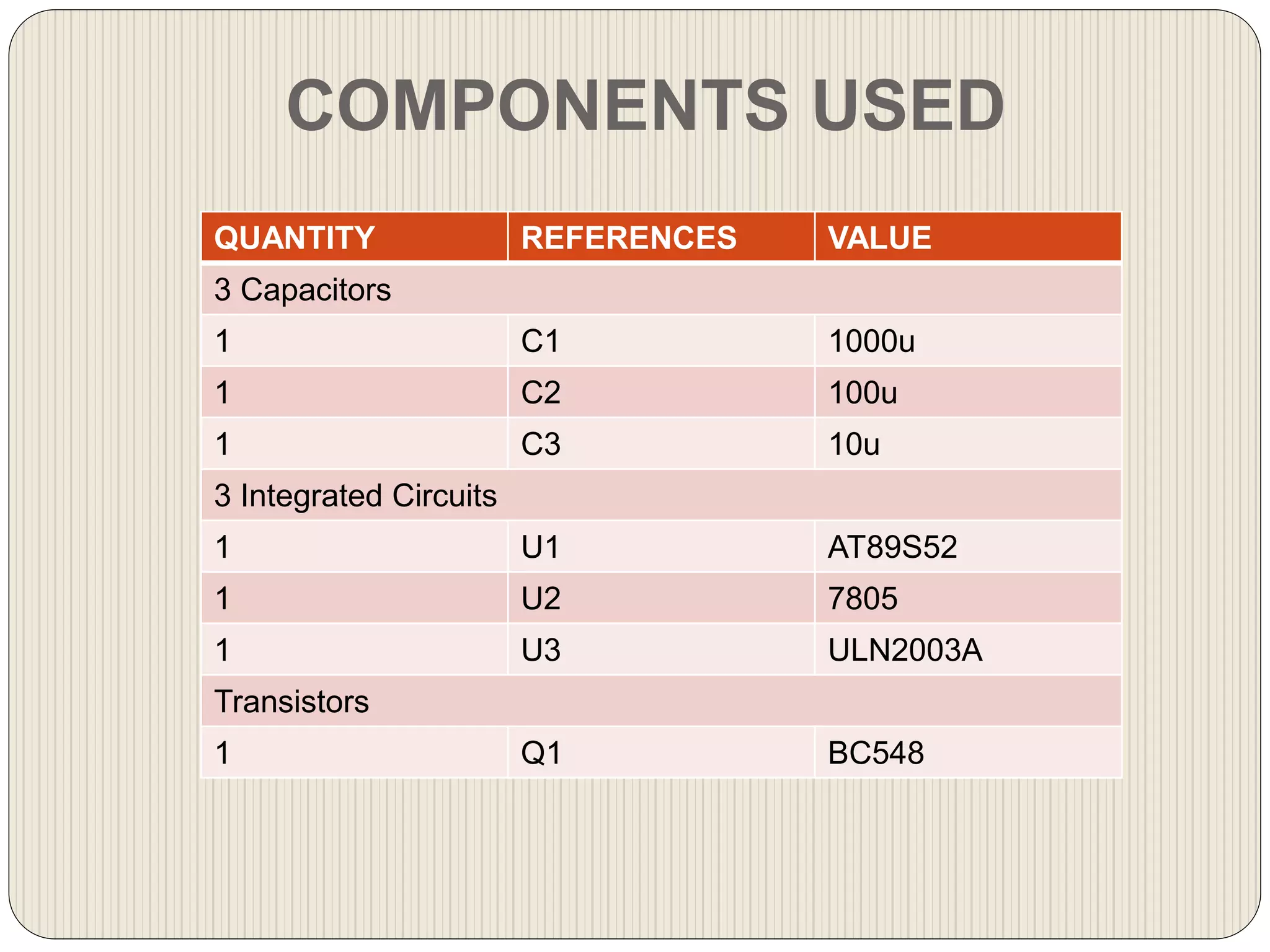
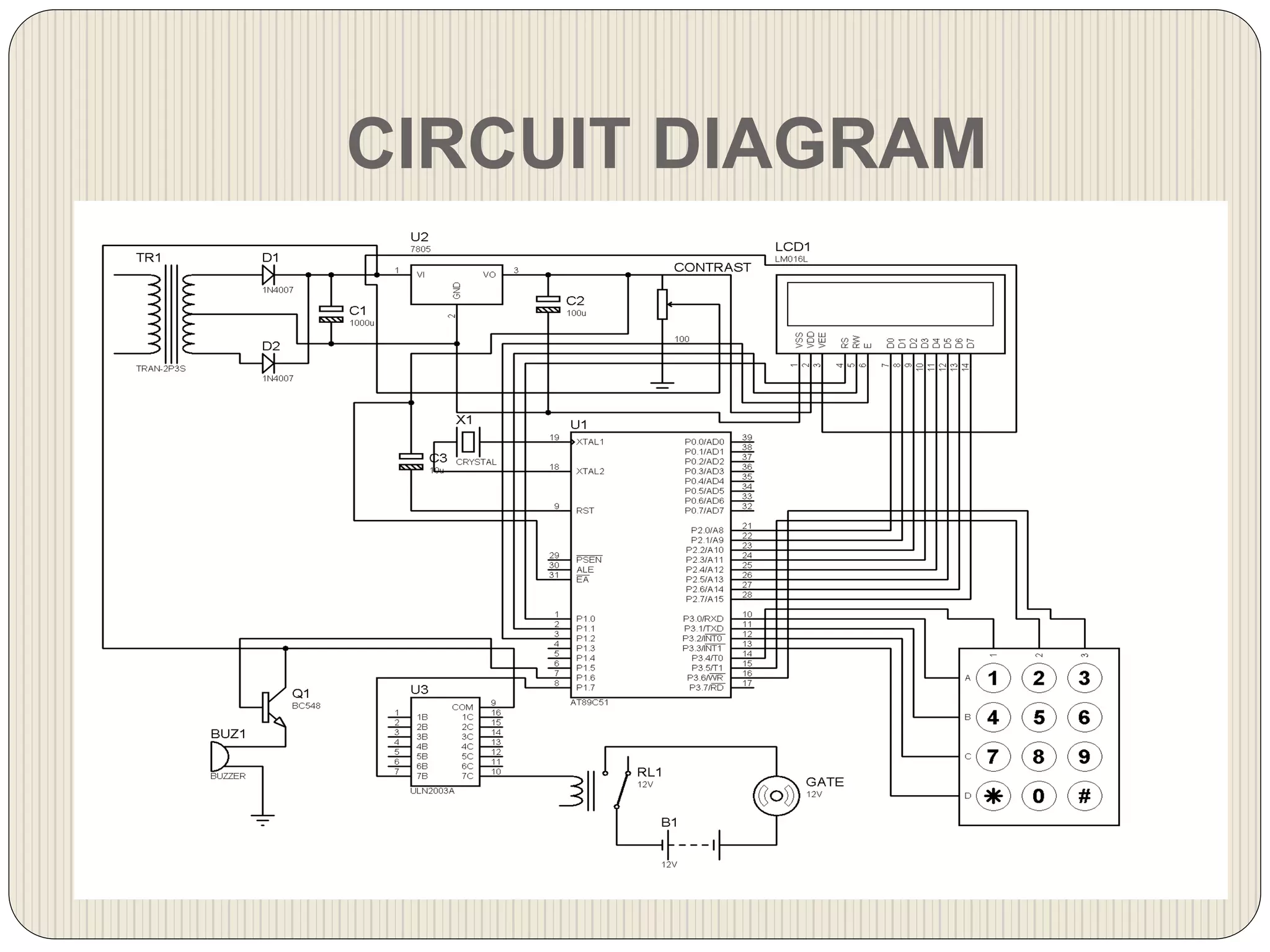
COMPONENTS USED
QUANTITY REFERENCES VALUE
3 Capacitors
1 C1 1000u
1 C2 100u
1 C3 10u
3 Integrated Circuits
1 U1 AT89S52
1 U2 7805
1 U3 ULN2003A
Transistors
1 Q1 BC548
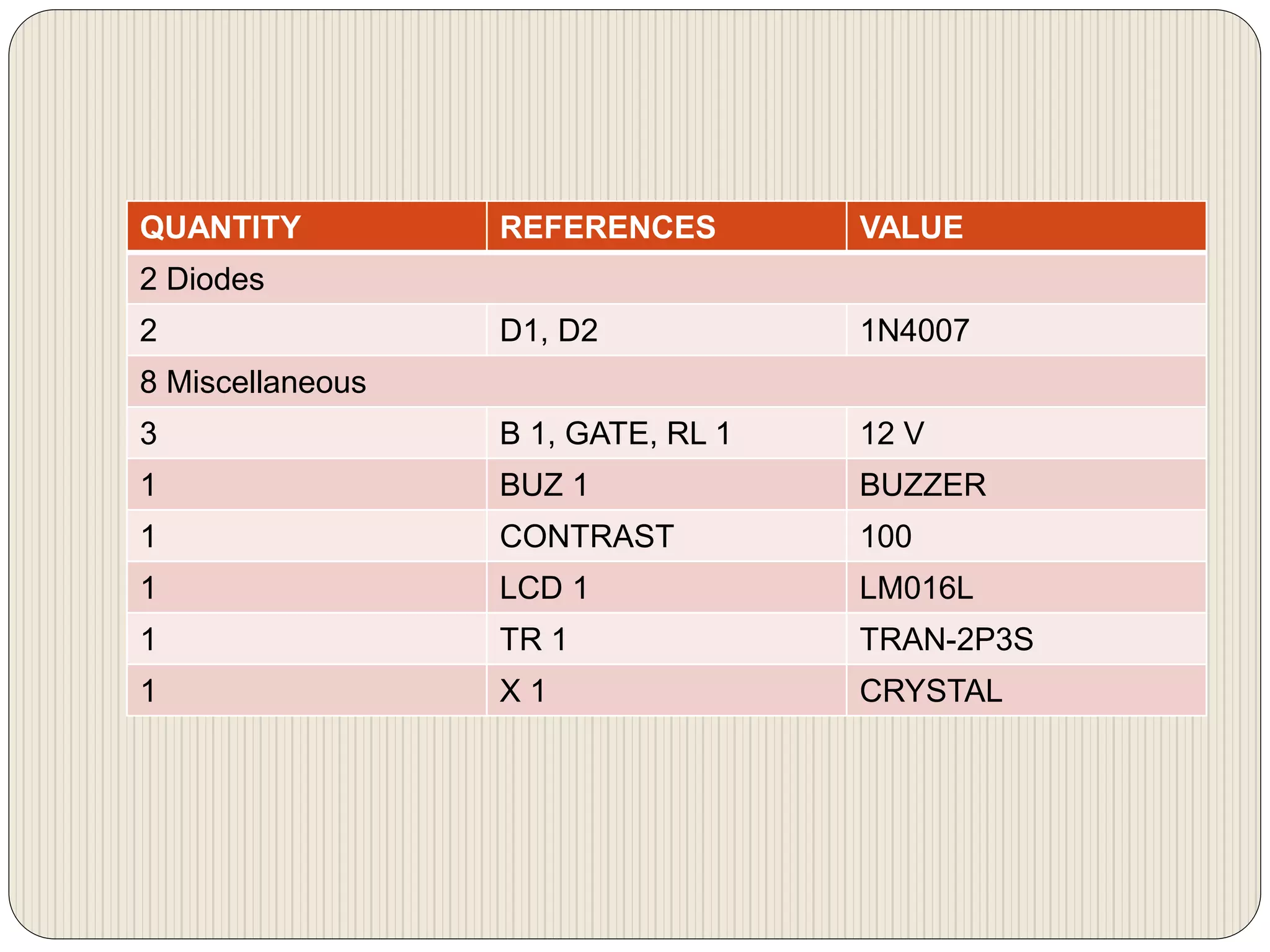
QUANTITY REFERENCES VALUE
2 Diodes
2 D1, D2 1N4007
8 Miscellaneous
3 B 1, GATE, RL 1 12 V
1 BUZ 1 BUZZER
1 CONTRAST 100
1 LCD 1 LM016L
1 TR 1 TRAN-2P3S
1 X 1 CRYSTAL
MAJOR
COMPONENT
S USED
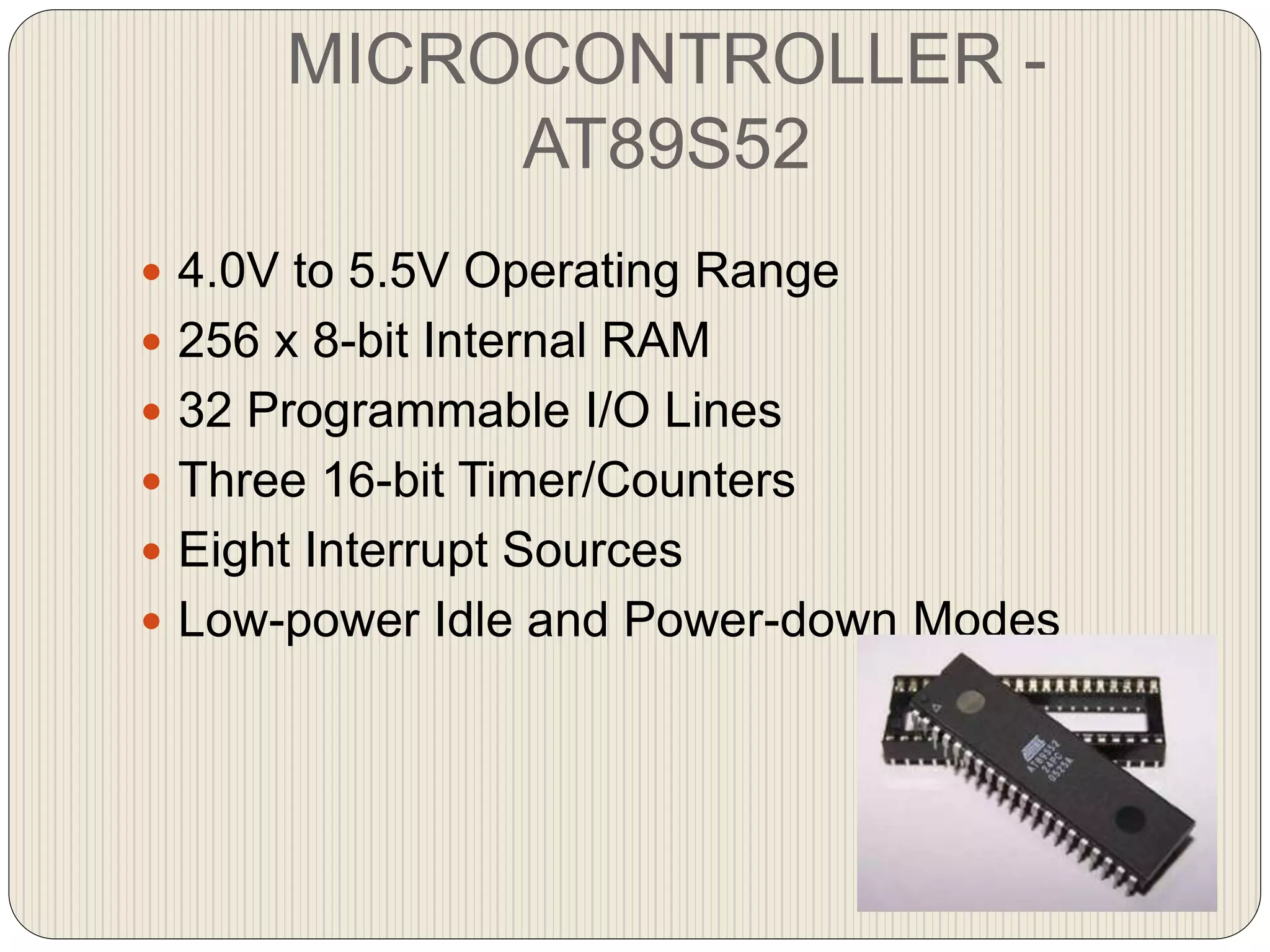
MICROCONTROLLER -
AT89S52
 4.0V to 5.5V Operating Range
 256 x 8-bit Internal RAM
 32 Programmable I/O Lines
 Three 16-bit Timer/Counters
 Eight Interrupt Sources
 Low-power Idle and Power-down Modes
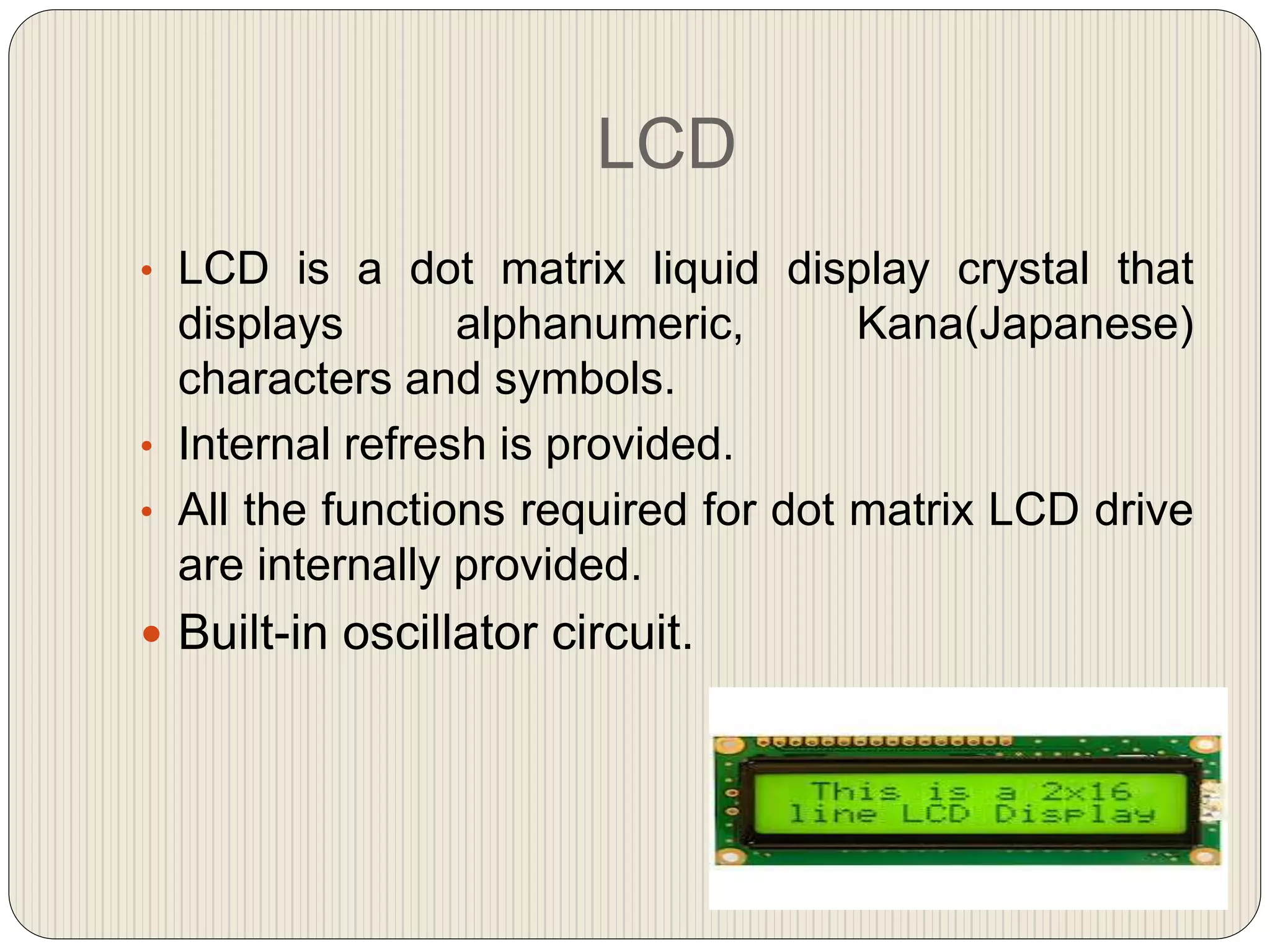
LCD
• LCD is a dot matrix liquid display crystal that
displays alphanumeric, Kana(Japanese)
characters and symbols.
• Internal refresh is provided.
• All the functions required for dot matrix LCD drive
are internally provided.
 Built-in oscillator circuit.
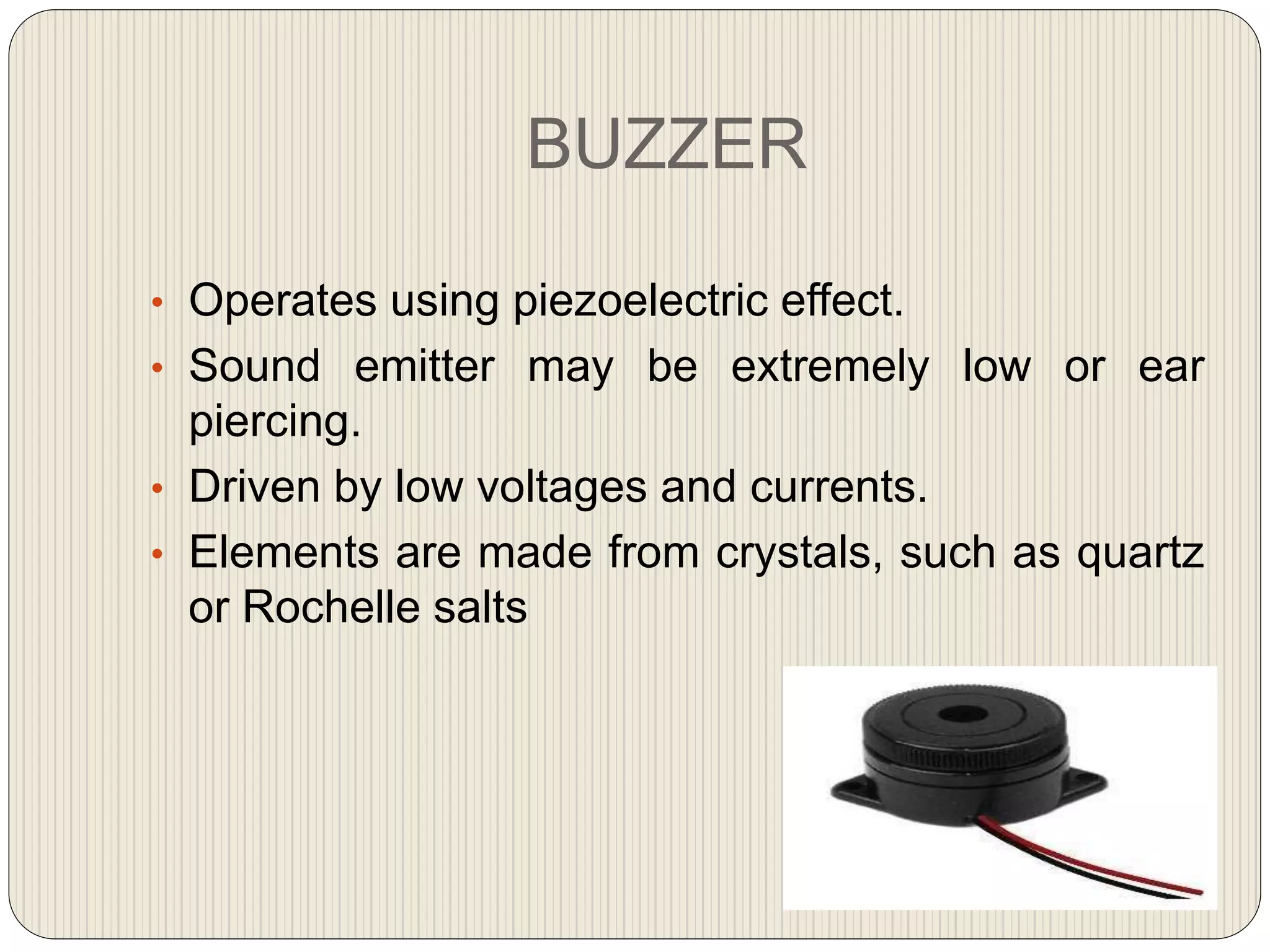
BUZZER
• Operates using piezoelectric effect.
• Sound emitter may be extremely low or ear
piercing.
• Driven by low voltages and currents.
• Elements are made from crystals, such as quartz
or Rochelle salts
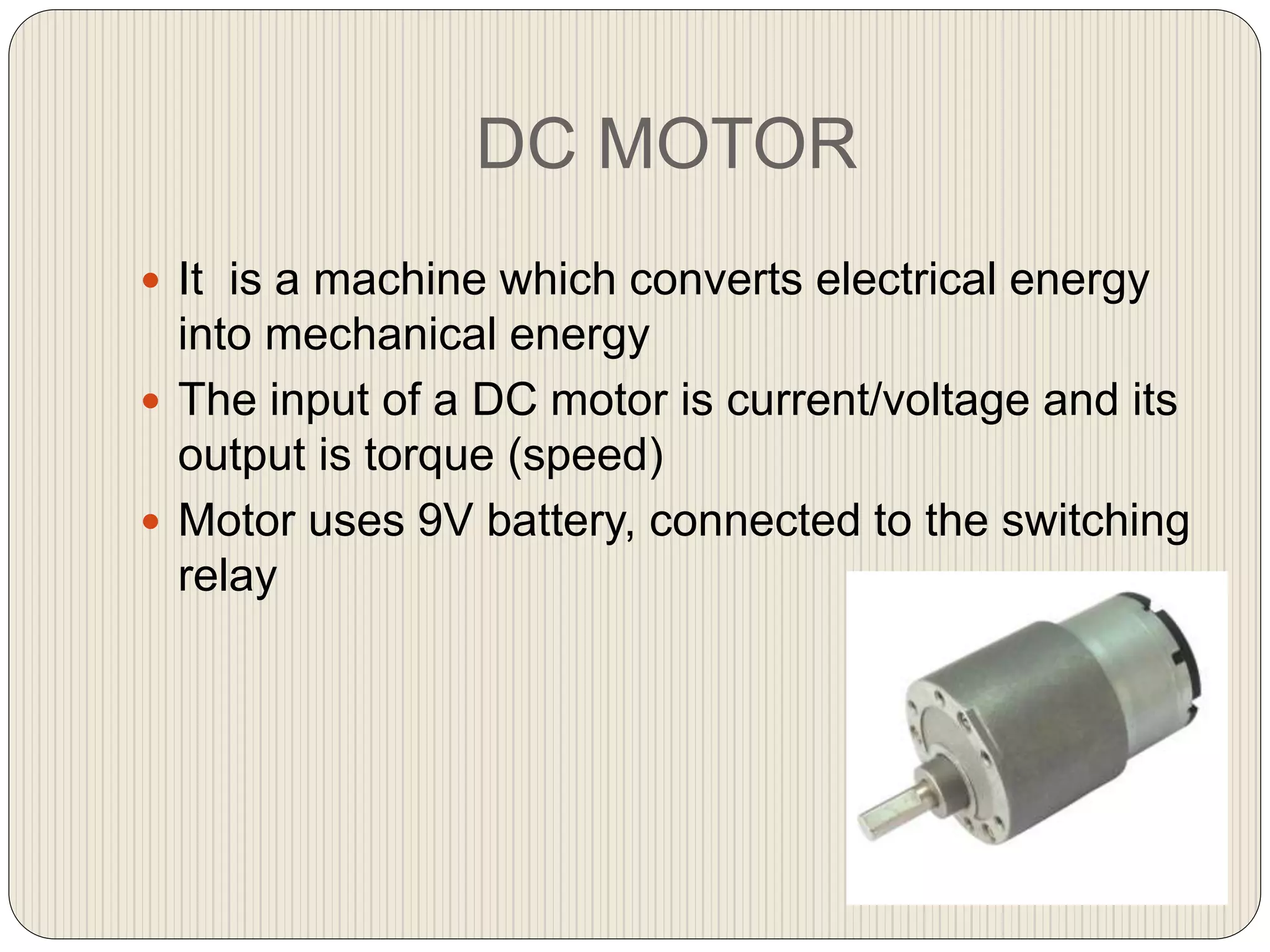
DC MOTOR
 It is a machine which converts electrical energy
into mechanical energy
 The input of a DC motor is current/voltage and its
output is torque (speed)
 Motor uses 9V battery, connected to the switching
relay
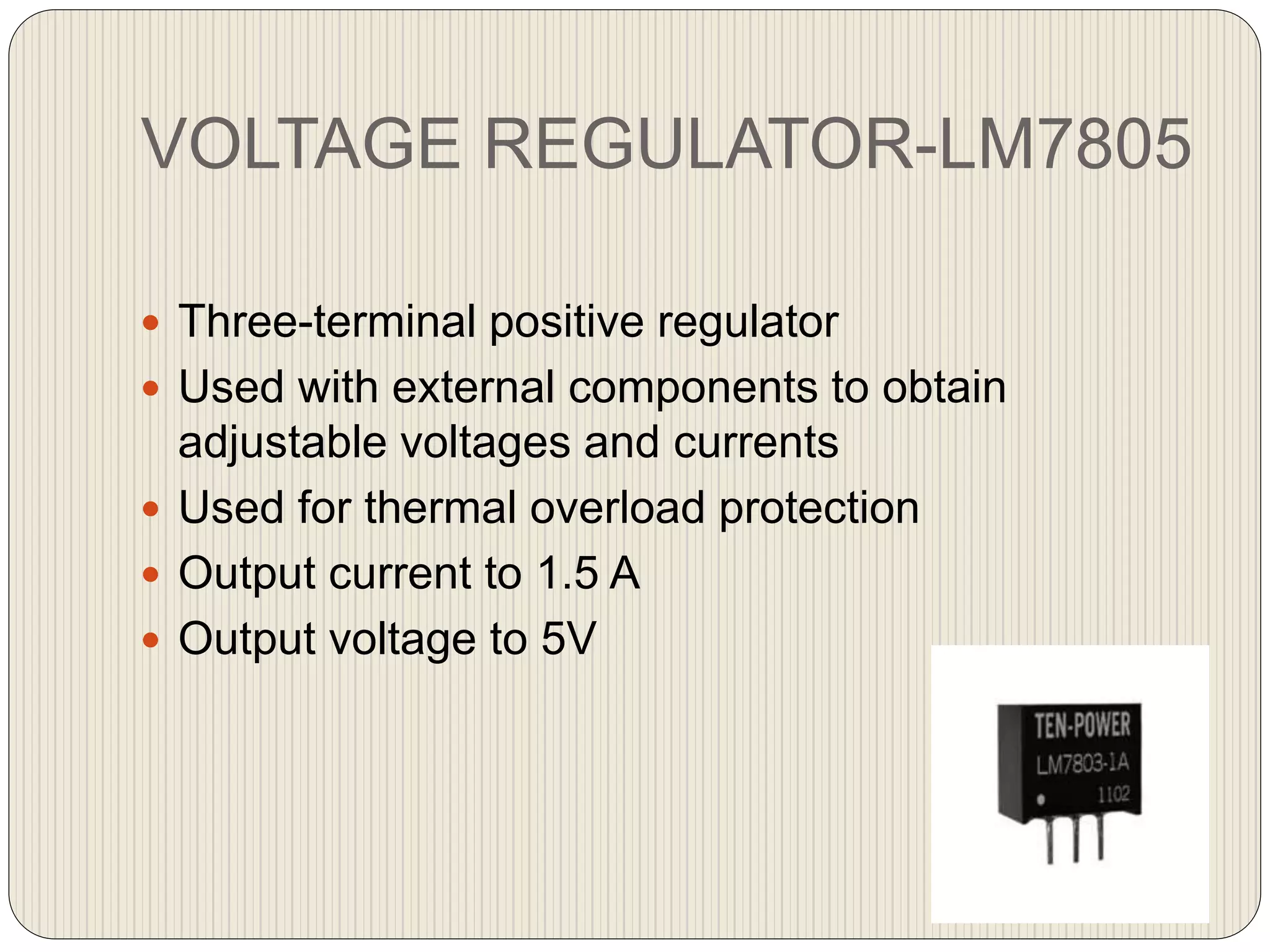
VOLTAGE REGULATOR-LM7805
 Three-terminal positive regulator
 Used with external components to obtain
adjustable voltages and currents
 Used for thermal overload protection
 Output current to 1.5 A
 Output voltage to 5V
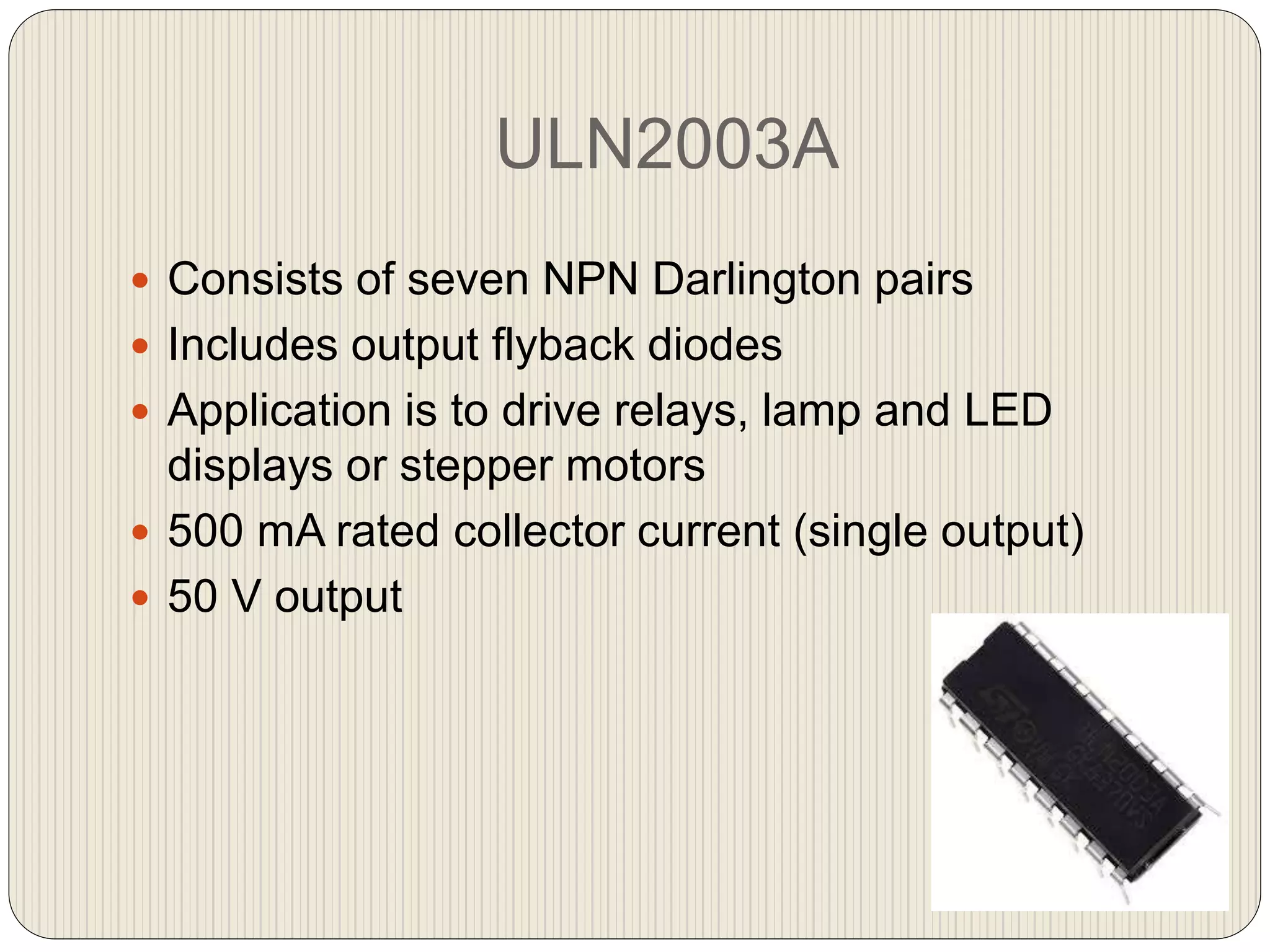
ULN2003A
 Consists of seven NPN Darlington pairs
 Includes output flyback diodes
 Application is to drive relays, lamp and LED
displays or stepper motors
 500 mA rated collector current (single output)
 50 V output
CIRCUIT DIAGRAM
SOFTWARE DESCRIPTION
 PROTEUS SOFTWARE is used for the simulation
of circuit
 CODING USED: Embedded C Language with the
implementation of Keil Software
 USB programmer Avrupro + was used to burn
the code in microcontroller
 Progisp Flash tool
ADVANTAGES
• No keys to be lost, stolen or occupied.
• Can be locked using keypad.
• Automatic door opening .
• Gives an indication for unauthorized entry.
• Totally cost efficient.
DISADVANTAGES
• Currently if the personal identification number
is somehow forgotten the system could not be
accessed.
• Powered by electricity may not function
properly in the case of a power failure.
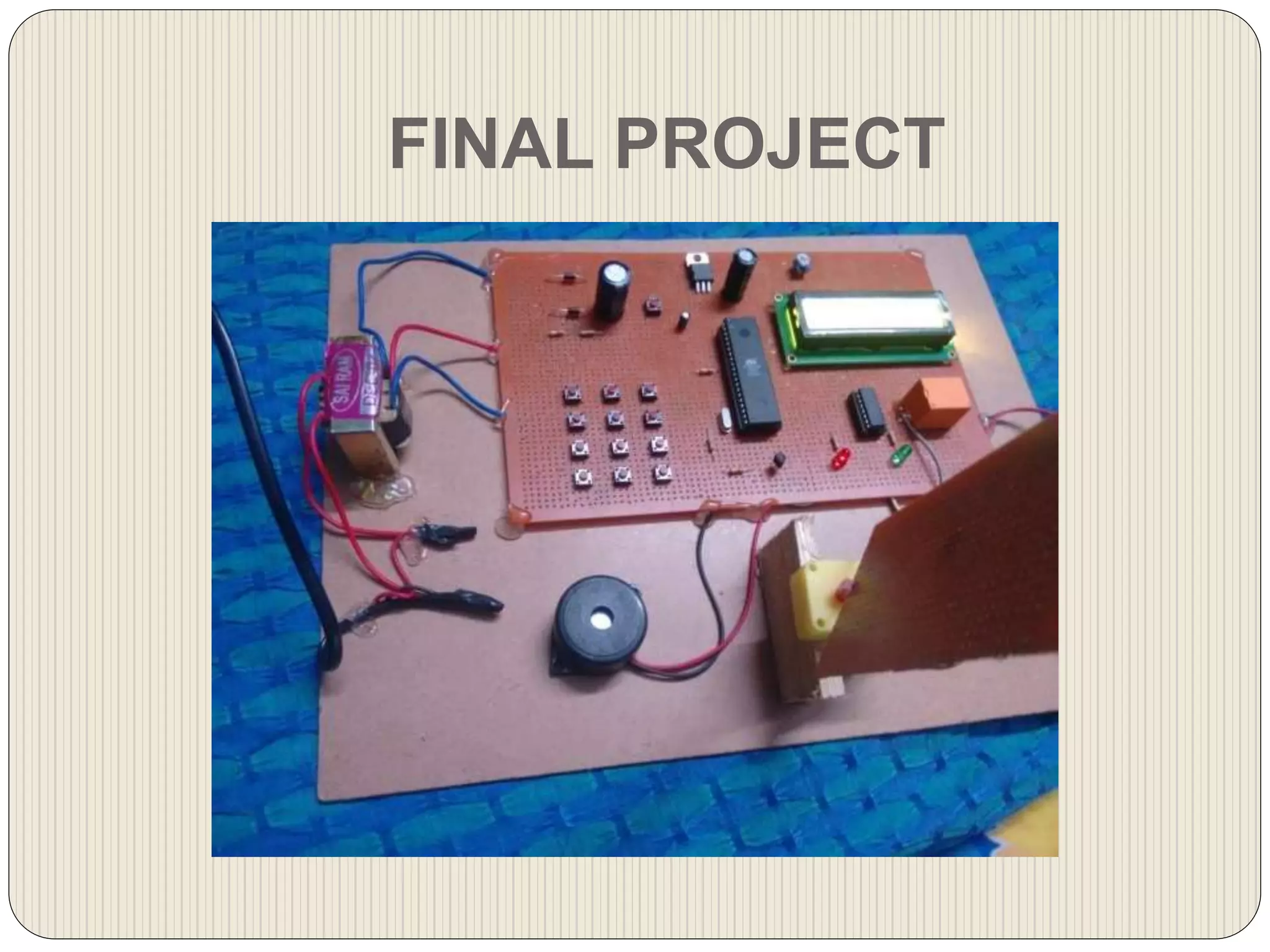
FINAL PROJECT
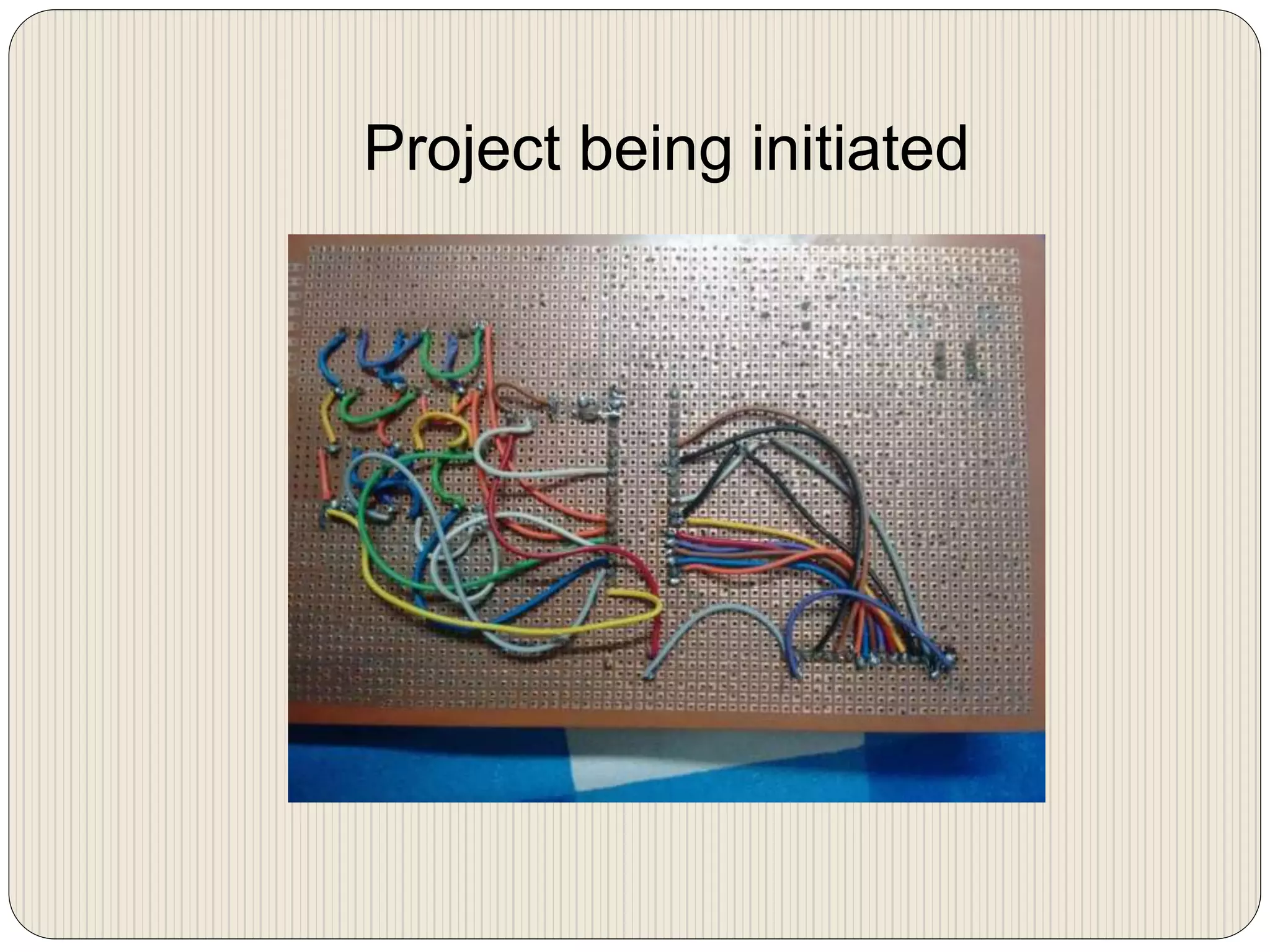
Project being initiated
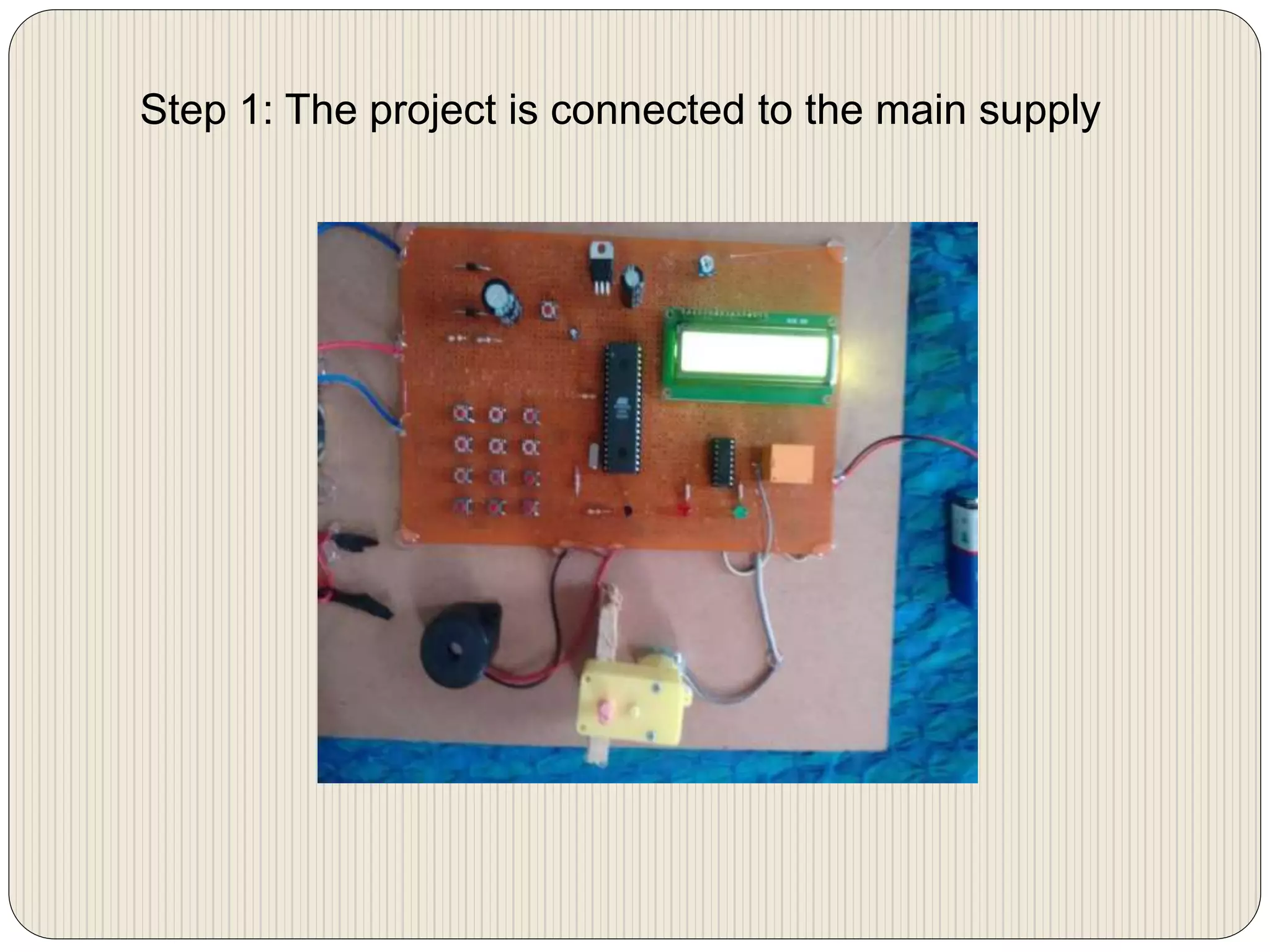
Step 1: The project is connected to the main supply
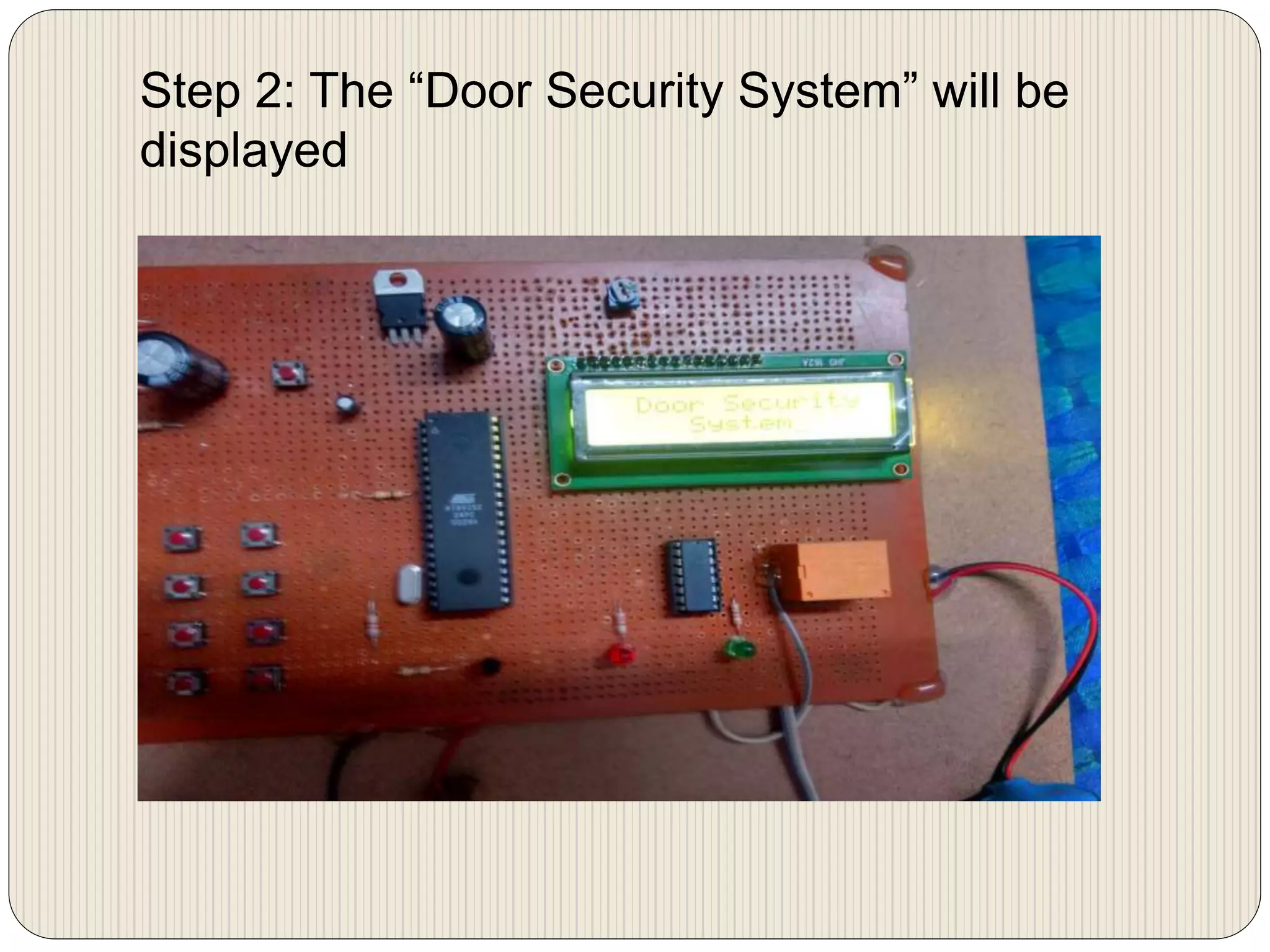
Step 2: The “Door Security System” will be
displayed
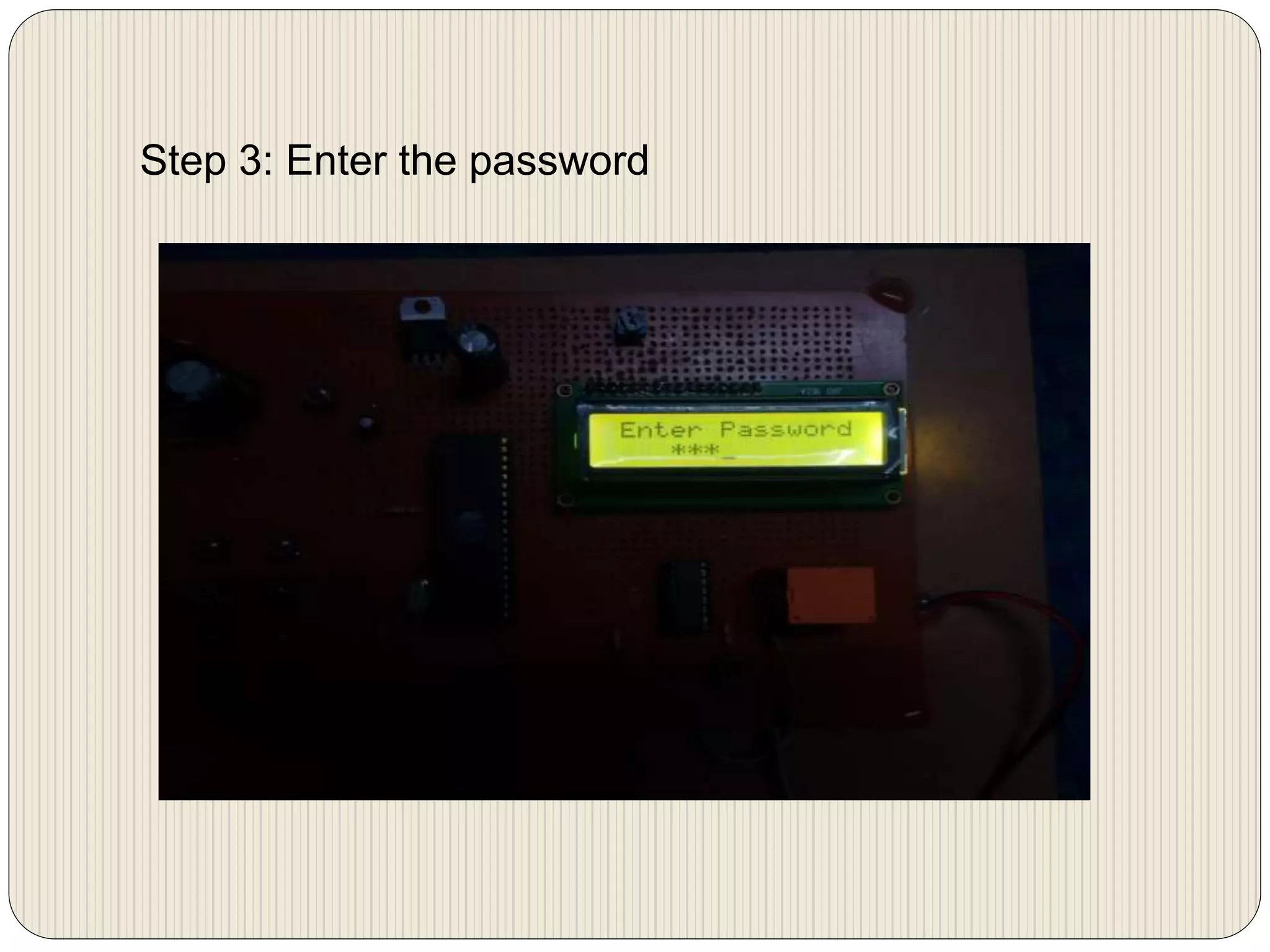
Step 3: Enter the password
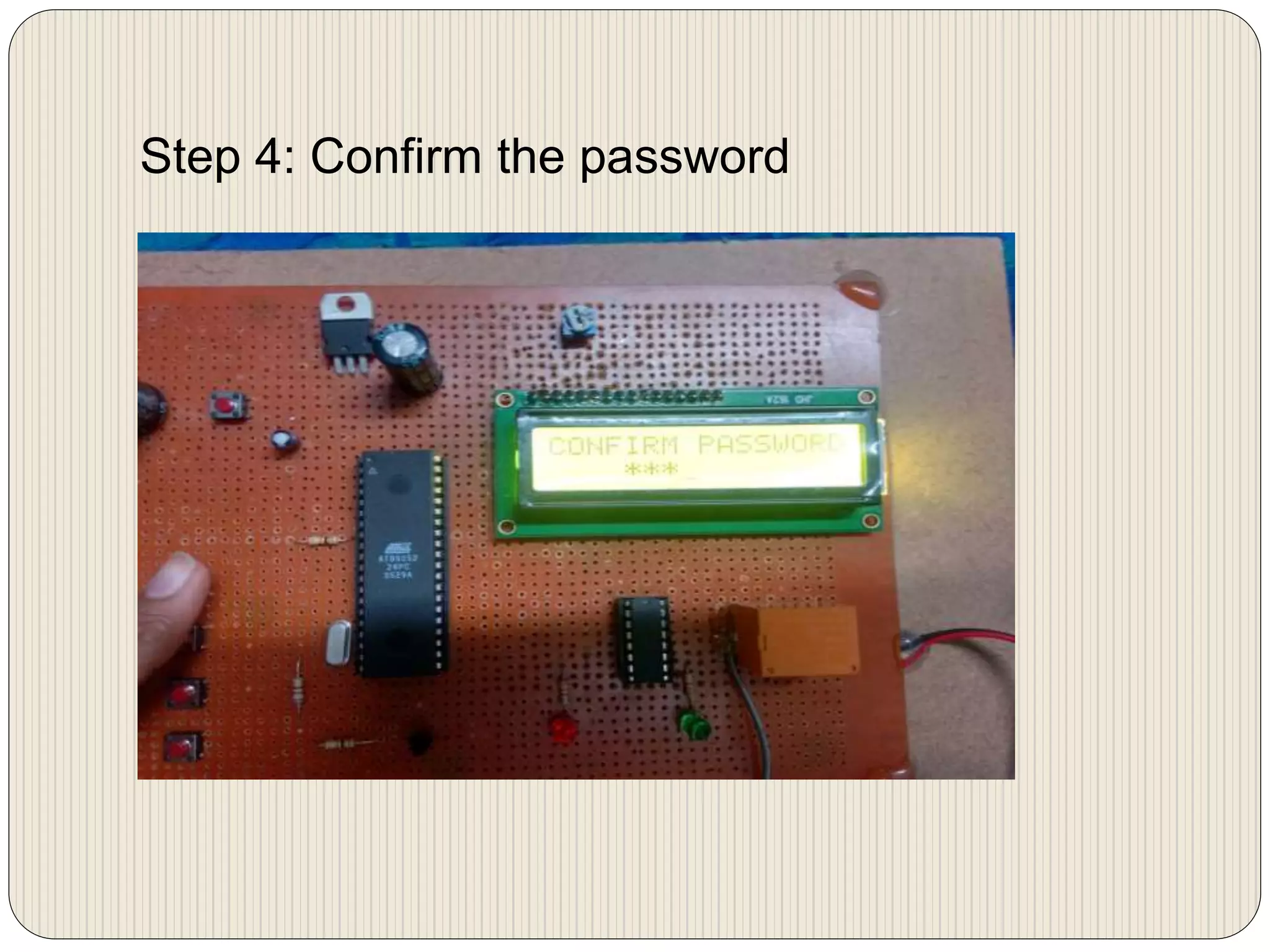
Step 4: Confirm the password
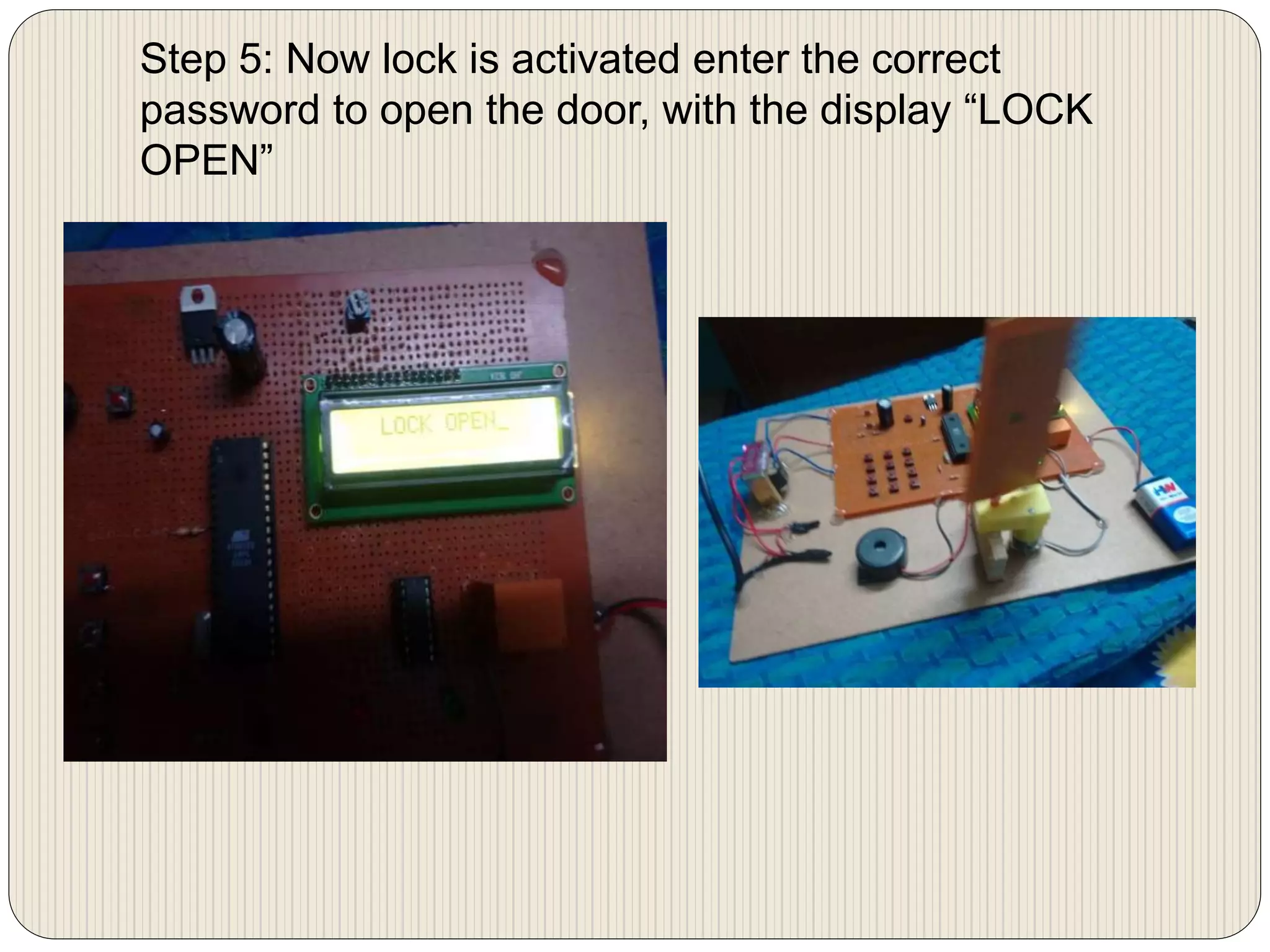
Step 5: Now lock is activated enter the correct
password to open the door, with the display “LOCK
OPEN”
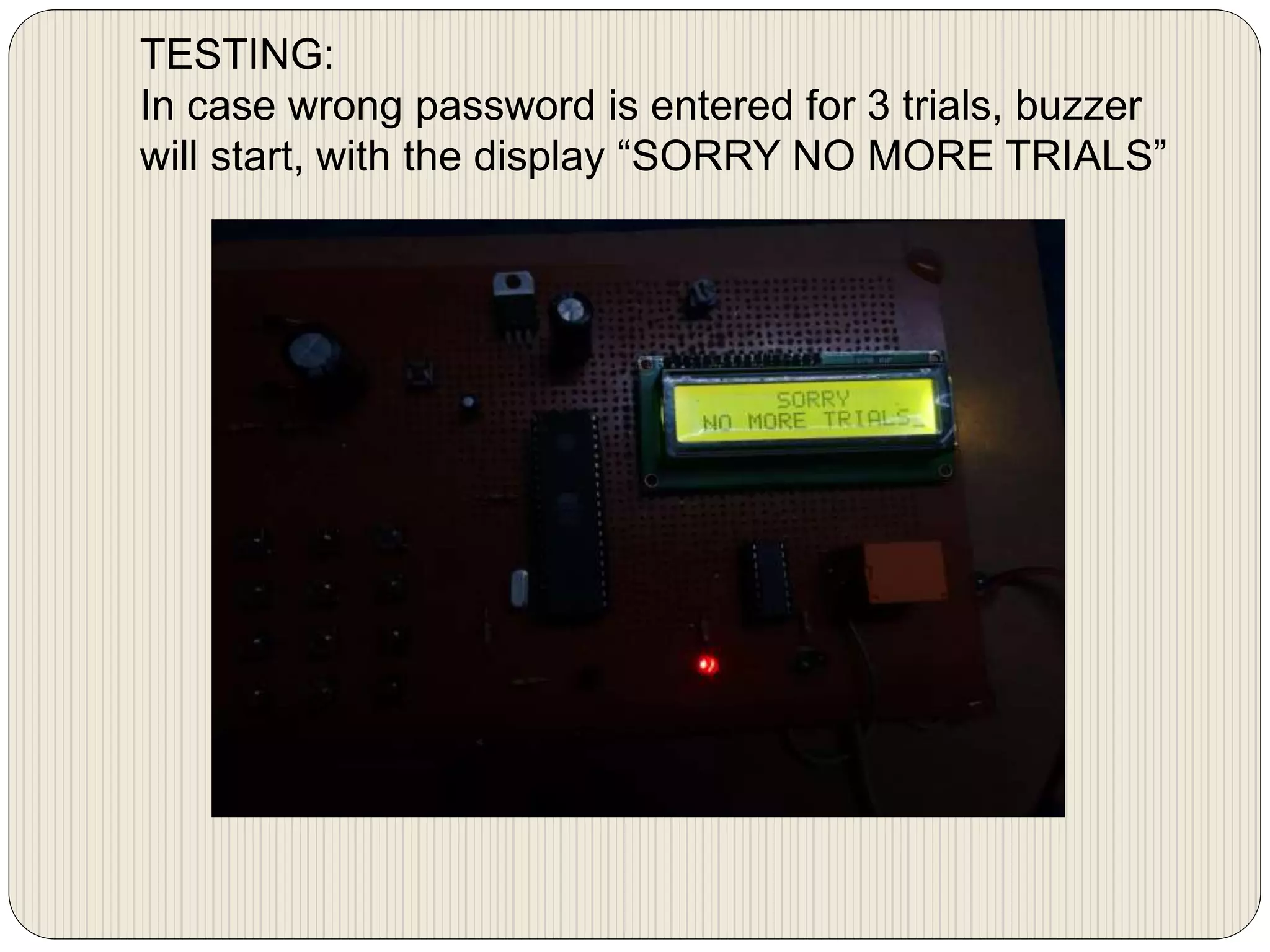
TESTING:
In case wrong password is entered for 3 trials, buzzer
will start, with the display “SORRY NO MORE TRIALS”
FUTURE SCOPE
•We can send this data to a remote location
using mobile or internet.
•We can add fingerprint sensor so entry will be
allowed for the authorized person using their
fingerprints.
•We can add fire, wind and LPG sensors so that
in case of accident, the doors will automatically
open.
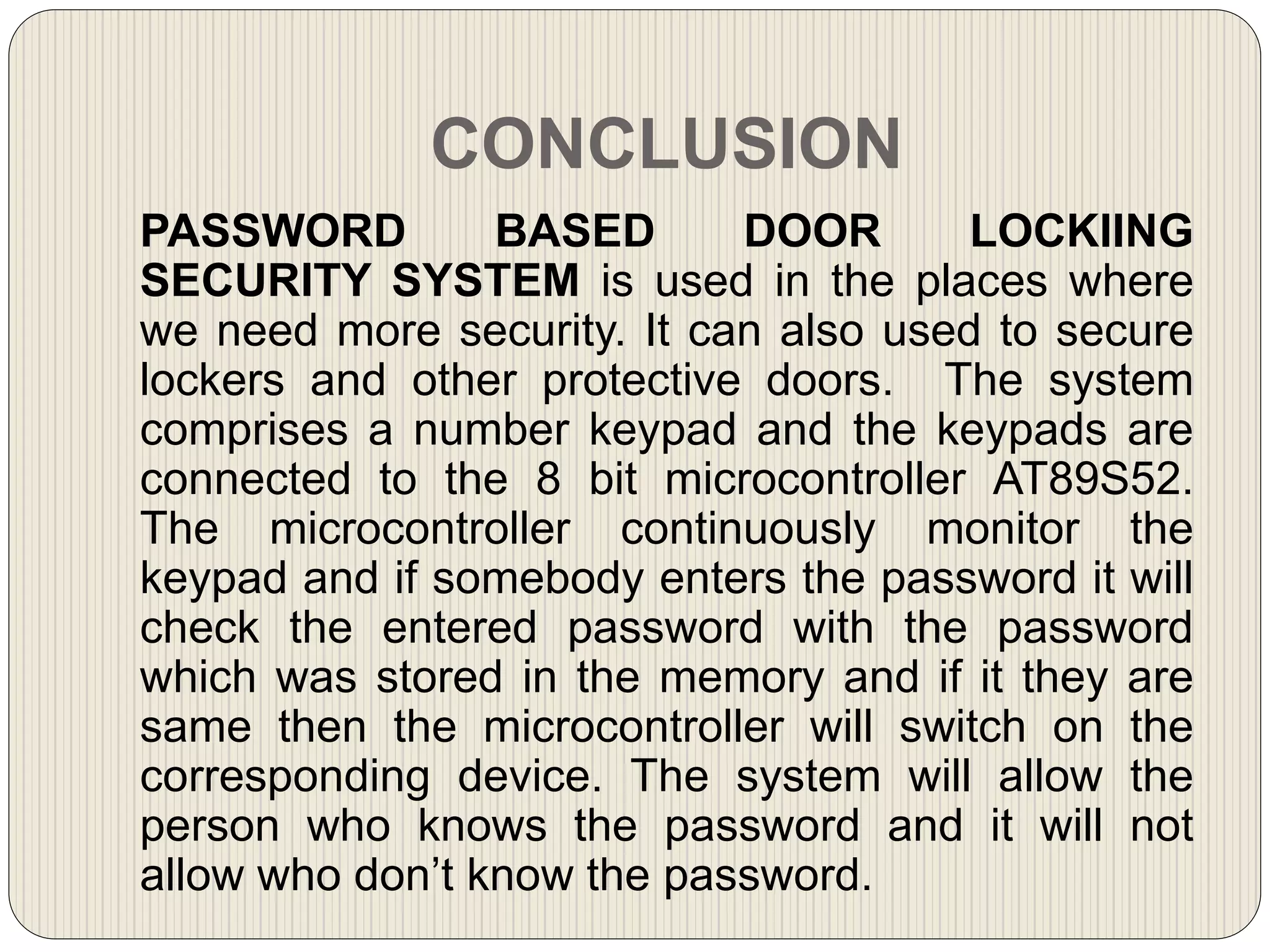
CONCLUSION
PASSWORD BASED DOOR LOCKIING
SECURITY SYSTEM is used in the places where
we need more security. It can also used to secure
lockers and other protective doors. The system
comprises a number keypad and the keypads are
connected to the 8 bit microcontroller AT89S52.
The microcontroller continuously monitor the
keypad and if somebody enters the password it will
check the entered password with the password
which was stored in the memory and if it they are
same then the microcontroller will switch on the
corresponding device. The system will allow the
person who knows the password and it will not
allow who don’t know the password.
REFERENCES
Book References:
 8051 Reference Manual, TICO Institute of Embedded
Technology
 Fundamentals of Embedded Software: Where C and
Assembly Meet by Lewis Daniel
Web References:
 www.atmel.com
 www.electronicshub.org
 www.keil.com
 http://www.edgefxkits.com/remote-password-
operated-load-control-by-android-applications
 http://www.edgefxkits.com/password-based-circuit-
breaker
Password based door locking system

Password based door locking system

  • 1.
    PASSWORD BASED DOOR LOCKING SECURITYSYSTEM PRESENTED BY: Anuj Kumar Gupta (04270102811) Prachi Sharma (04570102811) Surabhi (07770102811) Sahil Pandey (07970102811)
  • 2.
    CONTENT  OBJECTIVE  INTRODUCTION COMPONENTS USED  CIRCUIT DIAGRAM  SOFTWARE DESCRIPTION  ADVANTAGES  DISADVANTAGES  FINAL PROJECT  FUTURE SCOPE  CONCLUSION  REFERENCES
  • 3.
    OBJECTIVE  Increase thesecurity level to prevent an unauthorized unlocking of the door.  Give the flexibility to the user to change or reset the password in case the user forgets that combination.  Lock the door by using password.  To give user more secure yet cost-efficient way of door locking system.
  • 4.
    INTRODUCTION Since the mainintension of this project is to design a security Door locks system. In order to fulfill this application there are few steps that has been performed i.e.  Designing the power supply for the entire circuitry.  Selection of microcontroller that suits our application.  Selection Key pad.  Selection of DC motor.  Selection of buzzer according to the requirement. Complete studies of all the above points are useful to develop this project.
  • 5.
  • 6.
    DESCRIPTION OF BLOCK DIAGRAM BlockDiagram consist of following blocks: • Keypad: It is an input device that helps to enter a code to open the door. This block gives the entered code signals to the microcontroller. • Buzzer and LCD: These are the final indicating devices for displaying the information and alarming. • DC motor: It moves the door opens and closes the door. • Relay: It drives this motor by receiving control signals from the microcontroller.
  • 7.
    COMPONENTS USED QUANTITY REFERENCESVALUE 3 Capacitors 1 C1 1000u 1 C2 100u 1 C3 10u 3 Integrated Circuits 1 U1 AT89S52 1 U2 7805 1 U3 ULN2003A Transistors 1 Q1 BC548
  • 8.
    QUANTITY REFERENCES VALUE 2Diodes 2 D1, D2 1N4007 8 Miscellaneous 3 B 1, GATE, RL 1 12 V 1 BUZ 1 BUZZER 1 CONTRAST 100 1 LCD 1 LM016L 1 TR 1 TRAN-2P3S 1 X 1 CRYSTAL
  • 9.
  • 10.
    MICROCONTROLLER - AT89S52  4.0Vto 5.5V Operating Range  256 x 8-bit Internal RAM  32 Programmable I/O Lines  Three 16-bit Timer/Counters  Eight Interrupt Sources  Low-power Idle and Power-down Modes
  • 11.
    LCD • LCD isa dot matrix liquid display crystal that displays alphanumeric, Kana(Japanese) characters and symbols. • Internal refresh is provided. • All the functions required for dot matrix LCD drive are internally provided.  Built-in oscillator circuit.
  • 12.
    BUZZER • Operates usingpiezoelectric effect. • Sound emitter may be extremely low or ear piercing. • Driven by low voltages and currents. • Elements are made from crystals, such as quartz or Rochelle salts
  • 13.
    DC MOTOR  Itis a machine which converts electrical energy into mechanical energy  The input of a DC motor is current/voltage and its output is torque (speed)  Motor uses 9V battery, connected to the switching relay
  • 14.
    VOLTAGE REGULATOR-LM7805  Three-terminalpositive regulator  Used with external components to obtain adjustable voltages and currents  Used for thermal overload protection  Output current to 1.5 A  Output voltage to 5V
  • 15.
    ULN2003A  Consists ofseven NPN Darlington pairs  Includes output flyback diodes  Application is to drive relays, lamp and LED displays or stepper motors  500 mA rated collector current (single output)  50 V output
  • 16.
  • 17.
    SOFTWARE DESCRIPTION  PROTEUSSOFTWARE is used for the simulation of circuit  CODING USED: Embedded C Language with the implementation of Keil Software  USB programmer Avrupro + was used to burn the code in microcontroller  Progisp Flash tool
  • 18.
    ADVANTAGES • No keysto be lost, stolen or occupied. • Can be locked using keypad. • Automatic door opening . • Gives an indication for unauthorized entry. • Totally cost efficient.
  • 19.
    DISADVANTAGES • Currently ifthe personal identification number is somehow forgotten the system could not be accessed. • Powered by electricity may not function properly in the case of a power failure.
  • 20.
  • 21.
  • 22.
    Step 1: Theproject is connected to the main supply
  • 23.
    Step 2: The“Door Security System” will be displayed
  • 24.
    Step 3: Enterthe password
  • 25.
    Step 4: Confirmthe password
  • 26.
    Step 5: Nowlock is activated enter the correct password to open the door, with the display “LOCK OPEN”
  • 27.
    TESTING: In case wrongpassword is entered for 3 trials, buzzer will start, with the display “SORRY NO MORE TRIALS”
  • 28.
    FUTURE SCOPE •We cansend this data to a remote location using mobile or internet. •We can add fingerprint sensor so entry will be allowed for the authorized person using their fingerprints. •We can add fire, wind and LPG sensors so that in case of accident, the doors will automatically open.
  • 29.
    CONCLUSION PASSWORD BASED DOORLOCKIING SECURITY SYSTEM is used in the places where we need more security. It can also used to secure lockers and other protective doors. The system comprises a number keypad and the keypads are connected to the 8 bit microcontroller AT89S52. The microcontroller continuously monitor the keypad and if somebody enters the password it will check the entered password with the password which was stored in the memory and if it they are same then the microcontroller will switch on the corresponding device. The system will allow the person who knows the password and it will not allow who don’t know the password.
  • 30.
    REFERENCES Book References:  8051Reference Manual, TICO Institute of Embedded Technology  Fundamentals of Embedded Software: Where C and Assembly Meet by Lewis Daniel Web References:  www.atmel.com  www.electronicshub.org  www.keil.com  http://www.edgefxkits.com/remote-password- operated-load-control-by-android-applications  http://www.edgefxkits.com/password-based-circuit- breaker