DEPARTMENT OF EEE
Presented By Guide By
1. 21310650 AJITHKUMAR.B
Mr.N.SRIRAM, B.E
2. 21310651 DEEPAN.K
3. 21310652 DHARUN.G
4. 21310655 GANGADURAI.M
5. 21310656 GOWTHAM.K
6. 21310684 VIGNESH.J
Topic :
AUTOMATIC WINDOW
BLINKS CONTROLLING
USING LDR
ABSTRACT
• ABSTRACT
• In this Project we are going to demonstrate how to make an automatic window blind
using Arduino and LDR Module. In daytime the curtain/Window blind will roll down and in
night time it will rolls up.LDR Module will give HIGH signal if Intensity of light is high and
it gives LOW signal when the Intensity of the light is low. Arduino will rotate the DC Motor
in clock wise direction whenever it detects HIGH from LDR Module and window blind get
rolled down, similarly when Arduino gets LOW signal from LDR Module it will rotate the
DC Motor in anti-clockwise direction and window blind will be rolled up. The time of
rotating the DC Motor will depend on the length of the curtain.
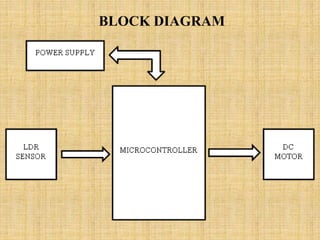
BLOCK DIAGRAM
• INTRODUCTION
• Automatic Window Curtains are self-opening curtains using light sensor. Most
dorms are dark even during the day because students do not open the curtains. The
problem here is that students’ not opening room curtains neither during the day or at
night. If an automatic curtain opener is used, the rooms may be brightening during
daytime without the needs for anyone moving a limb. Especially students will be able to
wake up easier when it is bright since the automatic window curtain system will detect
brightness from outside of the room. The objective of this work is to alert students on the
time it was at that instant. The second objective is to in still healthy lifestyle habits in
student’s life. Third objective is to build an automatic curtain which opens and closes
according to the day or night time. The amount of light brightening the room can be
controlled by the proposed system. By using alight sensor (Light Dependent Resistor, or
LDR) to control the system via Arduino microcontroller, a switch to determine the
direction of the curtain can be done smoothly.
• PROPOSED SYSTEM
• The purpose of this project is to control the window blinds automatically
using LDR sensor when there is need of sun light or air. It detects itself weather
there is need for light or not. When darkness rises to a certain value then
automatically window blinds are closed and when there is source of light
i.e. day time, the window blinds are automatically opened. In our project we
have used a microcontroller, LDR sensor which detects the source of light and
a geared DC motor for opening and closing of the window blinds. To detect the
presence of source of light we use LDR sensor. LDR is a special type of
resistance whose value depends on the brightness of the light, which is falling on it.
It has resistance of about 1 mega ohm when in total darkness, but a resistance of
only about 5kohms when brightness illuminated. It responds to a large part of light
spectrum.
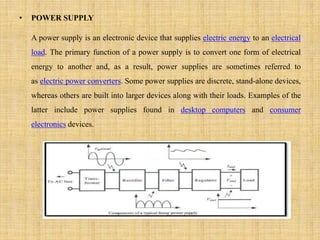
• POWER SUPPLY
A power supply is an electronic device that supplies electric energy to an electrical
load. The primary function of a power supply is to convert one form of electrical
energy to another and, as a result, power supplies are sometimes referred to
as electric power converters. Some power supplies are discrete, stand-alone devices,
whereas others are built into larger devices along with their loads. Examples of the
latter include power supplies found in desktop computers and consumer
electronics devices.
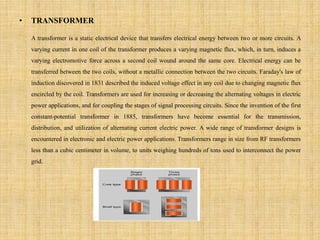
• TRANSFORMER
A transformer is a static electrical device that transfers electrical energy between two or more circuits. A
varying current in one coil of the transformer produces a varying magnetic flux, which, in turn, induces a
varying electromotive force across a second coil wound around the same core. Electrical energy can be
transferred between the two coils, without a metallic connection between the two circuits. Faraday's law of
induction discovered in 1831 described the induced voltage effect in any coil due to changing magnetic flux
encircled by the coil. Transformers are used for increasing or decreasing the alternating voltages in electric
power applications, and for coupling the stages of signal processing circuits. Since the invention of the first
constant-potential transformer in 1885, transformers have become essential for the transmission,
distribution, and utilization of alternating current electric power. A wide range of transformer designs is
encountered in electronic and electric power applications. Transformers range in size from RF transformers
less than a cubic centimeter in volume, to units weighing hundreds of tons used to interconnect the power
grid.
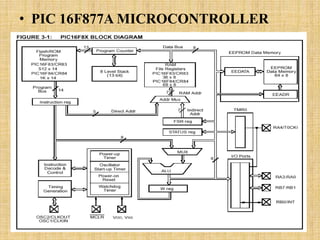
• PIC 16F877A MICROCONTROLLER
• HIGH PERFORMANCE RISC CPU
 Only 35 single word instructions to learn
 All single cycle instructions except for program branches, which are two-
cycle
 Operating speed: DC-20 MHZ clock input DC-200 ns instruction cycle
 2K x 14 words of program memory, 128 x 8 bytes of Data Memory (RAM)
 Pin out compatible to PIC16C72/72A and PIC16F872
 Interrupt capability
 Eight-level deep hardware stack
 Direct, Indirect and Relative Addressing modes
• PERIPHERAL FEATURES
 High sink/source current: 25mA
 Timer0: 8-bit timer/counter with 8-bit pre scalar
 Timer1: 16-bit timer/counter with pre scalar, can be incremented during SLEEP via external
crystal/clock
 Timer2: 8-bit timer/counter with 8-bit period register, pre scalar and post scalar
 Capture, compare, PWM (CCP) module
 Capture is 16-bit, max. Resolution is 12.5 ns
 Compare is 16-bit, max. Resolution is 200 ns
 PWM max. Resolution is 10-bit
 8-bit, 5-channel analog-to-digital converter
 Synchronous Serial Port (SSP) with SPI tm (slave)
 Brown-out detection circuitry for Brown-out Reset (BOR)
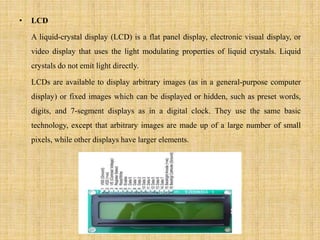
• LCD
A liquid-crystal display (LCD) is a flat panel display, electronic visual display, or
video display that uses the light modulating properties of liquid crystals. Liquid
crystals do not emit light directly.
LCDs are available to display arbitrary images (as in a general-purpose computer
display) or fixed images which can be displayed or hidden, such as preset words,
digits, and 7-segment displays as in a digital clock. They use the same basic
technology, except that arbitrary images are made up of a large number of small
pixels, while other displays have larger elements.
• LED
A light-emitting diode (LED) is a two-lead semiconductor light source. It is a pn-
junction diode, which emits light when activated.]When a suitable voltage is
applied to the leads, electrons are able to recombine with electron holes within the
device, releasing energy in the form of photons. This effect is called
electroluminescence, and the color of the light is determined by the energy band
gap of the semiconductor.
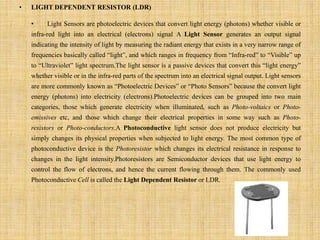
• LIGHT DEPENDENT RESISTOR (LDR)
• Light Sensors are photoelectric devices that convert light energy (photons) whether visible or
infra-red light into an electrical (electrons) signal A Light Sensor generates an output signal
indicating the intensity of light by measuring the radiant energy that exists in a very narrow range of
frequencies basically called “light”, and which ranges in frequency from “Infra-red” to “Visible” up
to “Ultraviolet” light spectrum.The light sensor is a passive devices that convert this “light energy”
whether visible or in the infra-red parts of the spectrum into an electrical signal output. Light sensors
are more commonly known as “Photoelectric Devices” or “Photo Sensors” because the convert light
energy (photons) into electricity (electrons).Photoelectric devices can be grouped into two main
categories, those which generate electricity when illuminated, such as Photo-voltaics or Photo-
emissives etc, and those which change their electrical properties in some way such as Photo-
resistors or Photo-conductors.A Photoconductive light sensor does not produce electricity but
simply changes its physical properties when subjected to light energy. The most common type of
photoconductive device is the Photoresistor which changes its electrical resistance in response to
changes in the light intensity.Photoresistors are Semiconductor devices that use light energy to
control the flow of electrons, and hence the current flowing through them. The commonly used
Photoconductive Cell is called the Light Dependent Resistor or LDR.
DC MOTOR
A DC motor is any of a class of rotary electrical machines that converts direct
current electrical energy into mechanical energy. The most common types rely on the
forces produced by magnetic fields. Nearly all types of DC motors have some internal
mechanism, either electromechanical or electronic; to periodically change the direction
of current flow in part of the motor. DC motors were the first type widely used, since
they could be powered from existing direct-current lighting power distribution systems.
A DC motor's speed can be controlled over a wide range, using either a variable supply
voltage or by changing the strength of current in its field windings. Small DC motors
are used in tools, toys, and appliances. The universal motor can operate on direct
current but is a lightweight brushed motor used for portable power tools and
appliances. Larger DC motors are used in propulsion of electric vehicles, elevator and
hoists, or in drives for steel rolling mills. The advent of power electronics has made
replacement of DC motors with AC motors
possible in many applications.
• CONCLUSION
• In this project, we have proposed a solution to automatically opening and
closing of a curtain using a microcontroller system. This microcontroller system is
consisting of light sensor, an Arduino microcontroller, a motor as the actuator that
will physically pull the curtain. The system itself can reduce the usage of internal
lighting during daytime as the room is illuminated by natural light from the outside.
This work is a low-cost project that can help others to draw open or close curtains
using light sensors. As a conclusion, reliability of this design reaches 90%, and able
to reach our expected result.
THANK YOU

AUTOMATIC WINDOW BLINKS CONTROLLING USING LDR.pptx

  • 1.
    DEPARTMENT OF EEE PresentedBy Guide By 1. 21310650 AJITHKUMAR.B Mr.N.SRIRAM, B.E 2. 21310651 DEEPAN.K 3. 21310652 DHARUN.G 4. 21310655 GANGADURAI.M 5. 21310656 GOWTHAM.K 6. 21310684 VIGNESH.J
  • 2.
    Topic : AUTOMATIC WINDOW BLINKSCONTROLLING USING LDR
  • 3.
    ABSTRACT • ABSTRACT • Inthis Project we are going to demonstrate how to make an automatic window blind using Arduino and LDR Module. In daytime the curtain/Window blind will roll down and in night time it will rolls up.LDR Module will give HIGH signal if Intensity of light is high and it gives LOW signal when the Intensity of the light is low. Arduino will rotate the DC Motor in clock wise direction whenever it detects HIGH from LDR Module and window blind get rolled down, similarly when Arduino gets LOW signal from LDR Module it will rotate the DC Motor in anti-clockwise direction and window blind will be rolled up. The time of rotating the DC Motor will depend on the length of the curtain.
  • 4.
  • 5.
    • INTRODUCTION • AutomaticWindow Curtains are self-opening curtains using light sensor. Most dorms are dark even during the day because students do not open the curtains. The problem here is that students’ not opening room curtains neither during the day or at night. If an automatic curtain opener is used, the rooms may be brightening during daytime without the needs for anyone moving a limb. Especially students will be able to wake up easier when it is bright since the automatic window curtain system will detect brightness from outside of the room. The objective of this work is to alert students on the time it was at that instant. The second objective is to in still healthy lifestyle habits in student’s life. Third objective is to build an automatic curtain which opens and closes according to the day or night time. The amount of light brightening the room can be controlled by the proposed system. By using alight sensor (Light Dependent Resistor, or LDR) to control the system via Arduino microcontroller, a switch to determine the direction of the curtain can be done smoothly.
  • 6.
    • PROPOSED SYSTEM •The purpose of this project is to control the window blinds automatically using LDR sensor when there is need of sun light or air. It detects itself weather there is need for light or not. When darkness rises to a certain value then automatically window blinds are closed and when there is source of light i.e. day time, the window blinds are automatically opened. In our project we have used a microcontroller, LDR sensor which detects the source of light and a geared DC motor for opening and closing of the window blinds. To detect the presence of source of light we use LDR sensor. LDR is a special type of resistance whose value depends on the brightness of the light, which is falling on it. It has resistance of about 1 mega ohm when in total darkness, but a resistance of only about 5kohms when brightness illuminated. It responds to a large part of light spectrum.
  • 7.
    • POWER SUPPLY Apower supply is an electronic device that supplies electric energy to an electrical load. The primary function of a power supply is to convert one form of electrical energy to another and, as a result, power supplies are sometimes referred to as electric power converters. Some power supplies are discrete, stand-alone devices, whereas others are built into larger devices along with their loads. Examples of the latter include power supplies found in desktop computers and consumer electronics devices.
  • 8.
    • TRANSFORMER A transformeris a static electrical device that transfers electrical energy between two or more circuits. A varying current in one coil of the transformer produces a varying magnetic flux, which, in turn, induces a varying electromotive force across a second coil wound around the same core. Electrical energy can be transferred between the two coils, without a metallic connection between the two circuits. Faraday's law of induction discovered in 1831 described the induced voltage effect in any coil due to changing magnetic flux encircled by the coil. Transformers are used for increasing or decreasing the alternating voltages in electric power applications, and for coupling the stages of signal processing circuits. Since the invention of the first constant-potential transformer in 1885, transformers have become essential for the transmission, distribution, and utilization of alternating current electric power. A wide range of transformer designs is encountered in electronic and electric power applications. Transformers range in size from RF transformers less than a cubic centimeter in volume, to units weighing hundreds of tons used to interconnect the power grid.
  • 9.
    • PIC 16F877AMICROCONTROLLER
  • 10.
    • HIGH PERFORMANCERISC CPU  Only 35 single word instructions to learn  All single cycle instructions except for program branches, which are two- cycle  Operating speed: DC-20 MHZ clock input DC-200 ns instruction cycle  2K x 14 words of program memory, 128 x 8 bytes of Data Memory (RAM)  Pin out compatible to PIC16C72/72A and PIC16F872  Interrupt capability  Eight-level deep hardware stack  Direct, Indirect and Relative Addressing modes
  • 11.
    • PERIPHERAL FEATURES High sink/source current: 25mA  Timer0: 8-bit timer/counter with 8-bit pre scalar  Timer1: 16-bit timer/counter with pre scalar, can be incremented during SLEEP via external crystal/clock  Timer2: 8-bit timer/counter with 8-bit period register, pre scalar and post scalar  Capture, compare, PWM (CCP) module  Capture is 16-bit, max. Resolution is 12.5 ns  Compare is 16-bit, max. Resolution is 200 ns  PWM max. Resolution is 10-bit  8-bit, 5-channel analog-to-digital converter  Synchronous Serial Port (SSP) with SPI tm (slave)  Brown-out detection circuitry for Brown-out Reset (BOR)
  • 12.
    • LCD A liquid-crystaldisplay (LCD) is a flat panel display, electronic visual display, or video display that uses the light modulating properties of liquid crystals. Liquid crystals do not emit light directly. LCDs are available to display arbitrary images (as in a general-purpose computer display) or fixed images which can be displayed or hidden, such as preset words, digits, and 7-segment displays as in a digital clock. They use the same basic technology, except that arbitrary images are made up of a large number of small pixels, while other displays have larger elements.
  • 13.
    • LED A light-emittingdiode (LED) is a two-lead semiconductor light source. It is a pn- junction diode, which emits light when activated.]When a suitable voltage is applied to the leads, electrons are able to recombine with electron holes within the device, releasing energy in the form of photons. This effect is called electroluminescence, and the color of the light is determined by the energy band gap of the semiconductor.
  • 14.
    • LIGHT DEPENDENTRESISTOR (LDR) • Light Sensors are photoelectric devices that convert light energy (photons) whether visible or infra-red light into an electrical (electrons) signal A Light Sensor generates an output signal indicating the intensity of light by measuring the radiant energy that exists in a very narrow range of frequencies basically called “light”, and which ranges in frequency from “Infra-red” to “Visible” up to “Ultraviolet” light spectrum.The light sensor is a passive devices that convert this “light energy” whether visible or in the infra-red parts of the spectrum into an electrical signal output. Light sensors are more commonly known as “Photoelectric Devices” or “Photo Sensors” because the convert light energy (photons) into electricity (electrons).Photoelectric devices can be grouped into two main categories, those which generate electricity when illuminated, such as Photo-voltaics or Photo- emissives etc, and those which change their electrical properties in some way such as Photo- resistors or Photo-conductors.A Photoconductive light sensor does not produce electricity but simply changes its physical properties when subjected to light energy. The most common type of photoconductive device is the Photoresistor which changes its electrical resistance in response to changes in the light intensity.Photoresistors are Semiconductor devices that use light energy to control the flow of electrons, and hence the current flowing through them. The commonly used Photoconductive Cell is called the Light Dependent Resistor or LDR.
  • 15.
    DC MOTOR A DCmotor is any of a class of rotary electrical machines that converts direct current electrical energy into mechanical energy. The most common types rely on the forces produced by magnetic fields. Nearly all types of DC motors have some internal mechanism, either electromechanical or electronic; to periodically change the direction of current flow in part of the motor. DC motors were the first type widely used, since they could be powered from existing direct-current lighting power distribution systems. A DC motor's speed can be controlled over a wide range, using either a variable supply voltage or by changing the strength of current in its field windings. Small DC motors are used in tools, toys, and appliances. The universal motor can operate on direct current but is a lightweight brushed motor used for portable power tools and appliances. Larger DC motors are used in propulsion of electric vehicles, elevator and hoists, or in drives for steel rolling mills. The advent of power electronics has made replacement of DC motors with AC motors possible in many applications.
  • 16.
    • CONCLUSION • Inthis project, we have proposed a solution to automatically opening and closing of a curtain using a microcontroller system. This microcontroller system is consisting of light sensor, an Arduino microcontroller, a motor as the actuator that will physically pull the curtain. The system itself can reduce the usage of internal lighting during daytime as the room is illuminated by natural light from the outside. This work is a low-cost project that can help others to draw open or close curtains using light sensors. As a conclusion, reliability of this design reaches 90%, and able to reach our expected result.
  • 17.