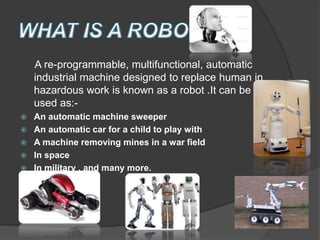
A re-programmable, multifunctional, automatic
industrial machine designed to replace human in
hazardous work is known as a robot .It can be
used as:-
 An automatic machine sweeper
 An automatic car for a child to play with
 A machine removing mines in a war field
 In space
 In military , and many more.
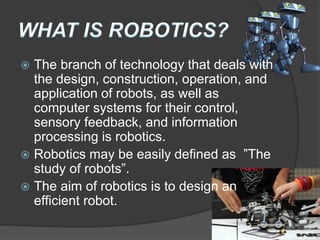
 The branch of technology that deals with
the design, construction, operation, and
application of robots, as well as
computer systems for their control,
sensory feedback, and information
processing is robotics.
 Robotics may be easily defined as ”The
study of robots”.
 The aim of robotics is to design an
efficient robot.
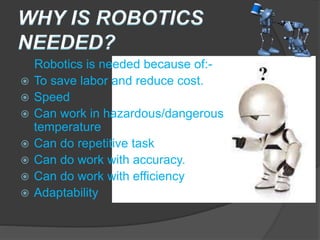
Robotics is needed because of:-
 To save labor and reduce cost.
 Speed
 Can work in hazardous/dangerous
temperature
 Can do repetitive task
 Can do work with accuracy.
 Can do work with efficiency
 Adaptability
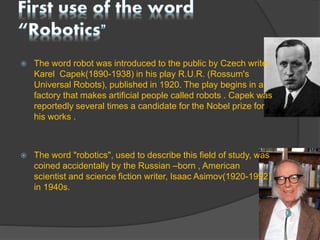
 The word robot was introduced to the public by Czech writer
Karel Capek(1890-1938) in his play R.U.R. (Rossum's
Universal Robots), published in 1920. The play begins in a
factory that makes artificial people called robots . Capek was
reportedly several times a candidate for the Nobel prize for
his works .
 The word "robotics", used to describe this field of study, was
coined accidentally by the Russian –born , American
scientist and science fiction writer, Isaac Asimov(1920-1992)
in 1940s.
Asimov also proposed his three "Laws of Robotics", and
he later added a “Zeroth law”.
 Zeroth Law : A robot may not injure humanity, or,
through inaction, allow humanity to come to harm
 First Law : A robot may not injure a human being,
or, through inaction, allow a human being to come to
harm, unless this would violate a higher order law
 Second Law: A robot must obey orders given it
by human beings, except where such orders would
conflict with a higher order law
 Third Law : A robot must protect its own
existence as long as such protection does not
conflict with a higher order law.
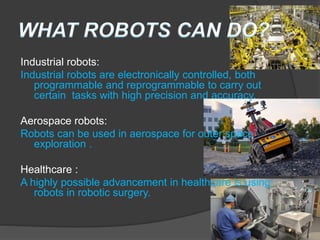
Industrial robots:
Industrial robots are electronically controlled, both
programmable and reprogrammable to carry out
certain tasks with high precision and accuracy.
Aerospace robots:
Robots can be used in aerospace for outer space
exploration .
Healthcare :
A highly possible advancement in healthcare is using
robots in robotic surgery.
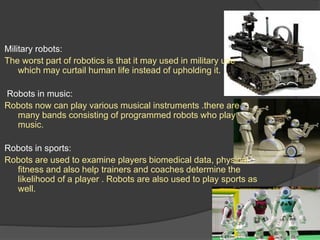
Military robots:
The worst part of robotics is that it may used in military use
which may curtail human life instead of upholding it.
Robots in music:
Robots now can play various musical instruments .there are
many bands consisting of programmed robots who play
music.
Robots in sports:
Robots are used to examine players biomedical data, physical
fitness and also help trainers and coaches determine the
likelihood of a player . Robots are also used to play sports as
well.
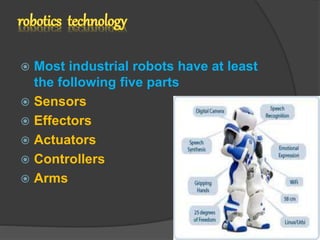
 Most industrial robots have at least
the following five parts
 Sensors
 Effectors
 Actuators
 Controllers
 Arms
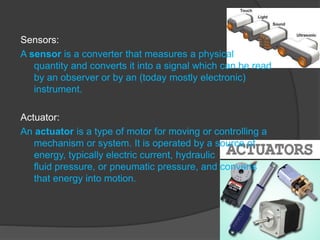
Sensors:
A sensor is a converter that measures a physical
quantity and converts it into a signal which can be read
by an observer or by an (today mostly electronic)
instrument.
Actuator:
An actuator is a type of motor for moving or controlling a
mechanism or system. It is operated by a source of
energy, typically electric current, hydraulic
fluid pressure, or pneumatic pressure, and converts
that energy into motion.
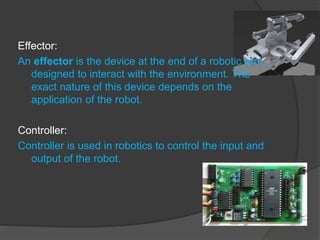
Effector:
An effector is the device at the end of a robotic arm,
designed to interact with the environment. The
exact nature of this device depends on the
application of the robot.
Controller:
Controller is used in robotics to control the input and
output of the robot.
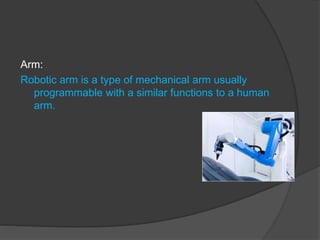
Arm:
Robotic arm is a type of mechanical arm usually
programmable with a similar functions to a human
arm.
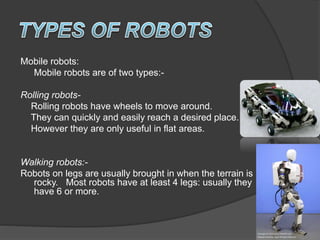
Mobile robots:
Mobile robots are of two types:-
Rolling robots-
Rolling robots have wheels to move around.
They can quickly and easily reach a desired place.
However they are only useful in flat areas.
Walking robots:-
Robots on legs are usually brought in when the terrain is
rocky. Most robots have at least 4 legs: usually they
have 6 or more.
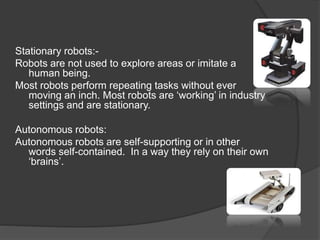
Stationary robots:-
Robots are not used to explore areas or imitate a
human being.
Most robots perform repeating tasks without ever
moving an inch. Most robots are ‘working’ in industry
settings and are stationary.
Autonomous robots:
Autonomous robots are self-supporting or in other
words self-contained. In a way they rely on their own
‘brains’.
Virtual robots:-
Virtual robots don’t exist in real life.
Virtual robots are just programs, building blocks
of software inside a computer.
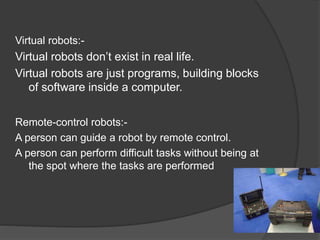
Remote-control robots:-
A person can guide a robot by remote control.
A person can perform difficult tasks without being at
the spot where the tasks are performed
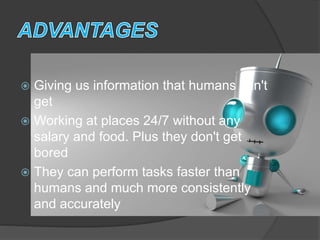
 Giving us information that humans can't
get
 Working at places 24/7 without any
salary and food. Plus they don't get
bored
 They can perform tasks faster than
humans and much more consistently
and accurately
 There is also the problem of evil people
using robots for evil purposes.
 People can lose jobs in factories
 It needs a supply of power
 It needs maintenance to keep it running.
In future the population of robots will grow
rapidly.
 This growth is lead by Japan that has almost
twice as many robots as the USA.
 All estimates suggest that robots will play an
ever-increasing role in modern society.
 They will continue to be used in tasks where
danger, repetition, cost, and precision prevents
humans from performing.
 Our only hope is that man, along with the
advancement in technology, always promotes
for the well being of mankind.
 Some people are concerned that robots will reduce
the number of jobs and kick people out of their jobs
 This is almost never the case. The net affect of
advanced technology such as robots is that humans
become more productive.
 Robotics uses AI techniques to build intelligent
robots for the purpose of efficiency.
 The research of Robotics and AI would lead to a
manufacturing of Robots that will be used in every
industry.
 In future, it is better to use robotics in a appropriate
and useful way, with this we can get peaceful &
effective world .

Robotics

  • 3.
    A re-programmable, multifunctional,automatic industrial machine designed to replace human in hazardous work is known as a robot .It can be used as:-  An automatic machine sweeper  An automatic car for a child to play with  A machine removing mines in a war field  In space  In military , and many more.
  • 4.
     The branchof technology that deals with the design, construction, operation, and application of robots, as well as computer systems for their control, sensory feedback, and information processing is robotics.  Robotics may be easily defined as ”The study of robots”.  The aim of robotics is to design an efficient robot.
  • 5.
    Robotics is neededbecause of:-  To save labor and reduce cost.  Speed  Can work in hazardous/dangerous temperature  Can do repetitive task  Can do work with accuracy.  Can do work with efficiency  Adaptability
  • 6.
     The wordrobot was introduced to the public by Czech writer Karel Capek(1890-1938) in his play R.U.R. (Rossum's Universal Robots), published in 1920. The play begins in a factory that makes artificial people called robots . Capek was reportedly several times a candidate for the Nobel prize for his works .  The word "robotics", used to describe this field of study, was coined accidentally by the Russian –born , American scientist and science fiction writer, Isaac Asimov(1920-1992) in 1940s.
  • 7.
    Asimov also proposedhis three "Laws of Robotics", and he later added a “Zeroth law”.  Zeroth Law : A robot may not injure humanity, or, through inaction, allow humanity to come to harm  First Law : A robot may not injure a human being, or, through inaction, allow a human being to come to harm, unless this would violate a higher order law  Second Law: A robot must obey orders given it by human beings, except where such orders would conflict with a higher order law  Third Law : A robot must protect its own existence as long as such protection does not conflict with a higher order law.
  • 8.
    Industrial robots: Industrial robotsare electronically controlled, both programmable and reprogrammable to carry out certain tasks with high precision and accuracy. Aerospace robots: Robots can be used in aerospace for outer space exploration . Healthcare : A highly possible advancement in healthcare is using robots in robotic surgery.
  • 9.
    Military robots: The worstpart of robotics is that it may used in military use which may curtail human life instead of upholding it. Robots in music: Robots now can play various musical instruments .there are many bands consisting of programmed robots who play music. Robots in sports: Robots are used to examine players biomedical data, physical fitness and also help trainers and coaches determine the likelihood of a player . Robots are also used to play sports as well.
  • 10.
     Most industrialrobots have at least the following five parts  Sensors  Effectors  Actuators  Controllers  Arms
  • 11.
    Sensors: A sensor isa converter that measures a physical quantity and converts it into a signal which can be read by an observer or by an (today mostly electronic) instrument. Actuator: An actuator is a type of motor for moving or controlling a mechanism or system. It is operated by a source of energy, typically electric current, hydraulic fluid pressure, or pneumatic pressure, and converts that energy into motion.
  • 12.
    Effector: An effector isthe device at the end of a robotic arm, designed to interact with the environment. The exact nature of this device depends on the application of the robot. Controller: Controller is used in robotics to control the input and output of the robot.
  • 13.
    Arm: Robotic arm isa type of mechanical arm usually programmable with a similar functions to a human arm.
  • 14.
    Mobile robots: Mobile robotsare of two types:- Rolling robots- Rolling robots have wheels to move around. They can quickly and easily reach a desired place. However they are only useful in flat areas. Walking robots:- Robots on legs are usually brought in when the terrain is rocky. Most robots have at least 4 legs: usually they have 6 or more.
  • 15.
    Stationary robots:- Robots arenot used to explore areas or imitate a human being. Most robots perform repeating tasks without ever moving an inch. Most robots are ‘working’ in industry settings and are stationary. Autonomous robots: Autonomous robots are self-supporting or in other words self-contained. In a way they rely on their own ‘brains’.
  • 16.
    Virtual robots:- Virtual robotsdon’t exist in real life. Virtual robots are just programs, building blocks of software inside a computer. Remote-control robots:- A person can guide a robot by remote control. A person can perform difficult tasks without being at the spot where the tasks are performed
  • 17.
     Giving usinformation that humans can't get  Working at places 24/7 without any salary and food. Plus they don't get bored  They can perform tasks faster than humans and much more consistently and accurately
  • 18.
     There isalso the problem of evil people using robots for evil purposes.  People can lose jobs in factories  It needs a supply of power  It needs maintenance to keep it running.
  • 19.
    In future thepopulation of robots will grow rapidly.  This growth is lead by Japan that has almost twice as many robots as the USA.  All estimates suggest that robots will play an ever-increasing role in modern society.  They will continue to be used in tasks where danger, repetition, cost, and precision prevents humans from performing.  Our only hope is that man, along with the advancement in technology, always promotes for the well being of mankind.
  • 20.
     Some peopleare concerned that robots will reduce the number of jobs and kick people out of their jobs  This is almost never the case. The net affect of advanced technology such as robots is that humans become more productive.  Robotics uses AI techniques to build intelligent robots for the purpose of efficiency.  The research of Robotics and AI would lead to a manufacturing of Robots that will be used in every industry.  In future, it is better to use robotics in a appropriate and useful way, with this we can get peaceful & effective world .