Basic organization of computer
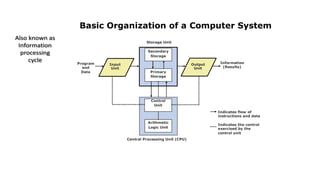
Basic Organization of a Computer System
Storage Unit
Information
(Results)
Program
and
Data
Input
Unit
Output
Unit
Indicates flow of
instructions and data
Indicates the control
exercised by the
control unit
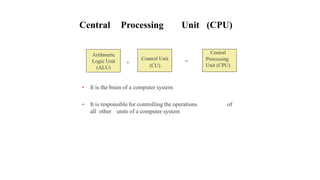
Central Processing Unit (CPU)
Control
Unit
Arithmetic
Logic Unit
Secondary
Storage
Primary
Storage
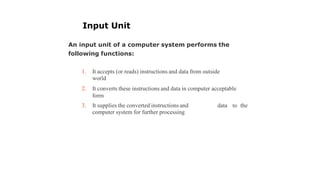
Input Unit
An input unit of a computer system performs the
following functions:
1. It accepts (or reads) instructions and data from outside
world
It converts these instructions and data in computer acceptable
form
2.
3. It supplies the converted instructions and
computer system for further processing
data to the
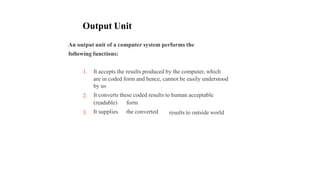
Output Unit
An output unit of a computer system performs the
following functions:
1. It accepts the results produced by the computer, which
are in coded form and hence, cannot be easily understood
by us
It converts these coded results to human acceptable2.
(readable)
It supplies
form
the converted3. results to outside world
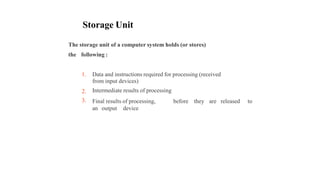
Storage Unit
The storage unit of a computer system holds (or stores)
the following :
1. Data and instructions required for processing (received
from input devices)
Intermediate results of processing2.
3. Final results of processing, before they are released to
an output device
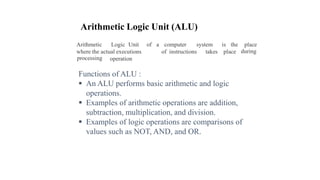
Arithmetic Logic Unit (ALU)
Arithmetic Logic Unit of a computer system is the place
duringwhere the actual executions of instructions takes place
processing operation
Functions of ALU :
 An ALU performs basic arithmetic and logic
operations.
 Examples of arithmetic operations are addition,
subtraction, multiplication, and division.
 Examples of logic operations are comparisons of
values such as NOT, AND, and OR.
Control Unit (CU)
Control Unit of a computer system manages and coordinates
the operations of all other components of the computer
system
Central Processing Unit (CPU)
=+
It is the brain of a computer system•
It is responsible for controlling the operations of•
all other units of a computer system
Central
Processing
Unit (CPU)
Control Unit
(CU)
Arithmetic
Logic Unit
(ALU)
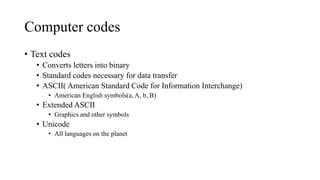
Computer codes
• Text codes
• Converts letters into binary
• Standard codes necessary for data transfer
• ASCII( American Standard Code for Information Interchange)
• American English symbols(a, A, b, B)
• Extended ASCII
• Graphics and other symbols
• Unicode
• All languages on the planet
5A-9
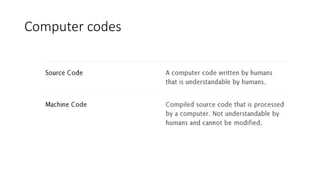
Computer codes
Computer for organization
Computer technology has great applications in
almost all kinds of businesses. Almost all kinds
of businesses are relying on computers for
automating their traditional processes
Computer for organization
• Business Communication
• Inventory Management
• Customer Relationship Management
• Payroll System
• Advertisement
• Data management
• Management Information System
• Human Resource Management
Business Communication
• Now-a-days companies use email ,live chat
systems, online meeting tools, video-
conferencing system and smart-phones as the
principal means of communication between
employees, suppliers and customers.
Inventory management
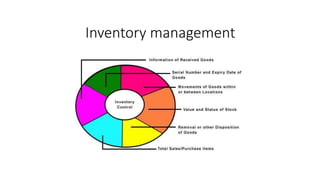
 Inventory management systems track the quantity of each
item a company maintains, triggering an order of additional
stock when the quantities fall below a pre-determined
amount.
Customer Relationship Management
• Customer Relationship Management (CRM) systems stores
every interaction a company has with a customer for future
reference . The customer has a better, more focused
experience and the company benefits from improved
productivity.
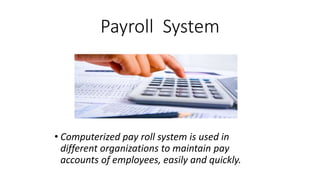
Payroll System
• Computerized pay roll system is used in
different organizations to maintain pay
accounts of employees, easily and quickly.
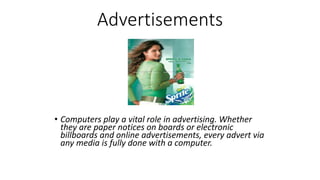
Advertisements
• Computers play a vital role in advertising. Whether
they are paper notices on boards or electronic
billboards and online advertisements, every advert via
any media is fully done with a computer.
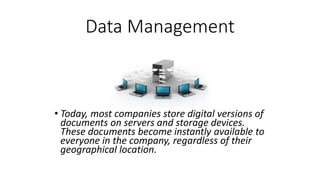
Data Management
• Today, most companies store digital versions of
documents on servers and storage devices.
These documents become instantly available to
everyone in the company, regardless of their
geographical location.
Management Information
System
Management Information Systems (MIS)
enable companies to track sales data,
expenses, productivity levels, profitability over
time, identify areas of improvement and use
the data as part of their strategic planning
process .
Human Resource Management
• The HRIS helps in:
• Human Resource Planning
• Recruitment
• Wage and Salary Planning
• Personnel Record Keeping
• Training and Development

Basic organization of computer

  • 1.
  • 2.
    Basic Organization ofa Computer System Storage Unit Information (Results) Program and Data Input Unit Output Unit Indicates flow of instructions and data Indicates the control exercised by the control unit Central Processing Unit (CPU) Control Unit Arithmetic Logic Unit Secondary Storage Primary Storage
  • 3.
    Input Unit An inputunit of a computer system performs the following functions: 1. It accepts (or reads) instructions and data from outside world It converts these instructions and data in computer acceptable form 2. 3. It supplies the converted instructions and computer system for further processing data to the
  • 4.
    Output Unit An outputunit of a computer system performs the following functions: 1. It accepts the results produced by the computer, which are in coded form and hence, cannot be easily understood by us It converts these coded results to human acceptable2. (readable) It supplies form the converted3. results to outside world
  • 5.
    Storage Unit The storageunit of a computer system holds (or stores) the following : 1. Data and instructions required for processing (received from input devices) Intermediate results of processing2. 3. Final results of processing, before they are released to an output device
  • 6.
    Arithmetic Logic Unit(ALU) Arithmetic Logic Unit of a computer system is the place duringwhere the actual executions of instructions takes place processing operation Functions of ALU :  An ALU performs basic arithmetic and logic operations.  Examples of arithmetic operations are addition, subtraction, multiplication, and division.  Examples of logic operations are comparisons of values such as NOT, AND, and OR.
  • 7.
    Control Unit (CU) ControlUnit of a computer system manages and coordinates the operations of all other components of the computer system
  • 8.
    Central Processing Unit(CPU) =+ It is the brain of a computer system• It is responsible for controlling the operations of• all other units of a computer system Central Processing Unit (CPU) Control Unit (CU) Arithmetic Logic Unit (ALU)
  • 9.
    Computer codes • Textcodes • Converts letters into binary • Standard codes necessary for data transfer • ASCII( American Standard Code for Information Interchange) • American English symbols(a, A, b, B) • Extended ASCII • Graphics and other symbols • Unicode • All languages on the planet 5A-9
  • 10.
  • 11.
    Computer for organization Computertechnology has great applications in almost all kinds of businesses. Almost all kinds of businesses are relying on computers for automating their traditional processes
  • 12.
    Computer for organization •Business Communication • Inventory Management • Customer Relationship Management • Payroll System • Advertisement • Data management • Management Information System • Human Resource Management
  • 13.
    Business Communication • Now-a-dayscompanies use email ,live chat systems, online meeting tools, video- conferencing system and smart-phones as the principal means of communication between employees, suppliers and customers.
  • 14.
  • 15.
     Inventory managementsystems track the quantity of each item a company maintains, triggering an order of additional stock when the quantities fall below a pre-determined amount.
  • 16.
  • 17.
    • Customer RelationshipManagement (CRM) systems stores every interaction a company has with a customer for future reference . The customer has a better, more focused experience and the company benefits from improved productivity.
  • 18.
    Payroll System • Computerizedpay roll system is used in different organizations to maintain pay accounts of employees, easily and quickly.
  • 19.
    Advertisements • Computers playa vital role in advertising. Whether they are paper notices on boards or electronic billboards and online advertisements, every advert via any media is fully done with a computer.
  • 20.
    Data Management • Today,most companies store digital versions of documents on servers and storage devices. These documents become instantly available to everyone in the company, regardless of their geographical location.
  • 21.
    Management Information System Management InformationSystems (MIS) enable companies to track sales data, expenses, productivity levels, profitability over time, identify areas of improvement and use the data as part of their strategic planning process .
  • 22.
    Human Resource Management •The HRIS helps in: • Human Resource Planning • Recruitment • Wage and Salary Planning • Personnel Record Keeping • Training and Development