
Data Communications and
Computer Networks
Learning Objectives
In
•
•
this chapter you will learn about:
Basic elements of a communication system
Techniques, channels, and devices used to transmit
data between distant locations
Types of computer networks
Communication protocols and their use in computer
networks
Internetworking tools and their use in building large
computer networks
•
•
•
•
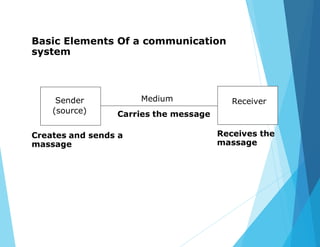
Basic Elements Of a communication
system
Medium
Carries the message
Receives the
massage
Creates and sends a
massage
ReceiverSender
(source)
Data Transmission Media
The most commonly used ones
Twisted-pair wire (UTP cable)
Coaxial cable
Microwave system
are:
•
•
•
•
•
Communications satellite
Optical fibers
Unshielded Twisted-(UTP)
Pair
Cable
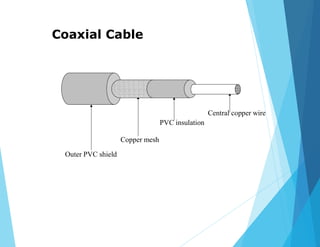
Coaxial Cable
Central copper wire
PVC insulation
Copper mesh
Outer PVC shield
Digital and Analog Data Transmission
• Analog signal: Transmitted power varies over a
continuous range. Example: sound, light, and radio
waves
• Digital signal: Sequence of voltage pulses represented
in binary form
• Computer
telephone
generated data signal is digital, whereas
lines carry analog signals
Digital and Analog Data Transmission
(Continued from previous slide)
• When digital data is to be sent over an analog facility,
digital signals
• Conversion of
modulation
• Conversion of
demodulation
must be converted to analog form
digital signal to analog form is known as
analog signal to digital form is known as
• Digital transmission of data is preferred over analog
transmission
transmission
of data due to lower cost, higher
speeds, and lower error rate
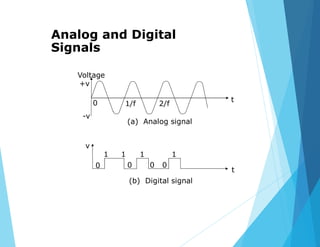
Analog and Digital
Signals
Voltage
+v
t0 1/f 2/f
-v
(a) Analog signal
v
1 1 1 1
0
t
(b) Digital signal
0 0 0
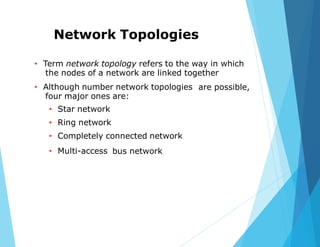
Network Topologies
• Term network topology refers to the way in which
the nodes of a network are linked together
• Although number network topologies
four major ones are:
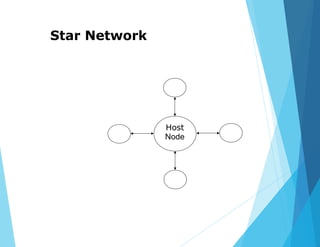
• Star network
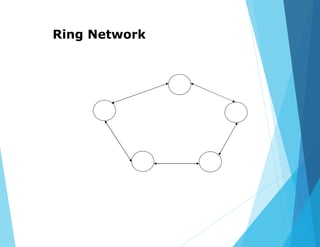
• Ring network
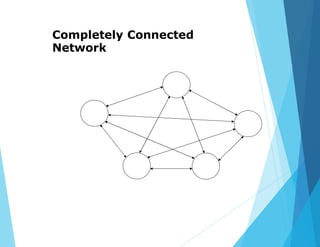
• Completely connected network
are possible,
• Multi-access bus network
Star Network
Host
Node
Ring Network
Completely Connected
Network
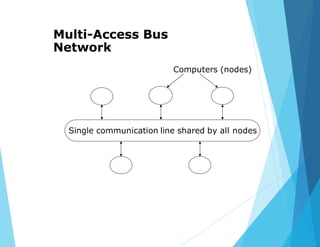
Multi-Access Bus
Network
Computers (nodes)
Single communication line shared by all nodes
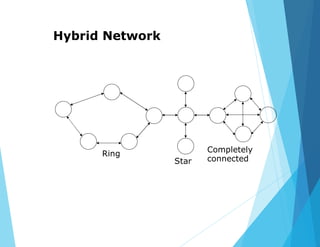
Hybrid Network
Completely
connected
Ring
Star
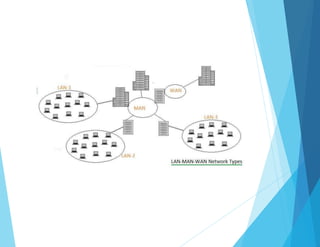
Network Types
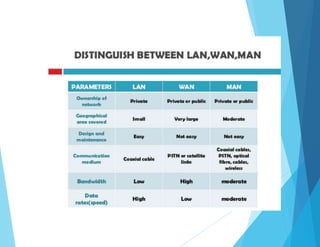
• Networks are broadly classified into two types: Local
Area Network (LAN) and Wide Area Network (WAN)
• Local Area Network (LAN) as compared to WAN:
• Limited to a small geographic coverage
• Has much higher data transmission rate
• Experiences fewer data transmission errors
• Has lower data communication cost
• Typically owned by a single organization
• Networks that share some of the characteristics of both
LANs and WANs are referred to as Metropolitan Area
Network (MAN)
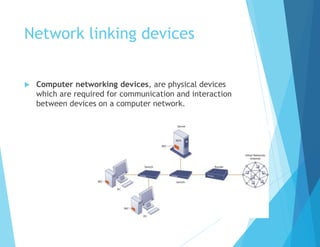
Network linking devices
 Computer networking devices, are physical devices
which are required for communication and interaction
between devices on a computer network.
Network Interface Card (NIC)
• Hardware device that allows a computer to be
connected to a network, both functionally and physically
• Printed circuit board installed on to one of the
expansion
• Provides a
attached
slots of computer
port on the back to which network cable is

Data Communications and Computer Networks

  • 1.
  • 2.
    Learning Objectives In • • this chapteryou will learn about: Basic elements of a communication system Techniques, channels, and devices used to transmit data between distant locations Types of computer networks Communication protocols and their use in computer networks Internetworking tools and their use in building large computer networks • • • •
  • 3.
    Basic Elements Ofa communication system Medium Carries the message Receives the massage Creates and sends a massage ReceiverSender (source)
  • 4.
    Data Transmission Media Themost commonly used ones Twisted-pair wire (UTP cable) Coaxial cable Microwave system are: • • • • • Communications satellite Optical fibers
  • 5.
  • 6.
    Coaxial Cable Central copperwire PVC insulation Copper mesh Outer PVC shield
  • 7.
    Digital and AnalogData Transmission • Analog signal: Transmitted power varies over a continuous range. Example: sound, light, and radio waves • Digital signal: Sequence of voltage pulses represented in binary form • Computer telephone generated data signal is digital, whereas lines carry analog signals
  • 8.
    Digital and AnalogData Transmission (Continued from previous slide) • When digital data is to be sent over an analog facility, digital signals • Conversion of modulation • Conversion of demodulation must be converted to analog form digital signal to analog form is known as analog signal to digital form is known as • Digital transmission of data is preferred over analog transmission transmission of data due to lower cost, higher speeds, and lower error rate
  • 9.
    Analog and Digital Signals Voltage +v t01/f 2/f -v (a) Analog signal v 1 1 1 1 0 t (b) Digital signal 0 0 0
  • 10.
    Network Topologies • Termnetwork topology refers to the way in which the nodes of a network are linked together • Although number network topologies four major ones are: • Star network • Ring network • Completely connected network are possible, • Multi-access bus network
  • 11.
  • 12.
  • 13.
  • 14.
    Multi-Access Bus Network Computers (nodes) Singlecommunication line shared by all nodes
  • 15.
  • 16.
    Network Types • Networksare broadly classified into two types: Local Area Network (LAN) and Wide Area Network (WAN) • Local Area Network (LAN) as compared to WAN: • Limited to a small geographic coverage • Has much higher data transmission rate • Experiences fewer data transmission errors • Has lower data communication cost • Typically owned by a single organization • Networks that share some of the characteristics of both LANs and WANs are referred to as Metropolitan Area Network (MAN)
  • 19.
    Network linking devices Computer networking devices, are physical devices which are required for communication and interaction between devices on a computer network.
  • 20.
    Network Interface Card(NIC) • Hardware device that allows a computer to be connected to a network, both functionally and physically • Printed circuit board installed on to one of the expansion • Provides a attached slots of computer port on the back to which network cable is