
International Business
10/2/2019
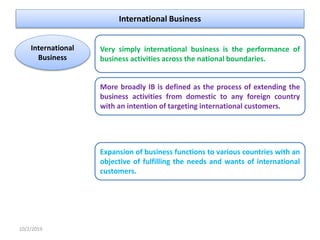
International Business
10/2/2019
International
Business
Very simply international business is the performance of
business activities across the national boundaries.
More broadly IB is defined as the process of extending the
business activities from domestic to any foreign country
with an intention of targeting international customers.
Expansion of business functions to various countries with an
objective of fulfilling the needs and wants of international
customers.
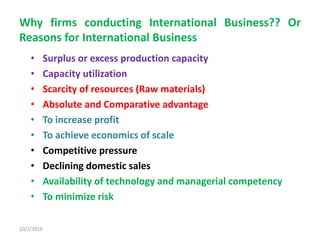
Why firms conducting International Business?? Or
Reasons for International Business
• Surplus or excess production capacity
• Capacity utilization
• Scarcity of resources (Raw materials)
• Absolute and Comparative advantage
• To increase profit
• To achieve economics of scale
• Competitive pressure
• Declining domestic sales
• Availability of technology and managerial competency
• To minimize risk
10/2/2019
Absolute advantage and Comparative
advantage
• Absolute Advantage: When a country can
produce a product more efficiently than any
other nation
• Comparative Advantage: When a country can
produce one product more efficiently and at
a lower cost than other products in
comparison to other nation
10/2/2019
10/2/2019
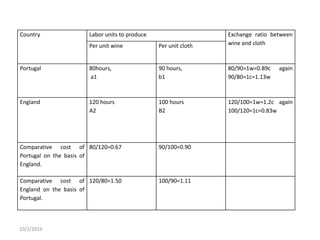
Country Labor units to produce Exchange ratio between
wine and clothPer unit wine Per unit cloth
Portugal 80hours,
a1
90 hours,
b1
80/90=1w=0.89c again
90/80=1c=1.13w
England 120 hours
A2
100 hours
B2
120/100=1w=1.2c again
100/120=1c=0.83w
Comparative cost of
Portugal on the basis of
England.
80/120=0.67 90/100=0.90
Comparative cost of
England on the basis of
Portugal.
120/80=1.50 100/90=1.11
Basic Concept of International Business
10/2/2019
1. Exporting and Importing:
Exporting refers Selling domestic made goods in another country
Importing means Purchasing goods made in another country.
2. Balance of Trade: The difference between the amount a country
exports and the amount it imports
3. Balance of Payment: The total flow of money into and out of a
country.
4. Exchange Rate: The rate at which one country ‘s currency can be
exchanged for that of another country.
• Fixed exchange rate
• Floating exchange rate
Barriers to International Business
1. Cultural and Social Barriers
2. Political Barriers
3. Tariffs and Trade Restrictions:
 Import tariff
 Quota
 Embargo
 Exchange control
10/2/2019
Approaches to international Business/ Modes
of entering into Foreign Market
• Exporting
• Licensing
• Joint Ventures
• Trading Companies
• Countertrading
• Direct Ownership
• Multinational Corporations
10/2/2019
10/2/2019

International Business

  • 1.
  • 2.
    International Business 10/2/2019 International Business Very simplyinternational business is the performance of business activities across the national boundaries. More broadly IB is defined as the process of extending the business activities from domestic to any foreign country with an intention of targeting international customers. Expansion of business functions to various countries with an objective of fulfilling the needs and wants of international customers.
  • 3.
    Why firms conductingInternational Business?? Or Reasons for International Business • Surplus or excess production capacity • Capacity utilization • Scarcity of resources (Raw materials) • Absolute and Comparative advantage • To increase profit • To achieve economics of scale • Competitive pressure • Declining domestic sales • Availability of technology and managerial competency • To minimize risk 10/2/2019
  • 4.
    Absolute advantage andComparative advantage • Absolute Advantage: When a country can produce a product more efficiently than any other nation • Comparative Advantage: When a country can produce one product more efficiently and at a lower cost than other products in comparison to other nation 10/2/2019
  • 5.
    10/2/2019 Country Labor unitsto produce Exchange ratio between wine and clothPer unit wine Per unit cloth Portugal 80hours, a1 90 hours, b1 80/90=1w=0.89c again 90/80=1c=1.13w England 120 hours A2 100 hours B2 120/100=1w=1.2c again 100/120=1c=0.83w Comparative cost of Portugal on the basis of England. 80/120=0.67 90/100=0.90 Comparative cost of England on the basis of Portugal. 120/80=1.50 100/90=1.11
  • 6.
    Basic Concept ofInternational Business 10/2/2019 1. Exporting and Importing: Exporting refers Selling domestic made goods in another country Importing means Purchasing goods made in another country. 2. Balance of Trade: The difference between the amount a country exports and the amount it imports 3. Balance of Payment: The total flow of money into and out of a country. 4. Exchange Rate: The rate at which one country ‘s currency can be exchanged for that of another country. • Fixed exchange rate • Floating exchange rate
  • 7.
    Barriers to InternationalBusiness 1. Cultural and Social Barriers 2. Political Barriers 3. Tariffs and Trade Restrictions:  Import tariff  Quota  Embargo  Exchange control 10/2/2019
  • 8.
    Approaches to internationalBusiness/ Modes of entering into Foreign Market • Exporting • Licensing • Joint Ventures • Trading Companies • Countertrading • Direct Ownership • Multinational Corporations 10/2/2019
  • 9.