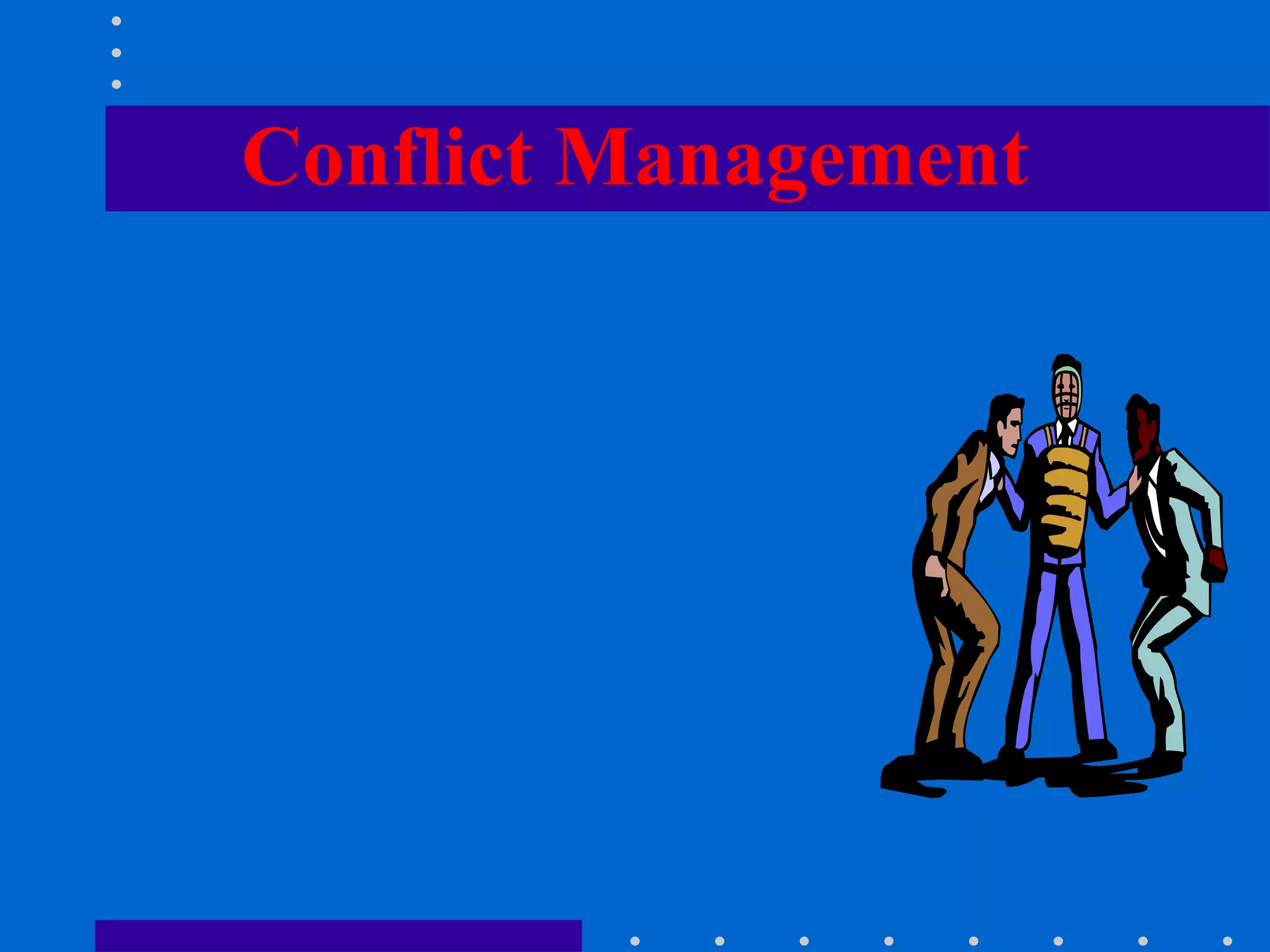
Conflict Management
Learning Objectives
1. To define “conflict”
2. To understand the importance of utilizing
appropriate personnel management skill to
deal with conflicts
3. To review typical conflicts one is involved,
and possible methods generally used
4. To become familiar with necessary skills in
resolving conflicts
Anabia, the Typist
Tania, Sonia and Anabia are typists/secretaries
in your organization. Sonia is from Comillla,
Tania from Chittagong and Anabia from a rural
village in Chandpur. Their average typing speed
during last three months has been:
Sonia (60), Tania (50) and Anabia (30)
What do you think of Anabia’s performance?
(Write your ranking using the scale from 1-5)
Anabia, the Typist (Cont’d)
Sonia and Tania had other jobs before
joining your organization. This is Anabia’s
first job. She joined three months ago
What do you think of Anabia’s
performance?
Anabia, the Typist (Cont’d)
While Sonia and Tania have new imported
typewriters, Anabia has an old one which
“jumps” frequently.
What do you think of Anabia’s performance?
Anabia, the Typist (Cont’d)
Most of Sonia’s and Tania’s work is straight
typing of reports yet they have a considerable
number of errors. Anabia on the other hand is
usually given heavy statistical data and her
work is practically errorless.
What do you think of Fatima’s performance?
What is conflict?
• A battle, contest or opposing forces existing
between primitive desires and moral, religious
or ethical ideas ( Webster’s Dictionary)
• A state of incompatibility of ideas between two
or more parties or individuals
Conflict management is the practice of
identifying and handling conflict in a sensible,
fair and efficient manner
Types of conflict
• Inter-personal and intra-
personal
• Inter-group and intra-group
• Competitive and Disruptive
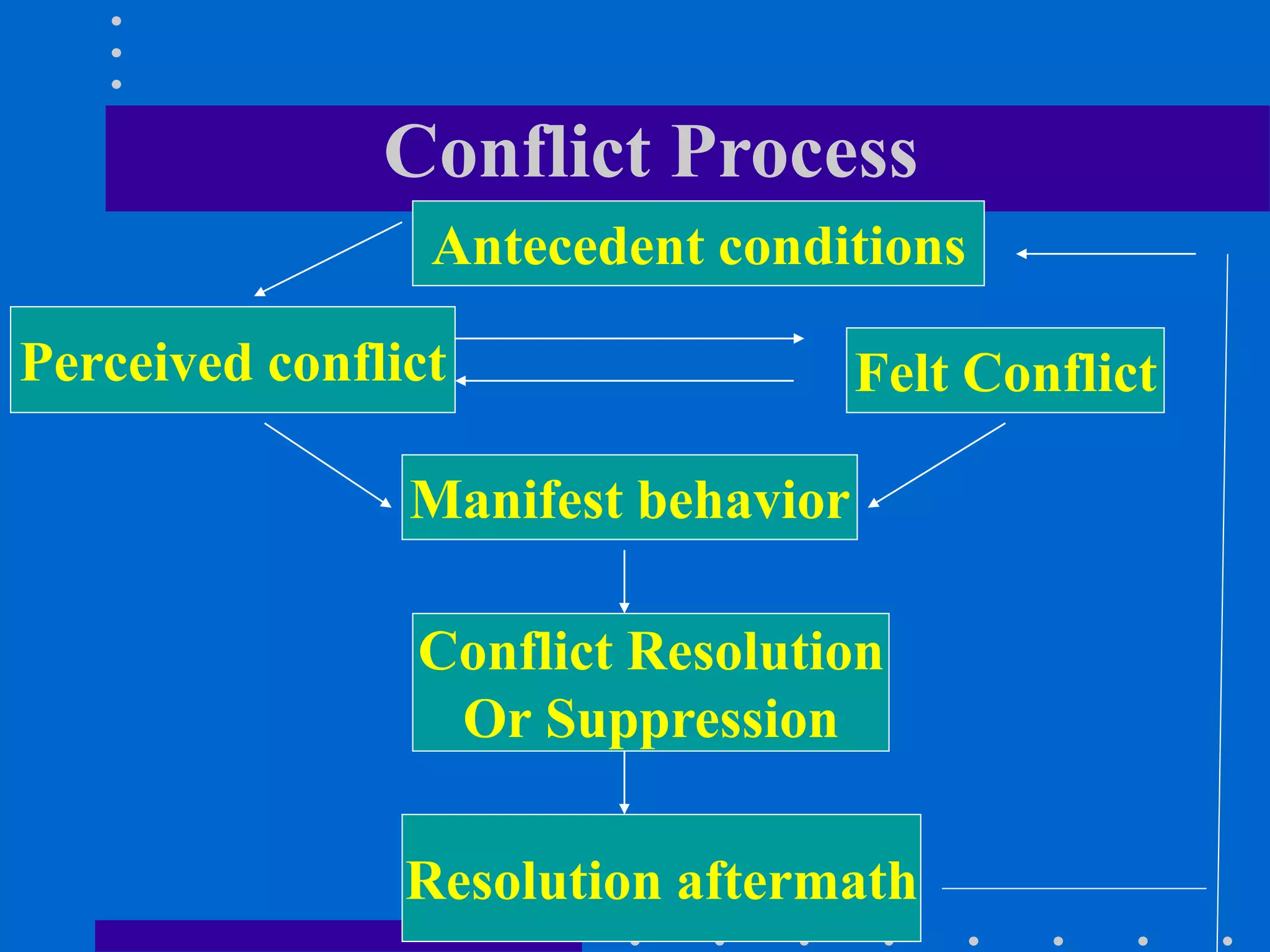
Conflict Process
Antecedent conditions
Perceived conflict Felt Conflict
Manifest behavior
Conflict Resolution
Or Suppression
Resolution aftermath
Antecedent Conditions
• Scarce Resources
• Conflicting attitude
• Ambiguous jurisdiction
• Communication barriers
• Need for consensus
• Unresolved prior conflicts
• Knowledge of self and others
How to create conflict?
• Not being a role model
• Take credit, no recognition
• Be judgmental
• Send written messages
• Subordinate should come to see me
• Make yourself inaccessible to your team
• Individual Vs team approach
• Telling them? Consulting them? Or deciding with them?
• Come tomorrow
• Introduce change without consultation or discussion
General causes of conflicts
• Poorly defined goals
• Divergent personal values
• Lack of cooperation/trust
• Competition of scarce resources
• Unclear roles/lack of job description
Effects of conflict in organizations
• Stress
• Absenteeism
• Staff turnover
• De-motivation
• Non-productivity
Now……….
Individual Exercise
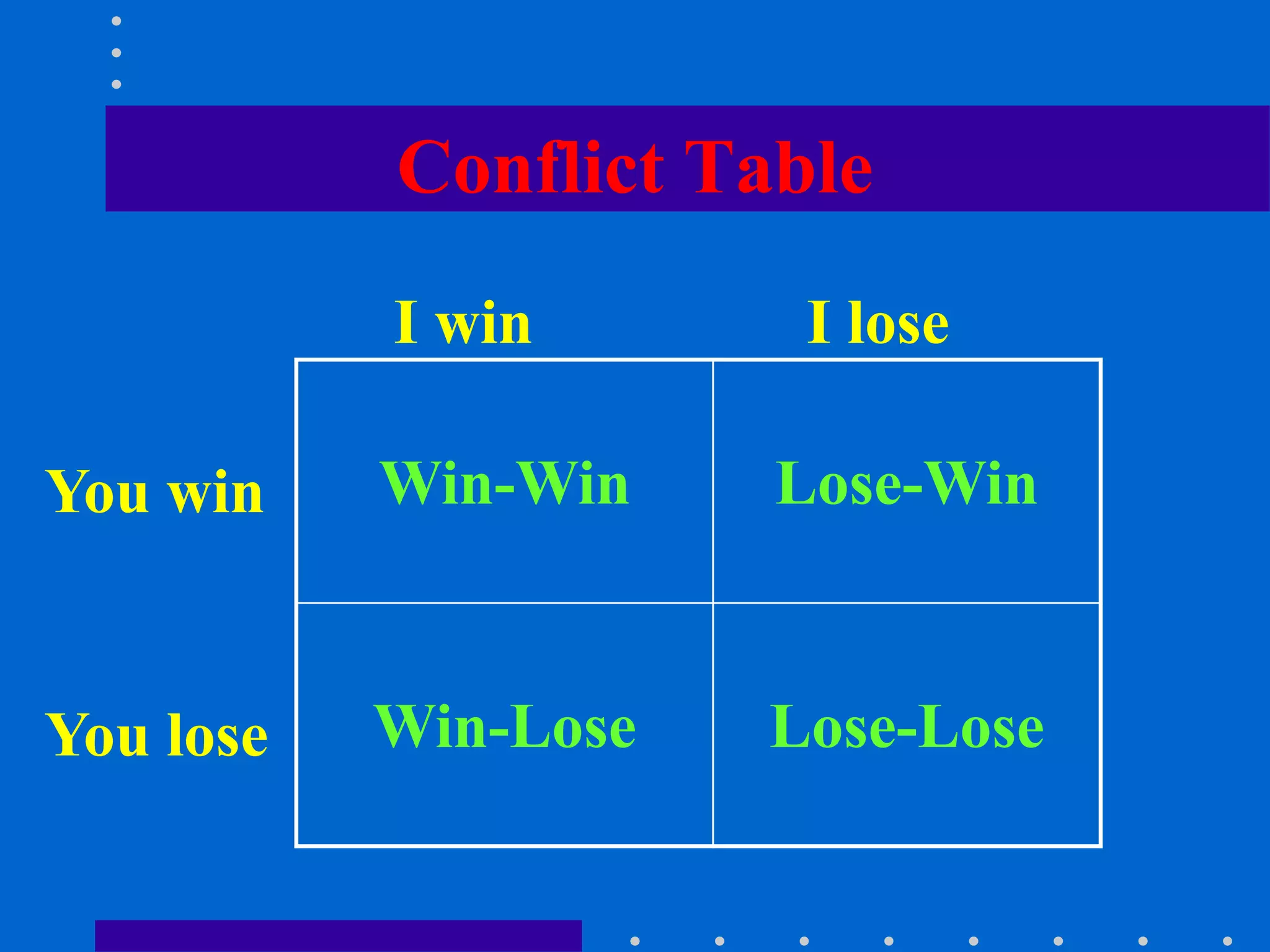
Conflict Table
Win-Win Lose-Win
Win-Lose Lose-Lose
I win I lose
You win
You lose
Methods to deal with conflicts
• Competition (win-lose situation)
• Accommodation (win-win situation)
• Avoidance (lose-lose situation)
• Compromise (lose-lose situation)
• Collaboration (win-win situation)
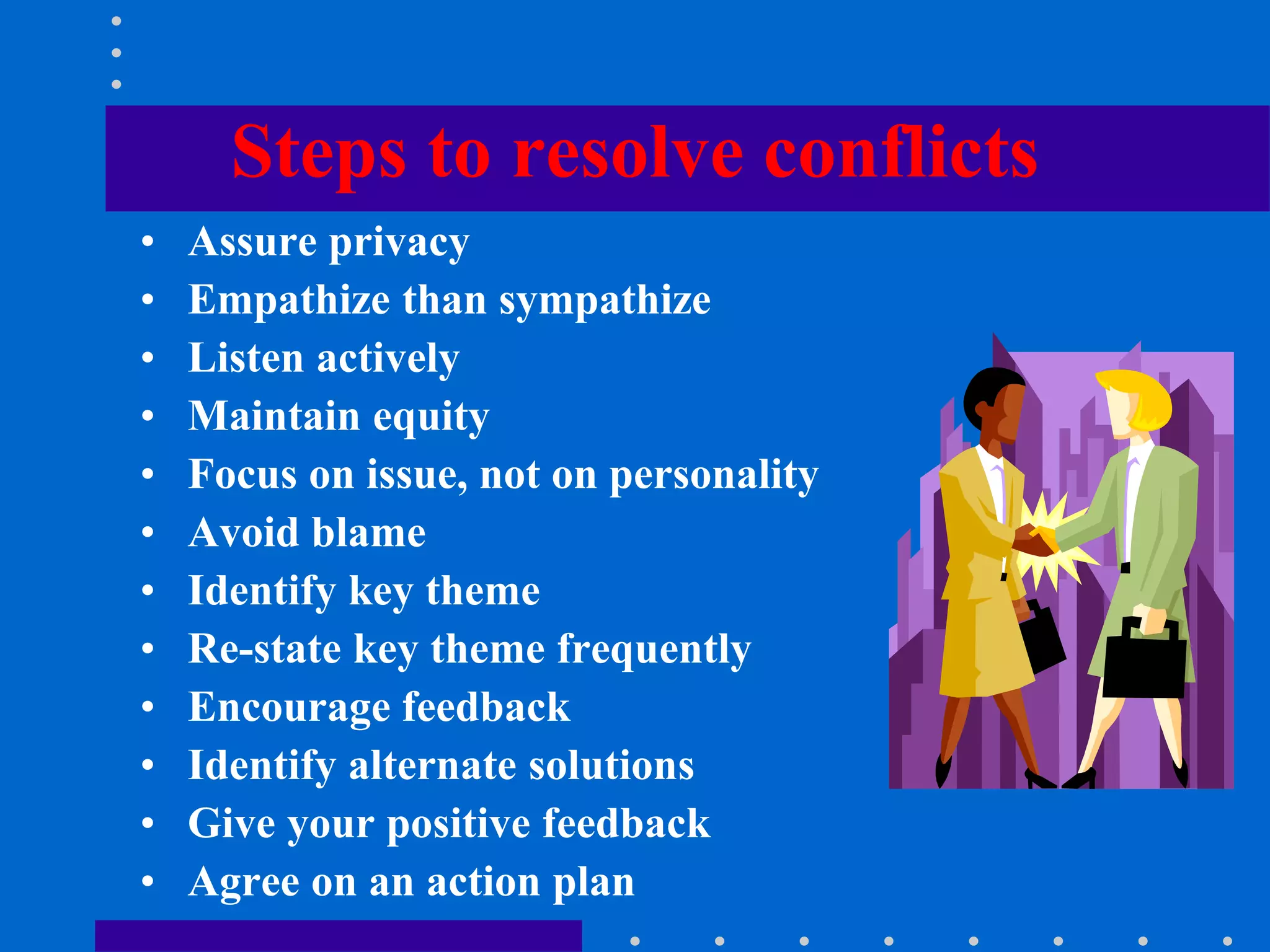
Steps to resolve conflicts
• Assure privacy
• Empathize than sympathize
• Listen actively
• Maintain equity
• Focus on issue, not on personality
• Avoid blame
• Identify key theme
• Re-state key theme frequently
• Encourage feedback
• Identify alternate solutions
• Give your positive feedback
• Agree on an action plan
How to prevent conflicts
• Frequent meeting of your team
• Allow your team to express openly
• Sharing objectives
• Having a clear and detailed job description
• Distributing task fairly
• Never criticize team members publicly
• Always be fair and just with your team
• Being a role model
Case Study
Now
work in a group
Conclusion
Conflict is unavoidable
• Complexity of organizational relationship
• Interaction among workers
• Dependence of workers on one another
Conclusion (Cont’d)
• Conflict is a healthy sign not a
negative process
• It reflects dynamics
Conclusion (Cont’d)
• Poorly managed conflicts
– Unfavorable with counter productive results
– Problems and negative attitude
• Well managed conflicts
– Stimulate competition
– Identify legitimate differences
– Powerful source of motivation

Introductory class of conflict management

  • 1.
  • 2.
    Learning Objectives 1. Todefine “conflict” 2. To understand the importance of utilizing appropriate personnel management skill to deal with conflicts 3. To review typical conflicts one is involved, and possible methods generally used 4. To become familiar with necessary skills in resolving conflicts
  • 3.
    Anabia, the Typist Tania,Sonia and Anabia are typists/secretaries in your organization. Sonia is from Comillla, Tania from Chittagong and Anabia from a rural village in Chandpur. Their average typing speed during last three months has been: Sonia (60), Tania (50) and Anabia (30) What do you think of Anabia’s performance? (Write your ranking using the scale from 1-5)
  • 4.
    Anabia, the Typist(Cont’d) Sonia and Tania had other jobs before joining your organization. This is Anabia’s first job. She joined three months ago What do you think of Anabia’s performance?
  • 5.
    Anabia, the Typist(Cont’d) While Sonia and Tania have new imported typewriters, Anabia has an old one which “jumps” frequently. What do you think of Anabia’s performance?
  • 6.
    Anabia, the Typist(Cont’d) Most of Sonia’s and Tania’s work is straight typing of reports yet they have a considerable number of errors. Anabia on the other hand is usually given heavy statistical data and her work is practically errorless. What do you think of Fatima’s performance?
  • 7.
    What is conflict? •A battle, contest or opposing forces existing between primitive desires and moral, religious or ethical ideas ( Webster’s Dictionary) • A state of incompatibility of ideas between two or more parties or individuals Conflict management is the practice of identifying and handling conflict in a sensible, fair and efficient manner
  • 8.
    Types of conflict •Inter-personal and intra- personal • Inter-group and intra-group • Competitive and Disruptive
  • 9.
    Conflict Process Antecedent conditions Perceivedconflict Felt Conflict Manifest behavior Conflict Resolution Or Suppression Resolution aftermath
  • 10.
    Antecedent Conditions • ScarceResources • Conflicting attitude • Ambiguous jurisdiction • Communication barriers • Need for consensus • Unresolved prior conflicts • Knowledge of self and others
  • 11.
    How to createconflict? • Not being a role model • Take credit, no recognition • Be judgmental • Send written messages • Subordinate should come to see me • Make yourself inaccessible to your team • Individual Vs team approach • Telling them? Consulting them? Or deciding with them? • Come tomorrow • Introduce change without consultation or discussion
  • 12.
    General causes ofconflicts • Poorly defined goals • Divergent personal values • Lack of cooperation/trust • Competition of scarce resources • Unclear roles/lack of job description
  • 13.
    Effects of conflictin organizations • Stress • Absenteeism • Staff turnover • De-motivation • Non-productivity
  • 14.
  • 15.
    Conflict Table Win-Win Lose-Win Win-LoseLose-Lose I win I lose You win You lose
  • 16.
    Methods to dealwith conflicts • Competition (win-lose situation) • Accommodation (win-win situation) • Avoidance (lose-lose situation) • Compromise (lose-lose situation) • Collaboration (win-win situation)
  • 17.
    Steps to resolveconflicts • Assure privacy • Empathize than sympathize • Listen actively • Maintain equity • Focus on issue, not on personality • Avoid blame • Identify key theme • Re-state key theme frequently • Encourage feedback • Identify alternate solutions • Give your positive feedback • Agree on an action plan
  • 18.
    How to preventconflicts • Frequent meeting of your team • Allow your team to express openly • Sharing objectives • Having a clear and detailed job description • Distributing task fairly • Never criticize team members publicly • Always be fair and just with your team • Being a role model
  • 19.
  • 20.
    Conclusion Conflict is unavoidable •Complexity of organizational relationship • Interaction among workers • Dependence of workers on one another
  • 21.
    Conclusion (Cont’d) • Conflictis a healthy sign not a negative process • It reflects dynamics
  • 22.
    Conclusion (Cont’d) • Poorlymanaged conflicts – Unfavorable with counter productive results – Problems and negative attitude • Well managed conflicts – Stimulate competition – Identify legitimate differences – Powerful source of motivation