The Basic Organization of
Computers
Today’s Menu
 Daal chawal without salad, chatni and
achaar
Motherboard
 based on stored
program design
 processor system
 CPU
 memory
 input/output
system
 input/output
devices
 secondary storage
Electronic Digital Computers
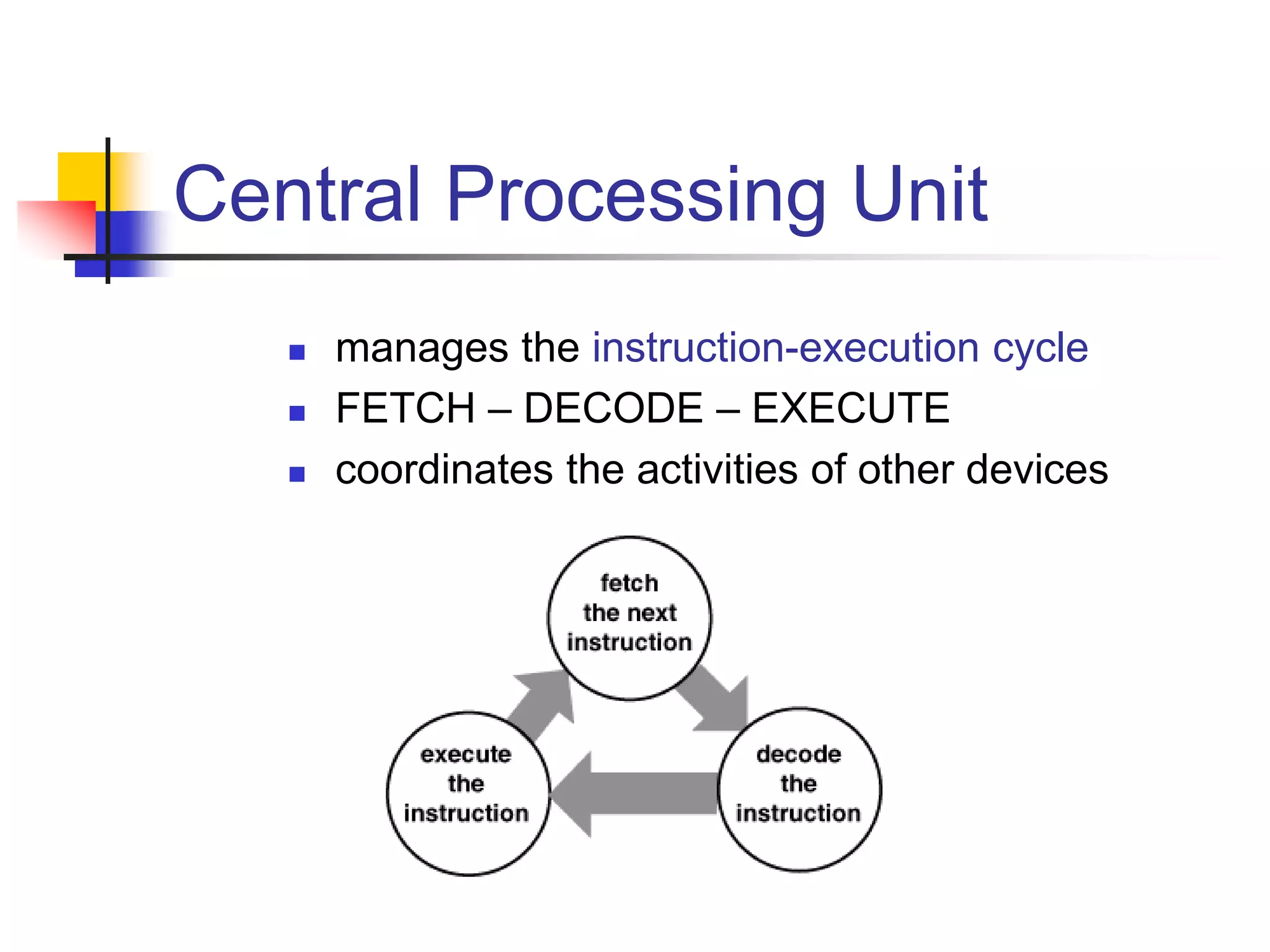
 manages the instruction-execution cycle
 FETCH – DECODE – EXECUTE
 coordinates the activities of other devices
Central Processing Unit
The CPU and Main Memory
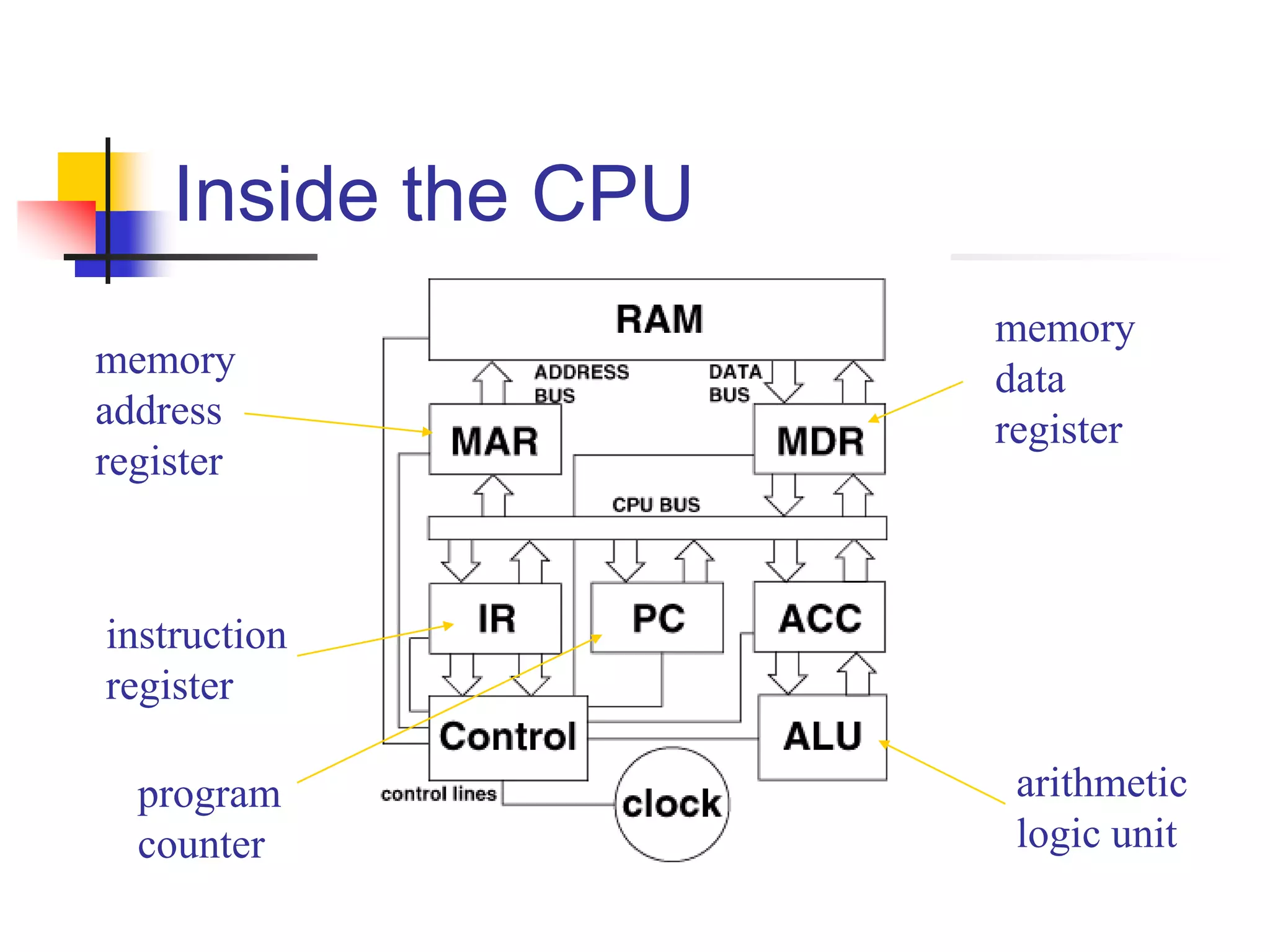
Inside the CPU
Inside the CPU
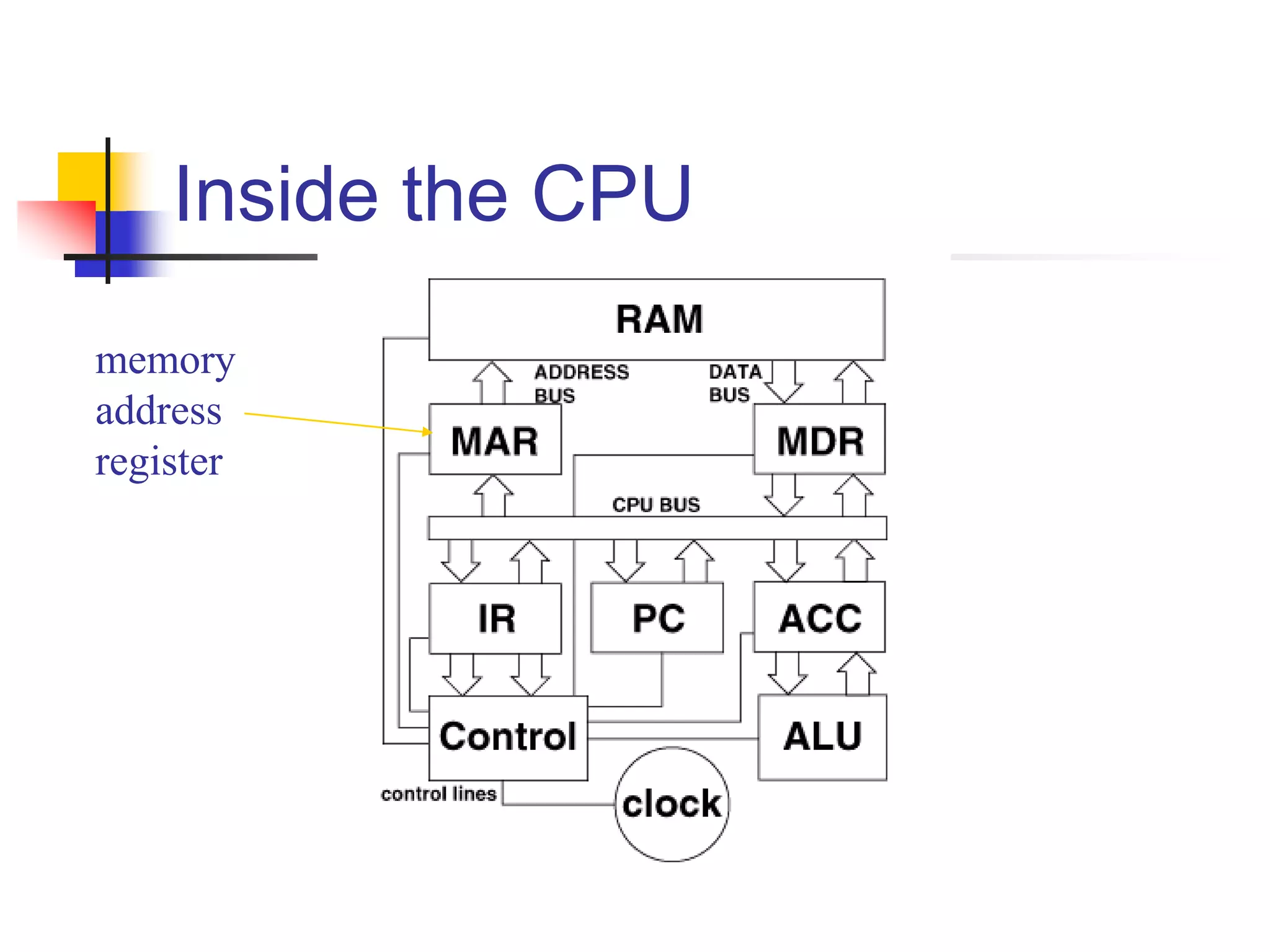
memory
address
register
memory
address
register
memory
data
register
Inside the CPU
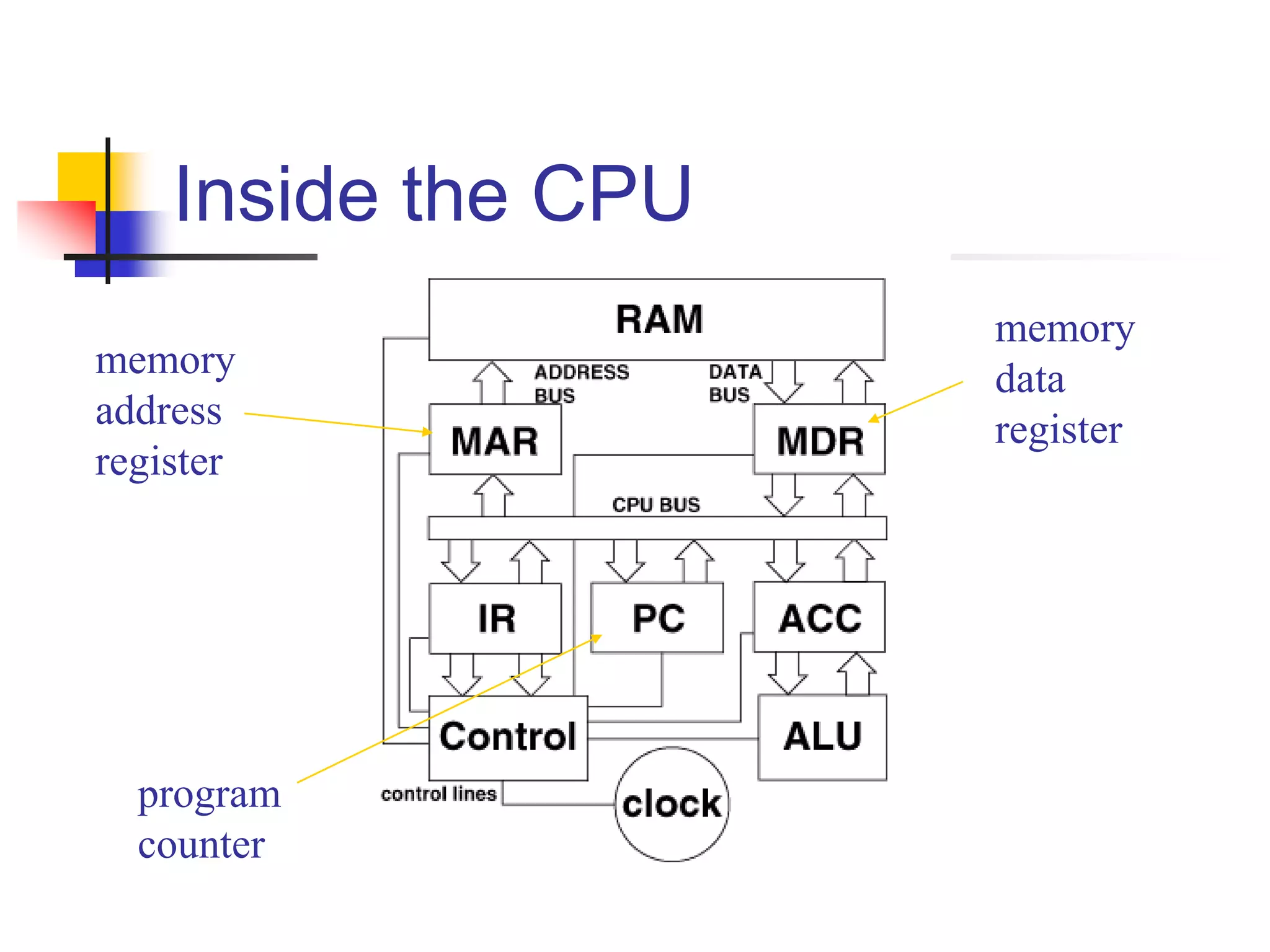
memory
address
register
memory
data
register
program
counter
Inside the CPU
memory
address
register
instruction
register
memory
data
register
program
counter
Inside the CPU
memory
address
register
instruction
register
memory
data
register
program
counter
arithmetic
logic unit
Inside the CPU
memory
address
register
instruction
register
memory
data
register
program
counter
accumulator
(work
register)
arithmetic
logic unit
Inside the CPU
memory
address
register
instruction
register
memory
data
register
program
counter
accumulator
(work
register)
arithmetic
logic unitsystem
clock
Inside the CPU
1. address of the
next instruction is
transferred from
PC to MAR
2. the instruction is
located in memory
FETCH the instruction
3. instruction is
copied from
memory to MDR
FETCH the instruction
instruction is
transferred to
and decoded in
the IR
DECODE the instruction
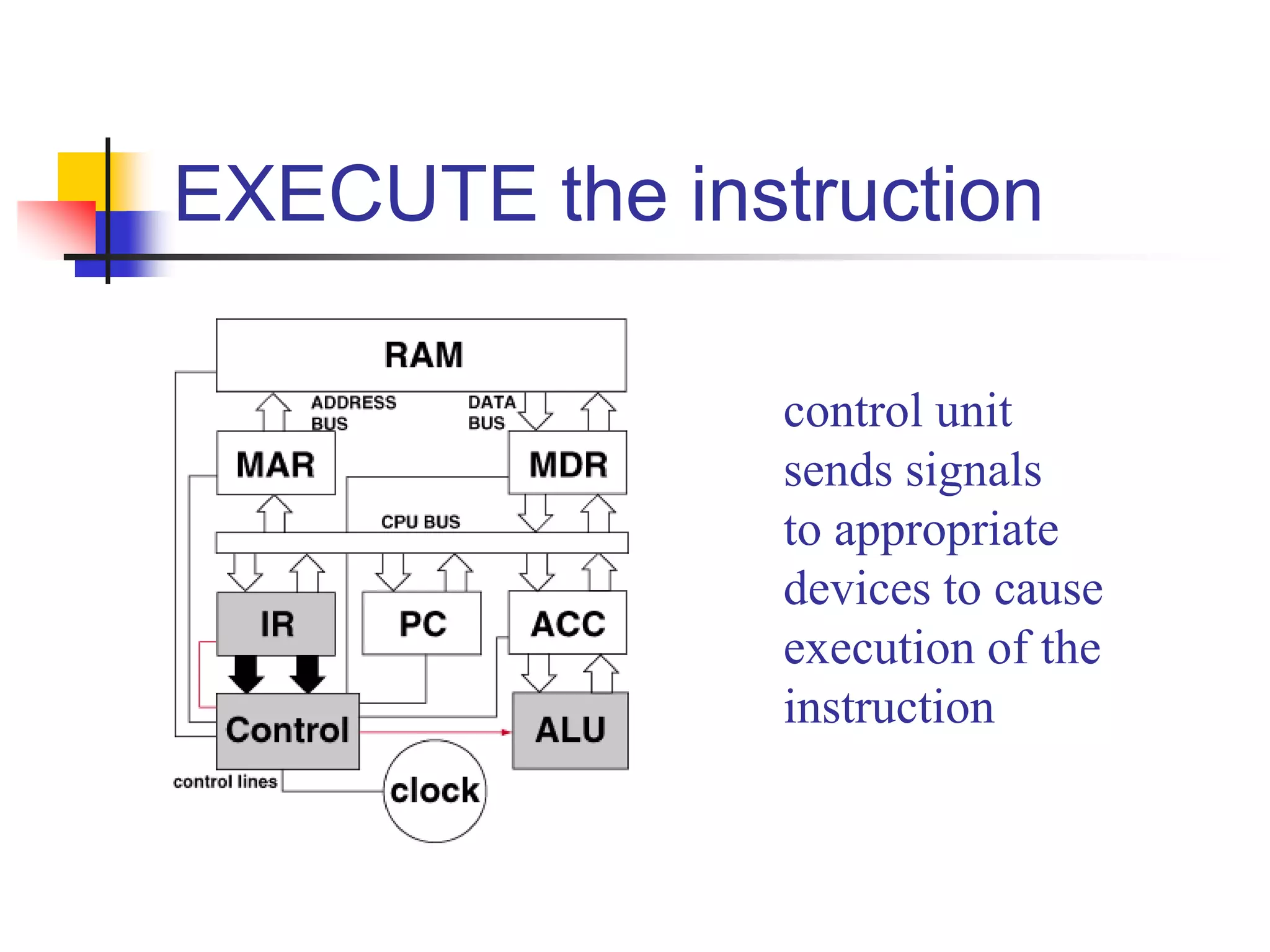
control unit
sends signals
to appropriate
devices to cause
execution of the
instruction
EXECUTE the instruction
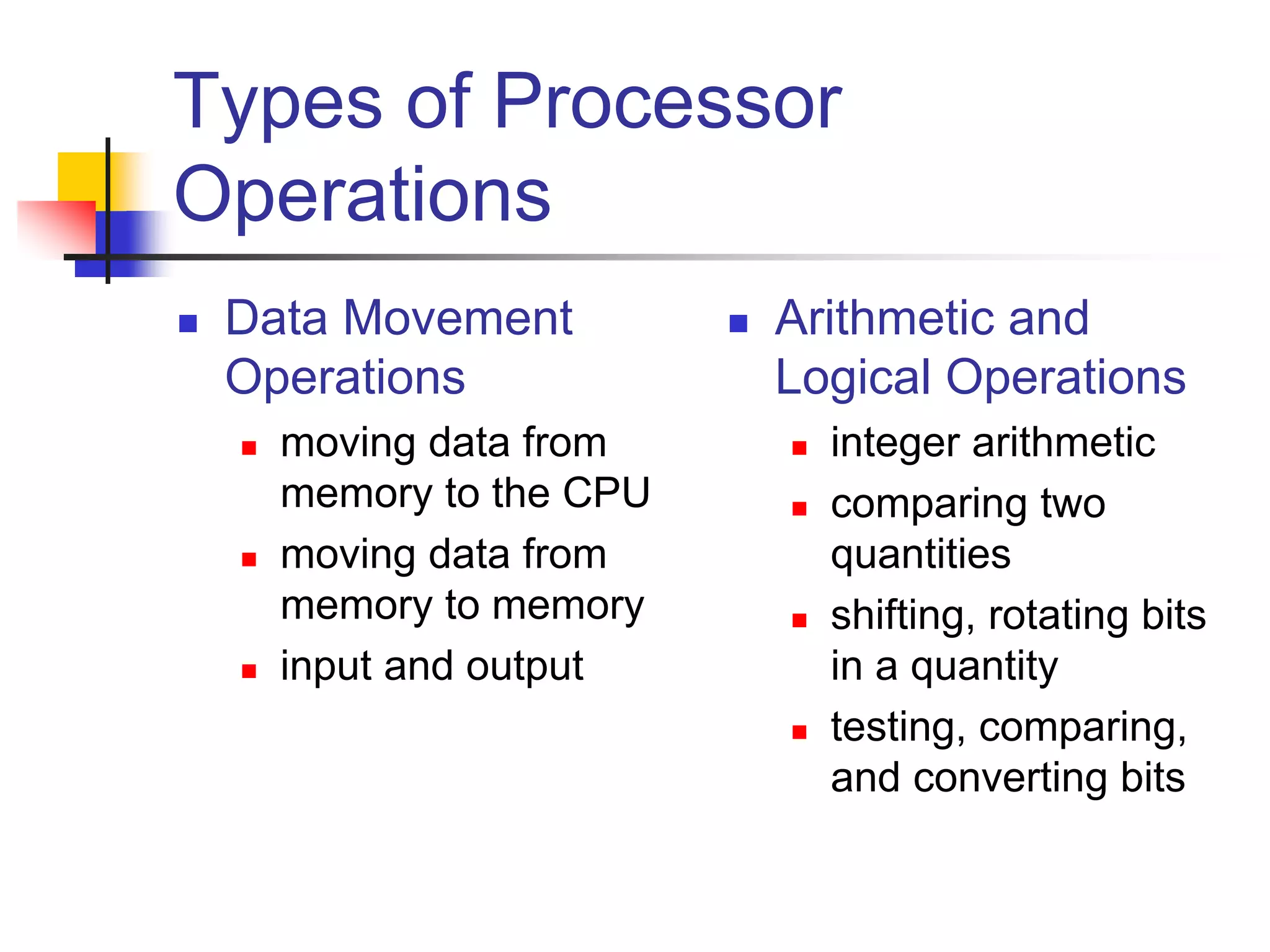
 Data Movement
Operations
 moving data from
memory to the CPU
 moving data from
memory to memory
 input and output
 Arithmetic and
Logical Operations
 integer arithmetic
 comparing two
quantities
 shifting, rotating bits
in a quantity
 testing, comparing,
and converting bits
Types of Processor
Operations
 Program Control
 starting a program
 halting a program
 skipping to other
instructions
 testing data to
decide whether to
skip over some
instructions
Types of Processor
Operations
PROCESSOR REGISTERS
 A processor has many registers to hold instructions, addresses,
data, etc
 The processor has a register, the Program Counter (PC) that
holds the memory address of the next instruction to get
 Since the memory in the Basic Computer only has 4096
locations, the PC only needs 12 bits
 In a direct or indirect addressing, the processor needs to keep
track of what locations in memory it is addressing: The Address
Register (AR) is used for this
 The AR is a 12 bit register in the Basic Computer
PROCESSOR REGISTERS
 When an operand is found, using either direct
or indirect addressing, it is placed in the Data
Register (DR). The processor then uses this
value as data for its operation
 The Basic Computer has a single general
purpose register – the Accumulator (AC)
PROCESSOR REGISTERS
 The significance of a general purpose register is that it can be
referred to in instructions
 e.g. load AC with the contents of a specific memory location;
store the contents of AC into a specified memory location
 Often a processor will need a scratch register to store
intermediate results or other temporary data; in the Basic
Computer this is the Temporary Register (TR)
PROCESSOR REGISTERS
 The Basic Computer uses a very simple model of input/output
(I/O) operations
 Input devices are considered to send 8 bits of character data
to the processor
 The processor can send 8 bits of character data to output
devices
 The Input Register (INPR) holds an 8 bit character gotten from
an input device
 The Output Register (OUTR) holds an 8 bit character to be
send to an output device
PROCESSOR REGISTERS
Registers in the Basic Computer
11 0
PC
15 0
IR
15 0
TR
7 0
OUTR
15 0
DR
15 0
AC
11 0
AR
INPR
0 7
Memory
4096 x 16
CPU
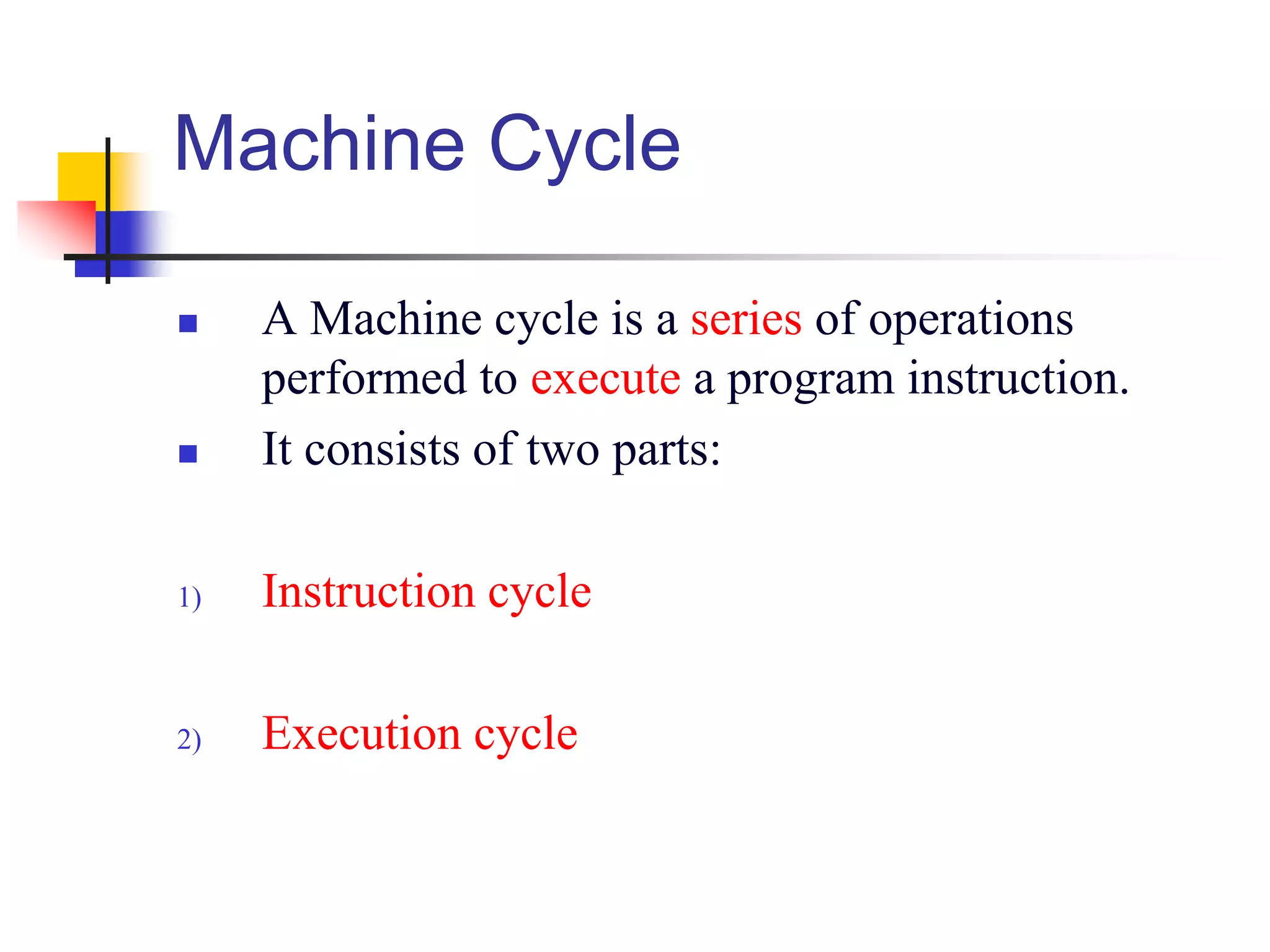
Machine Cycle
 A Machine cycle is a series of operations
performed to execute a program instruction.
 It consists of two parts:
1) Instruction cycle
2) Execution cycle
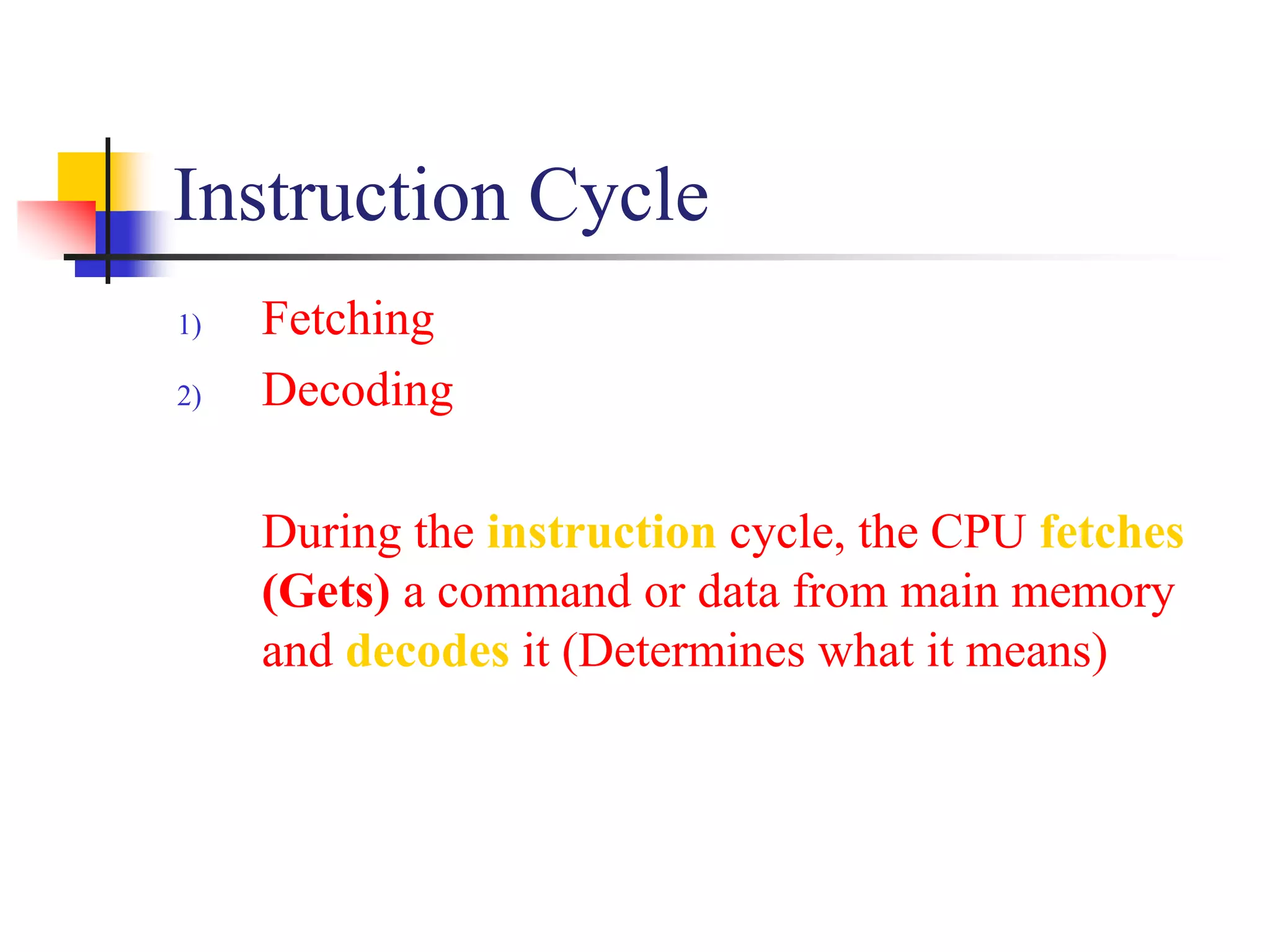
Instruction Cycle
1) Fetching
2) Decoding
During the instruction cycle, the CPU fetches
(Gets) a command or data from main memory
and decodes it (Determines what it means)
Execution Cycle
1) Executing
2) Storing
During the execution cycle, the CPU executes
the instruction (Performs the Operation on the
data), and may store the instruction's result in
memory/Register
Processing Speeds
 There are three ways in which processing speeds
are measured:
1) Time to complete one machine cycle in fractions
of a second.
2) Time to complete instructions in millions of
instructions per second.
3) Time in floating point operations per second.
Factors Affecting Processing
Speed
 Registers – temp memory area – 32 bit
 Memory and computing power - RAM
 System clock – Hz – cycles - GHz
 The bus – the highway
 The data bus – CPU & devices
 The address bus – CPU & RAM
 Cache memory – L1(CPU resident), L2 (External)
31
Intel Processors
Current Intel processors
32
Intel Processors (cont’d.)
Current Intel processors (continued)
33
AMD Processors
Current AMD processors
34
Beep Codes and Their Meanings

The Basic Organization of Computers