BASAL READING APPROACH
It is a core reading program that is used to teach children to read. It is usually a grade-levelled series of textbooks produced by an educational publisher which focus on teaching reading either by a code-emphasis approach or a meaning-emphasis approach.
It is very dependent on books and instructional materials, in terms of its presentation.
Code emphasis approachRelies heavily on phonemic awareness and decoding and word attack skills
Meaning-emphasis programTends to stress the concept of "reading for understanding" and the accompanying workbooks have questions about the stories read, vocabulary lessons and lessons encouraging students to write about what they have read.
History
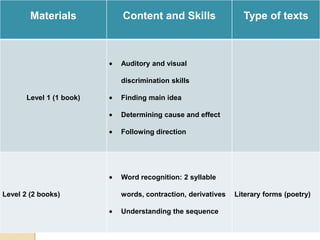
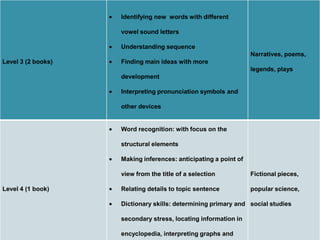
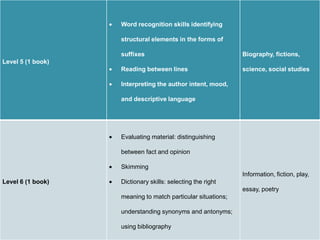
Materials and Content of Basal Reader
Advantages1. Well organized, each skill is presented in a sequential order.2. Good scope and sequence; skills are taught continuously throughout all of the grades.3. Teacher's manual is full of ideas to be used. 4. Readers are colorful, well illustrated, and contain a variety of literature appropriate for each age.
Advantages 5. Includes systematic instruction in word recognition, comprehension, and some study skills with a gradual introduction of each new skill. 6. A big help to a beginning teacher.7. Some contain criterion-referenced tests to check skill mastery.
Advantages 8. Some have an IRI for placement.9. Stories attempt to be multi-ethnic and non-stereotyping of women.
Limitations 1. Readability. The stories often vary widely in grade level within a reader.2. Teachers have a tendency to regard the guide as The Source instead of as a guide.3. Recreational reading for pleasure is often neglected.
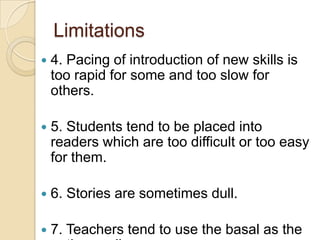
Limitations4. Pacing of introduction of new skills is too rapid for some and too slow for others.5. Students tend to be placed into readers which are too difficult or too easy for them. 6. Stories are sometimes dull.7. Teachers tend to use the basal as the entire reading.
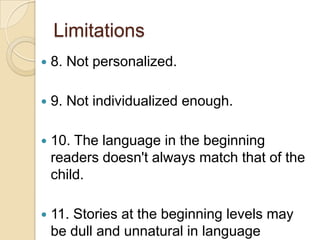
Limitations8. Not personalized.9. Not individualized enough.10. The language in the beginning readers doesn't always match that of the child. 11. Stories at the beginning levels may be dull and unnatural in language patterns.

Basal reading approach

  • 1.
  • 2.
    It is acore reading program that is used to teach children to read. It is usually a grade-levelled series of textbooks produced by an educational publisher which focus on teaching reading either by a code-emphasis approach or a meaning-emphasis approach.
  • 3.
    It is verydependent on books and instructional materials, in terms of its presentation.
  • 4.
    Code emphasis approachReliesheavily on phonemic awareness and decoding and word attack skills
  • 5.
    Meaning-emphasis programTends tostress the concept of "reading for understanding" and the accompanying workbooks have questions about the stories read, vocabulary lessons and lessons encouraging students to write about what they have read.
  • 6.
  • 7.
    Materials and Contentof Basal Reader
  • 11.
    Advantages1. Well organized,each skill is presented in a sequential order.2. Good scope and sequence; skills are taught continuously throughout all of the grades.3. Teacher's manual is full of ideas to be used. 4. Readers are colorful, well illustrated, and contain a variety of literature appropriate for each age.
  • 12.
    Advantages 5. Includessystematic instruction in word recognition, comprehension, and some study skills with a gradual introduction of each new skill. 6. A big help to a beginning teacher.7. Some contain criterion-referenced tests to check skill mastery.
  • 13.
    Advantages 8. Somehave an IRI for placement.9. Stories attempt to be multi-ethnic and non-stereotyping of women.
  • 14.
    Limitations 1. Readability.The stories often vary widely in grade level within a reader.2. Teachers have a tendency to regard the guide as The Source instead of as a guide.3. Recreational reading for pleasure is often neglected.
  • 15.
    Limitations4. Pacing ofintroduction of new skills is too rapid for some and too slow for others.5. Students tend to be placed into readers which are too difficult or too easy for them. 6. Stories are sometimes dull.7. Teachers tend to use the basal as the entire reading.
  • 16.
    Limitations8. Not personalized.9.Not individualized enough.10. The language in the beginning readers doesn't always match that of the child. 11. Stories at the beginning levels may be dull and unnatural in language patterns.