The Language 
Experience approach 
Teaching English for Secondary Education 
Universidad Santo Tomás 
Professor Cecilia Maller A 
(Based on Christy Ann Lacuesta´s PPP)
What is a Language Experience ? 
• A strategy to develop and reinforce reading and writing 
using personal experiences and student´s own 
repertoire of language. 
• The students themselves initiate with their own 
experiences; through projects and other resulting 
interactive activities. 
• Ex. Going on a trip, seeing a movie, 
Looking at a picture, etc.
Language Experience : A Method 
• Language experience approach is a method actually uses 
students own words to help them read. 
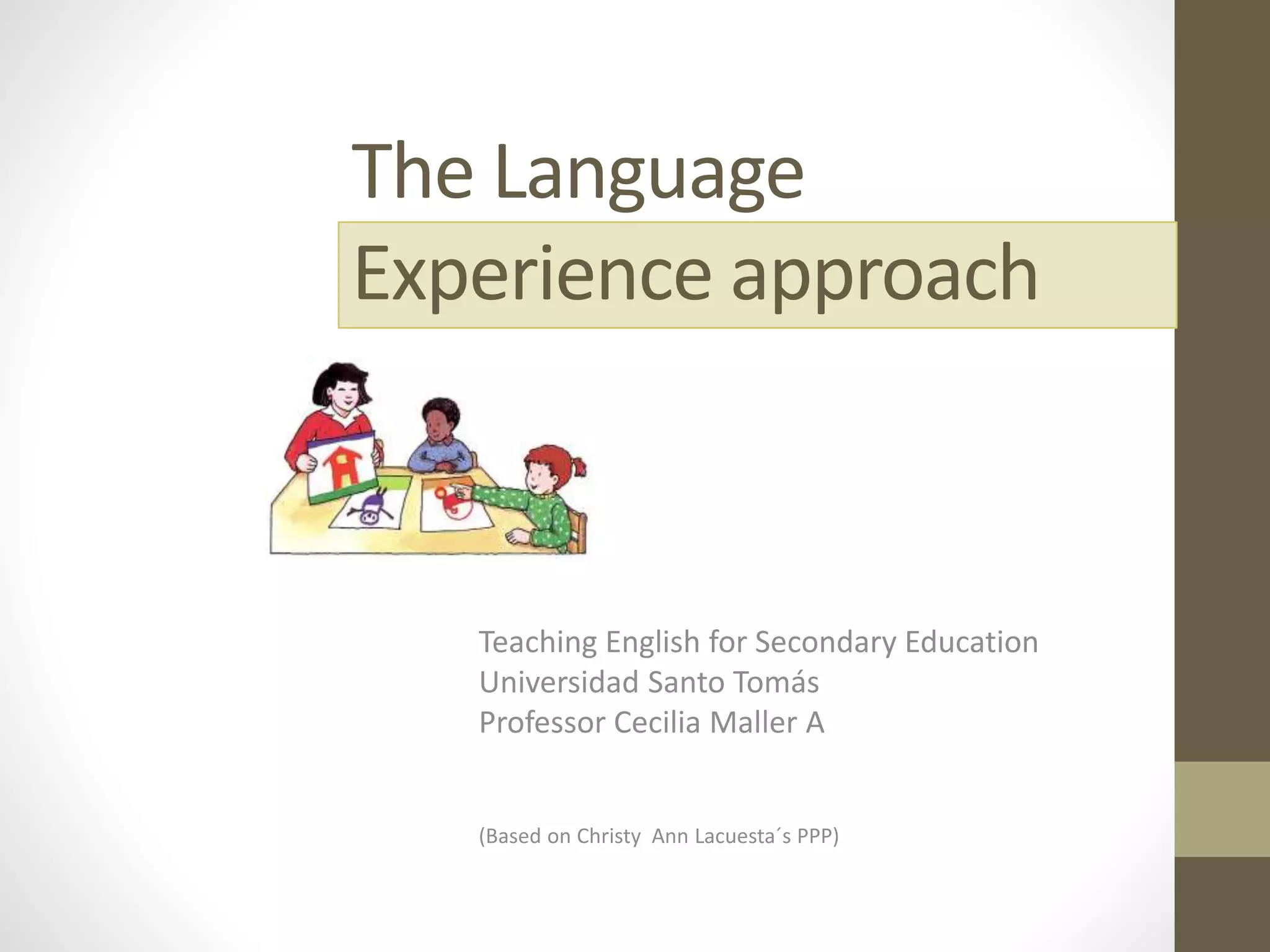
Your student may draw a picture of Dad in a car. In that 
case you would write underneath the drawing; Dad is in the 
car. 
You continue to collect drawings your students makes and 
write a short sentence underneath each drawing. A picture of 
a playground would read. We went to the playground.
When you’ve collected enough pictures you make them into 
a book for your students to read again and again. Write 
underneath the drawing a description your student gives for 
drawing. This way your student will remember much better 
what is written. 
First you will write every word and sentence. Slowly your 
student will begin to trace over the words you have written 
and finally the student will write the words and sentences 
alone.
• Some people use this method as a first approach to 
reading in order to help their student understand that 
what they’ve drawn and what you have written is a 
form of communication between the student and 
yourself. 
• The Language experience approach supports learner’s 
concept development and vocabulary growth while 
offering many opportunities for meaningful reading and 
writing activities through the use of personal 
experiences and oral language.
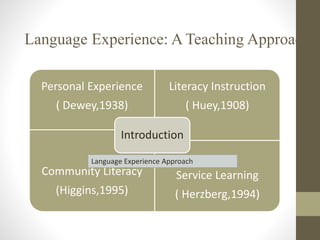
Language Experience: A Teaching Approach 
Personal Experience 
( Dewey,1938) 
Literacy Instruction 
( Huey,1908) 
Introduction 
Language Experience Approach 
Community Literacy 
(Higgins,1995) 
Service Learning 
( Herzberg,1994)
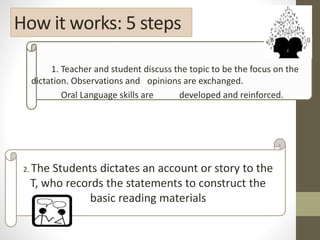
How it works: 5 steps 
1. Teacher and student discuss the topic to be the focus on the 
1 
dictation. Observations and opinions are exchanged. 
Oral Language skills are developed and reinforced. 
2. The Students dictates an account or story to the 
T, who records the statements to construct the 
basic reading materials
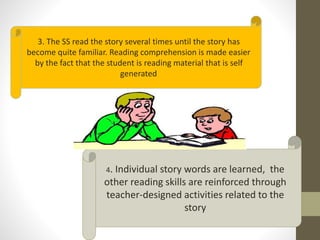
3. The SS read the story several times until the story has 
become quite familiar. Reading comprehension is made easier 
by the fact that the student is reading material that is self 
generated 
4. Individual story words are learned, the 
other reading skills are reinforced through 
teacher-designed activities related to the 
story
5. Students move from reading their own dictation 
to reading other-author materials as they develop 
confidence and skill with reading process
Theoretical Support 
• Based on several key language learning principles
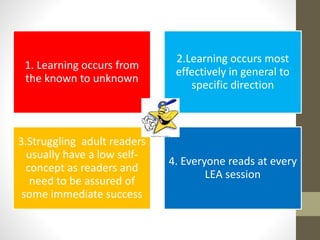
1. Learning occurs from 
the known to unknown 
2.Learning occurs most 
effectively in general to 
specific direction 
3.Struggling adult readers 
usually have a low self-concept 
as readers and 
need to be assured of 
some immediate success 
4. Everyone reads at every 
LEA session
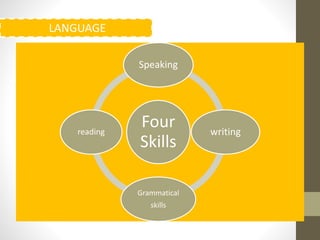
Speaking 
Four 
Skills 
writing 
Grammatical 
skills 
LANGUAGE 
reading
HOW C AN WE MOST EFFECTIVELY ADAPT 
THE LEA? 
• Providing all the input for sometime and taking the heat off the 
student ( Wales,1994,p.203) 
• Advocates the use of picture or word cues to initiate and 
contextualize topics of conversation (Ringel,1989) 
• Cooperative Learning
LEA follow-up lessons on: 
•Grammar 
•Lexicon 
•Pronunciation 
•spelling
The LEA 
Although there is no one “super method” 
for language teaching, LEA offers a: 
useful and effective method for beginning 
literacy instruction . 
How? 
by linking the students’ language and 
experience in learning
• Language experience encourages students to: 
explore, think and talk. 
This talk, during and after the language 
experience provides: 
*many opportunities to expand students’ 
vocabulary, 
*extend their knowledge of grammar, and 
*scaffold their interactions.
• Language experience activities also help to 
provide a bank of experiences that 
students have in common. 
• These can be recalled and referred to in 
subsequent learning.
• Language experience activities are often 
related to current topics or to students’ own 
lives. They can be particularly effective when 
linked to a specific text. 
Examples: 
●visiting the supermarket after reading 
Finding Mum to find the items in the story 
and making a meal out of the ingredients. 
●using skype to talk to students in another 
school before or after reading Talking to 
Nanny.
The role of the TEACHER 
• to model the writing and the thinking aloud process; 
• to develop writing skills and introduce different writing genres 
through mini-lessons; 
• to promote rereading as a strategy for students to remember what 
they are writing about; 
• to develop purpose of writing and writing for an audience; 
• to demonstrate appropriate writing conventions.
Observers will see: 
• students and teacher thinking aloud about their experience 
while writing about it; 
• the teacher modeling the translation of students’ signs into an 
appropriate written version; 
• students rereading what they have dictated 
• Students documenting their language experience through 
pictures and written compositions
How to record language experience: 
• Ask students to sign what they are learning. 
• Act as a scribe and write in English what is signed. 
• Sign back to the students to make sure they agree with 
the story that was written down. 
• “Think aloud” to demonstrate processes to students.
• Relate the complexity of the text to the language 
level of the students. 
• Let the students contribute drawings or other art 
to enhance the writings. 
• Use mini lessons to focus on specific language or 
reading skills.
Hope you enjoyed today´s class
REFERENCES 
Bruffee, K. A. (1993). 
Collaborative learning: Higher education, interdependence, and the authority of 
knowledge. London: John Hopkins UP. 
Bruner, J. S. (1983). 
In search of mind: Essays in autobiography. NY: Harper. 
Caplan, M. (1989). 
Making it meaningful: A whole language guide for literacy tutors. Saint John, N.B.: 
Laubach Literacy of Canada. 
Dewey, J. (1938). 
Experience and education: The Kappa Delta Pi lecture. New York: Macmillan. 
Dixon, C. N., & Nessel, D. D. (1983). 
Language experience approach to reading and writing: Language experience reading 
for second language learners. Hayward, CA: Alemany Press
Herzberg, B. (1994). Community service and critical teaching. College 
composition and communication, 45, 307-319. 
Huey, E. B. (1908). The psychology and pedagogy of reading. New York: 
Macmillan. [Republished (1968) by M.I.T. Press in Cambridge: MA] 
Jones, E. V. (1986). Teaching reading through experience. Life Learning, 9(7), 
Lamoreaux, L., & Lee, D. M. (1943). Learning to read through experiences. NY: 
Appleton-Century-Crofts. Morris, R. (1979). Success and failure in learning to read. 
Hammondsworth: Penguin. 
Nessel, D. D., & Jones, M. B. (1981). The language-experience approach to reading: A handbook 
for teachers. NY: Teachers College Press. 
Peck, W., Flower, L., & Higgins, L. (1995). Community literacy. College composition and 
communication, 46, 199-222. 
Richard, Patricia(2003). Making it happen, From Interactive to Participatory Language Teaching. 
Ringel, H. (1989). English as a second language: Language experience approach-instructional 
guide and ESL reader. Philadelphia: National Service Center. Educational 
Resources Information Clearinghouse Document No. 318 275. 
Spinner, J. (1997, March 13) Columnist’s criticism of composition courses inaccurate, 
wrongheaded. Arizona Daily Wildcat, p. 4
Stauffer, R. G. (1980). The language experience approach to the teaching of 
reading. NY: Harper & Row. 
Wales, M. L. (1994). A language experience approach (LEA) in adult 
immigrant literacy programs in Australia. Journal of Reading, 38, 200-208. 
Wurr, A. J. & Rutkin, T. J. (1998). The language experience approach: Linking 
experience and education for adult L2 learners. Shimonoseki Municipal 
University

The Language Experience Approach

  • 1.
    The Language Experienceapproach Teaching English for Secondary Education Universidad Santo Tomás Professor Cecilia Maller A (Based on Christy Ann Lacuesta´s PPP)
  • 2.
    What is aLanguage Experience ? • A strategy to develop and reinforce reading and writing using personal experiences and student´s own repertoire of language. • The students themselves initiate with their own experiences; through projects and other resulting interactive activities. • Ex. Going on a trip, seeing a movie, Looking at a picture, etc.
  • 3.
    Language Experience :A Method • Language experience approach is a method actually uses students own words to help them read. Your student may draw a picture of Dad in a car. In that case you would write underneath the drawing; Dad is in the car. You continue to collect drawings your students makes and write a short sentence underneath each drawing. A picture of a playground would read. We went to the playground.
  • 4.
    When you’ve collectedenough pictures you make them into a book for your students to read again and again. Write underneath the drawing a description your student gives for drawing. This way your student will remember much better what is written. First you will write every word and sentence. Slowly your student will begin to trace over the words you have written and finally the student will write the words and sentences alone.
  • 5.
    • Some peopleuse this method as a first approach to reading in order to help their student understand that what they’ve drawn and what you have written is a form of communication between the student and yourself. • The Language experience approach supports learner’s concept development and vocabulary growth while offering many opportunities for meaningful reading and writing activities through the use of personal experiences and oral language.
  • 6.
    Language Experience: ATeaching Approach Personal Experience ( Dewey,1938) Literacy Instruction ( Huey,1908) Introduction Language Experience Approach Community Literacy (Higgins,1995) Service Learning ( Herzberg,1994)
  • 7.
    How it works:5 steps 1. Teacher and student discuss the topic to be the focus on the 1 dictation. Observations and opinions are exchanged. Oral Language skills are developed and reinforced. 2. The Students dictates an account or story to the T, who records the statements to construct the basic reading materials
  • 8.
    3. The SSread the story several times until the story has become quite familiar. Reading comprehension is made easier by the fact that the student is reading material that is self generated 4. Individual story words are learned, the other reading skills are reinforced through teacher-designed activities related to the story
  • 9.
    5. Students movefrom reading their own dictation to reading other-author materials as they develop confidence and skill with reading process
  • 10.
    Theoretical Support •Based on several key language learning principles
  • 11.
    1. Learning occursfrom the known to unknown 2.Learning occurs most effectively in general to specific direction 3.Struggling adult readers usually have a low self-concept as readers and need to be assured of some immediate success 4. Everyone reads at every LEA session
  • 12.
    Speaking Four Skills writing Grammatical skills LANGUAGE reading
  • 13.
    HOW C ANWE MOST EFFECTIVELY ADAPT THE LEA? • Providing all the input for sometime and taking the heat off the student ( Wales,1994,p.203) • Advocates the use of picture or word cues to initiate and contextualize topics of conversation (Ringel,1989) • Cooperative Learning
  • 14.
    LEA follow-up lessonson: •Grammar •Lexicon •Pronunciation •spelling
  • 15.
    The LEA Althoughthere is no one “super method” for language teaching, LEA offers a: useful and effective method for beginning literacy instruction . How? by linking the students’ language and experience in learning
  • 16.
    • Language experienceencourages students to: explore, think and talk. This talk, during and after the language experience provides: *many opportunities to expand students’ vocabulary, *extend their knowledge of grammar, and *scaffold their interactions.
  • 17.
    • Language experienceactivities also help to provide a bank of experiences that students have in common. • These can be recalled and referred to in subsequent learning.
  • 18.
    • Language experienceactivities are often related to current topics or to students’ own lives. They can be particularly effective when linked to a specific text. Examples: ●visiting the supermarket after reading Finding Mum to find the items in the story and making a meal out of the ingredients. ●using skype to talk to students in another school before or after reading Talking to Nanny.
  • 19.
    The role ofthe TEACHER • to model the writing and the thinking aloud process; • to develop writing skills and introduce different writing genres through mini-lessons; • to promote rereading as a strategy for students to remember what they are writing about; • to develop purpose of writing and writing for an audience; • to demonstrate appropriate writing conventions.
  • 20.
    Observers will see: • students and teacher thinking aloud about their experience while writing about it; • the teacher modeling the translation of students’ signs into an appropriate written version; • students rereading what they have dictated • Students documenting their language experience through pictures and written compositions
  • 21.
    How to recordlanguage experience: • Ask students to sign what they are learning. • Act as a scribe and write in English what is signed. • Sign back to the students to make sure they agree with the story that was written down. • “Think aloud” to demonstrate processes to students.
  • 22.
    • Relate thecomplexity of the text to the language level of the students. • Let the students contribute drawings or other art to enhance the writings. • Use mini lessons to focus on specific language or reading skills.
  • 23.
    Hope you enjoyedtoday´s class
  • 24.
    REFERENCES Bruffee, K.A. (1993). Collaborative learning: Higher education, interdependence, and the authority of knowledge. London: John Hopkins UP. Bruner, J. S. (1983). In search of mind: Essays in autobiography. NY: Harper. Caplan, M. (1989). Making it meaningful: A whole language guide for literacy tutors. Saint John, N.B.: Laubach Literacy of Canada. Dewey, J. (1938). Experience and education: The Kappa Delta Pi lecture. New York: Macmillan. Dixon, C. N., & Nessel, D. D. (1983). Language experience approach to reading and writing: Language experience reading for second language learners. Hayward, CA: Alemany Press
  • 25.
    Herzberg, B. (1994).Community service and critical teaching. College composition and communication, 45, 307-319. Huey, E. B. (1908). The psychology and pedagogy of reading. New York: Macmillan. [Republished (1968) by M.I.T. Press in Cambridge: MA] Jones, E. V. (1986). Teaching reading through experience. Life Learning, 9(7), Lamoreaux, L., & Lee, D. M. (1943). Learning to read through experiences. NY: Appleton-Century-Crofts. Morris, R. (1979). Success and failure in learning to read. Hammondsworth: Penguin. Nessel, D. D., & Jones, M. B. (1981). The language-experience approach to reading: A handbook for teachers. NY: Teachers College Press. Peck, W., Flower, L., & Higgins, L. (1995). Community literacy. College composition and communication, 46, 199-222. Richard, Patricia(2003). Making it happen, From Interactive to Participatory Language Teaching. Ringel, H. (1989). English as a second language: Language experience approach-instructional guide and ESL reader. Philadelphia: National Service Center. Educational Resources Information Clearinghouse Document No. 318 275. Spinner, J. (1997, March 13) Columnist’s criticism of composition courses inaccurate, wrongheaded. Arizona Daily Wildcat, p. 4
  • 26.
    Stauffer, R. G.(1980). The language experience approach to the teaching of reading. NY: Harper & Row. Wales, M. L. (1994). A language experience approach (LEA) in adult immigrant literacy programs in Australia. Journal of Reading, 38, 200-208. Wurr, A. J. & Rutkin, T. J. (1998). The language experience approach: Linking experience and education for adult L2 learners. Shimonoseki Municipal University