Submitted by:
Charisse Robinson
Submitted to:
Dr. Lin Carver – EDUC 6706 Beginning Reader
                    PreK-3
              Walden University
   “the ability to use reading and writing for a
    variety of tasks at school and outside of
    school” (Tompkins, 2010).

   Peter Afflerback (2007) describes reading as a
    dynamic, strategic, and goal-oriented
    process.
   Research supports the following for an
    enriched literacy classroom:
   Print-Rich Environment
   Charts that support literacy
   Functional print used for classroom
    communication
   Classroom libraries (variety of genres)
   Displaying of student writing
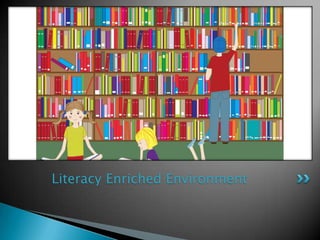
Literacy Enriched Environment
   Assessing and getting to know my students is
    a critical component in gathering data in
    order to select appropriate texts, plan
    effective instruction, motivate my students to
    read for enjoyment, and provide books that
    match students’ personal interest.
   In getting to know my students and foster an
    effective and enriched literature environment,
    I administered assessments for both
    noncognitive and cognitive factors.
   Reading inventories provide us as
    teachers with valuable information
    about our students’ literacy
    interests, as well as their reading
    performance and growth
    (Afflerbach, (2007).


                                     •Motivation   to Read Profile

                            •Elementary   Reading Attitude Survey

                           •Teacher-created   reading inventories
   DIBELS created by Dr. Roland              DIBELS has helped me to
    Good and Dr. Ruth Kaminski
    (2005) (Dynamic Indicators of              monitor my students
    Basic Early Literacy Skills). DIBELS       reading progress
    is a set of procedures and                 especially my students
    measures for assessing the
    acquisition of early literacy skills       reading
    from K-6th grade. The seven                progress, especially for
    measures DIBELS is comprised of
    are:
                                               my students who are
                                               reading below grade
    ◦   Phonemic Awareness                     level. In addition, I can
    ◦   Alphabetic Principle                   use DIBELS data to plan
    ◦   Accuracy                               and drive my literacy
    ◦   Fluency with connected text
                                               instruction.
    ◦   Reading Comprehension
    ◦           DIBELS
        Vocabulary                         Benefits of using DIBELS
   TRC (Text Reading and            TRC has been
    Comprehension). TRC
                                      beneficial in helping
    assesses a students ability
    to read with
                                      me with crucial data on
    comprehension.                    my students reading
                                      levels, word accuracy,
                                      and comprehension of
                                      text.


              TRC                 Benefits of Using TRC
   Selecting the appropriate texts for students is
    important in having an effective literacy program
    and supporting a rich literacy environment.
    Motivation to read is an important factor in
    enhancing students’ love of reading. I learned
    selecting books that match students’ personal
    interests is just as important as selecting texts that
    match students’ reading levels. In addition, I
    found the Literacy Matrix, presented by Dr.
    Hartman (2008) to be very critical and useful in
    creating a balance when selecting and using
    various texts.
Dr. Hartman’s Literacy Matrix is divided in four
 quadrants consisting of: Linguistic, Semiotic,
                   Narrative, and Informational
   Dr. Janice Almasi (2008) adds another important
    dimension to the Literacy Matrix emphasizing
    that teachers must also take into account the
    difficulty of the text too. In examining the
    difficulty of text teachers must look at the
    readability (sentence length, number of syllables,
    the text’s length, structure (informational,
    descriptive, cause/effect, problem/solution,
    compare/contrast, poetic) its use of connective
    words or signal words, the size of print, and the
    visual support (Laureate Education, Inc.).
   Learning activities should be relevant and meaningful and
    students should be engaged throughout the learning process.
    Teaching in an urban school district can be challenging. Far
    too often students come to school with little to no prior
    knowledge and experiences. Another important factor to add
    to this mix is the fact that a lot of students also enter with
    very low motivation for learning and reading. To combat
    this, I work to provide learning activities that are authentic in
    nature; learning actively engages the learner; students are
    given opportunities to construct and reflect on their learning
    in various ways. For example, guided reading, interactive
    read-alouds, word study/vocabulary foldables, interactive
    writing, inquiry/investigation, graphic organizers, literature
    circles, drama, and reflective journals. Etc.
   The goal of the Interactive Perspective of
    literacy is not only to teach students how to
    read, but how to become strategic processors
    as well (Laureate Education, Inc.).
   In reflecting on my literacy program, I
    realized that I employ more Interactive
    activities. Teaching students to think
    critically about a text can be challenging. I
    do provide activities in which students are
    required to think critically, evaluate, and
    respond to the text; however, there is room
    for me to provide many more activities on the
    higher-end of Bloom’s Taxonomy.
   I require students to make inferences and
    draw conclusions. Students are asked to
    evaluate a text, make connections, and
    provide support for their reasoning. In
    responding to text, students respond in
    journals, create “thick-questions”, respond to
    various stance questions, and use graphic
    organizers.
   The critical perspective teachers students to
    examine a text, think critically about it, and
    judge that text (Laureate Education, Inc.,
    2010b). In the Critical Perspective students
    are required to look at a text through a
    different perspective. Students look beyond
    the text (Laureate Education, Inc., 2009).
   Afflerbach, P. (2007). Understanding and using reading assessment, K-12.
    Newark, DE: International Reading Association.
   Good, R., & Kaminski, r. (2005). Dynamic indicators of basic early literach
    skills (6th ed.). Eugene, OR: Institute for the Development of Educational
    Achievement.
   Gunning, T.J. (2005). Creating literacy: Instruction for all students.
    Boston, MA: Pearson Education, Inc.
   Laureate Education, Inc. (Producer). (2008). Analyzing and selecting texts
    [DVD]. The beginner reader Prek-3. Baltimore, MD: Author
   Laureate Education, Inc. (Executive Producer) (2009). Critical perspective.
    Baltimore, MD: Author
   Laureate Education, Inc. (Executive Producer). (2010b). Perspectives on
    Literacy Learning [Webcast]. The beginning reader, Prek-3. Baltimore, MD:
    Author

Literate Environment Analysis Presentation

  • 1.
  • 2.
    Submitted to: Dr. LinCarver – EDUC 6706 Beginning Reader PreK-3 Walden University
  • 3.
    “the ability to use reading and writing for a variety of tasks at school and outside of school” (Tompkins, 2010).  Peter Afflerback (2007) describes reading as a dynamic, strategic, and goal-oriented process.
  • 4.
    Research supports the following for an enriched literacy classroom:  Print-Rich Environment  Charts that support literacy  Functional print used for classroom communication  Classroom libraries (variety of genres)  Displaying of student writing
  • 5.
  • 6.
    Assessing and getting to know my students is a critical component in gathering data in order to select appropriate texts, plan effective instruction, motivate my students to read for enjoyment, and provide books that match students’ personal interest.
  • 8.
    In getting to know my students and foster an effective and enriched literature environment, I administered assessments for both noncognitive and cognitive factors.
  • 9.
    Reading inventories provide us as teachers with valuable information about our students’ literacy interests, as well as their reading performance and growth (Afflerbach, (2007). •Motivation to Read Profile •Elementary Reading Attitude Survey •Teacher-created reading inventories
  • 10.
    DIBELS created by Dr. Roland  DIBELS has helped me to Good and Dr. Ruth Kaminski (2005) (Dynamic Indicators of monitor my students Basic Early Literacy Skills). DIBELS reading progress is a set of procedures and especially my students measures for assessing the acquisition of early literacy skills reading from K-6th grade. The seven progress, especially for measures DIBELS is comprised of are: my students who are reading below grade ◦ Phonemic Awareness level. In addition, I can ◦ Alphabetic Principle use DIBELS data to plan ◦ Accuracy and drive my literacy ◦ Fluency with connected text instruction. ◦ Reading Comprehension ◦ DIBELS Vocabulary Benefits of using DIBELS
  • 11.
    TRC (Text Reading and  TRC has been Comprehension). TRC beneficial in helping assesses a students ability to read with me with crucial data on comprehension. my students reading levels, word accuracy, and comprehension of text. TRC Benefits of Using TRC
  • 12.
    Selecting the appropriate texts for students is important in having an effective literacy program and supporting a rich literacy environment. Motivation to read is an important factor in enhancing students’ love of reading. I learned selecting books that match students’ personal interests is just as important as selecting texts that match students’ reading levels. In addition, I found the Literacy Matrix, presented by Dr. Hartman (2008) to be very critical and useful in creating a balance when selecting and using various texts.
  • 13.
    Dr. Hartman’s LiteracyMatrix is divided in four quadrants consisting of: Linguistic, Semiotic, Narrative, and Informational
  • 14.
    Dr. Janice Almasi (2008) adds another important dimension to the Literacy Matrix emphasizing that teachers must also take into account the difficulty of the text too. In examining the difficulty of text teachers must look at the readability (sentence length, number of syllables, the text’s length, structure (informational, descriptive, cause/effect, problem/solution, compare/contrast, poetic) its use of connective words or signal words, the size of print, and the visual support (Laureate Education, Inc.).
  • 15.
    Learning activities should be relevant and meaningful and students should be engaged throughout the learning process. Teaching in an urban school district can be challenging. Far too often students come to school with little to no prior knowledge and experiences. Another important factor to add to this mix is the fact that a lot of students also enter with very low motivation for learning and reading. To combat this, I work to provide learning activities that are authentic in nature; learning actively engages the learner; students are given opportunities to construct and reflect on their learning in various ways. For example, guided reading, interactive read-alouds, word study/vocabulary foldables, interactive writing, inquiry/investigation, graphic organizers, literature circles, drama, and reflective journals. Etc.
  • 16.
    The goal of the Interactive Perspective of literacy is not only to teach students how to read, but how to become strategic processors as well (Laureate Education, Inc.).
  • 17.
    In reflecting on my literacy program, I realized that I employ more Interactive activities. Teaching students to think critically about a text can be challenging. I do provide activities in which students are required to think critically, evaluate, and respond to the text; however, there is room for me to provide many more activities on the higher-end of Bloom’s Taxonomy.
  • 18.
    I require students to make inferences and draw conclusions. Students are asked to evaluate a text, make connections, and provide support for their reasoning. In responding to text, students respond in journals, create “thick-questions”, respond to various stance questions, and use graphic organizers.
  • 19.
    The critical perspective teachers students to examine a text, think critically about it, and judge that text (Laureate Education, Inc., 2010b). In the Critical Perspective students are required to look at a text through a different perspective. Students look beyond the text (Laureate Education, Inc., 2009).
  • 21.
    Afflerbach, P. (2007). Understanding and using reading assessment, K-12. Newark, DE: International Reading Association.  Good, R., & Kaminski, r. (2005). Dynamic indicators of basic early literach skills (6th ed.). Eugene, OR: Institute for the Development of Educational Achievement.  Gunning, T.J. (2005). Creating literacy: Instruction for all students. Boston, MA: Pearson Education, Inc.  Laureate Education, Inc. (Producer). (2008). Analyzing and selecting texts [DVD]. The beginner reader Prek-3. Baltimore, MD: Author  Laureate Education, Inc. (Executive Producer) (2009). Critical perspective. Baltimore, MD: Author  Laureate Education, Inc. (Executive Producer). (2010b). Perspectives on Literacy Learning [Webcast]. The beginning reader, Prek-3. Baltimore, MD: Author