Conceptual Framework
The world is now in the “Knowledge
age” where the challenge of education
is to:
Conceptual Framework
prepare learners to deal with the
challenges of the changing world.
Students must understand and
operate communication and
information.
The world is now in the “Knowledge
age” where the challenge of education
is to:
Conceptual Framework
Apply higher level thinking skill in
decision and solving problems.
Conceptual Framework
Mother Tongue
Filipino
English
- unified framework which allows
easy transitions from acquiring and
learning one language to another.
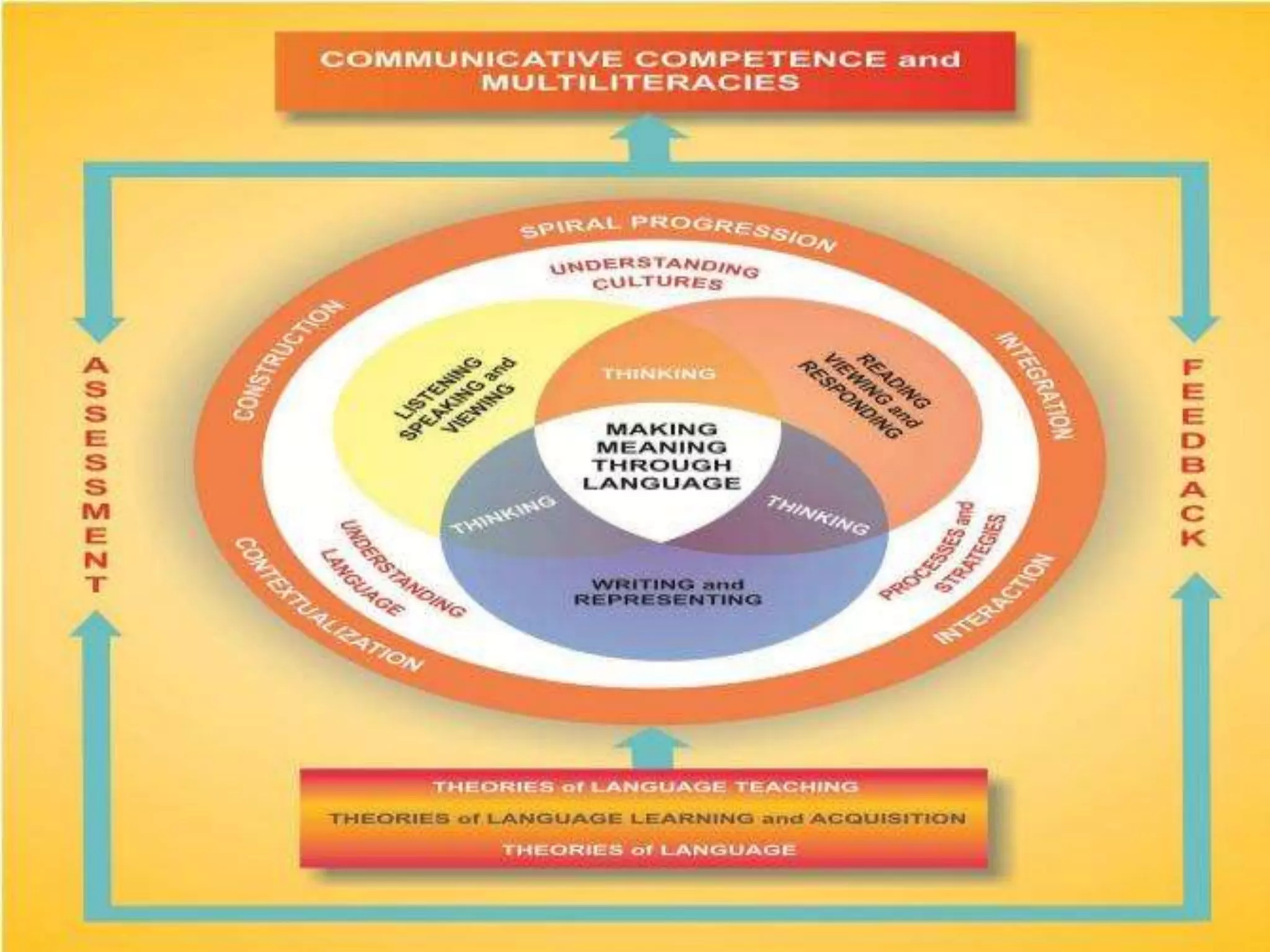
The curriculum has four (4) components
COMPONENT 1: Language Learning Process
COMPONENT 2: Effective Language Use
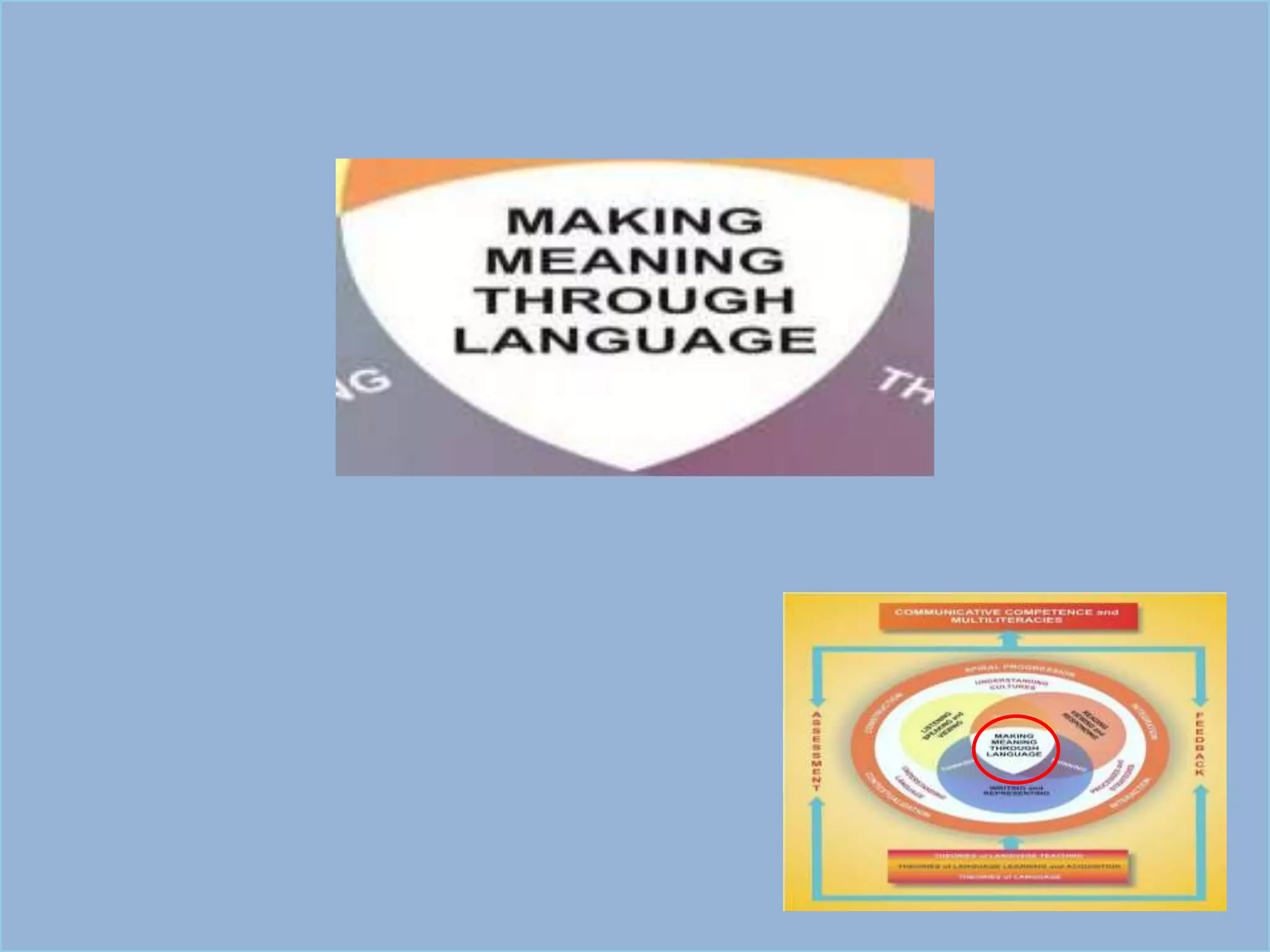
COMPONENT 3: Making Meaning through Language
COMPONENT 4: Holistic Assessment
COMPONENT 1: Language Learning Process
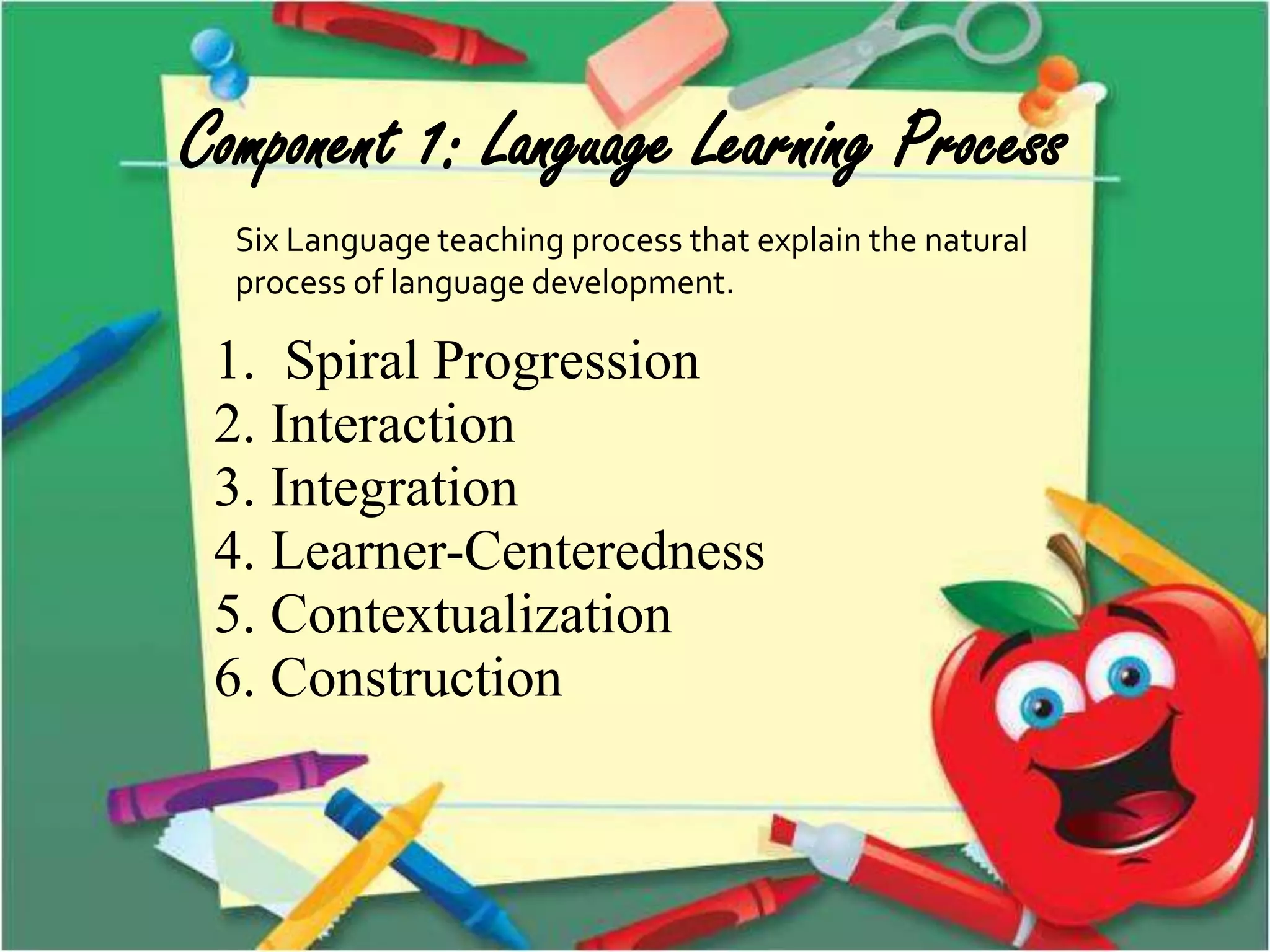
Component 1: Language Learning Process
Six Language teaching process that explain the natural
process of language development.
1. Spiral Progression
- Increasing levels of difficulty.2. Interaction
- Learning will be situated in the context
of communication.
3. Integration
- Areas of language learning will be taught in
integrated way.
Component 1: Language Learning Process
Six Language teaching process that explain the natural
process of language development.
4. Learner-Centeredness
-learners are the center of teaching-
learning process.
5. Contextualization
- Learning tasks and activities will be designed
for learners to acquire the language in
authentic and meaningful contexts use.
6. Construction- Learners will be provided with
sufficient scaffolding .
Component 1: Language Learning Process
Six Language teaching process that explain the natural
process of language development.
4. Learner-Centeredness
5. Contextualization
6. Construction
1. Spiral Progression
2. Interaction
3. Integration
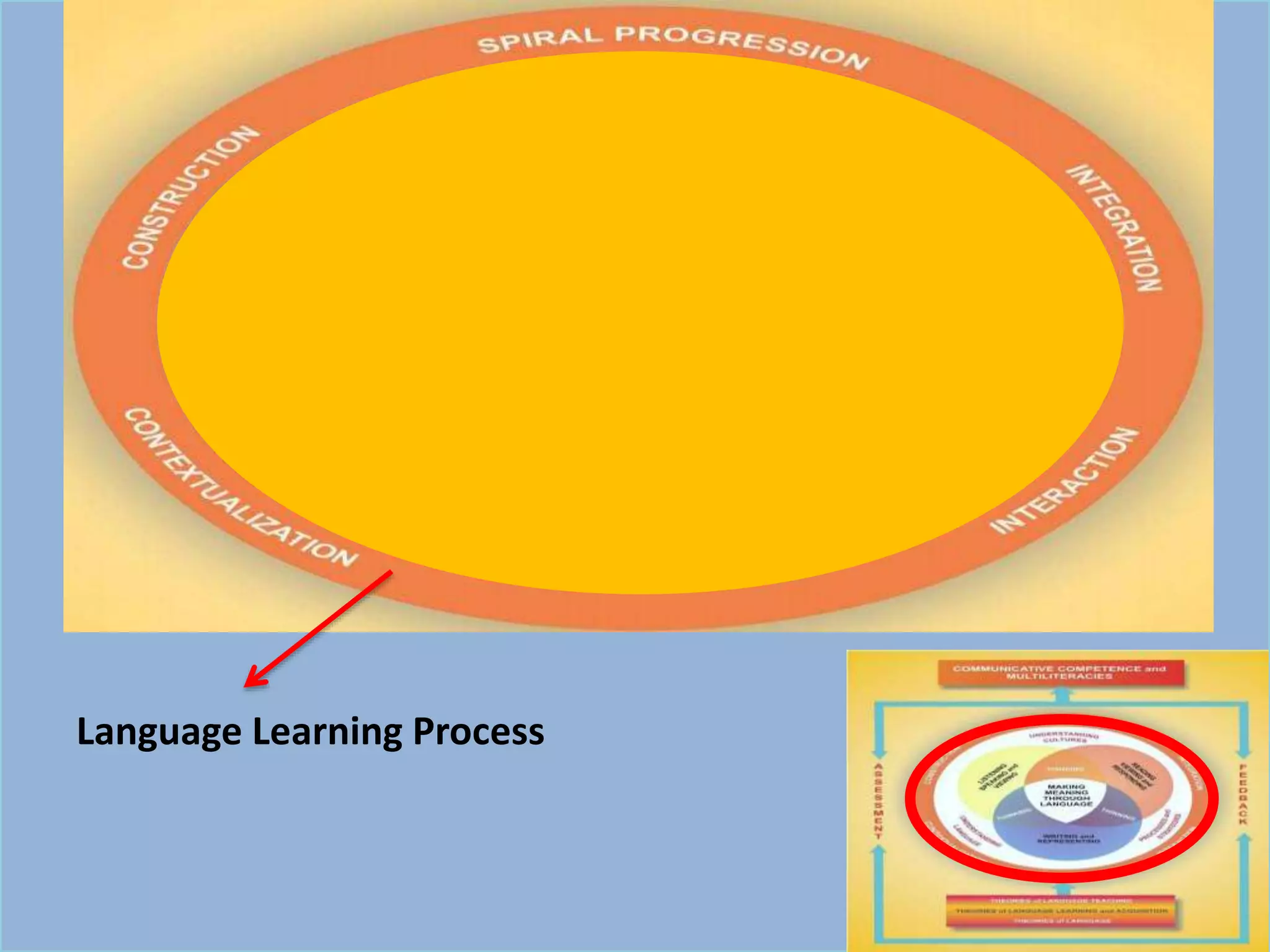
Language Learning Process
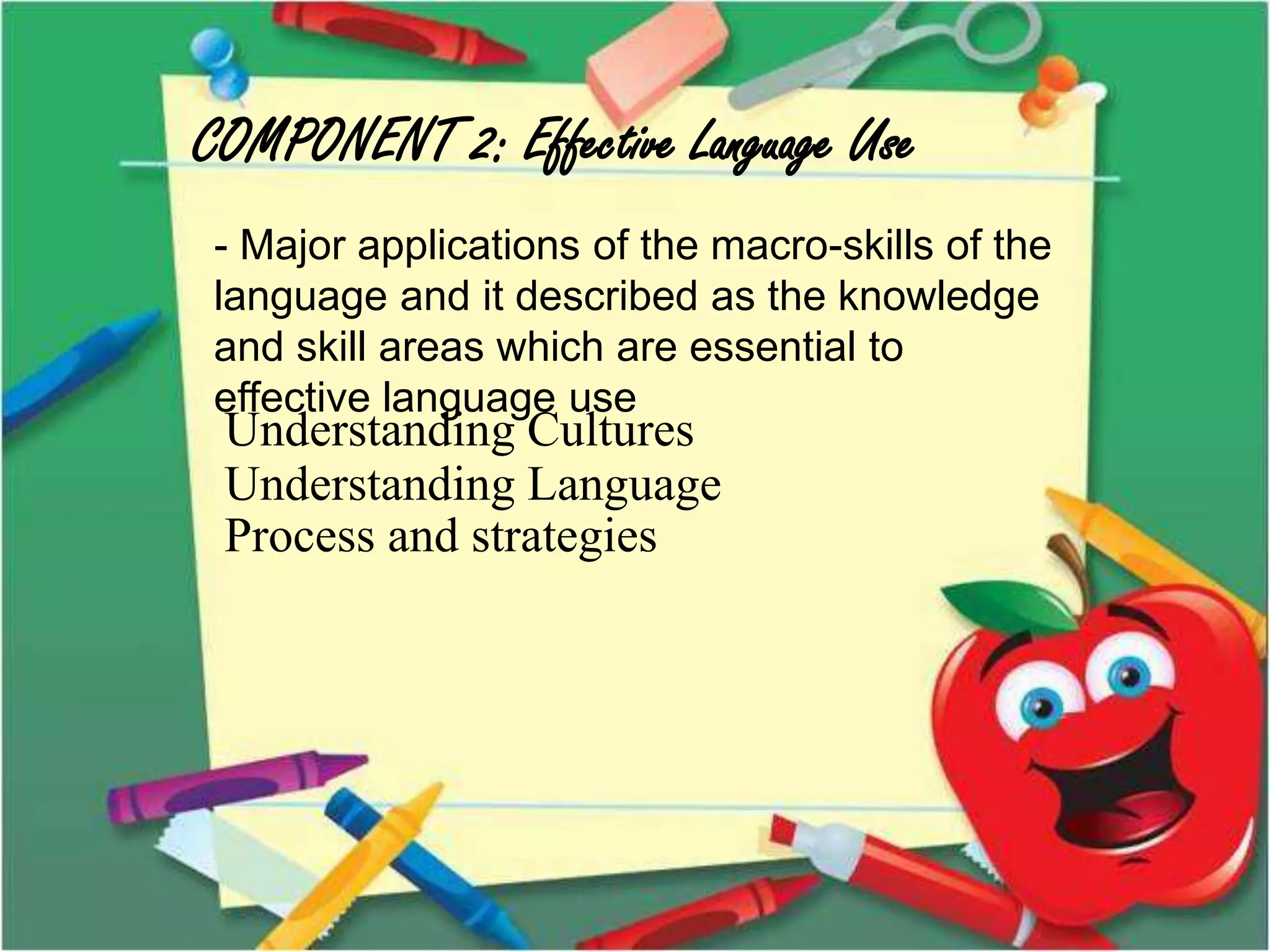
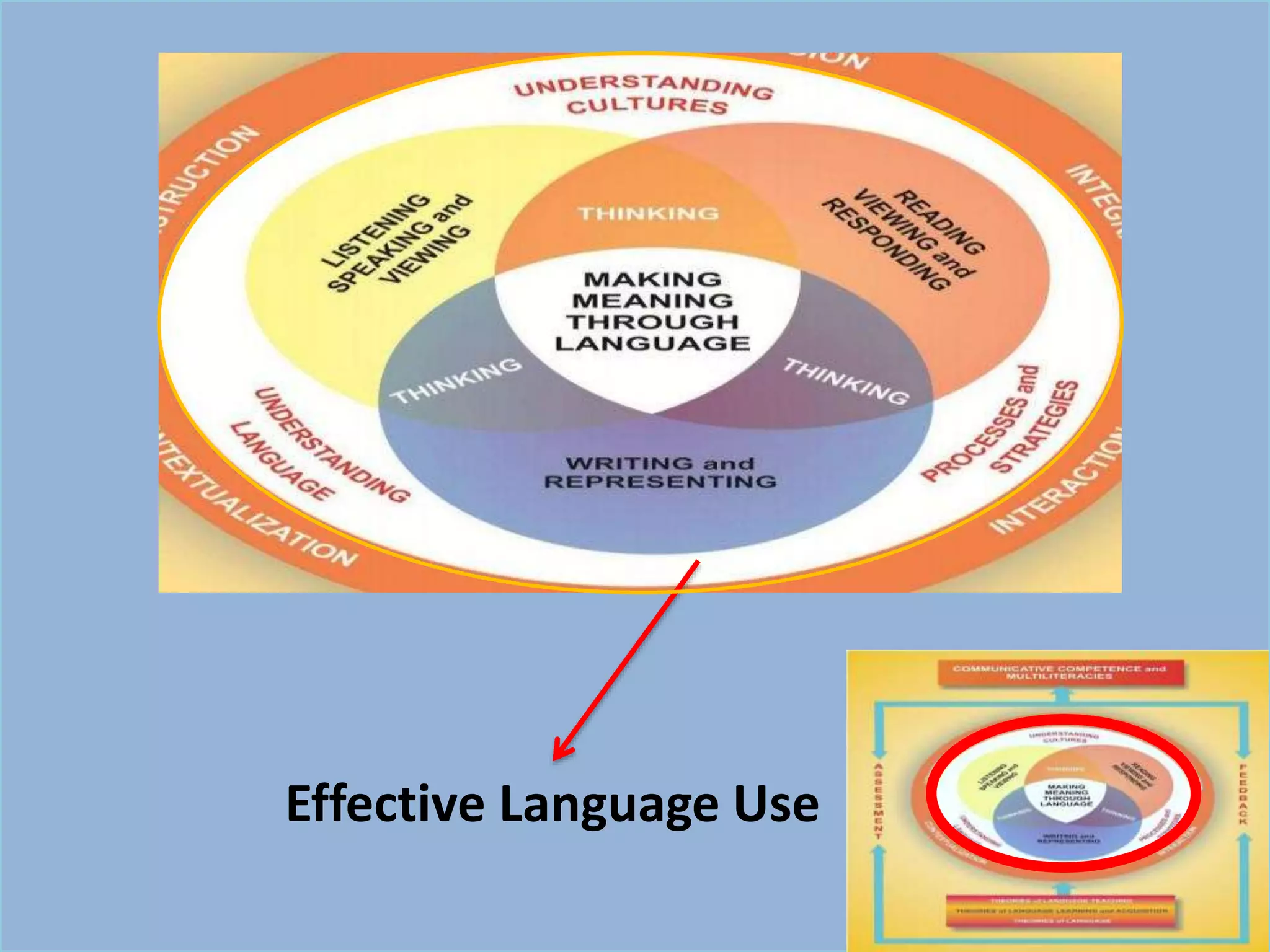
COMPONENT 2: Effective Language Use
- Major applications of the macro-skills of the
language and it described as the knowledge
and skill areas which are essential to
effective language use
Understanding Cultures
Understanding Language
Process and strategies
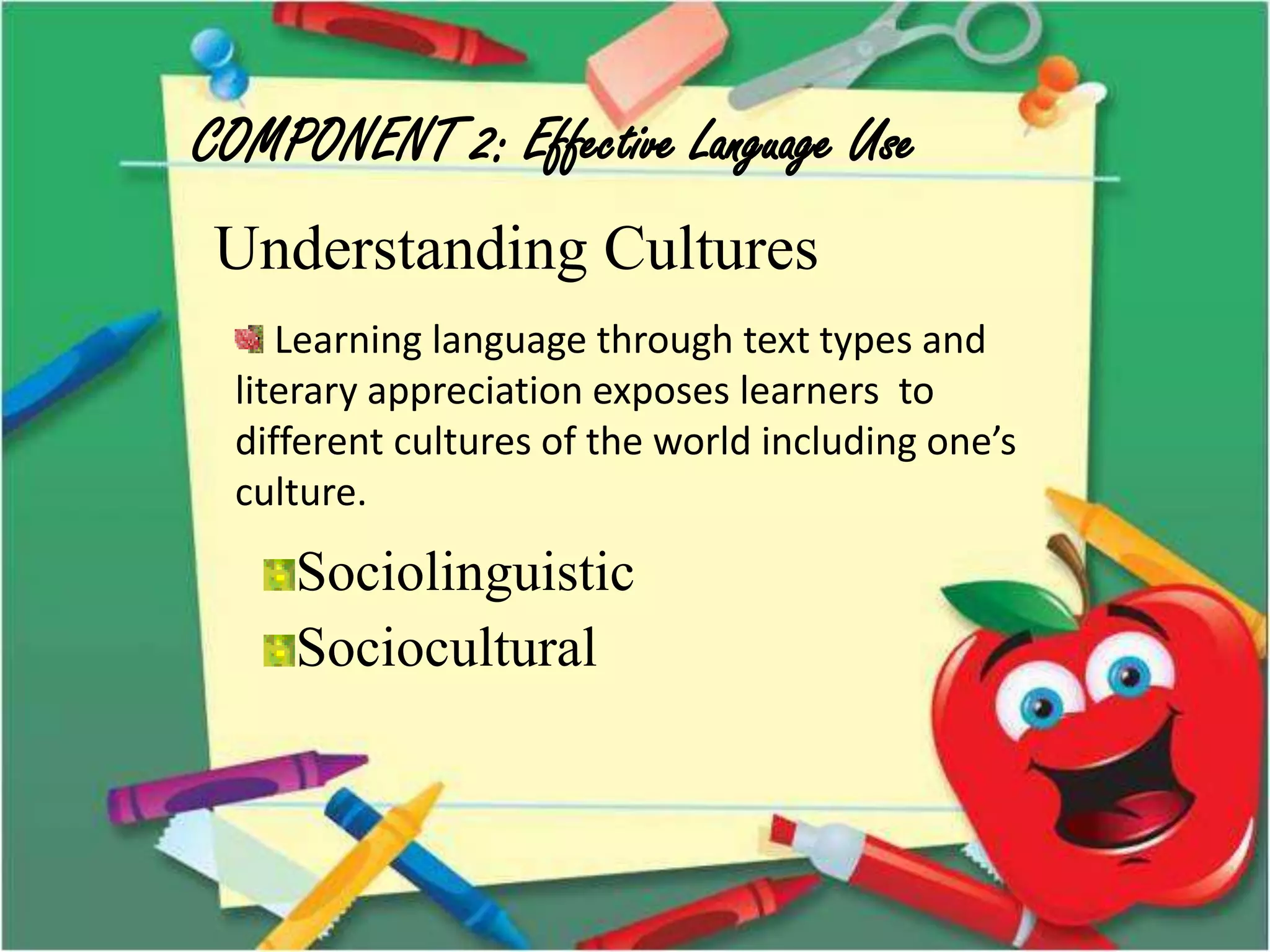
COMPONENT 2: Effective Language Use
Understanding Cultures
Learning language through text types and
literary appreciation exposes learners to
different cultures of the world including one’s
culture.
Sociocultural
Sociolinguistic
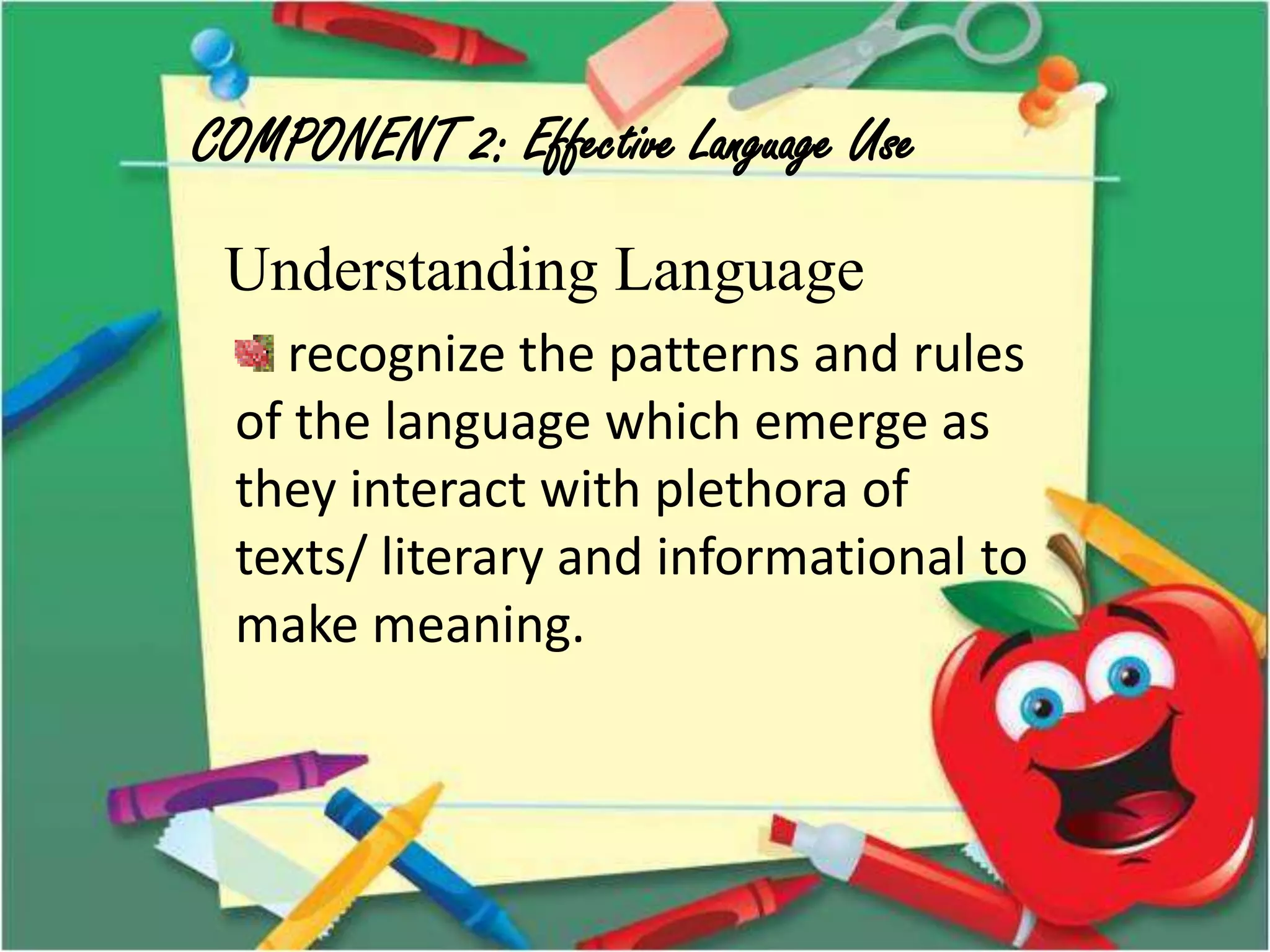
COMPONENT 2: Effective Language Use
Understanding Language
recognize the patterns and rules
of the language which emerge as
they interact with plethora of
texts/ literary and informational to
make meaning.
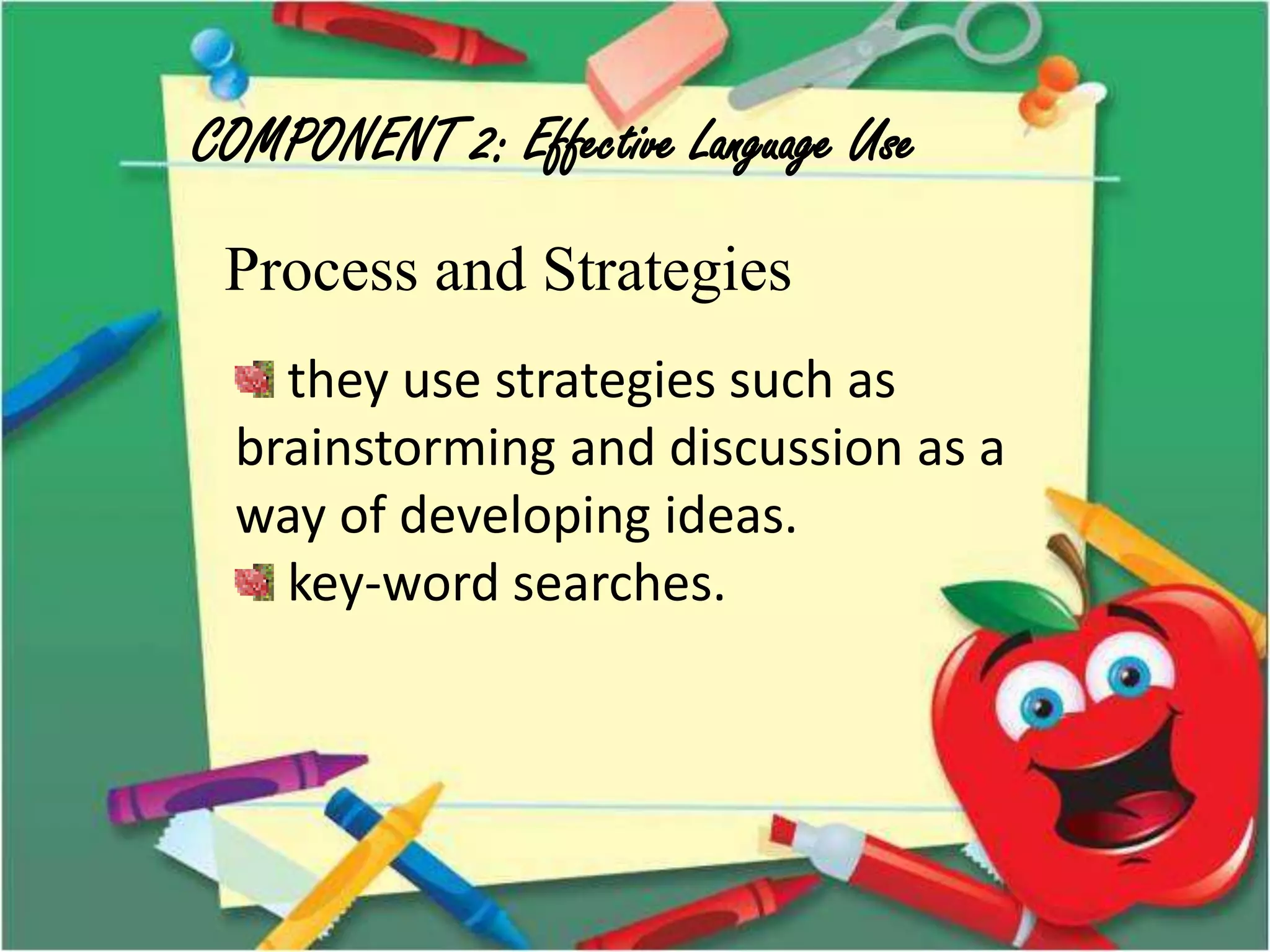
COMPONENT 2: Effective Language Use
Process and Strategies
they use strategies such as
brainstorming and discussion as a
way of developing ideas.
key-word searches.
Effective Language Use
COMPONENT 3:
Making Meaning through Language
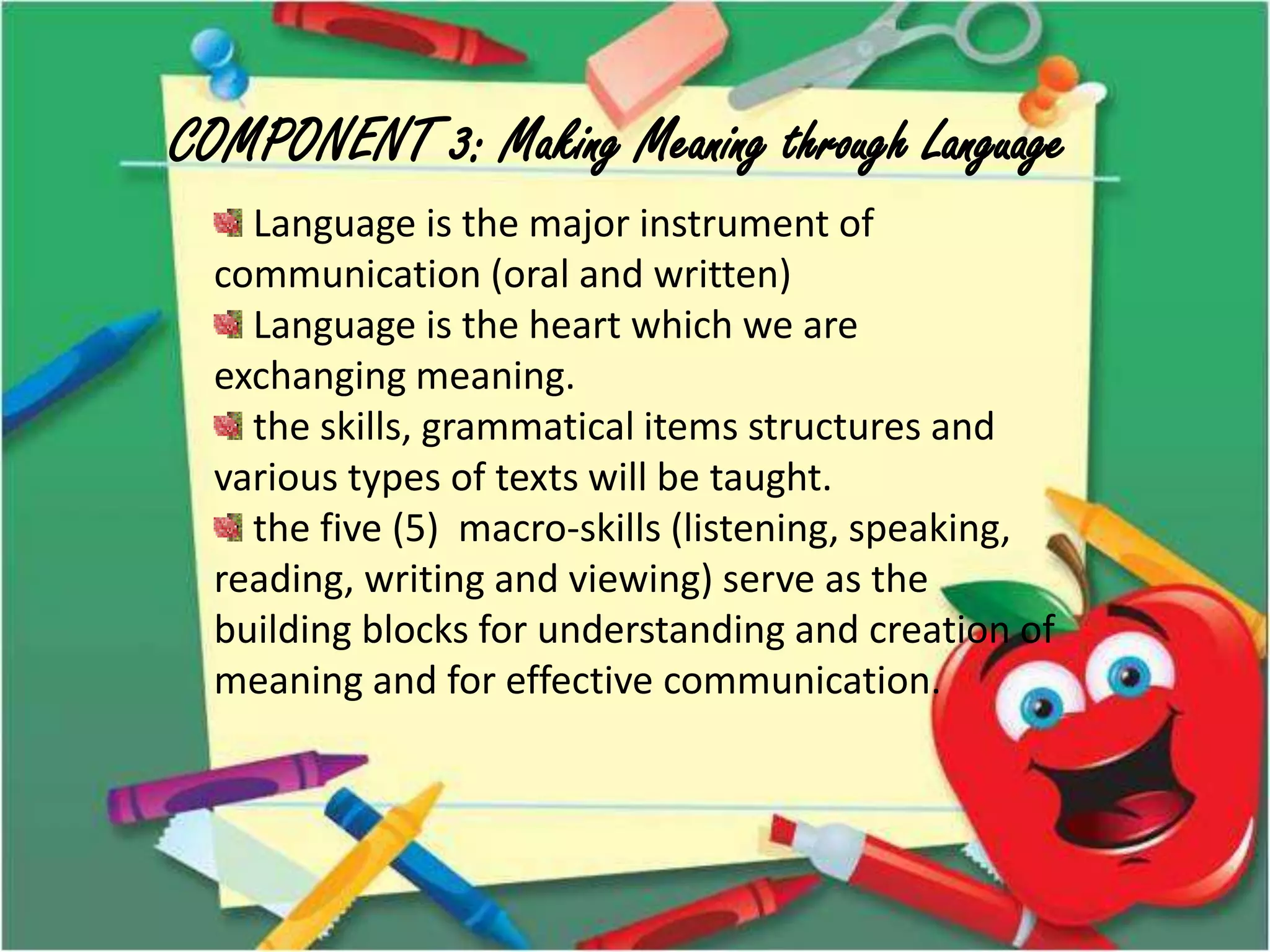
COMPONENT 3: Making Meaning through Language
Language is the major instrument of
communication (oral and written)
Language is the heart which we are
exchanging meaning.
the skills, grammatical items structures and
various types of texts will be taught.
the five (5) macro-skills (listening, speaking,
reading, writing and viewing) serve as the
building blocks for understanding and creation of
meaning and for effective communication.
COMPONENT 4: Holistic Assessment
ongoing gathering of information on
different aspects of a child from various
sources.
it inform teachers about their teaching
practices and guide them in the design and
delivery of student learning.
it enables the parents to support their
children’s development and growth.
COMPONENT 4: Holistic Assessment
Characteristics of Assessment
Proximity to Actual
Language use and
Performance
COMPONENT 4: Holistic Assessment
Characteristics of Assessment
A Holistic View of
Language
COMPONENT 4: Holistic Assessment
Characteristics of Assessment
An Integrative view of
Learning
COMPONENT 4: Holistic Assessment
Characteristics of Assessment
Developmental
Appropriateness
COMPONENT 4: Holistic Assessment
Characteristics of Assessment
Multiple Referencing
Assessment
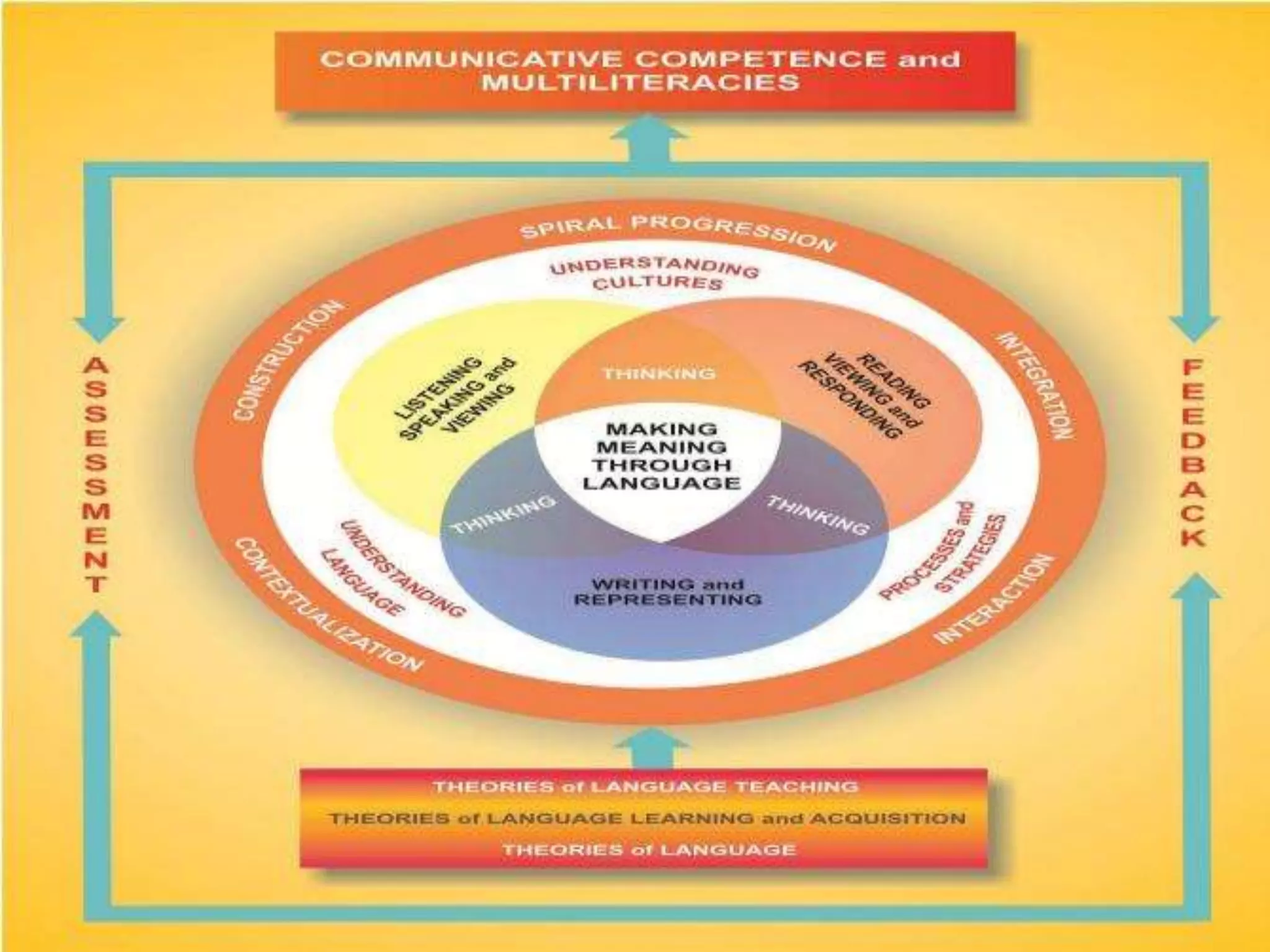
K 12 english language arts curriculum conceptual framework

K 12 english language arts curriculum conceptual framework

  • 3.
  • 5.
  • 6.
    The world isnow in the “Knowledge age” where the challenge of education is to: Conceptual Framework prepare learners to deal with the challenges of the changing world. Students must understand and operate communication and information.
  • 7.
    The world isnow in the “Knowledge age” where the challenge of education is to: Conceptual Framework Apply higher level thinking skill in decision and solving problems.
  • 8.
    Conceptual Framework Mother Tongue Filipino English -unified framework which allows easy transitions from acquiring and learning one language to another.
  • 9.
    The curriculum hasfour (4) components COMPONENT 1: Language Learning Process COMPONENT 2: Effective Language Use COMPONENT 3: Making Meaning through Language COMPONENT 4: Holistic Assessment
  • 10.
    COMPONENT 1: LanguageLearning Process
  • 11.
    Component 1: LanguageLearning Process Six Language teaching process that explain the natural process of language development. 1. Spiral Progression - Increasing levels of difficulty.2. Interaction - Learning will be situated in the context of communication. 3. Integration - Areas of language learning will be taught in integrated way.
  • 12.
    Component 1: LanguageLearning Process Six Language teaching process that explain the natural process of language development. 4. Learner-Centeredness -learners are the center of teaching- learning process. 5. Contextualization - Learning tasks and activities will be designed for learners to acquire the language in authentic and meaningful contexts use. 6. Construction- Learners will be provided with sufficient scaffolding .
  • 13.
    Component 1: LanguageLearning Process Six Language teaching process that explain the natural process of language development. 4. Learner-Centeredness 5. Contextualization 6. Construction 1. Spiral Progression 2. Interaction 3. Integration
  • 14.
  • 15.
  • 16.
    COMPONENT 2: EffectiveLanguage Use - Major applications of the macro-skills of the language and it described as the knowledge and skill areas which are essential to effective language use Understanding Cultures Understanding Language Process and strategies
  • 17.
    COMPONENT 2: EffectiveLanguage Use Understanding Cultures Learning language through text types and literary appreciation exposes learners to different cultures of the world including one’s culture. Sociocultural Sociolinguistic
  • 18.
    COMPONENT 2: EffectiveLanguage Use Understanding Language recognize the patterns and rules of the language which emerge as they interact with plethora of texts/ literary and informational to make meaning.
  • 19.
    COMPONENT 2: EffectiveLanguage Use Process and Strategies they use strategies such as brainstorming and discussion as a way of developing ideas. key-word searches.
  • 20.
  • 21.
  • 22.
    COMPONENT 3: MakingMeaning through Language Language is the major instrument of communication (oral and written) Language is the heart which we are exchanging meaning. the skills, grammatical items structures and various types of texts will be taught. the five (5) macro-skills (listening, speaking, reading, writing and viewing) serve as the building blocks for understanding and creation of meaning and for effective communication.
  • 24.
  • 25.
    COMPONENT 4: HolisticAssessment ongoing gathering of information on different aspects of a child from various sources. it inform teachers about their teaching practices and guide them in the design and delivery of student learning. it enables the parents to support their children’s development and growth.
  • 26.
    COMPONENT 4: HolisticAssessment Characteristics of Assessment Proximity to Actual Language use and Performance
  • 27.
    COMPONENT 4: HolisticAssessment Characteristics of Assessment A Holistic View of Language
  • 28.
    COMPONENT 4: HolisticAssessment Characteristics of Assessment An Integrative view of Learning
  • 29.
    COMPONENT 4: HolisticAssessment Characteristics of Assessment Developmental Appropriateness
  • 30.
    COMPONENT 4: HolisticAssessment Characteristics of Assessment Multiple Referencing
  • 31.