Reported by:
Tr. Anna Lyn Andres
Tr. Jinky Besonia
Sir Joey Esquejo
 As Subject Matter
 As Experience
 As Cultural Reproduction
Characteristics
of Curriculum
The Word: “Curriculum”
• Latin: Running course
• Scotland 1603: Carriage way, road
• United States 1906: Course of study
• United States, 1940: Plan for learning (study)
ntroduction
Curriculum as
Subject Matter
Curriculum is a design PLAN for
learning that requires the purposeful
and proactive organization,
sequencing, and management of the
interactions among the teacher, the
students, and the content
knowledge we want students to
acquire.
Curriculum from Different Points of View
1.
Traditional
Points of View
of Curriculum
2.
Progressive
Points of View
of Curriculum
• body of subjects or subject matter
prepared by the teachers for the
students to learn
• synonymous to “course study” and
“syllabus”
Traditional Point of View
He views curriculum as
“permanent studies”
where the rules of
grammar, reading,
rhetoric and logic and
mathematics for basic
education are
emphasized.
Robert M. Hutchins
(1899-1977)
Hutchins:
Basic Education should emphasize the
3R’s and college education should be
grounded on liberal education.
Arthur Bestor
(1908-1994)
• He believes that the mission of
the school should be
intellectual training.
Bestor:
• Curriculum should focus on the
fundamental intellectual disciplines of
grammar, literature and writing.
• It should also include mathematics,
science, history & foreign language.
Discipline is the sole source of
curriculum. Thus, curriculum is divided
into chunks of knowledge we call
subject areas in basic education.
In college,
discipline may include
humanities, sciences,
Languages & many more.
Joseph Schwab
(1939-1986)
Most of the traditional ideas view
curriculum as written documents or plan
of action in accomplishing goals
Subject-centered
Learner-centered
Problem-centered
Curriculum Design Models
Taba
Model
Tyler
Model
Subject-Centered Curriculum
focuses on the content
of the curriculum
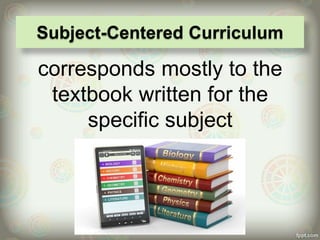
corresponds mostly to the
textbook written for the
specific subject
Subject-Centered Curriculum
In the Philippines, our
curricula in any level is
also divided in different
subjects or courses.
Most of the schools
using this kind of
structure aim for
excellence in the subject
matter content.
“Subject-Centered
Model”
of a Curriculum
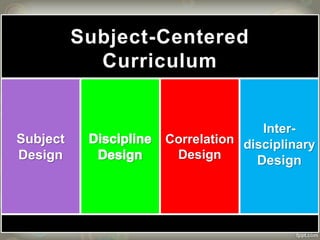
Subject-Centered
Curriculum
Subject
Design
Correlation
Design
Inter-
disciplinary
Design
It is easy to deliver and practical.
Oldest and so far the most popular
approach for teachers, parents and other
laymen
Curriculum is organized according to how
essential knowledge has been developed in
the various subject areas
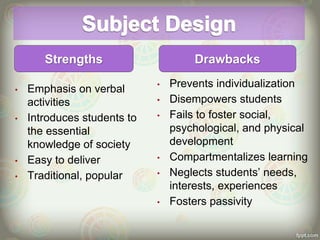
• Emphasis on verbal
activities
• Introduces students to
the essential
knowledge of society
• Easy to deliver
• Traditional, popular
• Prevents individualization
• Disempowers students
• Fails to foster social,
psychological, and physical
development
• Compartmentalizes learning
• Neglects students’ needs,
interests, experiences
• Fosters passivity
Strengths Drawbacks
Focuses on academic discipline
The manner in which content is learned is
suggested by the methods scholars employ to
study the content of their fields.
Often used in college / universities and
technical-vocational courses but not in
elementary levels
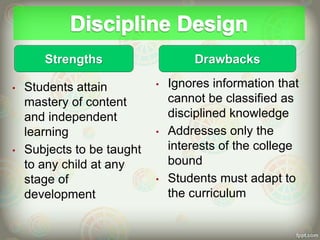
• Students attain
mastery of content
and independent
learning
• Subjects to be taught
to any child at any
stage of
development
• Ignores information that
cannot be classified as
disciplined knowledge
• Addresses only the
interests of the college
bound
• Students must adapt to
the curriculum
Strengths Drawbacks
Comes from a core, correlated curriculum
design that links separate subject designs in
order to reduce fragmentation
Subjects are related to one another but each
subject maintains its identity
• Allows linkage of
some subjects to
reduce
fragmentation
• Requires
alternative forms of
scheduling
• Requires teachers
to plan differently
(cooperatively)
Strengths Drawbacks
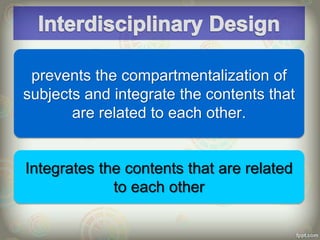
prevents the compartmentalization of
subjects and integrate the contents that
are related to each other.
Integrates the contents that are related
to each other
• Allows students to
discern relationships
among various aspects
of curriculum content
• Students participate in
the construction of
meaning
• Issue of breadth vs
depth
Strengths Drawbacks
Thank
You!

Curriculum As A Subject Matter

  • 1.
    Reported by: Tr. AnnaLyn Andres Tr. Jinky Besonia Sir Joey Esquejo  As Subject Matter  As Experience  As Cultural Reproduction Characteristics of Curriculum
  • 2.
    The Word: “Curriculum” •Latin: Running course • Scotland 1603: Carriage way, road • United States 1906: Course of study • United States, 1940: Plan for learning (study) ntroduction
  • 3.
  • 4.
    Curriculum is adesign PLAN for learning that requires the purposeful and proactive organization, sequencing, and management of the interactions among the teacher, the students, and the content knowledge we want students to acquire.
  • 5.
    Curriculum from DifferentPoints of View 1. Traditional Points of View of Curriculum 2. Progressive Points of View of Curriculum
  • 6.
    • body ofsubjects or subject matter prepared by the teachers for the students to learn • synonymous to “course study” and “syllabus” Traditional Point of View
  • 7.
    He views curriculumas “permanent studies” where the rules of grammar, reading, rhetoric and logic and mathematics for basic education are emphasized. Robert M. Hutchins (1899-1977)
  • 8.
    Hutchins: Basic Education shouldemphasize the 3R’s and college education should be grounded on liberal education.
  • 9.
    Arthur Bestor (1908-1994) • Hebelieves that the mission of the school should be intellectual training.
  • 10.
    Bestor: • Curriculum shouldfocus on the fundamental intellectual disciplines of grammar, literature and writing. • It should also include mathematics, science, history & foreign language.
  • 11.
    Discipline is thesole source of curriculum. Thus, curriculum is divided into chunks of knowledge we call subject areas in basic education. In college, discipline may include humanities, sciences, Languages & many more. Joseph Schwab (1939-1986)
  • 12.
    Most of thetraditional ideas view curriculum as written documents or plan of action in accomplishing goals
  • 13.
  • 14.
    Subject-Centered Curriculum focuses onthe content of the curriculum
  • 15.
    corresponds mostly tothe textbook written for the specific subject Subject-Centered Curriculum
  • 17.
    In the Philippines,our curricula in any level is also divided in different subjects or courses. Most of the schools using this kind of structure aim for excellence in the subject matter content.
  • 18.
  • 19.
  • 20.
    It is easyto deliver and practical. Oldest and so far the most popular approach for teachers, parents and other laymen Curriculum is organized according to how essential knowledge has been developed in the various subject areas
  • 21.
    • Emphasis onverbal activities • Introduces students to the essential knowledge of society • Easy to deliver • Traditional, popular • Prevents individualization • Disempowers students • Fails to foster social, psychological, and physical development • Compartmentalizes learning • Neglects students’ needs, interests, experiences • Fosters passivity Strengths Drawbacks
  • 22.
    Focuses on academicdiscipline The manner in which content is learned is suggested by the methods scholars employ to study the content of their fields. Often used in college / universities and technical-vocational courses but not in elementary levels
  • 23.
    • Students attain masteryof content and independent learning • Subjects to be taught to any child at any stage of development • Ignores information that cannot be classified as disciplined knowledge • Addresses only the interests of the college bound • Students must adapt to the curriculum Strengths Drawbacks
  • 24.
    Comes from acore, correlated curriculum design that links separate subject designs in order to reduce fragmentation Subjects are related to one another but each subject maintains its identity
  • 25.
    • Allows linkageof some subjects to reduce fragmentation • Requires alternative forms of scheduling • Requires teachers to plan differently (cooperatively) Strengths Drawbacks
  • 26.
    prevents the compartmentalizationof subjects and integrate the contents that are related to each other. Integrates the contents that are related to each other
  • 27.
    • Allows studentsto discern relationships among various aspects of curriculum content • Students participate in the construction of meaning • Issue of breadth vs depth Strengths Drawbacks
  • 30.

Editor's Notes

  • #3 Elapsed Time Content Objective Related Information Teaching Method Constructivist Learning Activity Examples Anecdote /Cartoon/Quotation/Joke